OAE
OAE Portal otoemissions.org

Since 2001  ·  otoemissions.org

Otoacoustic Emissions Portal

The international reference for OAE research, hardware, software, clinical applications, and educational resources.

311
Articles
12
Sections
24+
Years Online
Our Sponsors & Collaborators

Add sponsor images to the sponsors/ folder alongside this HTML file.

Editor's Perspective

February - May 2025: An Overiew of the NHS practices in the World

Editorial written by Stavros Hatzopoulos
written by Stavros Hatzopoulos
For many reasons related to the administration duties from the majority of the Portal staff (myself included), the activities in the Portal have been slowed down. In addition to the fact that OAEs and neonatal screening are NOT the new kids in the block anymore, and as a consequence new software and hardware developments are hard to come by....

Guest Editorials

April - June 2019: Telehealth and Audiology

Guest editorial Mark Krumm PhD
Mark Krumm PhD
Telehealth , or telemedicine, is the provision of health care services using a telecommunications medium (American Speech-Language-Hearing Association, 2005; Ricketts, 2000; Wootton, 2001). Specifically, telehealth indicates that practitioner services are provided to patients using an electronic medium such as a computer network, the telephone, satellite or two way radio (Mun & Turner, 1999; St...

White Paper of the Month

Subjective tinnitus and contralateral suppression of otoacoustic emissions

Whitepapers Maria Riga MD, PhD et al
Maria Riga MD, PhD et al
About the corresponding author : Dr. Maria Riga, is currently an Assistant Professor of Otorhinolaryngology at Democritus University of Thrace , in Alexandroupolis, Greece. She was born in Thessaloniki, Greece. She graduated from the Medical School of the Aristotle University of Thessaloniki....

Latest News

Mar 2025

Paper on the Screening practises in Europe

As it was announced, this is the first paper on the Hearing Screening practices in Europe, which was published in the Journal Children. Abst…

Feb 2025

A new sponsor for the OAE Portal

After a successful collaboration with the Italian Company Inventis on the evaluation of their evoked potentials system Celesta, we are very …

Mar 2023

20-03-2023

We have been conducting an internal re-organization of the Portal material, specially in the areas of Hardware and Software. Additional them…

Sep 2020

Special issue on Pediatric and Adult Cochlera Implants

I am happy to announce that with two close collaborators profs Andrea Ciorba and Piotr H Skarzynski we will edit a special issue of the Jour…

Jun 2020

The Book advances in Audiology and Hearing Science

The 2-volume book Advances in Audiology and Hearing Science has been finally published by AAP. There are significant contributions in the ar…

Sep 2019

Technical beta-testing report on the R-140 AOAE device

After a series of measurements in 2018 we were able to evaluate a new interesting AOAE device the R140 from Resonance Italy. The device was …

OAE Portal

Basics of OAEs

🔬 13 articles articles
SOAEs

SOAEs

The Spontaneous Otoacoustic Emissions (SOAEs) are low-level narrow band signals recorded in the external meatus in the absence of any stimulus. SOAEs were primarily considered upon their discovery as cochlear pathology or a result of irregularities in the arrangement of OHC rows. It is hypothesized now that their generation mechanism is similar to that of TEOAEs; that is they are a reflection of the traveling wave energy at various points of the organ of Corti showing impedance perturbations. According to this hypothesis, these structural perturbations do not have any effect on the audiometric threshold. 

     The prevalence of SOAEs is significantly lower than that of TEOAEs and DPOAEs. However, the use of more sensitive microphones over the past years has revealed a higher SOAE prevalence than previously was thought when they were first discovered. Currently, the use of better instrumentation shows that SOAEs are found in about 60 to 70% of young, normal hearing adults. 

Main characteristics of SOAEs:

  • When present, one ear can exhibit one or several peaks at different frequencies and of different amplitudes. The number of SOAEs varies from one ear to another and from one subject to another.

  • SOAEs are very stable with time and do not fluctuate much in frequency, making them a good indicator of trauma that can occur in one ear, as with other types of OAEs. However, the amplitude of each SOAE can fluctuate by as much as 10 dB depending on the time of recording.

  • When multiple SOAEs are present, the amplitudes of each of the peaks are different from one another. For example in newborns and infants, it is not rare to record SOAE amplitudes ranging from -20 dB SPL to 20 dB SPL in the same ear. 

  • SOAE amplitudes can be reduced and their frequencies shifted following acoustical stimulation of the medial olivocochlear system. It has been shown that the effect of a contralateral auditory stimulation on DPOAEs is stronger in the vicinity of SOAEs.

  • Gender effect: The SOAEs demonstrate a gender-prevalence, in that they are significantly more prevalent in women than men and with higher numbers of SOAEs in females than in males when they are present. 

  • Asymmetry: There is a higher prevalence of SOAEs and a greater SOAE number in the right ear than in the left ear. 

  • Age effect: The prevalence of SOAEs has been shown to be at a higher level in infants, full-term and pre-term neonates than in adults. SOAEs can be recorded as early as 30 weeks of conceptional age in pre-term neonates. The highest incidence of SOAEs (85%) has been found in neonatal pre-term and full-term populations. Also, SOAE number is greater in infants than in adults. 
          The majority of SOAE peaks are observed between 1 and 2.5 kHz in adults. In infants, SOAEs are mainly observed between 2 and 5 kHz. SOAE changes with time in newborns could possibly reflect on-going cochlear maturation. However, evolution of the physical characteristics of the outer ear is supposed to explain the main differences between infants and adults. The outer ear amplifies sounds more in younger subjects and for higher frequencies than in adults. 

  • Relation between SOAEs and auditory sensitivity: SOAE presence is suggested to be linked to higher auditory sensitivity. SOAEs cannot been observed in cases of hearing impairment of 25 dB or more in adults. Their existence is also an indicator of strong and robust TEOAEs. Moreover, SOAEs are more present in females than in males and in right ears than left ears in agreement with better hearing in females and in right ears. HOWEVER, their absence does not signify that the subject has a hearing loss and there is no known correlation between SOAE number and audiological assessment. 


Test procedures:

  • SOAE can be recorded using the same equipment as other types of OAEs. The same sensitive microphone is required. 

  • SOAEs can be recorded in the external auditory meatus in the absence of any stimulus. 

  • It is also possible to detect SOAEs by synchronizing them to low-level click stimulation. In this case, the recording window lasts longer than for TEOAE recordings (usually 80 ms instead of 20 ms) and SOAEs are observed in the 60-80 ms window while TEOAEs elicited by a click do not persist after 20 ms. This recording method is a default setting on the ILO system by Otodynamics. Several authors have pointed out that this technique allows recording of SOAEs AND Synchronized-SOAEs. Comparisons of both SOAE recording methods (without and with a stimulus) have shown that they both give quite similar results. One of the advantages of using a low-level stimulus is to ensure that a good fit is obtained in the outer ear canal by checking the stimulus waveform.

  • SOAEs can be recorded at any time, even during sleep (which can be very useful in babies).

  • Most OAE equipment allow SOAE recordings.


      Because SOAEs are not present in 100% of normal-hearing adults, their clinical use remains uncertain at the present time while their presence is a sign of a normal functioning cochlea, their absence does not signify hearing impairment. 
      Research is still in progress to explain some of the relationships between the presence of SOAEs and higher auditory sensitivity. In any case, when present, SOAEs can be considered useful in monitoring and following any small changes in the mechanics of the cochlea.

TEOAEs

Webinar on TEOAEs from the Interacoustics web site

The following webinar, from the Interacoustics web site explains how the ear can produce sound (OAE), how this can be measured with the TEOAE and DPOAE methods and what the clinical value of such measurement is. Jos Huijnen Msc , senior Manager of Interacoustics, International Clinical Training,  presents the information.

DPOAEs

Threshold and DPOAEs

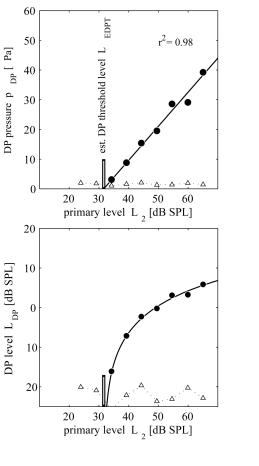
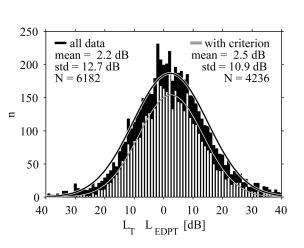
The relationship between DPOAEs and Audiometric outcomes (mainly with the Pure Tone Audiometry) has been also a debating issue from the early days of otoacoustic emissions. While it is known that hearing impairments higher than 30 to 40 dB HL cause a significance decrease of the TEOAE responses, the same it is not valid for DPOAE recordings. Due to the efficiency of the DPOAE stimulation schemes it is possible to record responses even from cases presenting hearing losses as high as 50 dB HL.

The true debate on the issue of threshold and DPOAEs revolves around the prediction of the auditory threshold by the signal values of the DPOAEs. In this context it can be said that in general the DPOAES cannot predict the Auditory threshold. The reason for the latter is the fact that auditory perception involves more parts of the auditory system than just the periphery whose function is reflected by the DPOAE measurements.

Neverthess when:


  • The external and middle ear functions are normal.
  • There are no retrocochlear hearing complications

the audiometric outcomes and the information from the DPOAEs are in agreement. Any deviation from this scenario causes a disagrerement between the DPOAEs and the audiometric outcomes.


     Recent research findings in the relationship between the auditory threshold (in neonates) and DPOAE signal values have provided interesting speculations which might lead to an acceptible threshold prediction. The reader can consult the following extra sources in the Portal :

  •  On the Prediction of cochlear pure-tone threshold and cochlear compression by means of extrapolated DPOAE I/O-functions by Thomas Janssen, Ph.D. December -January 2004 (Editorial) .
  •  DPOAE I/O Functions in Normal and Impaired Human Ears by Mike Gorga et al (future PowerPoint Presentation)
DPOAEs

DPOAE Test Procedures

Editor's Note:A portion of the material presented has appeared in the NATASHA (Network and Tools for the Assessment of Speech/Language and Hearing Ability) project web pages.


  • Set-up (equipment, test environment, etc.):

    Since no patent was deposited for the DPOAE stimulation scheme, a large number of manufacturers have developed DPOAE devices.

  • Stimuli:

    The DPOAE stimulus consists of two pure tone signals of which the frequency ratio varies from 1.20 to 1.22.

    The L1 and L2 values vary from 75 to 55 dB SPL. For screening applications a small number of frequencies is tested, such as 2.0, 3.0 and 4.0 kHz (referenced to F2). For ototoxicity- monitoring applications the bandwidth of the measurements extends up to 8-10 kHz (referenced to F2).

    The probe positioning is an equally crucial procedure as with TEOAE testing. An erroneous position of the probe CAN block or severely alter the shape of the DP-gram. Usually an erroneous position results in a blockage in one of the two microphones which emits the F1 or the F2 tone.

    It is well known that the cochlear-amplifier is more vulnerable at lower stimulus intensities and for the detection of light cochlear insults primary intensities in the range of 50 - 55 dB SPL should be used.

  • Interpretation of results

    From the information presented in the Introduction page on DPOAEs, it might be clear that it is difficult to optimize a DPOAE protocol, as different setting affects different frequencies. In this context any DPOAE protocol represents a clinical compromise.

    Neonatal subjects (pre or full-term) often show in their DP-grams a notch (an abrupt decrease of the 2F1 - F2 amplitude) around 3 kHz. This phenomenon is probably related to the interaction between the DPOAE response and a standing wave in the external meatus.

    The level of the DPOAEs or the S/Ns of the DP-gram or the IO plots do not have a precise clinical significance. The observed fine structure (caused by interactions of the DPOAE components) of the "DP-gram" clearly limits the extensive clinical application of DPOAEs. Different methods have been introduced to eliminate this effect either by masking ("Single Generator DPOAE") or by determining the level-dependencies of these components. See Mauermann et al. (1999) for a review of these effects.

DPOAEs

Concepts of DPOAEs

Distortion product otoacoustic emissions (DPOAE) are responses generated when the cochlea is stimulated simultaneously by two pure tone frequencies whose ratio is between 1.1 to 1.3.

Recent studies on the generation mechanism of DPOAEs have underlined the presence of two important components in the DPOAE response, one generated by an intermodulation "distortion" and one generated by a "reflection".

The prevalence of DPOAEs is 100% in normal adult ears. Responses from the left and right ears are often correlated (that is, they are very similar). For normal subjects women have higher amplitude DPOAEs. Aging processes have an effect on DPOAE responses by lowering the DPOAE amplitude and narrowing the DPOAE response spectrum ( i.e. responses at higher frequencies are gradually diminishing).The DPOAEs can be also recorded from other animal species used in clinical research such as lizards, mice, rats, guinea pigs, chinchilla, chicken, dogs,and monkeys.

Terminology

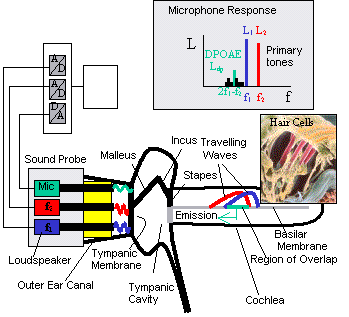
  • The pure tones which stimulate the cochlea are called primaries and they are assigned as F1 and F2 and their corresponding amplitudes are assigned as L1 and L2.The lower tone is usually the F1 and the higher tone the F2.

  • In order to generate the intermodulation DPOAE component, the primaries should have frequencies which are close to one another. The ratio of the F2 / F1 frequencies is called frequency ratio FR. The choice of the FR has an effect on the amplitude of the DPOAEs at different tested frequencies.

  • Due to intermodulation the cochlea generates an long series of components which are not present in the input stimuli. These components are called distortion products. The most prominent and mostly used in clinical practice is the cubic difference distortion product denoted as 2F1 - F2.

  • The DPOAE protocols employed in clinical practice are divided in two categories. Protocols using primaries with equal intensities are called symmetric (L1 = L2), for example 70-70 dB SPL. Protocols using unequal primary intensities (L1 > L2) are called asymmetrical, for example 65-55 dB SPL. The latter can identify better cases with hearing impairment and they are used in most screening programs.

    When asymmetrical DPOAE protocols are used, the intermodulation components are generated close to the F2 primary tone. Therefore the DPOAE information is referenced to F2. When symmetrical protocols are used the DPOAE information is referenced to the geometric mean, which is defined a the square root of F1 * F2.

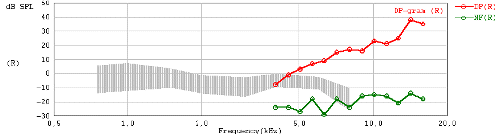
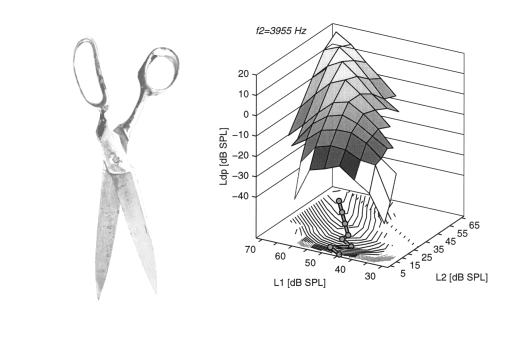
  • There are two ways to present the DPOAE information: In the DP-gram modality we measure the 2F1 - F2 amplitudes at various F2 frequencies, having fixed the stimulus intensities, for example F1=65 dB and F2=55 dB SPL. In the Input -Output (IO) modality, we measure the 2F1 - F2 at a fixed F2 frequency, varying the primary stimulus levels.


    DP-gram response from a Sprague-Dawley rat under ketamine anesthesia.


DPOAE generation mechanisms:

       For the moment, we will consider the cochlea simply as a black box and the ear-canal signal as representing the output of this system. Into this black box, two pure tones are applied which, traditionally, are referred to as the f1 and f2 primaries (f1<f2). If the cochlea acts in a linear manner, then we would expect that the output frequencies would be the same as the input frequencies. In other words, the function relating the input to the output signal is a straight line representing a linear function. However, if the function relating the input of the two sinusoids to the output is not a straight line, that is, the input/output (I/O) function is nonlinear, then new frequencies will be generated at the output. I/O functions that are typically used to represent the basilar membrane (BM) response are described in Fig 3 in Fahey et al (2000). One of these I/O plots (Fig 3b) is highly similar in shape to the hair cell receptor voltage versus stereocillia displacement function measured earlier by Hudspeth and Corey (1977) and Russell et al (1986). These types of nonlinear I/O functions obtained from various cochlear structures are relevant to the discussion of physical mechanism(s) within the cochlea that are capable of generating DPOAEs. If such functions exhibit both even- and odd-order symmetry, then all the DPOAEs that can be found in the ear-canal signal will be observed. Thus, combinations of the primaries that result in even-order DPOAEs, such as the simple difference tone, f2-f1, and many odd-order DPOAEs, the largest and most commonly studied one being the 2f1-f2 frequency, will be measured. Other DPOAEs often seen are the lower odd-order sideband 3f1-2f2 and the upper odd-order sideband DPOAE at the 2f2-f1 frequency.

        When the f1 and f2 primaries are presented to the ear canal, the first constraints that must be placed upon DPOAE generation can be appreciated from observations of the underlying BM mechanics [for a recent excellent review, see Robles and Ruggero, (2001)]. Presentation of a pure tone to the ear canal results in the well-known traveling wave of displacement on the BM, that peaks at its characteristic frequency (CF), and then rapidly dies out at more apical points that are lower in frequency. This displacement pattern defines the place on the BM where DPOAEs must be generated. That is, the only place where f1 and f2 can mix in the nonlinearity (often assumed to be based in the OHCs--see below) is in the tail of the BM displacement of the f1 primary. If f2 is placed at a much higher frequency, then, because of the steep apical cutoff of BM displacement, f2 cannot substantially interact with f1. Consequently, on theoretical grounds, DPOAEs must be produced at, or near to, the f2 place, where the two primaries can physically interact on the BM.

        This theoretical prediction is borne out by findings from suppression studies in which a third tone (f3) is used to interfere with DPOAE generation. By sweeping f3 in level and frequency, suppression tuning curves (STCs) can be produced, with their tips typically tuned near the f2 place for the 2f1-f2 DPOAE (eg, Brown & Kemp 1984; Martin et al 1998a). Much of this requirement also accounts for the much studied f2/f1 ratio effect, in which DPOAE levels decrease on either side of an optimum ratio value. In humans, this ideal f2/f1 ratio is approximately 1.22, and DPOAEs are largest at this ideal separation of the two primary tones. Some of this ratio effect, as the primary f1 and f2 tones come closer together, may be due to mutual suppression or interaction of multiple DPOAEs (Stover et al 1996a). It has also been proposed that this phenonmenon can be explained by a second-filter effect (Brown et al 1992).

        When DPOAEs are produced in the cochlea, they can be seen on the BM, and they propagate just as if they were external tones introduced into the ear canal (Robles & Ruggero, 2001). Because the 2f1-f2 is lower in frequency than the f2 place where it is generated, this combination tone will not be perceived, if someone is deaf at this lower frequency. Such an outcome occurs because the 2f1-f2 DPOAE travels to its characteristic place, where it then acts like an external tone.

        Basilar-membrane mechanics also explain why DPOAE are more effectively produced at lower primary-tone levels, when the level of f2, ie, L2, is lower than the level of f1, ie, L1. This is the familiar unequal-level primary tones protocol, typically 65/55 dB SPL, that is almost universally advocated in the clinical literature (Stover et al 1996b) for obtaining DPOAEs in humans. The rationale for lowering L2 is to equate the amplitudes of the vibration of the traveling waves representing the two primaries, where they interact on the BM. Because the BM response is highly compressive at the CF, assumed to be f2 for DPOAEs, and linear at the off-CF frequency of f1, then lowering the level of f2, where it is 'amplified' at low stimulus levels, helps to equate the two stimuli, where they interact at the f2 place [see Fig 4 in Kummer et al (2000) for a superb explanation of this phenomenon]. As primary-tone levels become higher, this L1-L2 difference is no longer needed to equate the two stimuli, a point often not appreciated in the clinical literature (Whitehead et al 1995).

        In short, DPOAEs are produced when the primary tones interact on the BM to stimulate nonlinear elements in the cochlea. There is now very convincing evidence that the OHCs are the site of this nonlinearity (Brownell 1990). Specifically, it has been proposed that OHC electromotility, first described by Brownell et al (1985), is the source of the 'cochlear amplifier'. That is, it is assumed that the OHC electromotility-based cochlear amplifier is responsible for the compressive BM response at CF, and the associated sharpness of nerve-fiber tuning seen in physiologically healthy preparations, but absent in damaged or dead animals (Robles & Ruggero 2001), along with the nonlinearity responsible for producing DPOAEs. However, other sources have been proposed for the cochlear amplifier including stereocillia motility (Martin et al 2000). Ultimately, it will probably be discovered that DPOAEs originate from a variety of nonlinear sources, besides OHC electromotility, that participate in the OHC-transduction process including opening and closing of transduction channels (Patuzzi 1998), nonlinearities in stereocillia-bundle motion (Jaramillo et al 1993), and asymmetries in stereocillia stiffness (Khanna & Hao 1993).

        Related to the question of how DPOAEs are generated is the issue of where do DPOAEs originate from with respect to a point(s) along the cochlear partition. As discussed above, it is generally assumed that DPOAEs come from the f2 place. However, once created, DPOAEs also propagate as traveling waves along the BM. Consequently, it is possible for a propagated DPOAE to stimulate the DPOAE place, ie, the 2f1-f2 frequency place, where other OAEs can be further produced by the mechanism of linear-coherent reflection (eg, Heitmann et al 1998; Kalluri & Shera 2001). These two sources (ie, the DPOAE generated at the f2 place and the emissions reflected from the 2f1-f2 DPOAE place) then mix to form the final ear-canal signal.

        Evidence also exists for basal DPOAE sources that may also contribute to the final DPOAE signal. These basal sources are revealed as secondary regions of suppression or enhancement above f2 during the collection of the STCs mentioned above. Such regions of suppression/enhancement are observed at frequencies that are more than an octave above f2 (Martin et al 1999; Mills 2000), where it is unreasonable for the f3, due to the steep apical cutoff of the traveling wave, to affect the f2 place. One possible explanation for these phenomena is that a harmonic of f1 (ie, 2f1) interacts with f2 to produce a simple difference-tone DPOAE. This emission will always have the same frequency as the 2f1-f2, so, depending upon the phase of the difference tone, either suppression or enhancement could result (Fahey et al 2000). Another possibility is that f3 acts as a catalyst to produce difference-tone DPOAEs by more complicated routes that can then interact with the 2f1-f2 DPOAE. Evidence for both possibilities seems to be present in the data.

        Another difficult-to-explain finding is the observation that the upper sideband 2f2-f1 DPOAE appears to originate from its characteristic place on the BM (Martin et al 1998b). As discussed above, this finding contrasts with the notion that all DPOAEs must be generated at the f2 place, where the two traveling waves representing f1 and f2 optimally interact. One possibility is that the 2f2-f1 observed in the ear canal comes largely from a difference-tone DPOAE based upon the interaction of a harmonic of f2 (ie, 2f2) and f1, which of course, will be at the 2f2-f1 frequency.

        A final issue that must be discussed regarding DPOAEs is the notion that there are 'active' versus 'passive' DPOAEs. This conceptualization originated from earlier studies like Norton and Rubel (1990) and Whitehead et al (1992a,b). In these investigations, administration of loop diuretics, such as ethacrynic acid or fursosemide, eliminated low-level DPOAEs, while DPOAEs evoked by high-level tones remained relatively unaffected [see Fig 3 in Whitehead et al (1992)]. Results like these led to the notion that DPOAEs evoked by high-level tones were not relevant to cochlear function, and many clinical studies focused on low-level primaries in the 55- to 65-dB SPL range. However, early studies in humans (Lonsbury-Martin et al 1990) clearly indicate that 75/75 dB SPL equilevel primaries can accurately track the pattern of hearing loss in individuals with impaired hearing. More recently, studies in mice with age-related hearing loss (Jimenez et al 1999) indicate that all levels of primaries accurately follow the progressive degeneration of high-frequency OHCs observed in these animals. Similarly, a brief exposure to damaging levels of noise will affect, not only low-level DPOAEs, but high-level DPOAEs as well (Howard et al 2001). Thus, more recent thinking assumes that there are not two sources of DPOAEs, that is, a low-level 'active' one along with a high-level 'passive' source. Rather, low-level DPOAEs are based upon a functional cochlear amplifier, whereas high-level DPOAEs arise when stimulation is sufficient to move the BM without amplification, in turn, stimulating remaining nonlinear elements to evoke DPOAEs.


Readers who wish to get additional information on the cochlear mechanisms responsible for the DPOAE generation, might consult the following editorial

DPOAE generation Mechamisms by Glen K Martin Ph.D. (USA, 2002)

TEOAEs

Chirp Evoked OAEs

 
Editor's Note:Despite the fact that chirp-OAEs were not applied widely in the clinical OAE field, they represent a considerable evolution in the TEOAE protocols. This material is mirrored from the NATASHA project web pages. The material has a technical nature and we recommend to the readers to visit Dr. Newmann's web-link for more details on this topic.

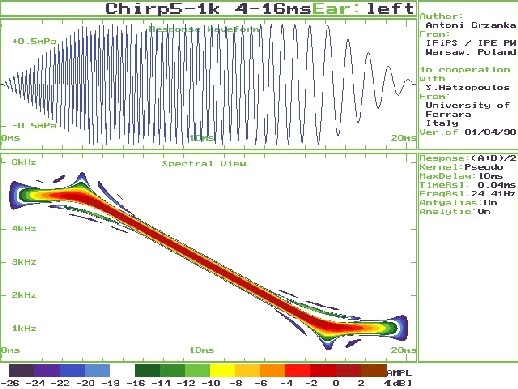
The use of chirplet stimuli are useful for evoking TEOAE in, e.g., clinical applications. Due to the higher level of the chirplet versus the click the signal-to-noise ratio can be improved. Therefore the detection of an TEOAE and the observation of saturation with increasing stimulus level is facilitated, especially when using the ''bark'' chirplet signal. This holds especially in the case of very weak TEOAE. In addition, the stimulation with narrowband stimuli allows a specific evaluation of the functionality of selected basilar membrane regions in a single measurement (Neumann, 1997, Neumann et al., 1994)


Equipment and Stimuli

a) Set-up (equipment, test environment, etc.):

The measurement of transient evoked otoacoustic emissions TEOAE using chirplets are almost similar to the procedures for TEOAE measurement using clicks. They may depend on the specific setup and instrumentations. Some important aspects for the measurement of TEOAE with chirplet signals are pointed out here:


    • A sound source with a flat frequency response should be used for the acoustical stimulation of the ear (e.g. Etymotic Research ER-2 insert ear phone). Otherwise the chirplet stimuli may need to be adapted to compensate for the frequency response of the sound source.


    • The amplitude of four successive stimuli need to be multiplied with the factors 1,1,1,-3, respectively. This nonlinear averaging suppresses the linear response and thus provides a better separation between stimulus and TEOAE (Bray and Kemp, 1987).


    • The chirplet signals should not be longer than 3 ms to allow a separation of stimulus and ear response.


    • The acoustic response of the inner ear to the chirp stimuli should be recorded in the sealed ear canal by using an insert ear probe (e.g. Etymotic Research ER 10 A).


    • A artefact rejection and noise reduction procedure should be processed to the data, e.g. by using a weighted averaging technique which utilizes the inverse of the respective RMS value and/or rejecting segments with high RMS values.


    • The stimulation with the chirplet signals might be carried out with the same setting of the maximum amplitude as a click used instead. This results in an higher stimulus level of the chirplet signal in comparison to the click stimulus due to the longer duration of the chirplet signals.


b) Stimuli:

Fig. 1c shows a chirplet signal after applying the described correction to the instantaneous frequency. It can be seen that the resulting chirplet signal matches the target spectrum much better than before. In order to uniformly distribute the stimulus energy over the entire basilar membrane, a non-uniform target spectrum can be used in the design of the stimulus. The chirplet signal in Fig. 1d was therefore designed for a target spectrum that is uniform on the bark scale using the formula according to ZWICKER and TERHARDT (1980). This stimulus is in the following referred to as the ''bark'' chirplet.


Fig. 1: Time signal and spectrum of chirplet signals with increasing instantaneous frequency from 500 Hz to 6000 Hz: a) rectangular window, linear increase of instantaneous frequency, b) Hanning window, linear increase of instantaneous frequency. c) Hanning window, compensation of the window effect by a nonlinear increase of the instantaneous frequency. d) same as c) with a target spectrum uniformly distributed on a bark scale.

Background information:


The basic idea to generate a chirplet signal for a given power spectrum is that the spectral energy at a certain frequency increases if the instantaneous frequency of the chirplet takes values close to this frequency during a longer period of time. Thus, by suitably selecting the time course of the instantaneous frequency of a signal, it is possible to manipulate its spectrum. Therefore, we specify the chirplet signal in terms of its instantaneous frequency F(t) and its envelope A(t):

The distribution of the instantaneous frequencies can be selected to be identical to the prescribed power spectrum L(f). Within the limitations discussed below, the spectrum of the generated signal would match the desired spectrum. In addition, the correspondence between the desired power spectrum and the observed power spectrum of the signal is better if the instantaneous frequency changes slowly with time. This implies that the instantaneous frequency function F(t) should be monotonic.

To obtain a distribution of the instantaneous frequency identical to the desired spectrum L(f), the rate of change of the instantaneous frequency F(t) must be inversely proportional to the spectral energy L(f) at this frequency. For example, a high energy of a particular frequency component in the desired spectrum of the signal should lead to a slow change of the instantaneous frequency at this particular frequency:

The envelope A(t) is not specified yet. To demonstrate the significant effect of the envelope A(t) on the resulting signal spectrum, a rectangular and a Hanning window is used to generate the chirplet signals shown in Figs. 1a and 1b. The signals in these figures were calculated for a duration of 3 milliseconds with a flat target spectrum between 500 Hz and 6000 Hz, with no power falling outside this range. Therefore, the instantaneous frequency function increases linearly from 500 Hz to 6000 Hz. The abrupt transitions of the signal in Fig. 1a (rectangular window) leads to an undesirable widening of the spectrum.

This widening effect can be reduced by using a Hanning window of length T as the envelope function A(t). The resulting signal is shown in Fig. 1b. Although the power spectrum is now limited to the desired range, the signal still does not match the target spectrum since the power is not uniformly distributed over the desired frequency range. This new difficulty is caused by the weighting introduced by the Hanning window. The reduction in signal amplitude at the beginning and at the end of the chirplet also reduces the contributions of these regions to the power spectrum.

To compensate the power loss in the low and high frequency regions the distribution of the instantaneous frequency is modified: Until now, the time variable used in the instantaneous frequency function F(t) was a linear function of time. The substitution of this time variable with a function t(t) enables a change in the instantaneous frequency distribution. This function t(t) compensates the effect of the weighting Hanning window by increasing with the integral of the window function. Since a loss in signal power should be compensated, the new function t(t) is given by the normalized integral of A²(t):


References:


Neumann, J., S. Uppenkamp and B. Kollmeier (1994). "Chirp Evoked Otoacoustic Emissions." Hear. Res. 79: 17-25


J. Neumann, Recording techniques, theory and audiological applications of otoacoustic emissions (BIS Verlag, Oldenburg, 1997) http://www.bis.uni-oldenburg.de/bisverlag/neurec97/inhalt.html


P. Bray and D. T. Kemp, "An advanced cochlear echo technique suitable for infant screening," British Journal of Audiology 11, 191-204 (1987)


TEOAEs

TEOAE contralateral suppression in Neonates and Adults


By [email protected]?subject=White%20paper%20on%20suppression%20in%20OAE%20Portal, Ph.D.
Louisiana State University Health Sciences Center
Department of Otorhinolaryngology and Biocommunication and the Kresge Laboratory


Introduction

Two of the most exciting findings in hearing research of the past years have certainly been the discovery of active mechanisms in the cochlea (Davis, 1983) and of two distinct efferent auditory pathways between the brain and the cochlea (Rasmussen, 1946; Warr and Guinan, 1978), which imply that auditory input can be modified before it reaches the brain. The first population of efferent neurons, thin and unmyelinated, arises from the lateral superior olivary complex and synapses with cochlear afferent neuron dendrites, close to the inner hair cells (IHCs) which are the primary, sensory receptors of the auditory system. The second population of neurons, known as the medial olivocochlear system (MOCS), is composed of large myelinated neurons originating from the medial nuclei of the superior olivary complex. These neurons project mainly contralaterally to innervate the outer hair cells (OHCs) which are presumably the source of cochlear active mechanisms (CAMs).

The MOCS’ role in hearing is still a matter of research and debate. The MOCS is thought to protect the cochlea against acoustic injury (Cody and Johnstone, 1982; Reiter and Liberman, 1995). This system also seems to be involved in the detection of signals in noise (Winslow and Sachs, 1987; Micheyl et al., 1995; Micheyl and Collet, 1996), such as speech sounds (Giraud et al., 1997), by modulating CAMs. Evidence of this modulation comes mainly from numerous studies on otoacoustic emissions (OAEs). OAEs are thought to be the by-products of CAMs, i.e., the activity of OHCs (Kemp, 1978; Brownell et al., 1985).

Since Buno (1978) and Murata’s work (1980) showing that acoustic stimulation of one cochlea may modify afferent fiber responses in the contralateral cochlea, other experiments have shown a method of studying the MOCS’ activity non-invasively in adults by coupling contralateral stimulation with OAE recording. The result is a frequency specific decrease of OAE amplitude (Collet et al., 1990; Ryan et al., 1991; Veuillet et al., 1991; Berlin et al., 1993). This technique is objective and non-invasive and may be applied to neonates and infants.


How to Record Efferent Suppression


In neonates, suppression is usually explored by stimulating the MOCS with a white noise presented to the ear contralateral to TEOAE recording. A common way to record TEOAEs is to elicit them with 80 ųsec linear clicks at 60-65 db SPL. The continuous white noise in the contralateral ear is 5 dB above the click stimulus with the level being monitored throughout testing. An average of two hundred responses repeated twice for each recording is sufficient to explore MOCS function.

The contralateral noise can be delivered through an earphone embedded in a foam cushion on which infants lie on their bellies, -- one ear down for noise, one ear up for TEOAE testing.

  • It is important to record suppression in a very quiet environment. Larger suppression can be found in infants tested post-isolette (2.177 dB) over pre-isolette (1.455 dB) (Goforth et al.,2000).

  • In infants it is of the up-most importance to be sure that the TEOAE probe does not move during the 2 consecutive recordings without and with noise recordings.

  • MOCS function or suppression of TEOAEs is determined by subtracting the "with noise" average from the "without noise" average.

  • MOCS activity can also be investigated with binaural and ipsilateral stimulation. In this case, the noise used to activate the MOCS precedes the click used to elicit TEOAEs (forward masking paradigm).


Characteristics of Suppression in Adults


    • With a classical 20 ms TEOAE recording, the majority of suppression takes place between 8 and 18 ms.

    • Binaural stimulation with white noise appears to be the most powerful stimulus for eliciting efferent suppression of TEOAEs in humans.
    • MOCS activity is frequency specific: the efferent system appears to be more functional at low and middle frequencies than at high frequencies (Veuillet et al. 1991).
    • The MOCS appears to be more efficient in right ear than in left ear (Khalfa and Collet, 1996).
    • Auditory Neuropathy patients have no efferent suppression of TEOAEs with binaural, contralateral or ipsilateral noise.
    • Some hyperacousic patients show abnormally large efferent suppression.


Efferent Suppression in Neonates


    • Efferent suppression is not present at an early age whereas cochlear active mechanism asymmetries are already present (i.e., in young pre-term neonates) (Morlet et al., 1993; Goforth et al., 2000).
    • Suppression progressively appears (Figure 1).
    • The MOCS does not appear to be fully mature at full-term birth.
    • There is no relation in infants between TEOAE amplitude and amount of suppression as in adults (Figure 2).
    • Its development was found to be asymmetrical (Figures 3-4).


  • Because it is not clear as to when in development the efferent system begins to function, it is not a useful diagnostic tool at birth as are OAE. However, if no efferent suppression is noticed 2-3 months after birth, other tests of the auditory function are recommended.


Figure 1:Efferent Suppression Increases with Conceptional Age


Figure 2: Efferent Suppression Increases with Conceptional Age


Figure 3A:Asymmetrical Development of Efferent Suppression for conceptional age < 36 weeks


Figure 3B:Asymmetrical Development of Efferent Suppression for coceptional age > 36 weeks


Figure 4: Efferent Suppression in Normal Children


Bibliography

  • Berlin et al., Hear. Res. 1993; 71: 1-11.
  • Brownell et al., Science. 1985; 227: 194-196.
  • Buno. Exp. Neurol. 1978; 59: 62-74.
  • Cody and Johnstone, Hear. Res. 1982; 6: 199-205.
  • Collet et al., Hear. Res. 1990; 43: 251-262.
  • Collet et al. Brain Dev. 1993; 15: 249-252.
  • Davis. Hear. Res. 1983; 9: 79-90.
  • Giraud et al., Neuroreport. 1997; 8: 1779-1783.
  • Goforth et al., Abstract A.R.O. 2000; #551.
  • Kemp. J. Acoust. Soc. Am. 1978; 64: 1386-1391.
  • Khalfa and Collet. NeuroReport. 1996; 7: 993-996.
  • Micheyl et al., Acta Otoalryngol. (Stockh.). 1995; 115: 178-182.
  • Micheyl and Collet. J. Acoust. Soc. Am. 1996; 99: 1604-1610.
  • Morlet et al., Acta Otolaryngol. (Stockh.). 1993; 113: 271-277
  • Morlet et al., Hear. Res. 1995; 90: 44-54.
  • Morlet et al., Neurosic. Lett. 1996; 220: 49-52.
  • Murata et al., Neurosci. Lett. 1980; 18: 289-294.
  • Rasmussen. J. Com. Neurol. 1946; 84:141-220.
  • Reiter and Liberman. J. Neurophysiol. 1995; 73: 506-514.
  • Ryan et al., Br. J. Audiol. 1991; 25: 391-397.
  • Veuillet et al., J. Neurophysiol. 1991; 65: 724-735.
  • Warr and Guinan. Brain Res. 1978; 173: 152-155.
  • Winslow and Sachs. J. Neurophysiol. 1987; 57: 1002-1021.
TEOAEs

Methods of TEOAE signal analysis


Traditionally the TEOAE responses are analyzed in the frequency domain via the popular Fast-Fourier Transform. The FFT decomposes the original TEOAE signal into a family of sinusoids ( the higher the frequencies of the TEOAE response, the larger the number of sinusoids in the output of the FFT).It should be noted that this sort of approach is ONLY an approximation of the true characteristics of the TEOAE signal, because we mainly assume that the auditory periphery is behaving in a linear manner. Nevertheless the FFT approach, pioneered by the ILO-xx family of devices, has been very popular the last 10 years and the majority of papers in the literature refer to FFT analyses.

      The FFT approach is very useful in an primary description of the TEOAE response which is needed in clinical protocols like neonatal screening. But when it is necessary to understand better the dynamics and the characteristics of the TEOAE response, the FFT approach is not appropriate. In the paragraph above we have mentioned that the FFT method works sufficiently, assuming that the auditory periphery is Linear. The reader might be confused at this point , given the names of the current TEOAE protocols which are known as Linear (L) or Non-Linear (NL) . It should be clarified that these names are not related in any way to non-linear methods. The NL protocol refers to collected TEOAE data where we assume that the differential clicks applied to the cochlea ( 3 positive and 1 negative ) generate an averaged TEOAE response which is dominated by non-linear components ( i.e responses from saturated cochlear generators). This assumption works well for adult subjects but not for well-babies or premature infants.


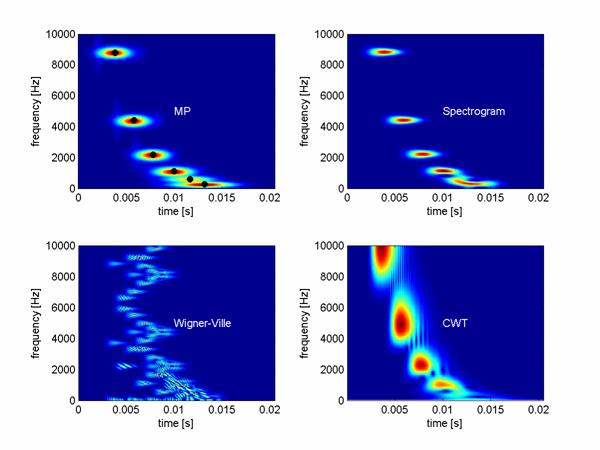
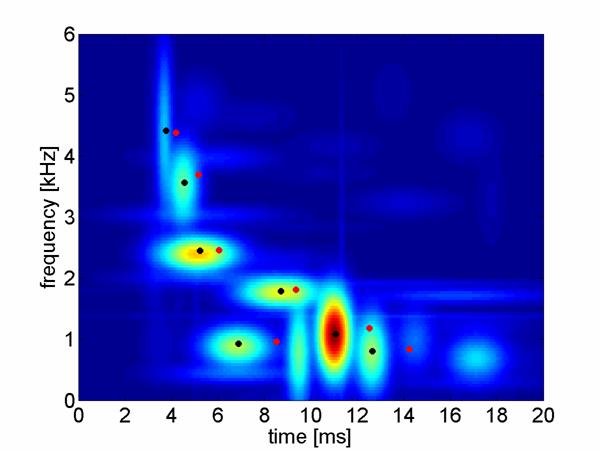
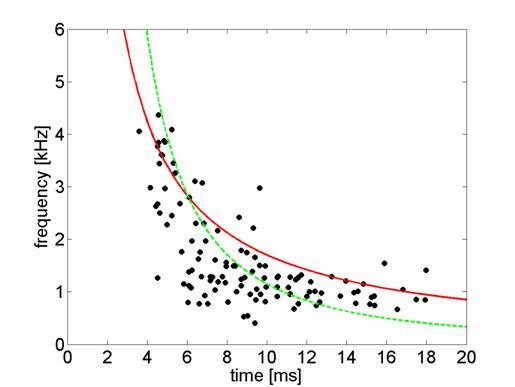
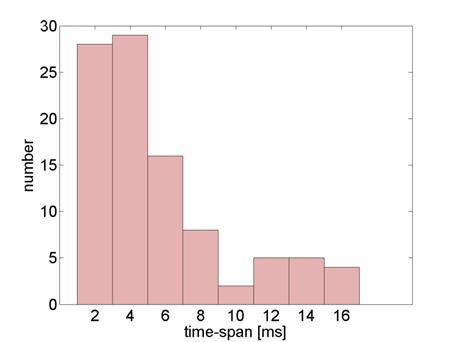
      Considering the evidence shown by a number of papers in the literature, suggesting that the TEOAE response contains not only TEOAE components, but distortion products and spontaneous emissions (see Brownell et al 1999; Kalluri and Shera 2001), this section is dedicated to new methods of TEOAE analysis which can provide new insights on the structure of TEOAEs and the relationship between the TEOAEs , DPOAEs and SOAEs. Although the signal processing algorithms are quite numerous, only a very small fraction of them has been applied to TEOAEs. The basic approaches are :

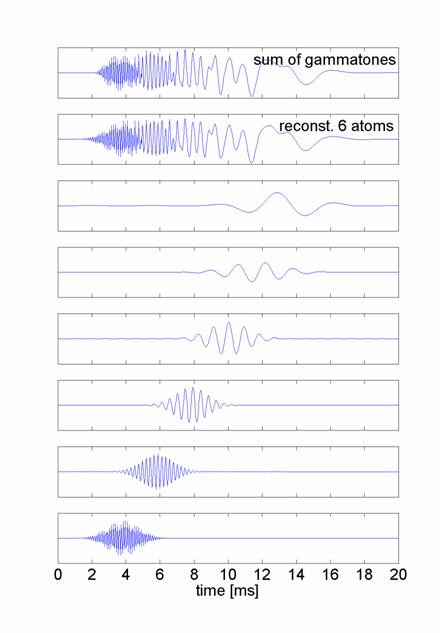
    1. Wavelet decomposition of TEOAEs(known also as Time-scale analysis). The TEOAE signal is decomposed not with sinusoids but with a function we call a wavelet. This approach refers to one of the most successful chapters of biomedical signal processing and it is very efficient if we would like to reproduced the TEOAE response but with significantly lower levels of noise (de-noising). For more information the reader can consult the following MEDLINE-enabled papers:
      1: Yao J, Zhang YT.
      Bionic wavelet transform: a new time-frequency method based on an auditory model.
      IEEE Trans Biomed Eng. 2001 Aug;48(8):856-63.

      2: Tognola G, Grandori F, Ravazzani P.
      Time-frequency analysis of neonatal click-evoked otoacoustic emissions.
      Scand Audiol Suppl. 2001;(52):135-7.

      3: Janusauskas A, Marozas V, Engdahl B, Hoffman HJ, Svensson O, Sornmo L.
      Otoacoustic emissions and improved pass/fail separation using wavelet analysis and time windowing.
      Med Biol Eng Comput. 2001 Jan;39(1):134-9.

      4: Morand N, Khalfa S, Ravazzani P, Tognola G, Grandori F, Durrant JD, Collet L, Veuillet E.
      Frequency and temporal analysis of contralateral acoustic stimulation on evoked otoacoustic emissions in humans.
      Hear Res. 2000 Jul;145(1-2):52-8.

      5: Tognola G, Grandori F, Avan P, Ravazzani P, Bonfils P.
      Frequency-specific information from click evoked otoacoustic emissions in noise-induced hearing loss.
      Audiology. 1999 Sep-Oct;38(5):243-50.

      6: Zheng L, Zhang YT, Yang FS, Ye DT.
      Synthesis and decomposition of transient-evoked otoacoustic emissions based on an active auditory model.
      IEEE Trans Biomed Eng. 1999 Sep;46(9):1098-106.

      7: Tognola G, Grandori F, Ravazzani P.
      Wavelet analysis of click-evoked otoacoustic emissions.
      IEEE Trans Biomed Eng. 1998 Jun;45(6):686-97.

      8: Blinowska KJ, Durka PJ.
      Introduction to wavelet analysis.
      Br J Audiol. 1997 Dec;31(6):449-59.

      9: Tognola G, Grandori F, Ravazzani P.
      Time-frequency distributions of click-evoked otoacoustic emissions.
      Hear Res. 1997 Apr;106(1-2):112-22.

      10: Rahko T, Kumpulainen P, Ihalainen H, Ojala E, Aumala O.
      A new analysis method for the evaluation of transient evoked otoacoustic emissions.
      Acta Otolaryngol Suppl. 1997;529:66-8.

      11: Wit HP, van Dijk P, Avan P.
      Wavelet analysis of real ear and synthesized click evoked otoacoustic emissions.
      Hear Res. 1994 Mar;73(2):141-7.

      12: Pasanen EG, Travis JD, Thornhill RJ.
      Wavelet-type analysis of transient-evoked otoacoustic emissions.
      Biomed Sci Instrum. 1994;30:75-80.


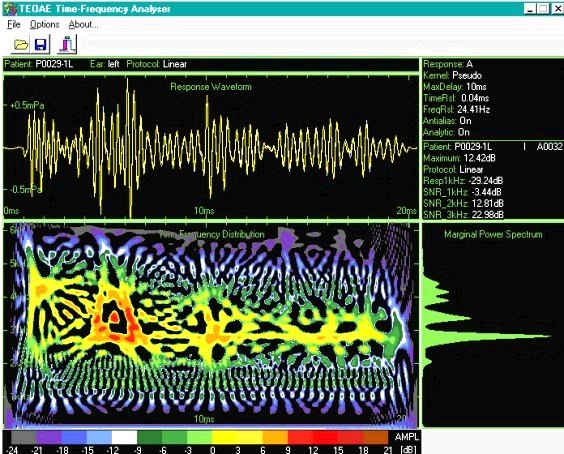
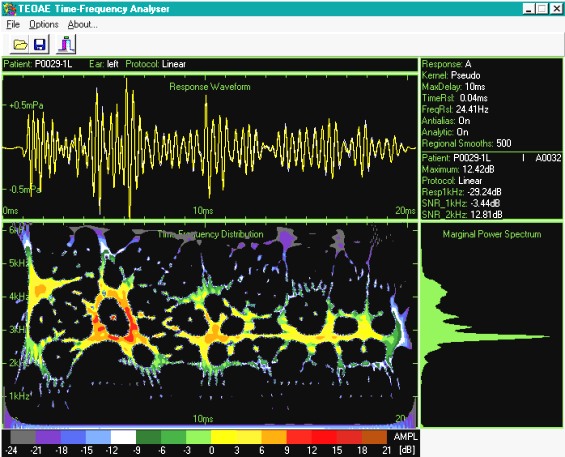
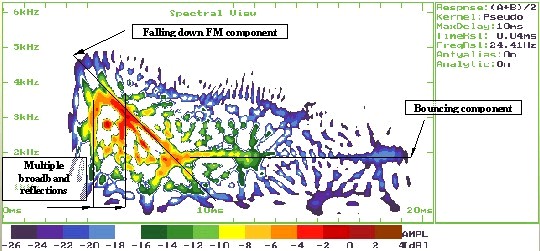
    2. Wigner-Ville-based decomposition of TEOAEs (known also as time-frequency analysis) and other adaptive kernels. In this approach the TEOAE signal is decomposed into a Time and Frequency matrix and interesting information can be gathered about the interaction of various TEOAE, DPOAE and SOAE components. The basics for the TF analysis are presented in the editorial of December 2001. For additional information the reader can consult :


1:  Hatzopoulos S, Cheng J, Grzanka A, Martini A.  
Time-frequency analyses of TEOAE recordings from normal and SNHL patients.
Audiology. 2000 Jan-Feb;39(1):1-12.


2:  Hatzopoulos S, Tsakanikos M, Grzanka A, Ratynska J, Martini A.  
Comparison of neonatal transient evoked otoacoustic emission responses recorded with linear and QuickScreen protocols.
Audiology. 2000 Mar-Apr;39(2):70-9.


3:  Hatzopoulos S, Cheng J, Grzanka A, Morlet T, Martini A.  
Optimization of TEOAE recording protocols: a linear protocol derived from parameters of a time-frequency analysis: a pilot study on neonatal subjects.
Scand Audiol. 2000;29(1):21-7.


  1. Higher-order kernels of the Volterra series: The TEOAE responses are analyzed to obtain the linear part and estimates of the slices of the 2nd and 3rd order Volterra kernels. Having this information one then can proceed in the estimation of other useful relationships such as the non-linear temporal interactions between the estimated kernels. For additional information the reader can consult :
    1: Thornton AR, Shin K, Gottesman E, Hine J.
    Temporal non-linearities of the cochlear amplifier revealed by maximum length sequence stimulation.
    Clin Neurophysiol. 2001 May;112(5):768-77.

    2: Thornton AR.
    Maximum length sequences and Volterra series in the analysis of transient evoked otoacoustic emissions.
    Br J Audiol. 1997 Dec;31(6):493-8.


  2. Recurrence Quantification Analysis (RQA):The RQA method aims to a direct and quantitative description of the amount of deterministic structure of the TEOAE response and it was shown to be an efficient and relatively simple tool in the non-linear analysis of many physiological signals. The basic idea behind RQA is the identification of recurrence of local data points in a reconstructed phase-space. The targeted system is analyzed by reconstructing the space of the true signal dynamics, using a coordinate system of surrogate variables, created by a combination of the measured signal and time-lagged copies of itself. For more information the reader can consult:
    1:  Zimatore G, Giuliani A, Parlapiano C, Crisanti G and Colosimo A .

    Revealing deterministic structures in click-evoked otoacoustic emissions
    J Appl Physiol 2000 Apr;88(4)1431-7.


  3. Classification Methods: This category refers to techniques which decompose the TEOAE or the DPOAE response into a set of unique parameters (i.e. correlation, response, noise level, S/N ratios at various ands etc). For the classification it is customary to use a training sets of data which in theory represent well the properties of the signals under classification ( i.e. from normal and hearing impaired ears). Once the training has been concluded another set of data (called the testing set) is classified. A positive aspect of these classification techniques is that every time the classification is correct, the classification system learns more and becomes more precise. Although this scenario might behelpfull for a few discrete categories, for example OAEs from normal ear and ears with otosclerosis, when the distributions of the categories under classification become overlapping the classification results are erroneous. For these cases it has been suggested to use very large training sets, a situation which is not very realistic in normal clinical set-ups.
            Two classification methodologies have been presented in the literature.

    • Spectral distriminant analysis: According to this method the classification is conducted not via parameters extracted from the time-waveform of the signal, but on data derived from the FFT of the TEOAE response. Since the FFT is very noise-sensitive the classification results are also noise dependent ( i.e. good TEOAE recordings are needed). The use of the FFT parameters provide an excellent way to resolve the issue of overlapping distributions, but the approach requires very large data sets. The user might find more information in the following papers.

      1:   Hatzopoulos S, Prosser S, Mazzoli M, Rosignoli M, Martini A.  
      Clinical applicability of transient evoked otoacoustic emissions: identification and classification of hearing loss.
      Audiol Neurootol. 1998 Nov-Dec;3(6):402-18.
      2:   Hatzopoulos S, Mazzoli M, Martini A.  
      Identification of hearing loss using TEOAE descriptors: theoretical foundations and preliminary results.
      Audiology. 1995 Sep-Oct;34(5):248-59.


    • Neural Networks: the developments in the area of NN are really impressive the last ten years and it issurprisingg that the method has not been used more extensively in the area of OAE characterization and classification. Usually the classification is conducted on time domain variables (TEOAEs) or S/N values of the DPOAEs, via the standard training and testing sets. More information can be found at :

      1:  Buller G, Lutman ME.
      Automatic classification of transiently evoked otoacoustic emissions using an artificial neural network.
      Br J Audiol. 1998 Aug;32(4):235-47.

      2: Kimberley BP, Kimberley BM, Roth L.
      A neural network approach to the prediction of pure tone thresholds with distortion product emissions.
      Ear Nose Throat J. 1994 Nov;73(11):812-3, 817-23.


Extra sources of information in the Portal


The reader might consult the following white papers and lectures

TEOAEs

Factors Affecting the TEOAEs


The following list refers to variables effecting significantly the amplitude of the TEOAE response.


  • Gender and ear differences: A number of studies on neonatal and adult subjects have reported that TEOAE recordings from females tend to show larger amplitudes and a more extensive TEOAE bandwidth. This evidence verifies previous data (McFadden: Sex differences in the auditory system Developmental Neuropsychology, 1998) reporting gender differences in the auditory system. The initial assumption that the TEOAE differences were the product of the diverse dimensions between the auditory structures of males and females, have been challenged by new evidence which shows that TEOAE differences exist even between heterosexual and homosexual subjects. An alternative hypothesis which might elucidate these differences would be to consider the role of hormones (estrogen in particular) on the functional status of the OHCs (see an early paper of Wharton JA, Church GT. Influence of menopause on the auditory brainstem response. Audiology 1990).
           Ear differences have been reported from the early studies on TEOAEs (See papers by Probst et al and Bonfils et al of the late 80s).The different TEOAE characteristics from the left and the right ear gave rise to the term hearing asymmetry.

  • The aging process: As aging processes affect the functional status and the distribution (effective number) of OHCs and IHCs, it is not surprising that aging affects the characteristics of the TEOAEs. It should be noted though that the most pronounced effects are generated by the alteration of the structures of the middle ear than the inner ear.

  • Genetic Factors: With the advances in the area of genetics it becomes more clear that a number of genetic factors expressed as variations of genes localized in various sub-structures of the organ of Corti are responsible for a large number of OAE dysfunction, which is also expressed as hearing impairment. Genetic factors , such as the ones we cluster together in well-identified syndromes, obviously affect not only TEOAEs but DPOAEs and SOAEs. Considering the noted gene-variations between races (for example Caucasian vs African) it is very probable that racial backgrounds might express different TEOAE characteristics, but there is no information in the literature for such studies.
TEOAEs

Threshold and TEOAEs


The relationship between TEOAEs and Audiometric outcomes (mainly with the Pure Tone Audiometry) has been a debating issue from the early days of otoacoustic emissions. The first author presenting evidence on the relationship between TEOAEs and auditory threshold, was David Kemp. According to his studies the TEOAE responses were present when the threshold levels of the tested subject were better or equal than 30 dB HL. This estimate refers to the average hearing threshold at the audiometric frequencies of 0.5 1.0, 2.0 and 4.0 kHz. Latter studies have presented evidence that the threshold level cut-off for the presence of TEOAEs is approximately from 35 to 40 dB HL.

Although the above statements hold true for the majority of clinical cases, there are examples where the TEOAE responses exist despite the observed hearing impairment. These are mostly cases where there is residual hearing at 1.0 or 2.0 kHz. The cochlear zones corresponding to these frequencies are favored by the resonant frequency of the forward and reverse middle ear transduction. Therefore for clinical cases showing a hearing level at 1.0 kHz and 2.0 kHz better than 30 dB HL and worst than 30 dB in the higher octaves (so than the average is around 35-40 dB) it is possible to record TEOAEs

The true debate on the issue of threshold and TEOAEs revolves around the prediction of the auditory threshold by the signal values of the TEOAEs. In this context it can be said that in general the TEOAEs cannot predict the auditory threshold. The reason for the latter is the fact that auditory perception involves more parts of the auditory system than just the periphery whose function is reflected by the TEOAE measurements.

Nevertheless when:


  • The external and middle ear functions are normal.

  • There are no retrocochlear hearing complications

the audiometric outcomes and the information from the TEOAEs are in agreement. Any deviation from this scenario causes a disagreement between the TEOAEs and the audiometric outcomes.

TEOAEs

TEOAEs Test Procedures

 
Editor's Note:A portion of the material presented in the TEOAE pages has appeared in the NATASHA (Network and Tools for the Assessment of Speech/Language and Hearing Ability) project web pages.

Equipment and Stimuli for human measurements

a) Set-up (equipment, test environment, etc.):

For measuring the TEOAEs the ILO-92, ILO-292, (Otodynamics) and Celesta / Capella (Madsen) standard equipment are used in most cases.

Editor's Note: This situation is bound to change very soon as the Otodynamics TEOAE patent has expired , and new equipment will enter the market as soon as in the second quarter of 2001.

The ear canal is closed with a probe and a cuff. The probe is connected to a  loudspeaker and a microphone.

b) Stimuli:

       By default the stimuli are trains of 4 biphasic clicks of 80 ms in the non-linear position (+1 +1 +1 -3). The stimulus intensity is set at 84 dB peak equivalent SPL (0.3 Pa peak) with the spectrum adjusted as flat as possible (band pass filter of 500-6000 Hz). The window for the TEOAE recording is set at 20.49 ms, but in order to ensure a significant stimulus artifact rejection the first 2.5 ms of the recording are suppressed.
    Due to recent advances in the TEOAE technology it is now possible to use a shorter recording window (12.5 ms) with a protocol called QuickScreen. A number of studies have also indicated that it is possible to use a Linearprotocol (of 70 - 75 dB SPL) to reliably record neonatal and adult subject responses.

quickscreen example
A response from a preterm neonate (30 weeks PCA) recorded with the QuickScreen protocol.


Linear example
A response from a preterm neonate (30 weeks PCA) recorded with the Linear protocol.


       Another type of TEOAE stimuli, but not commonly used, are the tone pips or tone-bursts. It is possible to elicit TEOAE responses using modulated tone-pips of a 4ms duration at frequencies of 1.0, 2.0 and 4.0 kHz, but the first 4-6 ms of the TEOAE response are contaminated by the stimulus artifact. In terms of clinical uses it is obvious that responses evoked by tone-pips have a significant clinical advantage over the use of clicks alone. In addition, a recent study by Vinck et al (1998) has reported that a correct classification of pure-tone thresholds between 500 and 4000 Hz up to 100% was possible, when variables from click and tone-burst otoacoustic measurements were used .        An interesting aspect of the tone-pip TEOAE generation is the possibility to calculate the OAE latency. The OAE latency is impossible to compute in the click-evoked TEOAEs, due to the presence of numerous frequency components (the latter can be overcome by using a wavelet transform decomposing the original TEOAE response into a set of specific components. For more info see Methods of TEOAE signal analysis). The TEOAE latency is a very good distriminant variable between normal and hearing impaired ears, and it is relatively easy to build reference templates to employ in the identification of the hearing status of an adult or neonatal subject (for more information on how to build these reference templates you might consult Hatzopoulos et al, Audiology, 1995; Hatzopoulos et al, Audiology-Neurotology, 1998)

The reader who is interested in tone-pip, tone-burst stimuli might consult the following papers(the titles are MEDLINE enabled, and by clicking on the authors names you might access the paper's abstract):
  Smurzynski J, Probst R.
Intensity discrimination, temporal integration and gap detection by normally-hearing subjects with weak and strong otoacoustic emissions. Audiology. 1999 Sep-Oct;38(5):251-6.
Harrison WA, Norton SJ.  
Characteristics of transient evoked otoacoustic emissions in normal-hearing and hearing-impaired children. Ear Hear. 1999 Feb;20(1):75-86.
  Vinck BM, Van Cauwenberge PB, Corthals P, De Vel E.  
Multi-variant analysis of otoacoustic emissions and estimation of hearing thresholds: transient evoked otoacoustic emissions. Audiology. 1998 Nov-Dec;37(6):315-34.
O-Uchi T, Kanzaki J, Ogata A, Inoue T, Mashino H, Yoshihara S, Satoh Y.  
Pathophysiology of hearing impairment in acoustic neuroma with profound deafness: analysis by evoked otoacoustic emission and promontory stimulation test. Acta Otolaryngol Suppl. 1994;514:95-100.
O-Uchi T, Kanzaki J, Satoh Y, Yoshihara S, Ogata A, Inoue Y, Mashino H.  
Age-related changes in evoked otoacoustic emission in normal-hearing ears. Acta Otolaryngol Suppl. 1994;514:89-94.
Hauser R, Probst R, Harris FP.  
Effects of atmospheric pressure variation on spontaneous, transiently evoked, and distortion product otoacoustic emissions in normal human ears. Hear Res. 1993 Sep;69(1-2):133-45.
Hauser R, Probst R, Lohle E.  
Click- and tone-burst-evoked otoacoustic emissions in normally hearing ears and in ears with high-frequency sensorineural hearing loss. Eur Arch Otorhinolaryngol. 1991;248(6):345-52.

TEst Procedures

When the user has selected the type of TEOAE protocol (QuickScreen, nonlinear or linear) may proceed to the acquisition of the TEOAE response. The protocol below refers to the procedural steps using the ILO88.

  • Insert the acoustic probe, fitted with a disposable plastic tip, into the patient's ear.
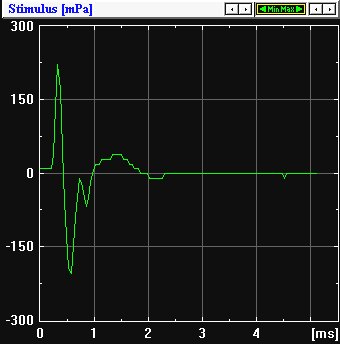
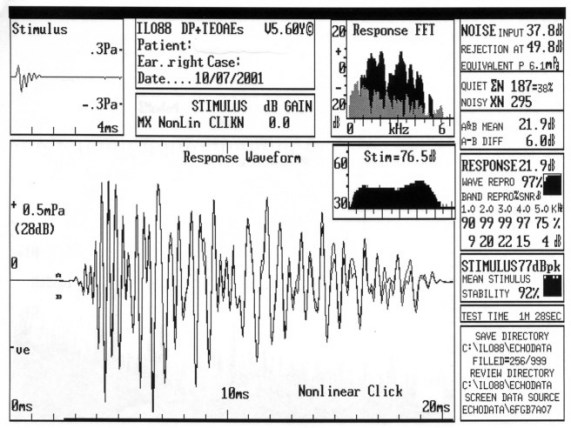
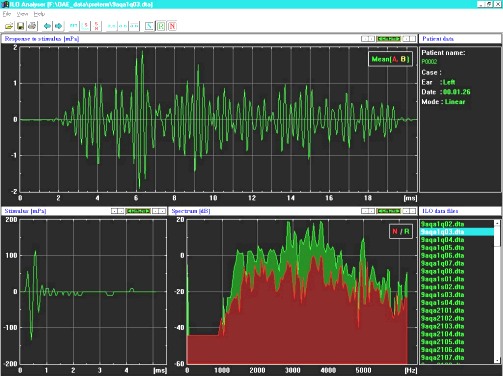
  • A standard click stimulus is applied and the sound in the ear canal is displayed as a waveform and spectrum so that the operator can adjust the fit of the probe and ensure proper stimulation for performing correctly the test. The cable of the probe should be directed 45° towards the top of the head. Experience has shown that this angle is not feasible with neonatal subjects, where a wider angle is used. The position of the probe into the external auditory canal is a crucial component of the proper conduction of the test especially in neonatal subjects. An example of an ideal stimulus-response is shown in Figure 1below.
  • Figure 1: Ideal shape of a click TEOAE stimulus

    An erroneous probe position may effect the lower TEOAE frequencies due to a bad coupling between the probe body and the external auditory canal. But in no case an erroneous position of a probe can result in absence of response, with the exception when the probe is completely out of the external auditory meatus. These considerations are valid ONLYfor the TEOAEs and cannot be extrapolated for the DPOAEs.

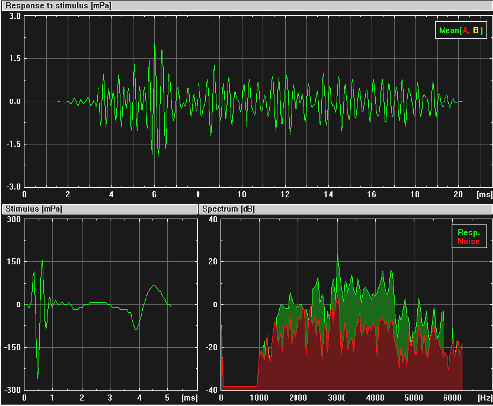
    Figure 2: Response from an agitated neonatal subject. The stimulus profile indicates that due to the movements of the subject, the probe is not placed in an optimal position. Nevertheless the obtained response is a PASS.


  • Following the check-fit, the test may start. The preset stimulus is repeated as many as 256 times (1024 clicks in total) and the "delayed" cochlear responses in the ear canal are acquired and accumulated in a memory bank in order to enhance the detection of the small cochlear signals against the background noise. It should be noted that neonatal subjects have significantly strongeremissions than adults and under normal conditions (the subject is calm) an average of 20 stimuli (80 clicks) can be sufficient.

    The patient (adults and children) should be quiet and sitting comfortably and still. Infants, if possible, should be lying still.

  • The stop-criteria for the test vary. The majority of programs use a pre-specified number of sweeps for each subject category (neonates, NICU residents, children, young adults, adults). It is also common to stop the recording when a variable reaches a specific value: For example when the overall reproducibility exceeds 75% or when the S/N ratio at certain frequencies is above a pre-determined level. NOTE:These criteria, independently how stringent might be, cannot guarantee that the employed OAE procedure will yield excellent results in the identification of both normal and hearing impaired ears. Signal theory indicates that by increasing the sensitivity of a test procedure the specificity decreases and vice versa. Today a sensitivity of 90 - 95 % is well accepted.
The reader who is interested in more information on the TEOAE evaluation criteria (sometimes termed also as scoring criteria) might consult the following papers (the titles are MEDLINE enabled, and by clicking on the authors names you might access the paper's abstract):
Norton SJ, Gorga MP, Widen JE, Folsom RC, Sininger Y, Cone-Wesson B, Vohr BR, Mascher K, Fletcher K.  
Identification of neonatal hearing impairment: evaluation of transient evoked otoacoustic emission, distortion product otoacoustic emission, and auditory brain stem response test performance. Ear Hear. 2000 Oct;21(5):508-28.
Norton SJ, Gorga MP, Widen JE, Vohr BR, Folsom RC, Sininger YS, Cone-Wesson B, Fletcher KA.  
Identification of neonatal hearing impairment: transient evoked otoacoustic emissions during the perinatal period. Ear Hear. 2000 Oct;21(5):425-42.
Hatzopoulos S, Tsakanikos M, Grzanka A, Ratynska J, Martini A.  
Comparison of neonatal transient evoked otoacoustic emission responses recorded with linear and QuickScreen protocols. Audiology. 2000 Mar-Apr;39(2):70-9. PMID: 10882045
Aidan D, Avan P, Bonfils P.  
Auditory screening in neonates by means of transient evoked otoacoustic emissions: a report of 2,842 recordings. Ann Otol Rhinol Laryngol. 1999 Jun;108(6):525-31.
Rhodes MC, Margolis RH, Hirsch JE, Napp AP.  
Hearing screening in the newborn intensive care nursery: comparison of methods. Otolaryngol Head Neck Surg. 1999 Jun;120(6):799-808.
Gorga MP, Neely ST, Bergman BM, Beauchaine KL, Kaminski JR, Peters J, Schulte L, Jesteadt W.  
A comparison of transient-evoked and distortion product otoacoustic emissions in normal-hearing and hearing-impaired subjects. J Acoust Soc Am. 1993 Nov;94(5):2639-48.
TEOAEs

TEOAEs


The Transient evoked otoacoustic emissions (TEOAEs) are the objective evidence of function of the cochlear mechanism. This implicates also normal function of the middle ear.

The terms "TEOAE" and "CEOAE" they both refer to a OAE response evoked by a click. Although the term "CEOAE" is more appropriatebecause indicates that the OAE response is evoked by a click stimulus, in the majority of the studies in the literature the term "TEOAE" is used.

The TEOAE responses are properties of normal ears. The generation mechanism is not fully understood yet, but a number of studies have presented evidence supporting that the TEOAEs are generated by a reflection of the travelling wave at micromechanical impedance perturbations in the Organ of Corti (Kemp, 1980). The TEOAEs can be also recorded from other animal species, used in clinical research, such as mice, rats, guinea pigs, chinchilla, rabbits, dogs, and monkeys. As it might be expected aging processes affect the amplitude and frequency content of the responses.

The fact that we have categorized the OAEs in various types (i.e, TEOAEs, DPOAEs, SOAEs, SFOAEs) does not automatically imply that the generation OAE mechanisms are as many. There are studies which have reported that the different types of OAEs influence each other, and a typical example is how the SOAE peaks enhance the TEOAE spectrum. In addition, a number of papers (Yates and Withnell, 1999; Withnell and Yates , 1998; Withnell et al, 1998; 2000) have underlined the relationship between distortion product otoacoustic emissions and TEOAEs where high frequency components of click stimuli generate low frequency DPOAEs.

The last few years the relationship of these types of OAEs have been attributed to the presence of two distinct cochlear mechanisms which gave rise to a different OAE taxonomy not in terms of the evoking stimulus , but in terms of the generation mechanism. Shera and Guinan (1999) postulated that the signals we commonly record, are the cumulative results of nonlinear processes (DPOAEs) and reflection mechanisms (TEOAEs). This hypothetical structure is known as the two source interference model. This theoretical foundation has been succesfully applied to distortion product otoacoustic emissions (Talmadge et al, 1999).

References:

Kemp DT 1980. Towards a model for the origin of cochlear echoes. Hear Res. 2, 533-548
Talmadge CL, Long GR, Tubis A, Dhar S, 1999. Experimental confirmation of the two-sourse interference model for the fine structure of distortion product otoacoustic emissions. J. Acoust. Soc. Am. 105, 275-292
Withnell RH and Yates G, 1998. Enhancement of the transient-evoked otoacoustic emission produced by the addition of a pure tone in the guinea pig. J Acoust Soc Am .104:344-349.
Withnell RH, Kirk D, Yates G, 1998. Otoacoustic emissions measured with a physically open recording system. J Acoust Soc Am.104:350-355.
Withnell RH, Yates GK, Kirk DL, 2000. Change to low frequency components of the TEOAE following acoustic trauma to the base of the cochlea. Hear Res. 139, 1-12.
Yates GK and Withnell RH , 1999. The role of intermodulation distortion in transient evoked otoacoustic emissions. Hear Res. 136, 49-64.


OAE Portal

Editorials

✍️ 53 articles articles
Editorial

February - May 2025: An Overiew of the NHS practices in the World

For many reasons related to the administration duties from the majority of the Portal staff (myself included), the activities in the Portal have been slowed down. In addition to the fact that OAEs and neonatal screening are NOT the new kids in the block anymore, and as a consequence new software and hardware developments are hard to come by.

In 2025, the members of my lab with a cooperation from  the Institute of Physiology and Pathology of Hearing in Warsaw, will present a series of Reviews on the hearing screening practices across the globe. We have identified 4 major geographic areas, such as Europe, Africa, West Asia and South America. We have purposely omitted data from North America and Australia, where the majority of advances are usually reported in the Literature.

The Reviews will appear in the peer-reviewed journal Children in various thematic Issues.

The First published review on the European NHS practices, will appear in March 2025.


Editorial

January - March 2024: Post-Covid Silent Years

The Otoacoustic Emissions Portal is on-line for almost 24 years (we started in June 2000). While we did not expect the COVID crisis to affect us  ,in terms of time and functionality, unfortunately the implications were more severe than expected. The overall team was dismantled for more than 18 months and  I have seen signs of recovery, in the end of 2023. Our scientific and personal lives have changed for good.

Meanwhile, users can browse over the materials we have deposited for all these years and hopefully this year we will go over the areas which has changed a lot the last 5 years, such as the Hardware and Software sections.

Also we have programmed a number of technical insertions regarding the performance of various OAE and AABR screeners, versus the second and forth trimester of 2024.


Editorial

September - December2020

A lot of things have occurred in 2020, one of which is the lock-down policy of the Italian government in order to prevent the spread of the SARS-CoV-2 pandemic.

Despite the fact that the Portal is an on-line entity, the various global lock-downs have impacted significantly our internal update procedures. At this very moment we do not have any estimate of when things will go back to normal and when the Portal contributors will be back on-line !!

I have been following the race to find a cure against the virus, my personal opinion is that this will be rather difficult till we understand exactly what is the SARS-CoV-2 and which  are exactly the targeting tissues. The respiratory complications are ONLY a part of the global infection activity.

In terms of drugs Chloroquine and Hydroxychloroquine have been widely promoted in various clinical setups, but data in the literature have suggested that in many treated cases side effects such as sensorineural hearing loss, tinnitus, and/or persistent imbalance, are  common. Azithromycin,  has been administered often in combination to Hydroxychloroquine, reinforcing its action, in SARS-CoV-2 patients. It has also been reported to cause both reversible and irreversible sensorineural hearing loss and tinnitus. Remdesivir and Favipiravir, are antiviral, adenosine nucleotide analogues, reported as a possible useful treatment against SARS-CoV-2. However, ototoxicity has been included amongst the possible side effects of adenosine nucleotide analogues; specifically, data in the literature report that patients may develop irreversible unilateral or bilateral hearing loss and tinnitus due to the use of these antivirals, usually after few weeks of administration.

The reason I presented the above excursus on the SARS-CoV-2 drug treatment strategies,  is that the fastest and most accurate methods to detect objectively ototoxicity are protocols based on otoacoustic emissions.

Me and my team have authored two papers on the topic of SARS-Cov-2 and ototoxicity. The links to my Researchagate pages are:

1. Ototoxicity prevention during the SARS-CoV-2 (Covid-19) emergency : Researchgate link 

2. Don’t forget ototoxicity during the SARS-CoV-2 (Covid-19) pandemic ! : Researchgate link


Editorial

February - May 2020

A lot of things have occurred in 2020, one of which is the lock-down policy of the Italian government in order to prevent the spread of the SARS-CoV-2 pandemic.

Despite the fact that the Portal is an on-line entity, the various global lock-downs have impacted significantly our internal update procedures. At this very moment we do not have any estimate of when things will go back to normal and when the Portal contributors will be back on-line !!

I have been following the race to find a cure against the virus, my personal opinion is that this will be rather difficult till we understand exactly what is the SARS-CoV-2 and which  are exactly the targeting tissues. The respiratory complications are ONLY a part of the global infection activity.

In terms of drugs Chloroquine and Hydroxychloroquine have been widely promoted in various clinical setups, but data in the literature have suggested that in many treated cases side effects such as sensorineural hearing loss, tinnitus, and/or persistent imbalance, are  common. Azithromycin,  has been administered often in combination to Hydroxychloroquine, reinforcing its action, in SARS-CoV-2 patients. It has also been reported to cause both reversible and irreversible sensorineural hearing loss and tinnitus. Remdesivir and Favipiravir, are antiviral, adenosine nucleotide analogues, reported as a possible useful treatment against SARS-CoV-2. However, ototoxicity has been included amongst the possible side effects of adenosine nucleotide analogues; specifically, data in the literature report that patients may develop irreversible unilateral or bilateral hearing loss and tinnitus due to the use of these antivirals, usually after few weeks of administration.

The reason I presented the above excursus on the SARS-CoV-2 drug treatment strategies,  is that the fastest and most accurate methods to detect objectively ototoxicity are protocols based on otoacoustic emissions.

I am assuming that around the end of the year we will see the first publications coming out in the literature.


Guest editorial

April - June 2019: Telehealth and Audiology


Telehealth, or telemedicine, is the provision of health care services using a telecommunications medium (American Speech-Language-Hearing Association, 2005; Ricketts, 2000; Wootton, 2001). Specifically, telehealth indicates that practitioner services are provided to patients using an electronic medium such as a computer network, the telephone, satellite or two way radio (Mun & Turner, 1999; Stanberry, 2000).Telehealth services are used to serve people with limited healthcare access who typically live in rural or inner city communities. 

Applications have advanced substantially since the first telehealth services were explored. Also, it is likely that the most important telehealth advancements have occurred in the past decade spurred by lower interactive video costs and the advent of powerful but affordable personal computers. In addition, the greater accessibility to cost effective Internet services, and rapid computerization of medical devices are important contributing factors leading to telehealth service development.

A pdf version of the editorial is also available

Terminology.

Although telehealth is a common term, similar terms are often used today. These terms include telemedicine, e-care, e-health, telepractice, and telecare. Telemedicine is frequently used to describe physician and other medical services. In contrast, telehealth is more broadly defined to include those services provided by allied health-care professionals and by physicians alike. This view led to the Comprehensive Telehealth Act of 1997 in the United States in which all health care services provided over a telecommunications system were defined as telehealth.  It is with this perspective that the term, telehealth , will be used for the remainder of the paper.

A brief history of telehealth.

Telehealth is over a century old (Stamm, 1998; Stanberry, 2000). While the first telehealth service was not documented, it was probably conducted using a telephone (or the telegraph) and was likely a consultation. In the early 1900’s, maritime telehealth services were provided to sailors on ships from land based physicians using two-way radio. It is interesting that similar maritime telehealth services continue today even though the transmissions are likely satellite based in most cases. In the 1960’s, the National Aeronautics and Space Administration (NASA) used telehealth technology with astronauts to measure vital signs and radiation exposure while in space. Because of the continued need to provide care to individuals in remote locations, telehealth services are commonly used in many professions, including cardiology, radiography, otology, pediatrics, pharmacology, psychology, psychiatry, and speech-language pathology (Blackham, Eikelboom, & Atlas, 2004; Krumm & Sims, 2011; Nickelson, 1998; Perednia & Allen, 1996; Spooner, Gotlieb, & the Steering Committee on Clinical Information Technology and Committee on Medical Liability, 2004; Stamm, 1998).

Telehealth models.

Telehealth services can be delivered by synchronous (real-time) or asynchronous (store and forward) methods. Synchronous data communication is typically conducted via interactive video and can be augmented by information sent in an asynchronous mode. In contrast, asynchronous telehealth services require that patient data has been recorded first at the patient site and then, after some period of time, sent electronically to the clinician for interpretation. Asynchronous procedures are commonly employed when there is inadequate bandwidth for synchronous procedures. In addition, asynchronous applications may be utilized when time is less of a concern regarding the diagnosis or when the clinician is unavailable to conduct services. Finally, analog equipment which cannot be used for remote computing purposes, often can be gainfully configured for asynchronous applications. For example, an old tympanometer, which can only print out immittance results, can still be used for asynchronous applications by scanning patient immittance results into a computer and sending the data (via email attachment) to an audiologist for interpretation.

Asynchronous telehealth technology. 

Asynchronous data transfer is probably used by audiologists today and may in fact be a common practice. Specifically, this form of telehealth technology is utilized when information such as tympanograms, audiograms, auditory brainstem response recordings, or video-otoscopy images are transmitted via E-mail or by fax (see Figure 1).


                                       Figure 1. Modes of asynchronous services.


Asynchronous studies have been published evaluating the efficacy of telehealth with  tympanometry, video-nystagmography (VNG), and video-otoscopy (Birkmire-Peters et al, 1999; Yates and Campbell, 2005).  In addition, E-mail communication was used to deliver cognitive-behavioral therapy for tinnitus treatment (Kaldo-Sandström et al, 2004) and for counseling new hearing aid users (Laplante-Lévesque et al, 2006).

One appealing asynchronous application is self-assessment of hearing sensitivity. Presently, self-assessment procedures involving hearing testing online appear to suffer from questionable calibration, poor validation, and the lack of control over environmental noise levels. Nevertheless, as this is an emerging area of audiology telehealth, it is likely problems associated with self-assessment will be solved in the future.

Synchronous services.

Synchronous services are characterized by the clinician delivering services to clients in real time or “live” (See Figure 2). Such services may include the use of online chat, the telephone, interactive video, or remote computing technology. Interactive video is typically utilized with synchronous services to observe client responses to stimuli and to assure clinicians that audiometric equipment (transducer, probes, and electrodes) are properly placed. Interactive video may be provided by a laptop Webcam or by a dedicated camera system that is interfaced directly to the computer network. While interactive video can require substantial bandwidth, the benefits are obvious, providing the clinician and patient with services that are essentially “face-to-face”. High costs have limited routine use of interactive video but it is increasingly available and affordable in rural communities.

Audiologists may use two models of synchronous telehealth models. The first model is the traditional model used in other professions. This model requires the extensive use of high-quality interactive video in which the clinician supervises testing by a technician at the remote site. Once the technician obtains patient data, the clinician will typically provide a diagnosis and recommend management. This model has already been used successfully by Marincovich (M. Marincovich, personal communication, April 5, 2009) to provide hearing evaluations and hearing aid fittings in a rural region of California in the USA. For this model to be effective, the technician must be trained well enough to administer, but not necessarily interpret, audiology test results. Rather, interpretation and counseling is done by the audiologist. This is an effective solution when the technician turnover is low and ongoing technician training is possible. Also, the traditional model has the benefit of comparatively modest technology requirements.


                                     Figure 2. Synchronous services using interactive video


Another form of synchronous audiology services incorporates remote-control in so that clinicians can test patients at distant sites. This is a reasonable telehealth strategy to consider as many audiology systems are computerized, utilizing a Windows platform; and as a result can be incorporated for remote computing applications.  Consequently, a clinician at one site can control computerized audiology equipment at a distant site using application sharing software through a network, modem or the Internet. The greatest advantage to this method is that a technician is not required to do testing at the patient site. However, a technician is still required to do tasks such patient basic instructions, transducer placement, otoscopy, and have some skills in running the computer at the patient site.  Figures 3 and Figure 4 show the equipment that is typically used with a synchronous program.


Figure 3. The clinician equipment configuration for an audiologist administering telehealth services. Note only a computer (with remote computing software) and a webcam is required at the clinician site.

  1. 1.     Using this paradigm, investigators have employed synchronous protocols to administer a variety of common hearing tests to subjects including pure tone, speech, otoacoustic emissions and the auditory brainstem evoked response (Choi, Lee, Park, Oh, & Park, 2007; Givens & Elangovan, 2003; Krumm, Ribera & Klich, 2007; Ribera, 2005; Swanepoel Koekemoer & and  Clark, 2010,Towers, Pisa, Froelich, & Krumm, 2005).


            Figure 4. Equipment required at the patient site. For remote computing purposes, a computer, web cam or dedicated camera, computerized audiometric equipment (an audiometer is pictured), video-otoscopy, immittance (not shown) and a LAN connection would permit basic audiology telehealth services.


In addition, synchronous technology has been utilized to program cochlear implants (Franck, Pengelly & Zerfoss. 2006;Ramos et al., 2008), program and verify hearing aids functioning (Fabry, 2004; Ferrari & Bernardez-Braga, 2009;Wesendahl, 2003) and to provide neural response/telemetry assessment (Shapiro, Huang, Shaw, Roland & Lalwani, 2008).  This telehealth technique presently requires further validation but been used successfully to administer hearing tests over considerable distances (Krumm, Ribera & Klich, 2007; Ribera, 2005; Towers, Pisa, Froelich, & Krumm, 2005).

The hybrid model.

While the sole use of asynchronous or synchronous technology appears to be reasonable in some circumstances, audiologists should consider the most efficient system to deliver telehealth services. In many cases, a combination of synchronous and asynchronous technology will yield the best solution for hearing health-care services. This combination of technology is considered a hybrid model and is regularly used in many telehealth programs.

Telehealth services and otoacoustic emissions in adults. Evoked otoacoustic emissions (EOAEs) have obvious applications for hearing assessment and, therefore, it is not surprising that investigators incorporated EOAEs in early audiology telehealth research. The first of these studies was a master thesis written by Schmiedge (1997) assessing the validity of DPOAEs recordings using synchronous methods. In this investigation, an Apple (Power PC) computer system was interfaced to a computer peripheral capable of generating and recording DPOAEs (Virtual Systems model 330, version 1.9). Timbuktu desktop remote computing software was installed on the computer controlling the DPOAEs for remote computing (synchronous) purposes. 

Subjects assessed in this study were college aged students who exhibited normal hearing sensitivity and no significant history of hearing loss. These subjects were tested in a sound treated booth equipped with the Virtual DPOAEs system connected to a high speed computer network and to a modem. An audiologist (in the same building as the subjects) operated another Power PC computer equipped similarly as the subject computer and, therefore could control the subject DPOAE system using the computer network or modem. Subjects’ DPOAE amplitudes were obtained and compared in the following conditions: face-to-face in a “typical” clinical condition with an audiologist; through a modem connection capable of achieving a 33,600 baud/second connection; and through a high speed local area network (LAN) connection. DPOAE recordings were obtained in 1/3 octave intervals in the frequency range of 1000-4000 Hz using an f1/f2 ratio of 1.21and a stimulus presentation of 65/55 dB SPL. 

Results of this study revealed high agreement of DPOAE means and standard deviations between face-to-face, modem and LAN conditions. The outcome of these data suggested that DPOAE recordings could be accurately measured using telehealth technology with “off the shelf” otoacoustic emissions system hardware and desktop remote computing software. However, in this study there were problems with recording DPOAE data. Computer recordings of DPOAE data would were somewhat unstable during both telehealth conditions and would periodically result in corrupt DPOAE recordings. A caveat is that corrupt data is always possible and should remain a concern.

            Following this work by Schmiedge,a paper was published by Elangovan (2005), describing a customized otoacoustic emissions system developed for synchronous telehealth applications. Elangovan found that this system produced comparable distortion product otoacoustic emission DPOAEs results for five adult subjects when telehealth and face-to-face comparisons were made. Although the outcomes for the otoacoustic emissions systems were impressive, the investigators made their measurements in the same location of the subjects. Consequently, further validation was needed at a distance to determine the value of the system described by Elangovan.

            The first research which demonstrated that EOAEs could be measured at a substantial distance was published by Krumm at. al (2007). In their study Krumm et al. (2007) utilized an off-the-shelf computerized Biologic Scout EOAEs system and a low cost video-conferencing system to record DPOAEs in 30 adult subjects. The EOAEs system was interfaced to a PC connected to a LAN at the subject test site. A second PC was used to provide telehealth services at approximately 1000 Kilometers (Km) away from the subjects. PCs at both sites, running the Windows 2000 operating system, were configured with an interactive video system (VIGO, Emblaze-Vcon, Hackensack, New Jersey) bundled with Meeting Point 4.6 video conferencing software. Remote computing was made possible by application sharing software bundled within the Meeting Point program.  A schematic of this system is found in Figure 5. Results of this suggested that the synchronous measurement of DPOAEs over long distances was feasible as telehealth and face-to-face DPOAE measurements were equal. Further, no technical problems occurred that were described earlier by Schmiedge (1997).


Figure 5. A schematic of the DPOAE system used by the author for synchronous DPOAE research over a distance. 

Telehealth and DPOAEs measurements in Infants.  In all likelihood, EOAEs in telehealth will be used with infant and young children involved in an early hearing detection and intervention (EDHI) program.  But EDHI program goals can be difficult to achieve due to inadequate professional expertise, lack of program planning and insufficient funding ((Mencher, Davis, Devoe, Bereford & Bamford, 2001). Also an EDHI program should exhibit continuity of services up-to-date information, operate as a community-based health program, and provide accurate tracking information for newborns requiring further screeing or assessment (Mencher et al., 2001).  O’Neil, Finitzo, and Littman (2000) addressing similar EDHI issues suggested new paradigms should be developed to insure that each infant is provided needed services regardless of circumstances.

            Such a paradigm may incorporate telehealth services.  Telehealth has been an effective medium of providing medical expertise to isolated communities and is a common practice in many health care professions.

            One intriguing nature of EOAE systems is that many of these systems are commonly operated through desktop personal computers (PCs). Consequently, many EOAE systems can be employed for synchronous telehealth applications including remote computing. Further, remote computing applications for infant hearing assessment seem to have at least three advantages over asynchronous applications. For example, when hearing screenings cannot be accomplished face-to-face, a hearing heath care professional could conduct hearing screening from another location. Also, once personnel are trained to conduct infant hearing assessment in underserved area, these individuals can be mentored and supervised by a hearing health care professional in real time while testing clients. Remote computing also allows observation at distant centers for quality control purposes to achieve appropriate referral rates deterring referrals with excessive false positives.

Finally, diagnostic hearing assessment can be accomplished by hearing health care professionals using remote computing technology. This consideration is important as research indicates that infants with hearing loss require appropriate amplification and aural habilitation before reaching six months of age. Even under ordinary circumstances it can be difficult to conduct follow-up screening, comprehensive hearing assessment and a hearing aid fitting in this time frame unless the infant is precisely managed. In comparison, an infant in an isolated community requiring services at distant medical centers may ultimately suffer from the lack of continuity of care resulting in untimely intervention. Hearing assessment completed remotely by a competent hearing health care professional could serve to reduce the lack of continuity of care and hasten the diagnostic and hearing aid fitting process if needed.

A few papers have been published concerning telehealth and EOAEs in pediatric populations. The first which paper discussed pediatric applications of telehealth and otoacoutic emissions, was by Krumm, Ribera and Schmiedge (2005). This paper provided rationale, models and pilot data supporting the use of telehealth technology with infant hearing screening programs.  Additionally, described some of the issues associated with creating a telehealth service including establishing connectivity at the clinic site, use of a VPN to provide patient privacy, and the need to work collaboratively with computer network personnel who do not necessarily share an enthusiasm for telehealth procedures. 

In 2008, Krumm, Huffman, Dick and Klichdescribed a study in which they used remote computing technology to record DPOAEs and automated auditory brainstem audiometry response (AABR) data with infants. Specifically, 30 infants ranging in age from 11–45 days (with an average age of 16 days) were seen for this study. Subjects recruited for this study did not pass prior DPOAEs screening at birth and were being seen for re-screening at their regional medical hospital.

The Biologic ABAER  system ( Natus, San Carlos, California, USA) was used to conduct all automated ABR (AABR) and DPOAE measurements. The ABAER system was interfaced to a computer and interactive video system in the same manner described previously Krumm et al. (2007). This system was interfaced to a personal computer (PC) running the Windows 2000 operating system and connected to a LAN at the subjects’ site. A second PC was utilized by the audiologist conducting telehealth measurements 200 Km away from the subjects. PCs at both sites were configured with a VCON Vigo desktop videoconferencing system and vPoint software which was used for remote computing applications. Consequently, the audiologist conducting synchronous testing could control both DPOAE and ABR applications at the subject site using the Internet and a broadband connectionA screen capture of a remote session utilizing remote computing technology to measure DPOAEs in a young subject is found in Figure 5. A virtual private network (VPN) connection was provided by the hospital at which the infant hearing re-screening was conducted to protect subject data transmission over the Internet. In addition, immittance and video-otoscopy images were sent from the subject site after being scanned into a computer system to simulate a complete infant telehealth hearing screening service.

Data analysis of this study indicated that DPOAE and AABR screening results were essentially equal when telehealth and face-to-face trials were compared. Figure 6 displays DPOAE representative results obtained in this study by telehealth and face-to-face methods.

As might be expected, most of the subjects passed the follow-up rescreening in this study.  However, some subjects were judged to need further referral. Specifically, one infant was referred on the basis of both DPOAE and AABR screening. Two other infants were referred by the AABR screening, probably as a result of excessive movement, but passed DPOAE screening. Hence, 29/30 infants passed DPOAE screening and 27/30 infants passed AABR screening in this study. Therefore, this study displayed some promise of providing ABR and DPOAE hearing screenings by remote computing to infants over the Internet.


Figure 6. Screen capture of a remote computing session in which DPOAEs are being measuring in a young child.

A rating scale was administered to the parents immediately following all infant hearing screenings to assess their satisfaction with telehealth services. One parent of each infant was provided a rating scale to complete. Twenty-six of thirty parents completed the rating scale. Four surveys were not answered as one parent was erroneously not offered a rating scale, and three declined to answer the rating scale.  The parents ages ranged from 20-34 years of age and respondents were mostly female (female n=19; male n=7). Parents rated telehealth screening results as excellent (n=22), very good (n=3), or acceptable (n=1). Concerning privacy of infant testing over the Internet, five parents were unsure about privacy, while others were a little concerned (n=8) or not concerned (n=13) about privacy. Although there seemed to be some parental ambivalence about privacy of screening results, all but one parent (n=25) indicated they would permit further telehealth infant hearing screenings.


Figure 7. A comparison of infant DPOAEs recording obtained by telehealthtechnology (top) and face-to-face by a clinician (bottom).

Although the outcome of this study was generally positive, it should be recognized there were a number of limiting factors to this study. First of all, the small n size of this study means that comparatively few infants with hearing loss were identified. Consequently, further studies are needed to determine the validity of the telehealth system described in this study on the basis of sensitivity and specificity measurements.  No such data has been published in a juried source at this time.

In addition, this study was conducted with one audiologist on-site to provide face-to-face assessments and a second audiologist provided telehealth services at a distance. The fact that testing face-to-face and via telehealth was done by audiologists probably resulted in the high agreement between the telehealth and face-to-face conditions describe in this study. Obviously, assistants at distant sites must apply EOAE probes, ear phones and electrodes to newborns or infants when actual hearing screenings are conducted by telehealth. Also, assistants must be trained to adjust malfunctioning or improperly fitting screening probes, electrodes or earphones during hearing screenings. So, further investigation examining the use of a trained assistant is necessary in future audiology telehealth studies.  Again, no such data has been reported in a juried source. Fortunately, the equipment used in this study provides the capacity to monitor AABR electrode application and DPOAE ear probe placements online when conducting remote computing sessions. Therefore, clinicians can identify and inform screening assistants to correct mechanical problems when infant hearing screenings are provided

There was one notable problem in this study concerning connectivity.  Although Internet connections between subject site and investigator site normally exceeded 384 Kilobits per second (Kbs), on two occasions the bandwidth was compromised by Internet congestion resulting in the loss of interactive video between sites. Even so, remote computing measurement could be continued and hearing screening results were successfully recorded using bandwidth below 100 Kbs. It is interesting that the parents did not respond negatively to the lack of interactive video other than indicating that the testing seemed slow.

Results and conclusions.

Although preliminary telehealth results are encouraging for infant hearing screening, additional investigation with telehealth procedures is needed to validate synchronous procedures with greater numbers of infants exhibiting hearing loss. The federal government in the United States has funded several telehealth projects for infant hearing screening and assessment. However, the results of these studies have not appeared in scientific journals.    

In addition to synchronous research, asynchronous and hybrid telehealth models should also be studied for EDHI screening, diagnostic and intervention services in rural communities. For example,in Northern Ohio (USA) one audiologist used asynchronous technology to measure DPOAEs with preschool children during hearing screenings (B. Whitford,personal communication, September 4, 2008). Further, clinicians providing direct EDHI services may consider the need to implement different newborn hearing screening protocols proposed in the literature to reduce false positives and follow-up visits (Gravel, White & Johnson et al.,2005; Lieu, Karzon, &Mange, 2005). These protocols include auditory brainstem response (ABR) testing at the time when newborns fail initial screenings; simultaneous use of both AABR and EOAE screenings at newborn screenings; and detecting middle ear disorders through high frequency tympanometry measurements. An audiologist could employ telehealth technology to provide some of these services.

Remote computing might also prove valuable as a means to provide ongoing instruction to hearing screening assistants established in rural areas. Specifically, clinicians can mentor and monitor assistants using remote computing applications while viewing newborn hearing screenings in real time. These services would be dispensed with the goal to enhance personnel expertise for newborn hearing screenings.

For clinicians contemplating telehealth applications, a few issues need to be reviewed. First of all, additional licensure or other clinician certification, may be needed to provide services in different regions and certainly countries. Also, informing the proper licensing authorities that telehealth services are being considered is sensible even if the clinician license permits such services.  Reimbursement for telehealth services may be unclear so funding sources must be clearly identified before telehealth services are initiated. Also, while it has been the experience of the author that most computerized audiology systems work well for remote computing applications, clinicians must prototype prospective computerized audiology systems for the remote computing and asynchronous applications to be assured that the telehealth technology will work as desired. 

Remote computing software is abundant. However, web-based conferencing software may be faster and just as cost effective as PC based video-conferencing software. Programs such as Teamviewer, Skype and DimDim may be used to provide low cost means to remote computing services but privacy must be assured through encryption or through a virtual private network (VPN). Teamviewer offers good encryption capabilities. Skype has offered encryption under paid plans. So, video/data encryption  or the use of a VPN must be carefully considered. Finally, the author would also advise clinicians to conduct telehealth services at distant sites first in which there is enthusiastic support. Even though telehealth is powerful, it is of no value if key personnel at the distant clinical site do not support new service methods.

In conclusion, while telehealth technology seems reasonable to use for screening and diagnostic services, the author recommends cautious validation and program review. Questionnaires should be provided to consumers who are served through telehealth services. Also, planning committees consisting of consumers, administrators and clinicians should be formed to assure proper procedures are developed for EDHI telehealth services.  Following the establishment of these mechanisms, clinicians could implement substantial telehealth strategies to bolster rural community services for parents and their hearing impaired infants.

On-line Examples

Tele-Audiology from the Tester side: https://ksutube.kent.edu/playback.php?playthis=4oup7d12r

Tele-Audiology from the patient/assistant site:  https://ksutube.kent.edu/playback.php?playthis=ys5yj2z6i


References


American Speech-Language-Hearing Association, (2005). Audiologists providing clinical services via telepractice: Technical report. Available from www.asha.org/policy.

Birkmire-Peters, D.P., Peters, L.J. & Whitaker, L.A. (1999). A usability evaluation for telemedicine medical equipment: a case study. Telemed J, 5(2):209–212.

Blackham, R., Eikelboom, R. H. & Atlas, M.D. (2004). Assessment of utilisation of ear, nose and throat services by patients in rural and remote areas. Australian Journal of Rural Health, 12, 150–151.

Choi, J., Lee, H., Park, C., Oh, S. & Park, K. (2007). PC-Based Tele-Audiometry. Telemed J E Health, 13(5):501–508.

Elangovan, S. (2005). Telehearing and the Internet. Semin Hear, 26:19–25.

Ferrari, D.V. & Bernardez-Braga G.R. 2009. Remote probe microphone measurement to verify hearing aid performance. J Telemed Telecare, 15, 122-124.

Franck, K., Pengelly, M. & Zerfoss S. (2006). Telemedicine offers remote cochlear implant programming. Volta Voices, 13(1):16–19.

Givens, G. & Elangovan, S. (2003). Internet application to tele-audiology-"nothin' but net." Am J Audiol, 12:50–65.

Gravel, J., White, K., Johnson, J., et al. (2005). A Multisite study to examine the efficacy of the otoacoustic emission/automated auditory brainstem response newborn hearing screening protocol: recommendations for policy, practice, and research. Am J Audiol2005; 14: S217–S228

Kaldo-Sandström,V., Larsen, H.C. & Andersson, G. (2004). Internet-based cognitive-behavioral self-help treatment of tinnitus: clinical effectiveness and predictors of outcome. Am J Audiol, 13(2):185–192.

Krumm, M., Huffman, T., Dick, K. & Klich, R. (2008). Providing infant hearing screening using OAEs and ABR using telehealth technology. J Telemed Telecare, 14(2):102–104.

Krumm, M., Ribera, J. & Klich R. (2007). Providing basic hearing tests using remote computing technology. J Telemed Telecare, 13(8):406–410.

Krumm, M., & Sims, M. (2011). Teleaudiology. Otolaryngol Clin North Am, 44 (8). 1297- 1304.

Laplante-Lévesque, A., Pichora-Fuller, M.K. & Gagné, J.P. (2003). Providing an internet-based audiological counselling programme to new hearing aid users: a qualitative study. Int J Audiol, 45:697–706.

Lieu, J., Karzon, R. &Mange C. (2006). Hearing screening in the neonatal intensive care unit: follow-up of referrals. Am J Audiol 2006; 15: 66–74

Mackert, M. & Whitten, P. (2007). Successful adoption of a school-based telemedicine program. J Sch Health, 77(6):327–330.

Mencher, G., Davis, A., Devoe, S., Bereford, D. & Bamford, J. (2001). Universal neonatal screening: past, present, and future. Am J Audiol, 10:3–12

Mun, S. & Turner, J. (1999). Telemedicine: emerging e-medicine. Ann Rev Biomed Eng 1:589–610.

O’Neal, J., Finitzo, T. & Littman, T. Neonatal hearing screening: followup and diagnosis. In: Roeser RJ, Valente M, Hosford-Dunn H, eds. Audiology Diagnosis. New York, NY: Thieme Medical Publishers, 2000; 527–44

Nickelson, D. (1998). Telehealth and the evolving health care system: Strategic opportunities for professional psychology. Professional Psychology: Research & Practice, 29, 527–535.

Perednia, D. & Allen A. (1996). Telemedicine technology and clinical applications. J Am Med Assoc, 273:483–488.

Ramos, A., Rodriguez, C., Martinez-Beneyto P., Perez D., Gault A., Falcon J.C. & Boyle P. (2009). Use of telemedicine in the remote programming of cochlear implants. Acta Otolaryngol, 129, 533-540.

Ricketts, T. (2000). The changing nature of healthcare. Annual Review of Public Health, 21, 639–657.

Ribera, J. (2005). Interjudge reliability and validation of telehealth applications of the Hearing in Noise Test. Semin Hear, 26:13–18.

Spooner, A.S., Gotlieb, E., & Steering Committee on Clinical Information Technology and Committee on Medical Liability, (2004). Telemedicine: pediatric applications. Pediatrics, 113:e639–e643.

Shapiro, W., Huang,T., Shaw, T., Roland, J. & Lalwani, A. (2008). Remote intraoperative monitoring during cochlear implant surgery is feasible and efficient. Otology & Neurotology,29:495-498.

Swanepoel, D.,  Koekemoer, K., &  Clark , J.,(2010). Intercontinental hearing assessment

        – a study in tele-audiology. J Telemed Telecare, 16 (5) 248-252

Stamm, B.H. (1998). Clinical applications of telehealth in mental health care. Prof Psychol Res Pr, 29:536–542

Standberry, B. (2000). Telemedicine: barriers and opportunities in the 21st century. J Intern Med, 247:615–627.

Towers, A.D., Pisa, J., Froelich, T.M. & Krumm M.  2005. The reliability of click-evoked and frequency-specific auditory brainstem response testing using telehealth technology. Semin Hear, 26, 19-25.

Wesendahl, T. (2003). Hearing aid fitting: application of telemedicine in audiology. International Tinnitus Journal, 9(1), 56-8.

Wootton, R. (2001).  Recent advances: telemedicine. Br J Med, 60:557–560.

Yates J.T. & Campbell, K.H. (2005). Audiovestibular education and services via telemedicine technologies. Semin Hear, 26:35–42.


About the Author


[email protected] is an associate professor in the School of Speech Pathology and Audiology at Kent State University in Kent, Ohio (USA).  He has been involved with telehealth applications for over a decade and has published a number of papers describing audiology telehealth use with pure tone audiometry, otoacoustic emissions, immittance, video-otoscopy and the auditory brainstem response (ABR). Dr. Krumm has also chaired the American Speech Language and Hearing Association (ASHA) committee on Telepractice and is presently the co-chair of the American Academy of Audiology (AAA) task force on telehealth.


Editorial

May -June 2019

As we have already announced  the book "Advances in Audiology, Speech Pathology and Hearing Science", to be published by Apple Academic Press (Around June 2020), will use a dedicated section of the Portal for all the relative multimedia references of the book.


The advantages of the use of Multimedia material in education are well-known. Now the book "Advances in Audiology, Speech Pathology and Hearing Science" was written as an aid to graduate classes in Audiology, ENT, Speech Pathology and Hearing Science and the possibility to constantly update its multimedia contents is a unique event in our fields.

We truly hope that the contributors to the book .. will continue to update the multimedia part of their chapter contributions, so that  the book can be always be in-vogue with the latest advances in our fields.

Editorial

March - June 2018

This is a very important period  for the OAE Portal. It is the first time when a book in the field of Audiology uses the Portal as a reservoir of Multimedia Material.

As we have already announced  the book "Advances in Audiology, Speech Pathology and Hearing Science", to be published by Apple Academic Press (in late 2019), will use a dedicated section of the Portal for all the relative multimedia references of the book. I would like to thank again our sponsor Horentek for believing in the project and for providing the necessary context for the re-modeling of the Portal's database structure.


The advantages of the use of Multimedia material in education are well-known. Now the book "Advances in Audiology, Speech Pathology and Hearing Science" was written as an aid to graduate classes in Audiology, ENT, Speech Pathology and Hearing Science and the possibility to constantly update its multimedia contents is a unique event in our fields.

We truly hope that the contributors to the book .. will continue to update the multimedia part of their chapter contributions, so that  the book can be always be in-vogue with the latest advances in our fields.


Editorial

December 2017 - February 2018

As it has been the tradition the last years, we occasionally focus on technology-related issues. The OAE technology has reached, as it was expected, a plateau the last 5-10 years, but information technologies continue to grow and new aspects of Tele-Health are emerging. We have also observed developments in the area of implantable devices (hearing aids and cochlear implants), but the main contributions are mainly in the area of software development than in new hardware implementations. Some interesting ideas have been reported about Implant systems releasing anti-inflammatory agents like dexamethasone in the inner ear, to suppress post-surgical side effects, but clinical trials have not started yet.There are some interesting trends in the area of wearable medical devices (mostly sensors ) which can connect to our mobile phones for data visualization and control, but we do not have reports for any Audiology / Hearing Science applications so far. This idea is intriguing and we are seeking authors for an editorial or a white paper on this topic. 

It would be nice to hear your opinion on this issue, since the OAE Portal is an Open  Access depository of Knowledge. It would be a great privilege for me and my collaborators to listen what you have to say.


Editorial

September - November 2017

As it has been the tradition the last  years, we occasionally focus  on technology related issues. The OAE technology has reached, as it was expected, a plateau the last 5-10 years, but information technologies continue to grow and new aspects of Tele-Health are emerging. We have also observed developments in the area of implantable devices (hearing aids and cochlear implants), but the main contributions are mainly in the area of software development than in new hardware implementations. Some interesting ideas have been reported about Implant systems releasing anti-inflammatory agents like dexamethasone in the inner ear , to suppress post-surgical side effects, but clinical trials have not started yet.There are some interesting trends in the area of wearable medical devices (mostly sensors ) which can connect to our mobile phones for data visualization and control, but we do not have reports for any Audiology / Hearing Science applications so far. This idea is intriguing and we are seeking authors for an editorial or a white paper on this topic. 

It would be nice to hear your opinion in these issue, since the OAE Portal is a Open  Access depository of Knowledge. It would be a great privilege for me and my collaborators to listen what you have to say.


Guest editorial

September 2016 - January 2017: Objective Assessment Of Infant Hearing: Essential For Early Intervention

About the guest Editor:  


Dr. Jay Hall III  <script type='text/javascript'> <!-- var prefix = 'ma' + 'il' + 'to'; var path = 'hr' + 'ef' + '='; var addy29970 = 'mkrumm' + '@'; addy29970 = addy29970 + 'kent' + '.' + 'edu'; document.write('<a ' + path + '\\'' + prefix + ':' + addy29970 + '\\'>'); document.write(addy29970); document.write('<\\/a>'); //-->\ </script><script type='text/javascript'> <!-- document.write('<span style=\\'display: none;\\'>'); //--> </script>This email address is being protected from spambots. You need JavaScript enabled to view it. <script type='text/javascript'> <!-- document.write('</'); document.write('span>'); //--> </script>is an internationally recognized audiologist with 40-years of clinical, teaching, research, and administrative experience. He received his Ph.D. in audiology from Baylor College of Medicine under the direction of James Jerger.  During his career, Dr. Hall has held clinical and academic audiology positions at major medical centers. Dr. Hall now holds appointments as Professor at Salus University and the University of Hawaii, and as Extraordinary Professor at the University of Pretoria South Africa. Dr. Hall is the author of over 160 peer-reviewed journal articles, monographs, or book chapters, and nine textbooks including the 2014 Introduction to Audiology Today and the 2015 eHandbook of Auditory Evoked Responses.


OBJECTIVE ASSESSMENT OF INFANT HEARING: ESSENTIAL FOR EARLY INTERVENTION


James W. Hall III, PhD


Osborne College of Audiology, Salus University, Elkins Park, Pennsylvania, USA 

Department of Audiology & Speech Pathology, University of Pretoria, South Africa 

Department of Communication Sciences and Disorders, University of Hawaii, Honolulu, Hawaii, USA


INTRODUCTION


Rationale for Objective Infant Hearing Assessment


The coordination of prompt identification, diagnosis, and management of hearing loss in children is now often referred to as Early Hearing Detection and Intervention, abbreviated EHDI. The “1-3-6 Plan or Principle” guides EHDI efforts. That is, hearing loss is detected before 1 month, diagnosis of hearing loss is complete within the first 3 months after birth, and intervention begins within 6 months. Substantial research evidence supports the benefits of early intervention for the acquisition of effective and efficient communication skills along with psychosocial development (JCIH, 2007). Rich, consistent, and reasonably normal auditory stimulation beginning with the first 6 months after birth drives nervous system development and takes full advantage of brain plasticity.


The evolution of this rather accelerated schedule for EHDI essentially eliminates the role of behavioral hearing assessment in the initial diagnosis of hearing loss and the first habilitation efforts with hearing aids and other devices. Fortunately, objective auditory tests are available for early and accurate diagnosis of infant hearing loss. These include aural immittance measurements, otoacoustic emissions (OAEs), and auditory evoked responses such as auditory brainstem response (ABR), auditory steady state response (ASSR), electrocochleography (ECochG), and cortical auditory evoked responses like the auditory middle latency response (AMLR), the auditory late response (ALR), and the P300 response. The ALR is also referred to as the cortical auditory evoked potential (CAEP).


Cortical auditory evoked responses, and really all auditory evoked responses, appear sequentially following presentation of effective stimulation. In this discussion of objective auditory measures in infants and young children, it’s relevant to point out that there is no clear and invariable distinction in the latency characteristics of the cortical auditory evoked responses. For example, the ALR and P300 responses occur within the same general post-stimulus analysis time. And, components of the AMLR when recorded from infants actually appear in the analysis time associated with the ALR for older children and adults.


Objective hearing procedures all share one major clinical advantage. They are not dependent on behavioral infant responses. The many general clinical strengths of objective hearing procedures are summarized in Table 1. This article reviews current application of four objective auditory assessment applied most often in the diagnosis of hearing loss in infants and young children, specially: 1) aural immittance measures, 2) OAEs, 3), ABR, and 4) ASSR. The important diagnostic roles of two other categories of objective auditory measures … ECochG and cortical auditory evoked responses … are only mentioned in passing due to space constraints.


________________________________________________________________


  • Do not require a behavioral response from the patient
  • Results are not influenced by motivation
  • Results are not influenced by cognitive status
  • Results generally are not influenced by state of arousal
  • Measurements can be made with patient sedated or anesthetized
  • Results are not influenced by native language
  • Patient is not required to follow detailed verbal instructions
  • Motor status does not influence test results
  • Measures provide information on regions of the auditory system from the middle ear to the cerebral cortex
  • Generally high degree of sensitivity to auditory dysfunction
  • In combination provide site specific information on auditory dysfunction
  • Valid measures are possible from infants and young children
  • Reasonable test time

________________________________________________________________

Table 1. This is a listing of the general clinical strengths and weaknesses of objective auditory measures available to clinical audiologists. Specific advantages associated with each measure are detailed within the text.


Other Clinical Applications


There are multiple clinical applications of objective auditory measures. We’ve already touched upon newborn hearing screening and diagnosis of hearing loss in infants and young children. Although these applications are indeed crucial, others also play an important role in children and also in adults. Diagnosis of auditory neuropathy spectrum disorder (ANSD) is only possible with a combination of objective techniques, including ECochG. Objective measures, such as OAEs and tympanometry, offer the most efficient and accurate means of screening for hearing loss in pre-school and school age children. Objective auditory procedures permit prompt and unequivocal identification and diagnosis of false or exaggerated hearing loss and, therefore, timely and appropriate management of pediatric and adult patient populations. Finally, objective measures supplement behavioral diagnostic audiometry procedures in the assessment of auditory processing disorders, including those resulting from traumatic brain injury (TBI). Objective test data is particularly useful when analysis of behavioral findings is confounded due to listener variables such as cognition, motivation, and native language or specific language impairment. In short, objective test procedures are essential in audiology today.


Historical Perspective


Initial efforts to objectively assess hearing in children date back more than 60 years. In the 1950s, several teams of otolaryngologists and audiologists applied ECochG was applied in estimation of auditory thresholds in difficult-to-test children who were delayed in speech and language, with hearing loss strongly suspected (see Hall, 2015 for review). The technique, however, was far from standard of care because ECochG recording in children then required a surgeon for placement of an electrode close to the cochlea with the patient under general anesthesia. 


In the 1960s, other groups of research-oriented audiologists and neurologists reported the application of the auditory late cortical evoked response in estimation of auditory thresholds in children who were unable to be assessed with behavioral audiometry. The good news was anesthesia and surgical support wasn’t needed for clinical measurement of cortical evoked responses, but the strategy was heavily dependent on patient cooperation and was very age dependent. Children undergoing auditory late response measurement needed to be almost motionless, yet awake.  Unfortunately, cortical auditory evoked response measurement required almost as much cooperation as behavioral audiometry. Until at least the mid-1970s, however, objective assessment of hearing in children using ECochG and cortical auditory evoked responses was available only in relatively few major medical centers throughout the world.


Cross Check Principle: A 40-Year Perspective


The modern objective hearing test battery was introduced in the 1970s.  Leading researchers, notably James Jerger, reported in dozens of peer-reviewed publications compelling evidence from large-scale studies in varied patient populations that objective auditory assessment was clinically valuable and necessary. Robert Galambos in the mid-1970s clearly demonstrated the unique contributions of ABR in newborn hearing screening and diagnosis of hearing loss in infants and young children (Hecox & Galambos, 1974).


In 1976, Dr. Jerger and then clinic supervisor and PhD student Deborah Hayes first articulated the enduring “cross-check principle.”  In their classic “The Cross-Check Principle in Pediatric Audiometry, Jerger & Hayes (1976) illustrate vividly with presentation of 5 case studies the limitations and pitfalls associated with exclusive reliance on behavioral test results. The authors then make a strong case for the use of independent test procedures, principally aural immittance (impedance) measures and ABR to verify or “cross-check” the behavioral test results. Jerger and Hayes confidently state: “In summary, we believe that the unique limitations of conventional behavioral audiometry dictate the need for a “test battery” approach. The key concept governing our assessment strategy is the cross-check principle. The basic operation of this principle is that no result be accepted until it is confirmed by an independent measure.” (Jerger & Hayes, 1976, p. 620).


The objective test battery did not expand further until approximately 20 years later when OAE technology became available as a routine clinical procedure. Within the next decade, the Joint Committee on Infant Hearing in 2000 recommended strongly the routine application of ABRs elicited with frequency-specific tone burst stimulation and also bone conduction ABR measurement for auditory assessment of infants and young or difficult-to-test children. During the same time period, the ASSR emerged as a clinically feasible technique for objective estimation of auditory thresholds, especially in children with severe to profound hearing impairment.  More recently ECochG has resurfaced once again as a valuable clinical tool, this time in the diagnosis of children with suspected ANSD. We now have readily available for use in patients of all ages, an assortment of objective techniques for early and accurate identification and diagnosis of every type and site auditory dysfunction, from middle ear disorders to ANSD to central auditory processing disorders.


Thousands of journal articles, hundreds of book chapters, and even entire textbooks, describe in detail the functional anatomy of objective auditory tests and how the procedures are performed and findings are analyzed. This paper reviews briefly advantages of four major objective auditory tests in the detection and diagnosis of infant hearing loss. It also highlights the unique contribution of each of these objective auditory procedures to the pediatric test battery.


AURAL IMMITTANCE MEASURES


Making the Most of Middle Ear Measurements


Aural immittance measures are valuable clinically for a variety of reasons. They are quick, technically simple, easily recorded in persons of all ages without regard to developmental or cognitive status, and they have relatively high sensitivity and specificity to middle ear disorders. The many compelling clinical advantages specific to aural immittance measurements, particularly in pediatric patient populations, are summarized in Table 2


________________________________________________________________

Strengths                                        

  • Equipment is widely-accessible
  • Clinical proven with over 40 years of clinical experience and research
  • Normative data are available
  • Anatomy and physiology relatively well defined
  • Relatively independent of developmental age or status
  • Brief test time
  • Relatively simple techniques
  • Useful as a screening technique
  • Measurement does not require sedation or anesthesia
  • High degree of sensitivity to middle ear dysfunction
  • Tympanometry provides information on middle ear mechanics
  • Detects and confirms perforation of the tympanic membrane
  • Detects and confirms patent ventilation tubes
  • Acoustic reflex provides information on afferent auditory pathways
  • Acoustic reflex is sensitive to retro-cochlear auditory dysfunction
  • Acoustic reflex provides information on lower brainstem auditory pathways
  • Acoustic reflex provides information on 7th cranial (facial) nerve
  • Acoustic reflex objectively detect or rule out sensory hearing loss

Weaknesses

  • Not a measure of “hearing”
  • Measurement requires an air-tight seal within external ear canal
  • Tympanometry only provides information on middle ear status
  • No information on higher brainstem auditory function
  • No information on cortical auditory function
  • No information on speech perception or understanding
  • Does not provide precise index of the degree of hearing loss
  • Acoustic reflex findings limited in patients with normal middle ear status

 Table 2. Selected clinical strengths versus weaknesses of aural immittance measures. All objectives measures share a number of clinical advantages, as summarized in Table 1 and described in detail in the text. Strengths of aural immittance measures that are discussed in the text are highlighted in bold font.


Research confirms that multi-frequency and multi-component techniques for tympanometry are more sensitive to low-impedance pathologies, such as tympanic membrane and ossicular chain abnormalities, than measurement of admittance recorded with a single low-frequency probe tone, usually 226 Hz. Nonetheless, audiologists typically rely on single component and single frequency tympanometry for detection and diagnosis of auditory dysfunction. Tympanometry and analysis of tympanogram findings is simpler when one component is recorded for one probe tone frequency. Most middle ear pathology in pediatric populations is detected and described with single-component and single-frequency tympanometry.


There are clear clinical indications for the use of high frequency tympanometry in addition to low-frequency tympanometry in infants up to the age of at least 4 months (Hall, 2010; Hall, 2014). Aural immittance characteristics differ substantially for infants versus older children and adults. Specifically, in comparison to older persons the middle ears of infants have a higher resistance component for a low frequency probe tone of 226 Hz. Ear canal volume measurements in infants, however, should be conducted with a low frequency probe tone in children under the age of 6 months.


Wide Band Reflectance/Absorbance


Another approach for middle ear assessment, measurement of wide band reflectance or absorbance, offers potential advantages over conventional tympanometry, particularly for detection of pathology in neonates and young children (Feeney et al, 2013). The WMEP involves essentially simultaneous measurement of power reflectance, impedance, and admittance using either a broadband (chirp) stimulus or multiple sinusoidal stimuli over a relatively wide frequency range of about 250 Hz to 6000 Hz.


Test time for wideband reflectance or absorbance is less than one minute and measurements are made at ambient pressure or with induced ear canal pressure. An airtight seal between the probe and the ear canal wall is not required. Wide band reflectance or absorbance has considerable potential value for detection of auditory dysfunction in infants and older children. And, measured in combination with OAEs using the same instrumentation including a single probe, wide band reflectance or absorbance may result in an unusual and desirable combination of high sensitivity and high specificity for detection of middle ear disorders.


The Diagnostically Powerful Acoustic Stapedial Reflex


Background Information. The acoustic stapedial reflex is one of several muscle responses to sound. It falls in the same general category as the post-auricular muscle response, the eye blink reflex, and the startle response. Another middle ear muscle, the tensor tympani muscle, is involved in the startle response. Careful measurement of stapedial acoustic reflexes yields considerable information on the anatomical status of the auditory system, especially when recorded in four conditions, that is, measurement of ipsilateral and contralateral acoustic reflex activity with right and left ear stimulation.


The major pathways in the acoustic reflex arc can be divided anatomically into five general portions: 1) the middle ear, the cochlea and the afferent pathway consisting of the 8th (auditory) cranial nerve on the side of the stimulus, 2) brainstem neurons within the cochlear nuclei , 3) for contralateral acoustic reflex measurement the trapezoid body and medial superior olivary complex plus polysynaptic pathways including neurons within the reticular activating system, 4) an efferent pathway involving motor fibers within the 7th cranial nerve on the side of the probe, and 5) the stapedius muscle and middle ear on the side of the probe. The presence of acoustic reflexes is highly dependent on normal middle ear function. Most middle ear abnormalities obscure confident detection of acoustic reflexes, even relatively subtle disorders that are not associated with markedly abnormal tympanograms or a significant (> 10 dB) gap between air- and bone conduction pure tone thresholds.


Identification of Sensory Hearing Loss. Tympanometry has unquestionable value as a screening tool for the detection of middle ear abnormalities. However, hearing requires integrity of much more than the middle ear. The application of hearing loss estimation with acoustic reflex thresholds was first reported in the early 1970s (Jerger et al, 1974). Presuming normal middle ear function, acoustic reflexes permit quick, ear specific objective differentiation of normal versus abnormal cochlear function. As clinical experience with acoustic reflex measurement accumulated, a direct relation was observed for hearing loss and the acoustic reflex for noise signals. In particular, the acoustic reflex threshold for broadband noise (BBN) increases rather systematically with worsening pure tone thresholds for sensory hearing loss. In contrast, acoustic reflexes elicited with pure tone signals showed little change in threshold from normal hearing sensitivity through 50 or even 60 dB HL, a reflection of the loudness recruitment phenomenon.


In a study of 326 adult subjects with varying degrees of sensory hearing loss, Hall, Berry & Olsen (1982) evaluated the acoustic reflex threshold for a BBN signal presented in the contralateral condition in differentiating patients with a pure tone average < 35 dB HL from those with a pure tone average > 35 dB HL. Figure 1 illustrates the differential effect of sensory hearing loss on acoustic reflex thresholds elicited with tonal versus BBN signals.  No subject with hearing loss (pure tone average > 35 dB HL) had an acoustic reflex threshold for BBN of less than 85 dB SPL.  The lower the acoustic reflex threshold for the BBN stimulus, the more likely hearing sensitivity is normal within the speech frequency region. Conversely, BBN acoustic reflex thresholds greater than 90 dB are invariably associated with sensory hearing loss.


Figure 1Acoustic reflex thresholds for pure tone versus broadband noise (BBN) stimuli are depicted as a function of hearing threshold levels

The results from a study of acoustic reflex thresholds in neonates provides further support for the use of a BBN stimulus in objectively differentiating between normal hearing sensitivity versus sensory hearing loss. Kei (2012) reported acoustic reflex threshold data collected with pure tone and BBN stimuli and a 1000 Hz probe tone in a group of 66 health newborn infants who had passed hearing screening. Acoustic reflexes were recorded in all stimulus conditions from all of the infants. The median acoustic reflex threshold in the normal hearing infant group was 55 dB HL for the BBN stimulus with a range of 50 to 75 dB HL. These findings confirm that an acoustic reflex threshold of 75 dB HL or better is consistent with normal hearing sensitivity.


Diagnostic Value of Acoustic Reflex Patterns


Possible Pathways and Test Conditions. A brief explanation of acoustic reflex conditions and patterns might be helpful (see Hall, 2014 for review).  In discussing acoustic reflex patterns, it’s important to make the distinction between “probe ear” and “stimulus ear.” Tympanometry is performed with the probe ear. For ipsilateral reflexes, the probe ear and stimulus ear are one in the same. Acoustic immittance change indicating the presence of an acoustic reflex occurs in the same ear as the acoustic stimulation. The term uncrossed is also used for the ipsilateral test condition, as the acoustic reflex pathways do not cross the midline of the brainstem.


The stimulus is presented to the ear opposite the probe ear in the contralateral acoustic reflex condition. Acoustic immittance change indicating the presence of an acoustic reflex occurs in the ear opposite the stimulation. The term crossed is interchangeable with contralateral, as the acoustic reflex pathways cross the midline of the brainstem via the trapezoid body and perhaps other decussating structures before coursing to the region of the motor nucleus of the 7th cranial (facial) nerve and then to the stapedius muscle via motor fibers within the 7th cranial nerve.


There are, then, four possible distinct and different measurement conditions in acoustic reflex measurement: 1) right ear ipsilateral, 2) left ear ipsilateral, 3) contralateral reflexes with the probe in the right ear and sound in the left ear, and 4) contralateral reflexes with the probe in the left ear and sound in the right ear. These four measurement conditions and normal findings for each are often shown graphically in a diagram like the one shown in Figure 2. An open box in the figure indicates the presence of normal acoustic reflexes with thresholds of < 90 dB HL. A shaded box indicates abnormally elevated acoustic reflex thresholds, whereas a filled in black box indicates that no acoustic reflex activity was detected in the test condition.


Figure 2: A diagram for plotting findings for tympanometry, acoustic reflexes in the ipsilateral and contralateral conditions, and pure tone audiometry. Findings are shown for a person with normal hearing sensitivity.


Combinations or patterns of findings for pure tone audiometry, tympanometry, and acoustic reflex recordings are generally related to likely clinical etiologies or diagnoses. The figures cited in the explanation below depict distinct patterns of acoustic reflex findings. In viewing these figures, and real world clinical findings, it’s useful to first examine the findings for tympanometry to confirm or rule out middle ear disorder followed by analysis of the acoustic reflex pattern for the four measurement conditions. The audiogram offers additional evidence of conductive hearing loss.


Vertical Acoustic Reflex Pattern: Mild Conductive Hearing Loss. The vertical pattern is often encountered clinically, particularly in pediatric populations where middle ear disorders are commonplace. Figure 3 shows an example of the vertical acoustic reflex pattern. The tympanogram on the right ear is clearly abnormal, immediately alerting the clinician to the likelihood of a conductive hearing loss. Referring to the lower portion of the figure, acoustic reflexes are absent whenever the probe is in the right ear with middle ear dysfunction. Detection of a normal contralateral acoustic reflex with sound in the right ear and probe in the normal left ear confirms, even before reference to pure tone findings, that the conductive hearing loss is mild at most.


Figure 3Findings for tympanometry, acoustic reflexes in the ipsilateral and contralateral conditions, and pure tone audiometry in a patient with middle ear dysfunction and mild conductive hearing loss for the right ear. The combination of findings is sometimes referred to as the vertical acoustic reflex pattern.


Greater conductive hearing loss for the right ear would result in elevation of the contralateral acoustic reflex measured with stimulation of the right ear and the probe in the left ear. A conductive hearing loss essentially reduces the effectiveness of the acoustic reflex stimulation by the magnitude of air bone gap. Since the acoustic reflex is normally activated with an intensity level of 85 dB HL, a conductive loss of 25 to 30 dB raises the contralateral acoustic reflex threshold for stimulation of the ear with conductive hearing loss to about 110 to 115 dB HL. 


Keep in mind that no acoustic reflex is typically measured with the probe in an ear with middle ear disorder, even in conductive hearing loss associated with a very modest 5 to 10 dB air-bone gap. The audiogram showing a slight air-bone gap in the top portion of Figure 3 confirms the acoustic reflex pattern. Prediction of degree of conductive hearing loss from the acoustic reflex pattern is especially useful in infants and young children for whom pure tone audiometry is not yet possible.


Vertical Acoustic Reflex Pattern: Facial Nerve Disorder. Facial nerve disorder is a second explanation for the vertical pattern of acoustic reflex abnormality. The pattern arises because the facial nerve is the final efferent pathway to the stapedius muscle. Acoustic reflexes are abnormal and usually absent whenever the probe is in the affected ear, as illustrated in Figure 4.  Two factors clearly distinguish this vertical pattern from the acoustic reflex pattern typical of mild conductive hearing loss illustrated earlier in Figure 3. The most obvious factor is normal tympanometry in facial nerve disorder, consistent with normal middle ear function. A normal audiogram or at least no difference between air and bone conduction pure tone thresholds also argues against middle ear disorder. Careful measurement of acoustic reflexes in the four test conditions permits identification of facial nerve disorder in patients of all ages, even infants and young children with syndromes or diseases the include as a sign facial nerve pathology and paralysis.


Figure 4Findings for tympanometry, acoustic reflexes in the ipsilateral and contralateral conditions, and pure tone audiometry in a patient with facial nerve dysfunction for the right ear in combination with normal middle ear function and normal hearing sensitivity bilaterally.


“Inverted L” Acoustic Reflex Pattern: Moderate Conductive Hearing Loss. The “inverted L” pattern (Jerger & Jerger, 1977) for acoustic reflexes is really a vertical pattern with the addition of an abnormality in the contralateral acoustic reflex with stimulation of the ear with conductive hearing loss and the probe in a normal ear. This pattern is reflected in Figure 5. Almost any degree of conductive loss will produce some elevation of the contralateral acoustic reflex with sound stimulation in the conductive loss. Greater degrees of conductive loss and larger air-bone gaps are associated with progressive elevations of the acoustic reflex.


Figure 5:  Findings for tympanometry, acoustic reflexes in the ipsilateral and contralateral conditions, and pure tone audiometry in a patient with middle ear dysfunction and moderate conductive hearing loss for the right ear. The combination of findings is sometimes referred to as the “inverted L” acoustic reflex pattern.

Diagonal Acoustic Reflex Pattern: Sensory Disorder. When acoustic reflexes are abnormally elevated in threshold or absent with stimulation of one ear, the most likely explanation is a sensory hearing loss. The diagonal pattern is illustrated in Figure 6. The chances of detecting acoustic reflex activity decline as the degree of sensory hearing loss increases. Normal acoustic reflex findings are anticipated in mild and even moderate sensory hearing loss, reflecting the loudness recruitment phenomenon. Generally, acoustic reflexes for pure tone signals are recorded until the degree of loss exceeds about 60 dB HL. The presence of normal acoustic reflexes with the probe in each ear under at least one condition confirms normal middle ear function in both ears.


Figure 6: Findings for tympanometry, acoustic reflexes in the ipsilateral and contralateral conditions, and pure tone audiometry are shown for a patient with severe sensory hearing loss on the right side. The combination of findings is sometimes referred to as the diagonal acoustic reflex pattern.


Diagonal Acoustic Reflex Pattern: Neural Disorder. At first glance the diagnostic pattern seen in Figure 7 may appear similar to, perhaps indistinguishable from, the diagnostic pattern just illustrated in Figure 6. Close inspection of all available findings clearly differentiate the two patterns. The big difference is the degree of hearing loss. With neural auditory dysfunction secondary to an acoustic tumor such as a vestibular schwannoma, the diagonal acoustic reflex abnormality is often associated with only mild hearing loss. The neural pattern may also be suspected due to acoustic reflex decay.

Figure 7:  Findings for tympanometry, acoustic reflexes in the ipsilateral and contralateral conditions, and pure tone audiometry are shown for a patient with neural hearing loss on the right side.


“Inverted L” Acoustic Reflex Pattern: Neural Disorder. A marked neural abnormality can produce the “inverted L” pattern, described earlier for a severe conductive loss. Abnormality of the 8th cranial (acoustic) nerve affecting sound stimulation of the involved ear produces the diagonal component of the pattern. A large neoplasm compressing the brainstem as well as the 8th cranial nerve may also affect the crossed or contralateral acoustic pathways within the brainstem with a resulting abnormality of both contralateral acoustic reflexes. The “inverted L” neural pattern is consistent with a larger tumor involving the 8th cranial nerve and brainstem, whereas the diagonal neural pattern is found usually in smaller tumors affecting only the 8th cranial nerve. Two findings distinguish the inverted L acoustic reflex pattern for conductive hearing loss versus neural disorder. For the neural pattern, tympanometry is normal for the neural pattern and there is no evidence of air-bone gap with pure tone audiometry.


Horizontal Acoustic Reflex Pattern: Brainstem Disorder. A horizontal acoustic reflex pattern, as depicted in Figure 8, is encountered in patients with brainstem auditory dysfunction, yet entirely normal peripheral auditory function. The presence of normal ipsilateral acoustic reflexes and normal tympanometry unequivocally rule out conductive hearing loss, sensory hearing loss, neural auditory dysfunction, and facial nerve disorder. The only appropriate anatomic explanation is brainstem auditory disorder.


Figure 8:  Findings for tympanometry, acoustic reflexes in the ipsilateral and contralateral conditions, and pure tone audiometry are shown for a patient with brainstem auditory dysfunction. The combination of findings is sometimes referred to as the horizontal acoustic reflex pattern.

Whenever the horizontal acoustic pattern is found clinically, it is very important to rule out technical problems and to verify that the appropriate stimulus intensity is being presented to each ear in through the contralateral stimulus transducer. If supra-aural earphones are used for contralateral stimulation, collapsing ear canals must also be ruled out. The horizontal acoustic reflex pattern is a strong sign of brainstem auditory dysfunction in patients at risk for central auditory nervous system dysfunction, including those with head injury and suspected auditory processing disorder (APD).


As noted at the beginning of this chapter, acoustic reflexes offer a completely objective auditory measure not influenced by the many listener variables like motivation, cognition, age, language, attention that might compromise behavioral measures of auditory function. The horizontal acoustic reflex abnormality strongly suggests the need for a comprehensive assessment of central auditory function and, depending on the outcome of the assessment, otolaryngology and/or neurology referral.


“Uni-Box” Acoustic Reflex Pattern: Brainstem Disorder. Jerger, Jerger & Hall (1979) first described rare pattern of acoustic reflex findings. The pattern is characterized by an abnormality is only one contralateral acoustic reflex condition as shown in Figure 9. All pathologic explanations other than an isolated unilateral brainstem auditory abnormality are convincingly ruled out due to the presence of normal acoustic reflexes in the other three acoustic reflex conditions, plus normal tympanograms and typically normal hearing sensitivity bilaterally. Observation of the uni-box acoustic reflex abnormality prompts a comprehensive assessment of central auditory function and, in many cases, otolaryngology and/or neurology referral.


Figure 9:  Findings for tympanometry, acoustic reflexes in the ipsilateral and contralateral conditions, and pure tone audiometry are shown for a patient with localized brainstem auditory dysfunction. The combination of findings is sometimes referred to as the “unibox” acoustic reflex pattern.


Clinical Efficiency of Acoustic Aural Immittance Measurements. The diagnostic efficiency of aural immittance measurements, including acoustic reflexes in the four test conditions, is unequalled in clinical audiology. With an investment of only a few minutes of test time and with equipment available in most audiology clinics it’s possible to objectively and sensitively identify facial nerve dysfunction and auditory dysfunction affecting a rather expansive region of the auditory system, from the middle ear to the lower brainstem. Patterns of findings for aural immittance measurements made at the start of a hearing assessment and before behavioral hearing assessment contribute to prompt and logical decisions on additional diagnostic testing and also appropriate patient management. 


OTOACOUSTIC EMISSIONS (OAEs)


Multiple Evidence-Based Applications of OAEs


OAEs contribute importantly and in a truly unique way to the diagnosis of auditory dysfunction, even though they have essentially no value in defining the degree of hearing loss. Some of the many clinical applications of OAEs are listed in Table 3. Each of the applications listed in Table 3 is evidence-based. That is, research findings in support of the clinical application are published in peer-reviewed journal articles. In terms of anatomic site sensitivity and specificity, in particular the detection and verification of outer hair cell dysfunction, OAEs have no rival in the hearing test battery. A full description of generation and mechanisms of OAEs, OAE measurement and analysis and the many evidence-based clinical applications of OAEs in children and adults is far beyond the scope of this brief review. A current review of the topic is available in a book devoted entirely to OAEs (Dhar & Hall, 2011).

________________________________________________________________

Pediatric Applications

  • Newborn hearing screening
  • Diagnosis of auditory dysfunction in infants and young children
    • Differentiation of site of auditory dysfunction
    • Identification of auditory neuropathy
    • False hearing loss
  • Monitoring ototoxicity
  • Pre-school and school screenings

Adult Applications

  • Diagnosis of cochlear versus neural auditory dysfunction
  • Identification of false and exaggerated hearing loss
  • Industrial and military hearing screening and conservation
  • Identification and monitoring of auditory dysfunction in noise/music exposure
  • Diagnosis and management of tinnitus and hyperacusis

Table 3. Selected evidence-based applications of otoacoustic emissions (OAEs) are listed for pediatric and adult patient populations.  Applications are not listed in order of importance.


Simple Guide to Measurement and Analysis


Pre-School Hearing Screening. Two selected clinical applications of OAEs are highlighted here. The first to be noted is the use of OAEs as a tool for hearing screening of pre-school children. There are many hundreds of publications describing newborn hearing screening with OAEs, but relatively little mention of their test performance or value in screening pre-school children (Kreisman, Bevilacqua, Day, Kreisman  & Hall, 2013). Detection of hearing loss in children in the age range of 3 months to 5 years is just as critical as it is for newborn infants. 


There are four compelling reasons why screening for hearing loss after the neonatal period is important: 1) Hearing loss in young children can have a major negative impact on speech/language acquisition, social development, emotional and psychosocial status, and pre-academic skills, such as reading readiness, 2) Pre-school hearing screening permits detection of young children with hearing loss who did not undergo hearing screening in the nursery before hospital discharge, 3) Screening during pre-school years detects progressive or delayed-onset cochlear hearing loss, a major contributor to the increased prevalence of hearing loss at school age, 4) Children who do not pass newborn screening and who are “lost-to-follow-up” in EHDI programs are found with pre-school OAE screening, and 5) Ongoing screening efforts detect conductive hearing loss secondary to middle ear disease.


The limitations of pure tone hearing screening in the pre-school years are well appreciated, especially by audiologists and others who have attempted this challenging task. Drawbacks to pre-school hearing screening include poor reliability, the adverse effect of a variety of test actors (e.g., cognitive status of the child, noise in the test setting, and skill and experience of the tester), sizable proportion of children who cannot be validly tested, and considerable test time.


In contrast, OAEs are quick, technically rather simple and, perhaps most importantly, not influenced by the troublesome listener variables. Research indicates that OAEs stand up well to the traditional pure tone hearing-screening standard (Hall & Swanepoel, 2010; Kreisman, Bevilacqua, Day, Kreisman  & Hall, 2013), when certain assumptions are met. Reliance on a simple signal to noise ratio (SNR) criterion for a pass or refer outcome is not sufficient. A DPOAE hearing screening test is enhanced with more rigorous criteria for a pass outcome, such as a SNR of > 6 dB plus an absolute distortion product amplitude of > 0 dB SPL.


This point is shown in Figure 10 with distributions for normal hearing versus hearing impaired persons as a function of DPOAE amplitude. DPOAE amplitude is plotted on the X-axis. Distributions of Pass and Refer outcomes are shown in relation to the criterion for a Pass outcome. Two criteria must be met for a Pass outcome: 1) A SNR of > 6 dB confirming the presence of a DP and 2) minimal DP amplitude of 0 dB representing the lower limit of normal DP amplitude. The use of these combined criteria for concluding a ‘refer’ result, detects almost 100% of ears with pure tone hearing thresholds of > 20 dB HL.


Figure 10 : A decision criterion is illustrated for the use of OAE amplitude findings in screening pre-school children for hearing loss.

OAEs in Tele-Audiology. Another exciting advance in clinical application is remote measurement of OAEs via tele-health techniques (Swanepoel & Hall, 2010; Swanepoel et al, 2010). Investigation of newborn hearing screening with DPOAEs showed no difference in findings for on-site face-to-face hearing screening versus hearing screening remotely with tele-medicine technology. In other words, hearing screening with DPOAEs conducted remotely was validated against the conventional approach for hearing screening with these technologies (Krumm, Hoffman, Dick, and Klich, 2008). A trained technician or facilitator can perform hearing screening with an OAE device with immediately electronic storage in an Internet accessible file. An audiologist then reviews OAE hearing screening outcomes remotely with an official reporting of the results. Asynchronous tele-audiology application of OAEs in hearing screening is inexpensive and highly efficiently.


AUDITORY BRAINSTEM RESPONSE (ABR)


Introduction to Auditory Evoked Responses


Published literature on the multiple and varied applications of auditory evoked responses in clinical audiology is vast (see Hall, 2015 for review). There is also remarkable accumulated clinical experience with electrophysiological responses elicited from the cochlea, auditory brainstem and auditory cerebral cortex. ECochG was the first auditory evoked response to be discovered and applied clinically.  Reports of the use of ECochG in the objective hearing assessment of difficult-to-test children date back to the 1960s. With the discovery of ABR, however, ECochG fell out of favor as an objective technique for auditory assessment. However, ECochG soon re-emerged as an electrophysiological procedure contributing to the diagnosis of Meniere’s disease. In the 1980s, ECochG techniques were first applied in intra-operative neurophysiological monitoring during surgeries putting the auditory system at risk. Most recently we have witnessed a resurgence of interest in ECochG as a critical test in the accurate diagnosis of ANSD, in particular the differentiation of pre-synaptic inner hair cell versus post-synaptic neural sites of auditory dysfunction (e.g. McMahon, Patuzzi, Gibson, & Sanli, 2008).


Auditory evoked responses are also useful in objectively evaluating function at the other end of the auditory system. Cortical auditory evoked responses were first recorded in 1939, less than 10 years after the discovery of ECochG. The literature on cortical auditory evoked responses, including the auditory middle latency response, the auditory late response, the auditory P300 response, and the mismatch negativity (MMN) response is even more extensive than for ECochG or ABR.


Many thousands of papers confirm the value of tonal and speech evoked cortical evoked responses in objective assessment of central auditory nervous system function in diverse patient populations ranging from a variety neuropsychiatric diseases to children and adults with suspected auditory processing disorders. One of the most recent and exciting applications of the auditory late responses is objective evaluation of cortical functioning in infants with sensory hearing impairment and ANSD undergoing habilitation with hearing aids and/or cochlear implants. Readers are referred to original research publications and current textbooks (Hall, 2015; Picton, 2011) for detailed information on cortical auditory evoked responses. The following review focuses exclusively on the ABR.


45 Years of ABR Research and Clinical Application


In the 45 years since Jewett and Williston (1971) discovered the ABR, effects of virtually every possible measurement parameter on the response have been investigated and described in the literature. Early studies of pediatric ABR application (e.g., Hecox & Galambos, 1974) laid the foundation for the later emphasis on newborn hearing screening and for today’s protocols for frequency-specific electrophysiological estimation of the audiogram using ABRs evoked with tone burst stimuli and the ASSR. Bone conduction ABR is now within the standard-of-care for hearing assessment of infants and young children (e.g., JCIH, 2007; NHSP, 2013). The ABR is unrivaled as a powerful diagnostic tool for in objective assessment of infant hearing and the identification and diagnosis of auditory neuropathy. A short list of clinical applications of ABR would also include:

  • Automated newborn hearing screening
  • Diagnosis of cochlear versus neural disorders in children and adults
  • Neurophysiological monitoring in the operating room
  • Neurophysiological monitoring of head injured patients in the neuro-intensive care unit
  • Remote diagnosis of infant hearing loss via tele-audiology
  • Measurement of the neural representation of speech processing within the auditory brainstem


A PubMed search (www.nlm.nih.gov) with the key words “auditory brainstem response” now produces over 12,200 articles. More than 300 articles were published annually from 1990 through 2010, but the number of papers on ABR has exceeded 400 per year since then. Admittedly, this vast literature consists of at least 4000 papers describing ABR in non-human animal species. Still, it would be reasonable to ask whether after 45 years and approximately 8000 reports of clinical ABR studies there is any new information that is worthy of publication. Multiple and varied lines of research contribute to the unabated volume of publications on ABR. Some of the articles describe application of the ABR in assessment of new clinical entities, often patients with rarely encountered diseases or genetic disorders.


Other investigators report technological advances in instrumentation that may lead to enhancement in ABR measurement or analysis. Remote ABR measurement via tele-audiology is now an option for provision of clinical services in regions where audiology expertise is lacking (Ramkumar et al, 2013). A sizeable proportion of recent publications are devoted to innovative stimuli for eliciting ABRs, including chirps and complex stimuli like speech. A substantial number of studies reported in the literature during the last decade are “cover studies” conducted in developing countries or countries with emerging audiology and hearing research professions, such as India, China, Brazil, and Iran to name a few. These papers describe replications of early investigations, but with current ABR instrumentation and with data from much larger samples of subjects.


The review that follows highlights the recent use of chirp stimuli in clinical measurement of the ABR in infants and young children. It is excerpted from the eHandbook of Auditory Evoked Responses (Hall, 2015).


Chirp Click Stimulus


What is a Chirp? As just noted, there is consensus that the ABR evoked with conventional click stimulation is dominated by activation of the basal region of the cochlea. Attempts to enhance the contribution of other regions of the cochlea to ABR generation include the creation of rather unique types of stimuli called “chirps”. Chirps are sounds that sweep rapidly from low-to-high frequencies or vice versa. Upward chirps are applied in recording auditory evoked responses. The term chirp is derived from the sound that birds and some other animals produce. The chirp stimulus is designed mathematically “to produce simultaneous displacement maxima along the cochlear partition by compensating for frequency-dependent traveling-time differences” (Fobel & Dau, 2004).


Since the 1980s various authors have reported detailed technical descriptions and mathematical models for chirp stimuli for use in measurement of auditory evoked responses (see Hall, 2015 for review). In theory, the chirp version of the click stimulus optimizes synchronization across a broad frequency region at high and low intensity levels, yielding a more robust ABR than the conventional click stimulus. A detailed explanation of the model of cochlear biomechanics and the mathematical functions important in the rationale for and generation of chirps is far beyond the scope of this discussion. The article authored by Fobel & Dau (2004) provides a useful source of background information on the topic.


Rationale for Chirp Stimuli. The overall physiological goal with chirp stimuli is to simultaneously activate a wide range of the cochlea from base to apex.  This is achieved with temporal compensation for the traveling wave delay as it moves from the high to the low frequency portions of the cochlea. Estimations of the traveling wave delay are available from extensive analysis of the differences in the latency of wave V for ABRs evoked with high frequency versus low frequency tone burst stimulation and also from systematic study with the derived-band technique for isolating contributions to the ABR of different frequency regions.


Dr. Manny Don of the House Research Institute, and others, studied the effects of ipsilateral high pass masking on “cochlear response times” associated with traveling wave distance and velocity along the basilar membrane (Don et al, 1994). Traveling wave time from higher frequency regions of the cochlea to lower frequency regions is approximately 5-ms. Factors influencing traveling wave times in cochlea include stimulus intensity level, hearing loss, and subject age. Most early research on chirp stimuli was conducted with ABRs recorded at moderate-to-low intensity levels from normal hearing adult subjects.


The following is a clinically oriented and admittedly oversimplified description of broadband chirp stimuli, or chirp versions of click stimuli that have been used to elicit ABRs since the pioneering studies of Jewett & Williston in early 1970s. Tone burst versions of chirps are described later in the same chapter within a discussion of frequency-specific stimuli. Briefly, spectrum of the chirp click stimulus like the conventional click stimulus includes energy across a wide frequency region. With chirp stimulation, however, lower frequency energy is presented earlier than higher frequency energy.


A click chirp stimulus is illustrated in Figure 11. Low frequency portions of the stimulus appear first with a progressive increase in time as frequency is increased. Rising or upward frequency chirp stimuli are mathematically designed to compensate temporally for travel wave times. Higher frequency energy in chirp stimuli is delayed relative to lower frequency energy. Low frequency energy essentially is given a “head start” as it begins its journey to the distant apical region of the cochlea. Mid-frequency energy in the region of 1000 Hz is presented milliseconds later and high frequency energy is delivered relatively last.  Travel waves for each of the frequency regions reach their cochlear destinations at the time harnessing synchronous activity from most of the cochlear, not just the high frequency portion.


Figure 11: Illustration of chirp stimulus used to evoke ABR. Earliest portion of the temporal waveform activates more apical regions of the cochlea and later portions of the waveform activate more basal regions.

Another way of considering the concept of click chirp stimulation is to describe the effect on ABR waveforms. Without the temporal compensation produced with chirp stimuli, ABR wave V latency for stimulation in the region around 500 Hz is about 5-ms longer than latency for 4000 Hz stimulation. Delivering lower frequency stimulus energy to the cochlea about 5-ms earlier than higher frequency stimulus energy essentially produces a corresponding shift in wave V latency.


ABR Wave V latency evoked with lower frequency stimulation occurs earlier than it typically does and at the same time as the ABR wave V for higher frequency stimulation. The overall effect is to evoke an ABR wave at the same latency for stimuli in each frequency region.  Amplitude of the chirp-evoked ABR is enhanced with the addition of super-imposed wave V components for stimuli within each of the frequency regions. This complex temporal compensation process is illustrated in Figure 12.


Figure 12:  Illustration of the concept of temporal compensation for enhancement of amplitude for chirp-evoked ABR


Larger amplitude for ABR wave V is not a trivial goal. The significant clinical advantages of a larger wave V, often a doubling in amplitude, and an increase in the ABR versus noise difference include: 1) more confident identification of wave V near the minimum response level or threshold, 2) detection of an ABR at lower intensity levels for presumably more accurate estimations of thresholds, and/or 3) decreased test time required for recording ABRs.


Factors Influencing Chirp-Evoked ABR. As noted already, early research on chirps focused almost exclusively on data collected at low-to-moderate intensity levels in carefully controlled laboratory settings from normal hearing adults. Early and more recent clinical investigations in normal hearing infants and young children have consistently confirmed larger amplitude for ABR wave V at low-to-moderate intensity levels (see Hall, 2015 for review).


There are well-appreciated effects of intensity level on the duration of chirp stimulus and also on cochlear mechanics and physiology underlying level-dependent changes cochlear traveling waves and delays. Mathematical formula and models developed for low intensity chirp stimuli are not appropriate for higher intensity levels. Level-dependent variations in ABRs evoked with chirp stimuli pose a clinical problem. Amplitude of ABRs recorded at high intensity levels with chirp clicks developed for low-level stimulation is actually smaller than ABR amplitude for conventional click stimuli. The clinical value of chirp stimuli in recording ABRs would certainly be diminished if it were limited to infants and young children with normal hearing or at most a mild hearing loss. Amplitude of ABR wave V tends to decrease as hearing loss increases. Therefore, one might argue that enhanced ABR amplitude with chirp stimulation would be of greatest value in patients with hearing loss.


Level-specific (LS) chirps offer an option for obtaining the benefits of chirp stimulation at a variety of different intensity levels. LS chirps are based on a unique level-specific delay model (Kristensen & Elberling, 2012). In contrast to fixed chirps developed for use only at lower intensity levels, duration of LS-chirps changes with stimulus level. The LS-chirps at each intensity level are based on a different delay model with the goal of eliciting the largest possible ABR amplitude. Intensity levels are calibrated using International Standards Organization reference values (dB p.-p.e. RETSPL). The is standard “specifies reference hearing threshold levels for tests signals of short duration applicable to the calibration of audiometric equipment where such signals are used.”


Several additional comments about chirps are worth noting at this juncture. Chirp stimuli and their effectiveness in enhancing the amplitude of ABRs are dependent on specific mathematical formulae and models. Not all chirps are created the same way. The forgoing discussion focused mostly on CE-chirps developed by and described in the publications of Claus Elberling (CE) and colleagues who designed stimuli designated as “CE-chirps”. It’s reasonable and advisable to inquire about the development of and clinical research evidence in support of chirps before applying them in ABR measurement from patients.


The second point has to do with clinical applications of chirp stimuli. The focus of this discussion has been the use of air conduction chirp stimuli in recording ABR in infants and young children. Chirp stimuli also appear to contribute to the additional applications of ABR, such early detection of retrocochlear auditory dysfunction and as bone conduction ABR. And, chirp stimuli play a role in the measurement of ASSR and cortical evoked responses.


Role of ASSR in the Pediatric Test Battery


An appreciation of the strengths and weakness of the ASSR, listed in Table 4, guides decisions on when it should be applied clinically and its role in the diagnostic process. Consistent with the cross check principle and in common with behavioral hearing tests and other electrophysiological auditory procedures, ASSR should not be recorded in isolation but, rather, as a component in an appropriate test battery. The literature reveals papers describing diagnostic applications of ASSR in various pediatric populations in addition to estimation of auditory thresholds, including:


  • Objective assessment of hearing aid gain in the sound field environment
  • Benefit from cochlear implantation
  • Diagnosis of ANSD
  • Detection and diagnosis of neurological auditory disorders
  • Assessment of auditory processing in dyslexia


This is a good place to dispel two common misconceptions. ASSR and ABR are not competitive electrophysiological procedures. In other words, the decision clinically is not to record either tone burst ABR or ASSR. The two procedures are complementary. Diagnosis of hearing loss and plans for intervention are often based on results of some combination of ABR recordings and ASSR recordings in the same child, along with findings for other objective auditory tests. Also, clinical experience suggests that test time is equivalent for tone burst ABR and ASSR measurement. Claims that tone burst ABR assessment is excessively time-consuming and ASSR requires relatively little test time are not supported with clinical research or experiences. A skilled clinician can complete a frequency-specific ABR assessment for both ears in 30 minutes or less with a sleeping patient, a clear plan of action, a carefully constructed tone burst protocol including options like chirp stimuli, and consistently good use of test time.


________________________________________________________________


Advantages

  • Frequency-specific signals are employed for estimation of thresholds at audiometric frequencies from 250 Hz to 8000 Hz.
  • Frequency-specific auditory thresholds can be estimated with air conduction and bone conduction signals.
  • Stimulus intensity levels as high as 120 dB HL can be used in eliciting frequency specific thresholds. The ASSR is, therefore, useful for electrophysiological assessment of severe to profound degree of hearing loss in infants and young children.
  • ASSR detection and analysis is automated and statistically based. Clinician experience in waveform analysis is not necessary.
  • Clinical devices are available from multiple manufacturers.


Potential Disadvantages

  • ASSR recording requires a very quiet state of arousal. Movement artifact and interference may preclude testing or may invalidate results with overestimation of actual auditory threshold levels in young children who are not sleeping. ASSR usually requires that the patient sleep naturally or with sedation. Anesthesia is sometimes necessary for valid ASSR assessment of hearing sensitivity.
  • The influence of deep sedation and anesthesia on the ASSR evoked by high modulation frequencies (e.g., > 60 Hz) requires further investigation. Sedation and anesthesia invalidates threshold estimations for ASSR evoked with slow modulation frequencies (e.g., < 60 Hz).
  • Modest discrepancies between ASSR thresholds and either behavioral and/or ABR thresholds are reported in the literature.
  • Discrepancies between ASSR thresholds and behavioral thresholds are possible for patients with conductive hearing loss.
  • Estimation of ear-specific thresholds with bone conduction signals requires the use of masking to the non-test ear. Unlike ABR, there is no biological marker for test ear with ASSR.
  • There is little site-specific information for patients with hearing loss since the ASSR waveform cannot be analyzed. ASSR cannot be used to differentiate sensory versus neural auditory dysfunction.
  • Absence of ASSR does not differentiate between profound sensory hearing loss versus ANSD.
  • In the USA there is no current procedural terminology billing code specifically for ASSR.

 Table 4. Strengths and weakness of ASSR as a clinical tool are listed here.


The ASSR like the ABR offers an opportunity for estimation of auditory thresholds in infants and young children who cannot be properly assessed with behavioral audiometry techniques. The ASSR provides a distinct edge over behavioral audiometry and in several respects even the ABR in this clinically challenging patient population (see Figure 13) . One strong feature of the ASSR, in comparison to the ABR, is the capacity for defining severe to profound hearing loss, that is, estimating hearing thresholds within range of 80 to 120 dB HL. The limitation of ABR in defining the degree of severe-to-profound hearing loss > 90 dB HL is well appreciated by clinicians and well documented in the literature.


Figure 13:  A graph illustrating the value of ASSR in estimating auditory thresholds in patients with severe-to-profound hearing loss that exceeds the intensity limits of ABR.


ABR and ASSR each can contribute importantly and rather uniquely to diagnostic auditory assessment of children. However, it is important, however, to keep in mind that neither the ABR nor the ASSR are actually tests of hearing. Each technique must be applied within an appropriate evidence based test battery consistent with the crosscheck principle (Jerger & Hayes, 1976) and with clinical guidelines for pediatric hearing assessment (JCIH, 2007).


Chirp-Evoked ASSR in Infants


Papers are beginning to emerge describing comparison of chirp-evoked ASSR with hearing thresholds and with ABR thresholds (Venail et al, 2015). Preliminary evidence suggests that chirp-evoked ASSRs are equivalent to and perhaps superior to conventional ASSR techniques for quick and accurate estimation of behavioral thresholds in adults and, most importantly, in infants and young children with normal hearing or hearing impairment (Venail et a, 2015; Mühler, Mentzel & Verhey, 2012). Efficiency and accuracy of technique chirp-evoked ASSR appears to be related to increased amplitude. One of the major clinical benefits of chirp stimuli is reduction in test time. For example, Mühler and colleagues (2012) in a study with normal hearing and “mildly to moderately hearing impaired” adult subjects reported a mean time of 18.6 minutes for completion of ASSR for four test frequencies in both ears, using a “semiautomatic adaptive algorithm.” Such brief test times open up the possibility of performing ASSR assessments in reasonably cooperative infants and young children who are sleeping naturally without the assistance of sedation or anesthesia.


CONCLUDING COMMENTS


Each of the objective measures reviewed here offers compelling advantages for the auditory assessment of infants and young children. However, the diagnostic power of objective auditory tests is fully realized only when they are applied in combination. Careful analysis of findings for an objective auditory test battery almost always yields prompt and precise description of auditory status, and it often leads to accurate diagnosis of auditory dysfunction. The key to meaningful analysis of findings for a test battery is the recognition of patterns associated with major auditory disorders. This is not a novel concept. It’s simply the modern day implementation of the 40-year old crosscheck principle.


Our review concludes with examination of selected patterns of auditory findings displayed in Table 5.  Normal test findings are indicated with two “minus” or negative symbols. The “+” or positive symbol is used to indicate abnormal findings, those that are positive for a disorder. In addition to the objective measures discussed in this review, the table includes representative findings also for ECochG and cortical auditory evoked responses. Even a cursory glance of information in the columns representing various auditory disorders in Table 5 confirms that none of the patterns is duplicated. Each pattern of findings is uniquely associated with a specific disorder.


______________________________________________________________________


                                                                              Auditory Disorder

                                                _______________________________________________

                                                Normal   Middle Ear      Cochlear         ANSD     CNS   APD

Test                                                                             OHC     IHC

______________________________________________________________________


Aural immittance                       

            Tympanometry              --                   +            --         --            --         --         --   

            Acoustic reflexes*          --                   +            +/-        +/-           +          +         +/-

OAEs                                         --                   +            +          --            --         --         --

ABR: click stimuli                                                        

            Air conduction               --                   +            +/-        +/-           +          --         --

            Bone conduction           --                   --           +/-        +/-           +          --         --

ABR: tone burst stimuli              --                  +/-           +/-        +/-           +/-        --         --

ASSR                                        --                  +/-           +/-        +/-           +/-       --          +/-

ECochG

            CM                                 --                  +             +          --            --        --          --   

            SP                                  --                  +             --         +             +/-       --          --

            AP                                 --                  +             +/-        +/-           +         --          --

Cortical auditory responses           --                  +/-           --         --            +/-       +           +

______________________________________________________________________


Table 5 : Patterns of objective test findings in selected types of auditory disorders.

Key to symbols: -- = Normal; + = Abnormal; +/- = Variable

* Acoustic reflexes elicited with broadband noise (BBN)


 Exclusive reliance on only one or two objective auditory measures often results in equivocal outcome. That is, the patient’s diagnosis is not clear. The patient’s hearing loss could be associated with one of multiple disorders. With an appropriately complete test battery, however, auditory disorders are confidently differentiated. An example might be useful to clarify this statement. Let’s assume a 3-month old infant undergoes follow-up diagnostic auditory assessment after failing neonatal hearing screening. The patient is a graduate of the intensive care nursery whose history includes management with several potentially ototoxic drugs plus neurological risk factors, such as pre-mature birth and asphyxia. Concerns include the possibility of cochlear hearing loss, neural disorder (e.g., a form of ANSD), or possibly central auditory nervous system dysfunction. Findings for common objective tests, such as acoustic reflexes, OAEs, ABR, and perhaps ECochG clearly point to the most likely auditory disorder.


In summary, the application of a complete objective test battery is the most effective and efficient strategy for prompt and accurate diagnosis of auditory dysfunction and hearing loss in infants and young children. Objective auditory assessment is essential for a successful EHDI program. Hearing assessment with a collection of objective auditory tests defines standard of care in pediatric audiology.


REFERENCES


  1. Dhar S & Hall JW III (2011). Otoacoustic Emissions: Principles, Procedures & Protocols. San Diego: Plural Publishing
  2. Don M, Ponton C, Eggermont J, and Masuda A. (1994). Auditory brainstem response (ABR) peak amplitude variability reflects individual differences in cochlear response times. Journal of the Acoustic Society of America, 96, 476-3491
  3.  Feeney MP, Hunter LL, Kei J, Lilly DJ, Margolis RH, Nakajima HH, Neely ST, Prieve BA, Rosowski JJ, Sanford CA, Schairer KS, Shahnaz N, Stenfelt S & Voss SE (2013). Consensus Statement: Eriksholm workshop on wideband absorbance measurements of the middle ear. Ear and Hearing, Supplement 1
  4.  Fobel O and Dau T (2004). Searching for the optimal stimulus eliciting auditor brainstem responses in humans. Journal of the Acoustic Society of America, 1162213-2222
  5.  Galambos R & Hecox, K (1978). Clinical applications of the auditory brainstem response. Otolaryngology Clinics of North America, 11, 709-722
  6.  Hall JW III, Berry GA and Olson K (1982).  Identification of serious hearing loss with acoustic reflex data:  Clinical experience with some new guidelines. Scandinavian Audiology, 11, 251-255
  7.  Hall JW III & Swanepoel, D (2010). Objective Assessment of Hearing. San Diego: Plural Publishing
  8.  Hall, JW III (2010). Aural immittance measures in audiology: More useful now than ever before. The Hearing Journal 63, 15-15
  9.  Hall JW III (2015). Introduction to Audiology Today.  Boston: Pearson Educational
  10.  Hall JW III (2015). eHandbook of Auditory Evoked Responses. Amazon.com, Kindle Direct Publishing (http://www.amazon.com/dp/B0145G2FFM)
  11.  JCIH (2007). Joint Committee on Infant Hearing Year 2007 position statement: Principles and guidelines for early hearing detection and intervention programs. Pediatrics, 120, 898-921
  12.  Jerger J, Burney P, Mauldin L & Crump B (1974). Predicting hearing loss from the acoustic reflex. The Journal of Speech and Hearing Disorders, 39, 11-22
  13.  Jerger JF & Hayes D (1976).  The cross-check principle in pediatric audiometry. Archives of Otolaryngology, 102, 614-420
  14.  Jerger JF, Jerger S and Hall JW III (1979).  A new acoustic reflex pattern. Archives of Otolaryngology, 105, 24-28
  15.  Jewett, D. L., & Williston, J. S. (1971).  Auditory evoked far fields averaged from the scalp of humans.  Brain, 4, 681-696
  16.  Kei J (2012). Acoustic stapedial reflexes in healthy neonaets: normative data and test-retest reliability. Journal of the American Academy of Audiology, 23, pp?
  17.  Kreisman BM, Bevilacqua E, Day K, Kreisman NV & Hall JW III (2013).Preschool hearing screenings:  A comparison of distortion product otoacoustic emission and pure tone protocols. Journal of Educational Audiology, 19, 49-57
  18.  Kristensen SGB & Elberling C (2012). Auditory brainstem responses to level- specific chirps in normal-hearing adults. Journal of the American Academy of Audiology, 23, 712-721
  19.  McMahon, CM, Patuzzi, RB, Gibson, WP & Sanli, H (2008). Frequency-specific electrocochleography indicates that presynaptic and postsynaptic mechanisms of auditory neuropathy exist. Ear and Hearing, 29, 314-325
  20.  Mühler, R, Mentzel, K & Verhey, J (2012). Fast hearing-threshold estimation using multiple auditory steady-state responses with narrow-band chirps and adaptive stimulus patterns. Scientific World Journal, 2012:192178. doi: 10.1100/2012/192178. Epub 2012 Apr 24
  21.  NHSP (2013). Newborn Hearing Screening Program. “Guidance for Auditory Brainstem Response testing in babies.”
  22. http://www.thebsa.org.uk/wpcontent/uploads/2014/08/NHSP_ABRneonate_2014.pdf
  23.  Picton, TW (2011). Human Auditory Evoked Potentials. San Diego: Plural Publishing
  24.  Ramkumar V, Hall JW III, Nagarajan R, Shankarnarayan VC & Kumaravelu S (2013). Tele-ABR using a satellite connection in a mobile van for newborn hearing testing. Journal of Telemedicine and Telecare, 19, 233-237
  25.  Swanepoel, D & Hall JW III. (2010). A systematic review of telehealth applications in audiology. Telemedicine and e-Health, 16, 181-200
  26.  Swanepoel D, Clark JL, Koekmoer D, Hall JW III, Krumm M, Ferrari DV, McPherson B, Olusanya BO, Mars M, Russo I & Barajas JJ. (2010). Telehealth in audiology: The need and potential to reach underserved communities. International Journal of Audiology, 49, 195-202
  27.  Venail F, Artaud JP, Blanchet C, Uziel A & Mondain M (2015). Refining the audiological assessment in children using narrow band CE-chirp-evoked auditory steady state responses International Journal of Audiology, 54, 106-113


Editorial

December 2016 - March 2017

As it has been the tradition the last  years, we occasionally focus  on technology related issues. The OAE technology has reached, as it was expected, a plateau the last 5-10 years, but information technologies continue to grow and new aspects of Tele-Health are emerging. We have also observed developments in the area of implantable devices (hearing aids and cochlear implants), but the main contributions are mainly in the area of software development than in new hardware implementations. Some interesting ideas have been reported about Implant systems releasing anti-inflammatory agents like dexamethasone in the inner ear , to suppress post-surgical side effects, but clinical trials have not started yet.There are some interesting trends in the area of wearable medical devices (mostly sensors ) which can connect to our mobile phones for data visualization and control, but we do not have reports for any Audiology / Hearing Science applications so far. This idea is intriguing and we are seeking authors for an editorial or a white paper on this topic. 

It would be nice to hear your opinion in these issue, since the OAE Portal is a Open  Access depository of Knowledge. It would be a great privilege for me and my collaborators to listen what you have to say.


Guest editorial

November 2015 - January 2016: Use of OAEs in Telehealth (Teleaudiology) Applications


About the guest Editors:  


Dr. Mark Krumm is an associate professor in the School of Speech Pathology and Audiology at Kent State University in Kent, Ohio (USA).  He has been involved with telehealth applications for over a decade and has published a number of papers describing audiology telehealth use with pure tone audiometry, otoacoustic emissions, immittance, video-otoscopy and the auditory brainstem response (ABR). Dr. Krumm has also chaired the American Speech Language and Hearing Association (ASHA) committee on Telepractice as well as the first American Academy of Audiology (AAA) task force on Telehealth.


Vidya Ramkumar is a faculty member at the Department of Speech, Language and Hearing Sciences at Sri Ramachandra University, Chennai, India. She is also a PhD candidate in Audiology at, Sri Ramachandra University,  in the area of tele-audiological application in newborn hearing screening in rural villages. She worked in the area of tele-audiological applications in testing hearing among school children as a part of her Fulbright-Nehru Doctoral Professional Research fellowship, which she completed in 2014. She was co-investigator of project titled “Newborn hearing screening using tele-audiology” and received funding from the Indian Council of Medical Research, Government of India. She has also been involved in development of mobile phone based applications in hearing screening and tinnitus. She has published articles in the area of tele-audiology, tinnitus and community based hearing screening programs. 


An Update: Use of OAEs in Telehealth (Teleaudiology) Applications

By Mark Krumm, Ph.D and  Vidya Ramkumar, M.S.


Introduction

Telehealth is the provision of services by practitioners from their location (the distant site) to clients located at site in another location (the local site). Audiologists have been using telehealth (tele-audiology) services in one form or another since the 1990s. There were obvious benefits to using otoacoustic emissions and telehealth including supporting newborn hearing screening and diagnostics programs (see Figure 1).


Figure 1. DPOAEs and TEOAEs could be used with telehealth technology to create better hearing healthcare for all individuals including infants


           The first known attempt to use otoacoustic emissions for telehealth purposes can be traced to proof of concept trials by Virtual Corporation in the mid-1990s. This work formed the basis of a master’s thesis produced by Schmiedge (1997). In his thesis, Schmiedge described a comprehensive study employing the Virtual Corporation system and PC Anywhere software to obtain DPOAEs remotely. While most of the thesis was dedicated to assessing the reliability of remote computing of DPOAEs over a local area network (LAN), Schmiedge also conducted remote computing trials with subjects located in another country (Canada) using a telephone modem.

           Schmiedge’s thesis was interesting for a number of different reasons. First, his thesis demonstrated that remote computing technology using DPOAEs was practical in the mid-1990s. He also found that DPOAEs could be reliably obtained using different mediums of telecommunications technology including a telephone modem. This study also implied that telehealth could be utilized with relative ease using off the shelf software and computerized audiology test systems as suggested in Figure 2.


Figure 2. Remote computing components indicated by Schmiedge (1997). This model would work either over a network or by modem connection.


                    Schmiedge’s interest in the use of DPOAEs for this thesis stemmed from the objective nature of otoacoustic emissions. Specifically, one could evaluate remote computing technology using DPOAEs without the bias of the subjects. In addition, DPOAEs are conducted rapidly and provide significant diagnostic information to determine hearing status. A further advantage to the use of DPOAEs (or TEOAEs) is these recordings provide a measurement of the noise floor in the ear canal. Consequently, clinicians could use this information to determine if the level of background noise at the client test  site was appropriate for testing.

                   Yet another compelling reason for Schmiedge was the ever-growing evidence that TEOAEs and DPOAEs would take a central role in universal newborn hearing screening and diagnostic programs. To be successful, these programs would have to be provided to newborns living in underserved areas. Hence audiologists would be required to work in distant communities or infants (and their parents) would have to travel significant distances to metropolitan centers for hearing health care services. A probable outcome was that travel would create barriers and infants would be lost to follow-up services. O’Neal et al. (2000), addressing the subject of service discontinuity, suggested that new paradigms must be developed to ensure that each infant is connected to needed services regardless of circumstances .One such paradigm was audiology services provided via telehealth. As webcam quality and speeds increasing by leaps and bounds, it became possible to see clear images of the client and OAE results on a computer screen early in the last decade (see Figure 3)


                         Figure 3. Telehealth screen capture of infant testing via telehealth in 2003


                 There were other obvious advantages to using telehealth to supplement universal newborn hearing programs. Health care personnel involved with newborn hearing services in rural locations would need consistent training, oversight and feedback by audiologists in order to provide quality services. Telehealth technology could be used to provide that oversight via video conferencing. Further, if necessary, the practitioner could actually control testing of otoacoustic emissions directly using remote computing technology if a computerized OAE system was available at the client (local) site.

                 Citing the benefits of telehealth, Krumm and Schmiedge (2005) wrote a paper discussing the implications of telehealth to support EDHI services. Synchronous applications were described by these authors as a method in which the clinician could test a client over a network or modem in real time. Krumm and Schmiedge also suggested that synchronous applications could include interactive video, remote computing software and computerized auditory brainstem response (ABR) or OAE systems for remote computing applications (see Figure 4). Asynchronous (or "store and forward") telehealth procedures were also described. Asynchronous telehealth methods are employed when client data is printed out, scanned in a computer (or faxed) and sent to a clinician for interpretation. Such data may include immittance results, hearing aid analyzer or real ear results, case history information, video otoscopy images, and video clips of the client being tested. An asynchronous system is diagramed in Figure 5.


Figure 4. A schematic of remote computing hardware, software and personnel  needed for remote computing testing. Remote computing software and interactive video are used at both sites. Audiology hardware is only located at the community test site.


                                Figure 5. An asynchronous method of sending DPOAEs to clinicians  involved with EDHI services.


               Additionally, a hybrid model was described in which a combination of synchronous and asynchronous technology is utilized for the provision of audiology telehealth services (Krumm 2007; Swanepoel and Hall, 2010).  For example, audiologists using a hybrid model might wish to use interactive video and remote DPOAEs testing procedures (which is synchronous technology). These results could be supplemented through asynchronous technology with local site assistants sending clinicians scanned files of information such as immittance, prior ABR/OAE results or video otoscopy records. Used in this way, hybrid telehealth systems appear to offer the most flexibility for practitioners wishing to provide a full array of hearing health care services. In other words, the hybrid model invites an “anything that works” mindset that results in the use of both synchronous and asynchronous audiology systems for hearing assessment. Figure 6 offers how both synchronous and asynchronous results might be transmitted to a clinician from the infant test site.


                      Figure 6. A hybrid system utilizing diagnostic tests for EDHI services.


              The first published study in which telehealth technology was used to assess infant hearing was described by Krumm, Huffman, Dick and Klich (2008). In this study, the investigators used distortion DPOAEs and automated ABR (AABR) to provide follow-up screenings to infants who had failed their initial hospital hearing screening at birth. Approximately 30 newborns, ranging 11-45 days of age, were rescreened using face-to-face measurements and by telehealth technology. The results of this study indicated that no significant differences existed between the use of telehealth and face-to-face measurements when infants were rescreened for DPOAEs and screening ABR. As this was a proof of concept study, further investigations or needed to examine "real world" applications.

                 The next telehealth study incorporating the use of hearing measures with young children was conducted by Ciccia et al. in 2010. This study was unique in that it was conducted with preschool children attending an inner-city medical center in Cleveland, Ohio (USA) for hearing healthcare services. While most telehealth projects are conducted in rural areas, it should be recognized that individuals who live in inner-city communities also have significant barriers to hearing healthcare. These barriers include professional shortages, accessibility of clinical locations to families and socio-economic issues (Ciccia et al., 2010).

                  In the study by Ciccia et al, the investigators provided preschool aged children with hearing screening services including otoscopy, pure tone testing, DPOAEs, tympanometry and otoscopy. As most of the children were under 6 years of age, children were generally screened using play audiometry and/or with DPOAEs. This project length was two years and over 411 children were screened during this time.

                   During the first year, the hearing screening was conducted by an audiologist supervising a trained assistant via interactive video. The audiologist trained the assistant in conducting otoscopy, immittance testing, screening DPOAEs and in play audiometry for preschool children. The assistant was a student in a local undergraduate speech-language and hearing program.  The “video only” model in year one was adopted to address the immediate need to provide hearing screenings at the screening site. During the second year, all of the hearing screening was done synchronously by remote computing technology using webcams, a video otoscope, a computerized audiometer and remote computing software, a computerized tympanometer and distortion product otoacoustic emissions systems. The results of the first year of telehealth screening results were compared to the second year results. Interestingly, virtually no difference existed between the two vastly different telehealth protocols of year one and year two.

                   The results of this study are notable for a couple of reasons. The first is that a relatively simple telehealth model was employed for hearing screening in the first year of the study. This telehealth model required a supervising audiologist (using interactive video from the distant location) to oversee screening procedures of an assistant at the screening site. In contrast, during the second year, the audiologist actually conducted the hearing testing using synchronous (and remote) computing technology. This study suggests that while remote computing is a reasonable and desirable method for audiologist employ in telehealth, the use of interactive video may be used to effectively supervise well trained assistants\\s to do preschool hearing screenings (including possibly play audiometry). In addition, the parents of the children screened in the study indicated they favored telehealth technology and thought this technology was equally as good as those services provided face-to-face. This outcome may be due to the fact that telehealth services were provided as a community based service in which clients and their parents felt comfortable. Consequently, this project offers valuable information about using more than one telehealth model to provide hearing screening services for preschool children.

                    An EDHI telehealth study described in two papers by Ramkumar et al. were published in 2013 and in 2014. In this study, many infants in rural India were tested with remote computing technology through satellite and DSL connections. A mobile van equipped with satellite technology for telemedicine applications was utilized at the infant test site in rural Indian villages (see Figure 7).  Additionally, local DSL services were located by project personnel finding hotspots in the local community where DSL services were available. As bandwidth for connectivity was restricted, the remote computing technology at the infant site required a dedicated interactive video line to one laptop and a separate line to a laptop dedicated for remote computing services.


Figure 7. The telemedicine van stationed in the rural community (top centre), health  worker cleaning a neonates skin for ABR (bottom left), Tele-ABR conducted inside the mobile tele-van (bottom right) 

               Further, the researchers trained community health workers employed in rural villages to act as facilitators for EDHI diagnostic services. These village health care workers were trained in depth in providing necessary services at the local site including equipment troubleshooting, OAE probe placement and ABR electrode placement. The village health care workers were local and trusted individuals that parents often knew in their communities (Rajendran et al. 2014). Consequently, there was little doubt these facilitators were important for establishing rapport with local community members who agree to have their newborns tested via telehealth (see Figure 8).

                                 Figure 8. Village health worker screening a neonate in the rural community in India.

                 One of the obstacles in this study was obtaining the desired bandwidth to provide telehealth services in rural India. In spite of technology issues associated with slower satellite mediated Internet and land based DSL speeds, these researchers were eventually able to provide EDHI diagnostic services to over 100 infants using remote computing technology (Ramkumar et al., 2014). Comparison of outcomes between tele and face to face ABR on neonates demonstrated no significant difference even in spite of tremendous connectivity barriers (Ramkumar et al., 2013).

          In a study that paralleled the work of Ramkumar et al. (2013), Hayes et al.  (2015) described comprehensive infant hearing services which were provided from clinicians located in the USA  to infants located in Guam utilizing mostly remote computing technology. Specifically, Hayes et al. were able to conduct complete EDHI evaluations using DPOAEs, ASSR, ABR, video otoscopy and tympanometry. These evaluations were made possible through trained EDHI assistants located in Guam who were responsible to prepare newborns for hearing testing. Various videos of teleaudiology sessions with children can be seen at the National Center for Hearing Assessment and Management, Utah State University at the following link:. http://www.infanthearing.org/teleaudiology/videos.html

                 Hayes et al. detailed significant programmatic needs such as training of assistants, considerations for parent satisfaction, clinician satisfaction and troubleshooting hardware issues. Of particular interest, this paper documented the need to test telehealth equipment (including both diagnostic and interactive video equipment) to ensure quality services to the local site in Guam. Noted in this study were issues relating to poor audio associated with the interactive video equipment and occasional loss of connectivity with the Internet. To overcome the poor audio issues associated with interactive video, a telephone was used to provide communication between the USA and Guam sites (Hayes et al., 2012). They also found the disconnection of the Internet was not disruptive even when occurring during a test session.

                     Finally, it is apparent that Hayes et al. (2015) spent a great deal of effort to provide in-depth training of facilitators at the client site in Guam. In addition to this systematic training, audiologists from Colorado were sent to Guam for a week of in-service training with Guam EDHI personnel and to inspect the local telehealth site facilities for suitability of service provision.

                     An important comment in the article by Hayes et al., (2015) concerns the cost and sustainability of audiology and telehealth services. Specifically these researchers indicated the startup cost for the telehealth services were substantial with equipment costs exceeding $60,000. Also, as this project was supported by a federal grant, the infants evaluated in this project were not charged a fee for service. Hayes et al. (2015) indicated sustainability of the project would require continued forms of income. This comment is of interest as virtually all audiology telehealth projects which have been described in the literature are either proof of concept or grant funded projects. These projects often end because no further source of funding is available. A notable exception appears to be projects which are supported by the federal government funding. Clearly, innovative entrepreneurship funding strategies may be needed to sustain teleaudiology programs.


Conclusions

OAE assessment has a long history with telehealth applications. Virtually all work in telehealth is with EDHI applications.  Clearly, OAEs can be used effectively and reliably with telehealth technology in both synchronous and asynchronous methods with essentially the same outcomes. But researchers indicate that telehealth assistants must have substantive training when supporting audiologists at client test sites. In addition, internet connectivity and audio communication may be problematic in telehealth services. However, prototyping telehealth equipment should lead to identification of these issues.

Data is lacking concerning the provision of EDHI services for children and behavioral testing. Visual reinforcement audiometry (VRA) appears difficult to do under a telehealth paradigm due to complex equipment needs. However, play audiometry appears reasonable with proper assistant training.

Finally, telehealth has limitations and clinicians must determine boundaries when clients should be seen in person. Such circumstances might include (but are not limited to) clients who are hard to test, second opinions, pediatric ear mold impressions, pediatric hearing aid fittings or parental concern over telehealth technology.  On the other hand, it is clear that telehealth offers the capability for providing services to individuals in underserved locations even when the clinician is literally a continent away.


References


Ciccia, A,Whitford, B, Krumm, M, McNeal, K. (2011).  Improving the access of young urban children to speech, language and hearing screening via telehealth.  J Telemed Telecare, 17,(5), 240-244.


Hayes, D., Eclavea, E., Dreith, S., & Habte, B. (2012). From Colorado to Guam: infant diagnostic audiological evaluations by telepractice. The Volta Review, 112(3), 243–253.

Hayes, D., Boada, K. and Coe, S. (2015). Early hearing detection and intervention by telepractice. SIG 18 Perspectives on Telepractice, 5, 38-47. 

Krumm, M. (2007). Audiology telemedicine. Journal of Telemedicine and Telecare,13(5) 224-229.

Krumm M, Huffman T, Dick K, Klich R. Telemedicine for audiology screening of infants. J Telemed Telecare 2008;14:102–4.

Krumm, M., Ribera, J., and Schmiedge, J., (2005).Using a telehealth medium for objective hearing testing: Implications for supporting rural universal newborn hearing screening programs (UNHS).  Seminars In Hearing.  26 (1), 3-12.

O’Neal J, Finitzo T, Littman T. Neonatal hearing screening: follow-up and diagnosis. In: Roeser, Valente, Hosford-Dunn, eds. Audiology Diagnosis. New York: Thieme; 2000:530.

Rajendran, A., Ramkumar, V. & Nagarajan, R., 2014. Perception of “mothers of beneficiaries” regarding a rural community based hearing screening service. International Journal of Pediatric Otorhinolaryngology, 78(12), pp.2083–2088

Ramkumar, V., Hall, J. W., Nagarajan, R., Shankarnarayan, C. V., & Kumaravelu, S. (2013). Tele-ABR using a satellite connection in a mobile van for newborn hearing testing. Journal of Telemedicine and Telecare, 19, 233–237.

Ramkumar, V., Nagarajan, R., Kumaravelu, & Hall, J.W.  (2014). Providing tele ABR in rural India. SIG 18 Perspectives on Telepractice, March 2014, 4,:30-36.

Swanepoel, D., & Hall, J. (2010). A Systematic review of telehealth applications in audiology. Telemedicine & E-Health, 16(2), 181–200.

Editorial

January - February 2016

The last few months  we had the opportunity to exchange some opinions on the possible directions the OAE Portal might take and whether we should introduce material geared for specific areas , showing a great expansion, such as India and Africa

The material in the Portal was designed with the Hearing Scientist / Audiologist in mind . The last few years the FORUM space was opened to a greater non-professional public, but only this year we have realized that we need more information for the ordinary non professional people, mainly for families who seek information on hearing deficits and intervention strategies (hearing aids, rehab, cochlear implants, speech therapy approaches etc).

We STILL don't have a definite answer on how to assist this important category of users. Some colleagues of mine have suggested the separation of the material for professional and non-professional users , but this division is very artificial and personally I am against it. The Portal material  has to be expanded .. and the task of the Portal user is to find it . Of course we need to make the exposure of non-technical material an easy process not buried in endless menus ... and although this seems very straight-forward  .. it is difficult to implement easily. 

It would be nice to hear your opinion in this issue, since the OAE Portal is a Open  Access depository of Knowledge. It would be a great privilege for me and my collaborators to listen what you have to say.

And now, another important point

We are seeking collaborators from areas where information is kind of difficult to get (India, Nothern, Central, & Southern Africa),  so please if you reside in these areas  drop us a line and tell us what you think about the information we provide in the Portal and how we can establish a connection / collaboration with you.


Guest editorial

June - October 2015: Why WAI (Wideband Acoustic Immitance)??


About the Guest-Editor

[email protected] is a senior scientist at Mimosa Acoustics, Illinois, USA, where she works remotely from Wellington, New Zealand. She obtained her PhD in Psychology in 1999 from Victoria University of Wellington on the psychophysics of human hearing. Her background is in psychophysics, otoacoustic emissions, and hearing conservation.

Dr Lapsley-Miller specializes in translational hearing research; bridging the gap between new technologies forged in research laboratories and clinicians wanting state-of-the-art easy-to-use tests for their patients.


Why WAI ????

Wideband acoustic immittance (WAI) provides a new window on the middle ear, by showing us how the middle ear is working over a wide frequency range (0.2 to 8 kHz). Information about middle-ear status helps us make more nuanced interpretations of inner-ear status seen through otoacoustic emission (OAE) testing. This is especially true in universal newborn hearing screening programs. For no extra effort, WAI also provides improvements in stimulus calibration that can increase OAE validity and reliability.


The Middle-Ear & OAEs

To make an OAE measurement, an acoustic stimulus is played into the ear canal. This stimulus propagates through the middle ear to the inner ear. Within the inner ear, OAEs are evoked by the stimulus and propagate back out through the middle ear into the ear canal where they are measured by a sensitive microphone. We cannot get a clear view of inner-ear status with OAEs without considering middle-ear status too.


Middle-ear reflectance

For instance, if there is middle-ear dysfunction such as negative middle-ear pressure or fluid in the middle-ear space, sound propagation can decrease. This is readily apparent when viewing middle-ear reflectance, which is a quantity derived from a WAI measurement. To understand what middle-ear reflectance represents, consider the sound power measured in the ear canal. It is a superposition of two pressure waves: the incident pressure due to the sound emitted by the probe, which travels towards the tympanic membrane; and the reflected pressure wave, which is primarily the sound reflected by the tympanic membrane, ossicles, and cochlea. Reflectance is the percentage of acoustic power reflected, relative to the incident acoustic power, and is plotted as a function of frequency. In a normal ear, reflectance is high below 1 kHz, low from 1-4 kHz, and high around 4-6 kHz. For an example, see the green line in the top panel of Figure 1. When reflectance is high, more acoustic power is reflected from the tympanic membrane and other structures back into the ear canal. When reflectance is low, more acoustic power propagates through the middle ear. The reflectance pattern over frequency can assist with differential diagnoses.


Figure 1. Reflectance and TEOAEs before (green) and after (pink) a Toynbee manoeuver that changed TPP from 0 daPa to ‑135 daPa. The black spectrum is the TEOAE noise level.


OAE measurements get hit with a double-whammy when middle-ear reflectance is higher than normal. First, the middle-ear attenuates the OAE stimulus as it propagates through the middle ear into the inner ear. This can decrease the effective OAE stimulus level. (Typically OAEs increase with increasing stimulus level, so a lower effective stimulus level decreases the OAE magnitude.) Second, the already-diminished OAE is attenuated further as it propagates back out through the stiffened middle ear. The measured OAE is smaller than it would have been had the middle ear been healthy. The resulting OAE can be lowered so much that you get a false-positive for sensorineural hearing loss. Or if you are tracking changes in OAEs over time, say in a hearing-conservation program or when monitoring for ototoxicity, you may see a false-positive decrease in OAE level.

In Figure 1, you can see the difference in a transient-evoked OAE (TEOAE) when there is negative middle-ear pressure (case example from the study reported in Marshall et al. (2015)). In this plot there are two measurements: one done with the participant’s middle-ear at ambient pressure (green line, tympanometric peak pressure 0 daPa) and one after a Toynbee manoeuver (pink line, tympanometric peak pressure -135 daPa), where the participant held their nose and swallowed. The top plot shows reflectance and the bottom plot shows the TEOAE spectrum. When the ear is pressurized, more acoustic power is reflected, especially at lower frequencies. The impact is seen in the TEOAE spectrum with a noticeable decrease in TEOAE amplitude, especially around 1 kHz where the biggest change in reflectance occurred.

As well as middle-ear conditions, reflectance can also be high if the probe is partially blocked or is pressed up against the side of the ear canal. Poorly fitting probes are also apparent, with acoustic leaks showing up as low reflectance at very low frequencies. Making a WAI measurement after fitting the probe is a great way to see if there is a good probe fit prior to making an OAE measurement.


OAE refer results in UNHS programs


The goal of universal newborn hearing screening (UNHS) programs is to detect babies who have sensorineural hearing loss so they can benefit from early intervention. UNHS programs provide a Pass or Refer result from either OAE or ABR tests. These screening tests are not diagnostic, but are used to determine referrals for more extensive diagnostic follow-ups.

It has long been best-practice in UNHS programs to rescreen babies who get a Refer result to reduce false-positives for diagnostic referrals. This rescreening is usually done after a delay, because testing within 24 hours of birth is much more likely to produce a refer result than testing after 24 hours (and preferably 36 hours). The majority of these false-positive referrals are from transient middle-ear dysfunction from the birth process (e.g., amniotic fluid, mesenchyme, and meconium in the middle-ear space), which clears within the first few days of life. Hunter et al. (2010) showed why rescreening OAEs after a delay was often successful – middle-ear reflectance tends to decrease over time, presumably as the middle ear clears, allowing more sound to propagate into the inner ear and back.

This transient middle-ear dysfunction is not reliably picked up with tympanometry in newborns. Hunter et al. (2010) and Sanford et al. (2009) both showed that WAI reflectance was vastly superior to tympanometry in predicting which ears would show low OAE levels due to middle-ear dysfunction. Adding WAI to OAE screening can potentially identify those babies most in need of diagnostic follow-up, help determine the best time for repeat screening, and reduce false-alarm referrals.

When using WAI with OAEs in testing newborns, a pass/refer result can be assigned to each test, giving four possible outcomes. Each outcome is illustrated in Figure 2 with real examples from the Hunter et al. (2010) study. This study showed that the reflectance around 2 kHz was the best predictor for whether the DPOAE test passed (DPOAE levels at 3 or 4 out of 4 frequencies are normal) or not (DPOAEs at 2 or more out of 4 frequencies are abnormally low). So although the spectrum is plotted from 1 to 6 kHz, pay particular attention to the 2 kHz region in the reflectance plot. Reflectance below 1 kHz is not plotted because in babies this region is often noisy and therefore is less diagnostic (Hunter et al., 2010).

Also plotted are two normative regions in gray. For the WAI plot, the gray norm represents an ambiguous region. Reflectance below this region (especially at 2 kHz), was associated with DPOAE pass results. Reflectance above this region (especially at 2 kHz) was associated with DPOAE refer results. Similarly, for the DPOAE plot, the gray norm also represents an ambiguous region (from the Boystown norms (Gorga et al., 1997)). DPOAEs above this region are associated with normal hearing. DPOAEs below this region are associated with abnormal hearing.

A complication with interpreting WAI and DPOAEs is there is not a one-to-one relationship between reflectance frequency and DPOAEs frequency, in part because the DPOAE is first generated by two tones at different frequencies (F1 and F2) and is measured at a third (2F1-F2), which is then plotted against F2. So for a DPOAE plotted at 2 kHz, the frequencies involved are 1.3, 1.7, and 2.0 kHz. Reflectance at all three frequencies may affect the resulting DPOAE measurement.


Figure 2. Four outcomes are possible when using WAI with DPOAEs in a newborn hearing screening program. The WAI plots show power reflectance (green line, %) and the normative ambiguous region (gray region, %). The DPOAE plots show DPOAE amplitude (green bar, dB SPL), the noise floor (black bar, dB SPL), and the Boystown 90% ambiguous region (gray region, dB SPL), where DPOAEs below the region are considered refer results. For the screening protocol used in this study, if 3 or 4 out of 4 DPOAE frequencies get a pass result, the overall result is a pass (left plots). If 2 or more out of 4 DPOAE frequencies get a refer result or are noisy, the overall result is a DPOAE refer (right plots). We can reduce these referrals by considering the WAI result. If the WAI result is elevated, the DPOAE refer is probably due to middle-ear dysfunction (top right). However, the possibility of underlying sensorineural hearing loss cannot be excluded, so repeat screening is needed. If the WAI result is normal, the DPOAE refer needs diagnostic follow-up for possible sensorineural hearing loss (bottom right). Sometimes the WAI result will be elevated but the DPOAEs are so strong, they are able to overcome the reduction in middle-ear transmission (bottom left).


Interpreting WAI+OAE pass/refer results


How could WAI be used in UNHS programs? Specific guidance is still in development, but potentially WAI can be used to enable smarter timing for rescreenings and follow-ups.  For instance, in the examples in Figure 2, the following courses of action may be appropriate:

  1. Normal reflectance – normal DPOAEs across all frequencies (top left). Screening passed and no rescreening or follow-up is needed.
  2. Elevated reflectance – low DPOAEs: possible middle-ear fluid (top right). Wait a few hours and rescreen to see if reflectance is lower and DPOAEs pass. Refer for diagnostic follow-up if DPOAEs do not pass on rescreening. Chances are reflectance will decrease as the middle-ear clears and the true DPOAE status will be more clearly revealed.  Elevated reflectance and low DPOAEs is commonly seen in newborn hearing screening programs, and causes undue worry for parents and an increased workload due to unnecessary diagnostic follow-ups. With WAI + DPOAEs, testers can immediately see if there is middle-ear dysfunction and can reassure parents that this is common and not of concern.
  3. Normal reflectance – low DPOAEs (bottom right). This ear is a priority for diagnostic follow-up because it may be permanent sensorineural hearing loss.  Rescreening is optional because we have eliminated the usual reason for DPOAE false-alarms – high middle-ear reflectance from transient middle-ear dysfunction. Any rescreening can occur immediately because the WAI results show the middle ear is not impeding sound propagation into the inner ear.
  4. Elevated reflectance – normal DPOAEs (bottom left). The DPOAEs are strong enough to overcome what is possibly a probe blockage or transient middle-ear dysfunction. Check for probe or ear canal blockage, or a collapsed ear canal, and then retest reflectance.  Since DPOAEs passed, rescreening is optional because an outer or middle-ear condition is not typically a reason for referral.

Although tympanometry is more reliable in older infants, children, and adults, the same principles for newborns apply for interpreting WAI + OAE tests in these age groups. In these older age-groups; however, high reflectance is also cause for follow-up for middle-ear dysfunction like otitis media.


WAI + DPOAE on the OtoStat


It is especially convenient to have a clinical device that can measure WAI and OAEs with the same probe fit and without the need for pressurization. This provides many opportunities for differential diagnoses. With Mimosa Acoustics OtoStat system, both WAI and DPOAE results are achieved within a minute and are displayed on the same screen. A further benefit to using WAI is that the WAI measurement itself can be used to calibrate the DPOAE stimuli. This clever trick means the combined WAI + DPOAE test takes no more time than the DPOAE test on its own. Saving time is crucial when testing uncooperative patients like infants and small children. Once the WAI test is started, it automatically goes on to the DPOAE test without further button pressing.


Enhanced calibration using WAI

WAI allows for a new type of calibration: forward pressure level (FPL) calibration. FPL calibration is perhaps the most significant advancement in calibration techniques in recent years.


Standing-wave nulls

You may have noticed that above 4 kHz (and in some ears even above 2 kHz) that calibration and the resulting OAE levels are unreliable (Siegel, 1994). This can be due to standing wave nulls. The larger the distance between the probe tip and the tympanic membrane (referred to as the residual ear canal), the lower the standing-wave null frequency. In a null, it is not possible to accurately set the OAE stimulus level using normal in-the-ear calibration. The calibrated level could be higher or lower than intended depending on how the system adjusts its levels. This difference can be up to 20 dB! (Siegel, 1994). This is a particular problem when monitoring an ear over time, because if the probe depth is different at each measurement, the null frequency changes. This can change the actual OAE stimulus level, and therefore evoke a higher- or lower-level OAE. Changes in OAEs could be merely due to probe placement and not inner-ear dysfunction.


FPL Calibration

So what does FPL calibration do? Remember earlier how the sound pressure in the ear canal is a superposition of two waves? When doing a regular in-the-ear (ITE) calibration the pressure is measured at the microphone, which can be some distance away from the tympanic membrane, and is the combination of both the forward and backward - traveling pressure wave.

Because the WAI measurement separates out the forward and backward components of the pressure, it allows us to set the level for just the forward-going (incident) part of the pressure in the ear canal – the part propagating into the middle and inner ear – and ignore the backward-going (reflected) component. This circumvents the problematic standing-wave nulls allowing for accurate levels throughout the entire frequency range. This is only possible with a WAI system where the probe is calibrated with known impedance (Allen, 1986). The resulting FPL stimulus level is still measured in dB SPL.

Figure 3 shows an example of DPOAEs measured in an adult ear using a standard screening protocol. The top plot shows the in-the-ear calibrations and the bottom plot shows the resulting DPOAE levels. The measurement in pink used regular in-the-ear calibration to set the DPOAE stimulus levels, where the pressure is measured at the microphone-end of the ear canal.  The dip at 4 kHz is characteristic of a standing wave null. This dip disappears when FPL calibration is used instead (green line). When setting the levels for the DPOAE measurement, the regular in-the-ear calibration overestimated the level needed around 4 kHz and underestimated below 2 and above 4 kHz.  

The resulting DPOAE levels were quite different. In this example, the effect is particularly noticeable at 4 kHz and above. At 8 kHz, the DPOAE measured with FPL calibration was more than 7 dB SPL higher.

FPL calibration not only increases the validity and reliability of OAE measurements, but also pure-tone audiometry (Withnell et al., 2009; Withnell et al., 2014). It is currently only available to researchers, but is soon to be released for clinical use.


Figure 3. Two DPOAE measurements with the same probe position in the ear canal. The first measurement uses regular in-the-ear calibration (pink) where the pressure is measured at the probe-microphone end of the sealed ear canal. The second measurement uses the forward going component (green), which estimates the pressure at the tympanic membrane end of the ear canal. The resulting DPOAE levels differ, especially at 6 kHz. Black bars represent the noise level; the gray region represents the Boystown 90% ambiguous norm.


Why WAI?

Why use WAI with OAE testing? By providing a view of the middle-ear while doing inner-ear testing with OAEs, using the same equipment, inner-ear status can be more accurately determined in a quick and convenient way. By providing a more accurate calibration, result validity and reliability is increased. WAI + OAE systems are set to revolutionize OAE testing.


Acknowledgments

Mimosa Acoustics would like to thank the OAE Portal for this opportunity to describe how WAI can benefit OAE testing. We would also like to thank :

Lisa Hunter (PhD, FAAA, Scientific Director, Audiology, Cincinnati Children's Hospital, and Associate Professor at University of Cincinnati) for her helpful feedback on UNHS programs ;

Linton Miller for editing.


References

Allen, J. B. (1986). "Measurement of eardrum acoustic impedance," in Peripheral auditory mechanisms, edited by J. B. Allen, J. L. Hall, A. E. Hubbard, S. T. Neely, and A. Tubis (Springer-Verlag, New York), pp. 44-51.

Gorga, M. P., Neely, S. T., Ohlrich, B., Hoover, B., Redner, J., and Peters, J. (1997). "From laboratory to clinic: a large scale study of distortion product otoacoustic emissions in ears with normal hearing and ears with hearing loss," Ear Hear. 18, 440-455.

Hunter, L. L., Feeney, M. P., Lapsley Miller, J. A., Jeng, P. S., and Bohning, S. (2010). "Wideband Reflectance in Newborns: Normative Regions and Relationship to Hearing-Screening Results," Ear Hear. 31, 599-610.

Marshall, L., Lapsley Miller, J. A., and Reed, C. M. (2015). Evaluating otoacoustic emission shifts due to middle-ear pressure with tympanometry and wideband acoustic immittance. (Poster presented at the 42nd Annual Scientific and Technology Conference of the American Auditory Society, Scottsdale, AZ), Mar 5-7. https://www.researchgate.net/publication/273001208

Sanford, C. A., Keefe, D. H., Liu, Y. W., Fitzpatrick, D., McCreery, R. W., Lewis, D. E., and Gorga, M. P. (2009). "Sound-conduction effects on distortion-product otoacoustic emission screening outcomes in newborn infants: test performance of wideband acoustic transfer functions and 1-kHz tympanometry," Ear Hear. 30, 635-652.

Siegel, J. H. (1994). "Ear-canal standing waves and high-frequency sound calibration using otoacoustic emission probes," J. Acoust. Soc. Am. 95, 2589-2597.

Withnell, R. H., Jeng, P. S., Parent, P., and Levitt, H. (2014). "The clinical utility of expressing hearing thresholds in terms of the forward-going sound pressure wave," Int. J. Audiol. 53, 522-530.

Withnell, R. H., Jeng, P. S., Waldvogel, K., Morgenstein, K., and Allen, J. B. (2009). "An in situ calibration for hearing thresholds," J. Acoust. Soc. Am. 125, 1605-1611.


Editorial

May - July 2015

      For the period of May - July  2015 we will focus on OAE software updates.  We have planned a series of updates in the area of OAE signal processing, neonatal tracking solutions and overall applications as in Telemedicine.

      Historically the first category (OAE Signa Processing) was developed in the late nineties when researchers required additional tools to analyze the TEOAE & DPOAE responses. The  developments in this area have been delayed significantly due to the  format of the available data. The latter  was caused by a lack of consensus regarding OAEs.  Every vendor used a proprietary solution (i.e. format) to save the data acquired with a specific family of devices and export options to other universal formats were not available. Most of the processing solutions which exist today are based on the data - format of the early Otodynamics TEOAE devices. Of course various solution shave been tested in the MATLAB programming environment , but none has been trully evolve.

     Neonatal hearing screening tracking has been developed well in the US, the other countries and continents show very little in terms of programs and overall flexibility in user-interface. Several updates are programmed in this area .. presenting the solutions present in today's market.

      A second editorial on Telemedicine  by Dr. Krumm will appear in late June 2015.

Guest editorial

March - June 2015 : A review on the technological advances in the area of UNHS


About the Guest-Editors

[email protected] is an assistant professor at the Institute of Physiology and Pathology of Hearing in Warsaw, Poland. Dr. Sliwa specializes in biomedical engineering and his professional interests focus on objective testing of hearing. He is also involved in developing and conducting educational programs on audiology in Poland.

[email protected] got his MD degree from the  Medical University of Warsaw in 2008 and a MSc from the  Department of Management (University of Warsaw) in 2010. He received his PhD degree from the  Medical University of Warsaw in 2012. Currently he  works in the Institute of Physiology and Pathology of Hearing as a resident, in Medical University of Warsaw as an Assistant and Academic Teacher and in the Institute of Sensory Organs as Director of Science and Development. He is an active member of many scientific societies. He chairs the vice Chairman position in the Junior European Rhinology Society from 2010. His academic and research work can be summarized by  652 congress presentations and posters, 29 round tables and more than 183 publications. His main interests this period of time are international projects including Asian and African countries.


About the Editor

Stavros Hatzopoulos PhD, is the web editor of the OAE Portal since 2001. His interests involve biomedical signal processing and applications of neonatal hearing screening technologies in national and international programs.


Introduction

Otoacoustic emissions (OAEs) or cochlear echoes is a term coined by David Kemp in 1978, describing the transient responses from the inner ear, upon its stimulation by an acoustic click stimulus. The last 20 years OAE protocols have been used in many areas of Audiology and Hearing Science (Robinette and Glattke, 1997). The most significant contribution of OAEs is in the area of Universal Neonatal Hearing Screening (UNHS).

While the main objective of neonatal hearing screening (NHS) is the identification of infants with a hearing deficit (≥ 30 dB HL), the objectives of a UNHS program have a broader vision. Two important phases are considered: (i) the identification of infants with mild and moderate hearing deficits; and (ii) an intervention in terms of hearing improvement (hearing aids, cochlear implants) and neural rehabilitation, aiming at the restoration of hearing and the normalization of the quality of life of the young patient.

Within the last decade, numerous new challenges have appeared in the UNHS arena, such as : (i) the need to validate the automated OAE/ ABR screeners; (ii) the need to qualify the responses from the automated devices; (iii) the need to obtain additional information (i.e. hearing threshold) for the subject under assessment, in a short period of time; (iv) and the need to integrate numerous measurements in a single portable automated device. To respond to these clinical demands, several new methodologies have been introduced to the UNHS clinical practice. In this context, the aim of this editorial  is to provide information on these new technological trends.


1. Automated Auditory Brainstem Responses.


In the early 2002, the first 4rth generation OAE devices appeared in the market and offered the possibility to integrate information from different testing protocols such as automated OAE (AOAE) and automated ABR (AABR) responses. The combined screening protocols (AOAE + AABR) targeted the identification of auditory neuropathy, most prevalent in the neonatal intensive care (NICU) environment.

         With the introduction of the AABR protocols in the NHS programs, several issues became evident and among those questions related to screening-times and screening costs. The latter is outside the objectives of this paper and will not be addressed.  A previous study of our group, in the context of the regional NHS project CHEAP in Emilia-Romagna, Italy (Ciorba et al, 2007), provided evidence suggesting that in terms of time-requirements, portable ABR (Audioscreener, Viasys; Accuscreen, GN-Otometrics;  Algo 3i, Natus)  and OAE devices were converging to the same time values. Data from the above study suggested that : (i) the average time for AOAE responses is less than 10s in a cooperative subject and less that 120s (2 min) in non-cooperative subjects ; (ii) the test times of AABR, in cooperative subjects, were less than 120 s, while uncooperative subjects were tested within 10 min (per ear). While it takes some minimum expertise to properly handle and position the OAE probe, the ABR electrode placement presents more complications especially in cases where the subject shows high electrode impedance. In the latter case the AABR testing is difficult to complete and the test times are unavoidably longer.

          Theoretically the combined 2-stage approach (i.e. AOAE + AABR) eliminates the risk of not identifying infants with Auditory Neuropathy and assures that the screening sensitivity is high. Contrary to this hypothesis, data from an American study (White et al, 2005) suggest that this is not the case. The study assessed information from 86634 infants and for the infants who were screened for hearing loss, using a typical 2-stage OAE/A-ABR protocol, approximately 23% of those with permanent hearing loss at 8–12 months of age, would have passed the AABR. These data suggest that stringent criteria should be incorporated in the final evaluation of the current OAE and ABR automated devices.

            Another interesting development in the ABR / AABR area is in the area of the evoking stimulus. Traditionally ABR and AABR protocols use click stimuli to synchronize as many neural fibers as possible and to obtain an ABR response of large amplitude with less sweeps. Recently chirp stimuli have been used to optimize the ABR / AABR responses. According to Kristensen and Elberling (2012) upward chirps are often designed to compensate for the cochlear traveling wave delay which is regarded as independent of stimulation level. A chirp based on a traveling wave model is therefore referred to as a level-independent chirp. Another compensation strategy, for instance based on frequency-specific auditory brainstem response (ABR) latencies, results in a chirp that changes with stimulation level and is therefore referred to as a level-dependent chirp. One such strategy, the direct approach, results in a chirp family that is called the level-specific chirp. The data from studies using level-dependent chirps (Ferm et al , 2013; Rodriguez et al , 2013; Zirn et al , 2013;  Cebulla et al, 2014; Rodriguez and Lewis , 2014; Stuart and Kobb, 2015) are very encouraging, reporting ABRs recorded in less time and with higher amplitude values. The latter is very important for the statistical algorithms of the AABR devices, meaning that higher statistical accuracy can be obtained in the chirp-evoked AABRs.


2. Middle Ear Reflectance and Middle Ear Power Analysis -MEPA


Editors Note : some material in this section is copied from the Mimosa Acoustics website

Data from studies which have evaluated the performance of NHS programs in the well baby clinic or in the NICU  (White et al, 2005; Aithal et al, 2012; Vos et al, 2015) have reported that the majority of “screening refers” are due to transmissive factors such as the amneotic fluid or any substance blocking the propagation of the acoustic stimulus. Usually these conditions are transient (i.e. they last 24-30 h) and infants can pass the OAE test when the fluid is absorbed or when the auditory meatus is clean.

Using a middle ear power analysis (MEPA) testing procedure, it is possible to determine whether the middle ear conducts properly acoustic stimuli, and in this context the OAE screening results can be interpreted more clearly. Data from the literature (Sanford et al,  2009; Hunter et al, 2010) have showed that one of MEPA metrics, the middle ear reflectance,  is more sensitive to Distortion Product OAE (DPOAE) status than the 1 kHz tympanometry values. Power reflectance is a measure of middle-ear inefficiency. It is the ratio or percentage of power reflected from the eardrum to the incident power, as a function of frequency. Acoustic power measurements objectively quantify middle-ear function or malfunction.

Currently there is only one manufacturer (Mimosa Acoustics) offering reflectance measurements. The company offers two devices capable of MEPA, DPOAE and general OAE measurements : the Otostat (handheld) and the HearID research oriented) model. These devices can measure wideband power reflectance up to 6 kHz and most importantly without the need for a pressurized ear canal.


To interpret the clinical usefulness of the MEPA approach Hunter et al (2010) constructed normative regions for newborns, relating Middle Ear Reflectance values, evoked by chirp stimuli and DPOAE amplitudes at 1.0, 1.5, 2.0, 3.0, 4.0 and 6.0 kHz. Three regions were described as :

  • (1) a Retest area (where the values of reflectance are high);
  • (2) an Ambiguous area (where the values of reflectance are moderate); and
  • (3) a Pass area (where the values of reflectance are low).

These areas are depicted in Figure 1. In terms of interpretation, If the MEPA reflectance values fall above the "Pass" area, especially around 2 kHz, outer or middle ear problems may be the cause, and a re-screening session after a few hours or a day is recommended prior to diagnostic referral.  If the outcome is still a refer, then clinical assessment is necessary. If the MEPA reflectance values fall within the "Pass" area, especially around 2 kHz, the middle ear is more likely to be normal and associated with a DPOAE pass result. If the DPOAE result is ambiguous or a refer, then middle ear issues are not suspected as a hearing deficit cause and further clinical assessment is necessary.  Table 1 summarizes all these outcomes.


Figure 1: Pass, ambiguous, and retest regions for wideband reflectance using chirp (solid regions) and sine (symbols) stimuli. Results above this region, especially at 2 kHz, are associated with false-positive DPOAE refer results. Data from Hunter et al., 2010 taken from the Mimosa Acoustics website


Table 1 : How to interpet Distortion Product OAEs and Reflectance Results in Newborns. Data taken from the Mimosa Acoustics website


3. Auditory Steady State Responses  (ASSR) in Neonatal Screening


Both OAE and ABR technologies utilize as stimuli electrical clicks and the acquired information is clearly more related to the audiometric frequencies of 1.0 and 2.0 kHz. Within this context, there has been a speculation of whether other technologies could be used in a fast hearing assessment of neonates, children and adults. A group of electrophysiological measurements similar to OAEs and AABR  includes electro-cochleography (EcoG), Middle latency  (ML)  and Steady State Responses (SSR). From this group the latter category has shown interesting characteristics due to fact, that by changing the modulation frequency of the stimuli one can get responses from the Auditory cortex (low modulation frequencies around 40 Hz) or from the Brainstem (Cone-Wesson et al; 2002; Dimitrijevic et al , 2002: John and Picton, 2002). The SSR protocol has already passed to an automated one (ASSR) and for the last 10 years numerous publications have been devoted to the threshold estimation via the ASSR technique. The ASSR protocols have been greatly optimized, (Gorga et al, 2004) and the SSR responses are detected in the frequency domain by robust probabilistic algorithms.

In 2002 Conne-Wesson et al,proposed the use of ASSR as a hearing screening tool, with the objective that ASSR could substitute the AABR. A few reports have been available since (Stueve and O’Rourke, 2003; Luts et al, 2004; Swanepoel et al; 2004) indicating a good agreement between ASSR and AABR at 2.0 kHz and various differences at 0.5, 1.0 and 4.0 kHz. Most studies recommended the use of the SSR technique in the clinic but the point of substituting the AABR with ASSR is not fully supported by the available data.

The factors which affect the AABR (ambient noise and electrode impedance) interfere with the ASSR recordings as well. In order to resolve these issues Vivosonic presented in 2010 a new line of devices using preamplifiers at the level of the scalp-electrodes (called amplitrodes) which suppress the level of ambient noise and provide very clean AABR and ASSR traces. It is to be seen how these electrodes will be intergraded in the normal clinical reality since the pre-amplifiers require electrical energy which translates into changing batteries every x tests.

In the context of neonatal screening, an ASSR screening protocol can target a few frequency points (i.e. 1.0 & 2.0 kHz or 2.0  & 4.0 kHz) which show immunity to ambient noise (see the neonatal data in Figures 2 A, B). One of the problems of the early ASSR devices  (Audera by Viasys; Master by Natus) was that the hearing threshold estimates were characterized by large variance.  Recent data from the literature and specifically from the Audix equipment developers (Neuronic)  report significant advances both in terms of software and hardware and a superior performance of a multiple SSR protocol to the conventional ABR (Mijares et al, 2013; Perez-Abalo et al; 2013).

Recently a study (Ciorba et al, 2013) presented data on the relationship between ABR, ASSR estimates and data from Conditioned Orientation Responses (COR), a technique widely diffused in the intervention phase of many UNHS programs. The data suggested a very good relationship between the outcomes of the ASSR and COR techniques, with the ASSR data being closer to the ABR estimates. Data from large-scale studies along this direction (i.e. comparing ASSR with other protocols) could support this hypothesis and eliminate the use of ABR and COR in the intervention phase of a UNHS program.


Figure 2: Panel A : ASSR response from a well baby who was crying using the AUDERA device from VIASYS. The lowest tested frequency of  500 Hz was not available due to noise. The length of the testing procedure was 22 min (14 min longer than the successfully completed  AABR test). Despite the theoretical noise immunity at 2.0 and 4.0 kHz the size of the error bars indicate that the measurements are too variable to be considered. The “x” symbols indicate the mean threshold level of the measurements. Panel B : ASSR response from a well baby using the AUDERA device. The length of this test was also longer that the AABR (16 vs 7 min). The AABR suggested a REFER probably due to conductive complications. In this case the 2.0 and 4.0 kHz frequencies show good noise immunity  (suggested by the small size of the error bars). The “x” symbols indicate the mean threshold level of the measurements.


4. Threshold estimation via DPOAE measurements


An interesting challenge for otoacoustic emissions has been the relationship between the amplitude of the OAE response and the hearing threshold (Whitehead et al 1995a; 1995b; Shera et al, 1999). For cases where no conductive losses are present there is a good agreement between OAEs and the hearing threshold. In such cases Input-Output distortion product OAE (DPOAE) protocols may offer more information (Whitehead et al, 1995a, Janssen et al, 1998; Dorn et al, 2001; Gorga et al, 2003b). Besides the relationship to pure-tone thresholds, DPOAE I/O-functions provide an estimate of the compression related to the  outer hair cell amplifier. Data supporting this hypothesis are available from animal studies where the hearing of the animals was  impaired with acute furosemide intoxication (Mills and Rubel, 1996) and human studies with subjects suffering from cochlear hearing loss (Janssen et al., 1998; Kummer et al., 1998; Boege and Janssen, 2002; Neely et al., 2003). In these studies the slope of the DPOAE I/O-function increased with increasing hearing loss revealing a loss of compression of the outer hair cell amplifiers. In this context by using numerous combinations of I/O  DPOAE recordings one can obtain very precise information related to the status of the cochlear amplifier (Gorga et al, 2003a, 2003b). Extrapolated DPOAE I/O-functions were constructed from neonates to estimate pure-tone threshold levels and the corresponding cochlear compression values (Janssen et al., 2003). The estimated hearing threshold was found to be increasing within the early postnatal period (average age: 3 days), predominantly at the higher frequencies, and to be normalized in a follow-up measurement (after four weeks). However, the slope of the DPOAE I/O-functions obtained in the first and second measurement was unchanged revealing normal cochlear compression. Consequently, these findings were interpreted as temporary conductive hearing losses due to the presence of amniotic fluid and/or Eustachian tube dysfunction. In this clinical scenario, especially during the first days of life, a hearing screening test may lead to false positive results due to a temporary conductive hearing loss. The use of the slope of DPOAE I/O-functions could be used as an index of conductive losses which might result in less false positives an in less time spent for audiological clinical diagnostics. According to the data of Janssen et al (2003) the values  of the DPOAE slope can discriminate and differentiate  conductive from  sensorineural hearing losses. In addition DPOAE I/O-functions have been reported to be correlated with loudness (Neely et al. 2003), so DPOAE I/O information would also offer the potentiality of assessing information to basic hearing aid fitting.

The research findings from Janssen et al (2003) and Gorga et al (2003a) have been commercialized in a device called Cochlea-Scan (Osvald et al, 2003) by Natus. Hearing threshold can be extrapolated up to values relative to 50 dB HL in the frequency range from 1.5 to 6 kHz. Figure 3 shows a typical hearing threshold profile and the corresponding Cochlea-Scan mediated estimation of hearing threshold. At present, the Cochlea-Scan device offers a platform for a third generation OAE testing (TEOAEs, DPOAEs), I/O DPOAE estimation with hearing threshold extrapolation.

Figure 3: Cochlea-Scan data in comparison to behavioral threshold levels, from an adult subject : Top panel, Cochlea-Scan responses and threshold estimation from the right ear; Middle Panel, behavioral data ; Bottom panel: Cochlea-Scan responses and threshold estimation from the left ear. The Cochlea-Scan panels report the estimated threshold values per frequency.  The acronym “NA” means that no threshold estimation was possible at the tested frequency. 


Further analyses  (Hatzopoulos et al, 2009) on the efficacy of the Cochlea-Scan DPOAE algorithm, relating hearing threshold data and Cochlea-Scan estimated thresholds from a group of adult sensorineural cases, suggested a different scenario than the one proposed initially by Janssen (2003). In the Hatzopoulos et al (2009) study behavioral and Cochlea-Scan data were analyzed with logistic regression models in order to find the probability (≤ 0.9) of a robust DPOAE response at 2.0, 3.0, and 4.0 kHz .The data suggested that the max behavioral levels where valid DPOAEs could be detected were equal to of 32.8, 21, and 34 dB respectively. For normal hearing adults the detection levels were lower. Figures 4 and 5 depict the relationship between behavioral data (at 2.0, 3.0 and 4.0 kHz) and Cochlea-Scan estimates from the cases presenting hearing loss. For example in Figure 4 and for 2.0 kHz, a probability of  90% Cochlea-Scan response detection corresponds to a threshold approximately of 15 dB HL.  In this context, it is still possible to have a detection threshold as high as 50 dB HL the corresponding probability falls below 30% and as such, limits the usefulness of the Cochlea-Scan protocol.


Figure 4: Logistic regression model for normal hearing threshold Cochlea-Scan data at 2.0 and 3 kHz. The equation relating the two variables (c= Cochlea-Scan data; p= behavioral data)  is shown at the top of each graph. The x axis shows behavioral threshold in dB HL and the y axis the probability of a Cochlea-Scan response. For a fixed response probability of 90% the detectable threshold level is approximately 15  and 20 dB HL, for the data at 2.0 and 3.0 kHz. This implies that in order to obtain a Cochlea-Scan response for a 50 dB HL hearing threshold the probability of finding a true response drops to  40% and 10% respectively ( for 2.0 and 3.0 kHz).


 Figure 5: Logistic regression model for normal hearing threshold Cochlea-Scan data at 4 kHz. The equation relating the two variables (c= Cochlea-Scan data; p= behavioral data) is shown at the top of each graph. The x axis shows behavioral threshold in dB HL and the y axis the probability of a Cochlea-Scan response. For a fixed response probability of 90% the detectable threshold level is approximately 35 dB HL. For a 50 dB HL threshold the probability of a true response drops to 15%. The relationship between the behavioral and Cochlea-Scan data at 4.0 kHz is optimized, but the sensitivity of the method drops very quickly as we move to higher thresholds 35 dB HL.


The authors at this point in time, could not verify if Natus has intentions of developing further this product. Cochlea-Scan threshold estimation could be greatly improved by introducing changes in the device’s algorithms related to : (i) the sample size which was used to calibrate the prototype device. Sampling a larger population can minimize the variance of the average DPOAE amplitude per tested frequency; (ii) by inserting correction factors in the algorithm which extrapolates DPOAE amplitudes to hearing levels. Janssen  (2003) has used a linear regression model to achieve this, but higher order models (quadratic, cubic) can offer higher precision in the threshold estimation.


5. Integration of multiple hearing assessment protocols into an automated device.

The success of the NHS screening practices challenged another area of pediatric audiology , the area of school-children screening. Data from large-scale screening programs, as in Poland, suggested that in this area different protocols could be applied than in UNHS programs, with emphasis on pure tone behavioral responses, tympanometry and ABR (Sliwa et al, 2009; 2011). The OAEs were found the less effective tool in the battery of screening tests, suffering mainly from the ambient noise present in schools.

       Recently fifth generation OAE equipment appeared in the market. A number of OAE manufacturers  (Natus, Path Medical solutions) proposed hand-held devices capable of testing subjects with OAEs / AOAEs, AABR and ASSR. A tympanometry assessment has not appeared so far due to complications in the probe of the device (canal pressurization issues). Mimosa Acoustics offers wide-reflectance measurements (which can substitute acoustic immitance) and OAEs but not evoked potentials.  

         The proposal from Path Medical Solutions (model: Sentiero - advanced) is a device capable not only of AOAE / AABR/ ASSR protocols, but also of protocols for speech Audiometry. Such a device can be easily implemented in both phases (identification , intervention)  of a UNHS program and it is hoped that other manufacturers will follow this protocol-integration trend.


Conclusions

The last 10 -15  years significant advances have been made towards  the integration of various protocols and technologies in UNHS strategies. The most important contribution is in the area of Auditory Steady State Responses which have been shown to be well correlated with other metrics in Audiology such as the AABR, ABR, OAEs and COR. The current technological trends call for an integration of even more protocols and algorithms in a hand-held device. The clinical robustness and response-quality of these new entries is yet to be evaluated.


References


Aithal S, Aithal V, Kei J, Driscoll C. Conductive hearing loss and middle ear pathology in young infants referred through a newborn universal hearing screening program in Australia. J Am Acad Audiol 2012 23: 673-685


Boege P, Janssen T. Pure-tone threshold estimation from extrapolated distortion product otoacoustic emission I/O-functions in normal and cochlear hearing loss ears.  J Acoust Soc Am 2002 111: 1810-1818.


Cebulla M, Lurz H, Shehata-Dieler W. Evaluation of waveform, latency and amplitude values of chirp ABR in newborns. Int J Pediatr Otorhinolaryngol 2014; 78: 762-768.


Cone-Wesson B, Dowell R, Tomlin D, Rance G, Ming Wu. The Auditory Staedy State Response. Comparisons with the Auditory Brainstem ResponseJ Am Acad Audiol 2002; 13: 173-187.


Dimitrijevic A, John S, Roon P, et al. Estimating the Audiogram Using Multiple Auditory Steady State Responses. J Am Acad Audiol 2002; 13: 205-224.


Dorn PA, Konrad-Martin D, Neely ST, Keefe DH, Cyr E, Gorga MP. Distortion product otoacoustic emission input/output functions in normal-hearing and hearing-impaired human ears. J Acoust Soc Am. 2001;110:3119-31.


Ciorba A,  Hatzopoulos S,  Camurri L,  Negossi L,  Rossi  M,  Cosso*  D , and Martini A.

Neonatal Newborn Hearing Screening:  Four Years Of Experience At The Ferrara University Hospital (Cheap Project) Acta Otorhinolaryngol Ital, 2007;27:10-16.


Ciorba A, Hatzopoulos S , Petruccelli J,  Mazzoli M , Pastore A , Kochanek  K, Skarzynski P , Wlodarczyk A  and Skarzynski H.Identifying congenital hearing impairment: preliminary results from a comparative study using objective and subjective audiometric protocols Acta Otorhinolaryngol Ital 2013;33:29-35.


Ferm I, Lighfoot G, Stevens J . Comparison of ABR response amplitude, test time and estimation of hearing threshold using specific chirp and tone pip stimuli in newborns. Int J Audiolo 2013;52:419-423.


Gorga MP, Neely ST, Hoover BM, Dierking DM, Beauchaine KL, Manning C. Determining the upper limits of stimulation for auditory steady-state response measurements. Ear Hear. 2004;25:302-7.


Gorga MP, Neely ST, Dorn PA, Hoover BM . Further efforts to predict pure-tone thresholds from distortion product otoacoustic emission input/output functions. J Acoust Soc Am 2003a;113:3275-3284.


Gorga MP, Neely ST, Dierking DM, Dorn PA, Hoover BM, Fitzpatrick DF.        Distortion product otoacoustic emission suppression tuning curves in normal-hearing and hearing-impaired human ears. J Acoust Soc Am. 2003b;114(1):263-78.


Hatzopoulos S, Petruccelli J, Ciorba A  and Martini A. Optimizing otoacoustic emission protocols for a UNHS program Audiol  Neurotol, 2009;14(1):7-16. 


Hatzopoulos S, Ciorba A, Petruccelli J, Grasso D, Sliwa L, Skarzynski H and Martini A. Estimation of the Hearing Threshold Using behavioral Audiometry, CochleaScan and ASSR protocols Int J Audiol  2009;48:625-631. 


Hunter L, Feeney P, Miller JL, Jeng P, and Bohning S. Wideband reflectance in Newborns. Normative regions and relationship to Hearing-Screening Results  Ear Hear 2010;31:599-610.


Janssen T, Kummer P, Arnold W .Growth behavior of the 2f1-f2 distortion product otoacoustic emission in tinnitus. J Acoust Soc Am 1998;103 (6):3418-3430.


Janssen T, Klein A, Gehr D.  Automatische Hörschwellenbestimung bei Neugeborenen mit extrapolierten DPOAE-Wachstumsfunktionen. Eine neue Hörscreening-Methode.  HNO  2003 16 : 125-128


John MS, Picton TW. Human auditory steady-state responses to amplitude-modulated tones: phase and latency measurements. Hearing Research 2000; 141: 57-79.


Kemp DT. Stimulated acoustic emissions from within the human auditory system. J Acoust Soc Am. 1978:1386-91.


Kristensen SG, Elberling C. Auditory brainstem responses to level-specific chirps in normal-hearing adults. J Am Acad Audiol 2012; 23:712-721.


Kummer P, Janssen T, Arnold W .The level and growth behavior of the 2f1-f2 distortion product otoacoustic emission and its relationship to auditory sensitivity in normal hearing and cochlear hearing loss. J Acoust Soc Am 1998 ;103 (6):3431-3444


Kummer P, Janssen T, Hulin P, Arnold W .Optimal L1-L2 primary tone level separation remains independent of test frequency in humans. Hearing Research 2000; 146: 47-56


Luts H, Desloovere C, Kumar A, Vandermeersch E, Wouters J. Objective assessment of frequency-specific hearing thresholds in babies. Int J Pediatr Otorhinolaryngol. 2004 68(7):915-26.


 MIjares E, Perez Abalo MC, Herrera D, Lage A, Vega M. Comparing sttistics for objective detection of transient and steady-state evoked responsed in newborns. Int J Audiol 2013;52:44-49.

Mills DM, Rubel ED . Developement of the cochlear amplifier. J Acoust Soc Am 1996; 100:  428-441.


Oswald JA, Janssen T Weighted DPOAE I/O-functions: A tool for automatically assessing hearing loss in clinical application. Z Med Physik 2003; 13: 93-98.


Perez Abalo MC, Rogriguez E, Sanchez M, Santos E, Torres Fortuny A. New system for neonatal hearing screening based on auditory steady state responses. J Med Eng Technol 2013;37:368-374.


Robinette M and Glattke T editors . Otoacoustic Emissions:Clinical Applications. Thieme, 1997, New York.


Rodriguez GR, Ramos N, Lewis DR. Comparing auditory brainstem responses to toneburst and narrow band CE-chirp in young infants. Int J Pediatr. Otorhinolaryngol 2013;77:1555-1560.


Rodriguez GR , Lewis DR. Establishing auditory steady-state response thresholds to narrow band CE-chirps in full term neonates. Int. J. Pediatr. Ororhinolaryngol 2014;78:238-243.


Sanford C, Keefe D, Liu YW, Fitzpatrick D, McCreery R, Lewis D, and Gorga M. Sound-Conduction Effects on Distortion-Product Otoacoustic Rmission Screening Outcomes in Newborn Infants: Test Performance of WideBand Acoustic Transfer Functions and  1 kHz Tympanometry. Ear Hear 2009;30: 635-652.


Shera CA, Guinan JJ Jr. Evoked otoacoustic emissions arise by two fundamentally different mechanisms: a taxonomy for mammalian OAEs. J Acoust Soc Am. 1999;105:782-98.


Sliwa L, Kochanek K, Pilka A, Senderski A, Sulkowski W, Skarzynski H. Assessment of usefulness of objective and audiometric methods in hearing screening of school children, in: 9th EFAS Congress, Puerto de la Cruz, Tenerife, 21–24 June, 2009.

Sliwa L, Hatzopoulos S,  Kochanek K, Piłka A, Senderski A  and Henryk Skarzynski. A comparison of audiometric and objective methods in hearing  screening of   school children. A preliminary  study. Int J Pediatr Otorhinolaryngol  2011 ;75: 483-488.


Stuart A, Cobb KM. Effect of stimulus and number of sweeps on the neonate auditory brainstem response. Ear Hear 2014;35:585-588


Stueve MP, O'Rourke C. Estimation of hearing loss in children: comparison of auditory steady-state response, auditory brainstem response, and behavioral test methods. Am J Audiol. 2003;12:125-36.


Swanepoel D, Hugo R, Roode R. Auditory steady-state responses for children with severe to profound hearing loss. Arch Otolaryngol Head Neck Surg. 2004;130:531-5.


White KR, Vohr BR, Meyer S, Widen JE, Johnson JL, Gravel JS, James M, Kennalley T, Maxon AB, Spivak L, Sullivan-Mahoney M, Weirather Y. A multisite study to examine the efficacy of the otoacoustic emission/automated auditory brainstem response newborn hearing screening protocol: research design and results of the study.Am J Audiol. 2005 ;14:S186-199.


Whitehead ML, McCoy MJ, Lonsbury-Martin BL, Martin GK . Dependence of distortion-product otoacoustic emissions in primary tone level in normal and impaired ears. I. Effects of decreasing   L2 below L1. J Acoust Soc Am 1995a 97: 2346-2358


Whitehead ML, Stagner BB, Lonsbury-Martin BL, Martin GK . Effects of ear-canal standing waves on measurements of distortion-product otoacoustic emissions. J Acoust Soc Am 1995b 98: 3202-3214


Vos B, Lagasse R, Leveque A. Main outcomes of a newborn hearing screening program in Belgium over six years. Int J Pediatr Otorhinolaryngol 2014 78:1496-1502.


Zirn S, Louza J, Reiman V, Wittlinger N, Hempel JM, Schuster M. Comparison between ABR with click and narrow band chirp stimuli in children. Int. J. Pediatr Otorhinolaryngol 2014; 78:1352-1355.


Editorial

March - April 2015

  For the period of March & April  2015 we will continue focusing on the OAE hardware updates. Unfortunately so far many manufacturers have not responded to our requests for inside-information ( apart those taken directly from their websites) so we will keep open the hardware update window. Now continuing from last month : 

There are several patterns emerging from the available OAE hardware as of today.

(i) Screening applications have totally overshadowed OAE research and the majority of devices offer OAE tests in moderate frequency ranges rarely exceeding 6.0 kHz. Only a handful of devices offer DPOAE testing up-to 12 kHz. This is not a surprise since the area of "clinical OAE applications" has reached a plateau for at least 10 years. Innovations arrive only in the area of OAE signal processing (new theoretical approaches to OAE spectral estimation) which contribute lightly to emerging clinical applications.

(ii) The majority of platforms / devices offer a combination of AOAE & AABR testing to address issues of Auditory Neuropathy. A number of portable devices goes even further incorporating standard and high frequency immitance testing. Thus a portable device can address the screening requirements of both neonatal and children populations.

In the past we have wondered what the future holds for OAEs technologies.  As time passes the answer seems to be that of a total integration. OAE technologies will be closely integrated with other audiological protocols to address "hearing impairment" by more efficient and less time-consuming means.  I am referring to a unification of modular technologies (AOAEs, AABR, AASSR, hearing aid testing, Cochlear Implant testing and calibration etc)  under a single container (operating system).

This speculation is based on the fact that the major players in the OAE/ ABR industry are few and that most technical innovations usually part from the European manufacturers (Madsen, Interacoustics. Otodynamics) . To note that the major players represent also the major hearing aid companies  and it will take little to pass to the next step that is a consortium between them and the 4 major Cochlear Implant firms.

Of course this position is open to discussion .. so let us know what you think .. or my contacting us or even better by posting something in the OAE Forum .

NOTE : After the period dedicated to hardware  we will pass to the area of OAE software .. which unfortunately till today .. is kind of inadequate.


       For the first semester of 2015 we have planned two guest-editorials in the areas of OAE hardware and Telemedicine applications. The March-June editorial was authored by myself and two well-known colleagues from the Institute of Physiology and Pathology of Warsaw, Drs Lech Sliwa and Piotr H Skarzynski. It is an in depth review of the technologies we have at our disposal in the area of Universal Hearing Screening and Intervention. Some of the material has appeared in other sections of the Portal but the editorial collapses all the recent advances in a single document.


Editorial

January - February 2015

  First of all our best wishes for a fulfilling and "clinically creative" 2015 !!  There is a reason why I have highlighted the term "clinically" since the next few months our focus will be dedicated to updates in the area of OAE Hardware.

There are several patterns emerging from the available OAE hardware as of today.

(i) Screening applications have totally overshadowed OAE research and the majority of devices offer OAE tests in moderate frequency ranges rarely exceeding 6.0 kHz. Only a handful of devices offer DPOAE testing up-to 12 kHz. This is not a surprise since the area of "clinical OAE applications" has reached a plateau for at least 10 years. Innovations arrive only in the area of OAE signal processing (new theoretical approaches to OAE spectral estimation) which contribute lightly to emerging clinical applications.

(ii) The majority of platforms / devices offer a combination of AOAE & AABR testing to address issues of Auditory Neuropathy. A number of portable devices goes even further incorporating standard and high frequency immitance testing. Thus a portable device can address the screening requirements of both neonatal and children populations.

In the past we have wondered what the future holds for OAEs technologies.  As time passes the answer seems to be that of a total integration. OAE technologies will be closely integrated with other audiological protocols to address "hearing impairment" by more efficient and less time-consuming means.  I am referring to a unification of modular technologies (AOAEs, AABR, AASSR, hearing aid testing, Cochlear Implant testing and calibration etc)  under a single container (operating system).

This speculation is based on the fact that the major players in the OAE/ ABR industry are few and that most technical innovations usually part from the European manufacturers (Madsen, Interacoustics. Otodynamics) . To note that the major players represent also the major hearing aid companies  and it will take little to pass to the next step that is a consortium between them and the 4 major Cochlear Implant firms.

Of course this position is open to discussion .. so let us know what you think .. or my contacting us or even better by posting something in the OAE Forum .


NOTE : After the period dedicated to hardware  we will pass to the area of OAE software .. which unfortunately till today .. is kind of inadequate.


Editorial

November - December 2014

  Continuing our discussion from last editorial I was pinpointing that the organization of the information in the Portal was designed with strict scientific criteria in mind, i.e. as a service to the  the Hearing Scientist / Audiologist. To provide a partial service to the non-professional audience thematic channels in the FORUM space were dedicated to a greater non-professional public, but only this year we have realized that we need more information for the ordinary non-professional people, mainly for families who seek information on hearing deficits and intervention strategies (hearing aids, rehab, cochlear implants, speech therapy approaches etc).

We have considered various strategies .. with the most obvious being the division of the material into two containers one for the scientific use and one for the non-professional. This solution was way -off our possibilities due to the financial restrictions we face the last few years (and maintaining a FREE Portal .. is an economic adventure). We STILL don't have a definite answer on how to assist this important category of users.  The Portal material  has to be expanded .. and the task of the Portal user is to find it easily . Of course we need to make the exposure of non-technical material an easy process not buried in endless menus ... and although this seems very straight-forward  .. it is difficult to implement easily. Nevertheless this is going to be our objective for the remaining 2014 and for the whole 2015.

It would be nice to hear your opinion in this issue, since the OAE Portal is a Open  Access depository of Knowledge. It would be a great privilege for me and my collaborators to listen what you have to say. So please drop us a line and tell us what you think about the non-professional entries in the Portal pages.


A partial solution to the exposure of material for non-professionals is the possibility to add dedicated channels in the FORUM space. From this November you can find in the FORUM space a thematic channel dedicated to Cochlear Implants and the information which arrives to us from the families of the implanted patients. In this channel the attention will be focused on young patients and their families .. so that the information can be easily shared among other interested parties. I this point we should thank the Institute of Physiology and Pathology in Warsaw , because not only they sponsor the general OAE activities of the OAE Portal  but they have provided valuable information from the implanted patients of Prof. Skarzinsky and his team.

I should also clarify that the Cochlear Implant Channel of the main FORUM will be dedicated mainly to issues related with post screening conditions (the Intervention phase of a EDHI program)


Editorial

September - October 2014

After the standard period of the summer interruption,  me and my collaborators are back on line. During last June and July we had the opportunity to exchange some opinions on the possible directions the OAE Portal might take. The Portal this year celebrates 13 years (from June 2001) and as such new insights and future directions are sought out.

The material in the Portal was designed with the Hearing Scientist / Audiologist in mind . The last few years the FORUM space was opened to a greater non-professional public, but only this year we have realized that we need more information for the ordinary non professional people, mainly for families who seek information on hearing deficits and intervention strategies (hearing aids, rehab, cochlear implants, speech therapy approaches etc).

We STILL don't have a definite answer on how to assist this important category of users. Some colleagues of mine have suggested the separation of the material for professional and non-professional users , but this division is very artificial and personally I am against it. The Portal material  has to be expanded .. and the task of the Portal user is to find it . Of course we need to make the exposure of non-technical material an easy process not buried in endless menus ... and although this seems very straight-forward  .. it is difficult to implement easily. Nevertheless this is going to be our objective for the remaining 2014 and for the whole 2015.

It would be nice to hear your opinion in this issue, since the OAE Portal is a Open  Access depository of Knowledge. It would be a great privilege for me and my collaborators to listen what you have to say.

So please drop us a line and tell us what you think about the non-professional entries in the Portal pages.


Editorial

June - August 2014

I am very glad to announce that all the  Educational material (PowerPoint presentations and White Papers) have been transferred to the new platform. Next,  we have scheduled to transfer the rest of the material from the Guest Editorials from 2001 to 2004.


The topics of emphasis for the next few months will be: (i)  TEOAE signal processing and Time Frequency analyses ; (ii) Post Screening Intervention policies (mainly in the Cochlear Implant area). For the latter we have observed an increased interest from the Portal visitors and as such we are evaluating the creation of a dedicated FORUM space with various arguments.


Most probably what is of interest to everybody is the experience of families who have children implanted , after the initial experience of hearing screening.  These issues will be tackled later on this year, as we need to liaison with Sponsors and affiliated Institutions.


Guest editorial

April - May 2004: Newborn Hearing Programs in Brazil. Models Outside the US reality. PART 2


Monica Jubran Chapchap* and Flavia Martins Ribeiro**

Brazilian Task Force on Universal Newborn Hearing Screening*

Coordinators of NHS program of Hospital Sao Luiz, Sao Paulo, Brazil* ** 


Introduction

 Newborn Hearing Screening (NHS) has been addressed in Brazil in the last 15 years and the number of NHS programs has increased significantly the last 3 years. The past decade was of great importance for the development of NHS (see introduction Newborn Hearing Screening Programs in Brazil, part 1, editorial 2002).


Current outcomes

          In September 2003 we acknowledged 174 NHS programs in 20 different states, and 68 of them are located in the state of Sao Paulo. Most of the NHS programs in this state use TEOAEs as a first choice (72%) or DPOAEs (15%) and a few programs use OAE and ABR combined specially for the NICU babies (13%). Brazil has 5794 hospitals and from those only a 174 (0.03%) have implemented NHS programs. The distribution of theses programs among the Brazilian states, taken from the Brazilian Task force on Universal Newborn Hearing Screening web site (www.gatanu.org) is shown in Figure 1. The implementation of new programs has increased significantly in the last years as shown in Figure 2.


Figure 1 

Figure 2


Actual problems

              Besides the progress in the number of NHS programs, we are facing some issues related to our social, cultural and economical situation. Our public health system cannot fully support the UNHS demand and we are developing some approaches to move towards UNHS models, which fit better the present economical resources in Brazil. On September 5-7th, 2003 the first National Meeting of Newborn Hearing Screening, was coordinated by GATANU and several points were identified about the course of NHS in Brazil :

  •  Most of the NHS programs are involved only with the detection step, using mainly OAEs with automated or conventional equipment based on standardized protocols of pass/fail criteria as mentioned in part 1 of this editorial. The diagnosis is still a difficult step mainly because it is made in different centers usually distant from the screening site. The other concern is the lack of knowledge in the hearing development and the handling of the audiological evaluation of the infant, especially in the area of electrophysiological procedures (ABR) . It is still argued in Brazil by a number of professionals that the diagnosis at this early age ( 40 weeks or less) is not totally reliable due of the immaturity of the auditory system. 
          The Joint Committee on Infant Hearing (2000) has recommended a complete electrophysiological test battery such as bone conducted and frequency-specific ABR, but only a few centers in Brazil use these procedures. This lack of know-how could delay the identification of the hearing loss and the consequent intervention policies.
  • The use of data management systems which can track and manage the NHS information and control the quality of data inserted in the NHS databases, needs to be extended to all participating NHS programs because only a minority is using such kind of data management. The Brazilian NHS programs are mostly based on private initiatives coordinated and run by audiologists that have a tertiary part in the program.

    There is a goal of concluding a multi center study by 2005 and for this purpose it is mandatory to use a standardized data management system . NCHAM (makers of the HITRACK software system) has been supporting us with no cost for the first 150 NHS programs using the software and GATANU is in charge of the technical and practical support at no charge as well.

  • To face the financial difficulties related to UNHS implementation, we have designed a new approach called Optional Newborn Hearing Screening (ONHS), testing babies with no risk indicators for hearing loss. In these programs the parents are informed about the importance of NHS and they have to assume the cost of the test. This is a step toward the implementation of a true UNHS program.
  • The screening equipment are very expensive considering the economical status across the country and the public health system that supports the majority of our population pays only US$ 1,00 per test making the UNHS a difficult challenge.
  • The legislation varies through the country by city and state policies. There are 1 state (Parana) and 12 counties laws. The implementation of NHS at this point is not related to the law support. In Brazil , the majority of the programs are implemented in cities and states without any hearing screening specific legislation. Brazil has 5561 counties which 74 have NHS and from those only 12 have relative legislation policies.  
  • Professionals related to the infant health care should get involved and cooperate for the early diagnosis of hearing loss.
  • The Task Force of Brazilian Society of Pediatrics (founded in 2000) has started the first national wide action campaign informing and involving all the pediatricians with the NHS programs.


Models and Screening protocols of a program in Sao Paulo

           The NHS program of the private Hospital Sao Luiz in Sao Paulo, was initiated in 1991 and until today has progressed through numerous steps (ie testing populations) as shown in Figure 3.


Figure 3

          The model, protocols for screening and diagnosis stages and the NHS program results from 1999 to 2002 are presented in Figures 4-11. It should be noted that the positive outcomes of this successful program are related to numerous resources, which are not readily available outside the Sao Paulo State.


Figure 4


Figure 5


Figure 6


Figure 7


Figure 8


Figure 9


Figure 10


Figure 11

Guest editorial

February - March 2004: Ipsilateral Suppression of Transiently Evoked Emissions


This Editorial is a Synopsis from the chapter on Ipsilateral Suppression by George A. Tavartkiladze, Gregory I. Frolenkov, Alexandr V. Kruglov, Serge V. Artamasov  in the book Otoacoustic Emissions and Clinical Applications . M. Robinette & T. Glattke editors, 


1. Introduction

Many studies have been devoted to the suppression of transient evoked otoacoustic emissions (TEOAEs) by contralateral acoustic stimulation starting with the 1993 paper by the Collet group in France. It is believed that this effect is mediated by the medial olivocochlear system (Durrant, 1998; Veuillet, Collet & Morgon, 1992), and it is relatively small. Typically the TEOAE suppression associated with contralateral stimuli of 70-75 dB SPL is about 1 to 2 dB (Veuillet et al., 1991). In contrast to contralateral stimulation, ipsilateral masking can result in more pronounced suppression of TEOAE (Kemp & Chum, 1980; Tavartkiladze et al., 1993; Wilson, 1980). The mechanisms underlying this effect seem to be twofold. From one view, the suppression results from intracochlear masking processes; from another view, it appears to be mediated through the olivocochlear system. This chapter describes various aspects of TEOAE masking properties under simultaneous and forward masking conditions that have been investigated for several years (Frolenkov et al., 1995; Tavartkiladze, et al., 1991, 1996).


2. Ipsilateral Simultaneous Masking of TEOAEs


Since the first description by Kemp (1978), the measurements of TEOAEs have progressed from laboratory research to clinical application. Today it is universally accepted that OAE phenomena are of cochlear origin (Probst, 1991; Zurek, 1985). Nevertheless, the particular segments of the cochlear partition generate TEOAE in response to a stimulus with given frequency composition remain unresolved (Hilger et al., 1995; Kemp 1986; Tavartkiladze et al., 1993). This situation is due to the very complex structure of the TEOAE frequency spectrums and to the fact that not all frequencies evoke TEOAEs (Probst et al., 1986). Constructing TEOAE tuning curves under simultaneous tonal masking conditions can reveale information about the location of the cochlear partition vibration maximum. Unfortunately, only a few researchers have described the results of TEOAE simultaneous masking investigations (Kemp & Chum, 1980; Wilson, 1980).


3. Simultaneous-Masking Procedures


All our simultaneous masking experiments were performed with subjects who were 21 to 33 years of age, with audiometric thresholds less than 20 dB HL within the frequency range of 125-8000 Hz, with type A tympanograms, and no signs of otologic diseases during the investigation. Because spontaneous otoacoustic emissions (SOAEs) could modify TEOAE responses (Probst et al., 1986), the existence of SOAE or (synchronized) quasi-SOAEs was tested using an ILO 88 system (Otodynamics, Hatfield, UK).

TEOAEs were recorded with a custom-designed acoustic probe, consisting of a microphone (EA-1842) and two Knowles (Itasca, IL) electroacoustic transducers (ED-1913) (Fig. 1). The free field calibration of the probe microphone was carried out by short broadband clicks with initial rarefaction wave. The probe under calibration was placed close to the measuring microphone (4676, Bruel & Kjaer, Nram, Denmark) connected to a measuring amplifier (2235 noise meter, Bruel & Kjaer). Output of the measuring amplifier was used for calibration of the probe. (The frequency response of the probe-microphone channel is presented in the left bottom panel of Fig. 1).

During the experiments, probe-microphone output was amplified and fed to a Medelec "Sensor-3" clinical averager using an effective filter bandwidth of 300 Hz (6 dB per octave) to 6000 Hz (12 dB per octave). One of the electroacoustical transducers was used to deliver test stimuli, which were 60 and 500 microsecond clicks, and tone bursts of different frequencies with trapezoidal envelope: 1 cycle rise/fall, 1 cycle plateau for frequencies less than 1 kHz, and 2 cycles rise and fall, 3 cycles plateau for frequencies more than 1 kHz. To reduce inter-subject variability of TEOAE amplitude, the stimulus intensity was related to the subject's sensation level and set at 20 dB SL to provide selective excitation of the limited segment of cochlear partition. Test stimuli repetition rate was 20 Hz.

TEOAE-response waveforms were obtained with synchronous averaging of 2000 consecutive responses to test stimuli. The signal was then routed into two independent channels of averaging system. Thus, averaged responses to even and odd stimuli were obtained. The sum of these curves formed the TEOAE record, and the difference between them was used for noise-level estimation. The second electroacoustical transducer was employed to deliver masking tones of different frequencies. First, the subjective threshold of tone perception was determined for each frequency. After that, masking was continued with constant intensity during the averaging process. Any intensity changes were performed at least 1-2 min before the start of averaging. For masker-artifact cancellation, the reference masker was attenuated, phase-corrected, and electrically added to the probe-microphone output (Fig.1) before leading it to the averager. The degree of attenuation and phase correction angle were manually adjusted in such a way as to minimize amplitude of the signal at the averager input. The adjustment was necessary each time when the frequency or intensity of the masker tone were changed.

The results obtained were used for the construction of iso-suppression tuning curves. For each frequency of masking tone, the relation between the masker intensity (5-60 dB SL) and TEOAE amplitude was determined. Then the masking tone intensity necessary for 50% reduction of TEOAE amplitude was approx20uation was less than 50%, even under the highest levels of masking tone (50-60 dB SL), the masking tone of this frequency was not considered to produce TEOAE reduction and this intensity was marked by the arbitrary value of 180 dB.

Figure 1

Fig 1: Schematic drawing of the simultaneous masking experiments setup. Left bottom panel represents the probe-microphone frequency response


4. TEOAE-Amplitude Calculation


Linear component cancellation (Bray & Kemp, 1987; Kemp,et al., 1986) was not suitable for these experiments, because the method dramatically reduced the amplitude of TEOAE evoked by stimuli of a relatively low intensity (Frolenkov et al., 1995; Grandori & Ravazzani, 1993; Tavartkiladze et al., 1994). Instead, TEOAEs were recoeded by ordinary averaging. However, the linear component cancellation was used for the determination of time window of analysis. For this purpose, the control TEOAE recordings were made at different click intensities (0-46 dB SL), and for each subject the difference was obtained between TEOAE records to 30 dB SL click and to 20 dB SL click after multiplying the latter record by a 10 dB correction coefficient (Fig. 2). The difference consisted of non-linear TEOAE components only and was used to determine the analysis window (Fig. 2). Additionally, the appropriateness of the time window estimate was determined by the construction of input/output curves for the RMS amplitude of TEOAE in time intervals shorter than window chosen. Any time intervals that did not include non-linear TEOAE components were excluded from consideration. Hamming window function and Fast Fourier Transform (FFT) was performed. The amplitude of the TEOAE was calculated as the square root of the difference between the signal power and noise power in the frequency range where the spectrum of signal exceeded that of noise more than 3 dB.


Figure 2

Fig.2. - Analysis time determination. A, B: TEOAE responses evoked by 50 s clicks with intensity of 30 dB SL and 20 dB SL correspondingly. C: The difference of the above recordings after multiplying of the record by the 10 dB correction coefficient. This difference consists of non-linear TEOAE components only and was used to determine the analysis window (indicated by horizontal line). The zero point on the time scale corresponds to the stimuli onsets. Stimulus artifact on record C was not completely cancelled due to the signal limitation by the ADC converter.


5. TEOAE Tuning Properties


The TEOAEs were suppressed in all the experiments with simultaneous tonal masking. Fig. 3 shows typical TEOAEs recorded in response to 1.5-kHz tone bursts without masking and with masking tone of various intensities. In the experiments, the masking effect increased directly with the sensation level of the masking tone. With the tone at 40 dB SL, almost total suppression of TEOAE was observed. Such significant response suppression was found only at the masking-tone frequency equal or close to that of the tone burst (Fig. 3).Figure 3

Fig.3: TEOAE reduction under simultaneous masking by 1.5-kHz tone of increasing intensity (indicated on the records). OAEs were evoked by 1.5-kHz, 20-dB SL tone bursts.


        Fig. 4 shows typical iso-suppression tuning curves of tone-burst and click-evoked OAEs. In all subjects and for all stimuli the tuning curve corresponded to the TEOAE frequency spectrum. In the case of tone-burst stimulation, locations of the maxima of the TEOAE and stimulus spectrum and tuning-curve tip were the same. The tuning properties of click-evoked OAE were different, and TEOAE spectral maxima, as well as TEOAE tuning-curves tips, did not correspond to the stimulus spectra. Indeed, clicks of various duration (60 microseconds and 500 microseconds) had quite different spectra . Irrespective of the click-stimuli spectra, the spectra of TEOAE were practically identical, and correspondingly similar TEOAE tuning-curves were obtained. In addition, the smaller difference between the tip and the low-frequency segment of the tuning curve with the 500 microseconds stimulus closely correlated to the existence of low-frequency TEOAE components which were not observed for the 60 microseconds click stimulation. In this subject tone burst stimulation with a frequency of 1.5 kHz was the most effective for the TEOAE excitation . The TEOAE evoked by this stimulus had in its spectrum essentially the same peaks that dominated in the spectra of TEOAE to broad-band stimulation . As a result, the tuning curve of the TEOAE to the 1.5 kHz tone burst was similar to the tuning curves of click-evoked OAEs (Fig.6-6). TEOAE spectra of all test subjects were characterized by the dominant peaks within the 1 to 2 kHz range, and the peaks strictly determined the tuning curves of both OAEs evoked by clicks of different duration and TEOAE to the tone burst of the most effective frequency. Nevertheless, this apparent independence of TEOAE-frequency composition and iso-suppression tuning curves from the stimuli spectra was only relative. When the stimulus energy was concentrated within the frequency range which did not comprise the frequencies of the dominant peaks of TEOAE to broad-band stimulation, the TEOAE with different frequency composition was observed . For example, OAEs evoked by 2.5 kHz tone bursts had the spectral peaks within the range of 1.8 to 2.6 kHz and the tuning curve with the tip located around 2.5 kHz (Fig. 4). Comparison of the tone-evoked OAE tuning curves showed that OAEs evoked with 2.5 kHz tone burst was characterized by a somewhat wider tuning curve than the TEOAEs to 1.5 kHz stimulation. This difference was not surprising considering the wider spectrum of TEOAE to the 2.5 kHz tone burst (Fig. 4). The tuning-curves shape with typical flat low frequency "plateau" and steep high frequency rise (Fig. 4) was observed in all subjects.

Figure 4

Fig. 4. Iso-suppression tuning curves (top) of OAEs evoked by clicks of different durations (A) and by tone bursts of different frequencies (B). Bottom records show from top to bottom: the spectra of stimuli and the spectra of corresponding TEOAEs. Stimuli intensity was 20 dB SL. Dashed lines indicate noise level.


The relation of TEOAE simultaneous-masking properties to the TEOAE-frequency composition was further explored by construction of tuning curves of the separate TEOAE frequency components (Fig. 5). It was found that the components were suppressed independently and had individual tuning curves with the typical shape (Fig. 4). The tips of the tuning curves were closely related to the frequency of separate components (Fig. 5). The intensities of masking tones that corresponded to the tuning curves tips tended to be higher for dominant peaks (Fig. 5). Usually the amplitudes of the TEOAE frequency components differed, and the tuning curve constructed from total TEOAE spectrum was determined by the contribution of TEOAE dominant spectral peaks (Fig. 5). Finally, the the independent suppression of the TEOAE frequency components was observed in all the subjects. Unfortunately, neither subjects had SOAEs, and it could not be determined how the presence of SOAEs could modify the suppression of TEOAE spectral constituents.


Figure 5

Fig.5 - Iso-suppression tuning curves of the separate frequency components of 500 m s-click evoked OAE (left) and of the overall TEOAE response (right). The tuning curves were constructed for the frequency ranges indicated above the TEOAE spectrum (bottom records). Dashed lines indicate noise level.


6. Ipsilateral Forward Masking of TEOAE


Neurons of the medial olivocochlear system (MOCS) can be effectively activated with both contralateral and ipsilateral sound (Liberman & Brown, 1986). Direct electrical stimulation of the crossed olivocochlear bundle (the subsystem of the MOCS presumably consisting of the ipsilaterally activating efferent fibers (Warren & Liberman, 1989) at the floor of the IV ventricle) has resulted in bilateral desensitization of the cochleas (Rajan, 1988, 1990), as well as in the suppression of the DPOAEs (Mountain, 1980). Therefore, it is reasonable to suggest some functional significance of the ipsilaterally activated olivocochlear feedback. Nevertheless, the latter reflex arc has received little attention in the literature. Evidence was presented for the involvement of efferent system in the ipsilateral forward-masking of the compound-action potential (Bonfils & Puel, 1987), and in the ipsilateral forward masking of TEOAE, demonstrated by the comparison between ipsilateral, contralateral, and binaural forward masking of TEOAE (Berlin et al., 1995). Nevertheless, the majority of the data related to the cochlear efferent physiology were obtained in experiments on the anesthetized animals, which may have changed reflex properties of the efferent neurons (Liberman & Brown, 1986). As a result, in an awake human being even the question about the latency of the contralateral activation of MOCS is still disputable (Lind, 1994). There are indications for the existence of the ipsilaterally activated efferent suppression of TEOAE in normal hearing subjects (Tavartkiladze et al., 1996). Comparison of the ipsilateral and contralateral efferent-mediated TEOAE suppressions in the same subject could be useful for the clinical testing of MOCS functioning.


7. Forward-Masking Experiment


As in the simultaneous-masking studies, subjects investigated were normal-hearing subjects with no history of otologic disease, with audiometric thresholds less than 20 dB within the frequency range of 125-8000 Hz, and type-A tympanograms. Absence of the spontaneous OAEs was proved by the ILO 88 analyzer (Otodynamics). Suppression of TEOAE by the continuous contralateral-noise stimulation is known to be of the same order of magnitude as the TEOAE spontaneous changes (Berlin et al., 1993) and slightly more than the TEOAE changes with directed attention (Froehlich et al., 1993). The TEOAE suppression by relatively short acoustic stimuli (clicks or broad-band noise no more than 30 ms duration) was investigated. This effect was expected to be somewhat smaller than the suppression associated with continuous noise presented contralaterally. To minimize baseline changes all TEOAE recordings were performed in one lengthy recording session without change of the probe’s position in the test ear.

The ILO88 system (with software version 3.94L) was set up with uniform (80-microseconds) linear clicks as stimulus 1 and quad-spaced clicks as stimulus 2. Stimulus 1 was routed to channel A as the ipsilateral acoustic stimulus. Stimulus 2 was fed to channel B. In click-to-click forward masking experiments, the latter stimulus was delivered ipsilaterally through the second electroacoustic transducer of ILO probe and was used as a masker. In noise-to-click forward masking experiments, output of the channel B triggered the general-purpose digital generator (HP33120A, Hewlett Packard). After appropriate attenuation (output attenuator of the Midimate 602 audiometer, Madsen Electronics) digitally generated broadband (bandwidth: 50-8000 Hz) noise bursts of 10 or 30 milliseconds duration were delivered ipsilaterally to the second electroacoustic transducer of the ILO probe or contralaterally to the TDH-39 headphone. Canceling of masking-signal artifact was observed in the course of averaging because the ILO system alternates the phase of every accepted stimulus and response. Before the execution of forward masking experiments, the TEOAE was also masked by continuous broad-band noise delivered contralaterally. In all forward masking experiments test clicks were delivered in sequence (inter-click interval 30 milliseconds) with the repetition rate of 3 Hz (Fig. 6). Such a low stimulation rate was used in order to guarantee a 200 milliseconds pause between the test series. This time was probably essential for the excitation decay in the olivocochlear reflex arc (Giraud et al., 1997; Warren & Liberman, 1989). Emission to each test click was stored separately. At least 1000 TEOAE responses were recorded without windowing. After averaging TEOAE responses in each software buffer (to different test clicks) were time-windowed (4-15 milliseconds) and their RMS amplitudes were calculated using ILO88 software. To trace baseline variations in response amplitude (see for example: (Berlin et al., 1993), TEOAE records were obtained alternatively: with and without contralateral or ipsilateral masking stimulation. Each TEOAE record in the presence of noise preceded the record without a masker. The mean differences (and their standard errors) of TEOAE amplitudes from these pairs (5 pairs per each point) were calculated. The time delay (D t) between the the onset of masker and the second test click in sequence was adjusted to be 1 to 30 milliseconds (Fig. 1). In noise-to-click forward masking experiments it was fixed at two predetermined values: 0 milliseconds (test A) or 15 milliseconds (test B). A tone-tailed test (t-test) was applied to determine the statistical significance of the TEOAE amplitude changes under masking conditions.

 Figure 6

Fig. 6. Time patterns used in forward masking studies. For the picture clarity only the case of noise-to-click masking was illustrated. Test clicks were separated by the 30 ms interval. Test sequences were delivered with the rate of 3 Hz. Time delay (D t) between the masker onset and the second click in the test sequence varied from 1 to 30 milliseconds in click-to-click masking experiments and was equal to 0 (test A) or 15 milliseconds (test B) in noise-to-click masking experiments.


8. Contralateral Masking With Continuous Broad-Band Noise


Contralateral noise remarkably reduced the TEOAE amplitude. In one subject OAE evoked by the clicks of moderate intensity of 65.5 dB SPL (relating to subjective threshold it was 30 dB SL) were diminished by as much as 2.3 dB with the use of 60 dB SL contralateral noise. The effect was observed at the masker intensities up to 30 dB SL .


9. Ipsilateral Click-to-Click Forward Masking

TEOAEs were dramatically suppressed during the first ms after masking click delivery (Fig. 7). This suppression consisted in the overall decrease of emission-time components with maybe a more prominent reduction of long-latency emission. the amplitude of emission recovered to 90% of the control value in 5 milliseconds. Changes of emission amplitude at longer interstimulus intervals were not significant.

Figure 7

Fig.7. Changes of TEOAE amplitude with interstimulus time interval (D t) under click-to-click forward masking conditions. Filled circle indicates the control TEOAE amplitude (TEOAE amplitude to the first click in test sequence). Dashed line indicates noise level. Test click intensity = 20 dB SL; masking click intensity = 46 dB SL.


10. Contralateral Versus Ipsilateral Noise-To-Click Forward Masking


Contralateral broad-band noise burst stimulation with the intensity of 50 dB SL (65 dB nHL) evoked statistically significant reduction of TEOAE amplitude 15 milliseconds after masker onset (Fig.8). This effect became more prominent with the increase of noise duration up to 30 milliseconds. The same noise stimulation presented ipsilaterally, evoked similar effect at the intervals between masker and the test of more than 30 milliseconds (Fig. 8). These effects could not be related to the efferent feedback activation by the test sequence because there were no statistically significant changes in the amplitude of OAE evoked by different clicks in test sequence without masking (Fig. 8). The time course of ipsilateral and contralateral suppressions was practically identical. Nevertheless, the prominent ipsilateral suppression at the masker-stimulus onset delay of 15 milliseconds was also found. It corresponded to the 5 milliseconds difference between masker end and the stimulus delivery, and obviously related to the dramatic TEOAE suppression revealed in click-to-click forward masking experiment (Fig. 7).

Figure 8

Fig 8. Temporal dynamics of contralateral (A) and ipsilateral (B) suppression of TEOAE. Each point represents the mean difference of TEOAE amplitudes (5 pairs) recorded in masker-on and masker-off conditions. Open squares on B show the mean TEOAE amplitudes without masker. The latter amplitudes were related to the mean amplitude of TEOAE evoked by the first click in test sequence. Error bars indicate standard errors.


11. Middle-Ear Reflexes


In noise-to-click forward-masking experiments noise intensities as high as 50 dB SL were used. With the noise presented continuously, this value was found to be only slightly below the threshold of stapedial muscle reflex in this subject. Nevertheless, the middle-ear reflex threshold using short-noise bursts of the maximum for our experiments duration (30 milliseconds), was determined to be as much as 80 dB SL, which is 30 dB higher than the intensity used in masking experiments . To eliminate the possibility of the middle-ear reflexes which cannot be recorded with conventional impedance measurements, the sound pressure in the outer-ear canal during alternative presentation of contralateral noise was evaluated. There was no pressure excursion at the 40 to 110 milliseconds poststimulus time when the stapedial reflex could be observed (Fisch & Schulthess, 1963; Metz, 1951). The observation could not rule out the theoretical possibility of slowly developing reflex tension in the middle-ear muscles. In order to exclude this possibility, the TEOAE amplitudes were compared without masker and just before masker onset (it is a response to the first click in test sequence). No statistically significant differences were found (Tavartkiladze et al., 1997).


12. Efferent-Mediated Effects in Ipsilateral-TEOAE Suppression


The magnitudes of the TEOAE suppression caused by contralateral continuous noise (e.g., 0.6 dB with the contralateral noise at 30 dB SL in one subject were only slightly less than previously reported mean values for normal-hearing subjects (0.7 dB with the masker intensity of 20 dB SL) (Collet et al., 1990). Hence, the excitability of the olivocochlear reflex arc (at least from contralateral side) was unlikely to differ significantly from the typical one. The dramatic decrease of the TEOAE under click-to-click forward-masking conditions at the interstimulus intervals smaller than 5 ms (Fig. 7) could be attributed exclusively to the intracochlear processes due to the longer minimal latency of the medial olivo-cochlear neuron responses to the external sound. This latency was found to be at least 6-8 ms in cat (Liberman & Brown, 1986) and 7 milliseconds in guinea pig (Brown, 1989), and there is no reason to expect the significant reduction of this time in human beings. Moreover, practically complete TEOAE inhibition observed withing the first 5 ms poststimulus (Fig. 7) correlated well with the degree of the TEOAE suppression that was reported previously for the ipsilateral simultaneous TEOAE masking (Tavartkiladze et al., 1994). Hence, the TEOAE suppression observed 5 ms after the end of ipsilateral masking noise burst (Fig. 8) may have been mainly of cochlear origin.

It is known that short acoustic clicks with relatively low repetition rate are quite ineffective in eliciting efferent response (Liberman & Brown, 1986). Longer stimuli (i.e., tone bursts of 50 milliseconds) are capable of exciting the MOCS neurons (Brown, 1989). Accordingly, noise bursts presented contralaterally or ipsilaterally elicited a statistically significant TEOAE reduction 30 milliseconds and more after the end of noise stimulation (Fig. 8). The latency of this effect from the contralateral side was found to be less than 15 milliseconds (Fig. 8). This value differs somewhat from the previously reported estimate of the contralateral TEOAE-suppression latency (less than 40-140 milliseconds) (Lind, 1994) and from the latency of the efferent-mediated ipsilateral suppression of the compound-action potential in guinea pigs [30-40 milliseconds (Bonfils & Puel, 1987]. So far no systematic studies of this question have been performed. Moreover, at the 15 milliseconds interval between contralateral noise and test click the possibility that additional TEOAE suppression related to the intracochlear processes on the ipsilateral side cannot be exclude. The degree of acoustic isolation between the two ears was not greater than 40 dB, and attenuated noise could stimulate ipsilateral cochlea owing to crosstalk. Nevertheless, the effect at longer noise-to-click intervals appears to result from MOCS activation because (1) its duration was not explained by intracochlear suppression (Fig. 7 and 8) and (2) the suppression magnitude was similar from ipsilateral and contralateral sides. The long duration of the efferent-mediated inhibition of TEOAE (more than 80 milliseconds; see Fig. 8) did not contradict previously reported TEOAE forward masking data (Gobsch et al., 1992; Lind, 1994) and other studies of ipsilateral effects (Berlin et al., 1995).

The most striking result of our experiments was the close resemblance of the magnitudes and time courses of the efferent-mediated effects elicited from contralateral and ipsilateral sides (Fig. 8). Berlin, et al. (1995) compared forward masking of TEOAE by ipsilateral, contralateral and binaural noise. In full accordance with the data presented in this chapter, they found TEOAE suppression of approximately the same magnitude (about 0.5 dB) for both ipsilateral and contralateral noise stimulation. Binaural noise stimulation caused more prominent reduction of TEOAE amplitude (about 1-1.5 dB). Differences between ipsilateral and contralateral effects were not significant 20 to 100 milliseconds after noise stimulation (Berlin et al, 1995). These results appear to contradict the results of Liberman and Brown (1986) who reported that 59% of MOCS neurons are most sensitive to the ipsilateral stimuli, 29%, to the contralateral ones, and 11%, from both. Consequently one could expect some difference in the magnitude of the efferent-mediated TEOAE suppression evoked by contralateral and ipsilateral stimulation. This discrepancy may be related to the fact that the MOCS neuron excitability pattern depends on the level of general anesthesia. Indeed, it was speculated that percent of binaurally responding MOCS neurons can be higher in less anesthetized animals (Liberman & Brown, 1986). Moreover, in unanesthetized decerebrated cats, 60% of efferent units were reported to respond to both contralateral acoustic stimulation and ipsilateral electrical stimulation (Fex, 1962, 1965). Thus, in awake human beings, a significant portion of MOCS neurons can be expected to be bilaterally activated. This could explain the similar magnitudes of the efferent-mediated TEOAE suppressions evoked by contralateral and ipsilateral stimuli.


13. References


Aran J-M: Current perspectives on inner ear toxicity. Otolaryngol Head Neck Surg 1995; 112: 133-144.

Avan P, Bonfils P, Loth D et al.: Quantitative assessment of human cochlear function by evoked otoacoustic emissions. Hear Res 1991; 52: 99-112.

Berlin CI, Hood LJ, Cecola RP et al.: Does type I afferent neuron dysfunction reveal itself through lack of efferent suppression? Hear Res 1993; 65: 40-50.

Berlin CI, Hood LJ, Wen H, Szabo P et al.: Contralateral suppression of non-linear click-evoked otoacoustic emissions. Hear Res 1993; 71: 1-11.

Berlin CI, Hood LJ, Hurley AE et al.: Binaural noise suppresses linear click-evoked otoacoustic emissions more than ipsilateral or contralateral noise. Hear Res 1995; 87: 96-103.

Bonfils P, Puel J-L: Functional properties of the crossed part of the medial olivo-cochlear bundle. Hear Res 1987; 28: 125-130.

Bray P, Kemp DT: An advanced cochlear echo suitable for infant screening. Br J Audiol 1987; 21: 191-204.

Brown M.C. Morphology and response properties of single olivocochlear fibers in the guinea pig. Hear Res 1989; 40: 93-110.

Collet L: Use of otoacoustic emissions to explore the medial olivocochlear system in humans. Br J Audiol 1993; 27: 155-159.

Collet L, Kemp PT, Veuillet E et al.: Effect of contralateral auditory stimuli on active cochlear micromechanical properties in human subjects. Hear Res 1990; 43: 251-262.

Dallos P :Response characteristics of mammalian cochlear hair cells. J Neurosci 1985; 5: 1591-1608.

Durrant JD: Contralateral suppression of otoacoustic emissios: delay of effect? J Commun Disord 1998; 31: 485-488.

Elberling C, Parbo J, Johnsen NJ et al.: Evoked acoustic emissions: clinical application. Acta Oto-Laryngol (Stockh) 1985; Suppl 421: 77-85.

Fex J: Auditory activity in centrifugal and centripetal cochlear fibers in cat. Acta Physiol Scand 1962; Suppl 189: 2-68.

Fex J: Auditory activity in uncrossed centrifugal cochlear fibers in cat. Acta Physiol Scand 1965; 64: 43-57.

Fisch U, Schulthess G: Electromyographic studies on the human stapedial muscle. Acta Otolaryngol (Stockh) 1963; 56: 287-297.

Froehlich P, Collet L, Morgon A: Transient evoked otoacoustic emission amplitudes change with changes of directed attention. Physiol Behav 1993; 53: 679-682.

Frolenkov GI, Artamasov SV, Kruglov AV et al.: Time and frequency components of transient evoked otoacoustic emission: the input/output functions. Abstr. Eighteenth Midwinter Meet. Assoc. Res. Otolaryngol. 1995: 121.

Giraud AL, Collet L, Chery-Croze S: Suppression of otoacoustic emission is unchanged after several minutes of contralateral acoustic stimulation. Hear Res 1997; 109: 78-82.

Gobsch H, Kevanishvili Z, Gamgebeli Z et al.: Behaviour of delayed evoked otoacoustic emission under forward masking paradigm. Scand Audiol 1992; 21: 143-148.

Grandori F: Non-linear phenomena in click- and tone-burst- evoked otoacoustic emissions. Audiol 1985; 24: 71-80.

Grandori F, Ravazzani P: Non-linearities of click-evoked otoacoustic emissions and the derived non-linear technique. Br J Audiol 1993; 27: 97-102.

Hauser R, Probst R, Lohle E: Click- and tone-burst-evoked otoacoustic emissions in normally hearing ears and in ears with high-frequency sensorineural hearing loss. European Arch Oto-Rhino-Laryngol 1991; 248: 345-352.

Hilger AW, Furness DN, Wilson JP: The possible relationship between transient evoked otoacoustic emission and organ of Corti irreguliarities in the guinea pig. Hear Res 1995; 84: 1-11.

Hill JC, Prasher DK, Luxon LM: Latency of contralateral sound-evoked auditory efferent suppression of otoacoustic emissions. Acta Otolaryngol (Stockh) 1997; 117: 343-351.

Kemp DT: Stimulated acoustic emissions from within the human auditory system. J Acoust Soc Am 1978; 64: 1368-1391.

Kemp DT: Towards a model for the origin of cochlear echoes. Hear Res 1980; 2: 533-548.

Kemp DT: Otoacoustic emissions, traveling waves and cochlear mechanisms. Hear Res 1986; 22: 95-104.

Kemp DT, Chum RA: Properties of the generator of stimulated acoustic emissions. Hear Res 1980; 2: 213-232.

Kemp DT, Bray P, Alexander L et al.: Acoustic emission cochleography: practical aspects. In Cianfrone G, Grandori F (eds): Cochlear Mechanics and Otoacoustic Emissions: Scand Audiol 1986; Suppl. 25: 71-95.

Kossl M, Russell IJ: The phase and magnitude of hair cell receptor potentials and frequency tuning in guinea pig cochlea. J Neurosci 1992; 12: 1575-1586.

Kubo T, Sakashita T, Hachikawa K et al.: Frequency analysis of evoked otoacoustic emissions. Acta Oto-Laryngol 1991; Suppl. 486: 73-77.

Liberman MC, Brown MC: Physiology and anatomy of single olivocochlear neurons in the cat. Hear Res 1986; 24: 17-36.

Lind O: Contralateral suppression of TEOAE. Attempts to find a latency. Br J Audiol 1994; 28: 219-225.

Lonsbury-Martin BL, Martin GK, Probst R et al.: Spontaneous otoacoustic emissions in nonhuman primate. II. Cochlear anatomy. Hear Res 1988; 33: 69-94.

Martin GK, Lonsbury-Martin BL, Probst R et al.: Spontaneous otoacoustic emissions in a nonhuman primate. I. Basic features and relations to other emissions. Hear Res 1988; 33: 49-68.

Norton SJ, Neely ST: Tone-burst-evoked otoacoustic emissions from normal-hearing subjects. J Acoust Soc Amer 1987; 81: 1860-1872.

Metz O: Studies on the contraction of the tympanic muscles as indicated by changes in the impedance of the ear. Acta Otolaryngol (Stockh) 1951; 39: 397-405.

Mountain DC: Changes in endolymphatic potential and crossed olivocochlear bundle stimulation alter cochlear mechanics. Science 1980; 210: 71-72.

Probst R, Coats AC, Martin GK et al.: Spontaneous, click-, and toneburst-evoked otoacoustic emissions from normal ears. Hear Res 1986; 21: 261-275.

Probst R: Otoacoustic emissions: An overview. In Pfaltz CR (ed): New aspects of cochlear mechanics and inner ear pathophysiology. Adv Otorhinolaryngol, 44: pp 1-91. Karger, Basel, 1990.

Probst R: A review of otoacoustic emissions. J Acoust Soc Am 1991; 89: 2027-2067.

Rajan R: Effect of electrical stimulation of the crossed olivocochlear bundle on temporary threshold shifts in auditory sensitivity. I Dependence on electrical stimulation parameters. J Neurophysiol 1988; 60: 549-567.

Rajan R: Functions of the efferent pathways to the mammalian cochlea. In Rowe M, Aitkin L (eds): Information processing in mammalian auditory and tactile systems, pp 81-96. Wiley Liss, New York, 1990.

Tavartkiladze GA, Frolenkov GI, Kruglov AV: On the site of the evoked otoacoustic emission generation. In Proc. XII Biennal Symposium of the International Electric Respons audiometry Study Group, (Terme Di Comano (TN) - Italy, September 25-29, 1991), 1991: 58.

Tavartkiladze GA, Frolenkov GI, Kruglov AV: Delayed evoked otoacoustic emission and mechanisms of its generation. Sensory Systems 1993; 7: 85-99.

Tavartkiladze GA, Frolenkov GI, Kruglov AV et al.: Ipsilateral suppression effects on transient evoked otoacoustic emission. Br J Audiol 1994; 28: 193-204.

Tavartkiladze GA, Frolenkov GI, Artamasov SV: Ipsilateral suppression of transient evoked otoacoustic emission: role of the medial olivocochlear system. Acta Otolaryngol (Stockh) 1996; 116: 213-218.

Tavartkiladze GA, Frolenkov GI, Kruglov et al.: Ipsilateral suppression of transient evoked otoacoustic emissions. In Robinette MS, Glattke TJ (eds): Otoacoustic Emissions: Clinical Applications, chapt.6, pp 110-129. Thieme, New-York-Stuttgart, 1997.

Veuillet E, Collet L, Duclaux R: Effect of contralateral acoustic stimulation on active cochlear micromechanical properties in human subjects: Dependence on stimulus variables. J Neurophysiol 1991; 65: 724-735.

Veuillet E, Collet L, Morgon A: Differential effects of ear-canal pressure and contralateral acoustic stimulation on evoked otoacoustic emissions in humans. Hear Res 1992; 61: 47-55.

Warren EH, Liberman MC: Effects of contralateral sound on auditory-nerve responses. I. Contributions of cochlear efferents. Hear Res 1989; 37: 89-104.

Wilson JP: Evidence for a cochlear origin for acoustic re-emissions, threshold fine-structure and tonal tinnitus. Hear Res 1980; 2: 233-252.

Wilson JP, Sutton GJ: Acoustic correlates of tonal tinnitus. In Tinnitus: Ciba Foundation symposium, pp 82-107. Pitman Books, London: 1981.

Zurek PM: Spontaneous narrowband acoustic signals emitted by human ears. J Acoust Soc Amer 1981; 69: 514-523.

Zurek PM: Acoustic emissions from the ear: A summary of results from humans and animals. J Acoust Soc Am 1985; 78: 340-344.

Guest editorial

January 2004: On the Prediction of cochlear pure-tone threshold and cochlear compression by means of extrapolated DPOAE I/O-functions


[email protected], Ph.D

ENT-Department, Technical University Munich, Germany


         Due to their non-linear transmission characteristics and corresponding intermodulation distortion, outer hair cells evoke intermodulation vibrations in cochlear micromechanics and fluid when stimulated by two tones f1 and f2 (f2 > f1) of neighboring frequencies. In humans, the 2f1-f2 distortion product (DPOAE) has the highest amplitude and is therefore primarily used for diagnosing cochlear dysfunction. There are two main problems when using DPOAEs as a probe for monitoring loss of sensitivity and loss of compression of the outer hair cell amplifiers.


Fig. 1. Schematic drawing of how to evoke DPOAEs within the cochlea and how to measure them in the outer ear canal. The sound probe consists of two loudspeakers for applying the primary tones with frequencies f1 and f2 and levels L1 and L2, and one microphone for measuring acoustic signals in the outer canal. DPOAEs are generated within the region of overlap of the traveling waves of the two primary tones close to the f2 place. The level Ldp of the 2f1-f2 DPOAE and the related noise floor (average of 6 spectral lines around 2f1-f2) are measures for determining DPOAE amplitude and signal-to-noise ratio.


1. First problem: How to elicit DPOAEs?


DPOAE amplitude is known to depend on the frequency ratio and level ratio of the two primary tones. If we want to use DPOAEs as a probe for monitoring changes in outer hair cell function we need to ensure that DPOAE generation is restricted to a distinct place in the cochlea. The question is: what is the best parameter setting for eliciting DPOAEs?  Intermodulation distortion originates in the cochlear region where the travelling waves of the two primary tones overlap. Due to the steeper slope of the travelling wave towards cochlear apex, the maximum interaction site is close to the f2 place in the cochlea. Thus, the outer hair cells of the f2 place contribute most to DPOAE generation (Fig. 1). The number of outer hair cells contributing to DPOAE generation depends on the size of the overlapping region which is determined by the levels L1 and L2 and the frequency ratio f2/f1 of the primary tones. To preserve the overlapping region at low primary tone levels for eliciting DPOAEs near the hearing threshold, a primary tone level setting has to be used that accounts for the different compression of the two primary tones at the DPOAE generation site, at f2. When using such a paradigm, the level and frequency of the higher primary tone (L2 and f2) are decisive for the generation of DPOAEs in the cochlea. Thus, when plotting the DPOAE level Ldp as a function of L2 (DPOAE I/O-function) DPOAEs reflect the compressive sound processing of the cochlea at the f2-place.


2. Using the scissor paradigm for eliciting DPOAEs.


How must a parameter setting look like that accounts for the different compression of the two primary tones? Whitehead et al. (1995a) and our group (Janssen et al., 1995a,b; Kummer et al., 2000) have proposed a primary tone level setting in which the difference between L1 and L2 increases with decreasing stimulus level. Using this paradigm, instead of the common used equilevel paradigm, DPOAE growth reflects the compressive nonlinear cochlear sound processing known from direct measurements of basilar membrane motion in animal experiments (Ruggero et al., 1997; Boege and Janssen, 2002). Fig. 2 shows the influence of the primary tone level difference on DPOAE level. As one can see not the L1=L2 condition yields the highest DP level, but the scissor pradigm. At high primary tone levels, L1 and L2 are equal. However, with lower stimulus levels the difference between L1 and L2 has to be increased using the formular L1=0.4L2+39 (with f2/f1=1.2). This so called scissor paradigm (in German: “Pegelschere”, Janssen et al., 1995 a,b) varies only slightly with f2 (Kummer et al., 2000). Thus, the formular L1=0.4L2+39 can be used nearly independent of f2. It should be emphazised, that this formular is only true for the sound probe (ER-10C, Etymotic Research, USA) and the sound pressure calibration method (in-the-ear calibration, see Whitehead et al., 1995b) used during the development of the scissor paradigm. Thus, when using different sound probes and/or different calibration methods a new scissor paradigm has to be determined. This is also true when measuring DPOAEs in different mammalian ears (for guinea-pigs, see Michaelis et al., to be published in Hearing Res).


L1 L2


65 65

63  60

61   55

59    50

57     45

55      40

53       35

51        30

49         25

47          20

Fig. 2. Scissor paradigm (left). DPOAE level Ldp for different L1, L2 combinations. DPOAEs when elicited by the scissor paradigm yielded highest levels (see projection on the floor). Dashed line on the floor indicates equilevel primary tone setting (after Janssen et al., 1995 a,b; Kummer et al., 2000).


3. Second problem: How to measure DPOAEs at near-to-threshold primary tone levels?


At near-to-threshold primary tone levels either no DPOAEs or DPOAEs with unsufficient signal-to-noise ratios can be measured. Therefore, when plotting the DPOAE level Ldp as a function of  f2 (DP-gram) the DPOAEs often do not reflect cochlear hearing thresholds. How to overcome the problem? The idea is as follows. If we can not reliably measure DPOAEs at close-to-threshold primary tone levels, then we have to estimate the DPOAEs at threshold. A simple way to estimate DPOAEs at threshold is to extrapolate DPOAE I/O-functions. For extrapolating DPOAE I/O-functions we need to know the relationship between the DPOAE level Ldp and the primary tone level L2


4. Using extrapolated DPOAE I/O-functions for estimating DPOAEs at threshold.


Using the scissor paradigm L1=0.4L2+39dB in most of the DPOAE I/O-functions recorded in normal-hearing human ears a logarithmic dependency of the distortion product sound pressure level LDPon the sound pressure level L2 of the f2 primary tone can be found (Boege and Janssen, 2002). In normal-hearing ears, in the low primary tone level range the slope amounted to about 1 dB/dB whereas in the high primary tone level range the slope amounted to about 1/3 dB/dB. With increasing hearing loss the slope continously increases (see Janssen et al., 1998; Kummer et al., 1998 for mean slope values in normal-hearing and cochlear impaired subjects). With that, DPOAE growth is similar to that what has been found in basilar membrane responses (Ruggero et al., 1997). Thus, DPOAE I/O-functions are able to reflect the compressive sound amplification in the cochlea at the outer hair cell level.


Fig. 3. DPOAE I/O-function in a semi-logarithmic scale  at f2 = 1709 Hz in a human cochlear hearing loss ear (upper panel) and log-log scale (lower panel). Solid line shows the fitted linear function. The vertical bar marks the estimated DPOAE threshold. Filled circles indicate DPOAEs, open triangles noise floor (after Boege and Janssen, 2002).


The logarithmic dependency of the DPOAE sound pressure level on the primary tone sound pressure level results in a linear dependency between the DPOAE sound presure pDP and the primary tone sound pressure level L2. In Fig. 3 the DPOAE sound pressure pDP (top panel) and the DPOAE sound pressure level LDP (bottom panel) of the same DPOAE I/O-function are plotted as a function of the primary tone level L2. The linear fit to the data (solid line) proves the logarithmic dependency of pDP on p2 or Ldp on L2. The correlation coefficient r2gives a measure of the accuracy of the linear fit. The vertical bar marks the intersection point of the regression line with the primary tone level axis which serves as an estimate of the cochlear pure-tone thresholdin both panels. (The estimated cochlear pure-tone threshold LEDPTis the extrapolated value equivalent to the primary tone level L2 that would give a zero DPOAE sound pressure (pDP =0).)


5. Correlation between estimated DPOAE threshold and behavioral threshold.

In our clinical data set we found a close correspondence between the estimated cochlear pure-tone threshold and the behavioral threshold which was recorded with the same sound probe.  


Fig. 4. Behavioral pure-tone threshold LT is plotted across estimated DPOAE threshold level LEDPT for 4236 DPOAE I/O-functions of 30 normal-hearing and 119 cochlear hearing loss ears fullfillung linear regression criteria (left). Distribution of the difference between between pure-tone threshold LT and estimated DPOAE threshold level LEDPT  (right) (after Boege and Janssen, 2002).


When comparing the behavioral pure-tone threshold LT and the estimated cochlear pure-tone threshold LEDPT for 4236 DPOAE I/O-functions of 30 normal-hearing and 119 cochlear hearing loss ears that fulfill linear regression criteria (for detail see Boege and Janssen, 2002) a significant correlation is present. Moreover, there is almost a 1:1 relationship between the subjective and the objective measures. This means that there is a direct quantitative relationship between the estimated cochlear pure-tone threshold and the behavioral pure-tone threshold (Fig. 4, left). When calculating the difference for all 6182 as well as for the 4236 I/O-functions fulfilling the criteria the mean difference amounted to 2.2 and 2.5 dB, respectively. The standard deviations were 12.7 and 10.9 dB, respectively (Fig. 4, right). 

Recently, Gorga et al. (2003) extended our method by increasing the primary tone level (up to 85 dB SPL) and changing the criteria for accepting I/O-functions. They also evaluated the effects of the primary tone frequency. The authors essentially replicated our results (Boege and Janssen, 2002) when using the same stimulus conditions and linear regression criteria. Taking measurements for a wider range of levels and slightly altering the inclusion criteria Gorga et al. achieved an improvement in test performance. They found prediction errors not to be uniformly distributed across test frequency. Best performance was observed for mid-to-high frequencies. In a retrospective study on our data using weighted extrapolated DPOAE I/O-functions we got similar results and attributed the frequency dependent estimation error to problems with in-the-ear-canal sound pressure calibration (Oswald and Janssen, 2003). Therefore, further efforts are necessary to improve the sound pressure calibration in the outer ear canal for applying definite sound pressure at the ear drum and hence improving cochlear pure-tone threshold estimation.


6. Using the slope of the DPOAE I/O-functions for estimating cochlear compression.


Besides the estimation of pure-tone thresholds, DPOAE I/O-functions provide an additional measure. That is the slope of the I/O-function, which is able to estimate the compression of outer hair cell amplifiers. This was shown for guinea pigs in which the outer hair cells were impaired using acute furosemide intoxication (Mills and Rubel, 1996) and for humans suffering from cochlear hearing loss (Janssen et al., 1998; Kummer et al., 1998; Boege and Janssen, 2002; Neely et al., 2003). In these studies the slope of the DPOAE I/O-function increases with increasing hearing loss revealing loss of compression of outer hair cell amplifiers.


7. Potential clinical applications of extrapolated DPOAE I/O-functions


An important problem in neonatal hearing screening is to interpret the effect of middle-ear status on the measures. Recently, we applied extrapolated DPOAE I/O-functions in human neonates to estimate cochlear pure-tone threshold and compression (Janssen et al., 2003). The estimated pure-tone threshold was found to be increased within the early postnatal period (average age: 3 days), predominantly at the higher frequencies, and to be normalised in a follow-up measurement (after four weeks). However, the slope of DPOAE I/O-functions obtained in the first and second measurement was unchanged revealing normal cochlear compression. Consequently, we interpret the findings as temporary sound conductive hearing loss due to amniotic fluid and/or Eustachian tube dysfunction. Thus, we conclude that newborn hearing screening, especially during the first days of life, may lead to false positive results due to a temporary sound conductive hearing loss. In order to avoid unnecessary and time consuming audiological testings we propose to use the slope of DPOAE I/O-functions in neonatal hearing screening to differentiate between (temporary) middle ear and (persisting) cochlear disorders.

We believe that extrapolated DPOAE I/O-functions give more information for diagnostical purposes than those of DP-grams or transitory evoked OEAs (TEOAEs). Beside the assessment of middle-ear status we suggest our method to be able to quantify loss of cochlear sensitivity and compression especially in newborns and children. Consequently, our future targets are to implement extrapolated DPOAE I/O-functions in a hand-held hearing screening device to provide frequency-specific and quantitative information on hearing loss and to  estimate whether there is a sound conductive or cochlear hearing loss. Another potential application of extrapolated DPOAE I/O-functions is to objectively adjust hearing aids in children. Since DPOAE I/O-functions are reported to be correlated with loudness (Neely et al. 2003), DPOAE would also offer the potentiality of basic hearing aid adjustment (Müller and Janssen, in preparation).


References:

  • Boege P, Janssen T (2002) Pure-tone threshold estimation from extrapolated distortion product otoacoustic emission I/O-functions in normal and cochlear hearing loss ears. J Acoust Soc Am 111 (4) 1810-1818
  • Gorga MP, Neely ST, Dorn PA, Hoover BM (2003) Further efforts to predict pure-tone thresholds from distortion product otoacoustic emission input/output functions. J Acoust Soc Am 113 (6) 3275-3284
  • Janssen T, Kummer P, Arnold W (1995a) Wachstumsverhalten der Distorsionsproduktemissionen bei kochleären Hörstörungen. Otorhinolaryngol NOVA 5:34-46
  • Janssen T, Kummer P, Arnold W (1995b) Wachstumsverhalten der Distorsions­produktemissionen bei normaler Hörfunktion. Otorhinolaryngol NOVA 5:211-22
  • Janssen T, Kummer P, Arnold W (1998) Growth behavior of the 2f1-f2 distortion product otoacoustic emission in tinnitus. J Acoust Soc Am Vol 103 (6):3418-3430
  • Janssen T, Klein A, Gehr D. (2003) Automatische Hörschwellenbestimung bei Neugeborenen mit extrapolierten DPOAE-Wachstumsfunktionen. Eine neue Hörscreening-Methode. HNO (to be published in December)
  • Kummer P, Janssen T, Arnold W (1998) The level and growth behavior of the 2f1-f2 distortion product otoacoustic emission and its relationship to auditory sensitivity in normal hearing and cochlear hearing loss.J Acoust Soc Am Vol 103 (6):3431-3444
  • Kummer P, Janssen T, Hulin P, Arnold W (2000) Optimal L1-L2 primary tone level separation remains independent of test frequency in humans. Hearing Research 146: 47-56
  • Michaelis CE, Gehr DD, Deingruber K, Arnold W, Lamm K. Optimum primary tone level setting for measuring high amplitude DPOAEs in guinea pigs (to be published in Hearing Res)
  • Mills DM, Rubel ED (1996). Developement of the cochlear amplifier. J Acoust Soc Am Vol 100:  428-441
  • Müller J, Janssen T. Similarity in loudness and distortion product otoacoustic emission input/output functions: Implications for an objective hearing aid adjustment (in preparation)
  • Neely ST, Gorga MP, Dorn PA (2003) Cochlear compresion estimates from measurements of distortion-product otoacoustic emissions. J Acoust Soc Am Vol 114: 1499-1507
  • Oswald JA, Janssen T (2003) Weighted DPOAE I/O-functions: A tool for automatically assessing hearing loss in clinical application. Z Med Physik 13: 93-9

  • Ruggero MA, Rich NC, Recio A, Narayan SS (1997) Basilarmembrane responses to tones at the base of the chinchilla cochlea. J Acoust Soc Am Vol 101: 2151-2163
  • Whitehead ML, McCoy MJ, Lonsbury-Martin BL, Martin GK (1995a) Dependence of distortion-product otoacoustic emissions in primary tone level in normal and impaired ears. I. Effects of decreasing  L2 below L1. J Acoust Soc Am 97: 2346-2358
  • Whitehead ML, Stagner BB, Lonsbury-Martin BL, Martin GK (1995b) Effects of era-canal standing waves on measurements of distortion-product otoacoustic emissions. J Acoust Soc Am 98: 3202-3214
Guest editorial

October - December 2003: Recording click-evoked otoacoustic emissions using MAXIMUM LENGTH SEQUENCES (MLS)

RECORDING CLICK-EVOKED OTOACOUSTIC EMISSIONS

         USING MAXIMUM LENGTH SEQUENCES 

(Summary of Thornton et al., 1994

ARD Thornton

MRC Institute of Hearing Research, Royal South Hants Hospital

Southampton, Hants, SO14 0YG

Telephone: (023) 8063 7946, Facsimile: (023) 8082 5611

Email: [email protected]?subject=From%20the%20otoemissions.org%20Website

1.      INTRODUCTION

Neonatal hearing screening, using evoked otoacoustic emissions (EOAEs) would be improved if the testing could be speeded up and made more sensitive to detect the small responses that occur shortly after birth (Kennedy et al. 1998, Thornton 1999). It was to address these two problems that the feasibility of applying maximum length sequence (MLS) techniques to evoked emissions was investigated.  The duration of the evoked emission is  of  the order of 20 ms so if the speed of the technique is increased by simply increasing the click presentation rate, the responses to successive clicks will start to overlap each other at rates greater than about 50 clicks/s, the rate recommended by Kemp et al. (1990).  It would be impossible to  recover the normal, evoked emission from these overlapped recordings.  However, if a particular sequence of clicks and silences, known as a maximum length sequence (MLS), is presented then  the overlapped responses can be deconvolved to give the original response that would have been obtained from conventional, slow, averaging.  Currently, such a technique has been applied to otoacoustic emissions with click rates of up to 5000 clicks/s.


2.      MAXIMUM LENGTH SEQUENCES


FIG.1

For each stimulation sequence of 1s and 0s a recovery sequence can be obtained by replacing each 0 in the stimulus sequence with -1.  An MLS and its recovery sequence are shown in Figure 1. Details of MLS generation and deconvolution have been published (Davies, 1966;  Burkhard  et al.,  1990) and  the first audiological application of  MLS  was given by Eysholdt and Schreiner (1982).

One way of visualising the recovery process is shown in Figure 2 using an MLS of length 3  comprising the stimulus sequence 1, 1, 0; the corresponding recovery sequence being  1, 1, -1.  To perform the recovery, the stimulus sequence is  rotated left by the minimum inter-stimulus interval two times to complete the matrix shown on the left hand side and is then multiplied by the  recovery sequence. 

FIG. 2

When the right hand matrix, containing the multiplied values, is summed the  ‘recovered' stimulus is obtained at twice its original amplitude (because the MLS stimulus  sequence had two clicks in it) with all other, later elements being cancelled to zero.  In order to improve the signal-to-noise ratio (SNR), time domain averaging is carried out as normal, with  analogue-to-digital converter (ADC) samples for corresponding points in consecutive  presentations of the MLS being summed.  For the MLS recovery process to work, there must be no gap between the deconvolved MLSs that will be added to the average.

This means that there must be no additional delay between ADC samples when the presentation of one  MLS finishes and the next begins; the time between samples being typically of the order of 30 µs.

In conventional averaging, the normal way of rejecting records that are too noisy is to have a reject level criterion that comes into effect when the click stimulus has passed.  The problem with MLS recordings, particularly at the higher rates, is that the click stimuli and emission responses  overlap, with the responses 'riding on top' of the stimuli and so it is simply not possible to properly reject noisy response epochs with such MLS stimuli. 


3.      "ON-THE-FLY RECOVERY"


To overcome this problem a procedure has been developed and named "on-the-fly recovery." Instead of adding each incoming ADC sample to a summation buffer the new method multiplies each sample as it arrives by the values in the recovery sequence and adds the results directly into the appropriate positions in a recovery buffer.  As soon as the last sample for one MLS has been dealt with, the recovery buffer contains the recovered response from all the stimuli in that MLS. By using double-buffering, each recovered response can be checked against the rejection criteria and accepted or rejected while the response to the next presentation of the MLS builds up in a second buffer; accepted responses are added to a final summation buffer. 

FIG.3

Consider an MLS of length 3 with stimulus sequence 1, 1, 0.  The 3 slices of the MLS are represented by M1, M2 and M3 (Figure 3[A]).  The recovery process, seen before, is illustrated again in Figure 3[B] and, in terms of the slices, in Figure 3[C].

An additional benefit of the "on-the-fly recovery" method is that it can recover only those parts of the MLS that are of interest.  The set of recovery sequence points to be used will change as one works through the MLS, but in a systematic way, so that finding the correct set is computationally simple.  This method allows the recovery window to be positioned anywhere within the duration of the MLS provided that the edges of the window correspond to points in the MLS; that is when a stimulus opportunity of either a click or a silence is occurring.  This is illustrated in Figure 3[D].


Recovery windows starting and ending at intervening points can obviously be achieved by rounding up the actual recovery window used to a whole number of MLS points and then subsequently discarding the unwanted portions. Figure 3[E] illustrates the recovery procedure using the ADC samples which are labelled a to i.  The position of each sample in the final buffer is shown in Figure 3[F].


4.      DYNAMIC RANGE


Since the small response overlaps and rides on top of the large click stimuli, a large dynamic range and good linearity are needed for MLS systems (Thornton, 1993b).  The dynamic range needed has been estimated as 94dB (Thornton et al., 1994).  Noise in the system is the limitation of the SNR and there are three noise sources identified so far :-

1.      Random noise from the microphone, amplifiers and ADC quantisation.  The largest contribution to the noise component is from the microphone.  Our system has at best about a 70 dB signal to noise ratio so, in the raw input signal, the EOAE is only approximately 20 dB above the noise floor.  However because these sources of noise are random they are reduced by averaging, the standard formula of 10.log (n) dB improvement in SNR occurs for n  averages.  Furthermore, if this noise is less than the noise from the test room and from subject or patient movement, then it will have little or no effect on the averaged waveform.

2.      Noise due to non-linearities in the system.  If the system is driven into a non-linear region of operation, the reconstructed waveform will have noise that is produced as a result of that non-linearity and since it is synchronised to the clicks, it will not be reduced by averaging.  Thus all distortion products should be less than the required 94 dB.

3.      Noise due to incomplete cancellation.  As explained above, the MLS technique works on the basis of cancellation, i.e. when one click waveform is subtracted from another, the result must be exactly zero.  If the clicks differ by only 1%, a 0.5% residual (the difference between each click and the mean click) would be left, giving a dynamic range of only 46 dB.  It is therefore very important that the clicks are matched precisely in both time and amplitude.  Non-random variations of click amplitude will not be reduced by averaging.


5.   SYSTEM DYNAMIC RANGE AND LINEARITY


FIG. 4

At high stimulus rates the stimuli become very close to each other. At 3000 clicks/s they are beginning to overlap each other.  At 5000 clicks/s the overlap is considerable.  This can be seen in Figure 4 which shows stimuli generated in an IEC 2 cc cavity in which a B&K microphone was mounted to record the signal.  The 5000 clicks/s stimulation rate does not look anything like a train of clicks as the stimuli have very nearly merged together.  However, there are two points of note. 

Firstly the ear, as will be shown later, appears to respond to this as a set of clicks presented at a rate of 5000/s.  Secondly the deconvolution procedure works for both the stimulus as well as the response and this fact enables us to check our Institute's in-house MLS system to see if any non-linearities have altered the clicks and caused interaction between the stimuli.


FIG. 5

Figure  5 shows the deconvolved click stimuli, albeit recorded through the system's 500 to 5000 Hz bandpass filter and therefore broadened somewhat, obtained at rates from 40 to 5000 clicks/s.  There appears to be very little difference between the conventional click at 40/s and the MLS clicks that follow. 


FIG. 6

Figure 6 shows the same data with the separation between click waveforms reduced to zero.  This enables the fine detail of the structural changes to be seen and it is clear that such differences as there are can be seen only as a slight increase in the line width that occurs from about 1.5 ms onwards.  The initial part of the click waveform, the one probably responsible for generating the EOAE, varies virtually not at all over stimulus rate. 

This indicates that both the dynamic range of the recording system and its linearity are good enough if the stimuli can be deconvolved to this degree of accuracy. 


  Figure 7 shows the waveforms for evoked emissions recorded conventionally and with the MLS technique at stimulus rates up to 5000 clicks/s. It can be seen that there is a decrease in the long latency, low frequency portion of the OAE waveform as stimulus rate increases.  This rate effect and other normative properties have been detailed elsewhere (Hine and Thornton, 1997).  Happily, for applications in neonatal screening, the short latency, high frequency part of the emission is much less altered by this rate effect.


The responses recorded at stimulus rates for which the clicks are clear distinct events, do not show any major changes from the responses recorded at the highest rates for which the clicks merged together.  Thus, as mentioned earlier, the auditory system appears to be responding to the ‘merged’ clicks in the same way as it does to the ‘distinct’ ones.  The technique has also been used to investigate pathological conditions (Hine et al, 1997; Norman et al, 1996) and applied to neonates (Slaven and Thornton, 1998).

There are applications to neonatal screening because, for neonates with good OAEs, the MLS technique can pass the baby some 13 times faster than the conventional technique.  However, the most important aspect of using MLSs is that, if averaging is done for the same time as the conventional technique, then responses can be detected that are only 20% of the amplitude of those that would be detected by the conventional response (Hine et al., 2001).  Given the small responses obtained on Day 1 of a neonate’s life this could be important in the future.

There are other areas of investigation which the MLS technique makes possible particularly those involving recording the non-linear temporal interaction responses generated by the cochlea (Thornton, 1997; Thornton et al, 2001).  Our current work indicates that these non-linear components may be more sensitive to pathology than the conventional ones.


 REFERENCES


Burkard R, Shi Y, Hecox KE.  Brainstem auditory evoked responses elicited  by maximum length sequences; Effects  of  simultaneous masking noise.  J Acoust Soc Am  1990; 87: 1656-64.

Davies  WDT.   Generation  and  properties  of  maximum   length sequences.  Control 1966; 10: 364-5.

Eyesholdt U, Schreiner C .  Maximum length sequences – a fast method for measuring brainstem evoked responses.  Audiology 1982; 21: 242-50.

Hine , J.E. and Thornton, A.R.D. Transient evoked otoacoustic emissions recorded using maximum length sequences as a function of stimulus rate and level.  Ear and Hearing, 1997, 18, 121-128.

Hine JE, Thornton ARD, Brookes GB.  Effect of olivocochlear bundle section on evoked otoacoustic emissions recorded using maximum length sequences.  Hearing Research 1997; 108:28-36.

Hine JE, Ho CT, Slaven A, Thornton ARD.  Comparison of transient evoked otoacoustic emission thresholds recorded conventionally and using maximum length sequences.  Hearing Research 2001; 156:104-14.

Kemp  DT,  Ryan  S, Bray P.  A guide to  the  effective  use  of otoacoustic emissions.  Ear Hear 1990; 11: 93-105.

Kennedy CR, Kimm L, Cafarelli Dees D, Campbell MJ, Thornton ARD.  A controlled trial of universal neonatal screening for early identification of permanent childhood hearing impairment.  The Lancet 1998; 352: 1957-64.

Norman M, Thornton ARD, Slaven A, Phillips AJ.  Otoacoustic emissions recorded at high rates in patients with confirmed acoustic neuromas.  American Journal of Otology 1996; 17:763-72.

Slaven, A and Thornton, ARD.  Neonatal otoacoustic emissions recorded using maximum length seguence stimuli.  Ear & Hearing 1998; 19(2): 103-110.

Thornton ARD.  High rate otoacoustic emissions.  J Acoust Soc Am 1993; 94: 132-6.

Thornton ARD, Folkard TJ, Chambers JD.  Technical aspects of recording evoked otoacoustic emissions using maximum length sequences. Scandinavian Audiology 1994; 23: 225-31.

Thornton ARD.  Maximum length sequences and Volterra series in the analysis of transient evoked otoacoustic emissions.  British Journal of Audiology 1997; 31:493-8.

Thornton ARD.  Maturation of click evoked otoacoustic emissions in the first few days of life. In: Grandori F, Collet L, Ravazzani P, editors. Otoacoustic Emissions from Maturation to Ageing. Series in Audiology Number 1. London: Decker Europe ; 1999. p. 21-32.

Thornton ARD.  Temporal non-linearities of the cochlear amplifier revealed by maximum length sequence stimulation.  Clinical Neurophysiology 2001; 112: 768-777.

Guest editorial

April - June 2003: Universal Newborn Hearing Screening in Poland

1.  Introduction

       Hearing screening in newborns and infants was first performed in Poland in the 60's. During these years hearing tests were performed in infants and toddlers, using mainly behavioral techniques and in a few hospitals rather in a broad scale. In the 90's the tests were conducted under the supervision of the Institute of Pathology and Physiology of Hearing within a context of a governmental project. Selected clinics and hospitals participated in that project, using different screening models (high risk groups or universal), different protocols and techniques (OAE-AABR, AABR-AABR). Despite these efforts the implementation of a large-scale hearing screening in newborns was not realistic. There are approximately 380,000 children born a year in Poland nowadays. If we assume a 3:1000 prevalence of binaural sensorineural hearing loss then we can expect to have approximately 1200 hearing impaired newborns each year.

        The possibility of implementing a universal newborn hearing screening in Poland appeared in 2001 with the initiative of "The Great Orchestra of Christmas Charity" Foundation.

       The Foundation was established in 1993 and in 2001 its members, decided to collect money for a newborn hearing screening project. The result was very successful more than 6 million dollars were collected on the 7th of January, 2001.


        A team of experts was put together having as members neonatologists, otolaryngologists, audiologists, speech-therapists and engineers. All the members worked on a voluntary basis. Their task was (1) to elaborate the details and the implementation of a national universal newborn hearing screening program, which would be based on the general guidelines published previously (European Consensus, 1998; Joint Committee on Infants Hearing Position Statement, 2000) and (2) take into account specific, local conditions. International experts such as Dr. Ferdinado Grandori (Italy), and Dr. Karl White (USA) contributed as consultants to the project.

The team of experts set the following program goals

1. Every newborn will be offered a hearing screening test in a neonatology department. The newborns which are not tested (for a variety of reasons) will be offered a hearing test in audiology departments.

2. Every child who will not pass the hearing test will be referred to an audiology department. Full diagnosis will be completed by the end of third month of life.

3. Every infant with confirmed hearing loss will receive appropriate intervention by the sixth month of life.

4. Infants with late on-set, progressive or acquired hearing loss will be diagnosed and receive appropriate intervention as soon as possible.

5. A computerized system that would maintain current information on hearing screening and any eventual follow-ups would be created. In this context, the safety of data could be guarantied.

6. A surveillance and a evaluation system would be created to assure that contact with infants who need intervention could be continuous and the quality of the program could be systematically improved.


Different local conditions were considered in connection to the program's goals, among others:

· The Time of newborns' discharge from the participating hospitals.

· Any previous neonatal staff's experience in hearing screening.

· How the tasks related to screening could affect the work organization in the various neonatology departments

· The Costs of medical equipment required for both neonatology and audiology departments.

· The Costs of the program's implementation and any additional running costs.


        Till 2001, babies were screened in many hospitals by the staff of the audiology depts, therefore only 17 out of 441 neonatology departments declared that their staff performed hearing screening on their own before. Taking this factor into consideration, the group of experts decided that the Polish program would be based on a two-stage OAE screening protocol. In order to avoid missing infants with late on-set hearing loss and auditory neuropathy, which is observed mainly in the high risk neonatal group, every infant with risk factors confirmed, would be referred to further observation despite the outcome of the screening result. The precise period of follow-up depended on the total number and type of risk factors.

         The Foundation bought screening devices for all neonatology departments (EroScan, by Maico), and diagnostic devices, which supplemented actual equipment of the audiology departments. The testing was conducted with computer terminals, which enable data acquisition and transmission to the central server, where all data is stored in the main database.

        A variety of informational printed material was prepared: instructions for the personnel conducting the screening, questionnaires, and brochures for parents. All printing-costs were covered by the Foundation.

        At the end of May 2002 a pilot program in 36 neonatal departments started. The aim of this pilot study was to check the efficiency of the personnel training, the proper data flow and the identification of any problems that might occur during the program. Based on this pilot project, a two stages training program for approximately 2000 nurses and doctors started in the autumn of 2002. By the end of November 2002 all neonatal and audiological departments joined the national UNHS program.


2. Model and protocol


       The UNHS is conducted in public hospitals (441), but a number of private hospitals is expected to join soon.

        In Poland, newborns are typically released after 48 hours. Every child is offered the hearing test before discharge from the neonatology department. Mothers are informed about hearing loss and its consequences. They receive full information about the screening methodology and any additional services. Although there is no obligatory legislation related to newborn hearing screening until now, almost 100% of born babies are screened.

        The hearing screening result is reported in each child's "Health Book". Newborns who do not need follow-up receive a "blue" information, while the referred cases receive the "yellow" information.

        Every parent, regardless of the screening result, receives a brochure that provides general guidelines for the expected baby's reactions to sound and the baby's speech development at various developmental milestones.

         Babies with at least one ear REFERRED and/or with confirmed hearing-loss risk factors are referred to 53 audiological departments.

         Those infants with confirmed hearing loss are referred to one of nine audiological centers, where an early intervention program is introduced. The rehabilitation is carried to the center which is closer to the residential area of the child.


3. Data Tracking and Surveillance System

       All data is registered both electronically and on paper. Due to the lack of common transmission and connection solutions among the participating hospitals and the issue of data security, a unique data transmission system was elaborated. The computer terminals are equipped with GSM (GPRS) modems communicating in a separate, dedicated network. The team of computer scientists monitors the proper system performance and upgrades the software according to newly develop requirements. The medical coordinator in the "The Children's Memorial Health Institute" (in Warsaw) supervises the entire system. A data analysis and reporting system was also created, in order to follow the progress made by each child at any level of the program.


4. Current outcomes

         From the beginning of the program 120,000 newborns were tested, which corresponds to an the average rate of 1500 daily hearing tests country-wise. Due to the positive results of hearing screening, less than 7% of newborns were referred to audiological departments, out of which 60% failed in only one ear. Children with risk factors account for less than 5% of the population, however about 70% of them resulted as PASS. As a result 11% of all newborns were referred to the second level centers. The number of children referred to next level constantly decreases. No important problems, associated with the follow up visits, have occurred so far.


5. Actual problems

         Although the program is not supervised by the government, the screening tests are now free of charge. All the running costs (except for the staff) are covered by the foundation and the personnel of the participating clinics conducts the tests as a part of their daily routine, without getting any additional payment. The audiological diagnosis costs are covered by the state, but unless some law regulations are settled, they might be insufficient for 2003. An emerging problem is the reimbursement for the hearing aid costs. The present system (partial reimbursement from different sources, relatively long time needed for administrative tasks) makes it difficult to obtain hearing aids before turning 6 months of age. So far all the children with confirmed hearing loss were equipped with hearing aids. The Foundation has undertaken certain actions to provide such a possibility to each newborn with detected hearing loss. The newborns' rehabilitation takes place basing on already existing speech therapy centers. Certain actions were undertaken in order to build up new network of centers specializing in newborn rehabilitation, which would be supervised by 16 local coordinators (one per district) and the general coordinator. The first workshops for speech therapists were organized. The work on including rehabilitation centers into the database system have already begun and the team of experts has considered advantageous that these centers should also be equipped with computer terminals running customized software.

Guest editorial

January - March 2003: A review of OAE related activities in the Eastern hemisphere

1.  Introduction

       The East is always a region with great diversity in terms of politics, economies and the sociocultural life of its countries. It contains the world most populous country, China with its 1.28 billion people, and many small Southeast Asian countries. The diversity is also evident in the availability and provision of hearing care personnel and resources to the people in the region. Information on deafness and hearing loss is still very scanty and not often comparable among many countries in Southeast Asia1. With this backdrop, it is reasonable to see various OAE related activities in some Asian countries such as China, Japan and Korea; and not much or even no OAE information in others, where OAEs is still a little-known topic.


2. The geographical distribution of OAE papers


       The major countries or economies in Asia include: China, Japan, Korea, India, Singapore, Indonesia, Malaysia, the Philippines, Thailand, Hong Kong and Taiwan. A MEDLINE search of OAE articles recorded in PubMed reveals that relevant research work has originated from China, Japan, Korea, Singapore, Hong Kong and Taiwan. It is not surprising to find insufficient OAE tempo in the other countries, where audiological services are in a different evolutionary status.

        Publications written by researchers and clinicians in China and Japan comprise the greatest proportion of works done in the region. However, most if not all, appear in local journals written in their own languages. In China, OAE articles can be easily found in local medical journals like Lin Chuang Er Bi Yan Hou Ke Za Zhi [Journal of Clinical Otorhinolaryngology (Wu-Han Shih)] and Zhonghua Er Bi Yan Hou Ke Za Zhi [Chinese Journal of Otorhinolaryngology (Beijing)]. Whereas in Japan, Nippon Jibiinkoka Gakkai Kaiho [Journal of the Otorhinolaryngological Society of Japan (Tokyo)] publishes most of the OAE related works done in its country.

        On the other hand, OAE related works done in smaller cities or countries like Hong Kong, Korea, Singapore and Taiwan usually can be found in English journals, and therefore more assessable to interested parties worldwide. The published work is scattered in international journals such as Audiology, Acta Otolaryngologica (Stockholm), Hearing Research, Journal of Audiological Medicine and the International Journal of Pediatric Otorhinolaryngology; and regional journals such as Asia Pacific Journal of Speech, Language and Hearing, and the Journal of Singapore Paediatric Society.


3. OAEs and Neonatal Hearing Screening

       The existence of many successful newborn auditory screening programs using OAEs worldwide has undoubtedly caught the attention of many clinicians in the East. It is a reliable, objective and quick procedure that can cover huge populations. It is also a relatively inexpensive clinical tool and can be performed by trained personnel like the nureses and audiological technicians apart from audiologists. All these features seem to be tailor-made for many Asian countries with their large population size and inadequate audiological personnel.

        Earlier published works done in China 2,3 and Japan 4 focused on targeted neonates or infants (like those with high risk factors or those suspected to have hearing loss) and reported favourable results. The first generation of the OAE devices, such as the Otodynamics ILO-88, were employed because they provided the flexibility of a relatively fast screening as well a detailed analysis of the TEOAE data. Recent published works5,6 consider the possibility of establishing universal screening schemes. Researchers have started evaluating the effectiveness of OAE automated screeners, such as the GSI 70 from Grason-Stadler. "Establishing local neonatal screening programmes are becoming common in the more affluent cities, such as Hong Kong and Shanghai, in China", says Bradley McPherson, Associate Professor of the Divison of Speech and Hearing Sciences in the University of Hong Kong. "And OAE has been trialed in preparation for universal screening and rehabilitation programmes". Readers who are interested in this material can refer to articles describing other Asian screening projects using OAEs in Singapore7, Thailand8 and Hong Kong9.


4. OAEs as a Research Tool

         Although OAEs as used in neonatal screening have very much been established, there are many things we have not clarified about its nature. On the other hand, there are still numerous possibilities in how we use OAEs as a diagnostic tool. Audiologists, ENT specialists, biologists and engineers in Asia see these opportunities and diversify their OAE researches. The first two groups of researchers usually focus their investigations on the clinical application of OAEs. Many reseach groups in many different Asian countries find common interest in establishing OAE norm data from their native young population10-18, varying OAE parameters or conditions to increase clinical accuracy19-30, and assessing the applicability of measuring OAEs in different groups of patients31-49. Apart from clinics and hospitals, quite a number of biology and engineering laboratories devote their efforts to OAE research. Their reseach projects include developing different kinds of animal models50-57 and investigating new measurement protocols58-60.

        Taking all these past diversed experiences together, the final question is "What is the direction of OAE related works in the East?" "I foresee the Asian OAE researchers in the near future will be mainly focussed on consolidating our clinical knowledge, asking questions concerning the screening effectiveness of various OAE procedures, and in developing new means to clearly measure the OAE responses," comments McPherson.


5. References

1. Rafei UM. Work of WHO in SEAR from 1 July 1999 to 30 June 2000. Retrieved on 10 January 2003 from here.

2. Xia Z, Li B. (1998) DPOAE in high-risk neonatal screening for hearing. Lin Chuang Er Bi Yan Hou Ke Za Zhi. 12(7):306-8.

3. Guo Y, Yao D. (1996) The application of otoacoustic emissions in paediatric hearing screening. Zhongguo Yi Xue Ke Xue Yuan Xue Bao. 18(4):284-7.

4. Matsumura M, Chida E, Kashiwamura M, Fukuda S, Satoh N, Inuyama Y. (1999) Transient evoked otoacoustic emission measurement in infants. Nippon Jibiinkoka Gakkai Kaiho. 102(11):1234-41.

5. Lin HC, Shu MT, Chang KC, Bruna SM. (2002) A universal newborn hearing screening program in Taiwan. Int J Pediatr Otorhinolaryngol. 63(3):209-18.

6. Matsumura M, Chida E, Suto S, Fukuda S, Kashiwamura M, Kuroda T, Ohwatari R, Inuyama Y. (2001) Utility of OAE screener (GSI 70) for the evaluation of distortion product otoacoustic emissions. Nippon Jibiinkoka Gakkai Kaiho. 104(7):721-7.

7. Ng J, Yun HL. (1992) Otoacoustic emissions (OAE) in paediatric hearing screening--the Singapore experience. J Singapore Paediatr Soc. 34(1-2):1-5.

8. Jariengprasert C, Sriwanyong S, Kasemsuwan L, Supapannachart S. (2002) Early identification of hearing loss in high-risk newborns and young children in Thailand by using transient otoacoustic emissions (TEOAEs). Asia Pacific J of Speech, Language and Hearing. 7:1-9

9. Yu KY. (2002) Effects of DPOAE pass/ refer criteria on outcome of neonatal hearing screening. Dissertation of M.Sc. in Audiology. The University of Hong Kong.

10. Wang YF, Wang SS, Tai CC, Lin LC, Shiao AS. (2002) Hearing screening with portable screening pure-tone audiometer and distortion-product otoacoustic emissions. Zhonghua Yi Xue Za Zhi (Taipei). 65(6):285-92.

11. Chan JCY, McPherson B. (2001) Spontaneous and transient evoked otoacoustic emissions: a racial comparison. J of Audiological Medicine. 10:20-32.

12. Dan H, Ni D, Li F. (1998) Distortion product otoacoustic emissions in normally hearing young humans. Zhongguo Yi Xue Ke Xue Yuan Xue Bao. 20(3):207-11.

13. Liu A, Cui Y, Huang H. (1998) A research for basic properties of distortion product otoacoustic emissions in normally hearing subjects. Lin Chuang Er Bi Yan Hou Ke Za Zhi. 12(10):435-8.

14. Chida E, Satoh N, Kawanami M, Kashiwamura M, Sakamoto T, Fukuda S, Inuyama Y. (1997) Relationship between distortion product otoacoustic emissions and pure tone thresholds in normal and hearing-impaired ears. Nippon Jibiinkoka Gakkai Kaiho. 100(4):436-43.

15. Qian J, Jiang W, Wang L. (1994) The frequency-domain analysis of TEOAE in neonates and youths. Zhonghua Er Bi Yan Hou Ke Za Zhi. 29(6):362-5.

16. Fuse T, Aoyagi M, Suzuki T, Koike Y. (1993) Clinical application of transiently evoked otoacoustic emissions in screening for auditory dysfunction. Nippon Jibiinkoka Gakkai Kaiho. 96(7):1125-32.

17. Shi Y. (1989) Evoked otoacoustic emissions from normal-hearing young Chinese. Zhonghua Er Bi Yan Hou Ke Za Zhi. 24(6):349-51, 385.

18. Xu L. (1989) Measurement of evoked otoacoustic emissions in normal-hearing adults. Zhonghua Er Bi Yan Hou Ke Za Zhi. 24(6):352-4, 385.

19. Chan RH, McPherson B. (2000). Test-retest reliability of tone burst evoked otoacoustic emissions. Acta Otolaryngologica (Stockholm). 120:825-834

20. Kuroda T, Fukuda S, Chida E, Kashiwamura M, Matsumura M, Oowatari R, Inuyama Y, Sato N. (2000) Influence of spontaneous otoacoustic emission (SOAE) on transiently evoked otoacoustic emission (TEOAE). Nippon Jibiinkoka Gakkai Kaiho. 103(10):1135-40.

21. Lee J, Kim J. (1999) The maximum permissible ambient noise and frequency-specific averaging time on the measurement of distortion product otoacoustic emissions. Audiology. 38(1):19-23

22. Chida E. (1998) Distortion product otoacoustic emissions for the assessment of auditory sensitivity. Nippon Jibiinkoka Gakkai Kaiho. 101(11):1335-47.

23. Qian J, Jiang W. (1997) Distortion product otoacoustic emissions on neonates. Lin Chuang Er Bi Yan Hou Ke Za Zhi. 11(1):3-5.

24. Shi Y, Jiang S, Gu R. (1997) Effects of short-term tone exposure on DPOAEs. Zhonghua Er Bi Yan Hou Ke Za Zhi. 32(1):41-4.

25. Wang H, Zhong N. (1997) A study on the contralateral suppressive effects of distortion product otoacoustic emissions. Lin Chuang Er Bi Yan Hou Ke Za Zhi. 11(11):489-92.

26. Wang H, Zhong N. (1997) Effects of selective attention on distortion product otoacoustic emissions. Lin Chuang Er Bi Yan Hou Ke Za Zhi. 11(12):543-5.

27. Inoue T. (1994) Practical study of evoked otoacoustic emissions concerning individual variation of noise susceptibility. Nippon Jibiinkoka Gakkai Kaiho. 97(1):75-83.

28. Sawaki M, Hattori T, Niwa H. (1994) Forward masking of transiently evoked otoacoustic emissions. Nippon Jibiinkoka Gakkai Kaiho. 97(4):688-95.

29. Kashiwamura M, Satoh N, Fukuda S, Kawanami M, Chida E, Inuyama Y. (1993) Changes in human spontaneous otoacoustic emissions with contralateral acoustic stimulation. Nippon Jibiinkoka Gakkai Kaiho. 96(6):922-30.

30. Abe T, Tsuiki T, Ito S, Endo Y, Suzuki K, O-Uchi T. (1990) Suppression of evoked otoacoustic emissions by contralateral noise exposure in humans. Nippon Jibiinkoka Gakkai Kaiho. 93(11):1890-7.

31. Yeo SW, Park SN, Park YS, Suh BD. (2002) Effect of middle-ear effusion on otoacoustic emissions. J Laryngol Otol. 116(10):794-9.

32. Lee JS, McPherson B, Yuen KC, Wong LL. (2001) Screening for auditory neuropathy in a school for hearing impaired children. Int J Pediatr Otorhinolaryngol. 19;61(1):39-46.

33. Park MS, Park SW, Choi JH. (2001) Distortion product otoacoustic emissions in diabetics with normal hearing. Scand Audiol Suppl. 52:148-51.

34. Sakashita T, Kubo T, Kyunai K, Ueno K, Hikawa C, Shibata T, Yamane H, Kusuki M, Wada T, Uyama T. (2001) Changes in otoacoustic emission during the glycerol test in the ears of patients with Meniere's disease. Nippon Jibiinkoka Gakkai Kaiho. 104(6):682-93.

35. Chang SO, Jang YJ, Rhee CK. (1998) Effects of middle ear effusion on transient evoked otoacoustic emissions in children. Auris Nasus Larynx. 25(3):243-7.

36. Cui X, Jiang S, Chen H. (1998) The relationship between loudness recruitment phenomenon and distortim product otoacoustic emission and their clinical significance. Zhonghua Er Bi Yan Hou Ke Za Zhi. 33(5):294-6.

37. Li H, Zhong N. (1998) Analysis of spectral history of distort-product otoacoustic emissions in subjects of transient vertebrobasilar ischemic vertigo. Lin Chuang Er Bi Yan Hou Ke Za Zhi. 12(5):217-20.

38. Wang H, Zhong N. (1998) A study on DPOAE in patients with diabetes mellitus. Lin Chuang Er Bi Yan Hou Ke Za Zhi. 12(11):483-6.

39. Hashimoto Y. (1997) Effect of intravenous injection of lidocaine HCl on evoked otoacoustic emissions in tinnitus case. Nippon Jibiinkoka Gakkai Kaiho. 100(7):747-53.

40. Liang F, Liu C, Liu B. (1997) Otoacoustic emission and auditory efferent function testing in patients with sensori-neural hearing loss. Chin Med J (Engl). 110(2):139-41.

41. Kashiwamura M, Ohwatari R, Satoh N, Kawanami M, Chida E, Sakamoto T, Fukuda S, Inuyama Y. (1996) Otoacoustic emissions of full-term and preterm neonates. Nippon Jibiinkoka Gakkai Kaiho. 99(1):103-111.

42. Liu B, Liu C, Song B. (1996) Otoacoustic emissions and tinnitus. Zhonghua Er Bi Yan Hou Ke Za Zhi. 31(4):231-3.

43. Tanaka Y. (1996) Relationship between distortion product otoacoustic emissions and frequency discrimination in normal-hearing and hearing-impaired ears. Nippon Jibiinkoka Gakkai Kaiho. 99(1):65-78

44. Takahashi S, Ikeda K, Kobayashi T, Takasaka T, Ohyama K, Wada H. (1996) Effect of aging on distortion product otoacoustic emissions. Nippon Jibiinkoka Gakkai Kaiho. 99(7):978-84.

45. Yokoyama K, Nishida H, Noguchi Y, Komatsuzaki A. (1996) Assessment of cochlear functions of patients with acoustic neuromas. Nippon Jibiinkoka Gakkai Kaiho. 99(4):586-93.

46. Kawanami M, Sato N, Kashiwamura M, Chida E, Sato M, Terakura N, Ishikawa K, Inuyama Y. (1993) Evoked oto-acoustic emissions in patients with secretory otitis media. Nippon Jibiinkoka Gakkai Kaiho. 96(9):1423-9.

47. Ke XM. (1993) Analysis of evoked otoacoustic emissions in patients with high frequency cochlear hearing loss. Zhonghua Er Bi Yan Hou Ke Za Zhi. 28(5):268-70, 313.

48. Shi YB. (1993) Evoked otoacoustic emission behavior in clinical sensorineural hearing loss. Zhonghua Er Bi Yan Hou Ke Za Zhi. 28(1):22-5, 59.

49. Wang ZM. (1992) Distorsion-products otoacoustic emissions in acoustic neuroma. Zhonghua Er Bi Yan Hou Ke Za Zhi. 27(6):337-9, 381-2.

50. Li K, Wang Z, Cao K. (1998) The effect of calcium ion in perilymphatic fluid on guinea pig's distortion product otoacoustic emissions. Zhonghua Er Bi Yan Hou Ke Za Zhi. 33(2):75-7.

51. Li K, Wang Z, Ni D. (1998) The effection of obstructing OCB with strychnine on the guinea pig's DPOAE. Lin Chuang Er Bi Yan Hou Ke Za Zhi. 12(8):368-9.

52. Liang Y, Zhong N. (1998) Determination of normal values and analysis of their relation for distortion product otoacoustic emission in guinea pigs. Lin Chuang Er Bi Yan Hou Ke Za Zhi. 12(3):124-7.

53. Wang L, Jiang W, Jiang P. (1998) Changes in distortion product otoacoustic emissions and hair cells after noise exposure in guinea pigs. Lin Chuang Er Bi Yan Hou Ke Za Zhi. 12(8):364-7.

54. Fujimura K, Yoshida M, Makishima K. (1997) Suppression tuning characteristics of the 2f1-f2 distortion product in cochlear microphonics and otoacoustic emissions. Nippon Jibiinkoka Gakkai Kaiho. 100(8):839-45.

55. Wang L, Jiang W, Jiang P. (1997) Effect of perilymphatic fistula on distortion product otoacoustic emissions in guinea pigs. Zhonghua Er Bi Yan Hou Ke Za Zhi. 32(3):160-2.

56. Kumagai S. (1995) Distortion-product otoacoustic emissions in kanamycin-treated guinea pig cochlea. Nippon Jibiinkoka Gakkai Kaiho. 98(3):368-79.

57. Ueda H, Yamamoto Y, Arai M, Saito I, Nakata S. (1993) Evoked otoacoustic emissions: a comparison between responses from humans and guinea pigs. Nippon Jibiinkoka Gakkai Kaiho. 96(12):2065-72.

58. Yang LP, Young ST, Kuo TS. (2002) Effects of noise on transient-evoked oto-acoustic emission pass/fail criteria. Med Biol Eng Comput. 40(3):278-81.

59. Yang LP, Young ST, Ku TS. (2002) Modification of the wavelet method used in transiently evoked otoacoustic emission pass/fail criterion to increase its accuracy. Med Biol Eng Comput. 40(1):34-40.

60. Zheng L, Yang F, Ye D. (1998) Location of cochlear defect by AR spectrum analysis of TEOAE. Zhongguo Yi Liao Qi Xie Za Zhi. 22(4):187-91.

Guest editorial

October - December 2002: Auditory Neuropathy/Dys-Synchrony. II. Management

1.  Introduction

       In this second part of our editorial devoted to Auditory Neuropathy/Dys-Synchrony (AN/AD), we would like to address several issues regarding its management. As it is not until recently that this specific kind of deafness was identified, several aspects of its management are still under investigation. However, the follow-up of dozens of patients seen at Kresge Lab allows us to give some insights about the main directions that need to be taken.


2. Background Information

       AN/AD patients have:


(1) evidence of poor auditory function, with difficulty hearing in at least some situations or for some stimuli;


(2) evidence of poor auditory neural function, with absent or elevated auditory brain-stem reflexes (either middle ear muscle reflex or olivocochlear reflex) and an abnormal auditory brainstem response (ABR);


(3) evidence of normal outer hair cell function, demonstrated by the presence of either or both otoacoustic emissions (OAEs) and cochlear microphonic (CM). A patient with this hearing disorder can have an audiogram of 90dBHL but still have OAEs. Alternately, a patient with AN/AD can have an audiogram in which all thresholds fall within the normal range of hearing, yet have no ABR.


       In AN/AD patients the exact site of the problem cannot be specified. Based on audiologic test results, the anatomic site of lesion of AN/AD lies somewhere in the auditory pathway between the outer hair cells and the afferent neurons of the auditory nerve. Locating the exact site of lesion is complicated by the likelihood that AN/AD has more than one etiology and by the tendency for secondary degenerative effects to occur as a result of damage to one part of the peripheral auditory system (Harrison, 2001).


       First of all, it is important to know that neither "correcting the audiogram" nor predicting hearing and speech behaviors based on ABR is useful for such patients. The ABR, while required for identification, is not predictive of future speech and language development in these patients. Some AN/AD patients develop speech and language skills despite the lack of an ABR. Also, pure tones do not give an accurate reflection of hearing in AN/AD patients. Pure tone test results may fluctuate, and range from normal thresholds to profound loss with many configurations. The predictive value of the pure tone results merits further study in terms of prognosis for the patient. There is also no significant correlation between CM amplitude and the presence or absence of transient evoked otoacoustic emissions (TEOAEs) with the degree of pure tone hearing loss (Starr et al., 2001).


3. Hearing Aids

       The potential benefit from hearing aids appears limited for most patients with AN/AD. Hearing aids may provide greater awareness to environmental sounds, and observation as well as aided sound field audiograms can reflect this. However, the experiences of the patients known to Kresge Lab indicate that hearing aids do not help in development of auditory communication or language acquisition, and this is a primary reason that we do not routinely recommend the use of hearing aids for AN/AD patients. Most patients with AN/AD reject the amplification of a dys-synchronous signal that can create a frustrating listening condition.


       If patients or professionals feel that a hearing aid trial is necessary for newly identified AN/AD patients, one ear can be aided and the OAEs of the other ear can be monitored to follow the status of AN/AD (Berlin, 1998).


4. Cochlear Implants

         Cochlear implants were not considered at first for AN/AD patients because of the suspected abnormality of the eighth nerve, which seemed counterintuitive for cochlear implant management. Given appropriate family and patient history, cochlear implants are a viable management option for AN/AD patients. Children usually show significant improvements in speech perception abilities, communication skills, and sound detection. A few adults with AN/AD have also been implanted.


We now make our decision on a case-by-case basis, looking at the history of the patient and the desires for future outcomes of the patient and family. Not knowing how a patient will develop makes it difficult to offer a single management plan. Therefore, the age of the patient, current language ability, and extent to which the condition is affecting their life should be considered. Implants are not the only management option but rather may be a strong possibility after careful consideration of the individual's background.


5. Changes over time

         Over time, AN/AD may improve, remain unchanged, or become worse. In a few rare cases, the condition seems to have improved over time. In our sample group of 100, seven patients began to develop age appropriate speech and language without amplification, and further intervention was not required for them to function in the hearing and speaking world (Berlin et al., 2001). However, they still no showed no synchronous ABR. Those infants that worsen tend to lose their emissions and become indistinguishable from sensory hearing loss patients. In these cases, early identification can be helpful; it may assist in understanding future behaviors such as sporadic evidence of hearing seen by good prosody, vocal monitoring, word use, awareness to environmental sounds, or a strong rejection of hearing aids.


      Berlin et al. (2001) suggested that AN/AD encompasses a continuum of possible outcomes from living in Deaf culture to only minimal difficulty hearing in noise. AN/AD is not limited to children; adults have also been diagnosed with it, though it is not known if the condition developed late, gradually grew worse, or was present but unidentified since infancy. To date, there is no means to accurately predict which course an AN/AD patient may take, whether improving, remaining the same, or progressively worsening.


The variation in AN/AD is particularly represented in adult patients. Some of those seen at Kresge Lab have been able to manage quite well with visual input such as lip reading, closed captioning or by using their own compensation strategies. Some AN/AD adults obtain success with cochlear implants, while others function well in the Deaf community and use sign language as their primary means of communication. A few patients show only mild functional effects of the AN/AD.


6. Other considerations

         With the development of newborn screening programs many AN/AD patients are identified at a young age. From the sample of 100 AN/AD patients (Berlin et al., 2001), the largest group was two years old or younger. For infants, management can mean watchful waiting. While this can seem frustrating for parents, it is necessary to ensure the best course of action. During the waiting period, visual language in the form of cued speech and some method of signs (e.g., baby signs, signed English, ASL) should be used with the infant to avoid language delays (Berlin et al., 2002).


The watchful waiting period can vary, though a general guideline used at the Kresge Lab is no more than 18-24 months of age. During this time, methods of visual language training are used, and the child should be monitored for presence of emissions, synchrony in the ABR, and development of language. The family should determine what they want for the child's future in terms of functioning in the hearing world.


AN/AD is not limited to the pediatric population. Some patients do not discover that they have AN/AD until later in life when difficulty in school or work is encountered. Some of these patients may also have associated conditions such as Charcot-Marie-Tooth disease, other neurological degenerative conditions, or visual deficits that require careful scrutiny. Current language level and function should be examined in this population. Even though language may develop, our experience is that AN/AD patients have little or minimal word or sentence recognition in the presence of competing noise. This can have a significant effect on educational and vocational achievement.


7. Conclusions

         The evolution of AN/AD continues to present a challenge to audiologists and other professionals because there are many variables to consider in its diagnosis and management. Rather than one path, AN/AD presents many facets and several possible outcomes for patients. The use of physiologic tests, MEMRs, ABR, OAEs, are critical to an accurate diagnosis. Age is not a limiting factor in the identification of new AN/AD patients. Rather than treating the audiogram, audiologists should match the management with the physiology and the needs of the patient and the family. This may mean not recommending hearing aids even though the audiogram might suggest that they are appropriate. In terms of outcome, there are many variations on the theme of AN/AD, which complicates the choices that families must make. Options should be explored based on patient history, including birth history and the possibility of peripheral neuropathy, and whether there is a desire to enter the hearing and speaking world. Cochlear implants have been found to be successful in many patients with AN/AD, and are one, though not the only, option. With the proliferation of screening programs using ABR, the detection of AN/AD is likely to increase markedly. Therefore we recommend watchful waiting so long as the patient's speech and language develops on target.


8. References


Berlin, C.I., Hood, L.J., Cecola, P., Jackson, D.F., & Szabo, P. (1993). Does type I afferent neuron dysfunction reveal itself through lack of efferent suppression? Hearing Research, 65, 40-50.


Berlin, C.I., Hood, L.J., Hurley, A., & Wen, H. (1996). Hearing aids: Only for hearing impaired patients with abnormal otoacoustic emissions. In C.I. Berlin (Ed.), Hair cells and hearing aids. San Diego: Singular Publishing Group, Inc., 99-111.


Berlin, C.I., (1998). Auditory Neuropathy. Current Opinions in Otolaryngology & Head and Neck Surgery, 6, 325-329.


Berlin, C. (1999). Auditory neuropathy: Using OAEs and ABRs from screening to management. Seminars in Hearing, 20(4), 307-315.


Berlin, C.I., Taylor-Jeanfreau, J., Hood, L.J., Morlet, T., Keats, BJ (2001). Managing and renaming auditory neuropathy (AN) as part of a continuum of auditory dys-synchrony (AD). Abstracts of the 24th Annual Midwinter Research Meeting ,Association for Research in Otolaryngology, 486, 137.


Berlin, C., Hood, L., & Rose, K. (2001). On renaming auditory neuropathy as auditory dys-synchrony. Audiology Today, 13, 15-17.


Berlin, C.I., Li, L., Hood, L.J., Morlet, T., Rose, K., & Brashears, S. (In press,2002). Auditory Neuropathy/Dys-synchrony: After the diagnosis, then what? Seminars in Hearing.


Deltenre, P., Mansbach, A.L., Bozet, C., Christiaens, F., Barthelemy, Pl, Paulissen, D., & Renglet, T., (1999). Auditory neuropathy with preserved cochlear microphonics and secondary loss of otoacoustic emissions. Audiology, 38, 187-195.


Harrison, R.V. (1998). An animal model of auditory neuropathy. Ear & Hearing, 19, 355-361.


Harrison, R. (2001). Models of auditory neuropathy based on inner hair cell damage. In Y. Sininger & A. Starr (Eds.), Auditory Neuropathy: A new perspective on Hearing Disorders (pp. 51-66). San Diego, CA: Singular Publishing Group, Inc.


Hood, L.J., Berlin, C.I., Morlet, T., Brashears, S., Rose, K., & Tedesco, S. (In press, 2002). Considerations in the Clinical Evaluation of Auditory Neuropathy/Auditory Dys-synchrony. Seminars in Hearing.


Rance, G., Beer, D.E., Cone-Wesson, B., Shepherd, R.K., Dowell, R.C., King, A.M. Rickards, F.W., & Clark, G.M. (1999). Clinical findings for a group of infants and young children with auditory neuropathy. Ear and Hearing, 20, 238-252.


Rogers, R. Kimberling, W.J., Starr, A., Kirschhofer, K., Cohn, E., Keyon, J.B., & Keats, B. (2001). The genetics of audiory neuropathy. In Y. Sininger & A. Starr (Eds.), Auditory Neuropathy: A new perspective on Hearing Disorders (pp. 15-35). San Diego, CA: Singular Publishing Group, Inc.


Sawada, S., Mori, N., Mount, R.J., & Harrison, R.V. (2001). Differential vulnerability of inner and outer hair cell systems to chronic mild hypoxia and glutamate ototoxicity: insights into the causes of auditory neuropathy. The Journal of Otolaryngology, 30(2), 106-114.


Shallop, J.K., Peterson, A., Facer, C.W., Fabry, L.B., Driscoll, C.L. (2001). Cochlear implants in five cases of auditory neuropathy: postoperative findings and progress. Laryngoscope, 111, 555-62.


Sininger, Y., & Oba, S. (2001). Patients with auditory neuropathy: Who are they and what can they hear? In Y. Sininger & A. Starr (Eds.), Auditory Neuropathy: A new perspective on Hearing Disorders (pp. 15-35). San Diego, CA: Singular Publishing Group, Inc.


Starr, A., Picton, T.W., Siniger, Y., Hood, L.J., & Berlin, C.I. (1996). Auditory neuropathy. Brain. 119, 741-753.


Starr, A., Sininger, Y., Nguyen, T., Michalewski, H.J., Oba, S., & Abdala, C. (2001). Cochlear receptor (microphonic and summating potentials, otoacoustic emissions) and auditory pathway (auditory brain stem potentials) activity in auditory neuropathy. Ear and Hearing, 22, 91-99.


Starr, A., Picton, T., & Kim, R. (2001). Pathophysiology of auditory neuropathy. In Y. Sininger & A. Starr (Eds.), Auditory Neuropathy: A new perspective on Hearing Disorders (pp. 67-82). San Diego, CA: Singular Publishing Group, Inc.


8. For more information

lhood@%20lsuhsc.edu or [email protected]?subject=%20From%20the%20OAE%20Portal :
Kresge Hearing Research Laboratory of the South
Department of Otolaryngology and Biocommunication
Louisiana State University Health Science Center
533 Bolivar Street New Orleans, LA 70112-2234, USA

Guest editorial

August - September 2002 : Auditory Neuropathy/Dys-Synchrony. I. Diagnosis


1.  Introduction

        This month’s editorial is dedicated to a recently described new type of hearing impairment, Auditory Neuropathy/Dys-Synchrony (AN/AD). It is not until recently that this specific kind of deafness was identified by experienced audiologists and scientists using new techniques of exploration of the auditory system such as otoacoustic emissions (OAEs).
We will address first the definition of AN/AD and the necessary diagnostic tools and, in a future editorial, we will address the question of its management.


2. What is Auditory Neuropathy / Dys-Synchrony?

        AN/AD is a type of hearing impairment that is characterized by:

  • absence of auditory brainstem responses (ABRs) associated with the presence of a cochlear microphonic.

  • presence of evoked OAEs (transient OAEs or distortion product OAEs)

  • a pure tone audiogram that varies from normal to profound.

  • disturbed speech perception inconsistent with audiogram and particular difficulty with speech in competing signals.

  • absence of middle ear reflexes

  • no efferent suppression of OAEs.


It is noteworthy to notice that a patient with AN/AD can have an audiogram of 90dBHL but still have OAEs and, alternately, a patient with AN/AD can have an audiogram in which all thresholds fall within the normal range of hearing, yet have no ABRs.

While cases with the symptoms of AN/AD were reported in the literature in the early 1980s (Worthington & Peters, 1980, Lenhardt, 1981, Kraus et al., 1984), the use of the term auditory neuropathy did not become prevalent until over a decade later (Starr et al., 1996). With hindsight we realize that we saw our first AN/AD patient at Kresge Hearing Research Laboratory in 1982. A boy of 14 years presented with no synchronous ABR, nearly normal though fluctuating pure tone thresholds, and relatively normal speech and language development. There were no neurological or motor deficits, and the patient’s complaints mimicked those of a patient with a central auditory processing disorder. His primary complaint was difficulty hearing in background noise or the presence of any competing signal. OAEs were not available in 1982 to further define his hearing ability, and he remained largely a mystery until several years later when additional patients with similar symptoms were identified.

Figure 1 shows the TEOAEs recorded in the right ear of a 10-year-old child and Figure 2 the ABR recordings. For the ABR, the two upper traces (in red) clearly show absence of any identifiable neural components, but the inversion of the polarity of the click stimulus reveal the presence of a long ringing cochlear microphonic that could have been improperly associated with a neural response if only one polarity of the click had been used.


Figure 1: TEOAE response


Figure 2: ABR recording


Patients with results that were seemingly just as incongruous were identified by several facilities in the United States and Canada. These patients were reminiscent of those with inexplicably absent ABRs and normal pure tones (Worthington & Peters, 1980, Kraus et al., 1984).

Once AN/AD was defined as a hearing disorder, some basic criteria for making the diagnosis could be established. Sininger and Oba (2001) suggest that patients must have all of the following to be considered as having AN/AD: (1) evidence of poor auditory function, with difficulty hearing in at least some situations or for some stimuli, (2) evidence of poor auditory neural function, with absent or elevated auditory brain-stem reflexes (either middle ear muscle reflex or olivocochlear reflex) and an abnormal ABR, and (3) evidence of normal hair cell function, demonstrated by the presence of OAEs and/or cochlear microphonic (CM).


3. What is the CM?

         An electrical response from the cochlea, the cochlear microphonic (CM) reflects a combination of inner and outer hair cell function. The CM can be identified by comparing auditory evoked potential averages obtained with both rarefaction and condensation clicks. Because the CM is a stimulus following response, it will reverse in phase with changes in the stimulus polarity from rarefaction to condensation (Ferraro & Krishnan, 1997). The appearance is that the waves "flip" or invert. For click and high frequency tone bursts, neural responses do not invert with stimulus polarity changes while the CM does. This comparison can also be used to distinguish wave I of the ABR from the CM because wave I may shift slightly in latency but does not invert. The CM in AN/AD patients has been noted to often be large and extend over a considerable time period. In some cases it may extend for several milliseconds and have the "appearance" of an ABR response (Berlin et al., 1998; Deltenre et al., 1999). This enhanced CM seems to be more pronounced with younger patients. Starr et al. (2001) found that the amplitude of the CM in AN/AD cases was greater in patients aged 10 years or younger when compared to normal hearing subjects. When a patient is suspected of having AN/AD, we recommend that a set of tests be administered first for proper classification of the hearing loss: middle ear muscle reflexes (MEMRs), OAEs, and ABRs with two polarities (Berlin, 1999). Notice that the presence of AN/AD does not rule out the possibility of cochlear loss or of a conductive component, and there can be several confounding factors that may make the diagnosis more difficult.


4. Can OAEs be absent in some cases of AN/AD?

         Yes. Absence of OAEs can be found when a conductive problem exists. If OAEs are attempted but not obtained in this case, then the status of outer cell function remains unknown. Obtaining accurate results in ABR or ECochG in these cases is important in identifying the presence of hair cell responses. In patients with conductive components, sound must travel through a compromised middle ear system to reach the cochlea, and any resultant OAEs must return through the same system. Cochlear microphonics are measured via electrodes on the scalp and thus spared the return trip through a compromised middle-ear system, making it possible to obtain CM in some patients where OAEs are absent (Hood et al., 2002). For surface recorded responses, insert earphones can help reduce stimulus artifact and aid in identification of the CM. Also, another factor that can confound the diagnosis of AN/AD is hearing aid use. OAEs may be absent or greatly reduced in patients who have worn hearing aids over a period of time. Since some AN/AD patients naturally lose their emissions over time, use of hearing aids in both ears makes it more difficult to tell whether absence of OAEs is occurring naturally or as a result of hearing aid use and excess amplification. We have followed a number of patients who had robust OAEs at birth or when they were first identified as AN/AD but later lost their emissions. Such patients who otherwise meet the criteria of having AN/AD but have no OAEs have been reported by others as well (Deltenre et al., 1999; Rance et al., 1999). Recently, a study of transient otoacoustic emissions (TEOAEs), CMs, and summating potentials in 33 AN/AD subjects found that eight had absent TEOAEs bilaterally and three had absent TEOAEs unilaterally (Starr et al., 2001). From this group, nine had present TEOAEs on prior tests and all were prior hearing aid users. CMs were present in all the ears with absent TEOAEs.


5. What is the exact cause of AN/AD?

         In AN/AD patients the exact site of the problem is not yet specified. Based on audiologic test results, the anatomic site of lesion of AN/AD lies somewhere in the auditory pathway between the outer hair cells and the afferent neurons of the auditory nerve. Locating the exact site of lesion is complicated by the likelihood that AN/AD has more than one etiology and by the tendency for secondary degenerative effects to occur as a result of damage to one part of the peripheral auditory system (Harrison, 2001). Proposed causes of AN/AD have been: (1) a disorder of the auditory nerve with normal outer hair cell function (such as peripheral hereditary motor-sensory neuropathy, Charcot-Marie-Tooth disease) (2) a disorder of the inner hair cells, or (3) a disorder of the synapse between inner hair cells and the eighth nerve dendrites (Berlin et al., 1993; Harrison, 1998; Starr et al., 1996, 2001). As more data are collected, it may be possible to define different types of AN/AD with varying prognostic and managerial implications.

Thorough birth and family histories can also provide insight into the diagnosis of AN/AD. Many patients identified with AN/AD have complicated birth histories, often having spent some time in the neonatal intensive care unit. In our first sample of 100 patients, we saw the following in birth histories of AN/AD patients: elevated bilirubin levels, prematurity, ototoxic medications, exchange transfusions, and oxygen deprivation requiring use of a vent. Mitochondrial disorders and neurological conditions such as cerebral palsy were also noted (Berlin et al., 2001).

The number of AN/AD patients with elevated bilirubin levels is not disproportionate to the number of babies with elevated bilirubin who do not develop hearing loss. More notable is the number of infants with AN/AD who have had exchange transfusions (Hood et al., 2002). From the sample of 100 patients reviewed by Berlin et al. (2001), 30 patients had jaundice while 25 had other complicating medical conditions such as cerebral palsy. However, many in this sample had no other complicating condition aside from AN/AD. This is interesting when compared to the group presented in the Starr et al. (1996) paper in which most patients did have some form of peripheral neuropathy. While AN/AD may occur in conjunction with a peripheral neuropathy, it is important to note that it can occur without any co-existing medical factors.


6. Can all newborn hearing screenings detect AN/AD?

         The answer is no. Because AN/AD subjects have OAEs (and newborns do not wear hearing aids), any newborn hearing screening using ONLY OAEs (TEOAEs or DPOAEs) as an assessment tool will not be able to identify AN/AD. Notice also that when ABRs are used without inversion of click polarities, a long and large CM might be misread as an ABR response and an AN/AD case missed. OAE use in screening has the advantage of being a fast and low-cost technique to operate in a nursery. If OAEs can not be used in conjunction with ABRs for all well-babies, we recommend however that at least babies with at least one risk factor for hearing (as described by international committees) been checked using both techniques. If this procedure is followed, then it must still be realized that some AN/AD cases –those with no risk factors- will be missed.


7. References

  • Berlin, C.I., Hood, L.J., Cecola, P., Jackson, D.F., & Szabo, P. (1993). Does type I afferent neuron dysfunction reveal itself through lack of efferent suppression? Hear. Res. 65, 40-50.

  • Berlin, C.I., Hood, L.J., Hurley, A., & Wen, H. (1996). Hearing aids: Only for hearing impaired patients with abnormal otoacoustic emissions. In C.I. Berlin (Ed.), Hair cells and hearing aids. San Diego: Singular Publishing Group, Inc., 99-111.

  • Berlin, C.I., Bordelon, J., St. John, P., Wilensky, D., Hurley, A., Kluka, E., & Hood, L.J. (1998). Reversing click polarity may uncover auditory neuropathy in infants. Ear Hear. 19, 37-47.

  • Berlin, C. (1999). Auditory neuropathy: Using OAEs and ABRs from screening to management. Seminars in Hearing, 20(4), 307-315.

  • Berlin, C.I., Taylor-Jeanfreau, J., Hood, L.J., Morlet, T., Keats, BJ (2001). Managing and renaming auditory neuropathy (AN) as part of a continuum of auditory dys-synchrony (AD). Abstracts ARO, 486, 137.

  • Berlin, C., Hood, L., & Rose, K. (2001). On renaming auditory neuropathy as auditory dys-synchrony. Audiology Today, 13, 15-17.

  • Deltenre, P., Mansbach, A.L., Bozet, C., Christiaens, F., Barthelemy, Pl, Paulissen, D., & Renglet, T., (1999). Auditory neuropathy with preserved cochlear microphonics and secondary loss of otoacoustic emissions. Audiol. 38, 187-195.

  • Ferraro, J.A., & Krishnan, G. (1997). Cochlear Potentials in clinical audiology. Audiol. Neuro-Otol. 2, 214-256.

  • Harrison, R.V. (1998). An animal model of auditory neuropathy. Ear Hear. 19, 355-361.

  • Harrison, R. (2001). Models of auditory neuropathy based on inner hair cell damage. In Y. Sininger & A. Starr (Eds.), Auditory Neuropathy: A new perspective on Hearing Disorders (pp. 51-66). San Diego, CA: Singular Publishing Group, Inc.

  • Hood, L.J., Berlin, C.I., Morlet, T., Brashears, S., Rose, K., & Tedesco, S. (In press, 2002). Considerations in the Clinical Evaluation of Auditory Neuropathy/Auditory Dys-synchrony. Seminars in Hearing.

  • Kraus, N. Ozdamar, O., Stein, L., & Reed, N. (1984). Absent auditory brain stem response: Peripheral hearing loss or brain stem dysfunction? Laryngoscope, 94, 400-406.

  • Lenhardt, M. (1981). Childhood central auditory processing disorder with brainstem evoked response verification. Arch. Otolaryngol. 107, 623-625.

  • Rance, G., Beer, D.E., Cone-Wesson, B., Shepherd, R.K., Dowell, R.C., King, A.M. Rickards, F.W., & Clark, G.M. (1999). Clinical findings for a group of infants and young children with auditory neuropathy. Ear Hear. 20, 238-252.

  • Sininger, Y., & Oba, S. (2001). Patients with auditory neuropathy: Who are they and what can they hear? In Y. Sininger & A. Starr (Eds.), Auditory Neuropathy: A new perspective on Hearing Disorders (pp. 15-35). San Diego, CA: Singular Publishing Group, Inc.

  • Starr, A., Picton, T.W., Siniger, Y., Hood, L.J., & Berlin, C.I. (1996). Auditory neuropathy. Brain. 119, 741-753.

  • Starr, A., Sininger, Y., Nguyen, T., Michalewski, H.J., Oba, S., & Abdala, C. (2001). Cochlear receptor (microphonic and summating potentials, otoacoustic emissions) and auditory pathway (auditory brain stem potentials) activity in auditory neuropathy. Ear Hear. 22, 91-99.

  • Worthington, D., & Peters, J. (1980). Quantifiable hearing and no ABR: Paradox or error? Ear Hear. 5, 281-285.


8. For more information

lhood@%20lsuhsc.edu or [email protected]?subject=%20From%20the%20OAE%20Portal :
Kresge Hearing Research Laboratory of the South
Department of Otolaryngology and Biocommunication
Louisiana State University Health Science Center
533 Bolivar Street New Orleans, LA 70112-2234, USA
Guest editorial

May - July 2002 : Mechanisms of DPOAE Generation


1.  Introduction

        This article presents a brief review of current knowledge and issues regarding the fundamental mechanisms of distortion-product otoacoustic emission (DPOAE) generation. Before discussing the specifics of the relevant DPOAE research, a more general framework, from which DPOAEs can be viewed with regard to the other otoacoustic emission (OAE) subtypes, is presented.

        The traditional categorization of OAEs often divides them simply into two categories based upon the stimulus parameters needed to evoke the specific classes of OAEs (Probst et al 1991). For example, spontaneous OAEs (SOAEs) are in a class of their own in that no stimulus is required to evoke these emissions. Transient-evoked OAEs (TEOAEs), stimulus-frequency OAEs (SFOAEs), and DPOAEs are placed in the other category referred to as the stimulus-evoked emissions in that all these OAEs are elicited by applying deliberate acoustic stimulation to the ear. A major limitation of this simple classification scheme is that little information is provided about the mechanisms of generation for the unique subtypes of OAEs. Generally, under this schema, all OAEs are assumed to arise from the same nonlinear mechanical workings that underlie cochlear processing (eg, Kemp 1978; Kemp & Brown 1983). Recently, Shera and Guinan (1999) presented a taxonomy for mammalian OAEs that can be experimentally verified (Kalluri & Shera 2001). In this conceptualization, Shera and Guinan (1999) proposed that OAEs arise from two fundamentally different mechanisms. Thus, there are OAEs that arise by linear reflection and those that are generated by nonlinear distortion. This distinction [see Fig 10 in Shera & Guinan (1999)] forms a 'family tree' of OAEs in which TEOAEs, SFOAEs, and SOAEs are based upon linear reflections, whereas DPOAEs are produced mainly from nonlinearities acting as emission sources. This classification system is extremely useful in that OAEs can be categorized based upon their mechanisms of generation. Thus, the familiar click-evoked TEOAEs come from reflection off of pre-existing micromechanical impedance perturbations, distributed along the organ of Corti, which might include such conditions as disorganized outer hair cell (OHC) arrays (eg, Lonsbury-Martin et al 1988), that are unique to each cochlea. On the other hand, DPOAEs arise primarily from nonlinear elements in the cochlea that are stimulated by the in-coming traveling waves. What is most important to realize is that OAEs recorded in the ear canal, especially in humans, are rarely due purely to one form or the other, but represent a mixture of the two emission sources. This point will be further addressed, below when the locations along the cochlear partition, from which DPOAEs appear to originate, are discussed. But, first, DPOAEs generated by nonlinear distortion, without any components attributable to linear reflection, are considered.


2. Cochlear Mechanics

       For the moment, we will consider the cochlea simply as a black box and the ear-canal signal as representing the output of this system. Into this black box, two pure tones are applied which, traditionally, are referred to as the f1 and f2 primaries (f1<f2). If the cochlea acts in a linear manner, then we would expect that the output frequencies would be the same as the input frequencies. In other words, the function relating the input to the output signal is a straight line representing a linear function. However, if the function relating the input of the two sinusoids to the output is not a straight line, that is, the input/output (I/O) function is nonlinear, then new frequencies will be generated at the output. I/O functions that are typically used to represent the basilar membrane (BM) response are described in Fig 3 in Fahey et al (2000). One of these I/O plots (Fig 3b) is highly similar in shape to the hair cell receptor voltage versus stereocillia displacement function measured earlier by Hudspeth and Corey (1977) and Russell et al (1986). These types of nonlinear I/O functions obtained from various cochlear structures are relevant to the discussion of physical mechanism(s) within the cochlea that are capable of generating DPOAEs. If such functions exhibit both even- and odd-order symmetry, then all the DPOAEs that can be found in the ear-canal signal will be observed. Thus, combinations of the primaries that result in even-order DPOAEs, such as the simple difference tone, f2-f1, and many odd-order DPOAEs, the largest and most commonly studied one being the 2f1-f2 frequency, will be measured. Other DPOAEs often seen are the lower odd-order sideband 3f1-2f2 and the upper odd-order sideband DPOAE at the 2f2-f1 frequency.

        When the f1 and f2 primaries are presented to the ear canal, the first constraints that must be placed upon DPOAE generation can be appreciated from observations of the underlying BM mechanics [for a recent excellent review, see Robles and Ruggero, (2001)]. Presentation of a pure tone to the ear canal results in the well-known traveling wave of displacement on the BM, that peaks at its characteristic frequency (CF), and then rapidly dies out at more apical points that are lower in frequency. This displacement pattern defines the place on the BM where DPOAEs must be generated. That is, the only place where f1 and f2 can mix in the nonlinearity (often assumed to be based in the OHCs--see below) is in the tail of the BM displacement of the f1 primary. If f2 is placed at a much higher frequency, then, because of the steep apical cutoff of BM displacement, f2 cannot substantially interact with f1. Consequently, on theoretical grounds, DPOAEs must be produced at, or near to, the f2 place, where the two primaries can physically interact on the BM.

        This theoretical prediction is borne out by findings from suppression studies in which a third tone (f3) is used to interfere with DPOAE generation. By sweeping f3 in level and frequency, suppression tuning curves (STCs) can be produced, with their tips typically tuned near the f2 place for the 2f1-f2 DPOAE (eg, Brown & Kemp 1984; Martin et al 1998a). Much of this requirement also accounts for the much studied f2/f1 ratio effect, in which DPOAE levels decrease on either side of an optimum ratio value. In humans, this ideal f2/f1 ratio is approximately 1.22, and DPOAEs are largest at this ideal separation of the two primary tones. Some of this ratio effect, as the primary f1 and f2 tones come closer together, may be due to mutual suppression or interaction of multiple DPOAEs (Stover et al 1996a). It has also been proposed that this phenonmenon can be explained by a second-filter effect (Brown et al 1992).

        When DPOAEs are produced in the cochlea, they can be seen on the BM, and they propagate just as if they were external tones introduced into the ear canal (Robles & Ruggero, 2001). Because the 2f1-f2 is lower in frequency than the f2 place where it is generated, this combination tone will not be perceived, if someone is deaf at this lower frequency. Such an outcome occurs because the 2f1-f2 DPOAE travels to its characteristic place, where it then acts like an external tone.

        Basilar-membrane mechanics also explain why DPOAE are more effectively produced at lower primary-tone levels, when the level of f2, ie, L2, is lower than the level of f1, ie, L1. This is the familiar unequal-level primary tones protocol, typically 65/55 dB SPL, that is almost universally advocated in the clinical literature (Stover et al 1996b) for obtaining DPOAEs in humans. The rationale for lowering L2 is to equate the amplitudes of the vibration of the traveling waves representing the two primaries, where they interact on the BM. Because the BM response is highly compressive at the CF, assumed to be f2 for DPOAEs, and linear at the off-CF frequency of f1, then lowering the level of f2, where it is 'amplified' at low stimulus levels, helps to equate the two stimuli, where they interact at the f2 place [see Fig 4 in Kummer et al (2000) for a superb explanation of this phenomenon]. As primary-tone levels become higher, this L1-L2 difference is no longer needed to equate the two stimuli, a point often not appreciated in the clinical literature (Whitehead et al 1995).


3. DPOAE Generation Mechanisms

        In short, DPOAEs are produced when the primary tones interact on the BM to stimulate nonlinear elements in the cochlea. There is now very convincing evidence that the OHCs are the site of this nonlinearity (Brownell 1990). Specifically, it has been proposed that OHC electromotility, first described by Brownell et al (1985), is the source of the 'cochlear amplifier'. That is, it is assumed that the OHC electromotility-based cochlear amplifier is responsible for the compressive BM response at CF, and the associated sharpness of nerve-fiber tuning seen in physiologically healthy preparations, but absent in damaged or dead animals (Robles & Ruggero 2001), along with the nonlinearity responsible for producing DPOAEs. However, other sources have been proposed for the cochlear amplifier including stereocillia motility (Martin et al 2000). Ultimately, it will probably be discovered that DPOAEs originate from a variety of nonlinear sources, besides OHC electromotility, that participate in the OHC-transduction process including opening and closing of transduction channels (Patuzzi 1998), nonlinearities in stereocillia-bundle motion (Jaramillo et al 1993), and asymmetries in stereocillia stiffness (Khanna & Hao 1993).

        Related to the question of how DPOAEs are generated is the issue of where do DPOAEs originate from with respect to a point(s) along the cochlear partition. As discussed above, it is generally assumed that DPOAEs come from the f2 place. However, once created, DPOAEs also propagate as traveling waves along the BM. Consequently, it is possible for a propagated DPOAE to stimulate the DPOAE place, ie, the 2f1-f2 frequency place, where other OAEs can be further produced by the mechanism of linear-coherent reflection (eg, Heitmann et al 1998; Kalluri & Shera 2001). These two sources (ie, the DPOAE generated at the f2 place and the emissions reflected from the 2f1-f2 DPOAE place) then mix to form the final ear-canal signal.

        Evidence also exists for basal DPOAE sources that may also contribute to the final DPOAE signal. These basal sources are revealed as secondary regions of suppression or enhancement above f2 during the collection of the STCs mentioned above. Such regions of suppression/enhancement are observed at frequencies that are more than an octave above f2 (Martin et al 1999; Mills 2000), where it is unreasonable for the f3, due to the steep apical cutoff of the traveling wave, to affect the f2 place. One possible explanation for these phenomena is that a harmonic of f1 (ie, 2f1) interacts with f2 to produce a simple difference-tone DPOAE. This emission will always have the same frequency as the 2f1-f2, so, depending upon the phase of the difference tone, either suppression or enhancement could result (Fahey et al 2000). Another possibility is that f3 acts as a catalyst to produce difference-tone DPOAEs by more complicated routes that can then interact with the 2f1-f2 DPOAE. Evidence for both possibilities seems to be present in the data.

        Another difficult-to-explain finding is the observation that the upper sideband 2f2-f1 DPOAE appears to originate from its characteristic place on the BM (Martin et al 1998b). As discussed above, this finding contrasts with the notion that all DPOAEs must be generated at the f2 place, where the two traveling waves representing f1 and f2 optimally interact. One possibility is that the 2f2-f1 observed in the ear canal comes largely from a difference-tone DPOAE based upon the interaction of a harmonic of f2 (ie, 2f2) and f1, which of course, will be at the 2f2-f1 frequency.

        A final issue that must be discussed regarding DPOAEs is the notion that there are 'active' versus 'passive' DPOAEs. This conceptualization originated from earlier studies like Norton and Rubel (1990) and Whitehead et al (1992a,b). In these investigations, administration of loop diuretics, such as ethacrynic acid or fursosemide, eliminated low-level DPOAEs, while DPOAEs evoked by high-level tones remained relatively unaffected [see Fig 3 in Whitehead et al (1992)]. Results like these led to the notion that DPOAEs evoked by high-level tones were not relevant to cochlear function, and many clinical studies focused on low-level primaries in the 55- to 65-dB SPL range. However, early studies in humans (Lonsbury-Martin et al 1990) clearly indicate that 75/75 dB SPL equilevel primaries can accurately track the pattern of hearing loss in individuals with impaired hearing. More recently, studies in mice with age-related hearing loss (Jimenez et al 1999) indicate that all levels of primaries accurately follow the progressive degeneration of high-frequency OHCs observed in these animals. Similarly, a brief exposure to damaging levels of noise will affect, not only low-level DPOAEs, but high-level DPOAEs as well (Howard et al 2001). Thus, more recent thinking assumes that there are not two sources of DPOAEs, that is, a low-level 'active' one along with a high-level 'passive' source. Rather, low-level DPOAEs are based upon a functional cochlear amplifier, whereas high-level DPOAEs arise when stimulation is sufficient to move the BM without amplification, in turn, stimulating remaining nonlinear elements to evoke DPOAEs.


4. Summary

In summary, it is clear that we know considerably more regarding DPOAEs generation than when DPOAEs were originally described over 20 years ago (Kemp 1979). In fact, we now have enough confidence in DPOAEs to use them to tell us about the functional status of the cochlea, which now is routinely done in a number of clinical applications including newborn hearing-screening programs. However, we now also realize that DPOAEs measured in the ear canal are considerably more complex than originally envisioned. The newly appreciated complexity of DPOAEs, however, should not be viewed negatively but, rather, should be seen as a further opportunity to extract more information about cochlear function, that will ultimately improve the utility of these emissions as a clinical test.


5. References


  • Brown AM, Kemp DT (1984): Suppressibility of the 2f1-f2 stimulated acoustic emissions in gerbil and man. Hear Res 13:29-37.

  • Brown AM, Gaskill SA, Williams DM (1992): Mechanical filtering of sound in the inner ear. Proc Roy Soc Lond B 250:29-34.

  • Brownell WE (1990): Outer hair cell electromotility and otoacoustic emissions. Ear Hear 11:82-92.

  • Brownell WE, Bader CR, Bertrand D, Ribaupierre Y (1985): Evoked mechanical responses of isolated outer hair cells. Science 227:194-196.

  • Fahey PF, Stagner BB, Lonsbury-Martin BL, Martin GK (2000): Nonlinear interactions that could explain distortion product interference response areas. J Acoust Soc Am 108:1786-1802.

  • Heitmann J, Waldmann B, Schnitzler H-U, Plinkert PK, Zenner H-P (1998): Suppression of distortion product otoacoustic emissions (DPOAE) near 2f1-f2 removes DP-gram fine structure--Evidence for a secondary generator. J Acoust Soc Am 103:1527-1531.

  • Howard MA, Stagner BB, Lonsbury-Martin BL, Martin GK (2002): Effects of reversible noise exposure on the suppression tuning of rabbit distortion-product otoacoustic emissions. J Acoust Soc Am 111:285-296.

  • Hudspeth AJ, Corey DP (1977): Sensitivity, polarity, and conductance change in the response of vertebrate hair cells to controlled mechanical stimuli. Proc Natl Acad Sci USA 74:2407-2411.

  • Jaramillo F, Markin VS, Hudspeth AJ (1993): Auditory illusions and the single hair cell. Nature 364:527-529.

  • Jimenez AM, Stagner BB, Martin GK, Lonsbury-Martin BL (1999): Age-related loss of distortion-product otoacoustic emissions in four mouse strains. Hear Res 138:91-105.

  • Kalluri R, Shera CA (2001): Distortion-product source unmixing: A test of the two-mechanism model for DPOAE generation. J Acoust Soc Am 109:622-637.

  • Kemp DT (1978): Stimulated acoustic emissions from within the human auditory system. J Acoust Soc Am 64:1386-1391.

  • Kemp DT (1979): Evidence of mechanical nonlinearity and frequency selective wave amplification in the cochlea. Arch Otorhinolaryngol 224:37-45.

  • Kemp DT, Brown AM (1983): An integrated view of cochlear mechanical nonlinearities observable from the ear canal. In: Mechanics of Hearing, E de Boer, MA Viergever (Eds). Delft, Delft Univ Pr, pp75-82.

  • Khanna SM, Hao LF (1999): Nonlinearity in the apical turn of living guinea pig cochleap. Hear Res 135:89-104.

  • Kummer P, Janssen T, Hulin P, Arnold W (2000): Optimal L1-L2 primary tone level separation remains independent of test frequency in humans. Hear Res 146:47-56.

  • Lonsbury-Martin BL, Martin GK, Probst R, Coats AC (1988): Spontaneous otoacoustic emissions in a nonhuman primate: II. Cochlear anatomy. Hear Res 33:69-94.

  • Lonsbury-Martin BL, Harris FP, Hawkins MD, Stagner BB, Martin GK (1990): Distortion-product emissions in humans: I. Basic properties in normally hearing subjects. Ann Otol Rhinol Laryngol 99, Suppl 147:3-13.

  • Martin GK, Jassir D, Stagner BB, Lonsbury-Martin BL (1998a): Effects of loop diuretics on the suppression tuning of distortion-product otoacoustic emissions in rabbits. J Acoust Soc Am 104:972-983.

  • Martin GK, Jassir D, Stagner BB, Whitehead ML, Lonsbury-Martin BL (1998b): Locus of generation for the 2f1-f2 vs 2f2-f1 distortion-product otoacoustic emissions in normal-hearing humans revealed by suppression tuning, onset latencies, and amplitude correlations. J Acoust Soc Am 103:1957-1971.

  • Martin GK, Stagner BB, Jassir D, Telischi FF, Lonsbury-Martin BL (1999): Suppression and enhancement of distortion-product otoacoustic emissions by interference tones above f2: I. Basic findings in rabbits. Hear Res 136:105-123.

  • Martin P, Mehta AD, Hudspeth AJ (2000): Negative hair-bundle stiffness betrays a mechanism for mechanical amplification by the hair cell. Proc Natl Acad Sci USA 97:12026-12031.

  • Mills DM (2000): Frequency responses of two- and three-tone distortion product otoacoustic emissions in Mongolian gerbils. J Acoust Soc Am 107:2586-2602.

  • Norton SJ, Rubel EW (1990): Active and passive ADP components in mammalian and avian ears. In: Mechanics and Biophysics of Hearing, P Dallos, CD Geisler, JW Matthews, MA Ruggero, CR Steele (Eds). New York: Springer-Verlag, pp219-226.
  • Patuzzi R (1998): A four-state kinetic model of the temporary threshold shift after loud sound based on inactivation of hair cell transduction channels. Hear Res 125:39-70.

  • Probst R, Lonsbury-Martin BL, Martin GK (1991): A review of otoacoustic emissions. J Acoust Soc Am 89:2027-2067.

  • Robles L, Ruggero MA (2001): Mechanics of the mammalian cochlea. Physiol Rev 81:1305-1352.

  • Russell IJ, Cody A, Richardson G (1986): The responses of inner and outer hair cells in the basal turn of the guinea pig cochlea and in the mouse cochlea grown in vitro. Hear Res 22:199-216.

  • Shera CA, Guinan JJ Jr (1999): Evoked otoacoustic emissions arise by two fundamentally different mechanisms: A taxonomy for mammalian OAEs. J Acoust Soc Am 105:782-798.

  • Stover LJ, Neely ST, Gorga MP (1996a): Latency and multiple sources of distortion product otoacoustic emissions. J Acoust Soc Am 99:1016-1024.

  • Stover LJ, Gorga MP, Neely ST, Montoya D (1996b): Toward optimizing the clinical utility of distortion product otoacoustic emission measurements. J Acoust Soc Am 100:956-967.

  • Whitehead ML, Lonsbury-Martin BL, Martin GK (1992a): Evidence for two discrete sources of 2f1-f2 distortion-product otoacoustic emission in rabbit: I. Differential dependence on stimulus parameters. J Acoust Soc Am 91:1567-1607.
  • Whitehead ML, Lonsbury-Martin BL, Martin GK (1992b): Evidence for two discrete sources of 2f1-f2 distortion-product otoacoustic emission in rabbit: II. Differential physiological vulnerability. J Acoust Soc Am 92:2662-2682.

  • Whitehead ML, McCoy MJ, Lonsbury-Martin BL, Martin GK (1995): Dependence of distortion-product otoacoustic emissions on primary levels in normal and impaired ears: I. Effects of decreasing L2 below L1. J Acoust Soc Am 97:2346-2358.


5. Contributing Author


Glen K Martin, Ph.D.
Department of Otolaryngology (B205)
University of Colorado Health Sciences Center
4200 East Ninth Ave, Denver CO 80262
303-315-1568 (voice)
303-315-8787 (fax)


Guest editorial

April 2002 : Cisplatin-Induced Ototoxicity: Cell-Biological Aspects of Hair Cell Degeneration

1.  Introduction

        Cisplatin (cis-diamminedichloroplatinum (II); PtCl2(NH3)2) is one of the most potent cytotoxic drugs currently available for cancer chemotherapy, and is especially effective in the treatment of advanced and metastatic forms of solid tumours such as testicular, ovarian and head-and-neck carcinomas. Its clinical efficacy, however, is limited by severe side effects, which include renal injury, peripheral neuropathies, hearing impairment, nausea and vomiting, visual impairment, and myelosuppression. Of these, nephrotoxicity, peripheral neurotoxicity and ototoxicity are potentially the major dose-limiting factors, in that they are cumulative and in general only partially reversible with discontinuation of therapy. Several attempts have been made to reduce the toxic side effects of cisplatin. Although vigorous pre- and post-hydration and mannitol-induced diuresis are now included routinely in cisplatin chemotherapy, these techniques have proven to be only partially successful, since renal failure still occurs, especially after repeated administration of cisplatin. It has also been attempted to reduce the toxic side effects of cisplatin by concomitant administration of so-called rescue agents (usually sulfur-containing ligands; cf., Reedijk and Teuben, 1999), but many of these compounds seem not only to reduce the nephrotoxicity and ototoxicity but the antitumour effect of cisplatin as well. Cisplatin-induced ototoxicity in humans is generally manifested as tinnitus and sensorineural hearing loss. This hearing impairment is dose-related, cumulative, bilateral, usually permanent and is initially characterized by a high-frequency deficit, but in patients receiving repeated doses of cisplatin progressively extends toward frequencies that are important for speech perception.


2. Histological changes

        Histologically, the most prominent change seen in the cochlea after chronic administration of cisplatin is degeneration of the organ of Corti, consisting of loss of the outer hair cells (OHCs) and the inner hair cells (IHCs) as well as a disturbance of the organ of Corti's typical microarchitecture. Hair cell loss follows a specific topographical pattern similar to that observed after chronic aminoglycoside administration or acoustic overstimulation. Initially, OHC loss is present predominantly in the basal cochlear turn, with the first row of OHCs being more vulnerable than the other OHC rows and the IHCs. In more severely damaged cochleas loss of both OHCs and IHCs is found along the entire basilar membrane. These findings correlate with the permanent, frequency-dependent elevation in the auditory thresholds and with the irreversible suppression of both the cochlear microphonics and compound action potential. Post-treatment degeneration of the organ of Corti, frequently observed during aminoglycoside-induced ototoxicity, has never been observed in cisplatin-intoxicated cochleas. In fact, recent studies indicate that functional and morphological recovery of the guinea-pig organ of Corti may be possible after cessation of cisplatin administration (Stengs et al., 1997; Cardinaal et al., 2000a), suggesting that an intrinsic regenerative mechanism is present in the organ of Corti. This finding may have clinical implications, especially since recovery of cisplatin-induced hearing loss has been reported to occur occasionally in patients. Equally important is the finding that concomitant administration of the neuroprotective ACTH(4-9) analogue (melanocortin) ORG 2766, which has been proven not to interfere with the antitumour effect of cisplatin, significantly reduces cisplatin-induced loss of OHCs (Smoorenburg et al., 1999; Cardinaal et al., 2000b). However, these phenomenological findings require more insight into the cellular mechanism(s) of cisplatin ototoxicity in order to further develop the protection and recovery potentials.


3. The Mechanisms of Ototoxicity

         Although the ototoxic effect of cisplatin has been extensively studied during the past decades, the cellular mechanism(s) by which cisplatin induces loss of OHCs and subsequent degeneration of the organ of Corti remain elusive. Furthermore, it is unclear if the degenerative changes in the organ of Corti and the functional and morphological changes in the stria vascularis in cisplatin-intoxicated cochleas occur by the same mechanism(s). This is mainly due to the fact that the cellular sites of cisplatin uptake and accumulation in the cochlea have not been properly identified. Although [195mPt]-labelled cisplatin could be detected in homogenated samples of the organ of Corti and the stria vascularis (Schweitzer, 1993), ultrastructural X-ray microanalysis studies have failed to localize cisplatin in OHCs (Maruyama et al., 1993; Saito and Aran, 1994; Welb, 1995). Electrophysiological studies have demonstrated that cisplatin interferes with the mechano-electric transduction process, either directly by blocking the transduction channels in the apical membranes of the OHCs or indirectly by a blockage of the voltage-sensitive calcium-channels in the basolateral membranes of the OHCs. However, one must bear in mind that most of these data have been obtained with in vitro models and may not resemble actual physiological alterations in the intact cochlea. In the absence of proof, we will assume that the cellular mechanism(s) underlying cisplatin-induced ototoxicity, which involves damage to terminally-differentiated, post-mitotic OHCs, are identical to the toxic action of cisplatin in tumour cells, which are more susceptible for damage by cytotoxic agents than non-proliferating cells.

         It is generally thought that the free (dichloro) form of cisplatin is passively transported across the plasma membrane of both normal and tumour cells. The lower chloride concentration of the cytoplasm and the lower cytosolic pH favour aquation of the dichloro form and successive deprotonation, which yields positively charged aquated species of the drug. These reactive species are potent electrophilics that will react with the nucleophilic groups of nucleic acids (DNA and RNA) and the sulfhydryl moieties of peptides (e.g., glutathione), proteins (e.g., metallothionein) as well as other cellular macromolecules (for a review, see Reed et al., 1996). It is commonly accepted that binding of cisplatin to DNA results in the formation of cisplatin-DNA adducts, which produce severe local distortions in the DNA double helix, and that this so-called DNA-platination is an essential first step in the cytotoxic action of cisplatin. The cellular consequences of cisplatin-induced DNA damage and the mechanism by which these adducts cause cell death, however, are less well-understood.

         One potentially important way by which cisplatin-DNA adducts may kill cells is by the induction of programmed cell death or apoptosis. Despite a large volume of literature describing the ability of cisplatin to induce apoptosis in various tumour cells and the recent observation that the ototoxic aminoglycoside antibiotic amikacin induces apoptosis in OHCs in the neonatal rat cochlea (Vago et al., 1998), reports presenting evidence for cisplatin-induced apoptosis of OHCs in the adult mammalian cochlea remain sparse (Alam et al., 2000). Moreover, in most ultrastructural studies, morphological features typical of apoptosis, such as nuclear condensation and segmentation, cell fragmentation and apoptotic bodies, were never observed in the organ of Corti of cisplatin-intoxicated cochleas. However, in cisplatin-intoxicated kidneys, and also in dorsal root ganglia, high levels of cisplatin-DNA adducts and cisplatin-induced apoptosis have been demonstrated. Since most nephrotoxic drugs usually exhibit ototoxic activity and nephroprotective agents also ameliorate cisplatin ototoxicity, it cannot be excluded that cisplatin induces OHC loss by apoptotic cell death subsequently to the formation of cisplatin-DNA adducts.

         Although genomic DNA is generally accepted as the critical cellular target of cisplatin, there is evidence that other cellular targets may also be involved, such mitochondrial DNA, cytosolic proteins, cell membrane phospholipids and cytoskeletal proteins, and hence, alternative cellular mechanisms might be involved in cisplatin-induced OHC loss. X-ray microanalysis studies of cisplatin-intoxicated kidneys have demonstrated that cisplatin is internalized through an endocytotic process and is accumulated in lysosomes in the proximal tubular epithelial cells (Makita et al., 1982; Berry et al., 1985), and it has been suggested that subsequent release of the lysosomal contents into the cytoplasm provokes cellular necrosis. In addition, a role of glutathione has been implicated. Alterations in the activity of anti-oxidant enzymes and depletion of cochlear glutathione levels have been demonstrated after cisplatin administration and this suggests a role for reactive oxygen species in cisplatin-induced ototoxicity (Rybak and Somani, 1999). Depletion of glutathione levels are associated with the generation of reactive oxygen species, and these can cause not only DNA strand breaks but also lipid peroxidation and aberrant expression of membrane-bound enzymes, which can alter the cell's ability to maintain ionic gradients. Most experimental data indicate that the ototoxic effect of cisplatin is a multi-target phenomenon, involving not only the organ of Corti but also in the stria vascularis, both at the physiological and morphological level (Schweitzer, 1993). Cisplatin administration results in a marked decrease in the endochlear potential, which is generated in the stria vascularis (Klis et al., 2000; Tsukasaki et al., 2000), but this decrease is not permanent, contrary to the elevated auditory thresholds. Histologically, cisplatin-induced strial changes, which consist of blebbing of the marginal cells, intermediate cell atrophy and strial oedema, are dose-related and resemble those observed after administration of loop diuretics. More evidence for an effect on the stria vascularis derives specifically from the finding that cisplatin inhibits strial adenylate cyclase activity, which is present predominantly in the basolateral membranes of the marginal cells and seems to be involved in electrolyte and solute transport in the stria vascularis. This is supported by the observation that both sodium and potassium concentrations in the endolymph are increased after cisplatin administration, probably due to changed passive transport of solutes. Furthermore, recent studies suggest that cisplatin also may affect the auditory neurons (Zheng and Gao, 1996; Gabaizadeh et al., 1997) and the spiral ganglion cells (Cardinaal et al., 2000b). If, and how, OHC loss and subsequent degeneration of the organ of Corti are related to the strial changes and the changes in the spiral ganglion is as yet unknown. A precise localization of the cellular site(s) of uptake and accumulation of cisplatin in the cochlea as well as proper identification of the cellular mechanisms involved in drug-induced OHC degeneration may shed more light onto this issue and this will be helpful in the development and implementation of more sophisticated treatment protocols to prevent the ototoxic side effects of cisplatin.


4. References

  • Alam, S.A., Ikeda, K., Oshima, K., Suzuki, M., Kawase, T., Kikuchi, T. and Takasaka, T. (2000) Cisplatin-induced apoptotic cell death in Mongolian gerbil cochlea. Hearing Res. 141: 28-38.

  • Berry, J.P., Brille, P., LeRoy, A.F., Gouveia, Y., Ribaud, P., Galle, P. and Mathé, G. (1985) Experimental ultrastructural and X-ray microanalysis study of cisplatin in the rat: Intracellular localization of platinum. Cancer Treatment Rep. 66: 1529-1533.

  • Cardinaal, R.M., De Groot, J.C.M.J., Huizing, E.H., Veldman, J.E. and Smoorenburg, G.F. (2000b) Dose-dependent effect of 8-day cisplatin administration upon the morphology of the albino guinea pig cochlea. Hearing Res. 144: 135-146.

  • Cardinaal, R.M., De Groot, J.C.M.J., Huizing, E.H., Veldman, J.E. and Smoorenburg, G.F. (2000a) Cisplatin-induced ototoxicity: Morphological evidence of spontaneous outer hair cell recovery in albino guinea pigs? Hearing Res. 144: 147-156

  • Gabazaideh, R., Staecker, H., Liu, W., Kopke, R., Malgrange, B., Lefebvre, P.P. and Van de Water, T.R. (19970 Protection of both auditory hair cells and auditory neurons from cisplatin induced damage. Acta Otolaryngol. (Stockh.) 117: 232-238.

  • Klis, S.F.L., O'Leary, S.O., Hamers, F.P.T., De Groot, J.C.M.J. and Smoorenburg, G.F. (2000) reversible cisplatin ototoxicity in the albino guinea pig. NeuroReport 11: 623-626.

  • Makita, T., Hakoi, K. and Ohokawa, T. (1982) X-ray microanalysis and elctron microscopy of platinum complex in the epithelium of proximal renal tubules of the cisplatin-administered rabbit. Cell Biol. Int. Rep. 10: 447-454.

  • Maruyama, T., Furuya, N. and Daimon, T. (1993) Distribution of platinum in the inner ear of guinea pigs treated with cisplatin. J. Otolaryngol. Jpn. 96: 1758-1759.

  • Reed, E., Dabholkar, M. and Chabner, B.A. (1996) Platinum analogues. In: Chabner, B.A. and Longo, D.L. (Eds.) Cancer Chemotherapy and Biotherapy, 2nd Edition. Lippincott-raven Publishers, Philadelphia, pp. 357-378.

  • Reedijk, J. and Teuben, J.M. (1999) Platinum-sulfur interactions involved in antitumour drugs, rescue agents and biomolecules. In: Lippert, B. (Ed.) Cisplatin. Chemistry and Biochemistry of A Leading Anticancer Drug. Wiley-VCH, Weinheim, pp. 339-362.

  • Rybak, L.P. and Somani, S. (1999) Ototoxicity. Amelioration by protective agents. Ann. NY Acad. Sci. 884: 143-151.

  • Saito, T. and Aran, J.-M. (1994) X-ray microanalysis and ion microscopy of guinea pig cochlea and kidney after cisplatin treatment. ORL 56: 310-314.

  • Schweitzer, V.G. (1993) Cisplatin-induced ototoxicity: Effect of pigmentation and inhibitory agents. Laryngoscope Suppl. 59.

  • Smoorenburg, G.F., De Groot, J.C.M.J., Hamers, F.P.T. and Klis, S.F.L. (1999) Protection and spontaneous recovery from cisplatin-induced hearing loss. Ann. NY Acad. Sci. 884:192-210

  • Stengs, C.H.M., Klis, S.F.L., Huizing, E.H. and Smoorenburg, G.F. (1997) Cisplatin-induced oto-oxicity: Electrophysiological evidence of spontaneous recovery in the albino guinea pig. Hearing Res. 111: 103-113.

  • Tsukasaki, N., Whitworth, C.A. and Rybak, L.P. (2000) Acute changes in cochlear potentials due to cisplatin. Hearing Res. 149: 189-198.

  • Vago, P., Humert, G. and Lenoir, M. (1998) Amikacin intoxication induces apoptosis and cell proliferation in rat organ of Corti. NeuroReport 9: 431-436.

  • Welb, R. (1995) Experimentelle Studie über die Wirkung von Cisplatin auf das Innenohr. Ph.D. Thesis, Heinrich-Heine-Universität, Düsseldorf, Germany.

  • Zheng, J.L. and Gao, W.Q. (1996) Differential damage to auditory neurons and hair cells by ototoxins and neuroprotection by specific neurotrophins in rat cochlear organotypic cultures.Eur. J. Neurosci. 8: 1897-1905.


5. Contributing Author

John De Groot, Ph.D.
Hearing Research Laboratories (Histology Unit), Department of Otorhinolaryngology,
University Medical Center Utrecht, Room G.02.531,
P.O. Box 85.500, NL-3508 GA Utrecht,
The Netherlands
Guest editorial

February -March 2002: Newborn Hearing Programs in Brazil. Models Outside the US reality. PART 1

1.  Introduction

        All around the world, the issue regarding the newborn hearing screening has been discussed among different kinds of professionals, and the hope lies on the early detection, diagnosis and intervention of hearing loss in very young children.

        The past decade in Brazil was of great importance for the development of newborn hearing screening. The Brazilian Task Force on Universal Newborn Hearing Screening – Grupo de Apoio a Triagem Auditiva Neonatal (GATANU) - was founded in 1998 and an important step was given towards the implementation of screening programs in hospitals. Also, in October 1998, it was created the Brazilian Committee on Infant Hearing (Comitê Brasileiro sobre Perdas Auditivas Na Infância 2000) with members from the Brazilian Societies of Otolaryngology, Pediatrics, Speech Pathology/Audiology and other national organizations. In November 1999 the Committee finished the first consensus about the newborn hearing screening (NHS) program. It was recommended that all newborns should be screened for hearing loss before hospital discharge, or at most by 3 months of age.

        Brazil has approximately 170.000.000 inhabitants (IBGE,2000). A developing and huge country with several economical and political particularities and regional diversities. If we consider the estimated number of 3.500.000 live births per year (FUNASA, 2000), and the prevalence of bilateral sensorineural hearing loss in this population as 3:1000, we will have around 10.500 new hearing impaired babies every year. Also, some local studies have showed that the diagnosis of congenital hearing loss is made after 24 months of age. These facts are sufficient to make us move on… We got a lot of work to do!!!

        Nowadays, universal newborn hearing screening (UNHS) program is not required by law in any State, but it is performed routinely in many of them. Some cities have laws which demand that every child born must have his hearing tested, but not every hospital in these counties perform the screening yet. In the year of 2001 we acknowledged 75 NHS programs in 16 different states, and 39 of them are located in Sao Paulo. Last year we had half of the amount of programs. The distribution of these programs among the states , taken from the web site www.gatanu.org is shown in Fig. 1.

Brazilian  clinics for neonatal screening
Figure1:


2. Protocols and Testing Results

         Who pays the cost of the Newborn Hearing Screening Programs? Most of the programs are supported by parents who are in charge of their baby hearing screening. Very few Health Insurance Cos covers the neonatal hearing screening. This cost varies from US$ 16,00 to 40,00 dollars, deppending on the hospital policies. Very few hospitals offer the screening without charging the parents.

        The professional team in NHS programs in Brazil involves audiologists, pediatricians and otolaryngologists. Many of these programs are coordinated by audiologists, and some by pediatricians or otolaryngologists. The audiologists are responsible for choosing and performing the protocols, parents counseling and orientation, and also for the follow-up in case of failure in the hearing screening.
        The screening test is generally accomplished prior to the hospital discharge, within 48 hours of birth, unless the babies are admitted in the neonatal intensive care unit (NICU).

        Two types of tests are commonly used: otoacoustic emissions (OAEs) and auditory brainstem response (ABR). Typically, screening programs use a two-stage screening approach (OAE-OAE, OAE-ABR or ABR-ABR).

        Children who fail in-hospital screening tests usually are asked to return to the hospital in order to be re-screened after 4 weeks after discharge. Positive results are usually validated by combination of otolaryngologic and audiologic examinations, before the age of 3 months. The Brazilian Committee endorses the recommendation(s) of the Joint Committee on Infant Hearing (2000) that infants with confirmed hearing loss should receive intervention before 6 months of age. This is our real challenge, to guarantee the necessary follow up and intervention that should follow the screening test.

        The first hospital to perform a newborn hearing screening was Hospital Israelita Albert Einstein, in São Paulo, Brazil. Below we report partially some results (taken from Chapchap and Segre, 2001) "From September 1996 to August 1999, 4631 babies were born at the maternity of Hospital Israelita Albert Einstein and 4196 (90,6%) had a hearing screening performed on the 2nd or 3rd day for the well-baby population, and before discharge for the NICU population. The TEOAE were recorded with an ILO88 OAE Analyser, software version 4.2, using the non-linear technique and "quickscreen" mode (time-window from 2.5 to 12 ms). A 2 stages protocol was used as shown in Fig. 2 and Fig. 3. The pass criteria chosen was the presence of 3 out 4 frequency bands evaluated with signal to noise ratio >= 3 dB for the 1.6 kHz or reproducibility >=50% and signal to noise ratio >=6 dB for the 2.4, 3.2 and 4.0 kHz or reproducibility >= 70%; total repro>=50%; probe stability > 70%. The considered stimulus level varied among 78 and 85 dB SPL. A minimum of 50 low noise sweeps was required. The software HI*screen and Hi*track were used for data collecting, management and analysis. The parents were personally informed by the audiologists about the program routine and after the hearing screening was performed, they received a written result of the test.


Figure 2:


Figure 3:


Results: From the 4196 babies tested, 4123 (98.2%) had a normal test and 73 (1.8%) failed at the first stage screening. The follow up was done in 60 (82%) of those 73 babies and 10 (2.3--1000 live births) had a confirmed hearing loss, 3 of which without any hearing risk factors.


Figure 4: Results of screening


3. The Future

         Health professionals in Brazil have a new challenge– the implementation of Universal Newborn Hearing Screening. Our goal of detection, diagnosis and intervention with hearing impaired children before the age of 6 months has not been achieved yet. Education, information and awareness about the need of early diagnosis and intervention is still necessary and mandatory in order to increase the number of programs in hospitals and maternities involving all the newborns and not only high-risk ones. We believe that the first step was already taken... But we still have a long way to go!!


4. References and Readings


  • AMERICAN ACADEMY OF PEDIATRICS, Task Force on Newborn and Infant Hearing, Pediatrics Vol. 103, No. 2 : 527-530, February, 1999.

  • APPUZZO,ML & YOSHINAGA-ITANO,C, Early Identification of Infants with Significant Hearing Loss and the Minnesota Child Development Inventory, Seminars in Hearing, Vol. 16, No. 2 : 124-139, may, 1995

  • Chapchap MJ and Segre CM. Universal newborn hearing screening and transient evoked otoacoustic emission: new concepts in Brazil. Scand Audiol Suppl, 2001, (53) 33-6

  • Comitê Brasileiro sobre Perdas Auditivas Na Infância - Recomendação 01--99. Jornal do CFFa 2000; 5: 3-7.

  • DOWNS, MP, The Case for Detection and Intervention at Birth, Seminars in Hearing, Vol. 15, No. 2 :70-83, may, 1994.

  • GRANDORI, F & LUTMAN,M, The European Consensus Development Conference on Neonatal Hearing Screening – Milan, May 15-16, 1998, Am J Audiol, 8(1) : 19-20, Jun, 1999.

  • JOINT COMMITTEE ON INFANT HEARING, Year 2000 Position Statement: Principles & Guidelines for Early Hearing Detection & Intervention Programs, Audiology Today, Special Issue : 1-23, August, 2000.

  • NATIONAL INSTITUTES OF HEALTH, Early identification of Hearing Impairment in Infants and Young Children – National Institutes of Health Consensus Development Conference Statement, 1-3; 11(1) :1-24, march, 1993.

  • PARVING, A, The need for Universal Neonatal hearing screening – some aspects of epidemiology and identification, Acta Paediatr Suppl, 88(432) : 69-72, dec, 1999.

  • SPIVAK,LG, Universal Newborn Hearing Screening, New York, Thieme, 1998.
Guest editorial

November 2001 - January 2002 : An introduction to Time- Frequency (TF) analysis for a TEOAE interpretation

1.  Introduction

        A number of handbooks introducing us in the world of sound, are stating that sound has three main characteristics time, frequency and intensity. My intention here is to give an introduction to these terms as deeply as necessary and then to proceed further to the more sophisticated topic of time frequency (TF) analysis and its interpretation in the context of TEOAEs.

        Time and frequency are somewhat connected terms. In a mathematical or engineering context it might be said that the information carried by a sound signal can be represented in one of two equivalent forms - in a time-domain or in a frequency-domain. Although the time-domain representation is the natural form, one can transform the information to the frequency domain and back to the time domain without any loss of information. This transformation considers only the mathematical properties of information in the signal. However, for very simple periodic signals, the transition to the frequency domain allows a better signal inspection than the natural time representation. On the other hand, if a source emits acoustic signals of variable frequency or there are transient segments in the acoustic signal, the frequency representation has only a formal and technical value. In this case, the spectrum of the signal, being the frequency domain representation, helps in evaluating the properties of the acoustic signal.

2. Properties of a simple periodic acoustic signal

        Let us go back to the considerations about the fundamental features of sound that is the time, intensity and frequency. I would like to focus only on practical aspects of these phenomena from the "engineering" point of view. And this approach will be particularly difficult if we try to describe time. A lot has been written about the term "time" in philosophical and physical aspects (i.e. theory of relativity), however these descriptions and subtleties have little practical meaning in consideration of the otoacoustic emission signals. It is more practical to follow a mathematical approach and say that time is a primitive term. For us, the most important feature of time is that it "runs" permanently.

        As the time "runs" we can observe the changes around us. For the otoacoustic emissions, our observations consist in the recording of acoustic pressure changes produced by the activity of the outer hair cells in the inner ear. As the movement of the cells has two phases, in the process of expansion and contraction, the acoustic pressure changes its sign being once positive then negative. It should be noted that in this example we are referring to the instantaneous values of the otoacoustic emission signals, as they are commonly presented in the "Waveform" panels of the majority of commercial software packages which run the acquisition of the OAE responses.

        The instantaneous value represents either the temporary phase of pressure or the intensity of the otoacoustic emission. We are going to separate these two aspects and focus only on the intensity. In evaluating the intensity, the "signal envelope" and "signal amplitude" terms are very helpful. In order to introduce definitions of these terms, we need to start with an easy case from the class of simple periodic signals. For these signals, nor the envelope neither the amplitude changes in time. The envelope consists of two straight parallel lines limiting all possible values of the signal. The upper line links all maximum values (peaks) of the waveform and the lower line links the minima. The reason why for simple signals both lines are straight is that nothing changes in the signal except of the phase of vibration. Amplitude is defined as the one half of the difference between the upper and lower line level of the envelope. For a large class of the simple periodic signals, the upper line is the mirror reflection of the lower line as both of them are symmetrically placed around the time axis. The otoacoustic emission signals roughly satisfy this condition. Anyway, in such cases, we can define the amplitude as the distance of the upper envelope line from the baseline.

3. More complex acoustic signals

        The above definition of the envelope is consistent only for less-complicated waveforms. If one tries to apply these definitions on a wider, general class of signals, he will meet a lot of difficulties. One of the problems appears in the case for which many oscillations appear inside one period of the signal. Examples of these class of signals include the glottal vibrations or the simpler arterial pressure waveform with its dichotic notch. These are examples of quasi periodic signals, where many positive and negative peaks exist in the segment covering one period. Which peak is important for the envelope calculation? The answer is suggested in the statement defining the problem. If we know what is the period of the oscillations, we can take one maximum in the range of the period for the upper level line of the envelope and one minimum for the lower line. The two extreme deviations, positive and negative, are important in this concept.

        The above method provides single points from particular periods as data for the signal's envelope. At this point certain questions arise: What about the rest of the continuous time scale? Are the values for the rest of the time scale important and how they can be evaluated? In order to find the answers to the above questions, let us recall that our intention is to get information about the sound intensity. The points which we are estimating, from the sequence of peaks of acoustic pressure, belong to a small subset of intensity samples. The full evaluation of the signal's envelope requires special processing methods.

        Through an evaluation of the sound intensity we aim to reconstruct the energetic characteristics of the vibrational source. For example, in a pendulum, the temporary angle of swing changes. Despite these variations there is continuous mutual exchange in the form of the energy. In the lowest position, the pendulum ball has the largest speed and maximal kinetic energy. In contrary, when the ball reaches highest position the kinetic energy is equal to zero because all energy is accumulated as potential one in gravitational field. The key property of this phenomenon is that the balance, being the sum of both forms of energy, is preserved, athough the ball position changes in a continuous oscillation format. The total energy stored in the vibrating object is a good measure of the intensity of the oscillations.

        The analogy with hair cells is direct, but in this context the oscillations have an active nature. This means, that vibrations are stimulated and energy is continuously provided to the cells. Here, the energy balance, calculated for a longer time period shows that the provided energy compensates any friction losses. We believe that the energy emitted from the hair cell vibrations is approximately proportional to the current energy of the cells. The observed otoacoustic emission differs from that emitted through some transformations occurring on the way between the source (cochlea) and external canal. Again we believe that these transformations are passive and that they modify the OAE signal slightly. If so, by investigating the energy of the "emitted wave" we can get access to the information about the current intensity of the vibration of the source. In the ideal pendulum, the energy (intensity) of the oscillations is constant and single measurement provides all characteristic of the phenomenon. The energy of vibrations of OAE source (or sources) depends on many factors and changes in time. The changes are the key goal of our experimental interest. The amplitude of vibrations, as we defined it above, reflects directly instantaneous power of the signal that is the intensity of OAE. The reconstruction of the amplitude variations in time is an important task leading indirectly to the knowledge about intensities of source sound vibrations.

4. Signal processing methods

        Considering the statements above, we can say that the information carried by the sequence of peak values is important and… fragmentary. In the paragraphs below, we are going to review methods to fill the gaps between the peaks creating the envelope and the amplitude. The most popular and traditional method is called peak rectification. The method derives from a former radio broadcasting technique, when the signals were coded using amplitude modulation. The radio transmitter modulated the carrier of constant frequency by changing the intensity of the emitted radio waves. The task of the receiver was to reconstruct the amplitude and in this way to get information about the intensity. The analogy with our task is vary close, the hair cells are the transmitters and our probe-microphones are the receiver. Because the envelope is symmetrical, it is enough to take only positive part of the waveform (rectification) and connect peaks of such signal. To perform such a connection, the device uses memorizing elements (capacitors) to store value of the last peak.

        The estimation of the instantaneous power offers more likelihood reflection of the amplitude. Values of the signal are squared (squared rectification), then the components being side-product of the highest rate of changes are removed by low-pass filtering. The resulted waveform is transformed by square rooting. For a signal obtained this way one can scale it to get the measure of the intensity.

        The first method, peak rectifier, is similar to hand made determination of the amplitude which one can perform on paper connecting successive peaks with a straight line or slowly decaying line. This method does not give smooth waveform and the accuracy of the method is not high. The second method using gives a smoother but not ideal representation. The dilemma arises how to select the cutting frequency of the low-pass filter. If we "cut" too low the high frequency components, we will get false ripples. If we "cut" too much, we will get inertial effects and the result will be slower then real changes of intensity.

        Another method of estimation of amplitude is the reconstruction of the analytical signal using Hilbert filtration. In the above sentence we have introduced two new terms - Hilbert filtration and analytical signal. In order to explain them we need to go back to the pendulum analogy. Let us recall that in the pendulum there are two forms of energy , the kinetic related to movement and the potential related to position. Sound has also two forms of the energy but by using microphones we record one of them called sound-velocity or pressure. In order to evaluate the energy of the acoustic signal one needs to know both forms of energy. One solution would be to use a second type of microphone, however such an approach is not very efficient. Instead of conducting complicated measurements, we can use a mathematical transformation to get the dual form of the signal. The transformation is called Hilbert filtration. A pair of signals consisted of real measured waveforms, obtained from the filtration, can be used to create a complex signal called analytical form. The amplitude of the analytical signal is calculated as the square root of instantaneous power of both components. Using this method the estimated amplitude provides a correct information about the source of the signal, but only in cases when the signal is simple. Mathematical proofs have verified that the envelope, determined by the amplitude of the analytical signal, passes through all peaks of the real component. So it satisfies the assumption from which we started - it crosses the amplitude peaks. The advantage of this method is that there is no questions on how to cut the high frequency oscillations because the this method has no inertia.

        However, the Hilbert filtration has limitations. If the signal has many peaks in the range of the period then the envelope will automatically pass through all such peaks. And in such cases the method will give a lot of false ripples. The method is limited only to simple signals.


5. Frequency

        Lets try to define a term which we can call as the "frequency component". But first few words about "frequency". The frequency is just reciprocal of the time length of the signal period - this fragment of the waveform which regularly repeats in the signal. Not all signals are periodic, which means that we cannot characterize all signals with frequency. To extend our consideration we will define a class of signals with variable frequency, where the period changes more or less systematically in time. The most popular example of such signal is what we call a "chirp" showed in the Figure 1. Although the amplitude and frequency of the chirp change in time, for this signal we can attribute values of amplitude and frequency. The simplest case of frequency component is the sinusoidal tone. However a waveform of similarly constant frequency and amplitude but not sinusoidal shape is for us a composed signal with harmonics. In turn, each harmonic having frequency being an integer multiplication of a fundamental frequency belongs to the class of frequency components.


Figure 1: TF representation of a Chirp signal


        Now we have a couple of terms which will allow us to determine the objective of time-frequency (TF) analysis. The goal of TF methods is to provide a picture of the signal as a set of frequency components. For each frequency component, we are interested in the evaluation of its amplitude and frequency variations. We assume that a particular frequency component may derived from a particular source or may be a harmonic So, we believe that performing a TF analysis of a signal like a TEOAE we are getting information about the sources or emission generators of the signal.

        The result of the TF analysis has a form where signal intensities are mapped on the plane in time and frequency coordinates. In theory we have a lot of variants of methods dedicated for TF analysis. However, the spectrogram called Short Term Fourier Transform (STFT) is the most popular and natural method introduced by Gabor. The distribution is created using traditional spectral analysis for sliding, short segments of the signal. For successive time instants, a segment of the signal is gated around a given point in the time scale. The spectrum calculated for this time instant shows how power is distributed over frequencies. The time scale is scanned by sliding the gating window.

        The STFT approach is very natural and has good physical interpretation. Unfortunately, the STFT gives results with low resolution. The time resolution is determined by the width of the sliding window and the obtained spectrum is averaged for the time period of "gated" segment. On the other hand, if one shortens the segment in order to increase the time resolution, he would lose frequency resolution. The uncertainty rule says that frequency resolution is reciprocal of the time resolution and vice versa. For such short signal as a TEOAE, dividing it into shorter segments results in very smeared image of the energy distribution. A distribution using the wavelet transform offers the possibility to get such image that time resolution is higher for high frequency components and lower for low frequency components. Generally like in spectrograms, however, the similar trade-off both domains exists here.

        We can increase the resolution two times by applying the so-called Wigner-Ville distribution (WVD). The "cost" of WND generating such over-natural effect consists in that false components, called cross-terms, appear in the image. Additionally, the values of the energy distribution is not positive everywhere, and this introduces difficulties in the interpretation of results.A typical TF represenation from a pre-term neonate is shown in Figure 2, generated with a custom-made software package, which will be soon be available in the OAE Portal site .


Figure 2: TF represenation of a TEOAE response, showing a large number of cross-terms


        Various methods of smoothing have been proposed in order to lessen the effect of cross-terms. This concept has lead to the Cohen class of smoothing distributions. In this family, the most prominent position is taken by the exponential distribution named as Choi-Williams. The majority of studies which have used time-frequency analyses have pointed out that each class of signals requires an optimal selection of a specific distribution, which yields optimal results for that class of signal. The first reason is the necessity to select the resolution to fit the particular characteristics of the studied signal. The most fundamental reason is that a given "waveform" may have more than one time-frequency representations. For example, a signal with variable amplitude and constant frequency may be interpreted (and generated) as a signal with amplitude modulation, or as the superposition of two tones with close frequency and constant amplitudes. The same waveform may be generated one way or another and one distribution may give an image consistent with the first generator and another distribution may be consistent with other one. The usefulness of a particular method of analysis depends on that how well it matches the original signal.

6. TEOAEs and TF analyses

       For TEOAE TF analysis I personally prefer to use the Wigner-Ville method modified with a specially fitted technique of regional smoothing. The method does not belong to the Cohen class of distributions because the smoothing is applied selectively to (a) regions where the energy is negative and (b) to the borders of such negative energy contours. With this method we can obtain significant improvements in the quality of the results, without losing significant portions of resolution. We know also the disadvantages of such an approach. When the cross-terms are located on the same places as the real components, the smoothing is not efficient enough to emphasize such information. Generally, though the smoother WVD method gives good results for the TEOAE signals.

        An example of the Wigner-Ville distribution with regional smoothing is shown in Figure 3.


Figure 3: The TF representation of Figure 2, smoothed 500 times


        Data from a recent study we have conducted on neonatal subjects have indicated that on the time-frequency plane one can distinguish several categories of components, such as:


  • Horizontal lines with almost constant frequencies

  • Almost vertical lines covering broad band of frequencies and short time period

  • Lines with decreasing (falling) frequencies.


Figure 4: Various types of TEOAE components in a TF representation


        Our interpretation of these results leads to the conclusion that every component category might be generated by a different cochlear mechanism. The horizontal lines are related to spontaneous emission. We have observed that the dominant frequencies of these lines overlap with the peak frequencies of the spectrum of spontaneous emissions. We suspect that the vertical lines are traces of the acoustic artifact the click produced by stimulus reflections. We have not clear explanations yet, about the decreasing frequency-components. We hypothesize that these component could reflect distortion product otoacoustic emissions, an argument which needs additional investigations.


Editorial

March - April 2014

I am very glad to announce that all the  Educational material (PowerPoint presentations and White Papers) have been transferred to the new platform. Next,  we have scheduled to transfer the rest of the material from the Guest Editorials from 2001 to 2004.


The topics of emphasis for the next few months will be: (i)  TEOAE signal processing and Time Frequency analyses ; (ii) Post Screening Intervention policies (mainly in the Cochlear Implant area). For the latter we have observed an increased interest from the Portal visitors and as such we are evaluating the creation of a dedicated FORUM space with various arguments. Most probably what is of interest to everybody is the experience of families who have children implanted , after the initial experience of hearing screening.  These issues will be tackled later on this year, as we need to liaison with Sponsors and affiliated Institutions.


Guest editorial

October - January 2014: Also 2nd- and 3rd-order intervals of spontaneous otoacoustic emissions confirm theory of local tuned oscillators


Introduction


Understanding the origin of spontaneous otoacoustic emissions (SOAEs) in mammals has been a challenge for more than three decades. Right from the beginning two mutually exclusive concepts were explored. After 30 years this has now resulted in two well established but incompatible theories, the global standing-wave theory and the local oscillator theory. The outcome of this controversy will be important for our understanding of inner ear functions, because local tuned oscillators in the cochlea would indicate the possibility of frequency analysis via local resonance also in mammals. In a recent investigation of this controversy, Braun (2013) gained new information from cases of high-multiple SOAEs in human ears. These cases, with 12 to 32 SOAEs per ear, presented large numbers of adjacent small frequency intervals. It was found that the distribution of frequency intervals of SOAEs shows no above-chance probability of multiples of the preferred minimum distance (PMD) between SOAEs. This result, together with several simulations of random-generated SOAE spacing, and a comparison of high-multiple with low- and medium-multiple SOAEs, indicated that the typical frequency spacing of human SOAEs may be due to a stochastic distribution of emitters along the cochlea plus a graded probability of mutual close-range suppression between adjacent emitters. After publication of the results, an argument was put forward that multiples of PMD in SOAE spacing might have been disguised by overlapping distribution peaks of higher-order intervals. Here, also the distribution of 2nd- and 3rd-order intervals from the same group of 18 ears with ≥ 15 SOAE per ear was analyzed. It was found that the distribution peaks were located far off from PMD multiples and that at the points of PMD multiples on the x-axis nothing of interest appeared. In conclusion, also 2nd- and 3rd-order spacing of SOAEs is consistent with the local oscillator theory of SOAE generation, and thus with intrinsic tuning of cochlear outer hair cells.


1. Background


   The global standing-wave theory (GST) and the local oscillator theory (LOT) of SOAE generation have been extensively described and discussed (recently in: Wit and van Dijk 2012). Here the two concepts are only outlined very briefly. The GST, based on concepts of Kemp (1979), Zweig and Shera (1995), and Shera (2003), proposes coherent reflections of basilar membrane (BM) traveling waves between the stapes and points of slight functional irregularities along the cochlear duct, in analogy with the coherent wave reflections in the optical cavity of a laser. Part of the energy of the BM standing wave vibrates the stapes, and via backward middle ear transmission sound is emitted into the ear canal. The standing wave is sustained by energy input from elements of the cochlear amplifier, in particular the outer hair cells (OHC). The LOT, based on concepts of Johannesma (1980), Bialek and Wit (1984), and van Hengel et al. (1996), proposes that the same elements of the cochlear amplifier behave as local oscillators without being coupled to a standing wave. They transmit part of their vibrational energy directly through cochlea and middle ear to the ear canal.


   Of the many qualities of SOAEs that the two theories have to account for, perhaps the most complex and demanding one is the observed spacing order of multiple SOAEs in one ear. Schloth (1983) and Dallmayr (1985; 1986) reported a preferred minimum distance (PMD) between spectrally neighboring SOAEs, which appears as outstanding mode in interval histograms. Later studies replicated this result, and Braun (1997) determined on the basis of a pool of 5245 intervals of human SOAEs that the mean PMD amounts to almost exactly 1 semitone (ST) = 1/12 of an octave (recently reviewed in: Wit and van Dijk, 2012).


   According to the GST, “the characteristic SOAE spacing can be traced to the value of the wavelength of the traveling wave” (Shera 2003, p. 259). In other words, the GST assumes a general standing wave system that self-stabilizes as the best fit to multiple sites of irregularities. By doing so, it amplifies multiple frequencies simultaneously, leading to multiple SOAEs with a characteristic, wavelength dependent, frequency spacing.


   Concerning the LOT, van Hengel et al. (1996) used a mathematical cochlear model to test the effect of frequency distance on mutual interaction of SOAEs. They concluded that “the resulting suppression profile leads to natural minimal distances of effective emissions, without any necessity of additional assumptions about the mechanics of the cochlea” (p. 3570).


   Thus, for the LOT the PMD is a short-range effect of mutual interaction of oscillators, whereas for the GST it is a long-range effect of the wavelength of the BM traveling wave. This conflict has the advantage that it can be resolved by experimental data. The simple empirical question was, can the predicted short-range and/or long-range effects be observed in measured SOAE data?


   High-multiple SOAEs (>10) in each ear of normal hearing human subjects are occasionally found in large screenings. Indications that SOAE mechanisms might vary according to emission numbers per ear had not been found, and there were no known reasons to expect such a variation. Therefore high-multiple SOAEs could reasonably be regarded as representative for all human SOAEs. Because of their large number of adjacent small SOAE intervals, ears with high-multiple SOAEs provided a unique and previously unexploited opportunity to examine the question of SOAE spacing order, and thus also the question of SOAE generation.


   The results of the new investigations (Braun, 2013) led to the following conclusions. The distribution of frequency intervals of human SOAEs shows no above-chance probability of multiples of the PMD. The size of PMD is related to SOAE density. The variation in size between adjacent small intervals is not significantly different in random-generated than in measured data. Each of these three results appeared to be in conflict with the predictions of the global standing-wave theory (GST) but in agreement with the local oscillator theory (LOT) of SOAE generation. After publication of the results an argument was put forward that multiples of PMD might have been disguised by overlapping distribution peaks of higher-order intervals. Therefore, also the distribution of 2nd- and 3rd-order intervals from the same group of 18 ears with ≥15 SOAE per ear was analyzed.


2. Results


   Fig.1 corresponds to Fig.3B of Braun (2013). Added are the distributions of 2nd- and 3rd-order intervals. 2nd-order intervals are intervals between an SOAE frequency and the frequency of its second next neighbor. 3rd-order intervals are intervals between an SOAE frequency and the frequency of its third next neighbor.


   The distribution of 2nd-order intervals shows a plateau-like peak between 170 and 270 Cent. The distribution of 3rd-order intervals shows a flat peak between 330 and 350 Cent. Most importantly, both added distributions again show no relation to multiples of PMD, such as 200, 300, 400, and 500 Cent.


   The right-shift of the new peaks relative to the expected locations at 200 and 300 Cent was examined further. It seemed reasonable to expect such right-shifts, in case there was a size correlation of neighboring intervals. For example, if an interval of 115 Cent has a neighbor also of 115 Cent, the 2nd-order interval is 230 Cent. In order to test this hypothesis, from the 18 ears two groups intervals were considered, >110 Cent and <90 Cent. Next, all intervals neighboring the grouped ones were extracted, separately for low-frequency and for high-frequency neighbors.

          Figure 1
  
   Fig.2 shows the distribution of the four groups of neighboring intervals. The groups of intervals >110 Cent have an outstanding chance to have a neighbor of ca 110 Cent, and the groups of intervals <90 Cent have an outstanding chance to have a neighbor of ca 90 Cent. The distributions of the four subgroups in Fig.2 were compared with the respective off-group distributions for the bins 50 to 180 Cent, and the differences were tested on significance by the paired t-test. For each of the two <90 Cent groups, the difference was significant on the 0.001 level. For >110 Cent, the low-side group showed a significant difference on the 0.05 level, whereas the high-side group did not reach significance. Overall, the size correlation of neighboring interval has turned out to be highly significant, and thus the right-shift of the peaks in the 2nd-and 3rd-order interval distributions (Fig.1) has found a plausible explanation.


   The rationale for the assumption of size correlation of intervals was based the mechanism of close-range suppression of a weak emitter by a stronger one, which is a necessary component of the LOT. If a strong emitter only permits neighboring emitters in a distance of >110 Cent, it is likely that this effect occurs both on the low- and the high-frequency side. This leads to a tendency of interval correlation, as seen in Fig.2. A corresponding effect can be expected for a weaker suppressor that permits neighbors in a distance of < 90 Cent.

 
          Figure 2
  
   The LOT also predicts a frequency dependence of interval size. Fig.4 of Braun (2006) shows that SOAE level in humans has a clear trend of a monotonous decrease from 1000 to 4000 Hz. Over this distance of two octaves the mean SOAE level decreased from ca –3 to ca –13 dB SPL. In other words, high-frequency SOAEs tend to have lower levels and thus less strength to suppress neighbors. This prediction could be tested by comparing the mean frequencies of the two groups described above. For each interval the mean of its two frequencies was calculated. Then the grand mean per group was determined. For the group of intervals >110 Cent the grand mean was 1992 Hz. For the group of intervals <90 Cent the grand mean was 2659 Hz. According to the data in Fig.4 of Braun (2006) the lower frequency corresponds to a mean level of ca –7.5 dB SPL, and the higher one to a mean level of ca –10 dB SPL. Thus, interval size is correlated with emission strength, and the prediction of the LOT has been confirmed.


References


Bialek W,Wit HP (1984) Quantum limits to oscillator stability: theory and experiments on acoustic emissions from the human ear. Phys Lett 104A:173-178.

Braun M (1997) Frequency spacing of multiple spontaneous otoacoustic emissions shows relation to critical bands: A large-scale cumulative study. Hear Res 114:197-203.

Braun M (2006) A retrospective study of the spectral probability of spontaneous otoacoustic emissions: Rise of octave shifted second mode after infancy. Hear Res 215:39-46.

Braun M (2013) High-multiple spontaneous otoacoustic emissions confirm theory of local tuned oscillators. SpringerPlus 2:135. http://www.springerplus.com/content/2/1/135

Dallmayr C (1985) Spontane oto-akustische Emissionen: Statistik und Reaktion auf akustische Störtöne. Acustica 59:67-75.

Dallmayr C (1986) Stationäre und dynamische Eigenschaften spontaner und simultan evozierter oto-akustischer Emissionen. Dissertation, Technische Universität München.

Johannesma PIM (1980) Narrow band filters and active resonators. Comments on papers by DT Kemp and RA Chum, and HP Wit and RJ Ritsma. In: van den Brink G, Bilsen FA (eds) Psychophysical, Physiological, and Behavioural Studies in Hearing. Delft University Press, Delft, pp 62-63.

Kemp DT (1979) The evoked cochlear mechanical response and the auditory microstructure - Evidence for a new element in cochlear mechanics. Scand Audiol Suppl 9:35-47.

Schloth E (1983) Relation between spectral composition of spontaneous otoacoustic emissions and fine-structure of threshold in quiet. Acustica 53:250-256.

Shera CA (2003) Mammalian spontaneous otoacoustic emissions are amplitude-stabilized cochlear standing waves. J Acoust Soc Am 114:244-262.

van Hengel PWJ, Duifhuis H, van den Raadt MPMG (1996) Spatial periodicity in the cochlea: The result of interaction of spontaneous emissions? J Acoust Soc Am 99:3566-3571.

Wit HP, van Dijk P (2012) Are human spontaneous otoacoustic emissions generated by a chain of coupled nonlinear oscillators? J Acoust Soc Am 132:918-926.

Zweig G, Shera CA (1995) The origin of periodicity in the spectrum of evoked otoacoustic emissions. J Acoust Soc Am 98:2018-2047.


About the Author

As a neurobiologist and a composer, [email protected] is specialized on investigating music related auditory physiology. Since 1993 he has published original research on inner ear function, otoacoustic emissions, pitch processing in the auditory midbrain, neurophysiology of acoustical sensory consonance, precognitive absolute pitch, and the physiology of octave circularity of pitch. From 2000 he works for the independent research organization Neuroscience of Music near Karlstad in Sweden.


Editorial

September - November 2013

We have dedicated a considerable time to the solution regarding the issue of the OAE FORUM. We have received numerous responses regarding the usefulness of a FORUM , considering that the majority of visitors can access the various communications channels of the Portal easily. A lot of users have suggested to eliminate the FORUM , due to the high levels of Spam, and to focus only on a communication between users and members of the OAE Portal. My personal opinion is that the FORUM provides a service, even when the user has resolved the issues he has been troubled with. That is, that experience can be shared with others facing similar problems. The majority of the Portal editorial board agreed to follow this direction.

In the last few months we have laid the design foundations for the FORUM, and from this month you can find a FRESH new Forum under the appropriate MENU. There is a problem though, we cannot transfer efficiently the old messages because the OLD and the NEW software structures are not compatible. So the obvious solution , at least for the next 6 months, is to have access to the OLD Forum . In addition we are considering the task of importing the messages from a generic email account , so that new users can utilize the information presented.


   We will do some experiments this month and we hope that you can provide some feedback.

Guest editorial

April - September 2013: Pediatric Applications of Tele-Health technology and evoked otoacoustic emissions

Telehealth, or telemedicine, is the provision of health care services using a telecommunications medium (American Speech-Language-Hearing Association, 2005; Ricketts, 2000; Wootton, 2001). Specifically, telehealth indicates that practitioner services are provided to patients using an electronic medium such as a computer network, the telephone, satellite or two way radio (Mun & Turner, 1999; Stanberry, 2000).Telehealth services are used to serve people with limited healthcare access who typically live in rural or inner city communities. 

Applications have advanced substantially since the first telehealth services were explored. Also, it is likely that the most important telehealth advancements have occurred in the past decade spurred by lower interactive video costs and the advent of powerful but affordable personal computers. In addition, the greater accessibility to cost effective Internet services, and rapid computerization of medical devices are important contributing factors leading to telehealth service development.

A pdf version of the editorial is also available

Terminology.

Although telehealth is a common term, similar terms are often used today. These terms include telemedicine, e-care, e-health, telepractice, and telecare. Telemedicine is frequently used to describe physician and other medical services. In contrast, telehealth is more broadly defined to include those services provided by allied health-care professionals and by physicians alike. This view led to the Comprehensive Telehealth Act of 1997 in the United States in which all health care services provided over a telecommunications system were defined as telehealth.  It is with this perspective that the term, telehealth , will be used for the remainder of the paper.

A brief history of telehealth.

Telehealth is over a century old (Stamm, 1998; Stanberry, 2000). While the first telehealth service was not documented, it was probably conducted using a telephone (or the telegraph) and was likely a consultation. In the early 1900’s, maritime telehealth services were provided to sailors on ships from land based physicians using two-way radio. It is interesting that similar maritime telehealth services continue today even though the transmissions are likely satellite based in most cases. In the 1960’s, the National Aeronautics and Space Administration (NASA) used telehealth technology with astronauts to measure vital signs and radiation exposure while in space. Because of the continued need to provide care to individuals in remote locations, telehealth services are commonly used in many professions, including cardiology, radiography, otology, pediatrics, pharmacology, psychology, psychiatry, and speech-language pathology (Blackham, Eikelboom, & Atlas, 2004; Krumm & Sims, 2011; Nickelson, 1998; Perednia & Allen, 1996; Spooner, Gotlieb, & the Steering Committee on Clinical Information Technology and Committee on Medical Liability, 2004; Stamm, 1998).

Telehealth models.

Telehealth services can be delivered by synchronous (real-time) or asynchronous (store and forward) methods. Synchronous data communication is typically conducted via interactive video and can be augmented by information sent in an asynchronous mode. In contrast, asynchronous telehealth services require that patient data has been recorded first at the patient site and then, after some period of time, sent electronically to the clinician for interpretation. Asynchronous procedures are commonly employed when there is inadequate bandwidth for synchronous procedures. In addition, asynchronous applications may be utilized when time is less of a concern regarding the diagnosis or when the clinician is unavailable to conduct services. Finally, analog equipment which cannot be used for remote computing purposes, often can be gainfully configured for asynchronous applications. For example, an old tympanometer, which can only print out immittance results, can still be used for asynchronous applications by scanning patient immittance results into a computer and sending the data (via email attachment) to an audiologist for interpretation.

Asynchronous telehealth technology. 

Asynchronous data transfer is probably used by audiologists today and may in fact be a common practice. Specifically, this form of telehealth technology is utilized when information such as tympanograms, audiograms, auditory brainstem response recordings, or video-otoscopy images are transmitted via E-mail or by fax (see Figure 1).

                                       Figure 1. Modes of asynchronous services.


Asynchronous studies have been published evaluating the efficacy of telehealth with  tympanometry, video-nystagmography (VNG), and video-otoscopy (Birkmire-Peters et al, 1999; Yates and Campbell, 2005).  In addition, E-mail communication was used to deliver cognitive-behavioral therapy for tinnitus treatment (Kaldo-Sandström et al, 2004) and for counseling new hearing aid users (Laplante-Lévesque et al, 2006).

One appealing asynchronous application is self-assessment of hearing sensitivity. Presently, self-assessment procedures involving hearing testing online appear to suffer from questionable calibration, poor validation, and the lack of control over environmental noise levels. Nevertheless, as this is an emerging area of audiology telehealth, it is likely problems associated with self-assessment will be solved in the future.

Synchronous services.

Synchronous services are characterized by the clinician delivering services to clients in real time or “live” (See Figure 2). Such services may include the use of online chat, the telephone, interactive video, or remote computing technology. Interactive video is typically utilized with synchronous services to observe client responses to stimuli and to assure clinicians that audiometric equipment (transducer, probes, and electrodes) are properly placed. Interactive video may be provided by a laptop Webcam or by a dedicated camera system that is interfaced directly to the computer network. While interactive video can require substantial bandwidth, the benefits are obvious, providing the clinician and patient with services that are essentially “face-to-face”. High costs have limited routine use of interactive video but it is increasingly available and affordable in rural communities.

Audiologists may use two models of synchronous telehealth models. The first model is the traditional model used in other professions. This model requires the extensive use of high-quality interactive video in which the clinician supervises testing by a technician at the remote site. Once the technician obtains patient data, the clinician will typically provide a diagnosis and recommend management. This model has already been used successfully by Marincovich (M. Marincovich, personal communication, April 5, 2009) to provide hearing evaluations and hearing aid fittings in a rural region of California in the USA. For this model to be effective, the technician must be trained well enough to administer, but not necessarily interpret, audiology test results. Rather, interpretation and counseling is done by the audiologist. This is an effective solution when the technician turnover is low and ongoing technician training is possible. Also, the traditional model has the benefit of comparatively modest technology requirements.

                                     Figure 2. Synchronous services using interactive video


Another form of synchronous audiology services incorporates remote-control in so that clinicians can test patients at distant sites. This is a reasonable telehealth strategy to consider as many audiology systems are computerized, utilizing a Windows platform; and as a result can be incorporated for remote computing applications.  Consequently, a clinician at one site can control computerized audiology equipment at a distant site using application sharing software through a network, modem or the Internet. The greatest advantage to this method is that a technician is not required to do testing at the patient site. However, a technician is still required to do tasks such patient basic instructions, transducer placement, otoscopy, and have some skills in running the computer at the patient site.  Figures 3 and Figure 4 show the equipment that is typically used with a synchronous program.

Figure 3. The clinician equipment configuration for an audiologist administering telehealth services. Note only a computer (with remote computing software) and a webcam is required at the clinician site.

1.     Using this paradigm, investigators have employed synchronous protocols to administer a variety of common hearing tests to subjects including pure tone, speech, otoacoustic emissions and the auditory brainstem evoked response (Choi, Lee, Park, Oh, & Park, 2007; Givens & Elangovan, 2003; Krumm, Ribera & Klich, 2007; Ribera, 2005; Swanepoel Koekemoer & and  Clark, 2010,Towers, Pisa, Froelich, & Krumm, 2005).

            Figure 4. Equipment required at the patient site. For remote computing purposes, a computer, web cam or dedicated camera, computerized audiometric equipment (an audiometer is pictured), video-otoscopy, immittance (not shown) and a LAN connection would permit basic audiology telehealth services.


In addition, synchronous technology has been utilized to program cochlear implants (Franck, Pengelly & Zerfoss. 2006;Ramos et al., 2008), program and verify hearing aids functioning (Fabry, 2004; Ferrari & Bernardez-Braga, 2009;Wesendahl, 2003) and to provide neural response/telemetry assessment (Shapiro, Huang, Shaw, Roland & Lalwani, 2008).  This telehealth technique presently requires further validation but been used successfully to administer hearing tests over considerable distances (Krumm, Ribera & Klich, 2007; Ribera, 2005; Towers, Pisa, Froelich, & Krumm, 2005).

The hybrid model.

While the sole use of asynchronous or synchronous technology appears to be reasonable in some circumstances, audiologists should consider the most efficient system to deliver telehealth services. In many cases, a combination of synchronous and asynchronous technology will yield the best solution for hearing health-care services. This combination of technology is considered a hybrid model and is regularly used in many telehealth programs.

Telehealth services and otoacoustic emissions in adults. Evoked otoacoustic emissions (EOAEs) have obvious applications for hearing assessment and, therefore, it is not surprising that investigators incorporated EOAEs in early audiology telehealth research. The first of these studies was a master thesis written by Schmiedge (1997) assessing the validity of DPOAEs recordings using synchronous methods. In this investigation, an Apple (Power PC) computer system was interfaced to a computer peripheral capable of generating and recording DPOAEs (Virtual Systems model 330, version 1.9). Timbuktu desktop remote computing software was installed on the computer controlling the DPOAEs for remote computing (synchronous) purposes. 

Subjects assessed in this study were college aged students who exhibited normal hearing sensitivity and no significant history of hearing loss. These subjects were tested in a sound treated booth equipped with the Virtual DPOAEs system connected to a high speed computer network and to a modem. An audiologist (in the same building as the subjects) operated another Power PC computer equipped similarly as the subject computer and, therefore could control the subject DPOAE system using the computer network or modem. Subjects’ DPOAE amplitudes were obtained and compared in the following conditions: face-to-face in a “typical” clinical condition with an audiologist; through a modem connection capable of achieving a 33,600 baud/second connection; and through a high speed local area network (LAN) connection. DPOAE recordings were obtained in 1/3 octave intervals in the frequency range of 1000-4000 Hz using an f1/f2 ratio of 1.21and a stimulus presentation of 65/55 dB SPL. 

Results of this study revealed high agreement of DPOAE means and standard deviations between face-to-face, modem and LAN conditions. The outcome of these data suggested that DPOAE recordings could be accurately measured using telehealth technology with “off the shelf” otoacoustic emissions system hardware and desktop remote computing software. However, in this study there were problems with recording DPOAE data. Computer recordings of DPOAE data would were somewhat unstable during both telehealth conditions and would periodically result in corrupt DPOAE recordings. A caveat is that corrupt data is always possible and should remain a concern.

            Following this work by Schmiedge,a paper was published by Elangovan (2005), describing a customized otoacoustic emissions system developed for synchronous telehealth applications. Elangovan found that this system produced comparable distortion product otoacoustic emission DPOAEs results for five adult subjects when telehealth and face-to-face comparisons were made. Although the outcomes for the otoacoustic emissions systems were impressive, the investigators made their measurements in the same location of the subjects. Consequently, further validation was needed at a distance to determine the value of the system described by Elangovan.

            The first research which demonstrated that EOAEs could be measured at a substantial distance was published by Krumm at. al (2007). In their study Krumm et al. (2007) utilized an off-the-shelf computerized Biologic Scout EOAEs system and a low cost video-conferencing system to record DPOAEs in 30 adult subjects. The EOAEs system was interfaced to a PC connected to a LAN at the subject test site. A second PC was used to provide telehealth services at approximately 1000 Kilometers (Km) away from the subjects. PCs at both sites, running the Windows 2000 operating system, were configured with an interactive video system (VIGO, Emblaze-Vcon, Hackensack, New Jersey) bundled with Meeting Point 4.6 video conferencing software. Remote computing was made possible by application sharing software bundled within the Meeting Point program.  A schematic of this system is found in Figure 5. Results of this suggested that the synchronous measurement of DPOAEs over long distances was feasible as telehealth and face-to-face DPOAE measurements were equal. Further, no technical problems occurred that were described earlier by Schmiedge (1997).


Figure 5. A schematic of the DPOAE system used by the author for synchronous DPOAE research over a distance. 

Telehealth and DPOAEs measurements in Infants.  In all likelihood, EOAEs in telehealth will be used with infant and young children involved in an early hearing detection and intervention (EDHI) program.  But EDHI program goals can be difficult to achieve due to inadequate professional expertise, lack of program planning and insufficient funding ((Mencher, Davis, Devoe, Bereford & Bamford, 2001). Also an EDHI program should exhibit continuity of services up-to-date information, operate as a community-based health program, and provide accurate tracking information for newborns requiring further screeing or assessment (Mencher et al., 2001).  O’Neil, Finitzo, and Littman (2000) addressing similar EDHI issues suggested new paradigms should be developed to insure that each infant is provided needed services regardless of circumstances.

            Such a paradigm may incorporate telehealth services.  Telehealth has been an effective medium of providing medical expertise to isolated communities and is a common practice in many health care professions.

            One intriguing nature of EOAE systems is that many of these systems are commonly operated through desktop personal computers (PCs). Consequently, many EOAE systems can be employed for synchronous telehealth applications including remote computing. Further, remote computing applications for infant hearing assessment seem to have at least three advantages over asynchronous applications. For example, when hearing screenings cannot be accomplished face-to-face, a hearing heath care professional could conduct hearing screening from another location. Also, once personnel are trained to conduct infant hearing assessment in underserved area, these individuals can be mentored and supervised by a hearing health care professional in real time while testing clients. Remote computing also allows observation at distant centers for quality control purposes to achieve appropriate referral rates deterring referrals with excessive false positives.

Finally, diagnostic hearing assessment can be accomplished by hearing health care professionals using remote computing technology. This consideration is important as research indicates that infants with hearing loss require appropriate amplification and aural habilitation before reaching six months of age. Even under ordinary circumstances it can be difficult to conduct follow-up screening, comprehensive hearing assessment and a hearing aid fitting in this time frame unless the infant is precisely managed. In comparison, an infant in an isolated community requiring services at distant medical centers may ultimately suffer from the lack of continuity of care resulting in untimely intervention. Hearing assessment completed remotely by a competent hearing health care professional could serve to reduce the lack of continuity of care and hasten the diagnostic and hearing aid fitting process if needed.

A few papers have been published concerning telehealth and EOAEs in pediatric populations. The first which paper discussed pediatric applications of telehealth and otoacoutic emissions, was by Krumm, Ribera and Schmiedge (2005). This paper provided rationale, models and pilot data supporting the use of telehealth technology with infant hearing screening programs.  Additionally, described some of the issues associated with creating a telehealth service including establishing connectivity at the clinic site, use of a VPN to provide patient privacy, and the need to work collaboratively with computer network personnel who do not necessarily share an enthusiasm for telehealth procedures. 

In 2008, Krumm, Huffman, Dick and Klichdescribed a study in which they used remote computing technology to record DPOAEs and automated auditory brainstem audiometry response (AABR) data with infants. Specifically, 30 infants ranging in age from 11–45 days (with an average age of 16 days) were seen for this study. Subjects recruited for this study did not pass prior DPOAEs screening at birth and were being seen for re-screening at their regional medical hospital.

The Biologic ABAER  system ( Natus, San Carlos, California, USA) was used to conduct all automated ABR (AABR) and DPOAE measurements. The ABAER system was interfaced to a computer and interactive video system in the same manner described previously Krumm et al. (2007). This system was interfaced to a personal computer (PC) running the Windows 2000 operating system and connected to a LAN at the subjects’ site. A second PC was utilized by the audiologist conducting telehealth measurements 200 Km away from the subjects. PCs at both sites were configured with a VCON Vigo desktop videoconferencing system and vPoint software which was used for remote computing applications. Consequently, the audiologist conducting synchronous testing could control both DPOAE and ABR applications at the subject site using the Internet and a broadband connection.  A screen capture of a remote session utilizing remote computing technology to measure DPOAEs in a young subject is found in Figure 5. A virtual private network (VPN) connection was provided by the hospital at which the infant hearing re-screening was conducted to protect subject data transmission over the Internet. In addition, immittance and video-otoscopy images were sent from the subject site after being scanned into a computer system to simulate a complete infant telehealth hearing screening service.

Data analysis of this study indicated that DPOAE and AABR screening results were essentially equal when telehealth and face-to-face trials were compared. Figure 6 displays DPOAE representative results obtained in this study by telehealth and face-to-face methods.

As might be expected, most of the subjects passed the follow-up rescreening in this study.  However, some subjects were judged to need further referral. Specifically, one infant was referred on the basis of both DPOAE and AABR screening. Two other infants were referred by the AABR screening, probably as a result of excessive movement, but passed DPOAE screening. Hence, 29/30 infants passed DPOAE screening and 27/30 infants passed AABR screening in this study. Therefore, this study displayed some promise of providing ABR and DPOAE hearing screenings by remote computing to infants over the Internet.


Figure 6. Screen capture of a remote computing session in which DPOAEs are being measuring in a young child.

A rating scale was administered to the parents immediately following all infant hearing screenings to assess their satisfaction with telehealth services. One parent of each infant was provided a rating scale to complete. Twenty-six of thirty parents completed the rating scale. Four surveys were not answered as one parent was erroneously not offered a rating scale, and three declined to answer the rating scale.  The parents ages ranged from 20-34 years of age and respondents were mostly female (female n=19; male n=7). Parents rated telehealth screening results as excellent (n=22), very good (n=3), or acceptable (n=1). Concerning privacy of infant testing over the Internet, five parents were unsure about privacy, while others were a little concerned (n=8) or not concerned (n=13) about privacy. Although there seemed to be some parental ambivalence about privacy of screening results, all but one parent (n=25) indicated they would permit further telehealth infant hearing screenings.


Figure 7. A comparison of infant DPOAEs recording obtained by telehealthtechnology (top) and face-to-face by a clinician (bottom).

Although the outcome of this study was generally positive, it should be recognized there were a number of limiting factors to this study. First of all, the small n size of this study means that comparatively few infants with hearing loss were identified. Consequently, further studies are needed to determine the validity of the telehealth system described in this study on the basis of sensitivity and specificity measurements.  No such data has been published in a juried source at this time.

In addition, this study was conducted with one audiologist on-site to provide face-to-face assessments and a second audiologist provided telehealth services at a distance. The fact that testing face-to-face and via telehealth was done by audiologists probably resulted in the high agreement between the telehealth and face-to-face conditions describe in this study. Obviously, assistants at distant sites must apply EOAE probes, ear phones and electrodes to newborns or infants when actual hearing screenings are conducted by telehealth. Also, assistants must be trained to adjust malfunctioning or improperly fitting screening probes, electrodes or earphones during hearing screenings. So, further investigation examining the use of a trained assistant is necessary in future audiology telehealth studies.  Again, no such data has been reported in a juried source. Fortunately, the equipment used in this study provides the capacity to monitor AABR electrode application and DPOAE ear probe placements online when conducting remote computing sessions. Therefore, clinicians can identify and inform screening assistants to correct mechanical problems when infant hearing screenings are provided

There was one notable problem in this study concerning connectivity.  Although Internet connections between subject site and investigator site normally exceeded 384 Kilobits per second (Kbs), on two occasions the bandwidth was compromised by Internet congestion resulting in the loss of interactive video between sites. Even so, remote computing measurement could be continued and hearing screening results were successfully recorded using bandwidth below 100 Kbs. It is interesting that the parents did not respond negatively to the lack of interactive video other than indicating that the testing seemed slow.

Results and conclusions.

Although preliminary telehealth results are encouraging for infant hearing screening, additional investigation with telehealth procedures is needed to validate synchronous procedures with greater numbers of infants exhibiting hearing loss. The federal government in the United States has funded several telehealth projects for infant hearing screening and assessment. However, the results of these studies have not appeared in scientific journals.    

In addition to synchronous research, asynchronous and hybrid telehealth models should also be studied for EDHI screening, diagnostic and intervention services in rural communities. For example,in Northern Ohio (USA) one audiologist used asynchronous technology to measure DPOAEs with preschool children during hearing screenings (B. Whitford,personal communication, September 4, 2008). Further, clinicians providing direct EDHI services may consider the need to implement different newborn hearing screening protocols proposed in the literature to reduce false positives and follow-up visits (Gravel, White & Johnson et al.,2005; Lieu, Karzon, &Mange, 2005). These protocols include auditory brainstem response (ABR) testing at the time when newborns fail initial screenings; simultaneous use of both AABR and EOAE screenings at newborn screenings; and detecting middle ear disorders through high frequency tympanometry measurements. An audiologist could employ telehealth technology to provide some of these services.

Remote computing might also prove valuable as a means to provide ongoing instruction to hearing screening assistants established in rural areas. Specifically, clinicians can mentor and monitor assistants using remote computing applications while viewing newborn hearing screenings in real time. These services would be dispensed with the goal to enhance personnel expertise for newborn hearing screenings.

For clinicians contemplating telehealth applications, a few issues need to be reviewed. First of all, additional licensure or other clinician certification, may be needed to provide services in different regions and certainly countries. Also, informing the proper licensing authorities that telehealth services are being considered is sensible even if the clinician license permits such services.  Reimbursement for telehealth services may be unclear so funding sources must be clearly identified before telehealth services are initiated. Also, while it has been the experience of the author that most computerized audiology systems work well for remote computing applications, clinicians must prototype prospective computerized audiology systems for the remote computing and asynchronous applications to be assured that the telehealth technology will work as desired. 

Remote computing software is abundant. However, web-based conferencing software may be faster and just as cost effective as PC based video-conferencing software. Programs such as Teamviewer, Skype and DimDim may be used to provide low cost means to remote computing services but privacy must be assured through encryption or through a virtual private network (VPN). Teamviewer offers good encryption capabilities. Skype has offered encryption under paid plans. So, video/data encryption  or the use of a VPN must be carefully considered. Finally, the author would also advise clinicians to conduct telehealth services at distant sites first in which there is enthusiastic support. Even though telehealth is powerful, it is of no value if key personnel at the distant clinical site do not support new service methods.

In conclusion, while telehealth technology seems reasonable to use for screening and diagnostic services, the author recommends cautious validation and program review. Questionnaires should be provided to consumers who are served through telehealth services. Also, planning committees consisting of consumers, administrators and clinicians should be formed to assure proper procedures are developed for EDHI telehealth services.  Following the establishment of these mechanisms, clinicians could implement substantial telehealth strategies to bolster rural community services for parents and their hearing impaired infants.

On-line Examples

Tele-Audiology from the Tester side: https://ksutube.kent.edu/playback.php?playthis=4oup7d12r

Tele-Audiology from the patient/assistant site:  https://ksutube.kent.edu/playback.php?playthis=ys5yj2z6i


References


American Speech-Language-Hearing Association, (2005). Audiologists providing clinical services via telepractice: Technical report. Available from www.asha.org/policy.

Birkmire-Peters, D.P., Peters, L.J. & Whitaker, L.A. (1999). A usability evaluation for telemedicine medical equipment: a case study. Telemed J, 5(2):209–212.

Blackham, R., Eikelboom, R. H. & Atlas, M.D. (2004). Assessment of utilisation of ear, nose and throat services by patients in rural and remote areas. Australian Journal of Rural Health, 12, 150–151.

Choi, J., Lee, H., Park, C., Oh, S. & Park, K. (2007). PC-Based Tele-Audiometry. Telemed J E Health, 13(5):501–508.

Elangovan, S. (2005). Telehearing and the Internet. Semin Hear, 26:19–25.

Ferrari, D.V. & Bernardez-Braga G.R. 2009. Remote probe microphone measurement to verify hearing aid performance. J Telemed Telecare, 15, 122-124.

Franck, K., Pengelly, M. & Zerfoss S. (2006). Telemedicine offers remote cochlear implant programming. Volta Voices, 13(1):16–19.

Givens, G. & Elangovan, S. (2003). Internet application to tele-audiology-"nothin' but net." Am J Audiol, 12:50–65.

Gravel, J., White, K., Johnson, J., et al. (2005). A Multisite study to examine the efficacy of the otoacoustic emission/automated auditory brainstem response newborn hearing screening protocol: recommendations for policy, practice, and research. Am J Audiol2005; 14: S217–S228

Kaldo-Sandström,V., Larsen, H.C. & Andersson, G. (2004). Internet-based cognitive-behavioral self-help treatment of tinnitus: clinical effectiveness and predictors of outcome. Am J Audiol, 13(2):185–192.

Krumm, M., Huffman, T., Dick, K. & Klich, R. (2008). Providing infant hearing screening using OAEs and ABR using telehealth technology. J Telemed Telecare, 14(2):102–104.

Krumm, M., Ribera, J. & Klich R. (2007). Providing basic hearing tests using remote computing technology. J Telemed Telecare, 13(8):406–410.

Krumm, M., & Sims, M. (2011). Teleaudiology. Otolaryngol Clin North Am, 44 (8). 1297- 1304.

Laplante-Lévesque, A., Pichora-Fuller, M.K. & Gagné, J.P. (2003). Providing an internet-based audiological counselling programme to new hearing aid users: a qualitative study. Int J Audiol, 45:697–706.

Lieu, J., Karzon, R. &Mange C. (2006). Hearing screening in the neonatal intensive care unit: follow-up of referrals. Am J Audiol 2006; 15: 66–74

Mackert, M. & Whitten, P. (2007). Successful adoption of a school-based telemedicine program. J Sch Health, 77(6):327–330.

Mencher, G., Davis, A., Devoe, S., Bereford, D. & Bamford, J. (2001). Universal neonatal screening: past, present, and future. Am J Audiol, 10:3–12

Mun, S. & Turner, J. (1999). Telemedicine: emerging e-medicine. Ann Rev Biomed Eng 1:589–610.

O’Neal, J., Finitzo, T. & Littman, T. Neonatal hearing screening: followup and diagnosis. In: Roeser RJ, Valente M, Hosford-Dunn H, eds. Audiology Diagnosis. New York, NY: Thieme Medical Publishers, 2000; 527–44

Nickelson, D. (1998). Telehealth and the evolving health care system: Strategic opportunities for professional psychology. Professional Psychology: Research & Practice, 29, 527–535.

Perednia, D. & Allen A. (1996). Telemedicine technology and clinical applications. J Am Med Assoc, 273:483–488.

Ramos, A., Rodriguez, C., Martinez-Beneyto P., Perez D., Gault A., Falcon J.C. & Boyle P. (2009). Use of telemedicine in the remote programming of cochlear implants. Acta Otolaryngol, 129, 533-540.

Ricketts, T. (2000). The changing nature of healthcare. Annual Review of Public Health, 21, 639–657.

Ribera, J. (2005). Interjudge reliability and validation of telehealth applications of the Hearing in Noise Test. Semin Hear, 26:13–18.

Spooner, A.S., Gotlieb, E., & Steering Committee on Clinical Information Technology and Committee on Medical Liability, (2004). Telemedicine: pediatric applications. Pediatrics, 113:e639–e643.

Shapiro, W., Huang,T., Shaw, T., Roland, J. & Lalwani, A. (2008). Remote intraoperative monitoring during cochlear implant surgery is feasible and efficient. Otology & Neurotology,29:495-498.

Swanepoel, D.,  Koekemoer, K., &  Clark , J.,(2010). Intercontinental hearing assessment

        – a study in tele-audiology. J Telemed Telecare, 16 (5) 248-252

Stamm, B.H. (1998). Clinical applications of telehealth in mental health care. Prof Psychol Res Pr, 29:536–542

Standberry, B. (2000). Telemedicine: barriers and opportunities in the 21st century. J Intern Med, 247:615–627.

Towers, A.D., Pisa, J., Froelich, T.M. & Krumm M.  2005. The reliability of click-evoked and frequency-specific auditory brainstem response testing using telehealth technology. Semin Hear, 26, 19-25.

Wesendahl, T. (2003). Hearing aid fitting: application of telemedicine in audiology. International Tinnitus Journal, 9(1), 56-8.

Wootton, R. (2001).  Recent advances: telemedicine. Br J Med, 60:557–560.

Yates J.T. & Campbell, K.H. (2005). Audiovestibular education and services via telemedicine technologies. Semin Hear, 26:35–42.


About the Author


[email protected] is an associate professor in the School of Speech Pathology and Audiology at Kent State University in Kent, Ohio (USA).  He has been involved with telehealth applications for over a decade and has published a number of papers describing audiology telehealth use with pure tone audiometry, otoacoustic emissions, immittance, video-otoscopy and the auditory brainstem response (ABR). Dr. Krumm has also chaired the American Speech Language and Hearing Association (ASHA) committee on Telepractice and is presently the co-chair of the American Academy of Audiology (AAA) task force on telehealth.


Editorial

April - May 2013


We have dedicated a considerable time to the solution regarding the issue of the OAE FORUM. We have received numerous responses regarding the usefulness of a FORUM , considering that the majority of visitors can access the various communications channels of the Portal easily. A lot of users have suggested to eliminate the FORUM , due to the high levels of Spam, and to focus only on a communication between users and members of the OAE Portal. My personal opinion is that the FORUM provides a service, even when the user has resolved the issues he has been troubled with. That is, that experience can be shared with others facing similar problems. The majority of the Portal editorial board agreed to follow this direction. So for the next few months we will be trying to implement a FORUM that is free of SPAM .

This month with the guest-editorial we present the work of Dr. Mark Krumm on the important issue of  TeleHeath (Editorial April-September 2013: Pediatric Applications of Tele-Health technology and evoked otoacoustic emissions). A companion white paper on the same topic, by  will be published in May 2013.  Dr. Krumm has also promised us a video showing how the technology behaves. The streaming version of the video will be on-line next month as well.


Guest editorial

June - September 2004: Clinical implications of OAE generation theory for the prediction of behavioral hearing thresholds


Summarized from Shaffer, Withnell, Dhar, Lilly, Harmon and Goodman (2003), Ear and Hearing, 24, 367-379

Lauren A. Shaffer1 and Sumitrajit Dhar2

1Department of Speech Pathology and Audiology, Ball State University, Muncie, IN 47306

2Department of Speech and Hearing Sciences, Indiana University, Bloomington, IN 47405


The clinical utility of otoacoustic emissions (OAEs) is limited because hearing thresholds cannot be accurately or reliably predicted from OAE tests results.  We recently published a paper that discusses this limitation in light of current theories of how OAEs are generated.  The following summarizes some of the main points from the paper.  For further detail, additional figures, and analysis methods, the reader is referred to Shaffer et al. (2003 ) (please see footnote1).


Theory of the generation mechanisms and sources of OAEs


Over the last decade, a coherent theory has developed suggesting that the different OAE types share common mechanisms of generation (Talmadge, Tubis, Long & Piskorki, 1998; Zweig & Shera, 1995).  Shera and Guinan (1999) suggested a re-classification of OAEs based on two mechanisms of generation, nonlinear distortion and linear coherent reflection.  Nonlinear distortion and linear coherent reflection can also be thought of in the terms suggested by Kemp (1986), “wave-fixed” and “place fixed”.  Nonlinear distortion is believed to arise from physiological nonlinearities associated with the action of the cochlear amplifier as it injects energy into the basilar membrane motion.  Therefore, OAE energy arising from nonlinear distortion is “fixed” to the traveling wave.  Reflection, on the other hand, may occur anywhere along the cochlear partition that an irregularity causes energy to be turned around.  There is still much uncertainty about what types of irregularities actually cause reflection in the cochlea.  In fact, Kemp (2002) suggested a further branching of generation terminology to distinguish between potentially passive mechanisms, such as an irregularity in hair cell number, and active mechanisms, such as variation in cochlear amplifier gain. 

While the question of what causes reflection remains unanswered, what is known is that the irregularities are randomly distributed (Zwieg & Shera, 1995) such that energy can be reflected at sites all along the cochlear partition.  Most of the reflected wavelets will occur with random phase relations causing the energy to be cancelled, however, energy that is reflected under the peak of the traveling wave will have a coherent phase that allows the positive summation of energy, creating a substantial reflection component of the OAE that is recorded in the ear canal. 

One problem with the classification system suggested by Shera and Guinan (1999) is that most emissions are not generated purely from one mechanism, but are a mix of the two different generation mechanisms, particularly as stimulus level is increased.  For example, stimulus frequency emissions, which are believed to arise from linear coherent reflection at low stimulus levels, may involve both nonlinear distortion and linear coherent reflection at higher stimulus levels (Long, Talmadge, & Thorp, 2001; Shera & Guinan, 1999).  Distortion product emissions and high-level transient evoked emissions also arise from a mix of nonlinear distortion and linear coherent reflection (Shera & Guinan, 1999; Yates & Withnell, 1999). 


The term ‘source’ can cause some confusion in a discussion of OAE generation.   The term is sometimes used synonymously with generation mechanism.  In Shaffer et al. (2003) we use the term ‘source’ to refer to the location or site where OAE energy arises regardless of the mechanism that generates the emission.  The 2f1-f2 DPOAE arises predominantly from two sources (e.g. Brown, Harris & Beveridge,1996; Gaskill & Brown, 1996; Kemp & Brown, 1983; Kummer, Janssen & Arnold,1995; Talmadge et al., 1996, 1997).  Energy of the 2f1-f2 DPOAE first arises at the site on the basilar membrane where the stimulus induced traveling waves interact.  For simplicity, we refer to this region as the “overlap” region.  The overlap region under many stimulus conditions can be approximated as the characteristic frequency location of f2.  Energy arising in this location is generated predominantly by nonlinear distortion. Thus, we refer to this energy as the nonlinear component.  The energy of the nonlinear component, which has a frequency of 2f1-f2, travels bi-directionally, basally toward the ear canal, and apically toward the characteristic frequency location of 2f1-f2 (CFdp).  At the CFdp location the energy undergoes linear coherent reflectionThis reflection component of the 2f1-f2 DPOAE then travels basally toward the ear canal.  At the stapes, some distortion product energy will pass on to the middle ear, while some energy will be reflected at this boundary causing a standing wave pattern to be developed in the cochlea and having dramatic effects on the level of the emission recorded in the ear canal (Talmadge et al., 1998; Dhar, Talmadge, Long & Tubis, 2002). 


Systematic variation in the amplitude of the composite DPOAE


The 2f1-f2 DPOAE measured in the ear canal is a vector sum of the nonlinear and reflection components that originate from two different cochlear sources and can be thought of as a composite of these different components.  The energy from these different sources interacts as it travels in the cochlea arising first at the overlap region, then being reflected at the Cfdp region and again at the middle ear boundary.  The resulting interference pattern leads to variation in the sound pressure level and phase of the composite DPOAE that is measured in the ear canal.  This variation in the sound pressure level of the DPOAE is quasi-periodic with frequency and is known as “fine structure” (see Figure 1 and footnote [2]
          All evoked OAEs show evidence of amplitude and phase fine structure when observed with fine frequency resolution.  In fact, the commonality in the frequency spacing of fine structure amplitude peaks across different emission types (including the minimum spacing between spontaneous emission peaks) provided early evidence of common mechanisms of generation (reviewed in Talmadge et al., 1998).


Figure 1.  Amplitude and phase fine structure for the 2f1-f2 DPOAE of a subject (KG) with normal hearing.  Note that peak to valley amplitude variation can be greater than 20 dB, and that valleys in the amplitude fine structure sometimes drop into the noise floor.   Talmadge, Long, Tubis and Dhar (1999) used a phasor model to show that characteristic phase patterns (ramp and sawtooth patterns) result from the interaction of the nonlinear and reflection components of the 2f1-f2 DPOAE.  Which pattern arises depends on the relative strength of the two components, which can vary with frequency.  In these data, ramp patterns appear in the frequency range from approximately1500 to 2000 Hz and sawtooth patterns appear above 2000 Hz.


Fine structure is not observed in clinical measurements of DPOAEs because common protocols call for recording the DPOAEs at 1/3 octave intervals.  This resolution is too coarse to observe fine structure.  The typical spacing between amplitude peaks in the fine structure varies with frequency, but in the mid audiometric frequencies ranges from approximately 100-200 Hz. Peak-to-valley variation in amplitude can be 20 dB or greater in normal hearing subjects (He & Schmeidt, 1993).  So, while fine structure is not observed in clinical testing, its presence can greatly complicate the interpretation of the clinical DP-gram and clinical DP input/output (I/O) function (Heitmann, Waldmann & Plinkert, 1996).

The problem in interpreting individual test results is that valleys or “dips” in the amplitude fine structure may drop below the confidence intervals of normative data and can also drop below the noise floor (see Figure 1).   Such points will be interpreted as evidence of dysfunction in the frequency region where the dip occurs, when, in fact, higher resolution recordings would show that such dips are part of a normal pattern of fine structure.

Problems equally arise in attempting to interpret DP I/O functions.  The peaks and valleys of amplitude fine structure shift with stimulus level, causing changes in the shape and slope of the I/O function.  This problem is illustrated schematically in Figure 2.  Shifts in fine structure with stimulus level may partly explain why in recent studies attempting to extrapolate thresholds from DPOAE I/O data, 30% and 60% of the I/O functions did not meet the criteria for inclusion (Boege & Janssen, 2002; Gorga, Neely, Dorn & Hoover, 2003).  Among normal hearing subjects, the majority did not meet the slope criterion (Gorga et al., 2003).  While fine structure was not considered in these studies, it may well explain the variability in I/O function slope among normal hearing subjects.


Figure 2.  Schematic of shift in fine structure with increasing stimulus level.  The colors represent different L2 levels for a constant L1.  Resulting I/O functions will vary in slope depending on where in the fine structure the sample is taken.  Frequencies near a “dip” or on the slope of fine structure can produce very different I/O functions.  Frequency shifts in DPOAE fine structure were first described by He and Schmeidt (1993).  The change in the shape or slope of I/O functions resulting from fine structure shifts with level illustrates that I/O functions are affected by the interaction of multiple source components.


At present the only way to deal with the clinical problems associated with low-resolution recording is to record with high stimulus resolution around any frequency in question to ascertain whether fine structure is influencing the DP-gram or I/O function.


Predicting behavioral thresholds from the composite DPOAE


So, how can theory of generation mechanisms and cochlear sources shed light on the limitations of the composite OAE in predicting behavioral hearing thresholds?  First, studies that have attempted to relate OAE amplitude to hearing thresholds typically correlate a single emission frequency to a single audiometric frequency (in the case of distortion products, the DPOAE amplitude at a given f2 frequency is correlated to the behavioral threshold at the same audiometric frequency).   From generation theory and experimental data, we now know that for DPOAEs and high level TEOAEs there are multiple cochlear sources that contribute to the emission (Avan, Bonfils, Loth & Wit, 1993; Withnell, Yates & Kirk, 2000), therefore the amplitude of the composite OAE at a single frequency represents the sensitivity of all the cochlear sources that have contributed to the emission, not just the sensitivity at a single frequency.  This “mismatch” between the cochlear locations that give rise to the emission and the emission test frequency may be responsible for some of the variability observed in simple correlations.

Amplitude fine structure also plays a roll in limiting the prediction of hearing thresholds from DPOAE level.  When data from large numbers of subjects are averaged to obtain normative values, the amplitude variation is essentially low-pass filtered and the fine structure pattern is no longer obvious in the averaged data.  What is obvious in the averaged data, however, is the large amplitude variance (and correspondingly large confidence interval range) resulting from fine structure (Gorga, Neely, Ohlrich, Hoover, Redner, & Peters, 1997).  For this reason, fine structure amplitude variation contributes to the overlap in amplitude distributions between normal hearing and impaired ears (Gorga et al., 1997), and probably also contributes to the tremendous variability seen in correlations of DPOAE level and hearing thresholds.


“Single source” or “component” DP-grams and DP I/O functions


Two different methods have been used to separate the nonlinear and reflection components of the composite DPOAE.   Waldmann, Heitmann, & Plinkert (1997) first conceptualized the “single-source” DPOAE (sgDPOAE), later showing that a suppressor tone close in frequency to 2f1-f2 could be used to reduce the amplitude variation in fine structure (Heitmann, Waldmann, Schnitzler, Plinkert & Zenner, 1998) by suppressing the reflection component from the Cfdp region.

The other technique used to separate the nonlinear and reflection components involves digital signal processing methods that exploit the observation that the phases of the two components exhibit different behaviors as a function of frequency. In fact, the two components have quite distinct phase behaviors.  Because the nonlinear component is associated with the stimulus traveling waves (wave-fixed), its phase is relatively invariant with frequency.  This behavior arises because the traveling wave exhibits an approximately constant number of cycles of vibration to the peak regardless of the frequency of the stimulus.  The result is that the nonlinear distortion produced always shares the same phase relation to the stimulus phase producing a flat phase versus frequency function.  The reflection component, on the other hand, which arises from fixed locations (place-fixed) on the cochlear partition has a rapidly rotating phase that accumulates across frequency.  The resulting phase versus frequency function has a steep slope.  From this discussion, it may be much clearer how two components, one with approximately constant phase and one with rapidly changing phase, sum together to produce the quasi-periodic pattern of amplitude and phase fine structure.

Stover, Neely, and Gorga (1996) first showed that inverse fast Fourier transform (IFFT) of the DP-gram could be used to separate the components in the time domain.  Because of their phase properties, the nonlinear and reflection components resolve as independent peaks when an IFFT is applied to high resolution DP-gram data.  Time-windowing can then be used to isolate the component peaks, and FFT used to convert the time-windowed data back into “component” DP-grams.  Figure 3 illustrates the nonlinear and reflection component DP-grams that result from using this analysis. Kalluri and Shera (2001) showed that a suppression paradigm and the IFFT/time-windowing analysis produce equivalent results in isolating the nonlinear component. For further details about this analysis or about the possible errors associated with the analysis, readers are referred to Kalluri and Shera (2001) and Shaffer et al., (2003).


Figure 3.  The IFFT and time-windowing analysis were applied to the fine structure data given in Figure 1.  After IFFT, two dominant peaks result in the time domain, the nonlinear component (blue) and the reflection component (light purple).  For the time domain data, axes are given at the top and to the right.  The dominant nonlinear and reflection component peaks were then isolated by time-windowing and converted back into the frequency domain by FFT.  The nonlinear component DP-gram is shown in red and the reflection component DP-gram is shown in green.  Axes for the frequency domain data appear at the bottom and to the left.  Note that while some amplitude variation remains in the component DP-grams, it does not show the periodicity of the original fine structure suggesting that it is not related to two-source interference.  Such residual amplitude variation may come from the unmixing of the sources during analysis (Kalluri & Shera, 2001) or may represent natural variation in the components across frequency.


The appeal of a “single-source” or  “component” DP-gram is that limiting the DP-gram to a single component removes the fine structure-related amplitude variation that arises from multiple components.  Therefore, normative data based on single-source DP-grams may exhibit less amplitude variance.  To the extent that fine structure is responsible for the tremendous variability noted in correlations of behavioral threshold to DPOAE level, correlations based on a component DP-gram might improve threshold predictions.  Toward this end, we correlated DPOAE level obtained using a suppression paradigm to behavioral thresholds.  Results suggest that correlation coefficients while statistically significant at some frequencies, in general, do not improve and are still quite variable when suppression is used to remove the reflection component.  A manuscript of these findings and how they can be interpreted in light of generation theory was recently submitted for review.


Conclusions


OAE generation theory suggests that DPOAEs arise from two different generation mechanisms and may involve multiple generation sources.  The interaction of multiple components leads to amplitude variation in the composite ear canal signal.  Clinical interpretation of OAE test results is complicated by the presence of this amplitude variation, which is known as fine structure.  Not only do multiple sources challenge the idea that the test frequency is assessing the sensitivity of a single cochlear location, but the amplitude variation resulting from multiple sources yields normative data with a large range of variance causing overlap of response distributions between normal and hearing impaired populations, and limiting the potential of correlational analyses to consistently predict hearing thresholds.  Methods that allow the isolation of DPOAE components may have some clinical utility.   Studies are needed to determine whether component DP-grams and component DP-I/O functions can be used to better predict behavioral thresholds.


References

Avan, P., Bonfils, P., Loth, D., & Wit, H.P. (1993). Temporal patterns of transient-evoked otoacoustic emissions in normal and impaired cochleae.  Hearing Research, 70, 109-120.


Boege, P., & Janssen, T. (2002).  Pure-tone threshold estimation from extrapolated distortion product emission I/O functions in normal and cochlear hearing loss ears. Journal of the Acoustical Society of America, 111, 1810-1818.


Brown, A.M., Harris, F.P., & Beveridge, H.A. (1996).  Two sources of acoustic distortion products from the human cochlea. Journal of the Acoustical Society of America, 100, 3260-3267.


Dhar, S., Talmadge, C.L., Long, G.R., & Tubis, A. (2002).  Multiple internal reflections in the cochlea and their effect on DPOAE fine structure.  Journal of the Acoustical Society of America, 112, 2883-2897.


Gaskill, S.A., & Brown, A.M. (1996). Suppression of human acoustic distortion product: dual origin of 2f1-f2. Journal of the Acoustical Society of America, 100, 3268-3274.


Gorga, M.P., Neely, S.T., Ohlrich, B., Hoover, B., Redner, J., & Peters, J. (1997). From the laboratory to clinic:  A large scale study of distortion product otoacoustic emissions in ears with normal hearing and ears with hearing loss.  Ear & Hearing, 18, 440-455.


Gorga, M., Neely, S., Dorn, P., & Hoover, B. (2003).  Further efforts to predict pure-tone thresholds from distortion product otoacoustic emission input/ouput functions.  Journal of the Acoustical Society of America, 113, 3275-3284.


He, N.H., & Schmiedt, R.A. (1993).  Fine structure of the 2f1-f2 acoustic distortion product:  Changes with primary level.  Journal of the Acoustical Society of America, 94, 2659-2669.


Heitmann, J., Waldmann, B., & Plinkert, P.K. (1996).  Limitations in the use of distortion product otoacoustic emissions in objective audiometry as the result of fine structure. European Archives of Otorhinolaryngology, 253, 167-171.


Heitmann, J., Waldmann, B., Schnitzler, H.P., Plinkert, P.K., & Zenner, H.P. (1998). Suppression of distortion product otoacoustic emissions (DPOAE) near 2f1-f2 removes DP-gram fine structure - Evidence for a second generator. Journal of the Acoustical Society of America, 103, 1527-1531.


Kalluri R., & Shera, C.A. (2001). Distortion-product source unmixing:  A test of the two-mechanism model for DPOAE generation. Journal of the Acoustical Society of America, 109, 622-637.


Kemp, D.T. (1986). Otoacoustic emissions, traveling waves and cochlear mechanisms. Hearing Research, 22, 95-104.


Kemp, D. T. (2002).  Exploring cochlear status with otoacoustic emissions:  The potential for new clinical applications, In M.S. Robinette and T.J. Glattke (Eds), Otoacoustic Emissions:  Clinical Applications, New York: Thieme.


Kemp, D.T., & Brown, A.M. (1983). An integrated view of the cochlear mechanical nonlinearities observable in the ear canal. In E. de Boer & M.A. Viergever  (Eds) Mechanics of Hearing (pp. 75-82).  The Hague, The Netherlands:  Martinus Nijhoff.


Kummer, P., Janssen, T., & Arnold, W. (1995). Suppression tuning characteristics of the 2f1-f2 distortion product otoacoustic emission in humans. Journal of the Acoustical Society of America, 98, 197-210.


Long, G.R., Talmadge, C.L., & Thorpe, C.A. (2001). Experimental measurement of level dependence of stimulus frequency otoacoustic emissions fine structure.  Association for Research in Otolaryngology:  Abstracts of the Twenty-fourth Midwinter Meeting, 46, 13.


Shaffer, Withnell, Dhar, Lilly, Harmon, & Goodman (2003). Sources and Mechanisms of DPOAE Generation:  Implications for the Prediction of Auditory Sensitivity Ear and Hearing, 24, 367-379.


Shera, C.A., & Guinan, J.J. Jr. (1999). Evoked otoacoustic emissions arise by two fundamentally different mechanisms:  A taxonomy for mammalian OAEs. Journal of the Acoustical Society of America, 105, 782-798.


Stover, L.J., Neely, S.T., & Gorga, M.P. (1996). Latency and multiple sources of distortion product emissions. Journal of the Acoustical Society of America, 99, 1016-1024.


Talmadge, C.L., Long, G.R., Tubis, A., & Dhar, S. (1999). Experimental confirmation of the two-source interference model for the fine structure of distortion product otoacoustic emissions. Journal of the Acoustical Society of America, 105, 275-292.


Talmadge, C.L., Tubis, A., Long, G.R., & Piskorski, P. (1998). Modeling otoacoustic and hearing threshold fine structure.Journal of the Acoustical Society of America, 104, 1517-1543.


Talmadge, C.L., Tubis, A., Piskorski, P., & Long, G.R. (1997).  Modeling otoacoustic emissions fine structure.  In E. Lewis, G. Long, R. Lyon, P. Narins and C. Steele (Eds), Diversity in Auditory Mechanics, Singapore:  World Scientific, pp. 462-471.


Talmadge, C.L., Tubis, A., Long, G.R., & Piskorski, P. (1996).  Evidence for the spatial origins, of the fine structure of distortion product otoacoustic emissions in humans, and its implications:  Experimental and modeling results, Abstracts of the Nineteeth Midwinter Meeting of the Association for Research in Otolaryngology, p. 94.


Waldmann B.,  Heitmann, J., & Plinkert, P. (1997).  Distorsionsproducte (sgDPOAE):  Entwicklung eines neuen prazisionsme systems.  Audiologische Akustic, 1, 22-31.


Withnell, R.H., Yates, G.K., & Kirk, D.L. (2000).  Changes to low-frequency components of the TEOAE following acoustic trauma to the base of the cochlea.  Hearing Research, 139, 1-12.


Yates, G.K., & Withnell, R.H. (1999). The role of intermodulation distortion in transient-evoked otoacoustic emissions, Hearing Research, 136, 49-64.


Zweig, G., &  Shera, C. (1995). The origins of periodicity in the spectrum of evoked otoacoustic emissions. Journal of the Acoustical Society of America, 98, 2018-2047.


Notes:


1 The publication entitled “Sources and Mechanisms of DPOAE Generation:  Implications for the Prediction of Auditory Sensitivity” contains an error in publishing.  References to “2f2-f2” are in error and should read “2f1-f2”.

[2] Data used for illustration in this paper were collected with the approval of the Indiana University Bloomington Campus Committee


   About the Author  ( Lauren Shaffer Ph.D.)

Current Position:  Assistant Professor of Audiology, Ball State University
 
2000  Ph.D.  Hearing Science   Purdue University
1991  M.S.   Biology                Ball State University
1986  B.A.    Biology                Wilmington College
Guest editorial

October - December 2004: Electrically Evoked OAEs


Electrically Evoked Otoacoustic Emissions (EE-OAEs)

Jiefu Zheng and Yuan Zou


1. Introduction


Electrically evoked otoacoustic emissions (EEOAEs) are acoustic signals emitted from the cochlea to the external ear canal when alternating current is delivered into the cochlea (Hubbard and Mountain, 1983; Mountain and Hubbard, 1989; Murata et al., 1991; Ren and Nuttall, 1995). Unlike acoustically evoked OAEs, the EEOAEs are considered "non-natural" because the cochlea is under the artificial situation stimulated with electrical currents rather than sounds. In addition, due to the need to open the bulla and place stimulation electrodes into/onto the cochlea, the procedures for EEOAE measurement are invasive. In general, there are two ways to apply current injection, one being the intracochlear and the other being the extracochlear stimulation. To our knowledge, the published reports of EEOAE measurements were conducted on animals. Animal species used for EEOAE research include gerbil, guinea pigs, chinchilla, lizards and chicken (Hubbard and Mountain, 1983; Nuttall and Ren, 1995; Sun et al., 2000; Manley 2001; Chen et al., 2001). The EEOAEs can always be obtained in normal ears.


The EEOAEs occur at the same frequency as that of the electrical stimulus as a result of fast electromotile responses of the outer hair cells (OHCs) that underlie the reverse transduction process (i.e., electrical-to mechanical transduction) (Mountain and Hubbard, 1989; Nuttall and Ren, 1995). They are reduced or absent in animals in which OHCs are damaged after treatment with ototoxic drugs or by acoustic injury (Ren and Nuttall, 2000; Reyes et al., 2001; Zheng et al., 2001; Nakajima et al., 1996). Experiments on basilar membrane (BM) motion induced by electrical stimulation indicate that OHCs undergoing electrically evoked motion are capable of producing high-fidelity, high frequency mechanical energy. The electrically evoked intracochlear energy results in conventional traveling waves within the cochlea, as well as emissions of sound from the cochlea (Xue et al., 1995; Nuttall and Ren, 1995). It is a consensus that the EEOAEs are generated at the location near the stimulation electrode. However, the mechanisms of EEOAE generation differ with methods for current delivery. It is thought that electrical currents delivered to the scala media (SM) pass through the transduction channels. Thus the EEOAEs are generated or modulated by mechanisms related to cochlear transduction (Yates and Kirk, 1998). In contrast, current delivered into the scala tympani (ST) (directly or from round window stimulation) may extracellularly stimulate the OHCs by directly affecting the transmembrane voltage of OHCs, resulting in voltage-dependent OHC motion (Ren and Nuttall, 1995; Nuttall and Ren, 1995; Nuttall et al., 2001). 


SM-applied current is thought to stimulate a spatially well-defined population of OHCs due to the confining effect of the SM space constant, which is estimated to be 1.5 to 4 mm (Xue et al., 1993; Nakajima et al., 1994). The space constant is frequency-dependent and as such it could be significantly shorter than 1.5 mm in the cochlear basal turn. The magnitude transfer functions (i.e., the magnitude of emissions as a function of the frequency) are relatively narrow band or low-pass functions and the slope of the phase-versus-frequency function of the emission (the group delay) is related to the tonotopic location of the SM electrode (Murata et al., 1991; Nakajima et al., 1994; Kirk and Yates, 1996) (see Figures 1 and 2). Similarly, currents applied in the ST result in emissions with tonotopically organized band-pass bandwidth properties as well (Nuttall et al., 2001) (Figure 3). In contrast, EEOAE transfer functions from passing current onto the round window (RW) are considerably broader in frequency (being from 60 Hz to 50 kHz in guinea pigs) with a group delay apparently consistent with the expected reverse propagation time from cochlear locations near the round window (Ren and Nuttall, 1995; Nuttall et al., 2001) (Figure 3).


When sweeping the electrical current with small frequency steps the resultant EEOAE transfer function shows peaks and notches in magnitude, the appearance being termed as ?fine structure?, which is similar to that has been observed in the DPOAE gram (Figure 3). Unlike the acoustically evoked OAEs, the EEOAE input-output function is generally linear even in sensitive cochlea (Figure 4), though nonlinearity could be observed in certain conditions (Ren and Nuttall, 1995; Nakajima et al., 1998). Nevertheless, simultaneously applied electrical currents at two frequencies (f1 and f2) are able to evoke DPOAEs as what are evoked by acoustic primaries (Ren et al., 1996)

EEOAEs can be modulated by an acoustic stimulus. It was firstly reported by Mountain and Hubbard and then by others that a simultaneously presented sound could enhance the EEOAEs evoked by currents applied into the SM (Mountain and Hubbard, 1989; Xue et al., 1993; Nakajima et al., 1994; Kirk and Yates, 1996) (see Figure 1). The enhancement is largest when the acoustic frequencies are near the characteristic frequency (CF) of the current injection location (Xue, et al., 1993). This enhancement is hypothesized as being the result of the opening of the negative feedback loop of the cochlear amplification by acoustic stimulation that causes reduction of the forward transduction. The ?opening? of the feedback loop, in this hypothesis, removes the suppression of the mechanical response and consequently results in an increased amplitude of the EEOAEs (Mountain and Hubbard, 1989). However, data inconsistent with this hypothesis were reported by others (Kirk and Yates, 1996). In round window evoked EEOAE study, it was observed that a high sound level acoustical tone enhanced the EEOAE fine structure at frequencies below that of the acoustical stimulus, and suppressed the overall level of the EEOAEs at frequencies above the acoustical frequency. The acoustic modulations on the EEOAEs was most efficient for frequencies approximately one half octave lower than the acoustical frequencies (Ren and Nuttall, 1998). The underlying mechanisms for these modulations were hypothesized to be the interaction between the electrically and acoustically evoked basilar membrane motions and/or the acoustical stimulus induced basilar membrane impedance discontinuity at its CF location that leads to a change of the electrically evoked traveling waves (Ren and Nuttall, 1998).


There is increasing evidence in favor of the hypothesis that the EEOAEs recorded in the ear canal have more than one origin on the BM. By using multiple component analysis method, a long delay component (LDC) and a short delay component (SDC) of EEOAEs were identified (Ren and Nuttall, 2000; Zou et al, 2003) (Figure 5). By observing the effects of furosemide, quinine, and other pathophysiological cochlear conditions on the multiple components of EEOAEs (Ren and Nuttall, 1998, 2000; Zheng et al, 2001), it was found that the LDC of the EEOAEs is closely related to the cochlear sensitivity and is vulnerable to cochlear damage. It was also found that the fine structure of EEOAEs was a feature of sensitive cochlea and depended on the presence of the LDC. The fine structure is postulated to result from the cancellation/enhancement effects of multiple sound waves in healthy cochlea. In contrast, the overall magnitude of EEOAEs is mainly related to the SDC and is relatively less sensitive to cochlear damage. Therefore, it is hypothesized thatelectrical currents delivered into the cochlea result in OHC motion and hence the basilar membrane vibration at the site near the stimulation electrode, giving rise to energy propagation to both forward (to apical) and backward (to basal) directions. The energy propagating backwards to the oval window results in stapes vibration, giving rise to the SDC. Whereas, the energy propagating forward will reflect from its own CF location, forming the LDC (Ren and Nuttall, 2000; Zou et al, 2003) (Figure 6).


2. Methods of EEOAE measurement

Experimental animals need to be anesthetized. A microphone is coupled to the ear canal to measure the acoustic signal generated in the cochlea by the electrical stimulation. In order to expose the cochlea for placement of the stimulation electrodes the bulla needs to be opened. The middle ear muscle tendons should be sectioned to avoid electrically evoked muscle contractions. The stimuli are usually sinusoidal constant currents delivered through an optically-isolated constant-current source. The acoustic signals in the ear canal are recorded in terms of magnitude and phase at the frequency of the electrical current.

Two approaches for electrical current stimulation are used to evoke the OAEs: (1) Intracochlear stimulation. Holes are made in the cochlea and electrodes are placed into the cochlea to deliver the current stimuli. According to the location of the electrode placement, there are two types of intracochlear stimulation, the scala media stimulation and scala tympani stimulation. (2) Extracochlear stimulation. The electrode is placed in the round window niche so that the current is delivered through the round window membrane into the scala tympani. The cochlea is kept intact in this situation.


 Scala media stimulation: A glass microelectrode is inserted into the scala media through the lateral wall or the basilar membrane (Figure 7). Constant current is injected into the scala media using the microelectrode. The tip diameter of the electrode is approximately 5 mm and the microelectrode is filled with 0.16 M, 1 M, or 3 M KCl. A Ag/AgCl wire is inserted into the neck muscles to serve as the current return electrode. The intensity of the currents could range from 1 to 50 mA peak-to-peak.


Scala tympani stimulation: A platinum-iridium wire is usually used (50-75 mm in diameter) for electrical current stimulation. The electrode is placed into the scala tympani (Figure 8). For monopolar electrode configuration, the Ag/AgCl wire (serving as the return electrode) is inserted into the neck muscles. For bipolar electrode configuration, a second platinum-iridium wire is placed into the scala tympani (or scala vestibuli) as the return electrode. The intensity of the currents could be 10 to 50 mA rms.


Extracochlear (round window) stimulation: The electric current is delivered to the scala tympani through a platinum-iridium electrode in the round window niche. The Ag/AgCl wire in the neck serves as the return electrode (Figure 9). The electric current level could be from 10 to 300 mA rms.


3. Data analysis and presentation


Magnitude and phase transfer functions

Magnitude and phase are essential information for EEOAEs research. The magnitude transfer function curve is obtained by plotting the magnitude as a function of the frequency, which provides information of the frequency response or bandwidth features (Figure 1 and Figure 3). As that has been mentioned in the Introduction, the EEOAE magnitude transfer function presents a feature of ?fine structure? in sensitive cochlea. While the overall level of the EEOAEs rises as the current intensity increase, the amplitude of fine structure (the peaks and notches in magnitude transfer function) tends to decrease with the increasing mean EEOAE level. When the phase (in degree or radian) is plotted against the frequency the phase transfer function curve will be obtained in that group delay could be calculated from the slope (see Figure 2 and Figure 3).


Input-output function

By plotting the magnitude of EEOAEs as a function of the electrical current intensity the input-output function (I/O function) is obtained. The I/O function of the EEOAEs is generally linear (see Figure 4).


Multiple component analysis

The presence of the fine structure suggests the existence of multiple sources of the EEOAEs and consequently, multiple components of the recorded emissions. A method of multiple component analysis (MCA) has been developed (Ren and Nuttall, 2000) in that the real part of the emission is calculated from the magnitude and phase  spectra and then the multiple components are extracted. By using the MCA for EEOAE data analysis, long delay component (LDC) and short delay component (SDC) are observed (Figure 5 and Figure 10).


4. Hearing sensitivity and EEOAEs

It has been demonstrated that the OHCs are the origin of the EEOAEs. Thus the EEOAEs provide a tool for the study of in vivo OHC electromotility. The magnitude and the fine structure (in the magnitude-frequency transfer function) of the EEOAEs are associated with the cochlear sensitivity. Any kind of insult to the cochlea that inhibits the OHC function will result in EEOAEs fine structure diminution and/or magnitude reduction. The fine structure is a feature of the sensitive cochlea and is very vulnerable to any damage on the OHCs whereas the overall mean magnitude of EEOAEs is relatively less sensitive to the damage. In fact, the reduction of the EEOAE magnitude is not proportional to the cochlear sensitivity loss. Even in the case when the animal is dead and the fine structure is abolished, the overall magnitude of EEOAEs is reduced by only about 15-20 dB, and residual EEOAEs still can be observed. Moreover, total loss of hair cells further reduces the EEOAE magnitude but generally residual emissions are still seen.


References:

Chen L, Sun W, Salvi RJ., Electrically evoked otoacoustic emissions from the chicken ear. Hear Res. 2001 Nov;161(1-2):54-64.

Hubbard, A.E., Mountain, D.C., 1983. Alternating current delivered into the scala media alters sound pressure at the eardrum. Science, 222, 510-512.

Kirk, D.L., Yates, G.K., 1996. Frequency tuning and acoustic enhancement of electrically evoked otoacoustic emissions in the guinea pig cochlea. J. Acoust. Soc. Am. 100, 3714-3725.

Mountain, D.C., Hubbard, A.E., 1989. Rapid force production in the cochlea. Hear. Res. 42, 195-202.

Manley, GA., 2001. Evidence for an active process and a cochlear amplifier in nonmammals. J. Neurophysiol. 86(2), 541-9. (Review)

Murata, K., Moriyama, T., Hosokawa, Y., Minami, S., 1991. Alternating current induced otoacoustic emissions in the guinea pig. Hear. Res. 55, 201-214.

Nakajima, H.H. and Olson, E.S., 1994. Electrically evoked otoacoustic emissions from the apical turns of the gerbil cochlea. J.Acoust. Soc. Am. 96 (2), 786-794.

Nakajima, H.H., Olson, E.S., Mountain, D.C., and Bubbard A.E., 1996. Acoustic overstimulation enhances low-frequency electrically-evoked otoacoustic emissions and reduces high-frequency emissions. Auditory Neuroscience. 3, 79-99.

Nuttall, A.L., Ren, T., 1995. Electromotile hearing: evidence from basilar membrane motion and otoacoustic emissions. Hear. Res. 92, 170-177.

Nuttall, A.L., Zheng, J., Ren, T., de Bore, E., 2001. Electrically evoked otoacoustic emissions from apical and basal perilymphatic electrode positions in the guinea pig cochlea. Hear. Res. 152, 77-89.

Ren, T., Nuttall, A.L., 1995. Extracochlear electrically evoked otoacoustic emissions: a model for in vivo assessment of outer hair cell electromotility. Hear. Res. 92, 178-183.

Ren, T., Nuttall, A.L., Miller, J.M., 1996. Electrically evoked cubic distortion product otoacoustic emissions from gerbil cochlea. Hear. Res. 102 (1-2), 43-50.

Ren, T., Nuttall, A.L., 1998. Acoustic modulation of electrically evoked otoacoustic emission in intact gerbil cochlea. Hear. Res. 120, 7-16.

Ren, T., Nuttall, A.L., 2000. Fine structure and multicomponents of the electrically evoked otoacoustic emission in gerbil. Hear. Res. 143, 58-68.

Reyes S, Ding D, Sun W, Salvi R., 2001. Effect of inner and outer hair cell lesions on electrically evoked otoacoustic emissions. Hear Res. 158, 139-50.

Sun, W., Ding, D., Reyes. S., Salvi R.J., 2000. Effects of AC and DC stimulation on chinchilla SOAE amplitude and frequency. Hear Res. 150, 137-148.

Xue, S., Mountain, D.C., Hubbard, A.E., 1993. Acoustic enhancement of electrically-evoked otoacoustic emissions reflects basilar membrane tuning: Experiment results. Hear. Res. 70, 121-126.

Xue, S., Mountain, D.C., Hubbard, A.E., 1995. Electrically evoked basilar membrane motion. J. Acoust. Soc. Am. 97, 3030-3041.

Yates G.K. and Kirk D.L., 1998. Cochlear electrically evoked emissions modulated by mechanical transduction channels. J. Neurosci. 18 (6), 1996-2003.

Zheng, J., Ren, T., Parthasarathi, A., Nuttall, A.L., 2001. Quinine induced alterations of electrically evoked otoacoustic emissions and cochlear potentials in guinea pigs. Hear. Res. 154, 124-134.

Zou Y. Zheng, J., Nuttall, A.L., Ren, T., 2003. The sources of electrically evoked otoacoustic emissions, Hear. Res.  180, 91-100


About the Author  (Jiefu Zheng, M.D., Ph.D.)


1984, obtained the M.D. degree (China)
1988, finished a 4 year resident training of Otolaryngology (China)
1995, obtained the Ph.D. degree of Audiology and Auditory Physiology (China)
1995-1998, clinical practice as an Attending Physician of Otolaryngology, Chinese PLA General Hospital (China)
1998-present, Research Scientist, Oregon Hearing Research Center, Oregon Health & Science University (U.S.A.)


Guest editorial

May - August 2005: Suppression of Otoacoustic Emissionsand the Efferent Auditory System. General thoughts and clinical Applications.


Introduction


In 1946, Grant Rasmussen reported his discovery of the olivocochlear (OC) system. Warr and Guinan (1979) anatomically outlined the two separate segments of the OC system, the lateral and the medial.  An efferent auditory pathway can be found in all cases of vertebrates. In human, the efferent auditory pathway is completely mature by 40 weeks after gestation (Ryan και Piron,1994). Morlet et al., (1993) have reported abnormal function of the OC bundle in a study of 42 premature infants (33-39 weeks). Its functional role remains largely unknown.


The two efferent divisions differ with respect to a number of morphological features, including (Sahley et al., 1997a):

1.     pattern of development,

2.     the size of cell bodies,

3.     brainstem locus of origin,

4.     preferred side of projection to the periphery,

5.     postsynaptic targets within the auditory periphery


The descending (efferent) OC system is known to have cell bodies and axons originating from nuclei within the superior olivary region in the upper pons (superior olivary complex-SOC). The descending fiber bundles provide direct, bilateral input to the cochlea via anatomically segregated medial and lateral efferent divisions (Warr 1992). All available evidence indicates that the dynamic properties of the Outer Hair Cells (OHCs) fall under the modulatory control of the medial efferent auditory system (Kujawa et al., 1993,1994; Collet et al. 1992; Gifford & Guinan 1987).


Clinical interest in the medial efferent system has been awakened by the advances made in the field of Otoacoustic Emissions (OAEs). Since the micromechanical properties of the OHCs are directly under the control of the medial efferent bundle, it sounds logical that stimulating this neural pathway, OHCs motility and, hence, OAEs should be affected. It is well established that the amplitude of both types of Evoked Otoacoustic Emissions (TEOAEs as well as the Distortion Product Otoacoustic Emissions-DPOAEs) can be suppressed when simultaneous contralateral sound stimulation is applied (Williams et al., 1994; Moulin et al., 1993; Ryan et al., 1991). This phenomenon is considered to be mediated through the medial efferent system (Williams et al., 1994).


Overview of the efferent auditory system neuroanatomy

The efferent auditory system is a descending bundle, which originates from the auditory cortex and terminates at the sensory cells of the organ of Corti. Throughout its descending course the efferent auditory pathway interacts with the afferent auditory pathway through feedback loops.


The olivocochlear bundle

In 1946, G. Rasmussen reported his discovery of the OC bundle. Warr (1992) and Warr & Guinan (1979) outlined two separate anatomic segments of the efferent auditory system, the lateral and medial.

 The lateral OC bundle arises from neurons within the Lateral Superior Olivary (LSO) nucleus complex in the upper pons and its unmyelinated axons terminate to the inner hair cells (ICHs) mainly (89%-91%) of the ipsilateral cochlea. They do not synapse directly at the basal surface of the IHCs but at specialized postsynaptic regions on afferent type I dendrites (Pujol & Lenoir 1986).

 The medial OC bundle arises from the neurons of the Medial Superior Olivary (MSO) nucleus complex and the Medial Nucleus of the Trapezoid Body (MNTB) and comprises of thick myelinated nerve fibers. About 75% of the fibers cross at the floor of the 4th ventricle and terminate at the OHCs of the contralateral cochlea, while the rest of them remain uncrossed and terminate to the OHCs of the ipsilateral cochlea. The fibers of the medial OC bundle synapse directly at the basal surface of the OHCs. Figure 1 schematically illustrates the olivocochlear bundle and its connections with the cochlear nucleus and hair cells within the cochlea.


Figure 1: Schematic presentation of the efferent auditory system and its connections to the afferent auditory system and the hair cells of the organ of Corti.


Both the lateral and medial fibers of the OC bundle pass dorsally from their cell bodies through the reticular formation to the floor of the 4th ventricle (Warr 1992). Together with the crossed vestibular efferents, descending auditory efferent axons form a compact bundle within the vestibular nerve root, the fibers pass the cochlear nuclei and send collateral projections into this structure before exiting the brainstem as a ventral component of the inferior division of the vestibular nerve (Warr 1992). Efferent fibers travel within the vestibular nerve, then enter the cochlea between the basal and second turn and enter the spiral ganglion, via the vestibulocochlear anastomosis of Oort in the fundus of the internal auditory meatus (Warr 1992; Iurato 1974). 


Descending pathways to the superior olivary complex

Descending auditory pathways arise from within the auditory cortex -the primary (AI) and secondary (AII) auditory field as well as the anterior auditory field (AAF)- through which the cortex may exert control over the superior olivary neurons of the efferent OC bundle. This descending control is indirect, via connections mostly with the ipsilateral inferior colliculi (IC). Limited amount of existing evidence suggests that descending fibers from the IC terminate on the cells of the SOC and MNTB. Furthermore, the descending collicular input to the SOC and MNTB is found to be tonotopic, which supports electrophysiological evidence (Rajan 1990) that descending collicular input is very capable of modulating levels of excitability within medial efferent OC neurons (Kimiskidis et al., 2004; Sahley et al., 1997b). 


 SOC interactions with the cochlear nucleus

Descending fiber projections arise from the SOC bilaterally, travel within the intermediate and dorsal acoustic stria and terminate within the cochlear nuclei. Fibers from LSO complex mainly terminate to the ipsilateral ventral cochlear nucleus (VCN) and, vice versa, afferent fibers from the VCN project to the ipsilateral LSO complex. A dense plexus from the MSO complex send fibers that terminate to the ipsilateral and mainly to the contralateral dorsal and ventral cochlear nuclei. Furthermore, afferent auditory fibers from the cochlear nuclei project mainly to the contralateral MSO nuclei (Sahley et al., 1997b). Thus, most medial OC nuclei are activated by the contralateral cochlea they innervate, and most lateral OC nuclei are excited by ipsilateral cochlear output. There exists, therefore, a neural pathway from one cochlea via the afferent auditory system to the MSO nuclei, and from there to the other cochlea via the medial efferent auditory system (fig. 2).


Figure 2:Schematic presentation of  contralateral suppression emission test and the neural pathways (afferent and efferent auditory system) being activated. Overall TEOAE amplitude without contralateral noise is at 16.3 dB SPL; when white noise is presented to the contralateral ear the overall amplitude is suppressed to 8.3 dB SPL. (MSO: medial superior olivary, CN: cochlear nucleus, SL: sensation level).


The role and clinical relevance of the efferent auditory system

 The role of the efferent auditory system remains largely unknown. In view of the preferential innervation of the OHCs by MSO fibers, it has been hypothesized that the stimulation of the medial efferents alters IHCs sensitivity indirectly by altering the micromechanical properties of the OHCs. It is well established that the length, tension and the stiffness of the OHCs along their longitudinal axis are under the control of the MOC bundle, thus enhancing the auditory sensitivity, especially for low level stimuli at 30-40 dB SL (Brownell 1990; Guinan 1986; Kim 1986; Siegel & Kim, 1982).


There is some evidence suggesting that the medial efferent system enhances the frequency resolving capacity (Micheyl & Collet, 1996; Igarashi et al., 1979) and the vowel discrimination, especially in a background of noisy environment (Muchnik et al., 2004; Sahley et al., 1997c). Furthermore, Tolbert et al. (1982) support the idea that the OC bundle optimizes the detection of interaural intensity differences for higher frequency signals by increasing, within the cochlea, the interaural disparity reaching the LSO. Therefore, better understanding of the significance of the medial efferent system and its pharmacological manipulation may prove beneficial for children and adults who have difficulties in speech discrimination in noisy environment (classroom etc), despite normal pure tone audiometric thresholds, as well as for subjects exposed to intense occupational noise.

Several studies have provided evidence suggesting that activation of the medial efferents serves a protective function in the mammalian auditory periphery against high-level auditory stimuli (Canlon 1996; Subramanian et al., 1993; Liberman 1991).

Since the medial olivocochlear bundle is mainly inhibitory, there has been already suggestions that dysfunction of the efferent auditory system, at any level from auditory cortex to cochlea, may be a basis for tinnitus generation, especially in noise-induced tinnitus cases (Prasher et al., 2001; Attias et al., 1996) and in tinnitus after head injury (Ceranic et al, 1998).

It has been also suggested that hyperacusis might be associated with dysfunction of the efferent system, as estimated by the abnormal OAEs suppression and the extreme high prevalence of recordable multiple SOAEs (Ceranic et al., 1998). 


Suppression of OAEs


Because descending medial efferent fibers preferentially terminate on OHCs, the prevailing view is that the micromechanical properties of the OHCs are in direct control of the efferent innervation. Since OAEs is thought to reflect these dynamic properties, it has been hypothesized that activating the medial efferents would produce alterations to cochlear micromechanics and, hence, to OAEs. Indeed, there is now great body of evidence that auditory sound stimulation, presented ipsilaterally (Tavartkilage et al., 1997) or contralaterally, results in reduction of the amplitude of both types of Evoked OAEs (TEOAEs and DPOAEs) (Moulin et al., 1993; Ryan et al., 1991; Collet et al., 1990). This phenomenon is called suppression of OAEs and it is proved that is mediated through the medial efferent system (Williams et al., 1994; Kujawa et al., 1993; Veuillet et al., 1991; Warren & Liberman 1989). 


Thus, it has been suggested that the contralateral suppression of OAEs could serve as an objective, non-invasive clinical test for the exploration of the non-linear micromechanics of OHCs and the clinical neurologic evaluation of the auditory brainstem in general and descending efferent bundle, specifically.


How to perform the suppression test?

As mentioned before, both types of evoked OAEs (TEOAEs and DPOAEs), can be suppressed when auditory stimulus is applied either to the ipsilateral or the contralateral ear. Contralateral suppression is more commonly used in both clinical and experimental projects. Ipsilateral suppression of TEOAEs has been studied by G. Tavartkiladge et al., (1997), but special equipment (probe) is needed and, as stated by the authors, suppression of TEOAEs could not be attributed only to the medial OC bundle but to intracochlear processes, as well.

The optimum parameters for performing the contralateral TEOAEs suppression test were found to be as follows (fig. 2):

1.   stimulus for TEOAEs generation: linear-clicks at approximately 60 dB SPL (±3 dB peak SPL), duration 80 μs and repetition rate of 50s-1.

2.   contralateral sound stimulation: white noise at low intensity (30-50 dB SL) (Berlin et al, 1994; Ryan et al, 1991), so that any crossover phenomenon and contraction of the contralateral stapedius muscle is avoided.  Some authors suggest that the contralateral sound stimulus should be presented at intensities of 10-15 dB lower than the threshold of contralateral acoustic reflex, elicited by white noise (Williams et al, 1994).

3.   collection and analysis of data: Ten runs of 60 sweeps each are averaged alternately with and without contralateral white noise stimulus. Thus, 5 alternate buffers were combined to give an average of 300 sweeps each. The difference between the amplitude in dB SPL of the total response without contralateral noise and that with contralateral noise is measured as the degree of suppression of TEOAEs (Prasher et al, 1994).


The suppression of TEOAEs in normal hearing adults shows a great intra-individual variability, but, according to several studies, 1 dB SPL is considered to be the “cut-off” point for normal medial OC bundle function (Prasher et al., 1994; Collet, 1993). Considering 1 dB SPL as the lowest “normal” level, the method shows a false positive rate of 6% (Prasher et al, 1994) in normal hearing subjects, and a false negative rate of 17% and 0% in cerebellopontine angle tumors and intrinsic pontine lesions, respectively. 


The suppression of DPOAEs has been studied mainly in experimental animal projects. Moulin et al (1993) propose the following parameters as optimal for this test:

1.     stimulus for DPOAEs generation: primary tones at low level (L1=L2=50-60 dB SPL).

2.     contralateral sound stimulation: white noise at a minimum intensity of 30 db SL.

DPOAEs are suppressed throughout their frequency range, the maximum suppression being at frequencies from 0.5 to 2 kHz (Moulin et al., 1993). DPOAEs suppression shows frequency specificity if narrow-band noise is used as a contralateral stimulus (Chery-Croze et al., 1993).


In conclusion, simultaneous contralateral sound stimulation results in the following changes in OAEs (SOAEs, TEOAEs and DPOAEs) (Collet 1993):

1.     Reduction of the overall amplitude of at least 1 dB SPL.

2.     Phase shift.

3.     The suppression effect becomes greater when the intensity of contralateral noise increases (greater suppression is reported at an intensity of 50 dB SPL).

4.     The degree of TEOAE and DPOAE suppression becomes greater as the level of the ipsilateral stimulation decreases (greater TEOAEs suppression is reported with clicks at an intensity of 60 ± 3 dB SPL and greater DPOAEs suppression with low-level primary tones).


Influence of maturation and ageing

In preterm babies (up to 40 weeks of gestation) no suppressive effect has been evidenced (Morlet et al., 1993), due to immaturity of the efferent auditory pathway. In fullterm babies a slight effect has been shown (Ryan et al., 1994). In the elderly, the suppressive effect is present but smaller than in young adults (Castor et al., 1994).


Influence of sleep

OAEs suppression occur during sleep whatever the stages, but in almost half of the subjects no effect is seen at the onset of sleep during 15 minutes (Froehlich et al., 1993).


OAEs suppression in clinical applications


OAEs is the only objective and non-invasive method for the evaluation of the functional integrity of the medial efferent system, and, therefore, for the evaluation of the structures lying along its course, at least up to the level of inferior colliculi (VIII nerve, cerebellopontine angle and pons).


Diagnosis of extrinsic and intrinsic pontine lesions

Although, literature data are rather poor, there is evidence that the efferent test could be useful in the diagnosis of pontine lesions either extrinsic (acoustic neuromas, meninigiomas, congenital cholesteatomas) or intrinsic (multiple sclerosis, ischemic infarcts, tumors). Prasher et al. (1994) conducted a study in 18 patients suffering cerebellopontine angle (CPA) tumors and 11 patients with intrinsic pontine lesions. According to their results, 15 out of 18 patients with CPA tumors demonstrated abnormal TEOAE suppression ipsilateral to the lesion. The suppression was abnormal in all patients suffering intrinsic pontine lesions.

The author performed the TEOAE suppression test in a group of 11 patients with CPA tumors (6 with acoustic neuroma, 1 congenital cholesteatoma, 3 meningioma, 1 lipoma) and a second group comprised of 21 patients suffering intrinsic pontine lesions (10 with multiple sclerosis, 7 ischemic infarct, 1 pontine hemorrhage and 3 tumors). A third group of 20 young healthy, normal hearing volunteers served as the control group for the TEOAE suppression test. Normal suppression (³1 dB SPL) demonstrated 18 out of the 20 controls (false positive rate 6.7%). All patients with CPA tumors showed abnormal suppression (<1 dB SPL), either ipsilaterally to the lesion or bilaterally (sensitivity 100%). Bilateral abnormal suppression was found whenever pressure was exerted on the pons due to the size of the tumor. Abnormal suppression was recorded in 17 out of 21 patients of the intrinsic pontine lesions (sensitivity 81%).

Figures 3 and 4 illustrate characteristic cases of abnormal TEOAE suppression in pontine demyelinating disease and CPA tumor, respectively.


  Figure 3 TEOAE suppression test in a case of a 30 year-old man complaining of different sound pitch perception from his left ear. Pure tone audiometry was within normal limits, TEOAEs were recorded with normal amplitude and repro- bilaterally but he lacked suppression of the emissions from both ears. MRI revealed a demyelinating lesion in the course of the VIII into the pons.


 Figure 4: TEOAEs suppression test in a case of a 51 year-old woman suffering a CPA meningioma on the right (MRI). She had a mild to moderate sensorineural hearing loss, normal OAEs and abnormal suppression bilaterally, presumably due to the pressure exerted on the brainstem by the tumor.


 Auditory neuropathy

Auditory neuropathy is a clinical entity that has drawn the interest of audiologists the last few years. It is characterized by sensorineural hearing loss in pure tone audiometry, speech discrimination difficulty, absence of acoustic reflexes, normal OAEs and absent or severely abnormal auditory brainstem responses (ABR) without any radiologically evident retrocochlear lesion. The age of patients range from infancy to adulthood and it could present as a neuropathy of the VIII nerve alone or, most frequently, as a part of hereditary motor sensory neuropathies (i.e. Charcot-Marie-Tooth syndrome, Freidreich’s ataxia syndrome) (Doyle et al., 1998; Starr et al., 1996) Auditory neuropathy patients lack suppression of OAEs (Hood et al., 2003; Lalaki 2003; Abdala et al,. 2000).


In conclusion, there exists evidence that the assessment of the medial olivocochlear system by recording OAEs under contralateral acoustic stimulation in a suspected lesion of the CNS could contribute to neuro-otological topographic diagnostics. It could be performed complementary to Auditory Evoked Brainstem Responses (ABR) or in cases with mean hearing threshold worse than 60 dB HL where the ABR test is of limited sensitivity (provided that TEOAEs could be recorded due to the retrocochlear nature of the hearing loss).


References


Abdala C, Sininger Y, Starr A. Distortion product otoacoustic emission suppression in subjects with auditory neuropathy. Ear Hear 2000; 21: 542-53.


Attias J, Bresloff I, Furman V. The influence of the Efferent Auditory System on Otoacoustic Emissions in Noise Induced Tinnitus: Clinical relevance. Acta Otolaryngol (Stockh) 1996; 116: 534-39.


Berlin C, Hood L, Hurley A, Wen H: Contralateral suppression of otoacoustic emissions: An index of the function of the medial olivocochlear system. Otol Head Neck Surg 1994; 110: 3-21.


Brownell WE. Outer hair cell electromotility and otoacoustic emissions. Ear Hear 1990; 11: 82-93.


Canlon B. The effects of sound conditioning on the cochlea. In Salvi RJ, Henderson D, Fiorino F, Colleti V(eds) “Auditory system plasticity and regeneration” , Thieme Medical Publishers, New York. 1996; pp 118-27.


Castor X, Veuillet E, Morgon A, Collet L: Influence of aging on active cochlear micromechanical properties and on the medial olivocochlear system in humans. Hear Res 1994; 15: 1-8.


Ceranic BJ, Prasher DK, Raglan E. Luxon L. Tinnitus after head injury: evidence from otoacoustic emissions. J Neurol Neurosurg Psychiatry 1998; 65: 523-29.


Chery-Croze S, Moulin A, Collet L: Effect of contralateral sound stimulation on the distortion product 2f1-f2 in humans: Evidence of a frequency specificity. Hear Res 1993; 68: 53-8.


Collet L: Use of otoacoustic emissions to explore the medial the medial olivocochlear system in humans. Br J Audiol 1993; 27: 155-59.


Collet L, Kemp DT, Veuillet E, Duclaux R, Moulin A, Morgon A: Effects of contralateral auditory stimuli on active cochlear micromechanical properties in human subjects. Hear Res 1990; 43: 251-62.


Collet L, Veuillet E, Bene J, Morgon A. Effects of contralateral white noise o click-evoked emissions in normal and sensorineural ears: Towards an exploration of the medial olivocochlear system. Audiology 1992; 31: 1-7.


Doyle K, Sininger Y, Starr A. Auditory neuropathy in childhood. Laryngoscope 1998; 108: 1374-77.


Froehlich P, Collet L, Vallat J, Morgon A: Sleep and cochlear active micromechanical properties in human subjects. Hear Res 1993; 66: 1-7.


Guinan JJ. Effect of efferent neural activity on cochlear mechanics. Scand Audiol (Suppl) 1986; 25: 53-62


Gifford M, Guinan JJ. Effects of electrical stimulation of medial olivocochlear neurons on ipsilateral and contralateral cochlear responses. Hear Res 1987; 29: 179-94.


Hood L, Berlin C, Bordelon J, Rose K. Patients with auditory neuropathy/dys-synchrony lack efferent suppression of transient evoked otoacoustic emissions. J Am Acad Audiol 2003; 14: 302-13.


Igarashi M, Cranford J, Nakai Y, Alford B. Behavioral auditory function after transection of crossed olivocochlear bundle in the cat : V. Pure-tone intensity discrimination. Acta Otolaryngol (Stokch) 1979; 87: 79-83.


Iurato S. Efferent innervation of the cochlea. In Keidel W, Neff W (eds) “Handbook of sensory physiology” . Springer-Verlag, New York 1974; pp 261-82.


Kim DO. Active and nonlinear cochlear biomechanics and the role of outer-hair-cell subsystem in the mammalian auditory system. Hear Res 1986; 22: 105-14.


Kimiskidis VK, Lalaki P, Papagiannopoulos S, et al. Sensorineural hearing loss and word deafness caused by a mesencephalic lesion: clinicoelectrophysiological correlations. Otol Neurotol 2004; 25: 178-82.


Kujawa S, Glattke T, Fallon M, Bobbin RP. A nicotinic-like receptor mediates suppression of distortion product otoacoustic emissions by contralateral sound. Hear Res 1994; 74: 122-34.


Kujawa SG, Glattke T, Fallon M, Bobbin RP. Contralateral sound suppresses distortion product otoacoustic emissions through cholinergic mechanisms. Hear Res 1993; 68: 97-106.


Lalaki P. Otoacoustic emissions in the assessment of the efferent auditory system: clinical and experimental protocols. Thesis 2003, Aristotle University, Thessaloniki, Greece.


Liberman MC. The olivocochlear efferent bundle and susceptibility of the inner ear to acoustic injury. J Neurophysiol 1991; 65: 123-32.


Micheyl C, Collet L: Involvement of the olivocochlear bundle in the detection of tones in noise. J Acoust Soc Am 1996; 99: 1604-10.


Morlet T, Collet L, Salle B, Morgon A. Functional maturation of cochlear active mechanisms and of the medial olivocochlear system in humans. Acta Otolaryngol (Stockh) 1993; 113: 271-7.


Moulin A, Collet L, Duclaux R. Contralateral auditory stimulation alters distortion products in humans. Hear Res 1993; 65: 193-210.


Muchnik C, Ari-Even Roth D, Othman-Jebara R et al. Reduced medial olivocochlear bundle system function in children with auditory processing disorders. Audiol Neurootol 2004; 9: 107-14.


Prasher D, Ceranic B, Sulkowski W, Guzek W. Objective evidence for tinnitus from spontaneous emission variability. In Henderson D, Prasher D, Kopke R, Salvi R, Hamernik R (eds). ”Noise Induced Hearing Loss: Basic Mechanisms, Prevention and Control”. Noise Research Publications, London. 2001; pp 471-83.


Prasher D, Ryan S, Luxon L. Suppression of Transiently Evoked Otoacoustic Emissions and Neuro-Otology. Br J Audiol  1994; 28:247-54.


Pujol R. Lenoir M. The four types of synapses in the organ of Corti. In Altschuler R, Bobbin R, Hoffman D (eds) “Neurobiology of hearing: The cochlea”  Raven Press, New York 1986; pp 161-72.


Rajan R. electrical stimulation of the inferior colliculus at low rates protects cochlea from auditory desensitization. Brain Res 1990; 506: 192-204.


Rasmussen G.  The olivary peduncle and other fibrous projections of the superior olivary complex. J Comp Neurol 1946; 84: 141-219.


Ryan S, Kemp DT, Hinchcliffe R: The influence of contralateral acoustic stimulation on click-evoked otoacoustic emissions in humans. Br J Audiol 1991; 25: 391-97.


Ryan S, Piron JP: Functional maturation of the Medial Efferent Olivocochlear System in human neonates. Acta Otolaryngol (Stockh) 1994; 114: 485-89.


Sahley T, Nodar R, Musiek F. Introduction. In Sahley T, Nodar R, Musiek F (eds). “Efferent Auditory System: Structure and Function”, Singular Publishing Group, Inc. San Diego, London. 1997a; pp1-5


Sahley T, Nodar R, Musiek F. Neuroanatomy of the auditory pathways. In Sahley T, Nodar R, Musiek F (eds). “Efferent Auditory System: Structure and Function”, Singular Publishing Group, Inc. San Diego, London. 1997b; pp 25-47.


Sahley T, Nodar R, Musiek F. Clinical relevance. In Sahley T, Nodar R, Musiek F (eds). “Efferent Auditory System: Structure and Function”, Singular Publishing Group, Inc. San Diego, London. 1997c; pp 7-24.


Siegel J, Kim DO. Efferent neural control of the cochlear mechanics? Olivocochlear bundle stimulation effects cochlear biomechanical nonlinearity. Hear Res 1982; 6: 171-82.


Starr A, Picton T, Sininger Y, Hood L, Berlin C. Auditory neuropathy. Brain 1996; 119: 741-53.


Subramaniam M, Henderson D, Spongr VP. Protection from noise induced hearing loss: Is prolonged “conditioning” necessary? Hear Res 1993; 65: 234-39.


Tavartkiladge G, Frolenkov G, Kruglov A, Artamasof S: Ipsilateral suppression of Transient Evoked Otoacoustic Emissions. In Robinette M, Glattke T (eds). “ Otoacoustic Emissions: Clinical Applications”, Thieme, New York. 1997; pp110-29.


Tolbert L, Morest D, Yurgelun-Todd D. the neuronal architecture of the anteroventral cochlear nucleus of the cat in the region of the cochlear nerve root: Horseradish peroxidase labeling of identified cell types. Neuroscience 1982; 7: 3031-52.


Veuillet E, Collet L, Duclaux R : Contralateral auditory stimulation and active micromechanical properties in human subjects : Dependence on stimulus variables. J Neurophysiol 1991 ; 65 : 724-35.


Warr WB. Organization of olivocochlear efferent systems in mammals. In Webster DB, Popper AN, Fay RR (eds). “The mammalian auditory pathway: Neuroanatomy”, Springer-Verlag, New York. 1992; pp 410-48.


Warr WB, Guinan JJ. Efferent innervation of the organ of Corti: two separate systems. Brain res 1979; 173: 152-5.


Warren EH III, Liberman CM:  Effects of contralateral sound on auditory-nerve responses. I. Contributions of cochlear efferents. Hear Res 1989; 37: 89-104.


Williams EA, Brookes G, Prasher DK: Effects of contralateral acoustic stimulation on otoacoustic emissions following vestibular neurectomy. Scand Audiol 1994; 22: 197-203.


About the Author

Panagiota lalaki MD, PhD is an expert of OAE suppression and clinical applications . She is an active member of the Portal's web Editorial Board.

Editorial

March 2013


In terms of Updates in March,  we intend to integrate better the sections related to White Papers and OAE Hardware. We are also planning to start the section on Cochlear Implants and NHS practices. An Editorial on OAEs and Tele-Health will appear some time in Mid-March.

We are still facing problems with the OAE Forum. The last year we have seen a dramatic increase in SPAM messages and the solutions at hand are two-fold: Or to increase the complexity of how to post in the FORUM ; Or close the FORUM from any more posting and handle the various requests with the Editorial Board Team. If you have a comment please let US know about it.

Guest editorial

January - April 2005 : NHS in Cyprus


Background


Cyprus is a country with approximately 8,500 births per year. More than 50% of births occur in privately owned gynecology/maternity hospitals and clinics, and the rest in state hospitals. In recent years, efforts to screen hearing loss in newborns were limited to the Νeonatal Intensive Care Unit in the country’s largest hospital, in Nicosia. Universal prenatal and neonatal screening for disease such as hypothyroidism, and PKU has been undertaken since 1989 by the Center for Preventive Pediatrics, a non-profit organization supported by state and charity funds.


The Center for Preventive Pediatrics initiated efforts to realize a Universal Newborn Hearing Screening Program in 2002, with a planning committee. The relatively small number and wide dispersion of births in many different sites precluded screening before discharge from the birthing facility. Therefore the decision was made that babies would be screened in special “screening sites” located in each major city. During the first pediatrician visit parents are provided with information and a leaflet in question/answer form in order to understand the importance and necessity of the screening their baby’s hearing. Scheduling for screening is undertaken by the pediatrician’s office during the baby’s first visit (around the seventh day of life), which results in screening babies before they reach the end of the second week. Technicians who have received extended special training perform the screening. The first site opened in Limassol in July 2004, as a pilot program. The next site is now in the process of opening in Nicosia, planned to start the second week of February 2005. The program will become universal after opening of the Nicosia site, with immediate coverage for the areas of Paphos (adjunct site for the Limassol center), and Larnaka (adjunct site to the Nicosia center).


Clinical protocols


The screening protocol includes Automated Transient Evoked Otoacoustic Emission (ILO288 Echocheck), and Automatic Auditory Brainstem Response (Natus ALGO). Babies receive the ATEOAE screening initially. If they pass, parents are provided with information on normal language development, milestones to verify the child’s progress, as well as the instances of progressive hearing loss of post-natal onset, and are discharged to the pediatrician’s care. If the first outcome is a “refer”, the ATEOAE testing is repeated within the following week. If the outcome of the second ATEOAE screening is a “pass” parents are provided with the information described above, and discharged. If the outcome of the second ATEOAE screening is “refer”, screening AABR is performed during the same session. If the outcome of the AABR screening is “pass”, they are provided with the above information and discharged, if it is “refer”, they are referred for a complete otologic and diagnostic hearing evaluation to specializing otorhinolaryngologists. The following flowchart describes the screening protocol.


Screener Training

The screening technicians are college graduates in fields related to child development and care. There is a psychologist, three preschool educators, and a sociologist. They underwent a three-week training course that included theoretical background on hearing, hearing loss, the basic principles of audiometry, as well as basic information on language development and early intervention. The theoretical training schedule is outlined in table 1. The seminars at the final days were coupled with observation of actual screening, and the program concluded with screening babies. 

Table 1. Screener training program

Day

Topic

Day 1

Physics of sound, outer and middle ear anatomy

Day 2

Inner ear anatomy and physiology

Day 3

Principles of pure tone audiometry

Day 4

Conductive Hearing loss

Day 5

Sensorineural hearing loss

Day 6

Otoacoustic emissions

Day 7

Auditory Brainstem Response

Day 8

Infant hearing loss. Screening,Cyprus UNHS program

Day 8

Normal language development, effects of hearing loss

Day 9

Intervention planning, hearing aids, cochlear implants

Day 10

Communicating with parents

Day 11

Infection control, database maintainance,

Day 12

Hands-on training on Cyprus UNHS equipment, observation

Day 13

Observation, hands-on screening

Day 14

Hands-on screening

Day 15

Hands-on screening


Budget details

The Cyprus UNHS is funded currently by the Center for Preventive Paediatrics. Funds originate mainly from charity donations. Table 2 does not include expenditures in the planning phase. Salaries reflect the yearly projection for UNHS director and the five screeners.


Table 2. Budget details

Expenditure

Amount

Salaries

£58,342

Supplies

£1,000

Travel

£4,000

Office expenses

£10,000

Office Rent

£10,800

Computers

£4,000

Screening Equipment

£26,560

Total

£114,702

              Total in Euro: 194,993.4


Results


Initial results are shown in table 3. There were 6 referrals from the UNHS. Two babies have unilateral hearing loss, one has bilateral severe to profound hearing loss, and the other three are in the process of being evaluated.


Table 3. Initial results from Cyprus UNHS


Pass

Refer

Total

OAE1

1271

26(2%)

1297

OAE2

15

11(0.8%)

26

AABR

5

6 (0.4%)

11


Problems and Solutions

Other than organizational difficulties, the program has not encountered severe difficulties until now. The main issues are centered around collaborating with physicians for referrals and diagnosis, and organizing intervention. Intervention is the next step to be covered by Cyprus UNHS.

Guest editorial

December 2005 - June 2006: Analysis of transiently evoked otoacoustic emissions by means of a Matching Pursuit algorithm.


W. Wiktor Jedrzejczak, Katarzyna J. Blinowska

Department of Biomedical Physics, Institute of Experimental Physics, Warsaw University, ul. Hoza 69, 00-681 Warszawa, Poland


Wieslaw Konopka

Department of Otolaryngology, Medical University, ul. Zeromskiego 113, 90-549 Lodz, Poland


Antoni Grzanka

Institute of Electronic Systems, Warsaw University of Technology, ul. Nowowiejska 15/19, 00-665 Warszawa, Poland

Independent Laboratory of Prevention of Environmental Hazards, Medical University, ul. Zwirki i Wigury 61, 02-091 Warszawa, Poland


      Click evoked otoacoustic emissions (OAE) and a set of tone bursts OAE, covering the same frequency band, were recorded and decomposed into the basic waveforms by means of high- resolution adaptive time-frequency approximation method based on Matching Pursuit algorithm. The method allows for description of the signal components in terms of frequencies, time occurrences, time-spans and energy. Resonant modes characteristic for given subject/ear, were identified. They were characterized not only by the close frequencies appearing for different tones, but they had usually similar latencies and time spans. Short time and long time resonant modes were identified. The second ones might be possibly connected with spontaneous emissions. The method opens a new perspectives in studying the fine structure of the OAE and testing of the theoretical models.


I. INTRODUCTION


The mechanisms of generation of otoacoustic emissions (OAE) are still a matter of a debate. In particular it concerns the role of linear and non-linear effects in shaping the structure of the OAE signal. Spontaneous OAE (SOAE) as well as evoked OAE (EOAE) exhibit periodic variations in amplitude and phase with frequency, which are called ?fine structure?. Early attempts to describe cochlear OAE fine structure were based on the assumption that they originated from nonlinear reflection (e.g. review by Shera and Guinan, 1999). However there are also models, which consider linear cochlear reflection as a main source of cochlear fine structure. These models involve the presence of low level inhomogeneities strewn along cochlea (Shera and Zweig 1993, Zweig and Shera 1995, Talmadge et al. 2000). In order to resolve the debate, the test of the models based on the precise analysis of the experimental data is needed. In particular the study of the fine structure of OAE calls for a method, which will have capability of decomposing the signal into basic components of well defined time-frequency characteristics. This work presents such method based on adaptive approximations, which has time-frequency resolution superior to the other methods currently applied for OAE studies and at the same time offers parametric description of the signal components.

           One of the parameters important for testing the models is the latency of frequency components. In the recent studies continuous wavelet transform (WT) (Tognola et al.1997) or discrete WT (Sisto and Moleti, 2002) were used.

The method proposed by us the Matching Pursuit (MP), is free of the limitation of WT, which binds inversely time and frequency bands, moreover the MP method makes possible the decomposition of the OAE signal into its basic components described by means of well defined frequencies, latencies, amplitudes, and time spans.

In this paper we shall first describe the method and demonstrate its performance by means of simulations. The comparison with other methods of time-frequency analysis will be shown. Then we will apply MP to the click and tone evoked OAE. We shall compare the time-frequency distributions obtained for click-evoked OAE with the superposition of the tone generated OAE, with the aim of testing for the linearity of the response. Finally we shall construct the frequency-latency curve and fit the function representing this relation.


II. METHOD


A. Experimental procedures


Otoacoustic emissions were recorded using ILO 292 Echoport system designed by Otodynamics. Dataset consisted of the OAE recordings from 12 young (20-25 years) adult men. All subjects were laryngologically healthy without any otoscopic changes in ears. Impedance audiometry tests for all subjects were performed. Type A tympanograms were recorded with correct reflex from stapedius muscle. In pure tone audiometry hearing threshold was 10-15 dB.

Responses to 260 repetitions of stimuli were averaged with the nonlinear mode of stimulation. Intensity of stimuli was kept on level of 65-68 dB. Click evoked otoacoustic emissions and a set of tone-bursts OAE were measured for each subject/ear. The tone-burst with central frequencies of: 1000, 1414, 2000, 2828, 4000 Hz and of half octave bands were used. These stimuli were constructed to cover the same frequency band (840 to 4757 Hz) as the click stimulus.


B. Data analysis method


Matching Pursuit (MP) algorithm was introduced by Mallat and Zhang (1993) and first applied to physiological signal processing by Blinowska and Durka (1994). The method is based on the decomposition of the signal into basic waveforms (called also atoms) from a very large and redundant dictionary of functions. Finding an optimal approximation of signal by selecting functions from very large and redundant set is a computationally intractable problem, therefore the sub-optimal solutions are applied. The waveforms are fitted in the iterative procedure, starting with the atom giving the highest product with the signal, which means that it accounts for the largest part of the signal energy. Then the next atoms are fitted to the residues. We used the dictionary of Gabor functions, given by the formula:

      (1)


The components of the signal are described by parameters: w- frequency, u- latency, s- time spread, - amplitude and f- phase. We have used Gabor dictionary consisting of 106 atoms.

The method is very robust in respect to noise. The addition of noise with variance twice bigger than the variance of the signal does not influence critically the time-frequency positions of waveforms corresponding to simulated structures, only some spurious waveforms are added (Blinowska and Durka 2001). The advantages of the method were demonstrated in the EEG studies e.g.: for extraction of specific structures from the signal (Zygierewicz et al. 1999) and for revealing microstructure of event related responses (Durka et al. 2001). The tutorial concerning MP method and MP software are available at http://eeg.pl .


III. RESULTS


A. Simulations


In order to demonstrate the properties of the MP algorithm and to compare it with other methods used for the evaluation of the OAE signals we have performed simulations based on the signals resembling OAE. Components of OAE were represented by gammatones, since it is commonly assumed that they reproduce the shape of click evoked OAE at single resonant frequency.

We have constructed the test signal consisting of 6 gammatones with frequencies: 280, 550, 1100, 2200, 4400, 8800 Hz and spaced 2 ms in time. In Fig. 1 the decomposition of this signal by means of the MP algorithm into the 6 atoms of highest energy is shown, together with the signal reconstructed from these atoms. Correlation coefficient between the reconstructed and original signal is 0.98. The rest of the energy of the original signal is accounted by the next atoms found in the iterative procedure. They describe the details of the shape of the gammatones, however their contribution to the total energy of the signal is small. We can see that the positions of the strongest atoms coincide with the maxima of the gamma bursts and the basic waveforms well reproduce the components of the simulated signal. Therefore we can accept the centers of the atoms found by MP as the latencies of OAE components connected with ?group velocities?.


Fig. 1. From the top: the simulated signal ? sum of six gammatones of frequencies 280, 550, 1100, 2200, 4400, 8800 Hz, the reconstruction of the signal from the first 6 functions (atoms), found by the MP procedure. Atoms 1-6 ?are shown in Figure 2.


Since we know the parameters of the signal components, we can construct time-frequency distribution of the signal energy. In Fig. 2 the time-frequency distributions (t-f distributions), for the simulated signal consisting of 6 gammatones, found by different methods are shown. Spectrogram gave good results for components of distant frequencies, however it was unable to separate two lower frequency components. It is easy to observe the low frequency resolution of WT for high frequencies and poor time resolution for low frequencies. Wigner de Ville (W-V) method without corrections give very poor picture which can be improved by introduction of appropriate correction terms. However the procedure of improving W-V performance is always to some extent arbitrary, moreover W-V method does not provide parametric description of the signal. The same holds for the continuous WT and spectrogram. MP procedure is characterized by the highest resolution and even more important ? it provides the parametric description of the signal components.


Fig. 2. Time-frequency (t-f) distribution of energy density for simulated signal (shown in Fig. 1) approximated by different methods: MP, spectrogram, Wigner-Ville, continuous wavelet transform. Black points on the first plot indicate t-f centers of the fitted functions.


B. Results for experimental data


Tone and click evoked OAE were decomposed by means of the MP algorithm and the parameters of the components were found. In Fig. 3 an example of the decomposition of click evoked OAE is shown. The basic features of the OAE are reproduced by the first 15 atoms, which account for 95% of the energy of the signal. When the components of the signal are known it is straightforward to construct the time-frequency distribution of the energy density (Fig. 4).


Fig. 3. The MP decomposition of click evoked OAE. From top to the bottom: original signal, reconstruction from 20 functions, functions found by the MP algorithm.


The sum of the tone evoked OAE corresponds quite well to the click OAE. In order to compare tone and click evoked OAE, on the Fig. 4 the centers of the atoms for click and tones evoked OAE are shown together. We can observe that the centers of tone evoked OAE tend to be shifted toward longer latencies. This might have been expected from the fact that the stimuli in the case of bursts were applied with some delays. We can conjecture that the click evoked response is the superposition of the tone responses, which indicates the linearity of the mechanisms for the applied level of stimuli.


Fig. 4. Time-frequency distribution of energy obtained by means of the MP decomposition of click evoked OAE. Black points indicate t-f centers of the main atoms of click evoked OAE. Red points mark the positions of the strongest atoms of responses to tone bursts.


The MP method provides directly the latencies and frequencies of the OAE components therefore construction of the latency-frequency dependence is straightforward. In case of tone-evoked OAE the positions of atoms not always corresponded exactly to the frequencies of stimulation, therefore the highest energy atoms occurring within ? 500 Hz band, in respect to the stimulation frequency, were used for the construction of the frequency-latency curve. For the click evoked OAE five highest energy atoms were selected.

We have fitted different kinds of power law functions to represent at best the frequency-latency relationship for the click and tone evoked OAE. The best fit for tone evoked OAE was obtained for the function:

 (2)

                  with parameters a =12.1 ms, b =-0.6237. Similar kind of fit was performed for click evoked OAE (Fig. 6). In this case the parameters of function given by Eq. (2) were: a =10.82 ms, b=-0.565.

High time-frequency resolution of the presented method made possible the study of the relationship between the stimulus and the pattern of the time-frequency cochlear response. We have observed that the frequency of the tone stimulus is not exactly reproduced in OAE and the response depends on the individual features of the subject?s cochlea. Namely for each subject there are resonant modes at some privileged frequencies, which appear to bigger or lesser degree for different frequencies of the stimulus. An example of the effect is illustrated in Fig. 5.


Fig. 5. Time-frequency contour distributions of energy for OAE signal evoked by tone burst stimuli (from 1000 to 4000Hz). Frequency of the stimulation is given above the maps. Frequencies of atoms with similar t-f parameters, which appear for different stimulus frequencies, are written next to them (in Hz).


Fig.6. T-f centers of functions fitted by the MP algorithm to click evoked responses for all subjects. Five highest energy atoms of MP decomposition were selected. The curve is a power t=afb fit to the data with parameters a=10.82 ms, b =-0.565 (R-square: 0.4407). Dotted curve correspond to the 17/f relation suggested by Talmadge.


In Fig. 7 the histogram of the time spans of the resonant modes is shown. It has a bi-modal character. It seems that there are some short-time resonant modes and the long ? time resonant modes. One can postulate that the second ones might be connected with the spontaneous OAE.


Fig. 7. Histogram of the time spans of the atoms which can be considered as a resonant modes.


IV. DISCUSSION


              The application of adaptive approximations by the MP algorithm allowed for identification of OAE intrinsic components, which eluded conventional methods of signal analysis. It was possible because of the high time-frequency resolution of the MP and the parametric description of the components. The time-frequency resolution of the MP method is superior to windowed Fourier transform or wavelet transform. Contrary to WT the MP method does not assume any arbitrary frequency bands. It does not require, as is the case for Wigner-Ville or Choi-Williams transforms, introduction of corrections connected with cross-terms, which is always to some extent subjective procedure. The property, which distinguishes MP from other methods, is the description of the components of a signal by means of parameters of the clear meaning, namely: their latencies, frequencies, time spans and energy (or amplitude). Usually most of the energy of the signal is described by a few components only.

              Comparison of t-f energy distributions for tone and click stimuli (for the level of stimuli applied in this study) revealed that the click evoked responses to the large extent correspond to the superposition of tone burst evoked responses, which indicates the similar mechanisms of the generation in both regimes of stimulation and a minor influence of the cochlear non-linearities.

The observation that for different frequencies of stimulation the same preferred response frequencies appeared in OAE spectrum was made already by Elberling et al. (1985). However the Fourier method available at that time did not allow to obtain time-frequency characteristics of these preferred frequencies. By means of MP method it was found that the components of the OAE signal occur for different stimulation frequencies with the same frequency and latency. Therefore they can be considered as a resonant modes of the inner ear. Already in the early eighties the models were proposed with the aim of explaining the privileged frequencies in the OAE signals (e.g. Manley 1983, Sutton and Wilson 1983, Neely and Norton 1987), which assumed the presence of irregularities along the cochlear partition. Another theory put forward by Bell (2002) connects fine structure of OAE with existence of resonance cavities in cochlea.

The MP method has a potential to become crucial tool in elucidation of the mechanisms operating in the cochlea and resolving controversies concerning the OAE generation. Superior time-frequency resolution of MP and quantification of the signal components in terms of physiologically meaningful parameters opens a new possibilities in confrontation of theory with experiment and binding different phenomena connected with otoacoustic emissions? e.g. spontaneous and evoked responses.?


REFERENCES

Bell A. (2002). ?Musical ratios in geometrical spacing of outer hair cells in colchea: strings of an underwater piano?? Proc. of the Intern. Conference on Music Perception and Copgnition, Sydney, 2002. Eds.C. Stevens, D. Burnham, G. Mc pherson, E. Schubert, J. Renwick, Adelaide. http://www.auditorymodels.org/jba/PAPERS/AndrewBell/Bell_ICMPC7.pdf


Blinowska K.J., Durka. P.J. (1994). ?The Application of Wavelet Transform and Matching Pursuit to the Time-Varying EEG signals,? in Intelligent Engineering Systems through Artificial Neural Networks. Eds.: C.H. Dagli, B.R. Fernandez. ASME Press, New York, ISBN 0-7918-045-8, Vol.4. pp.535-540.


Blinowska K.J., Durka. P.J. (2001). ?Unbiased high resolution method of EEG analysis in time-frequency space,? Acta Neurobiologiae Experimentalis, vol. 61, pp. 157-174.


Durka P.J., Ircha D., Neuper Ch., Pfurtscheller G. (2001). ?Time-frequency microstructure of event-related EEG desynchronization (ERD) and synchroznization (ERS),? Medical & Biological Engineering & Computing, Vol. 39, No. 3, pp. 315-321.


Mallat, S. G., Zhang, Z., (1993). ?Matching pursuit with time-frequency dictionaries,? IEEE Trans. Sign. Process. 41, 3397-3415.


Manley, G. A. (1983). ?Frequency spacing og acoustic emissions: A possible explanation,? in Mechanisms of Hearing, edited by W. R. Webster and L. M. Aitkin (Monash U. P., Clayton, Australia), pp.36-39.


Neely, S. T., and Norton, S. J.,? (1987). ?Tone-burst-evoked otoacoustic emissions from normal-hearing subjects,?? J. Acoust. Soc. Am. 81, 1860-1872.


Shera, C.A., Guinan, Jr., J. J. (1999). ?Evoked otoacoustic emissions arise by two fundamentally different mechanisms: A taxonomy of mammalian OAEs,? J. Acoust. Soc. Am. 105, 782-798.


Sisto, R., Moleti, A., (2002). ?On the frequency dependence of the otoacoustic emission latency in hypoacoustic and normal ears,?? J. Acoust. Soc. Am. 111, 297-308.


Sutton, G. J., and Wilson, J. P. (1983). ?Modeling cochlear echoes: The influence of irregularities in frequency mapping on summed cochlear activity,? in Mechanics of Hearing, edited by E. de Boer and M. A. Viergever (Delft U. P., Delft, The Netherlands), pp. 83-90.


Talmadge, C.L., Tubis, A., Long G. R., Piskorski, P. (1998). ?Modeling otoacoustic emission and hearing threshold fine structures,?? J. Acoust. Soc. Am. 104, 1517-1543.


Talmadge, C.L., Tubis, A., Long G. R., Tong, C. (2000). ?Modeling the combined effects of basilar membrane nonlinearity and roughness on stimulus frequency otoacoustic emission fine structure,?? J. Acoust. Soc. Am. 108, 2911-2932.


Tognola, G., Grandori, F., and Ravazzani. P. (1997). "Time-frequency distributions of click-evoked otoacoustic emissions," Hear. Res. 106, 112-122.


Zweig, G., Shera, C.A., (1995). ?The origin of periodicity in the spectrum of evoked otoacoustic emissions,? J. Acoust. Soc. Am. 98, 2018-2047.


Zygierewicz J., Blinowska K.J., Durka P.J., Szelenberger W., Niemcewicz Sz., Androsiuk W. (1999). ?High resolution study of sleep spindles,? Clinical Neurophysiology 110 (12), pp. 2136-2147.


Guest editorial

June -November 2006 : NHS programs in Belgium


Universal Newborn Hearing Screening in Belgium

by Prof PJ Govaerts, the Eargroup, Antwerp-Deurne, Belgium.


Geo-politics

Belgium is a west-European country with approx. 10.300.000 inhabitants.  It is a federal country with 3 semi-autonomous regions, Flanders (6.000.000 inhab), Wallonia (3.300.000 inhab) and the Capital Region of Brussels (1.000.000 inhab).  Medical prevention belongs to the regional responsibilities.  In Wallonia and Brussels no universal neonatal hearing screening programs exist.  Efforts are being made to implement them in the near future though.


History of UNHS in Flanders

In Flanders neonatal hearing screening was started by the Eargroup team in Antwerp under Dr. PJ Govaerts in 1993.  After a pilot phase with several modifications to the techniques being used, the regional Well Baby Clinics (“Kind & Gezin”) adopted the idea and launched a universal program in Flanders in 1998, which became fully operational in 1999.  In Flanders, the annual birth rate is approx 60.000.  Screening is done at the Well baby centres within the first 2 months after birth by means of automated ABR (ALGO®).  In case of unilateral or bilateral fail, a second test is done 1-2 weeks later.  In case of unilateral or bilateral fail on this test, the child is referred to one of a list of  “centres of reference”.  These centres are selected on the basis of geographical and political reasons.  No quality criteria apply.  The centres are bound to follow a diagnostic protocol as defined in a mutual contract between the Well Baby Organisation and the centre.  In case of confirmation of the hearing loss, the child is referred to an auditory rehab centre for hearing aid fitting and family guidance.


Outcome of UNHS in Flanders

In 2003 and 2004 the UNHS tested 90,7 – 93,5% of the newborns (ref: annual reports Kind & Gezin).  NICU children are not being tested!  An additional 3% of the newborns were tested in and by the maternities and approx 2% of children refused to undergo the screening.   The first test was done during the first month of life in approx 70% of the cases and during the second month in another 27-28% of cases.  After the first test, approx 3,5% were enrolled for a second test.  After the second test, approx 3 per thousand newborns remain to be referred for diagnostic work-up.  Approximately 1,0 to 1,2 per thousand are reported to have an ABR-confirmed bilateral hearing loss with thresholds above 40 dB.


What have we learnt?


  1. Do not re-discover the wheel !

When Karl White launched his UNHS program in Rhode Island in 1990, it became clear that the OAE-device that was developed by Kemp et al in the late 80’s would allow for the first time ever to really screen the hearing of all newborns with good test specificity and sensitivity and above all with an acceptable price. Soon after receiving the first reports from Karl White, we decided to invite him to Belgium to teach us how to implement UNHS.  He came over several times and his teaching was of invaluable importance to speed up things in Flanders.  We now see that many countries in Europe and abroad still hesitate to launch UNHS programs because they first want to repeat all the experiments and operational comparisons that were already done 10 years ago and that are well documented.  This loss of time is unjustified.


2.     Work at 2 levels

 We believe that for a UNHS program to succeed, two distinct levels have to be well defined: 1) the central (regional or national) level where the responsibilities for the epidemiology, the monitoring and the “trace and chase” function have to be situated and 2) the local (hospital or well-baby centre) level where the operational competences and responsibilities are situated.  Both levels are complementary and have different tasks.  The central level will never be able to execute the individual screening and to cover sufficiently high numbers.  The central level should keep the database, should define and monitor the quality control and should organize task forces to really trace and chase the babies that are at risk for being lost to follow up.  The local level should execute the screening, inform the parents, and stay motivated.


3.     Be sure to have a solid “after screen program”

In Flanders we are proud of having a UNHS since 1998, but we still experience major difficulties in the quality of the after-screen.  After a double fail on the screen, babies are referred for diagnostic work-up.  Already at the moment of referral, parents need expert counselling.  Only expert counselling will reassure them that everything is under control.  This is essential since parents at that moment have lost their hope and yet, after so many efforts, nobody tells them whether there is a hearing loss or not.  They have plenty of questions that need an answer at that very moment.  Otherwise, the parents will also loose their thrust and compliance.  The diagnostic workup should be done by competent people.  Too much is at stake to allow compromises of whatever kind.  In Flanders parents are referred to a limited list of “centres of excellence” but this list is constructed on political grounds without any qualitative criterion.  This is a disaster.  Objective criteria should be established that check not only for eligibility as centre of excellence, but that also enable continuous monitoring of the existing centres.  After a proper diagnostic workup, children with a hearing loss need family guidance, hearing aid fitting and (re-)habilitation.  It takes time for specialized rehab centres to gain experience in these very young kids, but also in this domain, excellence may exist, is required and should be monitored. Here again, we have learnt how difficult it is to establish criteria of good practise and we still have much work to do.


4.     Do not compromise on the standards

Fortunately many people who are involved in UNHS, are very committed and they really want to do the best.  But not many health care professionals are used to manage large quantities of subjects and data like in screening programs.  It is difficult to keep the same high quality standards that we are used to use in individual clinical practise when we are suddenly dealing with large population data.  Yet it is crucial not to compromise on these standards.  For instance, if epidemiology tells us that the prevalence of bilateral sensorineural hearing loss is 1,2 per thousand newborns, it is not correct to give your UNHS program good marks when it finds 1,2 children per thousand with a hearing loss, not mentioning that also unilateral losses and conductive losses were included in its figures.


5.     Prodigious children have many fathers

The fate of pioneers is to face much opposition as long as their project is immature and the outcome not yet proven.  Once their child appears to be prodigious, many are those who claim paternity J.


Conclusion

In conclusion, Flanders is the first region outside the USA with 60.000 newborns a year and with an operational UNHS program.  The coverage is over 90% and thanks to some local initiatives, it is around 95%.  The screen specificity seems to be high (99,8% with 0,2% false alarms).  The sensitivity is not really known because no robust epidemiological figures are known about the prevalence of congenital hearing loss.  Assuming a prevalence of 0,12%, the sensitivity is between 83 and 100%.  Assuming a prevalence of 2% however, which has been found in well-controlled maternity based studies, the sensitivity is between 50 and 60%.   The use of automated ABR is arguable mainly because of the high cost of the disposables.  The selection of centres of reference on geographical and political grounds rather than on qualitative criteria is even more problematic.  The reported hearing losses are not well documented and the type of deafness (sensorineural or conductive) is not reported.  The lack of transparency of the Well Baby Organisation renders scientific analysis of these data cumbersome.


References

JJJ Dirckx, K Daemers, K Van Driessche, Th Somers, FE Offeciers, PJ Govaerts.  Numerical assessment of TOAE-screening results: currently used criteria and their effect on TOAE prevalence figures.  Acta Otolaryngol (Stockh) 1996; 116: 672-9.

K Daemers, J Dirckx, K Van Driessche, Th Somers, FE Offeciers, PJ Govaerts.  Neonatal hearing screening with otoacoustic emissions: an evaluation. Acta ORL Belg 1996; 50: 203-9.

G De Ceulaer, K Daemers, K Van Driessche, S Mariën, Th Somers, FE Offeciers, PJ Govaerts.  Neonatal Hearing Screening with transient evoked otoacoustic emissions: a learning curve.  Audiology 1999; 38: 296-302.

PJ Govaerts, G De Ceulaer, M Yperman, K Daemers, K Van Driessche, Th Somers, FE Offeciers.  A two-stage, bipodal screening model for universal neonatal hearing screening.  Otol Neurotol. 2001;22(6):850-4.

G De Ceulaer, K Daemers, K Van Driessche, M Yperman, PJ Govaerts.  Neonatal hearing screening with transient evoked otoacosutic emissions - retrospective analysis on performance parameters.  Scand Audiol 2001; 30 Suppl 52: 109-11.

K Deben, S Janssens de Varebeke, T Cox, P Van de Heyning.  Epidemiology of hearing impairment at three Flemish Institutes for Deaf and Speech Defective Children.  Int J Pediatr Otorhinolaryngol. 2003;67(9):969-75.

I Courtmans, V Mancilla, C Ligny, B Belhadi, E Damis, P Mahillon P.  Hearing screening of newborns. Preliminary results. Rev Med Brux. 2005;26(1):11-6. French

Guest editorial

November 2006 - January 2007 : Comments on the clinical use of DPOAEs


Guest editorial

February- November 2007 : Auditory Neuropathy


Auditory Neuropathy : Introduction

Auditory Neuropathy: the torment of modern researchers and audiologists and a real challenge to their diagnostic abilities and their understanding of the auditory function.

         At the same time, auditory neuropathy might prove to be an excellent chance for breaking away from the standard audiological traditions and bridge together many scientific fields. It is very possible that the extremely familiar term sensorineural hearing loss will NOT have precise meaning in the near future.


Clinical approach to auditory neuropathy

     During the last few years, Auditory Neuropathy (AN) has been established as a well-accepted clinical entity. The term is ascribed to Starr et al  [1]who 10 years ago published the first report on AN. The data he discussed were based  on 10 patients having: (i) mild to severe hearing loss ; (ii) poor speech discrimination scores; (iii) absent or severely disturbed auditory brainstem responses (ABR); (iv) normal otoacoustic emissions (OAEs);and  (v) no central nervous system abnormalities . They have attributed their findings to a functional disorder of the acoustic nerve.  In this context it should be noted that Auditory Neuropathy-like cases had been reported several years earlier [2, 3, 4] The last decade the introduction of OAEs in the everyday clinical practice has resulted in diagnosing AN at increasing rates. It is not surprising, therefore, that numerous reports have appeared recently in the international literature.


     Today we use the definition for auditory neuropathy patients, whose clinical and audiological characteristics are summarized in Table 1

Table 1*: Typical clinical and laboratory findings in patients with auditory neuropathy
  • Variable pure tone audiometry (from normal hearing to severe/profound hearing loss). Any configuration possible. Uni- or bilateral. 
  • Poor speech recognition scores (worse than that predicted from PTA, particularly in noise).
  • Otoacoustic emissions (TEOAEs or DPOAEs) present. 
  • Click-evoked auditory brainstem responses absent or severely abnormal. 
  • Cochlear microphonic present. 
  • Acoustic stapedious muscle reflexes (ipsi- and contralateral) absent. 
  • Suppression of TEOAEs by contralateral noise absent. 
  • Masking level difference not detectable. 
  • Gap detection absent. 
  • No central nervous system abnormalities on MRI to account for these findings.
* Modified from Linda J. Hood, Charles I. Berlin, Thierry Morlet, Shanda Brashears, Kelly Rose, Sonya Tedesco. Considerations in the Clinical Evaluation of Auditory Neuropathy/Auditory Dys-Synchrony. Seminars in Hearing (2002) 23 (3): 201-7.


     However, there is no consensus about the term Auditory Neuropathy;. Neural synchrony disorder, brainstem auditory processing syndrome, central auditory dysfunction, auditory synaptopathy, auditory dys-synchrony and primary auditory neuropathy have also been used to describe patients showing similar audiological findinds.

     The prevalence of the recently described pathology known as ‘‘auditory neuropathy’’ in children with hearing loss has been reported to vary greatly, ranging between 0.5 and 24% [4, 5, 6, 7, 8, 9 ] while the prevalence of auditory neuropathy in the non-risk population is unknown. It is estimated that one in every ten children with hearing loss may suffer from auditory neuropathy [10 ].
     Concerning the etiology of auditory neuropathy, it is not well understood yet. Theoretically, all pathologies which affect transmission of the auditory signal from the level of inner hair cells to auditory cortex could give clinical and physiological evidences of what we today call “auditory neuropathy”. In such cases, if the necessary imaging studies fail to reveal a space occupying lesion or anatomic abnormalities [11] we can conclude that one or more intrinsic factors of the auditory pathway could account for these findings. Therefore, regardless the underlying pathology, auditory neuropathy may be considered as an intrinsic dysfunction of the auditory pathways. Patients meeting the profile of auditory neuropathy may be phenotypically healthy or they may suffer from various and seemingly dissimilar pathologies, including neonatal jaundice and anoxia, infections, neurologic, endocrine, metabolic and genetic diseases (Table 2> from references 9,12, 13, 14, 15, 16).   We can speculate that their harmful effect may be either: 

a) Segmental or localized, limited to a certain part of the auditory pathway (eg, otoferlin mutations that result in defective exocytosis of neurotransmitter at the synapses between inner hair cells and auditory nerve [17])
b) Multilevel or generalized, affecting a great part of the auditory pathway (eg, bilirubin-induced damages on auditory nuclei and probably auditory nerve [18, 19,]).


Table 2: Medical conditions associated with Auditory Neuropathy
  •    Neonatal anoxia
  •   Premature birth
  •    Neonatal hyperbilirubinemia
  •    Infectious process (e.g., mumps, meningitis)
  •   Immune disorder (e.g., Guillain-Barré syndrome)
  •   Nonspecific febrile illness
  •   Hereditary sensory-motor neuropathy (or Charcot-Marie-Tooth disease)
  •   Mitochondrial enzymatic defects 
  •   Olivo-Pontine cerebellar degeneration
  •   Friedreich's ataxia
  •   Stevens-Johnson syndrome
  •   Ehlers-Danlos syndrome
  •   Spinocerebellar degeneration
  •    Leukodystrophy
  •    Gonad dysgenesis
  •   Seizures
  •   Leber's hereditary optic neuropathy
  •   Waardenburg’s syndrome
  •   Maple syrup urine disease

     According to the transmission patterns, auditory neuropathy could also be divided in a) genetic and b) non-genetic or acquired. Neonates suffering from hyperbilirubinemia and anoxia may develop acquired auditory neuropathy. On the contrary, mutations in the different chromosomes and genes have been reported to be the cause of autosomal dominant or recessive auditory neuropathy, either non-syndromic or accompanied with other inherited neuropathies [20, 21, 22, 23]. Recently, genetic studies [17, 24,25, 26] showed that mutations in otoferlin gene cause non-syndromic recessive auditory neuropathy by affecting calcium-mediated synaptic exocytosis of inner hair cells. Failure of neurotransmitter release blocks the auditory signals at the level of the synapses between inner hair cells and VIIIth nerve endings, thus resulting in a true “auditory synaptopathy”. Another study [27] has demonstrated that mutations in the gene encoding pejvakin, a newly identified protein of the afferent auditory pathway, cause DFNB59 auditory neuropathy. Since this protein is expressed not only in the cochlear sensory epithelium but in the cochlear nuclei, superior olivary complex and inferior colliculus as well, it is believed that it may have a role in the propagation of action potentials through auditory pathway and, consequently, its deficiency could be responsible for an auditory neuropathy phenotype.

        Prognosis of auditory neuropathy remains unpredictable. There are variable reports in the literature showing clinical or laboratory improvement of some patients [6, 28, 29] while others remain stable over time or even worsen, losing outer hair cells’ function [5, 30, 31]. Moreover, some patients may intermittently suffer from auditory neuropathy [32]. In a large series of high risk infants we found that most infants meeting the auditory neuropathy profile (13 out of 20, or 65%) demonstrated a restoration of their auditory neural transmission, that is normal ABR recordings on re-examination. Remarkably, recovery was significantly more common in infants with low birth weight [see reference 9 for details]. In any case, it becomes obvious that some subjects suffering from auditory neuropathy will get better but we are not able to accurately predict who will restore their auditory performance.

       The remarkable variation in the clinical and laboratory findings and the unpredictable prognosis observed in many auditory neuropathic patients makes their management difficult, without commonly acceptable “rules”. Audiologists and otologists should avoid a strict approach to this unexplained pathology. On the contrary, a flexible attitude must be adopted taking into account individual needs. It is author’s belief that in infants and young children behavioural tests should mainly direct the management of auditory neuropathy, not the results of physiologic tests. Hearing aids and cochlear implants are among treatment modalities but not all auditory neuropathy cases have the indication or would benefit from them.

         Studies have showed that only some of the patients suffering from auditory neuropathy would benefit from hearing aids [5 , 33 ]. Probably, these patients can hear but cannot understand [34]. If auditory neuropathy is purely an expression of de-synchronization of acoustic nerve signalling, then hearing aids do not represent the management of choice. Similar uncertainties and queries are encountered in cases treated with cochlear implantation. Some researchers have reported favourable outcomes while others have described poor speech perception scores in patients with auditory neuropathy who have received a cochlear implant [e.g., 5,35, 36, 37 ]. The site and severity of lesion (-s) and the underlying pathology may play a role for the observed diversity in surgical management of auditory neuropathy. It is also possible electric stimuli provided by the cochlear implant to re-synchronize auditory signalling, operating as a pacemaker for the auditory pathway.


Hearing screening programs and auditory neuropathy


      Since OAEs are generated within the cochlea, OAE-based hearing screening can not detect neural dysfunction. Consequently, infants with auditory neuropathy or neural conduction disorders without concomitant sensory (ie, outer hair cell) dysfunction will not be detected by OAEs [38]. In such cases OAEs will give false negative results. Babies treated in neonatal intensive care units are at increased risk for hearing loss, neural conduction and/or auditory brainstem dysfunction, including auditory neuropathy [38]. Probably OAEs do not represent the method of choice for screening high risk populations. The same could apply to all infants suffering from neurologic, metabolic, endocrine or central nervous system disorder, where a higher rate of central auditory dysfunction is expected. The impact of similar findings -that is the combination present OAEs/abnormal ABR- on neonatal hearing screening programs will probably lead to crucial changes in their schemes. Auditory brainstem responses (either automated or conventional) supplemented by OAEs in cases showing elevated thresholds, atypical or absent responses, may prove more effective methodology for screening high risk neonates. 

Case Studies

Case 1: Auditory Neuropathy with present acoustic middle ear reflex.

Case 1

Comments: In patients suffering from auditory neuropathy acoustic middle ear reflex is typically absent. In this case, present OAEs (left) and absent ABR (top-right) in a phenotypically normal child 1 ½ years old are accompanied by present ipsilateral middle ear reflexes, bilaterally (bottom-right, arrows).The Acoustic stapedious muscle reflex can be present in patients suffering from auditory neuropathy. Tone-evoked stapedious reflex may not need the strict synchronization required for ABR recordings.

Case 2: Auditory neuropathy in a child with pituitary stalk interruption syndrome (PSIS)


Case 2

Comments: Another unusual case of auditory neuropathy. A boy 2 years old was referred for audiologic evaluation due to a mild speech delay (first true words at the age of 15 months), mild hypotonia, clumsy walking and short stature. Auditory brainstem responses were consistent with severe to profound hearing loss bilaterally (top-left), TEOAEs were normal in both ears (top-right) while free-field audiometry suggested only mild hearing loss, if any. We did not recommend hearing amplification. At the same age (2y.o.) primary hypothyroidism was diagnosed. Physiologic tests were repeated at age 3 ½ yielding similar findings. Subjective tests revealed normal pure tone thresholds bilaterally (bottom-left) and near normal speech discrimination scores. Due to persistent short stature a detailed endocrine investigation was undertaken and growth hormone insufficiency was diagnosed. Pituitary MRI (bottom-right) was characteristic of pituitary stalk interruption with a hypoplastic anterior lobe of hypophysis (arrow) and a bright ectopic posterior lobe, just below the hypothalamus (arrowhead). The pituitary stalk is not visible. Today the child is 9 years old, he is under replacement therapy, he has never used hearing aids and he shows normal speech skills. The combination of PSIS and auditory neuropathy represents a poorly understood pathology of unknown pathogenetic mechanism. It could be attributed to genetic interactions during the fetal growth, between genes which are involved in the embryogenesis of hypophysis and those responsible for auditory neuropathy phenotype.


Conclusions

      Genetic or acquired, syndromic or non-syndromic, segmental or multilevel, permanent, transient or fluctuant, auditory neuropathy is an intrinsic dysfunction of auditory pathways with many unexplored aspects. We must first understand the underlying pathogenetic mechanism (-s) before drawing definitive conclusions about its terminology, etiology (-ies), prognosis and optimal management. Till then, the use of the controversial term “auditory neuropathy” probably represents the less offensive action among those we have taken for this disorder.


Key issues relative to AN

• Interpret a positive screening OAE-test cautiously, especially in neonates from ICUs

• Repeat physiologic tests in newborns diagnosed with auditory neuropathy at about 6 months of age

• Inform/educate parents adequately

• Individualize treatment plan

• Use behavioural tests for decision making concerning hearing amplification and cochlear implantation

• If hearing aids are recommended, consider monaural amplification, low maximum power output, close monitoring with OAEs

• If cochlear implantation is recommended, allow adequate time to elapse because CNS maturation or auditory function restoration may be in progress

• Be well-informed about the latest developments on the subject


References


1. A. Starr, T. Pincton, Y. Sininger, L. Hood, C. Berlin. Auditory neuropathy. Brain 119 (1996) 741-753. H. Davis, S.K. Hirsh. A slow brain stem response for low frequency audiometry. Audiology 18 (1979) 445-461.

2. H. Davis, S.K. Hirsh. A slow brain stem response for low frequency audiometry. Audiology 18 (1979) 445-461

3. D. Worthington, J. Peters, Quantifiable hearing and no ABR: paradox or error? Ear Hear. (1980) 1:281-285.

4. N. Kraus, O. Ozdamar, L. Stein, N. Reed. Absent auditory brain stem response: peripheral hearing loss or brain stem dysfunction? Laryngoscope 94 (1984) 400-406.

5. G. Rance, D. Beer, B. Cone-Wesson, R. Shepherd, R. Dowell, A. King, F. Rickards, G. Clark. Clinical findings for a group of infants and young children with auditory neuropathy. Ear Hear. 20 (1999) 238-252.

6. C. Madden, M. Rutter, L. Hilbert, J. Greinwald, D. Choo. Clinical and audiological features in auditory neuropathy. Arch. Otolaryngol. Head Neck. Surg. 128 (2002) 1026-1030.

7. C.I. Berlin, T. Morlet, L.J. Hood. Auditory neuropathy/dyssynchrony: its diagnosis and management. Pediatr. Clin. North Am. 50 (2003) 331-340.

8. A.L. Berg, J.B. Spitzer, H.M. Towers, C. Bartosiewicz, B.E. Diamond. Newborn hearing screening in the NICU: profile of failed auditory brainstem response/passed otoacoustic emission. Pediatrics 116 (4) (2005) 933-938.

9. Ioannis Psarommatis, Maria Riga, Konstantinos Douros, Petros Koltsidopoulos, Dimitrios Douniadakis, Ioannis Kapetanakis, Nikolaos Apostolopoulos. Transient infantile auditory neuropathy and its clinical implications. Int J Pediatr Otorhinolaryngol 70 (2006) 1629-1637.

10. Yvonne S. Sininger. Identification of Auditory Neuropathy in Infants and Children. Seminars in Hearing (2002) 23(3): 193-200.

11. Craig A. Buchman, Patricia A. Roush, Holly F. B. Teagle, Carolyn J. Brown, Carlton J. Zdanski, John H Grose. Auditory Neuropathy Characteristics in Children with Cochlear Nerve Deficiency. Ear & Hearing (2006) 27 (4): 399-408.

12. R. Tibesar, J.K. Shallop. Auditory neurapathy, in: C. Cummings, P. Flint, B. Haughey, T. Robbins, R. Thomas, L. Harker, M. Richardson, D. Schuller (Eds.), Otolaryngology: Head & Neck Surgery, 4th ed., Elsevier Mosby, Philadelphia, 2005, 3503-3521.

13. Y. Sininger, S. Oba. Patients with auditory neuropathy: who are they and what can they hear? in: Y. Sininger, A. Starr (Eds.), Auditory Neuropathy: A New Perspective on Hearing Disorders, Singular Press, San Diego, 2001, 15-35.

14: A. Starr. The neurology of auditory neuropathy, in: Y. Sininger, A. Starr (Eds.), Auditory Neuropathy: A New Perspective on Hearing Disorders, Singular Press, San Diego, 2001, 37-50.

15. Ceranic B, Luxon LM. Progressive auditory neuropathy in patients with Leber's hereditary optic neuropathy. J Neurol Neurosurg Psychiatry (2004) 75(4):626-30.

16. Beno?t Jutrasa, Laura J. Russell, Anne-Marie Hurteau, Martine Chapdelaine. Auditory neuropathy in siblings with Waardenburg’s syndrome. Int J Pediatr Otorhinolaryngol (2003) 67, 1133-1142.

17. Isabelle Roux, Saaid Safieddine,Regis Nouvian, M’hamed Grati, Marie-Christine Simmler, Amel Bahloul, Isabelle Perfettini, Morgane Le Gall, Philippe Rostaing, Ghislaine Hamard, Antoine Triller, Paul Avan, Tobias Moser, Christine Petit. Otoferlin, Defective in a Human Deafness Form, Is Essential for Exocytosis at the Auditory Ribbon Synapse. Cell (2006) 127, 277–289.

18. Wayne T. Shaia, Steven M. Shapiro, Robert F. Spencer. The Jaundiced Gunn Rat Model of Auditory Neuropathy/Dyssynchrony. Laryngoscope (2005) 115: pp 2167-2173.

19. Steven M. Shapiro. Definition of the Clinical Spectrum of Kernicterus and Bilirubin-Induced Neurologic Dysfunction (BIND). Journal of Perinatology (2005) 25:54–59

20. Perez H, Vilchez J, Sevilla T, Martinez L. Audiologic evaluation in Charcot-Marie-Tooth disease. Scand Audiol Suppl (1988) 30:211-13.

21. Bahr M, Andres F, Timmerman V, Nelis ME, Van Broeckhoven C, Dichgans J. Central visual, acoustic, and motor pathway involvement in a Charcot-Marie-Tooth family with an Asn205Ser mutation in the connexion 32 gene (in process citation). J Neurol Neurosurg Psychiatry (1999) 66:202-6.

22. Butinar D, Zidar J, Leonardis L, Popovic M, Kalaydjieva L, Angelicheva D, Sininger Y, Keats B, Starr A. Hereditary auditory, vestibular, motor, and sensory neuropathy in a Slovenian Roma (Gypsy) kindred. Ann Neurol (1999) 46:36-44.

23. Starr A, Michalewski HJ, Zeng FG, Fujikawa-Brooks S, Linthicum F, Kim CS, Winnier D, Keats B. Pathology and physiology of auditory neuropathy with a novel mutation in the MPZ gene (Tyr145->Ser). Brain (2003)126(7):1604-19.

24. Yasunaga S, Grati M, Cohen-Salmon M, El-Amraoui A, Mustapha M, Salem N, El-Zir E, Loiselet J, Petit C. A mutation in OTOF, encoding otoferlin, a FER-1-like protein, causes DFNB9, a nonsyndromic form of deafness. Nat Genet (1999) 21:363-9.

25. Varga, R., Kelley, P.M., Keats, B.J., Starr, A., Leal, S.M., Cohn, E., Kimberling, W.J. Non-syndromic recessive auditory neuropathy is the result of mutations in the otoferlin (OTOF) gene. J. Med. Genet. (2003) 40, 45–50.

26. Tekin M, Akcayoz D, Incesulu A. A novel missense mutation in a C2 domain of OTOF results in autosomal recessive auditory neuropathy. Am J Med Genet A (2005) 138:6–10.

27. Sedigheh Delmaghani, Francisco J del Castillo, Vincent Michel, Michel Leibovici, Asadollah Aghaie, Uri Ron, Lut Van Laer, Nir Ben-Tal, Guy Van Camp, Dominique Weil, Francina Langa, Mark Lathrop, Paul Avan, Christine Petit. Mutations in the gene encoding pejvakin, a newly identified protein of the afferent auditory pathway, cause DFNB59 auditory neuropathy. Nature Genetics (2006) 38 (7): 770-778.

28. L. Stein, K. Tremblay, J. Pasternak, S. Banerjee, K. Lindemann, N. Kraus. Brainstem abnormalities in neonates with normal otoacoustic emissions. Semin. Hear. 17 (2) (1996) 197-212.

29. Rhee Chung-Ku, Park Hyun-Min, Jang Yong-Ju. Audiologic Evaluation of Neonates With Severe Hyperbilirubinemia Using Transiently Evoked Otoacoustic Emissions and Auditory Brainstem Responses. Laryngoscope 109 (1999) 2005-2008.

30. J. Marko, A. Morant, M. Orts, M.I. Pitarch, J. Garcia. Auditory neuropathy in children. Acta Otolaryngol. 120 (2000) 201-204.

31. P. Deltenre, A.L. Mansbach, C. Bozet, F. Christiaens, P. Barthelemy, D. Paulissen, T. Renglet. Auditory neuropathy with preserved cochlear microphonics and secondary loss of otoacoustic emissions. Audiology 38 (1999) 187-195.

32. Starr, A., Sininger, Y. S., Winter, M., Dereby, M. J., Oba, S., Michalewski, H. J. Transient deafness due to temperature-sensitive auditory neuropathy. Ear and Hearing (1998) 19: 169-179.

33. Berlin C, Bordelon J, St John P, D. Wilensky, A. Hurley, E. Kluka, L.J. Hood. Reversing click polarity may uncover auditory neuropathy in infants. Ear Hear (1998) 19:37–47.

34. Zeng FG, Oba S, Sininger Y, Starr A. Temporal and speech processing deficits in auditory neuropathy, Neuroreport 10:3429–3435, 1999.

35. Peterson A, Shallop J, Driscoll C, Breneman A, Babb J, Stoeckel R, Fabry L. Outcomes of cochlear implantation in children with auditory neuropathy. J Am Acad Audiol. (2003) 14(4):188-201.

36. Rosamaria Santarelli, Pietro Scimemi, Erica Dal Monte, Elisabetta Genovese, Edoardo Arslan. Auditory neuropathy in systemic sclerosis: a speech perception and evoked potential study before and after cochlear implantation. Eur Arch Otorhinolaryngol (2006) 263: 809–815.

37. Miyamoto RT, Kirk KI, Renshaw J, Hussain D. Cochlear implantation in auditory neuropathy. Laryngoscope (1999) 109(2 Pt 1):181-5.

38. Joint Committee on Infant Hearing, Position statement: principles and guidelines for early hearing detection and intervention programs, Pediatrics (2000) 6(4): 798-817.

Editorial

January 2013


The first trimester of this year will be dedicated to the fine-tuning of  the material in the OAE Portal, with a specific emphasis in the area of OAE hardware and neonatal hearing screening (fourth generation devices).

The material on PowerPoint presentations and White papers will be gradually updated. For the latter we have set April 15, 2013 as the final deadline date. My collaborators have assured me that we will be able to have everything on-line prior to this date, but again the revision process might cause some un-expected delays. 

We are still facing problems with the OAE Forum. The last year we have seen a dramatic increase in SPAM messages and the solutions at hand are two-fold: Or to increase the complexity of how to post in the FORUM ; Or close the FORUM from any more posting and handle the various requests with the Editorial Board Team. If you have a comment please let US know about it. 


Finally, I hope that 2013 will be  a year where we can surpass & resolve the majority of  global economic problems which unfortunately condition research and eduacation. 

Editorial

December 2012

Till the end of December you will notice some formatting issues or missing pages in the new implementation. For this reason you will find on the horizontal MENU a voice with the title "Old Site". You can use this link to get access to the old Portal site and material, in case something in not in place yet . 


A great thanks to all the collaborators who worked for the realization of this Portal version. And of course Season Greetings to all !!!


Guest editorial

December 2007 : Pharmacological OtoProtection strategies against Cisplatin-induced Ototoxicity

Dr. Theneshkumar

Introduction

Cisplatin induced ototoxicity is one of the main dose-limiting side-effect of anti-neoplastic treatment. Even though the histopathology of cisplatin ototoxicity has been well understood, the molecular mechanisms underlying the hearing loss are not fully understood. It is believed that reactive oxygen species (ROS) play a role in cisplatin ototoxicity. Cisplatin chemotherapy induces a decrease in plasma antioxidant levels and suppresses the formation of endogenous anti-oxidants, which may reflect a failure of the antioxidant defense mechanism against the ROS mediated oxidative damage [46]. The deleterious consequences of excessive oxidation and the patho-physiological role of ROS have been studied intensively [12, 24, 34]. The hearing impairment in cisplatin ototoxicity has been demonstrated by the effect of cisplatin on the outer hair cells (OHC) located in the organ of Corti in the inner ear [3,40,44,45]. This phenomenon is more severe at the first row of OHCs in the basal turn of the cochlea and then progresses to the other two rows of OHCs [3]. The apoptotic damage has been partly explained by a decrease of the endogenous anti oxidant- glutathione level in these cells. OHCs have lower antioxidant capacity compared with other cell types in the organ of Corti [43]. The level of glutathione in the OHCs is lower than of the level in other cell types in the organ of Corti, and there is a gradient of glutathione levels in the OHCs positioned from the base to the apex of the cochlea. Apical OHCs have much higher levels of glutathione than basal OHCs [39]. A secondary target for cisplatin is the spiral ganglion and the stria vascularis [44, 45].
           In this review we present information on a number of pharmacological otoprotectors which had shown some promising results and we will present  other molecules which show good otoprotection potential and they might be incorporated in future otoprotection strategies.


1. Cisplatin

Cisplatin is a platinum-based chemotherapeutic agent, known to be one of the most active platinum compounds in cancer treatment that was introduced into clinical chemotherapy in the early 1970s. It is highly effective in the treatment of head and neck cancer, soft-tissue neoplasms, lung cancer, squamous cell cancer, testicular, ovarian, cervical, and bladder cancer. Although it is not completely understood how cisplatin acts intra-cellularly, there are evidence that cisplatin is intra-cellularly converted into its monohydrated complex, which is the most important cytotoxic agent mediating the reaction with DNA [22]. Also it is believed that this monohydrated complex is responsible for cisplatin’s common side effects, which are nephrotoxicity, neurotoxicity and ototoxicity [11, 19, 36, 46]. In a study by Li et al [14] have explained another mechanism where the high-mobility group protein (HMG1) and inducible nitric oxide-synthase (iNOS) play a big role in cisplatin toxicity. They found that elevated levels of expression of HMG1 and iNOS in response to cisplatin chemotherapy occurred in the spiral ganglion cells of the basal cochlear turn in comparison to HMG1 and iNOS levels in the spiral ganglion cells of the basal cochlear turn of untreated control animals. In contrast, HMG1 expression was not detected by immuno-histochemistry in the myocardial tissue of either control or cisplatin-treated animals [ 14].
Clinically cisplatin administration can cause tinnitus and high frequency sensorineural hearing loss, which can be permanent or progressive, involving also lower frequencies. There is evidence in the literature that with an increase of the total administration dose of cisplatin, almost every patient has the risk of developing at least some degree of hearing loss [2, 6].


2. Reactive oxygen species

Reactive oxygen species (ROS) are defined as oxygen molecules having an unpaired electron in the outer orbit [15]. ROS are generally unstable and very reactive. They can be converted to other non-radical reactive species, such as hydrogen peroxide, hypochlorous acid (HOCl), hypobromous acid (HOBr), and peroxynitrite (ONOO_) by antioxidants. ROS are produced in animals and humans under physiologic and pathologic conditions [9].


3. Possible pathway of cisplatin induced ototoxicity:

 Cisplatin results in depletion of glutathione and antioxidant enzymes (Superoxide dismutase, catalase, glutathione-peroxidase and glutathione-reductase) in cochlear tissues, with a corresponding increase of the malondialdehyde levels [35]. These effects are mainly caused by the generated ROS. Cisplatin chemotherapy also induces a decrease in the plasma antioxidant levels, which may reflect a failure of the intra and extra cellular antioxidant defense mechanism against oxidative damage induced by cisplatin. The latter might be caused from the consumption of antioxidants due to the induced oxidative stress as well from the renal loss of the water-soluble, low molecular-weight antioxidants [46]. These conditions eventually lead to the oxidation of biomolecules by ROS causing cellular damage. Oxidative damage can manifest in different ways; It might affect the DNA, leading to nucleotide oxidation and dimerization, and ultimately to mutations during the replication process. It might alter protein function by changing the structure and the function of enzymes.             Intracellular toxic products such as nitrotyrosine are produced when peroxinitrites react with cellular proteins. Peroxinitrites are formed when ROS interact with nitric oxide in the cells. Lastly, Membrane lipids are preferred targets of oxygen free radicals and their oxidation may lead to membrane dysfunction and cell lysis. Damage to the mitochondrial membrane will result in the release of cytochrome C which for its part will activate caspase 9 and then 3 that will end in apoptosis of the outer hair cell [3.

The following flow-chart summarizes the various steps leading to cellular apoptosis caused by cisplatin administration:


4. Classification of Antioxidants


4.1 Compounds that directly scavenge the formed free-radicals

Antioxidants chemically bind to the ROS and this chemical binding does not depend on endogenous enzymes. But to some extent, there is also an interaction with intracellular enzymes since some of these compounds should be recycled [1]. These antioxidants are also known as direct antioxidants or chain-breaking antioxidants.

  • Monophenolic (has a single phenolic group in its chemical structure) E.g.: Vitamin E, Estrogen, and Serotonin
  • Polyphenolic (has more than one phenolic group in its structure) E.g.: Flavonoids, Hydroquinones , Stilbenes.


 4.2 Compounds that reduce the formation of free radicals.

       These compounds chemically bind with the molecules that participate in the ROS formation. They are also known as indirect antioxidants. Examples include calcium antagonists, glutamate receptor antagonists and iron chelators.


4.3 Compounds that support the endogenous antioxidant production.

      These compounds take part in the endogenous antioxidant production or take part in antioxidant recycling. Examples include: N-Acetyl-cysteine, D-Methionine and Lipoic acid.


5. Otoprotectors which have shown protection effects 


5.1 N- Acetylcysteine (NAC):


          N-Acetylcysteine (NAC) is an amino acid form best utilized by the body and widely used in clinical practice as a mucolytic agent. NAC is a cysteine analog with strong antioxidant activity. Induces synthesis of glutathione which contributes to long-term protection against ROS and its sulf-hydryl group is thought to play a main role in the observed otoprotection. As a glutathione precursor and an antioxidant, it has many important functions including the preservation of hearing [12, 33, and 28]. In a study by Dickey et al. rats those were treated with 400 mg/kg NAC I.V. for 15 min before cisplatin therapy (6 mg/kg) showed a very good auditory brainstem response (ABR), while the control group showed a poor ABR response reflecting a clear ototoxicity, mainly at higher frequencies [8].


5.2 Methionine: MET


Methionine is an amino acid with antioxidant properties, MET has a protective effect both on auditory hair cells and auditory neurons from various types of ototoxic hearing loss, especially from cisplatin, ionic platinum compounds, and aminoglycosides. These effects are explained by MET’s antioxidant capacity as a precursor for glutathione. In addition upregulation of HMG1 and iNOS in response to cisplatin chemotherapy could be prevented by systemic delivery of MET [4, 14]. Various animals models (Wistar and Sprague-Dawley rats) have been tested in the evaluation of the otoprotection capacity of D- MET against cisplatin induced ototoxicity [5, 16]. Data from these studies have showed that animals which received 16 mg/kg cisplatin, and various dosages (75, 150 and 300 mg/kg) of D- MET presented various degrees of otoprotection. The best results were observed in the animals receiving the higher dosage of D-MET.


5.3 Vitamin E


Vitamin E is the main lipid-soluble, chain-breaking antioxidant found in membranes and in plasma. Being a free radical scavenger it also shows potential otoprotection and it can be used in cisplatin therapy [41]. Rats receiving a single dose of vitamin E (4 g/kg) for 30 min before a cisplatin injection (16 mg/kg) showed a remarkable preservation of ABR thresholds at 8, 16, and 32 kHz, when compared to the control group. These results were confirmed by electron microscopy of the cochlea where a significant preservation of OHCs was observed in the group injected with vitamin E [23].


5.4 Ebselen


Ebselen is an anti-inflammatory, antioxidant compound, which acts as a glutathione peroxidase mimic. Ebselen shows a neuroprotection and inhibits free radical induced apoptosis. Increases in both reduced glutathione (GSH) and oxidized glutathione (GSSG) have been demonstrated with ebselen treatment [18, 21, 25, 31, 32, 38]. A study from Ryback et al. already confirmed the cytoprotective effect from ebselen after cisplatin administration in rats [35]. A recent study tested individual (16 mg/kg) and combined formulations (8 mg/kg for both) of allopurinol and ebselen in an attempt to reduce the formation of ROS during cisplatin exposure (16 mg/kg) in rats. The results showed that a combined administration of these two agents gave an otoprotective effect with an improved response at lower doses than could be achieved by either agent alone [29].  These results were supported by of the OHCs preservation and ABR thresholds.


5.5  Interaction-effects between Cisplatin and Otoprotectors


The otoprotector compounds referenced so far have shown some good otoprotection against cisplatin, but additional studies have shown that these protectors reduce the antineoplastic effect of cisplatin and they are toxic at high dosages.
        In the case of N- Acetylcysteine and D-Methionine, their complexes formation wih cisplatin may reduce the anti-tumor effect of cisplatin when administrated systemically. According to Schweitzer [37], sulfur containing compounds may prevent cisplatin from interacting with intracellular target molecules. This is because the nucleophilic oxygen or sulfur atoms interacting with the electrophilic site of the cisplatin [42]. It is known that cisplatin reacts with methionine's sulfhydryl group [26]. In the studies conducted by Campbell et al., 1999 [4] D-Methionine has shown protective effect against cisplatin-related side-effects in animal studies. But in the study by Ekborn et al [11] it was found that i.v. administration of D-methionine lowered the systemic exposure to cisplatin. Even the pre-administration of D-methionine does not reduce the ototoxic or nephrotoxic effects of cisplatin in the guinea pig after dose adjustment compared with similar cisplatin exposure in treated and control animals [10,11]. Also L-methionine in vitro [20]  and in vivo [7]  may reduce the anti-tumor effect of cisplatin when administrated systemically [7, 20]. The dose of vitamin E (4g/kg) given to the animal models is extremely high. The oral median lethal dose found in several species is 2 g/kg. At high dose vitamin E could cause increase in mortality due to subarachnoid hemorrhage in human [27]. High dose of vitamin E can depress leukocyte oxidative bactericidal activity and mitogen-induced lymphocyte transformation. This is not preferable for clinical cases where the subjects are undergoing cisplatin treatment. In theory the selenium group in the ebselen structure is even more nucleophilic due to its high degree of polarization than the sulfur, therefore ebselen is also suspected for complex formation hence ebselen may reduce the anti-tumor effect of cisplatin by forming a complex.


6. Future Strategies


        Chemo-protectants are limited in clinical use due to concerns about the potential for negative interaction with chemotherapy of the tumor, resulting in reduced chemotherapeutic efficacy. A possible way to avoid interaction effects is to administer the protector drugs in different routes. For example, when cisplatin is given intravenously an otoprotector should be given intramuscularly, subcutaneously or intraperitonealy, the latter one being more convenient in animal models such as mice, rats and guinea pigs. On the other hand, the most advantageous administration modality remains the local administration where a higher concentration of compound can be directly administrated to the inner ear without affecting other organs, and avoidance of side-effects in the rest of the body [30].

        The major disadvantage in local administration is the presence of scar tissue in the middle ear of a patient which blocks the access and the technique is not very patient friendly which for the moment presents many practical and unresolved issues [30]. Another concern is related to the dosage of the protector given in order to obtain a good protection and the time necessary to reach the inner ear. In this context, it might be very advantageous to formulate a cocktail-combination of protectors. Data from ebselen studies  [29]  have shown that it is possible to reduce the dosage of ebselen (minimizing possible side-effects) with the simultaneous administration of allopurinol and the anti-tumor effect of cisplatin in vivo tumor models at the mean time by combining ebselen and allopurinol the protection was obtain at lower dose than could be obtained by either agent alone [29]. Vitamin E is a lipid-soluble chain-breaking antioxidant in membranes and in plasma [17]. It is quickly oxidized in a high ROS filled environments and vitamin C is the main reductant of oxidized vitamin E [46]. Therefore by combining vitamin E with vitamin C may reduce the vitamin E dosage and increase the effectiveness of vitamin E. The possible advantages in introducing a cocktail are that ccocktails may give much better results as it can act on different cell targets, correctly combined drugs in the cocktail will interact with each others to increase the efficiency of each other and cocktails are easy to administrate.
                 Finally it is important not only to work on mono protector therapy but also to work on combined protector therapy since this type of study may show good outcome which could be used in future clinical practices as clinical application is our final destination.


Effects of protective agents against cisplatin ototoxicity:


Protector                  Administration      Animal model                      Protection                        Refs
N- Acetylcystine                    I.V.                Rat                                         +++                             [8]
D-Methionine                        I.P.                Rat                                         +++                             [5]
Tocopherol                           I.P.               Rat                                            ++                             [23]
Tocopherol                           I.P.               Guinea pig                                  ++                             [41]
Tocopherol + tiopronin          I.P.               Guinea pig                                  ++                             [13]
Ebselen                                I.P.               Rat                                          +++                            [35]
Ebselen & Allopurinol              P.O.             Rat                                            ++                             [29]

Abbreviations:      I.P.: intraperitoneal;          ++: Moderate protection;
                         I.V.: intravenous;           +++: Good protection;
                         P.O.:Orally


References


  1. Behl C and Moosmann B. Antioxidant neuroprotection in alzheimer’s disease as preventive and therapeutic approach. Free Radical Biology & Medicine 2002; 33: 182–191.
  2. Beneditti Panici P, Greggi S, Scambia G, Baiocchi G, Lomonaco M, Conti G et al. Efficacy andtoxicity of very high-dose cisplatin in advanced ovarian carcinoma: 4-year survival analysis and neurological follow-up. Int. J. Gynecol. Cancer 1993; 3: 44–53.
  3. Cardinaal R, De Groot J, Huizing E, Veldman J, Smoorenburg G. Cisplatin-induced ototoxicity: morphological evidence of spontaneous outer hair cell recovery in albino guinea pigs?. Hear Res. 2000; 144:147–56.
  4. Campbell K, Meech R, Rybak L, Hughes L. D-Methionine protects against cisplatin damage to the stria vascularis. Hear Res. 1999; 138:13–28.
  5. Campbell K, Meech R, Rybak L, Hughes L., The effect of D-methionine on cochlear oxidative state with and without cisplatin administration: mechanisms of otoprotection.. J Am Acad Audiol. 2003 Apr; 14(3):144-156.
  6. Clerici W, Hensley K, DiMartino D, Butterfield D. Direct detection of ototoxicant-induced reactive oxygen species generation in cochlear explants.
    Hear Res. 1996 Sep 1; 98(1-2):116-24.
  7. Daley-Yates P, McBrien D. Cisplatin metabolites in plasma, a study of their pharmacokinetics and importance in the nephrotoxic and antitumour activity of cisplatin. Biochem. Pharmacol.1984; 33: 3063-3070.
  8. Dickey D, Muldoon L, Kraemer D, Neuwelt E. Protection against cisplatin-induced ototoxicity by N-acetylcysteine in a rat model. Hear Res. 2004; 193: 25–30.
  9. Evans P, Halliwll B. Micronutrients: oxidant/antioxidant status. Br J Nutr. 2001 May; 85 Suppl 2:S67-74.
  10.  Ekborn A, Laurell G, Johnstrom P, Wallin I, Eksborg S, Ehrsson H. D-Methionine and cisplatin ototoxicity in the guinea pig: D-methionine influences cisplatin pharmacokinetics. Hear Res. 2002; 165: 53–61.
  11. Ekborn A, Lindberg A, Laurell G, Wallin I, Eksborg S, Ehrsson H. Ototoxicity, nephrotoxicity and pharmacokinetics of cisplatin and its monohydrated complex in the guinea pig. Cancer Chemother.Pharmacol. 2003; 51:36–42.
  12. Feghali J, Liu W, Van de Water T. L-n-Acetyl-cysteine protection against cisplatin-induced auditory neuronal and hair cell toxicity. Laryngoscope 2001; 111:1147–55.
  13. Fetoni A, Sergi B, Ferraresi A, Paludetti G, Troiani D. Protective effects of alpha-tocopherol and tiopronin against cisplatin-induced ototoxicity. Acta Otolaryngol. 2004 May; 124(4):421-426.
  14. Geming L, Wei L, Dorothy F. Cisplatin ototoxicity to the rat inner ear: A role for HMG1 and iNOS. NeuroToxicology 2006; 27: 22–30.
  15. Gilbert D. Fifty years of radical ideas. Ann N Y Acad Sci. 2000; 899:1-14.
  16. Giordano P, Lorito G, Ciorba A, Martini A, Hatzopoulos S. Protection against cisplatin ototoxicity in a Sprague-Ddawley rat animal model. Acta otorhinolarygol Ital. 2006; 26:198-207.
  17. Halliwell B, Gutteridge J. Free Radicals in Biology and Medicine. Oxford: Oxford University Press 1993. P.188-276.
  18. Hattori R, Inoue R., Sase K, Eizawa H., Kosuga K, Aoyama T et al. Preferential inhibition of inducible nitric oxide synthase by ebselen. Eur J Pharmacol. 1994 Apr 15; 267(2):R1-2.
  19. Hatzopoulos S, Di Stefano M, Albertin A, Martini A. Evaluation of cisplatin ototoxicity in a rat animal model. Ann. N.Y. Acad. Sci. 1999; 884: 211–225.
  20. Heudi O, Cailleaux A, Allain P. Kinetic studies of the reactivity between cisplatin and its monoaquo species with L-methionine. J. Inorg. Biochem. 1998; 71: 61-69.
  21. Hoshida S, Aoki K, Nishida M, Yamashita N, Igarashi J, Hori M et al. Effects of preconditioning with ebselen on glutathione metabolism and stress protein expression. J. Pharmacol. Exp. Ther. 1997; 281: 1471–1475.
  22. Jones M, Basinger M, Beaty J, Holscher M. The relative nephrotoxicity of cisplatin, cis-Pt (NH3)2(guanosine) 2 2+, and the hydrolysis product of cisplatin in the rat. Cancer Chemother Pharmacol. 1991; 29:29–32.
  23. Kalkanis J, Whitworth C, Rybak L. Vitamin E reduces cisplatin ototoxicity. Laryngoscope 2004; 114:538–542.
  24. Kopke R, Liu W, Gabaizadeh R, Jacono A, Feghali J, Spray D et al. Use of organotypic cultures of Corti’s organ to study the protective effects of antioxidant molecules on cisplatin-induced damage of auditoryhair cells. Am J Otol. 1997; 18: 559 –571.
  25. Lass A, Witting P, Stocker R, Esterbauer H. Inhibition of copper and peroxyl radical-induced LDL lipid oxidation by ebselen: antioxidant actions in addition to hydroperoxide-reducing activity. Biochim. Biophys. 1996; 1303:111–118.
  26.  Lempers E and Reedijk J. Reversibility of cisplatinmethionine in proteins by diethyldithiocarbamate or thiourea: A study with model adducts. Inorgan. Chem.1990; 29: 217-222.
  27. Leppala J, Virtamo J, Fogelholm R. Controlled trial of alpha-tocopherol and beta-carotene supplements on stroke incidence and mortality in male smokers. Arterioscler Thromb Vasc Biol. 2000; 20(1):230-5.
  28. Lorito G, Giordano P, Prosser S, Martini A, Hatzopoulos S. Noise induced hearing loss : a study on the pharmacological protection in the sprague dawley rat with N-acetyl cysteine. Acta Otorhinolaryncol Ital. 2006; 26:133-139.
  29. Lynch E, Gu R, Pierce C, Kil J. Reduction of acute cisplatin ototoxicity and nephrotoxicity in rats by oral administration of allopurinol and ebselen. Hear. Res. 2005; 201:81–9.
  30. Light J, Silverstein H. Transtympanic perfusion: indications and limitations. Curr Opin Otolaryngol. Head Neck Surg. 2004; 12:378–83.
  31. Muller A, Cardenas E, Graf P, Sies H. A novel biologically active seleno-organic compound-I. Biochem. Pharmacol. 1984; 33: 3225–3229.
  32. Narayanaswami V, Sies H. Oxidative damage to mitochondria and protection by ebselen and other antioxidants. Biochem. Pharmacol. 1990; 40: 1623–1629.
  33. Neuwelt E, Pagel M, Hasler B, Deloughery T, Muldoon L. Therapeutic efficacy of aortic administration of N-acetylcysteine as a chemoprotectant against bone marrow toxicity after intracarotid administration of alkylators, with or without glutathione depletion in a rat model. Cancer Res. 2001; 61:7868–74.
  34. Rybak L, Ravi R, Somani S. Mechanism of protection by diethyldithiocarbamate against cisplatin ototoxicity: antioxidant system. Fundam Appl Toxicol. 1995; 26:293–300.
  35. Rybak L, Husain K, Morris C, Whitworth C, Somani S. Effect of protective agents against cisplatin ototoxicity. Am. J Otol. 2000; 21:513–520.
  36. Rybak L, Whitworth C. Ototoxicity: therapeutic opportunities.Drug Discov Today 2005 Oct 1; 10(19):1313-21.
  37. Schweitzer V. Cisplatin-induced ototoxicity: the effect of pigmentation and inhibitory agents. Laryngoscope. 1993 Apr; 103:1-52.
  38.  Schewe T. Molecular actions of ebselen-an anti-inflammatory antioxidant. Gen. Pharmacol. 1995; 26: 1153–1169.
  39. Sha SH, Taylor R, Forge A, Schacht J.  Differential vulnerability of basal and apical hair cells is based on intrinsic susceptibility to free radicals. Hear Res. 2001 May; 155:1-8.
  40. Smoorenburg G, De Groot J, Hamers F, Klis S. Protection and spontaneous recovery from cisplatin-induced hearing loss. Ann N Y Acad Sci. 1999; 884:192–210.
  41. Teranishi M, Nakashima T, Wakabayashi T. Effects of alphatocopherol on cisplatin-induced ototoxicity in guinea pigs. Hear Res. 2001 Jan; 151:61-70.
  42. Treskes M, Nijtmans L, Fichtinger-Schepman A, Van der Vijgh W. Effects of the modulating agent WR2721 and its main metabolites on the formation and stability of cisplatin–DNA adducts in vitro in comparison to the effects of thiosulphate and diethyldithiocarbamate. Biochem Pharmacol. 1992; 43:1013–9.
  43. Usami S, Hjelle O, Ottersen O. Differential cellular distribution of glutathione - an endogenous antioxidant in the guinea pig inner ear. Brain Res.1996; 743: 337–340.
  44. Van Ruijven M, De Groot J, Smoorenburg G. Time sequence of degeneration pattern in the guinea pig cochlea during cisplatin administration. A quantitative histological study. Hear Res. 2004; 197:44–54.       
  45. Van Ruijven M, De Groot J, Klis S, Smoorenburg G. The cochlear targets of cisplatin: an electrophysiological and morphological time-sequence study. Hear Res. 2005; 205:241–8.
  46. Weijl N, Hopman G, Wipkink-Bakker A, Lentjes E, Berger H, Cleton FJ et al.  Cisplatin combination chemotherapy induces a fall in plasma antioxidants of cancer patients. Ann Oncol. 1998 Dec; 9(12):1331-7.


  [email protected] MD, Ph.D

Guest editorial

November 2008 : Presence and Behavior of Otoacoustic Emissions in Children with Auditory Neuropathy/Auditory Dys-Synchrony

Introduction

Auditory neuropathy (AN) is a hearing disorder clinically characterized by present otoacoustic emissions (OAEs) and absent or grossly abnormal Auditory Brainstem Response (ABR) testing/measures. The diagnostic label “Auditory Neuropathy” was coined by Starr, Picton, Sininger, Hood, and Berlin in 1996, due to the pattern of results that seemingly indicated normal outer hair cell function, as determined by normal OAE recordings, in the presence of abnormal functioning of the vestibulo-cochlear nerve (VIIIth nerve), indicated by abnormal ABR responses and absent middle ear muscle reflexes (MEMRs). Berlin, Hood, and Rose (2001) further investigated the underlying mechanisms of AN in order to ascertain the precise location of dysfunction. From their investigation, Berlin et al. determined that the VIIIth nerve might not always be the site of lesion in AN; consequently, adding the term Auditory Dys-Synchrony in lieu of AN exclusively was recommended in an attempt to be semantically appropriate (Berlin, 2001). OAE and ABR test results of subjects with AN/AD indicate normal functioning of the auditory system up to and including the outer hair cells (OHCs); however, the abnormal responses of the ABR indicate that the auditory signal is not being successfully transmitted to the brainstem. This pattern of abnormality exhibited in the ABR results suggests that the site of dysfunction in subjects with AN/AD could be the inner hair cells (IHCs), the synapse between the IHC and their dendrites, spiral ganglion, VIIIth nerve fibers, or combinations of these sites (Doyle et al., 1998; Varga et al., 2006). While the precise site of dysfunction may be variable in individuals with AN/AD, Santarelli et al. theorize/hypothesize that most cases of AN/AD results from the impaired function of the VIIIth nerve due to demyelinization and to a lesser extent axonal loss (2001).

The known etiologies of AN/AD are diverse; however, approximately 50% of all subjects with AN/AD have no known etiology. The accepted causes of AN/AD appear to be genetic, toxic-metabolic, or immunological (Starr et al., 2000). Due to the relatively recent entrance of AN/AD into the audiological scene, incidence reports of this hearing disorder are sparse. Of frequent investigation are the statistical reports of sensorineural hearing loss in children. It is estimated that approximately 1-2 out of every 1000 children have some degree of hearing loss (Cheng et al., 2005). David and Hirsh (1979) estimated that 1 in every 200 children with hearing loss have AN/AD. Additionally, Berlin et al. (2002) estimated that nearly 10% of the diagnosed deaf population has AN/AD. Kraus et al. (1984) determined that approximately 15% of subjects with no ABR had AN/AD and Madden et al. (2002) reported that 8% of the children with hearing loss had been diagnosed with this hearing disorder, since initiating the AN/AD diagnosis protocol just 5 years before. While prevalence estimations of this hearing disorder vary (ranging from approximately 5 to 15%), it is evident that this disorder occurs consistently enough to be seen in any otodiagnostic center, which employs measures for diagnosing AN/AD.

Auditory Neuropathy/Auditory Dys-Synchrony is diagnosed in patients who present with a very distinct set of clinical findings. The clinical manifestations of AN/AD include variable audiometric data, poor speech discrimination, absent middle ear muscle reflexes, absent or grossly abnormal ABR responses and present OAEs.


1. Clinical Findings

Variable audiometric data: Variable responses to air and bone conduction stimuli. Hearing thresholds ranging from normal to seemingly no response to tonal stimuli have been reported (Sininger et al., 1995; Berlin et al., 2003; Starr et al., 1996). Poorer thresholds in the lower frequencies as compared to the higher frequencies has been reported (Sininger et al., 1995)

Poor Speech Discrimination: In the auditory system, neurons generate synchronous compound action potentials in relation to presenting frequency stimulation. The firing of these synchronous potentials encode both loudness and pitch pattern percepts, all while extracting spectral peaks and waveform envelopes for speech recognition (Zeng et al., 1999). A disturbance in the synchronous firing of the auditory system interferes with the precise encoding of temporal cues, which impairs speech comprehension abilities (Starr et al., 2003). Individuals with AN/AD are believed to have dys-synchronous auditory systems because of abnormal ABR measures whilst maintaining OAEs. Patient reports, as well as speech recognition measures have been shown to be out of proportion to the pure tone hearing loss. According to Rance et al., speech recognition ability in children with a prelingual form of AN/AD varies. Approximately 50% have little or no speech understanding in spite of sufficient sound detection ability. The other 50% appears to make use to their residual hearing and perform well on both open and closed set tests of speech recognition tests (2002). Although approximately 50% of pediatric patients with AN/AD can understand speech in quiet environments, generally, most patients experience much difficulty understanding speech in the presence of background noise (Hood, 1998; Berlin, 1998). This phenomenon occurs when listening conditions become degraded because an intact neural system is necessary for understanding speech in adverse listening conditions (Tlumak, 2002).

Absent Middle Ear Muscle Reflexes (MEMRs): (Berlin et al., 2003; Lee et al., 2001; Sininger et al., 1995)

Absent or grossly abnormal ABR responses: The synchronous activity of the auditory nerve and auditory brainstem is measured by way of auditory brainstem response (ABR) testing. This measure reflects neural activity synchronized to the onset of the acoustic stimuli. A disturbance in the neural synchrony would disrupt temporal encoding and would thereby affect the ability to obtain ABR responses (Zeng et al., 1999). The occurrence of absent or markedly abnormal ABRs with present cochlear microphonic (CM) potentials in individuals with AN/AD has been reported in the literature (Berlin et al., 2002; Tlumak, 2002; Berlin et al., 1998; Starr et al., 1996). The CM is a gross potential generated by cochlear hair cells, with the predominant response believed to arise from the OHCs. The detection of the CM with surface electrodes is considered a distinctive sign of OHC integrity in individuals with AN/AD (Santarelli et al., 2006). High intensity rarefaction and condensation clicks are used to distinguish the CM from the neural response. With opposite polarities, the CM inverts while the neural response shows only minor latency shifts. (Hood, L. J., et al., Chapter 9). Starr et al. (2000) investigated ABRs obtained from 52 subjects with AN/AD. Their research indicated several possible configurations for the abnormal responses. Seventy three percent of subjects had present CMs with no measurable I, III, or V components, 21% displayed only Wave V of prolonged latency and reduced amplitude, and 6% exhibited Wave V with Wave III of poor morphology. Cochlear microphonics were present in all abnormal ABR configurations (Starr et al., 2000).

Normal Middle Ear Function, as indicated by normal middle ear pressure and mobility. While an individual with AN/AD may have the hearing disorder and temporary middle ear dysfunction concurrently, OAE measures may appear absent in these cases, due to middle ear pathology.

 Present Otoacoustic Emissions: Kemp first described otoacoustic emissions in 1978. OAEs are sounds that occur in the external ear canal when the eardrum receives sound pressure vibrations, which are transmitted from the cochlea through the middle ear (Kemp, 2002). These sounds arrive in the ear canal as a result of Basilar Membrane (BM) disturbances that are created by the cochlear amplifier (OHCs) and then travel from the hair cells to the base of the cochlea. This motion of the BM causes the oval and round windows to move in opposition of each other causing vibrations of the ossicles and eardrum, which are recorded as OAEs in the ear canal (Kemp, 2002). According to Kemp et al., (1990) the primary value of OAEs is that their presence indicates normal function of the preneural cochlear receptor mechanism (cochlear amplifier). In general, OAEs are only present in normal or near normal functioning ears. This however is not the case in the OAE results of individuals with AN/AD. While ABR results suggest substantial deficits in hearing ability, OAE measures indicate normal OHC function. Some reports of AN/AD have reported that OAEs were present in all individuals with AN/AD (Santarelli et al., 2002; Shivashankar et al., 2003, Doyle et al., 1998), however, recent reports have indicated partially or completely absent OAEs in these individuals (Marco et al., 2000; Lee et al., 2001; Deltenre et al., 1999; Starr et al., 2001; Raveh et al., Madden et al., 2002). A review of literature was conducted for the purposes of examining the risk factors for AN/AD and determining the presence or absence of OAEs in the AN/AD population.


2. Literature review

Raveh et al. (2007) described the TEOAE test results of 26 pediatric subjects with AN/AD. The mean age at presentation of the hearing disorder was 13 months, ranging from neonate to 16 years of age. Prematurity, hyperbilirubinemia, ototoxic drug therapy, perinatal asphyxia, family history of hearing loss, parental consanguinity, and meningitis, all factors known to be associated with AN/AD, were present in 18 of the subjects, and are believed to be the etiological factors of the disorders in these cases. The remaining 8 children had no known associated risk factors or pathologies. TEOAEs were present in 18 of the 26 subjects. Three subjects had no OAEs and the remaining 5 subjects were not tested. All subjects without OAEs did have CMs upon electrophysiological testing, thus indicating OHC function, in 100% percent of the subjects tested, although OAE measures did not indicate this finding.

Doyle et al. (1998) conducted TEOAE testing on eight pediatric subjects, aged 4-15 years old, with previously diagnosed AN/AD. These children were initially diagnosed with sensorineural hearing loss (SNHL), but further investigation confirmed AN/AD. Steven’s-Johnson syndrome and Friedreich’s ataxia were diagnosed in two of the subjects; no additional disorders were present in the six other subjects. TEOAEs were present in 15 out of 16 ears. One child presented with unilateral AN/AD and a profound hearing loss in the opposite ear, with no measurable OAEs in that ear. The investigators provided no explanations or theories concerning the absence of OAEs in this subject; additionally, no reports of CM were provided to conclusively rule out AN/AD in this ear.

Santarelli and Arslan (2002) described the DPOAEs of 5 subjects with AN/AD whose ages ranged from 11 months to 19 years old. Complex medical histories were reported in 4 of the 5 subjects. Concomitant medical diagnoses included Kasabeth-Merritt syndrome, optic atrophy, prematurity, tachycardia, polypnea, hepato-splenomegaly and jaundice, for which treatments included blood transfusion and phototherapy. DPOAEs were recorded in 9 out of the 10 test ears. DPOAEs were present from 1-4 kHz in 4 ears, 1-6 kHz in 2 ears, 2-4 kHz in 3 ears (high levels of ambient noise were reported during 2 recordings) and absent in 1 ear, which had significant negative pressure as indicated by abnormal tympanometry measures. This report indicated partial or complete DPOAE responses in all ears tested, which presented with normal middle ear functioning.

Shivashankar et al. (2003) reported the DPOAE results of twenty-four subjects with auditory neuropathy. Their ages ranged from 13 to 49 years old. The onset of AN/AD was during the first and second decade of life for the majority of the subjects. History of noise exposure, infection, and trauma were unremarkable prior to the onset of AN/AD and no family of hearing loss was reported for any of the 24 subjects. DPOAEs were present in all 24 subjects with AN/AD, thus indicating normal OHC function in these individuals and providing evidence that AN/AD can occur in individuals with no other medical conditions or disorders.

Otoacoustic emissions were assessed in 18 subjects with AN/AD by Madden et al. in 2002. Risk factors for AN/AD varied and often appeared in combinations. Hyperbilirubinemia, prematurity, exposure to ototoxic medications, mechanical ventilation, and family history of hearing loss were reported in the subject’s medical histories. Additionally, cerebral palsy was reported in two of the subjects. DPOAEs were reported in 14 out of the 18 subjects. The four subjects with absent OAEs showed present CM potentials upon electrophysiological testing, indicative of OHC function in 100% of the subjects, although DPOAE measures only indicated OHC function in 78% of the subjects.

Starr et al. (2001) reported the TEOAEs of 33 subjects with AN/AD, whose ages ranged from 4 months to 64 years old. TEOAEs were present in 44 (70%) of the 63 ears that were assessed, and absent in 19 ears (30%). Eight of the subjects had bilateral absent TEOAEs, while 3 subjects had unilaterally absent TEOAEs. Of the 11 subjects with absent TEOAEs, 9 had present OAEs in previous evaluations and all 11 had a history of hearing aid use, indicating possible over-amplification as the cause of absent OAEs.

Rance et al. (1999) investigated twenty pediatric subjects aged 1 - 49 months with AN/AD. Jaundice, hypoxia, cerebral palsy, facial palsy, hydrocephalus, low birth weight, and unilateral middle ear malformation were among the associated medical conditions that were reported in 16 of the 20 subjects. The remaining 4 subjects had no risk factors for the hearing disorder. TEOAEs testing was attempted in 17 of the subjects. TEOAEs were obtained bilaterally in 8 subjects and unilaterally in 1 subject. The unilateral case of present OAEs indicated absent TEOAEs in the malformed ME ear of a subject and present TEOAEs in the anatomically intact ear. The remaining 8 subjects (nearly 50%) had no measurable TEOAEs. All subjects showed normal OHC functioning through the use of electrophysiologic measures of the CM, including those subjects with absent OAEs.

Lee et al. (2001) described the TEOAE results of 2 school-aged children, ages 11 and 12 years old, whose test results met the diagnostic criteria for AN/AD. No known risk factors for hearing loss were noted in the medical histories of either child. TEOAEs and DPOAEs were present bilaterally in one child and unilaterally in the other.  In the child with bilateral OAE responses, OAEs were obtained between 1-4 kHz in one ear and at 4 kHz only in the opposite ear. Child 2 had unilaterally present TEOAEs restricted to the 3-4 kHz region and present DPOAEs at 3-6 kHz. Cochlear microphonics were present in all 4 ears, indicating OHC function in both subjects, bilaterally.

Marco et al. (2001) investigated the TEOAE recordings of 2 pediatric subjects, aged 7 months and 20 days old, with AN/AD. Medical history was unremarkable in one child and remarkable for jaundice and intrauterine carbon monoxide intoxication in the other. TEOAEs were recorded initially and were absent upon subsequent testing, approximately 8 months later. This finding gives valuable insight into the time-course for the disappearance of OAEs, indicating that the disappearance of these emissions could happen relatively quickly. Hearing aids were used in one of the subjects; however, the potential cause of the loss of OAEs in the other subject is unclear.

Deltenre et al. (1999) described the TEOAE responses of 2 pediatric subjects with AN/AD. Subject 1 was a twin born prematurely with a complex medical history remarkable for severe respiratory distress syndrome complicated by persistent pulmonary hypertension of the newborn and bronchodysplasia. Subject 2 was born 10 weeks premature and has a history of hyperbilirubinemia, necrotizing enterocolitis, which required ventilation, septic shock with metabolic acidosis, kernicterus and spastic diplegia. Treatments included various antibiotics and exchange transfusions. TEOAEs were present bilaterally in Subject 1 and present unilaterally (above 2 kHz only) in Subject 2. Prior testing of Subject 2 indicated present OAEs bilaterally, which were described as normal, just one-year prior. In follow-up testing conducted at 4 and 7 years of age for Subjects 1 and 2 respectively, OAEs for both children were absent bilaterally; however, CM measures remained.

Reports of risk factors associated with AN/AD as well as OAE presence and behaviors indicate that both can be highly variable in individuals with AN/AD. The medical histories reported in the studies of AN/AD ranged from unremarkable to highly medically involved subjects. Risk factor reports suggest that hyperbilirubinemia and kernicterus, ototoxic drug therapy, family history of hearing loss, cerebral palsy, respiratory disorders, and treatments including mechanical ventilation and blood transfusions are among the leading etiological risk factors for the hearing disorder, with several investigations reporting the presence of these conditions in the medical histories of their study participants. The results of OAE testing revealed that while OAEs may be normal in some individuals with AN/AD there are populations of individuals with AN/AD and present with OAEs that disappear, partially present OAEs, and absent OAE responses.

The varying results of OAEs in addition to the contradictory results of present OAEs and absent ABR measures in patients with AN/AD denote the need for further investigation into the presence and behaviors of OAEs in this special population. This paper will report and discuss the risk factors and OAE results of 12 children with AN/AD at A. I. duPont Hospital for Children in Wilmington, DE.


3. Methods


Twelve infants and children (9 males and 3 females) with AN/AD were included in this retrospective study. The subjects were previously diagnosed with AN/AD due to present OAE responses and/or absent or grossly abnormal click evoked ABRs with present CMs. Ten patients had symptoms of AN/AD bilaterally, while the remaining 2 subjects showed symptoms of AN/AD unilaterally, with one subject exhibiting normal auditory function in the opposite ear and the other exhibiting symptoms of sensorineural hearing loss in the opposite ear. The average age of the subjects at diagnosis was 29 months, with a range from 2 months to 8 years of age. The parents or guardians of the 12 subjects gave signed consent for participation in the present study.

The medical records of the subjects were reviewed to determine if any risk factors for AN/AD or hearing loss were present in their prenatal, birth, neonatal, or past medical histories. Additionally, the results of all OAE testing performed on the subjects were reviewed to determine the presence or absence of OAEs. Distortion Product Otoacoustic Emissions were assessed using Bio-logic OAE instrumentation and Transient Evoked Otoacoustic emissions were assessed using the ILO-88 OAE system. The DPOAE at 2f1-f2 was recorded in response to f1 and f2 primary tones of 65 and 55 dB SPL, respectively. The f2/f1 ratio was 1.2. Primary tones were stepped in 6 regular intervals from 2000 to 6000 Hz. The minimum sample size of the DPOAE recording was 40 points with a maximum sample size of 1024 points. Transient Evoked OAEs were evoked using clicks of 80dB, ± 3 dB. The presence of normal DP and TEOAEs was determined by response amplitudes of at least 3 dB above the noise floor. Results of OAE testing were divided into three categories: low, mid and high frequency responses. Low frequency OAEs included responses between 1000-2999 Hz, mid frequency OAE responses were obtained between 3000-4999 Hz, and high frequency responses were recorded between 5000-6999 Hz. A total of 62 OAE recordings were obtained from the 12 patients between June 2005 and December 2007.


4. Results

Risk factors that are known to be associated with hearing loss and AN/AD were found in 8 (67%) of the 12 pediatric subjects (summarized in Table 2). Evidence of Hyperbilirubinemia/jaundice was reported in 3 subjects, prematurity in 2, anoxia/breathing difficulties in 3, and ototoxic medication treatment in 2. Four subjects had associated medical pathologies. Intraventricular Hemorrhage (IVH) in 2, cerebral palsy in 1, and evidence of a peripheral neuropathy was present in 1. Only 4 (33%) of the 12 subjects had no known associated pathologies or risk factors for AN/AD.

The OAE results of the 12 subjects are summarized in Table 2. Otoacoustic emissions response amplitudes of at least 3 dB above the noise floor were recorded in 61 (98%) of the 62 recordings. One recording yielded absent OAEs in the presence of normal middle ear function, as determined by tympanometry measures. Subsequent tests later yielded measurable OAEs in the same subject.

Of the 61 recordings with measurable OAEs, 27 (44%) had recordable emissions in all frequency regions assessed (low, mid, and high frequencies), while 35 recordings (57%) had partially present OAEs (OAEs responses in one or two frequency regions). Twenty-two (64%) of the 34 recordings with partially present OAEs exhibited present otoacoustic emissions in 2 frequency regions and the remaining thirteen (40%) had present OAE responses in just one frequency region. Forty-two percent of the partially present OAE recordings were obtained in ears with abnormal middle ear function (e.g. PE tubes, significant negative and positive pressure, and possible effusion).

The presence and absence of OAEs were analyzed as a function of low, mid, and high frequency. This analysis revealed low frequency OAE responses were recorded in 81% of the recordings, mid frequency OAEs responses were recorded in 77%, and high frequency OAEs were recorded in 55% of the recordings. Additionally, no correlation between age of subject and absence and presence of OAEs responses was observed.

Twenty-six OAE recordings were obtained post hearing aid use, in 6 of the subjects involved in the study. Of these 26 recordings, 11 were partially present. Previous OAEs testing revealed partially present OAEs, prior to initiating hearing aid use.

Presence and absence of OAEs were analyzed as a function of ototoxic medication exposure in two subjects. Otoacoustic emissions were partially present in one subject and present at all frequency regions assessed in the other. Additionally, no pattern of OAE presence or absence was observed in the subjects with common etiological risk factors for AN/AD, e.g. EVA, jaundice, and ventilation.


5. Results

The analysis of the data from 12 pediatric subjects with AN/AD reveals risk factors for this hearing disorder. Similar to Madden et al. (2002), the present investigation found these risk factors to be variable and often occurring in combination with one another. Overall, 67% of the 12 pediatric subjects showed evidence of jaundice, prematurity, anoxia, and treatment with ototoxic medication. Other investigations have found these four medical conditions and treatments to be among the leading risk factors of AN/AD (Rance, et al., 1999; Madden et al., 2002). Cerebral palsy was reported in the medical history of one subject in this study. This supports past analyses of children with AN/AD, which indicated cerebral palsy to be among the associated conditions of AN/AD (Rance et al., 1999; Madden et al., 2002). Two cases of Intraventricular Hemorrhage IVH occurred in combination with jaundice and ventilation dependence. The presence of IVH in these cases may be purely coincidental. No etiological accounts of AN/AD due to IVH have been reported, while several reports have described AN/AD due to jaundice and mechanical ventilation (Rance et al., 1999; Madden et al., 2002). As this and other studies indicate, using a combination of OAE and ABR testing to evaluate OHC function, in addition to conventional audiometric techniques will serve to effectively assess the integrity of the auditory system in these individuals.

Classically, AN/AD has been considered a disorder of the auditory nerve with normal functioning of the OHCs within the cochlea. Further investigation of this hearing disorder has confined the potential site of dysfunction to encompass not only the auditory nerve, but also the IHCs, the synapse between the IHCs and VIIIth nerve fibers, or combinations of these sites (Doyle et al., 1998; Varga et al., 2006). The present study indicates that OAEs responses in children with AN/AD can be highly variable. One hundred and eighty two possible responses were measured in sixty-two OAE recordings. Of the 182 possible responses (from 62 recordings), 130 responses were obtained, thus indicating the absence of OAE responses in 29% of the frequency regions. These findings are contrary to early investigations, which report normal OAEs in individuals with AN/AD (Doyle, K. J., Sininger, Y., & Starr, A., 1998; Berlin, C. I., 1998.

Evidence of OHC integrity was previously determined in the 12 pediatric subjects involved in this study, by way of CM presence in absent or grossly abnormal ABR recordings; however, as mentioned, corroboration of normal OHC function was not always indicated by OAEs responses. Although OAEs responses and CM potentials have common generators, certain circumstances can occur which might produce a CM with OAEs response (Rance et al, 1999). One such circumstance involves cases of middle ear pathology, which can prevent the recording of OAE responses. Middle ear dysfunction, as indicated by abnormal tympanometry measures, was present in 37% of the absent OAE responses, suggesting middle ear pathology may have interfered with the measurement of these OAE responses. However, more than 60% of the absent OAEs occurred in ears with normal middle ear function. Another possible cause of present CM potentials with absent OAE responses could be an insult to the OHCs, sufficient enough to disrupt the active process of the hair cells, but not the CM potential. According to Rance et al. (1999), OAEs can be abolished with even minor cochlear insults. Potential cochlear insults in the form of ototoxic medication therapy and hearing aid use were present in 9 of the 12 (75%) of the patients involved in this study and may have accounted for the absence of 36% of the OAEs responses. Potential cochlear insults in combination with middle ear dysfunction could be responsible for as much as 54% of absent OAEs. Starr reports absent OAEs secondary to the progressive nature of AN/AD. The disorder is believed to naturally progress to involve the mechanical properties of OHCs, which consequently abolishes OAE responses, while CMs still persist. This phenomenon is believed to occur in approximately one-third of all patients with AN/AD and could account for the absence of OAEs in the remaining 46% of absent OAE recordings (Starr, A.)

The present report and other investigations of OAE behavior in individuals with AN/AD provides evidence that OHC function may not be “normal” in all cases of AN/AD. This finding has very important implications for the necessity to reevaluate the general consensus regarding the diagnostic criteria for AN/AD, which requires the presence of normal OAEs for diagnosing the hearing disorder. Utilizing the test strategy described by Berlin et al. (2003), which includes tympanograms, ipsilateral and contralateral middle ear reflexes, and OAEs can be used as a quick and objective means of screening for AN/AD and other types of hearing loss. Normal tympanometry results with absent MEMRs, and one or more OAEs (even of low amplitude) may be an indication of AN/AD, and an abbreviated suprathreshold ABR should ensue to aid in proper diagnosis of the type of hearing loss.

Auditory Neuropathy/Auditory Dys-Synchrony presents distinct management challenges compared to other types of hearing impairments (Madden, C. et al, 2002). For individuals with AN/AD, hearing aids have been shown to provide little to no benefit (Raveh, E. et al., 2007), while hearing aids are often very beneficial for individuals with sensorineural type hearing losses. Due to insufficient outcomes of hearing aid use with individuals with AN/AD, frequency modulated (FM) systems are often recommended in lieu of hearing aids. FM systems assist in overcoming the difficulty individuals with AN/AD often experience with understanding speech in the presence of background noise. If FM systems do not provide sufficient benefit, FM system use in combination with low-gain amplification from hearing aids is recommended. Finally, if no benefit, in terms of speech and language development, is achieved from the hearing aid/FM system combination, cochlear implantation is advised, regardless of degree of hearing loss. Generally, cochlear implantation is only recommended in severe to profound cases of sensorineural hearing impairment, where no beneficial use of residual hearing can be obtained through the utilization of hearing aids. Nevertheless, cochlear implantation is a treatment option for individuals with severe AN/AD and recent cochlear implantation of children with AN/AD has shown favorable outcomes (Madden, C. et al., 2002).

Treatment of AN/AD should be managed on a case-by-case basis due to varying audiological factors; consequently, several avenues of rehabilitation have been undertaken for the 12 subjects involved in the current study. Two subjects use FM systems alone, 4 use low gain, digital hearing aids with high quality noise reduction technology, 3 use HA/FM system combinations, and 2 have received cochlear implants. Additionally, in order to achieve maximum development of speech and language skills, 5 subjects receive auditory training and speech-language therapy with their respective hearing devices. These children are currently under continued management and progress for speech and language development will determine the next rehabilitation step.

In conclusion, management for AN/AD and sensorineural hearing loss are markedly different, therefore accurately differentiating between the two hearing disorders is critical to ensure that individuals receive maximum benefit from proposed treatment plans. Clinical manifestations including hearing loss, poor speech discrimination especially in noise, absent middle ear muscle reflexes, normal tympanograms, and present, partially present, or absent OAEs requires the use of condensation and rarefaction clicks to visualize the CM and accurately diagnose or rule out AN/AD.


References


  1. Berlin, C. (1998). Auditory neuropathy. Current Opinion in Otolaryngology & Head &
    Neck Surgery, 6, 325-329.

    Berlin, C., Bordelon, J., St. John, P., Wilensky, D. Hurley, A., Kluka, E., & Hood, L.
    (1998). Reversing click polarity may uncover auditory neuropathy in infants. Ear & Hearing, 19, 37-47.

    Berlin, C., Hood, L., & Rose, K. (2001). On renaming auditory neuropathy as auditory
    dys-synchrony. Audiology Today, 13 (6), 15-17.

    Berlin, C., Hood, L., Morlet, T., Rose, K., & Brashears, S. (2002). Auditory
    neuropathy/dyssynchrony, after the diagnosis, then what? Seminars in Hearing, 23 (3), 209-214.

    Berlin, C., Morlet, T, & Hood, L. (2003). Auditory neuropathy/dyssynchrony: Its
    diagnosis and management.  The Pediatric Clinics of North America, 50, 331-340.

    Deltenre, P., Mansbach, A, Bozet, C., Christiaens, F., Barthelemy, P., Paulissen, D., &
    Renglet, T. (1999). Auditory neuropathy with preserved cochlear microphonics and secondary loss of otoacoustic emissions. Audiology, 38, 187-195.

    Doyle, K. J., Sininger, Y., & Starr, A. (1998). Auditory neuropathy in childhood.
    Laryngoscope, 108, 1374-1377.

    Hood, L. (1998). Auditory neuropathy: What is it and what can we do about it? The
    Hearing Journal, 51(8), 10-18.

    Kemp, D. (2000). Otoacoustic emissions, their origin in cochlear function, and use.
    British Medical Bulletin, 63, 223-241.

    Kemp, D., Ryan, S., & Bray, P. (1990). A guide to the effective use of otoacoustic
    emissions. Ear & Hearing, 11 (2), 93-105.

    Kraus, N., Bradlow, A. R., Cheatham, M. A., Cuningham, J., King, C. D., Koch, D. B.,
    Nicol, T. G., McGee, T. J., Stein, L. K., & Wright, B. A. (2000). Consequences of neural asynchrony: a case of auditory neuropathy.  Journal of the Association for Research in Otolaryngology, 1, 33-45.

    Lee, J. S. M., McPherson, B., Yuen, K. C. P., & Wong, L. L. N. (2001). Screening for
    auditory neuropathy in a school for hearing impaired children. International Journal of Pediatric Otorhinolaryngology, 61, 39-46.

    Madden, C., Hilbert, L., Rutter, M., Greinwald, J., & Choo, D. (2002). Pediatric cochlear
    implantation in children with auditory neuropathy. Otology and Neurotology, 23, 163-168.

    Marco, J., Morant, A., Orts, M., Pitarch, M. I., & Garcia, J. (2000). Auditory neuropathy
    in children. Acta Otolaryngolica, 120, 201-204.

    Miyamoto, R., Kirk, K. L., Renshaw, J., & Hussain, D. (1999). Cochlear implantation in
    auditory neuropathy. Laryngoscope, 109, 181-185.

    Rance, G., Cone-Wesson, B., Wunderlich, J., & Dowell, R. (2002). Speech perception
    and cortical event related potentials in children with auditory neuropathy. Ear & Hearing, 23, 239-253.

    Raveh, E., Buller, N., Badrana, O., & Attias, J. (2007). Auditory neuropathy: Clinical
    characteristics and therapeutic approach. American Journal of otolaryngology- Head and Neck Medicine and Surgery, 28, 302-308.

    Santarelli, R. & Arslan, E. (2002). Electrocochleography in auditoryneuropathy. Hearing
    Research, 170, 32-47.

    Santerelli, R., Scimemi, P., DalMonte, E., & Arslan, E. (2006). Cochlear microphonic
    potential recorded by transtympanic electrocochleography in normally hearing and hearing-impaired ears. Acta Otorhinolaryngol Ital, 26, 78-95.

    Shivashankar, N., Satishchandra, P., Shashikala, H. R., & Gore, M. (2003). Primary
    auditory neuropathy - An enigma. Acta Neurologica Scandinavica, 108, 130-135.

    Sininger, Y. S., Hood, L. J., Starr, A., Berlin, C. I., & Picton, T. (1995). Hearing loss due
    to auditory neuropathy. Audiology Today, 7, 10-13.

    Starr, A., Michalewski, H. J., Zeng, F. G., Fujikawa-Brooks, S., Linthicum, F., Kim, C.
    S., Winnieri, D., & Keats, B. (2003).  Pathology and physiology of auditory neuropathy with a novel mutation in the <PZ gene (Tyr145à Ser). Brain, 126, 1604-1619.

    Starr, A., Picton, T. W., Sininger, Y., Hood, L. J., & Berlin, C. I. (1996). Auditory
    neuropathy. Brain, 119, 741-753.

    Starr, A., Sininger, Y., Nguyen, T., Michalewski, H. J.,  Oba, & Abdala, C. (2001).
    Cochlear receptor (microphonic and summating potentials, otoacoustic emissions) and auditory pathway (auditory brainstem potentials) activity in auditory neuropathy. Ear & Hearing, 22 (2), 91-99.

    Starr, A., Sininger, Y. S., & Pratt, H. (2000). The varieties of auditory neuropathy.  
    Journal of Basic & Clinical Physiology & Pharmacology, 11 (3), 215-230.

    Tlumak, A. I. (2002). Electrophysiological responses in individuals with auditory
    neuropathy.  Seminars in Hearing, 23 (3), 183-191.

    Varga, R., Avenarius, M., Kelley, P. M., Keats, B. J., Berlin, C. I., Hood, L. J., Morlet, T.
    G., Brashears, S. M., Starr, A., Cohn, E. S., Smith, R. J. H., & Kimberling, W. J. (2006). OTOF mutations revealed by genetic analysis of hearing loss families including a potential temperature sensitive auditory neuropathy allele. Journal of Medical Genetics, 43, 576-581.

    Zeng, F. G., Oba, S., Garde, S., Sininger, Y., & Starr, A. (1999). Temporal and speech
    processing deficits in auditory neuropathy. NeuroReport, 10, 3429-3435.


         Dr. Paula Moore

Guest editorial

December 2010: Separation Anxiety: DPOAE Components Refuse to be Apart

 In two relatively recent papers, (Dhar & Shaffer, 2004; Shaffer & Dhar, 2006) have explored the possibility of improving the prediction of behavioral hearing thresholds from distortion product otoacoustic emission (DPOAE) level. DPOAEs are sounds generated in the cochlea (Kemp, 1979) that can be recorded in the ear canal using appropriate recording and analysis equipment. When a normally functioning cochlea is stimulated simultaneously with two pure tones, say at frequencies f1 and f2 (f1 < f2), the cochlea generates energy at various other frequencies related to those of the stimulus tones. The DPOAE produced at the frequency 2f1-f2 is commonly used for clinical purposes as it is easily recorded from human ears under certain stimulus conditions. DPOAEs at frequencies lower than those of the stimulus tones, such as that at the frequency 2f1-f2, can be called ÒapicalÓ DPOAEs as the tonotopic organization of the basilar membrane dictates that their characteristic frequency place lies apical to that of the stimulus tones.

                      In typical clinical applications, DPOAEs are recorded with relatively coarse frequency spacing. For example, a clinical device may default to measuring DPOAEs at 3 frequencies per octave. The resultant DPOAE level versus frequency function is referred to as the DP gram. When DPOAEs are recorded with significantly greater frequency resolution, the resultant DPOAE level versus frequency function exhibits an alternating pattern of peaks and valleys. This pattern is referred to as fine structure in the literature and the peaks and valleys are referred to as maxima and minima, respectively (Kemp, 1979). An example of one such recording is displayed in Figure 1. Note the pseudo periodic variation in DPOAE level over the entire recording frequency range.

Figure 1

Figure 1. Example of DPOAE fine structure measured from a normal-hearing young human adult. DPOAE level, phase, and noise floor are represented using the orange, green, and gray traces, respectively.

Figure 2. Animation of two-source model of DPOAEs. See text for details.


Figure 3. Animation of generation of fine structure due to interference between two DPOAE components. See text for details.


Figure 4. Animation of effects of suppressor tone on DPOAE components and fine structure. See text for details.

Figure 5

Figure 5. Output of inverse FFT operation on DPOAE level and phase recorded from a normal-hearing human ear. The two DPOAE components are separated by color

Figure 6

Figure 6. Differences in the results of iFFT analysis on data obtained between 2200 and 2600 Hz from 16 ears.


Editorial

November 2012

The emphasis of this period (second semester of 2012) will be placed on two issues ; (1) Hearing  Screening with OAEs or similar / derived protocols ; and (ii) OAE analysis methods. Numerous updates on the OAE instrumentation, from our sponsors, are expected with the first two months of the year. As usual the latest updates in terms of lectures and white-papers can be found at the future highlights page.

OAE Portal

OAE Hardware

🖥️ 17 articles articles
OAE Equipment Models

Resonance R140 - Beta test 2019

EDITOR'S NOTE : We had the chance to evaluate an interesting 4th generation AOAE device prior to its official release the R140 by Resonance (Italy). On the average, the device performed well but it required some additional optimization prior to the official release. In late 2019 the manufacturer had promised to provide the device for another set of measurements, due to the Covid situation this phase was never implemented.


Technical Report

Evaluation of the R140 Resonance OAE device


Ferrara, April 2019

INTRODUCTION

The objective of this pilot study was to evaluate the clinical performance of the Resonance R140 device in infants and adults. The touch-screen Accuscreen screening device was used as the gold OAE standard.


MATERIALS and METHODS


Testing Period:

The pilot project started in September 2018 and ended in December 2018. The project was coordinated by the clinic of Audiology and ENT, in conjunction with the clinic of Pediatrics, of Ferrara University.


Subjects

  1. 50 adult volunteers participated in the study and were subdivided in 3 sub-groups according to their age: GR1: 8-12; GR2: 21-23; GR3: 24 -64. All subjects were assessed with pure tone audiometry in order to classify their hearing into the standard hearing loss classes (normal, border-line normal, mild, moderate hearing loss etc.). The subjects were only assessed with R140 DPOAE and TEOAE protocols.
  2. 70 neonates were assessed during the second day of life, having an age > 24 hrs. The testing time was dictated by data in the literature (4,5,6) suggesting that after 24 hrs, many sound transmissive factors are no longer present in the external canal or in the middle ear, thus facilitating the recording of the OAE response. The subjects were assessed with DPOAE and TEOAE protocols (R140) and by TEOAE protocols (Accuscreen, Otometrics, Italy). The performance of Accuscreen was considered as the clinical standard.


OAE Protocols

For the R140, the adult and neonatal subjects were assessed with 3 OAE protocols

(i)            By a 70-70 dB SPL DPOAE protocol testing the frequency range from 2.0 to 4.0 kHz (3 testing points). If the response was not evaluated as a PASS in these 3 points, additional higher frequencies were also tested (i.e. > 5.6 kHz).

(ii)          By a TEOAE protocol (TEOAE clinical) evaluating the signal to Noise ratio (S/R) of the response, at the frequency range from 1.0 to 4.0 kHz (5 frequency bands).

(iii)         By a TEOAE protocol evaluating the TEOAE response in the 1.0 – 4.0 kHz range, by a statistical algorithm (TEOAE screening). The latter is similar to the statistical algorithm the Accuscreen device uses.


For the Accuscreen testing the default TEOAE protocol was used only on the neonatal subjects. Additional information on the protocol can be found in the the white paper by Dr. Armin Giebel on the foundations of the statistical algorithm employed in the Natus – Otometrics family of hearing screening devices.

       In terms of timing (first, second, third) the 4 protocols were randomly executed.

Statistical Analyses

The data were analyzed under the assumption of a normal distribution of the tested variables. No correction factors were introduced into the data sets. Various differences among the R140 TEOAE and DPOAE responses were evaluated by standard 2-tailed t-tests. A p < 0.05 was considered significant.


RESULTS from the ADULT groups


From the 3 tested protocols the one which generated the largest number of PASSes was the DPOAE protocol. Tables 1, 2, 3 show the performance of the protocols per subgroup (i.e. GR1, GR2, GR3). The analytical data on the distribution of the response amplitude (TEOAE-clinical and DPOAE) are included in the Appendix.


PASS

REFER

NC

DPOAE

5

0

0

TEOAE-clinical

3

1

1

TEOAE-Screening

4

1

0

Table 1: Screening evaluation in the GR1 group (5 subjects): NC= Non Conducted

In the GR1 group the best performance was seen in the DPOAE protocol . Both TEOAE protocols presented REFER  cases and only the TEOAE -clinical protocol generated a NC status (the recording could not be terminated).


PASS

REFER

NC

DPOAE

4

0

0

TEOAE-clinico

4

0

0

TEOAE-SCR

4

0

0

Table2: Screening evaluation in the GR2 (4 subjects): NC = Non Conducted.

In the GR2 group all protocols generated the same PASS outcomes. It is worthwhile to mention that the DPOAE responses were characterized by excellent S/N ratios , exceeding in some cases 15 dB .


PASS

REFER

NC

DPOAE

40

1

0

TEOAE-clinical

18

22

1

TEOAE-Screening

7

21

14

Table 3: Screening evaluation in the GR3 group (41 subjects): NC = Non Conducted.


(i)            Table 3 shows that the DPOAE protocol generated the largest number of PASS outcomes (40/41). The outcome difference (yield) between the OAE protocols was found to be  large, specially between the DPOAE and the TEOAE-screening protocol yields (see comment below).

(ii)          For the GR3 adult group, the TEOAE-Screening protocol presented many inconclusive cases (14/41), probably due to the fact that the algorithm was calibrated for neonatal and not adult ears.

(iii)         The performance of the TEOAE protocols can be improved by optimizing better the screening protocol parameters. For a number of cases a REFER outcome could be transformed into a PASS considering less frequency points (3 out of 4) or different (lower) values of the classifying criteria.

(iv)         The DPOAE and TEOAE-clinical protocols captured different aspects of the OAE response. The data from the frequency distribution (See the Appendix Section 1) are different. Table 4 presents a signal comparison between protocols at 3.0 kHz, where the mean response values are significantly different. A partial explanation of the observed difference is the fact that the DPOAE protocol is referenced to 3.3 and not 3.0 kHz.


TEOAE SN3

DP SN3_3

Mean

3,018367347

10,772

Variance

29,08319728

415,599033

Observations

49

50

Hypothesized Mean Difference

0


df

56


t Stat

-2,598218643


P(T<=t) one-tail

0,005976819


t Critical one-tail

1,672522303


P(T<=t) two-tail

0,011953638


t Critical two-tail

2,003240719


 Table  4:t-test results from the GR3 TEOAE e DPOAE comparison at 3 kHz . The test assumed unequal variances .


RESULTS FROM THE NEONATAL GROUP


The performance of the 3 R140 protocols vs Accuscreen is reported in Table 5. The TEOAE protocols presented a high number of unconcluded recordings (36 and 41 out of 70). The best performer, as in the case of the adult subjects, was the DPOAE protocol.


PASS

REFER

NC

Accuscreen

62 (88,5%)

8

0

DPOAE

57 (93,4%)

4

9

TEOAE-clinical

17 (50%)

17

36

TEOAE-Screening

20 (68,9%)

9

41

Table  5: Clinical performance of the 4 tested protocols NC = NON Conducted


  1. Although the PASS outcome of Accuscreen, in terms of subjects, is higher than the DPOAE protocol (62 vs 57), the latter generated less REFER cases and therefore presented a higher outcome ratio (93,4%) than the Accuscreen.
  2. There is a considerable difference between the outcomes of the two statistical TEOAE protocols (88,5% vs 68,9%).  Interestingly, the number of REFERS between the two is almost identical (8 vs 9). Overall the Accuscreen performs better, but the R140 protocol is probably penalized by the high number of inconclusive recordings. Despite the fact that the timing of the execution of the protocols was randomized, there are no data on the amount of ambient noise during the execution of the R140 TEOAE-Screening protocol, thus it is unknown if the number of inconclusive recordings is related to high levels of acoustic noise.
  3. As for the adult subjects, the R140 OAE protocols captured different aspects of the OAE response. Table 6 shows the DPOAE-TEOAE S/N differences at 3 kHz. 


TEOAE SN3

DP SN3_3

Mean

11,65714286

50,4677049

Variance

45,5589916

507,234438

Observations

35

61

Hypothesized Mean Difference

0


df

77


t Stat

-12,51497629


P(T<=t) one-tail

1,52176E-20


t Critical one-tail

1,664884537


P(T<=t) two-tail

3,04352E-20


t Critical two-tail

1,991254395


Table  6: T-test results from the TEOAE e DPOAE comparison at 3 kHz, in the neonatal group.  The test assumed unequal variances.

As in the case of adult subjects, part of the observed signal differences might be caused by the fact that the DPOAEs are referenced to 3.3 kHz. An additional factor is, that the TEOAE protocol has generated significantly less responses (35 vs 61) than the DPOAE one.


Latest OAE hardware vendor Updates

Intelligent Hearing Systems : 09/02/2015

Mrs Raquel Lauture from Intelligent Hearing Systems sent us an update regarding their OAE / ABR line of products.

SmartOAE: 

 The SmartDPOAE system is a full-featured Distortion Product OAE (DPOAE) and Transient OAE (TrOAE) testing system. It can acquire a DP-Gram with up to 41 frequency points. Its built-in scripting feature allows advanced users to define sequences of frequencies and intensities for automated data collection. The user also has full control over the stimulus levels, frequency ratio, artifact rejection, and sweep count. We offer a high frequency option for testing at up to 16kHz for human subjects and at up to 32kHz for animal testing using the 10B+ probe microphone and our High Frequency Transducers. The system also allows for the acquisition of the DPOAE Input-Output function. The data can be exported to an ASCII file.

 The SmartTrOAE provides graphical displays of the OAE time signal, frequency analysis, and ear canal response. Advanced features include time-frequency plots, which can be used to illustrate how the frequency composition of transient OAE responses, Noise, and SNR change over time. Linear, non-linear, and spontaneous acquisition modalities are included. The user can change the stimulus from clicks to tones or user-defined stimulus files.

IHS offers a dual probe system which allows for recording contralateral, ipsilateral, and binaural suppression.  The Suppression Option includes full control of suppressor level, duration, and the amount of time between the masking and the stimulus signal. The module also includes a suppression analysis module developed by the Kresge Hearing Research Laboratory, which incorporates a temporal and spectral comparison of the control and suppression data.

 SmartEP

For ABR testing, IHS offers the SmartEP system. SmartEP is a sophisticated, multi-channel (up to 8) full-featured evoked potentials system with the versatility to meet both all clinical and research needs. SmartEP offers the ability to acquire ECochGs, ABRs, a fast rate intensity sequence using Chain Stimuli, Frequency Specific ABRs using Notch-Noise Masking, eABR, MLR,  LLR, P300/MMN, Frequency Following Responses using Advanced Auditory Research module, High Frequency EPs up to 32kHz, Somatosensory/ ENoG EPs,  and VEPs.  SmartEP gives the user full-control of all acquisition parameters.

IHS offers also the SmartEP-CAM module, a continuous acquisition module which simplifies the acquisition of continuous multi-channel high resolution AEP, OAE and EEG signals.  It is also available a Complex ABR (cABR) Research Module based on  Dr. Nina Kraus and colleagues at Northwestern University’s,  Complex ABR analysis of speech elicited AEP responses.


Specific information on these devices (brochures) can be obtained from IHS .

OAE Equipment Models

GN-Otometrics: Alpha OAE

Touch screen navigation

With single touch operation, learning and screening is fast and fun.

Alpha_2

Bult-in probe test cavity

Document probe status in seconds.

Alpha_3

Engage the child

The video and full color touch screen helps reduce fidgeting and squirming.


 Information obtained from the manufacturers web site
 
OAE Equipment Models

Mimosa Acoustics: OtoStat

Mimosa Acoustics Otostat


Testing is as easy as 1, 2, 3...

  1. Choose age group
  2. Choose eartip size
    ...
    MEPA & DPOAE test runs automatically
    ...
  3. Save test results

Testing with the OtoStat is as easy as 1, 2, 3

Optionally, enter a patient name or ID, tap on the plot to show alternative displays, and connect the OtoStat to your support computer to print results and show extended analyses.

Resources


Information obtained from the manufacturer's web site

OAE Equipment Models

Mimosa Acoustics: HearID

Mimosa Acoustics' HearID® Auditory Diagnostic System

The Mimosa Acoustics' HearID auditory diagnostic system offers different methods to assess middle-ear and inner-ear status. The HearID light-weight hardware combines state-of-the-art data collection electronics with the low-noise, high-sensitivity ER10C sound probe from Etymōtic Research. The Audio Processing Unit plugs into a standard USB 2 slot in a laptop computer.

HearID Hardware - Audio Processing Unit version
HearID hardware: USB Audio Processing Unit, MEPA Calibration Cavity Set,
Etymōtic ER10C Probe, and a selection of eartips.

The HearID software provides instant, easy access to patient records, test history records, and the measurement modules. From this interface, multiple software measurement modules may be activated, depending on your needs:

HearID Hardware

  • 24-bit proprietary Audio Processing Unit (USB); used for digital-signal processing.
  • ER10C sound probe from Etymōtic Research. Probe cable length: 6 feet.
  • Mimosa Acoustics calibration cavity set (MEPA3 only).
  • Disposable foam and rubber eartips for comfortable, stable, probe insertion. 7 sizes available, suitable for infants to adults.
  • Cutoff 2cc syringe, for use as a test cavity.
  • All components fit into a rugged carry case.
  • A Laptop computer is not provided, but is required. It must meet our minimum specifications. More...

HearID Resources

These brochures are compatible with the latest version of HearID. They may not be compatible with your HearID system if you have an earlier model. Contact your vendor or Mimosa Acoustics for more information.

HearID Screenshots

The HearID main window provides instant, easy access to patient records, test history records, and the measurement modules. (All patient names are fictitious).

HearID Screenshot of Patient Database
HearID main window showing patient list, test history list,
and measurement options for the MEPA measurement module.


Information mirrored from the manufacturers web site

Latest OAE hardware vendor Updates

Mimosa Acoustics: 22/01/2015

Mimosa Acoustics has announced a new module for HearID to do medial-olivocochlear reflex testing (MOCR 2.1.1) . A brief description follows :

Measure the medial-olivocochlear reflex (MOCR) with contralateral suppression of TEOAEs or SFOAEs. This is a new module especially for research customers.

  • Use MOCR assays similar to those recently published by Lynne Marshall and colleagues.
  • Highly configurable protocols, real-time display, reports, and analysis.
  • Automatically print results to pdf.
  • Automatically save detailed results to Matlab files for further in-depth analysis.

Sample Screen


Latest OAE hardware vendor Updates

OTODYNAMICS : 10/10/2005

Otodynamics have designed new DP adult tips. The tips have been engineered to improve the quality and accuracy of stimulation when using DP probes. The basic shape of the tips has not changed, but the new shorter design enables the tips to fit flush with the end of the probe coupler tubes. This means increased accuracy when measuring and calibrating stimulus levels for DPOAE testing. This quality enhancement will also benefit TEOAE measurements. To read the rest of the announcement (pdf file) click here.

Latest OAE hardware vendor Updates

INTERACOUSTIS : 28/05/2008

  The following software updates are now available:

EP15/EP25 v. 3.03
VEMP module added (license needed)

ASSR v. 1.01
Minor bug fix

ABRIS v. 1.05
German language added

DPOAE20 v. 1.02
German language added

TEAOE25 v. 3.04
Minor bug fix

Latest OAE hardware vendor Updates

INTERACOUSTICS: 18/12/2007

The OAE Hardware pages were updated with recent material from Interacoustics. Software improvements in a number of programs are reported below:

EP15/EP25 v. 3.03 released on 1/2-2007
* VEMP is now available for the ECLIPSE platform, either as a stand alone system or as part of the EP15 or EP25 system.
* All ECLIPSEs and those MedPCs holding a USB driven board can be upgraded to hold the EP25 version 3.03 which has the option to add a VEMP license.

ABRIS v. 1.05 released on 3/5-2007
* The ABRIS module has been translated to German.

DPOAE v. 1.02 released on 3/5-2007

* The DPOAE module has been translated to German.
* Improved pass criterion, variance and sideband check
* An extra decimal has been added to DP and noise result in order to get a higher degree of accuracy.
* Improved printout: The f1 frequency colon has been removed and a S/N level calculation added instead.

TEOAE25 v. 3.04 released on 4/10-2007

* Fixes a few minor bugs

Interacoustics ASSR v. 1.01 released on 8/5-2007

* Fixed a minor bug in the calibration application setup

OAE Hardware

Synthetic Table ( 2015 and beyond)


Manufacturer
Model
AABR
 OTHER
TE / DP
Generation
ALGO (NATUS) ALGO 3i
ALGO 5
yes ---- no ----
Biologic (NATUS)
AuDX-I
no
---- no / yes
3rd
 
AuDX_II 
AuDX-plus
no
----
yes / yes
2nd
 
ABaer
yes
----
yes /yes
4rth
Fischer-Zoth (NATUS )
Acu-screen III
yes Touch Screen
yes / yes
4th
GN-Otometrics
Acu-screen
yes Touch Screen
yes / yes
4th
 
Madsen Alpha +
no Touch Screen
yes / yes
4rth
 
Capella
no
SOAEs
OtoSuite
yes / yes
2nd

Cardinal Health (Grason Stadler)

GSI-Corti
no
Touch Screen
yes / yes
3rd
 
Audera
platform
yes ASSR
yes / yes
3rd
 
Audioscreener
yes
----
yes / yes
4rth
Intelligent Hearing Systems
Smartscreener Plus 2
yes
----
yes /yes
4th
 
Smart OAE
no Research options
16 KHz / 32 kHz probes
no /yes
3rd
 
Smart TrOAE
no Research options
yes / no
3rd
Interacoustics
Eclipse platform
yes
ASSR
yes / yes
3rd
 
Titan platform

yes

wide band tympanometry

12 kHz DPs

yes / yes
4th
 
OtoRead
no
12 kHz DPs
yes / yes
4th
Labat
Echo-Lab
yes
----
yes
4rth
Maico-Diagnostics
EROSCAN plus
no
12 kHz DPs
yes / yes
4th
 
EROSCAN pro
no
Tympanometry
yes / yes
4th
 
MB-11 Beraphone
yes ---- ---- ----
 
EasyScreen
yes
TouchScreen ---- ----
Mimosa Acoustics
OtoStat
no
 Middle ear Reflectance no / yes
5th
 
HearID
no
Middle ear Reflectance, SFOAEs
yes / yes
5th
Neurosoft
Neuro Audio Screen
yes
Touch Screen
yes / yes
4rth
 
Neuro Audio Clinical
yes
AEPs
yes / yes
2nd
Otodynamics
OtoPort family
yes ---- yes / yes 4th
 
ILO-288 Echoport USB family
no
----
yes / yes
2nd
 
ILO-292 Echoport family
no
Version II does binaural testing
yes / yes
2nd
Path Medical
Sentiero
yes
PTA
yes / yes
5th* special category
  Sentiero Advanced   yes PTA, ASSR yes / yes  5th* special category 
  Sentiero Desktop no  tympanometry, tone & speech Audio yes / yes  5th* special category
Resonance
R140
yes
not yet
yes / yes
2nd AND 4rth
Vivosonic
Integrity™ V500 platform
yes
no
yes / yes
2nd AND 4rth


                 Explanation on the equipment generation

  • 2nd generation = good for clinical work and screening

  • 3rd generation = ONLY for screening

  • 4rth generation = ONLY for screening

  • 5th generation = A new state of the Art standard, where a portable device can offer hearing screening and diagnostic tools. This category is primarily applicable to young children or at the intervention phase of a EHDI program. The devices from Mimosa Acoustics offer also an evaluation of Middle Ear Reflectance (via a middle Ear Power Analysis - MEPA) a state of the art approach to middle ear function assessment.
Latest OAE hardware vendor Updates

GN OTOMETRICS 10/06/2003

The company has released a Multimedia CD called Infant Hearing Screening: Education and training CD (2003),. The material focuses on the application of the AccuScreen neonatal screening device, but there are many generic examples on screening practices and the auditory periphery. If you are interested in obtaining a copy, contact Mr. [email protected]

OAE Hardware

Detailed List (from 2015 and beyond)


This is a complete list of the current OAE hardware manufacturers in the market. If you are aware of a manufacturer who is not listed please contact us immediately.


The purpose of these pages is not to provide you with another list of hardware links. We would like to offer you a better service by including a detailed description of each equipment and in the near future technical commentaries from known colleagues in the field. We are also considering implementing a Hardware Frequently Asked Question (FAQ) Forum, once we accumulate a number of questions. If you have a hardware-related question, please use the OAE Forum and the thematic hardware channel


NOTE :The "latest updates" links, are activated only for those manufacturers who are sending us news on their products.


  • GN-Otometrics (Madsen, Aurical , ICS)        

    • Madsen Alpha : The touch-screen interface on the MADSEN Alpha OAE and Alpha OAE+ makes these handheld hearing screeners insightful and easy-to-use. A built-in probe check cavity ensures testing accuracy by allowing the screener to check the probe in an instant. The Child Mode includes a video designed to engage the child’s attention during the test. The MADSEN Alpha OAE is DPOAE only. It includes a single protocol and a predefined pass/refer criteria that will produce results in seconds. The MADSEN Alpha OAE+ offers six protocols - including a mix of automatic stopping criteria and complete frequency range tests. It comes with a docking station for charging and includes a Print-to-PDF feature. An optional label printer is available for both models.

    • AccuScreen portabe handheld TEOAE / DPOAE and ABR screener with a touch-screen interface.

    • Capella2 clinical system (TEOAE, DPOAE, SOAE) . This is a joint-venture between Madsen and IHS (Intelligent Hearing Systems) who provided the OAE sodtware.  The device operates under the OTOsuite software solution which integrates measurements from many different devices ( Audiometers, tympanometers, Aurical fitting solutions etc) 


  • Cardinal Health (ex Grason-Stadler-VIASYS)       

    •  GSI Corti : is a portable, battery-operated diagnostic and screening instrument that measures OAEs for the assessment of cochlear function in infants, children and adults.

    •  AudioScreener: is a hearing screening device, combining the two-in-one technology of otoacoustic emissions (OAE) and auditory brainstem response (ABR) in a hand-held, PC-free, simple-to-operate device.

    • Audera platform : The GSI Audera provides AEP, OAE and ASSR testing in a modular system. Audera offers the newest in ABR stimulus generation, with CE-Chirp® and CE-Chirp Octave Band stimuli. CE-Chirp increases the ABR Wave V amplitude compared to traditional click and tone burst stimuli. CE-Chirp stimuli makes conventional ABR and frequency specific ABR testing far more efficient, particularly for infants and children. This results in reduced test time, less need for sedation, and increased test confidence.

  • Intelligent Hearing Systems       

      • SmartScreener Plus 2: DPOAE, TEOAE and ABR screener. The system offers you a choice of automated ABR screening, OAE screening, or both. The device is simple to operate and does not require special technical skills or interpretation of results by the device operator. Advantages of SmartScreener-Plus 2: Good price for equipment and disposables supplies, such as the EarHug sound couplers ; Highly ergonomic and integrated Screener Cart configuration ; Battery operation ; Simple hardware and software user interface;  Friendly voice prompts; Advanced data management; Multiple security levels and password protection; Built-in System Maintenance Utility program; Documents and Videos module ;Customizing of forms, extended hour support, data analysis ;

    • SmartOAE (DPOAEs): The device includes many features suitable for research purposes, such as: High Frequency up to 16kHz for human subjects ; High Frequency up to 32kHz for animal subjects; Input/Output function (DP-IO); DPOAE Scripting.

    • SmartTrOAE (TEOAEs): The device is suitable for all clinical Transient Evoked Otoacoustic Emissions (TEOAE) applications. The base functionality includes: Standard click TEOAEs; Spontaneous OAEs;Continuous contralateral masking; Automatic probe fit check ; Recordings clearly marked as Pass or Refer. Optional Add-on Module :Ipsilateral suppression. Additional features for research purposes include: Suppression analysis module. Time-Frequency Plots; Detailed frequency analysis information;


    • Interacoustics        

        • OtoRead : Portable handheld OAE (TEOAE, DPOAE) system. Expanded protocols allow up to 6 frequency evaluations extending up to 12kHz with the Distortion Product model. The DPOAE/ TEOAE test protocols can be set up with standard or custom pass/refer criteria. With this flexibility, the OtoRead™ can be used as a full diagnostic instrument to evaluate ototoxicity, difficult to test patients, occupational hearing loss onset and functional hearing loss cases. 

        • Eclipse platform : The Eclipse hardware platform offers an ABR, an ASSR module and accommodates as well  DPOAE and TEOAE modules. DPOAE20: The DPOAE20 module produces detailed DP Grams with protocols designed by the user for their preferences or requirements. Build your own customized normative data sets or use the supplied norms from Interacoustics. TEOAE25 The TEOAE25 uses linear or non-linear broad band clicks to evoke otoacoustic emissions. The extensive range of clinical options provides full clinical evaluation of TEOAEs. The TEOAE25 also has protocol settings for automatic pass/refer result displays for hearing screening. Factory defaults are also available. 

        • Titan Platform : The Titan has its own 'Suite' of software that includes Clinical Impedance, Wide Band Tympanometry, DP & TEOAE, ABRIS (ABR Screening Module). The software is NOAH compatible, but it also includes a database (OtoAcess)  to manage the data. For the OtoAccess users there is  a HiTrack add-on, which is an essential element for those conducting hearing screening in the US.

    • Labat Biomedical Instruments        

      • EchoLab Eclipse plus : (portable handheld DPOAE / TEOAE / ABR screener)


    • Maico Diagnostics         

        • ERO scan plus : Portable handheld DPOAE / TEOAE screener. Main characteristics: Performing screening and diagnostic testing with TE and / or DPOAE;  Fast automatic test with Pass/Refer and graphical test result display; Sharp, colored Organic LED Display; Direct evaluation via value and bar diagram; Up to 12 frequencies displayed within the device, DP up to 12 kHz; 5 DP / 2 TE protocols with user customizable parameters (diagnostic version); High noise immunity for operation in normal clinical environment; Lightweight, small earprobe Long life, rechargeable battery;  Bluetooth® communication .

        • ERO scan pro : OAE, Tympanometry and Ipsi Reflexes in one portable device. Main characteristics: OAE and Tympanometry are completed in as little as 20 seconds; 226 Hz and 1000 Hz Tymp probe tone<,  Upgradable to advanced diagnostic capabilities with key codes<, Customizable settings and protocols; Print to thermal paper, PDF or PC printer; Patient management database.

          • MB-11 Beraphone: Portable AABR device. Main characteristics: Fast and automatic ABR-screening, reliable results within seconds; Unique BERAphone® with integrated electrodes saving costs for disposables; CE-Chirp™ stimulus evoking a higher ABR than a Click stimulus; Automatic impedance check of the electrode skin contact; Tracking data export functionality; Stimulation level of 35 dBnHL. 


  • We have been informed that the technology rights of the Virtual 330 DPOAE equipment (designed exclusively for the Macintosh platform) have been purchased by Maico. 


  • Mimosa Acoustics

    • OtoStat : a portable handheld DPOAE, MEPA (middle ear reflectance assessment) screener. Main characteristics: Portable, handheld, touch screen;  With two taps, it is possible to test the middle and inner ear with a single probe; Tests completed in seconds; No startling pneumatic pressure;  Extended middle-ear test frequency range: 200 – 8,000 Hz; Newborn, infant, child, and adult normative regions;  Plug into a computer for extended analysis and reporting; Test the inner ear with distortion-product otoacoustic emissions (DPOAEs);  Test the middle ear with wideband acoustic immittance (MEPA); No annual calibration needed, reducing your costs and equipment down time;  Alerts you to poor probe ts and high noise.

    • HearID : a portable TEOAE, DPOAE, SFOAE, MEPA system. Main characteristics :diagnostic system offers different methods to assess middle-ear and inner-ear status. The HearID light-weight hardware combines state-of-the-art data collection electronics with the low-noise, high-sensitivity ER10C sound probe from Etymōtic Research. The Audio Processing Unit plugs into a standard USB 2 slot in a laptop computer. The HearID software provides instant, easy access to patient records, test history records, and the measurement modules. From this interface, multiple software measurement modules may be activated, depending on the testing needs. Available modules are : (i) MEPA clinical reflectance module; (ii) DPOAE module ; (iii) TEOAE module; (iv) SFOAE module-research option ; (v) Contralateral stimulation,  available for the TE and SF modules, and restricted to research users only.


  • NATUS ( ALGO, Biologic Systems, Zoth )     

        • AuDx, AuDX-II, AuDX-plus (Portable TEOAE DPOAE screeners and diagnostic systems)

        • Echo-screen III  : Portable TEOAE, DPOAE, ABR screener with a large touch-screen.

        • ABaerTM Automated ABR Screening System (AABR) with options for AOAE (DPOAE and/or TEOAE).
      • ALGO  family of screeners . The model 3i is the portable AABR screener while model 5 is the desktop version.


  • Neurosoft        


    • Neuro Audio Screen : TEOAE, DPOAE & ABR handheld screener. Main characteristics: Transient evoked otoacoustic emission (TEOAE) for hearing screening;  Distortion product otoacoustic emission (DPOAE) for hearing screening; Auditory brainstem response / brainstem evoked response audiometry (ABR / BERA) for in-depth screening; The device can be referred to diagnostic class because of the possibility to perform the techniques in expert mode;  The exams can be exported instantly to patient database of medical institution via Bluetooth; The test results can be printed on a portable or standard laser printer.

    • Neuro Audio : Complete clinical system, (AEP, ABR and OAE) intended for objective audiometry of newborns, children and adults. Main characteristics : Auditory brainstem response (ABR)/Brainstem; evoked response audiometry (BERA) (air and bone conduction) including EABR Auditory steady-state response; (ASSR) with possibility of simultaneous stimulation at 4 frequencies for both ears (multi-ASSR); Transient evoked otoacoustic emission (TEOAE); Distortion product otoacoustic emission (DPOAE); Spontaneous otoacoustic emission (SOAE); Middle- and long-latency auditory evoked potentials (MLR, LLR/CAEP); Vestibular evoked myogenic potentials (VEMP); Pure tone audiometry (PTA) (air and bone conduction); Electrocochleography (ECochG); Cognitive evoked potentials (MMN, P300).


  • Otodynamics       


    • Echoport ILO288 -I/ II : Version is a TEOAE desktop screener . Vesrion II is a TEOAE  & DPOAE desktop screener.

    • Echoport ILO292-I / II : Version I is a desktop device with full range capabilities for all types of clinical OAEs , via a single probe. Tests available : TEOAE, DPOAE, SOAE, DP Growth and inter-comparison functions. The version II is a complete binaural 2-channel system.

    • Otoport series : A family of 5 handheld devices which can perform TEOAE, DPOAE , and AABR testing. The following pdf  document summarizes the characteristics and differences of the Otoport family of devices.


  • Path Medical        

    • Sentiero : A handheld 5th generation device (TEOAEs, DPOAEs, AABR, PTA) , offering hearing screening and diagnostic capabilities. The device is geared more towards the intervention phase of an EHDI program than in hearing screening.

    • Sentiero Advanced:  A handheld 5th generation device which combines Tone & speech Audiometry, TEOAE, DPOAE & ABR and ASSR.  The new diagnostic ABR and ASSR, is typically used for NHS conformational diagnostics, neurological diagnostics and objective threshold assessment.

    • Sentiero desktop :A portable device combining tone & speech Audiometry, TEOAE, DPOAE & tympanometry and auditory reflex testing.


          • For a comparison review on the DPOAE performance of the Audioscreener (Everest Biomedical), the AuDx(Biologic Corp), the EroScan (Etymotic Corp) and the ILO-92(Otodynamics) you might consult the following papers:

            Parthasarathy TK, Klostermann B.
            Similarities and differences in distortion-product otoacoustic emissions among four FDA-approved devices.
            J Am Acad Audiol. 2001 Sep;12(8):397-405. 

          • For a comparison review on the DPOAE performance of some older devices such as the Virtual 330, the Madsen Celesta, the Grason-Stadler 60, the Biologic's Scout and the Mimosa Cubdis you might consult the following paper:

            Hornsby B, Kelly T and Hall JW III (1996).
            Normative data for five FDA-approved distortion product OAE systems.
            Hear J. 49:39-46.
OAE Equipment Models

GN- Otometrics: Capella

 With Madsen’s Capella, you can combine otoacoustic emissions (OAE) testing, screening tympanometry and infant hearing screening in the same Windows ™ -based system. Because Capella is software-based and modular, you can choose only those testing options you require now and add more later. Each testing mode is offered as a separate application module in the form of software and accessories. The following application modules can be freely combined : Distortion Product OAE, Transient Evoked OAE, Screening Tympanometry, and Echo-Screen ™ TEOAE Screening. Both OAE modules include a mode for measurement of Spontaneous OAE’s. Echo-Screen is Madsen‘s handheld OAE screener. Capella can now emulate Madsen’s Echo-Screen handheld OAE infant hearing screener. The new Screening Tympanometry module offers the choice of both 226 and 1000 Hz probe tones.


      Pentium recommended, minimum 16 MB RAM. VGA Graphics Adapter. Windows operating system (NT, 95, 98, ME). RS232C Serial interface (min. 1 free COM port)


DISTORTION-PRODUCT OTOACOUSTIC EMISSIONS (DPOAE)

  • Stimulus Level Range 30-70 dB SPL
  • Stimulus 3rd order Intermodulation < -80 dB
  • Input Sensitivity . 50 dB SPL: 80 to -30 dB SPL
  • For Stimulus < 50 dB SPL: 60 to -50 dB SPL
  • Microphone Frequency Response Accuracy : ± 3 dB from 500 to 4000 Hz ± 6 dB from 4000 to 9000 Hz
  • Sound Level: 711 Coupler Reference (volume- compensat ed) ± 4 dB from 500 to 4000 Hz ± 7 dB from 4000 to 9000 Hz
  • In Situ Sound Level Adjustment ± 4.5 dB from 500 to 4000 Hz

    TRANSIENTLY EVOKED OTOACOUSTIC EMISSIONS (TEOAE)

  • Stimulus Type: (a) Non-linear Pulse width 40, 80, 120 µsec; (b) Linear: Unipolar click. Pulse width 40, 80, 120 µsec.
  • Stimulus 30-80 dB p.e. SPL approx. -30 to 60
  • Level Range dB nHL
  • Level Accuracy ± 4 dB
  • Acoustical Bandwidth 500-4000 Hz ± 5 dB @ 1000 Hz

    SPONTANEOUS OTOACOUSTIC EMISSIONS (SOAE)

  • Input Sensitivity 0-70 dB SPL
  • Frequency Ranges 500-5000, 500-10,000 Hz

    ECHO-SCREEN MODE

  • Stimulus Mode Non-linear: Pulse width 83 µsec
  • Stimulus 70-85 dB SPL automatic volume
  • Level Range adapting
  • Signal Bandwidth 1400-4000 Hz

    TYMPANOMETRY MODE

  • Standards EN 61027, ANSI S3.39
  • Probe Tones 226 Hz at 85 dB SPL 1000 Hz at 75 dB SPL
  • Volume Range 0.1 ml to 8 ml
  • Air Pressure Range +200 to -400 daPa Accuracy ±10% or ±10 daPa


DISTORTION-PRODUCT OTOACOUSTIC EMISSIONS (DPOAE)

  • Stimulus: 2 stimulus channels
  • Geometric Center Frequencies 0.5, 0.75, 1.0, 1.5, 2.0, 3.0, 4.0, 6.0, 8.0 kHz

TRANSIENTLY EVOKED OTOACOUSTIC EMISSIONS (TEOAE)

  • Stimulus Type: (a) Non-linear & 3 clicks of the same polarity and 1 click fast-Screen: of opposite polarity, at 3 times the amplitude of the 1st click; (b) Linear: Unipolar click. Pulse width 40, 80, 120 µsec.

ECHO-SCREEN MODE

  • Stimulus Mode Non-linear,& 3 clicks of the same polarity and 1 click fast-Screen: of opposite polarity, at 3 times the amplitude of the 1st click. 

Available tests


  • TEOAEs

  • DPOAEs

  • SOAEs

  • Tympanometry


The owners of the MADSEN PC-based systems can upgrade their products with software rather than having to buy new hardware. The MADSEN products integrate with office management networks (they support the NOAH TM standard) and hospital mainframe systems. Even equipment diagnostics and troubleshooting can be handled via modem.


Capella runs under the NOAH/PAX databases. All the OAE measurements can be organized in a professional database, allowing to manage more easily large numbers of patients. The OAE test system can be installed on the same PC or network you use to perform other audiological measurements, like audiometry and real ear measurement, for example. And all your measurements can be saved in the same patient file.


GN Otometrics , 2 Dybendalsvænget , P.O. Box 119 , DK-2630 Taastrup , Denmark
Phone: +45 72 111 555 
Fax: +45 72 111 548 
E-mail address: [email protected]
web adress: www.madsen.com
OAE Equipment Models

GN_Otometrics: Accuscreen

AccuScreen

TEOAE, DPOAE & ABR in one hand


Newborn-Hearing-Screening


  •     OAE and ABR in modular technology
  •     automatically evaluation, short test time
  •     auditory screening in two steps
  •     one equipment – one probe
  •     quick, easy, reliable, validated 


     OAE & Automated ABR in one hand held screening device


TEOAE-screening: quick, easy, reliable, inexpensive, clinically validated


DPOAE-screening: quick, easy,  frequency specific information


Automatical ABR-measurement: The “gold-standard“ of audiology for screening with
the highest specificity


The modular combination increases  validity, saves time and money.


Clinically fully tested signal statistical algorithms for OAE and Automated ABR.


Approved OAE-technology combined with the unequalled performing specificity of an  ABR-screening test.


 AccuScreen


TEOAE, DPOAE &  Automated ABR in modular technology *


q       Approved OAE technology

q       One probe - two technologies

q       Self calibrating, controlled stimulus

q       Graphic LC-display, large font size

q       Optimised artefact recognition using eight signal/noise quality ranges

q       Measurement progress online displayed

q       'Pass / Refer' results following strictly signal statistic criterions

q       Display of measurement quality

q       Printout  on label printer

q       Memory for 250 measurements

q       Wireless connection to PC for up/download of results and patient data

q       Database management

q       Battery-powered, weight app. 600g


Automated ABR Module


q       Disposable hydrogel electrodes (Ag/AgCl)

q       No preparation of the skin needed

q       Automatical measurement of impedance

q       Control of impedance

q       Prototype weighted signal statistics

q       prototype as weighted  factor for signal statistics

q       Typical time of measurement < 1 minute

q       Clinically validated test criterion for a level of 35 dB nHL


  • All technologies : TEOAE, DPOAE and Automated ABR are available as combined unit or as separate devices


OAE Hardware

Synthetic Table up to 2014


Manufacturer
Model
AABR
TEOAEs
DPOAEs
Generation
Biologic
AuDX-I
no
yes
yes
3rd
 
AuDX_II 
AuDX-plus
no
yes
yes
2nd
 
ABaer
yes
yes
yes
4rth
 
Scout Sport
no
yes
yes
2nd
Fischer-Zoth (Natus)
Echo-screen
no
yes
yes
3rd
 
Echo-screen TDA
yes
yes
yes
4rth
GN-Otometrics
Echo-screen
no
yes
yes
3rd
 
AccuScreen
yes
yes
yes
4rth
 
Capella
no
yes
yes
2nd

Cardinal Health Grason Stadler

GSI-60
no
no
yes
2nd
 
GSI-70
no
no
yes
3rd
 
Audioscreener
yes
yes
yes
4rth
Intelligent Hearing Systems
Smart OAE
yes
yes
yes
2nd
Interacoustics
TEOAE-25
yes
yes
yes
3rd
 
DPOAE 20
yes
yes
yes
3rd
 
OtoRead
no
yes
yes
3rd
Kuba micro
Kuba micro
yes
yes
no
4rth
Labat
Echo-Lab
yes
yes
yes
4rth
Maico-Diagnostics
EROSCAN
no
yes
yes
3rd
Mimosa Acoustics
OtoStat
no
no
yes
5th
 
HearID
no
yes
yes
5th
Neurosoft
Neuro Audio Screen
yes
yes
yes
4rth
 
Neuro Audio Clinical
yes
yes
yes
2nd
Otodynamics
Echocheck
no
yes
no
3rd
 
ILO-288 Echoport USB family
no
yes
yes
2nd
 
ILO-292 Echoport family
no
yes
yes
2nd
Path Medical
yes
yes
yes
5th* special category
Sonamed
Clarity
yes
no
yes
2nd
Starkey Labs
DP-2000
no
no
yes
3rd
 
TE-2001
no
yes
no
3rd
Vivosonic
Integrity™ V500 platform
is expected
yes
yes
2nd AND 4rth


                 Explanation on the equipment generation

  • 2nd generation = good for clinical work and screening

  • 3rd generation = ONLY for screening

  • 4rth generation = ONLY for screening

  • 5th generation = A new state of the Art standard, where a portable device can offer hearing screening and diagnostic tools. This category is primarily applicable to young children or at the intervention phase of a EHDI program. The devices from Mimosa Acoustics offer also an evaluation of Middle Ear Reflectance (MEPA) a state of the art approach to middle ear function assessment.
OAE Hardware

Detailed List (up to 2014)

This is a complete list of the current OAE hardware manufacturers in the market. If you are aware of a manufacturer who is not listed please contact us immediately.


The purpose of these pages is not to provide you with another list of hardware links. We would like to offer you a better service by including a detailed description of each equipment and in the near future technical commentaries from known colleagues in the field. We are also considering implementing a Hardware Frequently Asked Question (FAQ) Forum, once we accumulate a number of questions. If you have a hardware-related question, please use the OAE Forum and the thematic hardware channel .


Editor's Note: All the OAE manufactures in the list below, have been contacted in advance in order to provide information on their products. For a number of manufacturers who have not furnish us with complete product specs yet, the appropriate information has been obtained from their web pages.

          The hardware updates links, are activated only for those manufacturers who are sending us news on their products.
 

  • Biologic Systems  (Now under NATUS)      

    • AuDx,  AuDX-II,   AuDX-plus  (Portable TEOAE DPOAE screeners and diagnostic systems)

    • Scout Sport TEOAE + DPOAE diagnostic system +(ABR as an option) 

    • ABaerTM Automated ABR Screening System (AABR) with options for AOAE (DPOAE and/or TEOAE).


  • GN-Otometrics (Madsen Electronics)        

    • Echo-Screen portabe handheld TEOAE screener:This is the same device as Fischer-Zoth's Echo-Screen. GN-Otometrics has licensed the technology and markets the product in their own OAE line.

    • AccuScreen portabe handheld TEOAE / DPOAE and ABR screener. The device is similar to Fischer-Zoth's Echo_Screen TDA.

    • Capella system (portable TEOAE, DPOAE, SOAE and tympanometry device). 

    • Hortmann AG instruments (under GN-Otometrics)

      • AmDis system using the sgDPOAE method (single generator DPOAE) 

      • Echomaster (TEOAE and DPOAE testing under pressure equalization of the middle ear)


  • Cardinal Health (ex Grason-Stadler-VIASYS)       

  • Fischer-Zoth (Now under NATUS)                              

    •  EchoScreen (Portable handheld TEOAE / DPOAE screener)

    •  EchoScreen_TDA (Portable handheld fourth generation ABR, TEOAE, DPOAE screener. NOTE : The page contains photos which might slow-down its visualization in the browser)


  • Intelligent Hearing Systems       

  • Interacoustics        

    • TEOAE-25 Transient OAE system 

    • DPOAE-20 is a clinical OAE device which allows the capture and reporting of all pertinent clinical test data

    • OtoRead portable handheld OAE (TEOAE, DPOAE) system 

    • ABRIS an AABR software module for the MedPC or the Eclipse black box-TEOAE 25 line of products. 


  • Kuba micro        

    • The instrument is a result from the co-operation between the Institute of Physiology and Pathology of Hearing and the Institute of Control Systems. Both Institutes reside Warsaw, Poland. The device utilizes as hardware platform a Palmtop PC and implements clinical and newborn / infant screening with Transient Evoked Otoacoustic Emissions and ABR. To get more information and relative links you can download the following pdf file (350K). The file will download inside your browser so expect some delays until its final visualization. To get more information about the product visit the web pages of the Polish Institute of Control Systems in Warsaw, or send email to this [email protected]?subject=%20Information%20for%20the%20Kuba-micro


  • Labat Biomedical Instruments        

    • EchoLab Eclipse (portable handheld DPOAE / TEOAE screener)

    • EchoLab Eclipse plus (portable handheld DPOAE / TEOAE / ABR screener)


  • Maico Diagnostics         

    • ERO scan (portable handheld DPOAE / TEOAE screener)

    • We have been informed that the technology rights of the Virtual 330 DPOAE equipment (designed exclusively for the Macintosh platform) have been purchased by Maico. 


  • Mimosa Acoustics

    • OtoStat :a portable handheld DPOAE, MEPA (middle ear reflectance assessment) screener.

    • HearID : a portable TEOAE, DPOAE, SFOAE, MEPA system.


  • Neurosoft        


    • Neuro Audio Screen : TEOAE, DPOAE & ABR screener

    • Neuro Audio : Clinical system, (ABR and OAE) intended for objective audiometry of newborns, children and adults 


  • Otodynamics       


    • Echoport ILO288 : TEOAE & DPOAE screener

    • Echoport ILO292 : Clinical 4-channel system 

    • Echocheck (handheld TEOAE screener)


  • Path Medical        


    • Sentiero : A portable 5th generation device (TEOAEs, DPOAEs, AABR, PTA) , offering hearing screening and diagnostic capabilities. The device is geared more towards the intervention phase of an EHDI program than in hearing screening 


  • Sonamed    (Now under NATUS)   

  • StarKey-Labs       

    • DP-2000 (portable DPOAE Screener, but it can be configured for clinical and research work). With the addition of the TE-2001 module it is possible to record TEOAEs for a variaty of stimuli. 


  • Vivosonic       

    • Integrity™ V500 platform (TEOAE, DPOAE, ABR, ASSR recording capabilities). 


  • For a comparison review on the DPOAE performance of the Audioscreener (Everest Biomedical), the AuDx(Biologic Corp), the EroScan (Etymotic Corp) and the ILO-92(Otodynamics) you might consult the following papers:

    Parthasarathy TK, Klostermann B.
    Similarities and differences in distortion-product otoacoustic emissions among four FDA-approved devices.
    J Am Acad Audiol. 2001 Sep;12(8):397-405. 

  • For a comparison review on the DPOAE performance of some older devices such as the Virtual 330, the Madsen Celesta, the Grason-Stadler 60, the Biologic's Scout and the Mimosa Cubdis you might consult the following paper:

    Hornsby B, Kelly T and Hall JW III (1996).
    Normative data for five FDA-approved distortion product OAE systems.
    Hear J. 49:39-46. 

OAE Portal

OAE Software

💻 6 articles articles
ILO-viewers

Structure of the ILO TEOAE files

Over the year's we have received a number of requests from many users regarding the ILO-Viewer and its EXPORTING capabilities. Most of the users require a method to export the TEOAE variables, for batch- processing or single record processing. The ILO software up to ILO V6 was offering a "txt" export option of the TEOAE ILO files. The ILO-viewer software offers the same option , but it saves only the TEOAE signal ( buffers A & B) , the noise  ( A-B) and the signal FFT (real part ) . These solutions are not optimized for a large processing of ILO data TEAE data. 

Back in the late 90's some members of the OAE Portal had access to the ILO TEOAE file structure and had implemented subroutines in BASIC and Pascal to read the ILO TEOAE file and save its contents to various arrays. The same subroutines appeared in mid-2005 as MATLAB m files. For the latter it has been difficult to trace the authors and offer freely the subroutines in the Portal.

The listing below is the code of a BASIC subroutine which was used to import TEOAE files for signal processing, Time-Frequency analysis and discriminant spectral classification. Unfortunately these programs were written for a DOS environment ( as the early flavors of the ILO software) therefore are obsolete at the present day. The code although could be used as a map to design modern versions of ILO Importing subroutines. The most important part of the file is the description of the various parts where the ILO information was stored. This ILO structure was valid up to version 5 , we have no reports that works for subsequent ILO versions. Probably users do not attempt to read separately the ILO files outside the ILO software environment. 


'---------------------- Get the Whole File ----------------------------------

OPEN FileName$(NF%) FOR RANDOM AS #1 LEN = LEN(FileBuffer)
GET #1, Stav, FileBuffer
CLOSE #1
'--------------------- Retrieve Information ---------------------------------

Subject$(NF%) = MID$(FileBuffer.Specs, 2, 18)
ear$(NF%) = MID$(FileBuffer.Specs, 23, 5)

' Even part : 1 - 1024
' Odd part : 1025 - 2048
' Stimulus : 2049 - 2304
' FFT : 2305 - 2560
' Noise : 2561 - 2816
' numb. of sweeps: 2817 - 2818
' High THR : 2819 - 2820
' Threshold : 2821 - 2822
' EE : 2823...2828 (6) Echo Energy
' Correlation : 2829 - 2830
' Contam : 2831...2836 (6)
' SE : 2837...2842 (6) Stimulus Energy
' Probe stabil. : 2843 - 2844
' ........... : 2845 - 2850
' LoHi % : 2851 - 2852
' Mode : 2853
' ILO Attenuation : 2854-2855
' ilo SAMPLING : 3093-3096

Shift% = 1024 ' Location of the Second seq
Temporary$ = MID$(FileBuffer.Sequences, 2817, 2)
ILOSweeps%(NF%) = CVI(Temporary$)

comp:
Temporary$ = MID$(FileBuffer.Sequences, 2837, 6)
A$ = "00" + Temporary$
Attenuation = CVS(A$)

Temporary$ = MID$(FileBuffer.Sequences, 2854, 2)
Attenuation% = CVI(Temporary$)
IloGain%(NF%) = (20 - CVI(Temporary$)) * 1.5

Startreading% = (Timeshift%) * 2
IF Startreading% = 0 THEN Startreading% = 1

FOR t% = Startreading% TO ((Timeshift% + Points%) * 2) STEP 2' Recall that points% of 2 Bytes each

Temporary$ = MID$(FileBuffer.Sequences, t%, 2)
TEmporary1$ = MID$(FileBuffer.Sequences, t% + Shift%, 2)

E = CVI(Temporary$) * Factor * .812 ' Volts Conversion +ILO matching
E = E / .0024414 ' Steps estimation
E = E * .01536 ' To convert in mPa
Even(NF%, Count%) = E / ILOSweeps%(NF%)

o = CVI(TEmporary1$) * Factor * .812 ' Volts Conversion
o = o / .0024414 ' Steps estimation
o = o * .01536 ' To convert in mPa
Odd(NF%, Count%) = o / ILOSweeps%(NF%)

AVE1 = AVE1 + Even(NF%, Count%)
AVE2 = AVE2 + Odd(NF%, Count%)

Count% = Count% + 1
IF Count% > Points% THEN EXIT FOR
Random2:
NEXT
' BUFFER FILES with zeros iF TIMESHIFT IS USED

' Store the STIMULUS data
o:
Count% = 1
Shift% = 2048 ' Location of the Second seq
StimPeak = 0
IF Points% < 256 THEN A% = Points% * 2 ELSE A% = 256
FOR t% = 1 TO A% STEP 2
Temporary$ = MID$(FileBuffer.Sequences, t% + Shift%, 2)

S = (CVI(Temporary$)) * 10 / 256' Voltage equivalent
S = S / .03906 ' To get Voltage steps
S = S * 9.96 * .812 ' mPa equivalent
Stimulus(NF%, Count%) = S

IF Stimulus(NF%, Count%) > StimPeak THEN StimPeak = Stimulus(NF%, Count%)
Count% = Count% + 1
NEXT
StimPeak = StimPeak / SQR(2)
'STEPS

'Define dB level
DBLevel% = 80 + IloGain%(NF%)

' Define IDEAL level
Ideal = .02 * 10 ^ (DBLevel% / 20)

' Define ratio for the appropriate dB reduction/addition

dBratio = StimPeak / Ideal

FOR t% = 1 TO A% / 2
Stimulus(NF%, t%) = Stimulus(NF%, t%) / dBratio
NEXT

' Store Correlation and Stability indexes
F:
Correl%(NF%) = CVI(MID$(FileBuffer.Sequences, 2829, 2))
Stability%(NF%) = CVI(MID$(FileBuffer.Sequences, 2843, 2))
GOTO CHECKPOINTS

ASCIIFILES:

' Have in mind that we need to read INDIVIDUAL files not MATRICES

OPEN FileName$(NF%) FOR INPUT AS #1
ErroRcounter% = 0
Count% = 1

AVE1 = 0:
AVE2 = 0

INPUT #1, G
IloGain%(NF%) = G

FOR Count% = 1 TO 512

INPUT #1, Position
IF Count% < Timeshift% OR Count% > (Timeshift% + Points%) THEN GOTO outofhere
Even(NF%, Count%) = Position ' Single precision
Even(NF%, Count%) = Even(NF%, Count%) * Factor

AVE1 = AVE1 + Even(NF%, Count%)
IF Even(NF%, Count%) = 0 AND Count% < Points% / 4 THEN ErroRcounter% = ErroRcounter% + 1

IF ErroRcounter% = Points% / 2 THEN
GOTO ERRORWINDOW
END IF
outofhere:
NEXT

' Read the Odd Sequence

ErroRcounter% = 0

FOR Count% = 1 TO Points%
IF Count% < Timeshift% OR Count% > (Timeshift% + Points%) THEN GOTO outofhere1
INPUT #1, Position
Odd(NF%, Count%) = Position ' Single precision
Odd(NF%, Count%) = Odd(NF%, Count%) * Factor

AVE2 = AVE2 + Odd(NF%, Count%)
IF Odd(NF%, Count%) = 0 AND Count% < Points% / 4 THEN ErroRcounter% = ErroRcounter% + 1

IF ErroRcounter% = Points% / 2 THEN
GOTO ERRORWINDOW
END IF
outofhere1:
NEXT

CLOSE #1

CHECKPOINTS:
' Pad the files with 000 if necessary
Check1:

EAVE(NF%) = AVE1 / (Points%)
OAVE(NF%) = AVE2 / (Points%)

m = LOG(Points%) / LOG(2)

IF INT(m) < m THEN

FOR y% = (Timeshift% + Points% + 1) TO 2 ^ (INT(m) + 1)
Even(NF%, y%) = 0
Odd(NF%, y%) = 0
NEXT

END IF

IF AVE1 = 0 OR AVE2 = 0 THEN GOSUB ERRORWINDOW

FOR y% = 129 TO 2 ^ m
Stimulus(NF%, y%) = 0
NEXT
'STOP
RETURN

'--------------------- Errors CURE ----------------------------------------
ERRORWINDOW:
BEEP: BEEP:
' Print the Error Window
Ymin% = 14: Ymax% = 21
Xmin% = 8: Xmax% = 72
Front% = 15
Back% = 9
GOSUB GWINDOW

LOCATE 15, 11
PRINT " Dear User ";
LOCATE 16, 11
PRINT " The INPUT routine has detected "; Points% / 2;
PRINT " zeros in the current";
LOCATE 17, 11
PRINT " file. Decide upon the action to be taken.";

Menu$(1) = " RESUME operations "
Menu$(2) = " EXIT to check File "
E1:

Num% = 2
Horizontal% = 36
Yposition% = 19
StartPoint% = 11
FrontColor% = 15
MenuEnable% = 1
GOSUB LR.ARROW

IF Number% = 0 THEN BEEP: GOTO E1
IF Number% = 1 THEN GOTO E2 ELSE GOTO Terminate
E2:
' Erase Current Window
COLOR 11, ScreenColor%
CLS
GOSUB lines

' Print the Original screen window
Ymin% = 12: Ymax% = 16
Xmin% = 10: Xmax% = 70
Front% = 15
Back% = 11
GOSUB GWINDOW

LOCATE 13, 30
COLOR 14, 11
PRINT "This is file #"; NF%;
A% = LEN(FileName$(NF%))
B$ = "I am Reading "
B% = LEN(B$)
X% = 15 + (50 - A% - B%) / 2
LOCATE 14, X%: COLOR 15, 11
PRINT B$; : COLOR 12, 11
PRINT FileName$(NF%);

ErroRcounter% = 0
CLOSE #1:
NF% = NF% + 1
ON VAL(Filetype$) GOTO ASCIIFILES, RANDOMFILES

Simulation and Modelling

Tartini\'s Tone


INTRODUCTION:


The program is a newly polished version of the macromechanical DPOAE-source demonstration. Interested users can download all the components from this zip file Berg_Tartini.zip. IF you have a problem (the zip file contains an exe file), please let us know and we will arrange another way ( the wetransfer service) of sending you the file.  

 The nucleus of the program goes back to Jont B. Allen and Ekbert Deboer long time ago, when computers were big, loud, hot and most expensive. (1k Core costed 1k Marks). The nonlinear concepts were added by the author. Michael Ganz, did some valuable supplements to reproduce “Margarete’s shoulder”, the Ldp=f(L1,L2).

The Program is written in Borland Pascal under DOS, easily movable to Borland Delphi 6 under Windows or Borland Kylix under Linux.


Who ever wants to know more,  should not hesitate to contact the author by email at : [email protected]


HOW TO USE THE PROGRAM:


Mac users can only use a simulation environment (Parallels, Virtual PC) to see the program running. You can copy the file into a folder of your choice and then run it to expand its contents.


Once you expand the contents of the zip file , in the folder of your choice, you should see four files: (1) Tartini.exe ; (2) velo1.dat ; (3) velo2.dat ; and (4) velodp.dat. Run the executable program and then press the button "Read" (the first in the lower left corner), to Input the three data files. When this is done (takes 1 to 2 seconds) other buttons are activated. By pressing F1, or F2 you can see the waveforms of the two primaries. Pressing the 2F1-F2 generates the waveform of the cubic product non-linearity as shown in the figure below.


      If you want to know the function of each button, place the cursor of the mouse over the button you want to identify its function, and a small explanation will be visible.


ADDITIONAL DETAILS:


Nonlinear mechanics of the inner ear and its relation to otoacoustic emissions: two steps on the way to a mathematical model of DPOAE generation. Ganz M and Berg MF, Department of Experimental Audiology, University of Magdeburg, Germany.


Among clinical users of the registration of distortion product otoacoustic emissions (DPOAE), the understanding of the basic causality and interpretation of the phenomenon is not yet widely spread, nor is the expected influence of the middle ear and ear canal clear. On the other side, the effort in mathematical modeling of middle and inner ear structures is driven very far by now. We are convinced, though, that the essentials of an effect as DPOAE generation must be understandable from quite simple models. In a first step de Boer's one-dimensional model was adopted and expanded by a weak frictional and a weak elastic nonlinearity, respectively. By means of perturbation theory the weakly nonlinear problem is converted in an approximation series of linear problems. So it is solvable by the common methods of linear differential equations (DEs), above all the superposition principle can be used. At the same time a structure of causality is introduced: Sources for outgoing waves are in first order approximation formed by incoming waves, and so they can be localized. The calculations show clearly that of all six cubic distortions only the 2f(1) - f(2) term does have a source in its 'allowed' region and so can travel outward. We can use the calculated DPOAE to study the influence of middle ear, external ear canal and probe plug. Some problems remain: the weakly nonlinear model in first order does not give account for proper L(dp) = f(L(1), L(2)) and L(dp) = f(f(2)/f(1)) dependency, nor does it deliver additional sources or the effect of additional suppressor tones. In a second step, therefore, we replace de Boer's simple model basilar membrane (BM) by a doubly resonant, coupled tectorial/basilar membrane (TM/BM) system. By feedback now we introduce a strong nonlinearity, which we can mathematically care for by an iterative feedback loop. The algorithm shapes the incoming waves according to strong compressive nonlinearity. More relastic incoming waves yield better source terms, and after optimization of the mistuning function between TM and BM the model now is able to deliver qualitatively correct L(dp) (L(1),L(2)) and L(dp)(f(2)/f(1)) dependencies.


A report on all is given in:

Ganz M. (Magdeburg), Berg MF (Erlangen),
Nonlinear Mechanics of the Inner Ear and its Relation to Otoacoustic Emissions: Two Steps on the Way to a Mathematical Model of DPOAE Generation. 
in Boehnke F (editor) Cochlear Mechanics, special issue of ORL, Karger, Basel 1999.


ADDITIONAL REFERENCES:


Dr. Berg has provided two additional text files with material related to the DPOAE generation program. These files include :

    •     An abstract on Otoacoustic Emitted Distorsion Products. A Clinical Study of Sudden Deafness Including Model Calculations for a Causal Interpretation of Disturbed Inner Ear Function. MD thesis presented to the Medical Faculty of the Friedrich-Alexander-Universitaet Erlangen-Nuernberg By Margarete Maennlein-Mangold Erlangen, April 1st 1998.
   
       
    •    The translation in english of his Appendix in the above thesis. The material is a very nice introduction to cochlear mechanics and it should be used easily by graduate students in Hearing Science.

Databases / Patient Tracking

HiTrack


EHDI Data Management With HiTrack


HiTrack has been designed specifically to meet the data needs of state EHDI and hospital-based hearing screening Program Coordinators. Our software will make your EHDI Data Management as easy as 1-2-3.


Screening is the first step in managing a newborn hearing program. HiTrack's user-friendly prompts help you import demographic data and screening results from screening equipment.
After screening you'll need a way to track children who need follow up services. HiTrack makes this process simple by providing visual cues on "next steps" needed and by generating lists of children whose follow-up is upcoming or overdue.


Lastly, you'll need to communicate information on child progress and screening program status to relevant parties such as health care providers, hospitals and state and regional agencies. With the use of customizable letters and reports, a potentially time-consuming task is accomplished with just a few clicks of a mouse.


Features in HiTrack 4 (only Windows version)


The HiTrack 4 Series represents the cutting-edge of EHDI Data Management. The HiTrack 4 database is built around a dynamic framework to provide the logic needed for managing the complex requirements of EHDI tracking and follow-up. The HiTrack client offers a task-oriented user interface and is designed for maximum flexibility.


Hearing Screening Protocol EngineTM


HiTrack's Hearing Screening Protocol EngineTM is a rule-based system that governs how infants are tracked. Based on the screening protocol selected by the Screening Program Coordinator, the software automatically suggests the "next step" needed for each baby being tracked through the screening and follow-up process. Users can select a protocol to best suit their facility's data tracking needs:


  •     Two-Stage Automated Pass/Manual Non-Pass 

  •     Two-Stage Fully Automated 

  •     Two-Stage Manual 

  •     Two-Stage Inpatient Automated 

  •     Two-Stage Dual Equipment Auto-Pass Only
  •     Two-Stage Dual Equipment Automated


Baby List


• Infants needing inpatient or outpatient screening can be easily identified


• Recommendation Templates are provided to help users arrange upcoming appointments

• Infants who pass screening with risk indicators entered are automatically placed in a Risk Monitoring file


• CDC Milestone Tracking, including filters for 'Met', 'Due Soon', 'Overdue' and 'Late'

• Work with babies from multiple facilities in one convenient list


Import & Merge Data


HiTrack's advanced Importer and Merger are both rule-based systems designed to be flexible and efficient. Data from external sources are merged in batches allowing error-free records to flow into the central database while questionable records are set aside for correction at the user's convenience.


• Support for most popular screening equipment


• Manually resolve questionable merges and “Unknown Codes” from screening equipment.


• Import and merge patient demographic data from hospital data systems


• Import and merge lists of Physicians, Audiologists and Screeners from hospital data systems.

Letters


• Customizable Letter Templates with stock letters in English and Spanish

• Letter history shows all letters generated for a baby or a facility


• Once a letter is queued they can be modified prior to printing


Reports


• Infant Reports


• Inpatient Screening Report


• Outpatient Screening Report


• Infants with Risk Indicators


• Infants with suspected Hearing Losses

• Infants Needing Diagnostics


• Summary Reports


• Tracking Flow Chart


• State Quarterly Report


• Hospital Summary Report


• CDC Milestone Summary Report

• Technology Summary Report


• Custom criteria can be applied to any report

• Users can define their own Custom Reports

• Easy to use filter options


Configuration Options


The HiTrack 4 database runs on top of Microsoft SQL Server, a powerful industry-standard database platform. The HiTrack software runs as either a Windows application or as a Web application that you reach through your browser. HiTrack also supports data integration with other medical databases through either HL7 Messaging or through direct database stored procedure linking.


Updates :

10/06/2015:  Mr. Daniel Ladner, Programmer & Help Desk Supervisor – HiTrack (IT Supervisor - National Center for Hearing Assessment & Management, Utah State University) has provided current price estimates for Hitrack : HiTrack is offered as a comprehensive subscription service that is billed annually.  The annual cost is based on the number of births per year in a program.  The standard cost is $1.15 per baby, but discounts are available if the NHS center commits to a multiple-year subscription or if it serves  more than 10,000 births a year.

10/06/2015: Users who will purchase HiTrack 4 , will be given for free the HiTrack 5 which is expected in 2016.

ILO-viewers

ILO viewer


This version of the viewer has extended capabilities in comparison to the previous version (2.xx). The program is a very fast browser of TEOAE files acquired with any of the ILO family of equipment (88, 92, 96 , 292 etc). It is very easy to use and provides the essential information presented in the main panel of the ILO software such as : The name and last name of the subject, the stimulation modality ( linear, nonlinear, QuickScreen), ear etc.


Figure 1: TEOAE response from a 32 weeks (PCA) preterm neonate.


How to Use the program


      The program contains information divided in the following 5 panels :

  • The FORM of the TEOAE response (with visible both traces A, B or their corresponding mean M).

  • The data of the tested subject (ear, protocol, date etc).

  • The form of the stimulus.

  • The spectra of the TEOAE response (green) and of the noise (in red).

  • The directory with the ILO data( i.e. files with the dta extension).From this panel you can localize the files which interest you and using the arrows (under the HELP menu)you can "navigate" backwards and forwards within the ILO recordings, each time visualizingthe ILO information.

New Features of version 3.xx


      Version 3 provides the possibility to calculate a cross-spectrum from the available ILO data extending the frequency range of the viewing window up to 12kHz. There is also a new command panel with 14 icons(shown below) with the following functions :


From the left to the right


  • Icon 1: Open an ILO file (TEOAE or SOAE but not DPOAEs).

  • Icon 2: Export the ILO file data in a txt format. The exported data included the responses from buffers A and B, the stimulus spectrum and the FFT spectrum.

  • Icon 3: This icon prints the data presented in the 5 panels.

  • Icon 4: Previous file in the ILO data directory. This opion is activated when a subdirectory and a list of files have been selected. This option is not working with data structures on a CD-ROM drive.

  • Icon 5: Next file in the ILO data directory

  • Icon 6: The button determines the origin of the plotted spectra. As a default the program uses the data stored in the ILO data file. The user can select another option (FFT analysis) where the program estimates the spectrum of the TEOAE response from the available raw data, but in a recording window of 12 kHz. From the two options (spectrum of th mean, cross-spectrum) the second is more appropriate in order to evaluate the high frequency content of the TEOAEs.


    Figure 2: Data as in Figure 1, but showing an expanded frequency spectrum


  • Icon 7: Button to set the scale-range of the data, the stimulus, and the spectrum plots. It is possible to use an automatic scale (the program scales according to the max value of the data set) or to set a predefined max value. The latter feature is useful in order to compare the properties of TEOAE responses from different subjects.


    • Icon 8:This icon opens a dialog box showing the response and S/N values of the selected TEOAE recording. If the internal FFT analysis has been selected previously, the panel will show data values up to 11 kHz.The user has the possibility to increase the width of the frequency displayed bands. For example using the default band-width of 500 Hz the S/N ratio at 1.0 kHz covers the fequencies from 0.5 to 1.5 kHz.


  • Icon 9: This icon selects to display in the response panel, both data traces (the buffers A and B in the ILO terminology).

  • Icon 10: This icon selects to display in the response panel, the difference between the buffers A and B, which is considering as an estimate of the noise embedded in the ILO recording.

  • Icon 11: This icon selects to display in the response panel,one trace which is the average of buffers A and B.

  • Icon 12: This icon selects to display in the spectrum panel, the stimulus spectral data.

  • Icon 13: This icon selects to display in the spectrum panel, the TEOAE response spectral data (color green).

  • Icon 14:This icon selects to display in the spectrum panel, the noise spectral data (color red).

     Two additional controls are available in the four data panels.They can be used to expand (ZOOM) or condense the plotted information. The controls look as in the image below:


HOW to Download the program (FREE DOWNLOADING)


     The program is in "exe" format and cannot be downloaded the traditional way. Please use the contact-us page to provide information on the ILO-viewer version you are interested and your email address. You will receive the program via the Wetrasfer.com services.

Signal Processing

Time Frequency Analysis II


Dr. Antoni Grzanka has updated the TF_analysis package with a new instrument  (TFanalyzer 2005) capable of selecting and filtering-out specific regions of the TF plane. Additional details of the Program can be found here.

The program is in "exe" therefore cannot be downloaded the traditional way, please use the contact-us page to send us your email and we will send you the program via the Wetransfer.com services.

Signal Processing

Time Frequency Analysis


Contents of this section: Time-frequency analysis package ver 4.xx


      The Time-Frequency TEOAE analysis package is a unique tool which permits the decomposition of a TEOAE response into time and Frequency components (see the November- January 2002 editorial for more information on the topic). In this context, we have observed that certain TEOAE components "last" more than others. These "more-lasting" components are usually well correlated with the spectral peaks of the TEOAE spectrum. The TF technique aims to unveil a number of relationships which exist within a TEOAE response, such as the relationship between TEOAE peaks and SOAEs, the presence of DPOAEs in the TEOAE response etc.

Editor's note:Since this is a new area of research the software which we offer is presented in a evaluation format. The copy you can download performs exactly the same functions as the original software, but in the TF plotting area shows a "evaluation copy" label. The reasons for such a decision are that we would like to sponsor Dr. Grzanka's future work on TF with your symbolical contributions from buying the TF software.

How to Use the program


      The program contains information divided in the following 5 panels :

  • The data of the tested subject (name, ear, protocol etc).

  • The FORM of the TEOAE response (with visible both traces A, B ).

  • The FORM of the Time-Frequency plane.

  • The parameters of the TF analysis and the ILO record .

  • The TEOAE spectrum.


Figure 1: TEOAE response from a term neonate (well-baby).

Features of the program


      The smoothing and signal analysis parameters are accessible by placing the cursor over the TF parameter panel and then pressing the right mouse key.


  • Selection of TEOAE response on which to perform the TF analysis (A, B, A-B, cross-spectrum etc)


    Figure 2: Selection of the TEOAE signal to analyze .

  • Version 4 of the TF package offers the possibility to use two kernels for the Time-Frequency estimation, namely the Wigner and the Pseudo-Wigner respectively. In the future we are considering the possibility to insert more kernels in order to find the kernel best suited for the TEOAE responses.


    Figure 3: TF Kernel selection .


  • Since the TF kernels generate a number of unwanted cross-terms (see Figure 1) we have developed a new method called regional smoothing , which eliminates them. Usually smoothing 200 times generates results which provide information on the various TEOAE components of interest. If you want to see how much the smoothing routine has eliminated the cross-terms, you can right-click on the TF image and select "negative". This new TF image refers to the areas of the TF plane where cross-terms are present. In theory you should continue the smoothing process until the negative TF image presents very small values (usually in blue color)


    Figure 4: Regional smoothing settings .

    Figure 5: The TF data from Figure 1, smoothed 200 times. Several components are shown (horizontal and declining lines).


    Figure 6: The negative TF representation of the data in Figure 5.


  • Analysis Options, where it is possible to select various TEOAE parameters of interest to be displayed in the TEOAE parameters panel.


    Figure 7: Analysis options table.


  • Display color options: The TF graph is coded according the color table shown at the bottom of Figures 1 and 5. It is possible to change the values of the table to fit your needs. If you right-click over the color-table you should see a menu like in the figure below.


    Figure 8: Color settings of the TF plots.

    By using With this menu, you can change the Maxscale (the signal-range of the table, in order to include weaker or stronger signal components) and the Division (the intensity-step which by default is set at 3dB per color).

HOW to Download the program (FREE DOWNLOADING)


      The available form of the program is as an "exe" file which is blocked by the majority of mail servers , as they consider it  spam. Please use the contact us page to send us your email address . We can then send you the file with the Wetransfer.com services. You will receive an email message and a link from which you can download and save the TF file.

      The downloadable program is in executable form (i.e tf_eval.exe)and does not include an installation routine. When you download it copy it into the subdirectory of your choice something like c:\\data\\TF

Technical Assistance / Suggestions


      In case you encounter problems or you have suggestions on how to improve the TF analysis package please contact us by clicking here.

OAE Portal

Clinical Applications

🏥 24 articles articles
NHS and Alternative Technologies (to OAEs)

Wideband Immittance In Neonates:


The traditional tympanometry probe-tone at 226 Hz evokes different results depending on the anatomical characteristics of the middle ear (ME)  cavity, which can influence the test results. The use of a wideband stimulus (i.e. acoustic click, chirp) has been shown to be more efficient and precise for a ME assessment.  Because of the presence of multiple frequencies in the transient stimuli, Wideband Tympanometry (WBT) is less susceptible to myogenic noise, which originates from the patient movements .

The WBT evaluates the ME function with a transient stimulus (click or chirp) testing frequencies from 226 to 8000 Hz, in small incrementing steps. Assessment of ME function over such a broad bandwidth provides detailed information on the ME status and can assist considerably any needed diagnosis.

Currently there are two families of devices in the market, which offer WBT measurements: (i) the Otostat,  and the HearID systems from Mimosa Acoustics, USA;  and (ii) the Titan system from Interacoustics, Denmark. As in the traditional tympanometry, WBT is performed by placing a sealing probe into the external auditory canal. The probe  contains a microphone, a pressure system and a speaker transducer. The Mimosa devices are PC-independent, while the Titan requires a PC connection to perform the WBT measurements. Figure 1 shows the WBT data from the Otostat system, displayed on a PC running the Otostation data management software. Figures 2, 3 show WBT data from the Titan device. 

Figure 1:WBT data from the Otostat system (Mimosa Acoustics). The panels indicate WBT Reflectance, Absorbance and Pressure response x tested frequency (The Otostat uses a chirp stimulus). The lower panels show the Distortion product OAEs in terms of spectrum and S/N ratios at the 4 tested frequencies. The WBT + OAE combination favors a good assessment of the ME function in neonates and it can be used to avoid many REFER or FAIL results. 


Figure 2: WBT normal data from a neonatal subject.  Portal Users have the possibility to download  a  video on how this image can be manipulated in the Titan environment in order to observe other aspects of the response. 


 Figure 3: WBT normal data from a neonatal subject, which probably presents some ME transmission problems.  Portal Users have the possibility to download  a  video on how this image can be manipulated in the Titan environment in order to observe other aspects of the response. 


Children\'s Screening

08/04/2015: Resources and Guidelines on children Screening

For users seeking additional material on Children Hearing Screening , the ECHO initiative (Early Children Hearing Outreach) pages can be very informative. Topics include : Videos & presentations, details about the ECHO initiative and other relative details about hearing screening. In addition the ECHO Initiative publishes a FREE monthly newsletter (requires a registration and a valid email address) with information on screening practices, tool to track children etc. Previous newsletters can be found here.

Children\'s Screening

25/03/2015 : White paper on Children Screening in various pilot programs

A new white paper has been added to the Hearing Screening category, titled " A Comparison of the Frequency of Positive Hearing Screening Outcomes in School Children from Poland and other countries of Europe , Central Asia and Africa" by Piotr H Skarzynski et al.


Children\'s Screening

Introduction and description of content

The issue of screening young children is usually related with their performance in the school environment. Obviously "poor" hearing affects not only attention but also comprehension.

As NHS programs become EDHI (hearing detection and intervention) the gap we currently have in children hearing screening closes down. The remaining undetectable deficits will probably be due (to a great extent) to transitory factors such as otitis media , imponing a lesser problem that the one we are facing today.

In terms of technologies , OAEs are fast in assessing the auditory periphery, but the school ambient conditions could result in unreliable data. Significant advances in the area of impedance tympanometry (see the March 2015 Editorial) and specially in in the area of Reflectance suggest that we can easily and accurately obtain a picture of middle ear status. Advances in micro-electronics have resulted in small and intelligent Audiometers (PC-based or not) which can provide accurate readings of the hearing threshold even in a noisy school environment. The combination of behavioral and tympanometry data is to our opinion the best index for Children's hearing. A recent paper by members of the Editorial board (Sliwa et al, A comparison of audiometric and objective methods in hearing  screening of   school children. A preliminary  study. Int J Pediatr Otorhinolaryngol  2011 75 (4), pp. 483-488)) points at this direction.


The area of Children's hearing screening is still open .. because  we need to define / optimize  better protocols and technologies . So this section will address these issues and report on various solutions.


Several resources related to this topic, already present in the Portal :

1. Christie Yoshinaga-Itano  : Infant Audiologic assessment and amplification (on-line lecture)

2. Douglas H. Keefe : Introduction to the Use of Acoustic Reflectance and Admittance to Assess Middle-Ear Status in Neonates (on-line lecture)

3. Douglas H. Keefe : Using Middle-Ear Measurements to Interpret Cochlear, Sensorineural, and Behavioral Responses in a Study of Neonatal Hearing Impairment (on-line lecture)

4. Carlie Driscoll : A Normative Study of Distortion Product Otoacoustic Emissions in Six-year-old School Children (white paper)

5. Bart Vinck : Distortion product otoacoustic emissions: An objective technique for the screening of hearing loss in children treated with platin derivatives (white paper)

 6. Thierry Morlet : Use of Otoacoustic Emissions in Elementary Schools (white paper)

Hearing Aids and NHS

Phonak Pediatric Resources

Phonak Italy has communicated some links which might be interesting for those who seek information on HAs in the Pediatric Population. The main link is here and in the page you can find information about:

Pediatric Solutions : (divided into information about infants and toddlers, school age and teens).

Pediatric Fitting : (here the user has access to various documents in pdf format)

Pediatric resources where various testimonials are available.

Hearing Aids and NHS

Introduction and description of content

From 2014 the contents of the Portal were enhanced with a thematic channel on Cochlear Implants, which in 2015 was developed into a Forum space to share the experiences of implanted children and their families. In a similar manner we have considered the area of Hearing Aids , which should developed in  a similar manner. These pages will be dedicated to the outcomes of EDHI projects sharing information on the first intervention steps aiding the aural perception of young patients prior to cochlear implantation.

Cochlear Implants and NHS

A new method for Partial Deafness Treatment (PDT): Data in the literature

Partial deafness treatment (PDT), developed by Henryk Skarzynski, is a provision of a mutually complementary acoustic amplification and electric stimulation, which are provided by the range of hearing aids, middle ear implants and cochlear implants. Due to the fact that not only individuals with a bilateral profound hearing loss can receive cochlear implants, but also those with a considerable residual hearing, implementation of a cochlear implantation program, which preserves residual hearing,  is of key importance. The round window surgical approach is used in an attempt to limit the loss of the residual hearing that might be caused while performing the cochleostomy.

This  review of published results demonstrates the safety, feasibility and efficacy of the PDT. The powerpoint point presentation includes information on the papers published by the authors and numerous photos shown the surgical approach. The ppt file can be accessed  here:

Cochlear Implants and NHS

A new method for Partial Deafness treatment ( PDT)


1    Partial Deafness


In recent years, there has been a change of attitude towards cochlear implant candidacy criteria, resulting from the development of implant technology and growing expertise in surgery and rehabilitation. Today, not only individuals with the bilateral profound hearing loss are considered likely to receive a cochlear implant; also these with considerable residual hearing, or even normal hearing at low frequencies up to 1,5 kHz, are considered as candidates for cochlear implantation (Skarzynski et al., 2010). There is a large group of patients whose hearing impairment is characterized by normal or slightly elevated thresholds in the low-frequency band with nearly total deafness in higher frequencies. We proposed to describe this type of hearing impairment as partial deafness. Patients with good hearing only in the low frequencies are able to detect all the vowels, but probably few, if any, consonants. Low frequency perception can foster speech reading, speech production, and environmental sound awareness can contribute to the recognition of intended emotions. Notwithstanding, such hearing still does not allow patients the ability to communicate efficiently in everyday life, particularly in noisy listening situations. Often these patients remain beyond the scope of effective treatment with hearing aids only, since amplification at frequencies above the region of substantial residual hearing provides little or no benefit for individuals with partial deafness.

2    Cochlear Implantation in the partially deafened case


In 2002 our centre decided to implant a partially deafened young woman [Skarżyński, Lorens, Piotrowska; 2003]. The patient’s left ear was implanted with a Med-El Combi 40+ system, using the standard electrode array. To avoid loss of low-frequency hearing, a partial electrode insertion was performed, with an approach to the scala tympani directly through the round-window membrane. The approximated depth of insertion was 20 mm. Eight of the 12 electric contacts were inserted. The low frequency hearing was preserved to the large extend as proved by audiometric and ABR evaluation. The audiometric thresholds measured at 125 Hz and 250 Hz were the same as those measured preoperatively. After a short period following activation of the cochlear implant, a quite large and highly significant improvement in the recognition of monosyllabic words was observed. 
Results from the first case supported further applications of cochlear implants for people with partial deafness [Skarżyński, Lorens, Piotrowska; 2003]. 

3    Partial Deafness Cochlear Implantation (PDCI)


Obtained results from the first partially deafened case were considered to be the first step towards the application of a partial deafness cochlear implantation (PDCI). To implement the method, a 3-step procedure was proposed, with pre-, intra- and post-operative parts [Skarżyński, Lorens, Piotrowska; 2003].
PDCI essentially involves 3 challenging aspects. 1) Careful selection of the right candidates most likely to gain substantial benefit from the procedure; 2) Surgical techniques allowing hearing preservation; and 3) transferring the maximum amount of sound information to the patient using an optimized configuration of electrical pulses to the electrodes combined with acoustic information.
The preoperative part of PDCI method includes clinical and audiological assessment to confirm fulfillment of qualification criteria, i.e., thresholds of 55 dB HL at 125, 250 and 500 Hz, and thresholds of 70 dB HL or higher at all higher audiometric frequencies. The subject should obtain limited benefit from the most-optimally fitted hearing amplification, with monosyllable scores in quiet of  55% correct or lower in both ears in the best-aided condition, at 60 dB SPL [Skarżyński, Lorens, Piotrowska; 2003].


The surgical procedure of PDCI proposed by Skarzynski consists of the following steps [Skarzynski et al. 2003, 2007a]:


1.    Antrotomy
2.    Posterior tympanotomy to allow for visualisation of the round window niche
3.    Puncture the round window membrane
4.    Approach the scala tympani directly through the round window membrane (with partial insertion of the electrode array)
5.    Electrode fixation in the round window niche with fibrin glue (membrane must be partially uncovered to preserve its mobility)
6.    Fixation of the device in the well created in the temporal bone

The postoperative part of PDCI method includes audiological assessment of preserved  hearing sensitivity at low frequencies and cochlear implant system fitting, with the latter focused on selection of appropriate parameters of electrical stimulation. [Skarżyński, Lorens, Piotrowska; 2003]. We demonstrated that PDCI subjects were able to use their natural low-frequency hearing without amplification together with their cochlear implant (CI) to obtain outstanding results in speech tests. As there is only partial insertion of the electrode, careful consideration of programming the device is required. Only those electrodes inserted in the cochlea are activated and this is determined based on telemetry and reported hearing sensation. Frequency of electrodes is determined by the audiogram. The aim is to programm the cochlear implant without any overlap with acoustic perception, so as to not interfere with this perception. This is usually between 500Hz and 1000Hz. Electrode frequency modification can be adjusted on the cochlear implant fitting software [Lorens et al., 2008].


Encouraged by outstanding results achieved by application of electric and acoustic stimulation in adults the decision was made to perform partial deafness cochlear implantation in children in 2004 (Skarzynski et al. 2007). Our pediatric study results showed that hearing could be preserved partially in all cases. Speech perception tests showed improvement in quiet and noise over time. We demonstrated that children with partial deafness perform better than their pre-operative hearing aid conditions, even in instances where hearing could not be preserved completely.

4.    Partial Deafness Treatment


The criteria for application of acoustic and electric amplification provided by the range of hearing aids, middle ear implants, and cochlear implants may complement one another.
The classification of partial deafness treatment (PDT) was first suggested by Skarzynski et al. 2010. The model is important for evaluating the post-implantation performance in homogeneous groups of patients with various levels of preoperative hearing. Results obtained in distinct groups of patients by authors using various assessment methods can provide valuable data for further widening PDT selection criteria and helping to establish it as a common intervention. All these advancements have resulted in the development and more widespread use of new technologies in postoperative care such as telemedical networks and other health services.


References


Lorens A, Geremek A, Walkowiak A, Skarżyński H: Residual acoustic hearing in the ear before and after cochlear implantation; in Jahnke K, Fischer M, editors. 4th European Congress of Oto-Rhino-Laryngology Head and Neck Surgery. Bologna, Monduzzi, 2000; 1:135-138


Lorens A, Polak M, Piotrowska A, Skarzynski H. Outcomes of Treatment of Partial Deafness With Cochlear Implantation: A DUET Study. Laryngoscope. 2008


Lorens A, Zgoda M, Skarzynski H. A new audio processor for combined electric and acoustic stimulation for the treatment of partial deafness. Acta Otolaryngol. 2012 Jul;132(7):739-50.


Skarżyński H, Lorens A, D’Haese P et al.: Preservation of residual hearing in children and post-lingually deafened adults after cochlear implantation: An initial study. ORL J. Otorhinolaryngol. Relat. Spec., 2002; 64(4):247-53


Skarzynski H, Lorens A, Piotrowska A: A new method of partial deafness treatment. Med Sci Monit. 2003;9(4):CS20-24.


Skarzynski H, Lorens A, Piotrowska A, Anderson I: Partial Deafness Cochlear Implantation Provides Benefit to a New Population of Individuals with Hearing Loss. Acta OtoLaryngol. 2006;126:934-940.


Skarzynski H, Lorens A, Piotrowska A, Anderson I: Preservation of low frequency hearing in partial deafness cochlear implantation (PDCI) using the round window surgical approach. Acta OtoLaryngol. 2007;127:41-48.


Skarzynski H, Lorens A, Piotrowska A, Anderson I: Partial deafness cochlear implantation in children. J Pediatr Otorhinolaryngol. 2007 Sep;71(9):1407-13.


Skarzynski H, Lorens A, Piotrowska A, Skarzynski PH: Hearing preservation in partial deafness treatment. Med Sci Monit, 2010; 16(11)


Skarzynski H, Lorens A: Partial deafness treatment. Cochlear Implants Int, 2010; 11


Skarzynski H, Podskarbi-Fayette R: A new cochlear implant electrode design for preservation of residual hearing: a temporal bone study. Acta Otolaryngol, 2010; 130: 435–42


Skarzynski H, Lorens A, Matusiak M et al: Partial deafness treatment with the Nucleus Straight Research Array Cochlear Implant. Audiol Neurootol, 2012; 17: 82–91


Skarzynski H, Lorens A, Zgoda M et al: Atraumatic round window deep insertion of cochlear electrodes. Acta Otolaryngol, 2011; 131: 740–49


Skarzynski H, Lorens A, Matusiak M, Porowski M, Skarzynski PH, James CJ. Partial deafness treatment with the nucleus straight research array cochlear implant. Audiol Neurootol. 2012;17(2):82-91.


Skarzynski H, van de Heyning P, Agrawal S, Arauz SL, Atlas M, Baumgartner W, Caversaccio M, de Bodt M, Gavilan J, Godey B, Green K, Gstoettner W, Hagen R, Han D, Kameswaran M, Karltorp E, Kompis M, Kuzovkov V, Lassaletta L, Levevre F, Li Y, Manikoth M, Martin J, Mlynski R, Mueller J, O'Driscoll M, Parnes L, Prentiss S, Pulibalathingal S, Raine CH, Rajan G, Rajeswaran R, Rivas JA, Rivas A, Skarzynski PH, Sprinzl G, Staecker H, Stephan K, Usami S, Yanov Y, Zernotti ME, Zimmermann K, Lorens A, Mertens G. Towards a consensus on a hearing preservation classification system. Acta Otolaryngol Suppl. 2013 Dec;(564):3-13


Skarzynski H, Olszewski L, Skarzynski PH, Lorens A, Piotrowska A, Porowski M, Mrowka M, Pilka A. Direct round window stimulation with the Med-El Vibrant Soundbridge: 5 years of experience using a technique without interposed fascia.Eur Arch Otorhinolaryngol. 2013 Mar 20.


Skarzynski H, Lorens A, Matusiak M, Porowski M, Skarzynski PH, James CJ. Cochlear Implantation With the Nucleus Slim Straight Electrode in Subjects With Residual Low-Frequency Hearing. Ear Hear. 2014 Jan 16.

Cochlear Implants and NHS

Choosing an IC electrode


 Each child candidate to cochlear implantation should receive the best possible electrode array for his/her unique cochlear anatomy. Complete cochlear coverage and optimal frequency-to electrode allocation should be guaranteed to ensure the best possible outcomes in speech perception and sound quality (Lee J et al., 2010).


Cochleae may differ significantly in size and shape from one another, as can individual cochlear duct lengths. Figure 1 depicts the variations in human cochlear duct length as from Hardy M, 1838 and Miller JD, 2007.


Figure 1. Variations in cochlear duct length


Surgical techniques and electrodes technology need to ensure that the delicate neural structures in the cochlea are left undamaged. Hearing preservation, in fact, is essential for two main reasons.


First, helping to ensure that the neural structures in the cochlea are left undamaged is critical in enabling recipients to benefit from future therapies and technologies. It is likely that any future interventions, be they device, biological, or pharmaceutical in nature, will be more successful in a cochlea where the neural structures have been preserved.


Secondly, many children with severe-to-profound hearing loss may still be able to hear some low frequency sounds. It is important to preserve this residual hearing during cochlear implant surgery as it enables the individual to use the natural hearing in combination with a cochlear implant (electro-acoustical stimulation). Several studies demonstrate that this provides the user with the best possible listening experience (Helbing S et al., 2010; Skarsynski H et al., 2011).

It has been established that the scala tympani is the ideal location for an electrode array (Adunka O & Buchman C, 2007). Once in the scala tympani, the electrode array should not perforate the basilar membrane and thereby destroy the delicate neural structures of the cochlear duct.

The choice of  the appropriate electrode array can be done with the aid of radiological imaging. For this, the diameter of the basilar turn is calculated on the computed tomography (CT) scan (Escudè B et al., 2006). Its value, labelled “A”, is measured as the largest distance from the round window to the opposite lateral wall, crossing the modiolus (Figure 2).


Figure 2. Two-dimensional reconstruction from HRCT data of the basal turn of the cochlea using a 1.0-mm layer, minimum intensity projection. Distance A is measured using the scanner system.

The “A” value may then be used for pre-operative assessment of the appropriate electrode variant, by using the graphs reported in Figure 3.


Figure 3. Selection of electrode arrays for round window or cochleostomy approaches.

The “A” value is only indicated for patients with normal cochlear anatomy. To use the appropriate graph depending on whether a Round Window or Cochleostomy approach is recommended.

The final positioning of the cochlear electrode array can be determined post-operatively by means of X-ray images as described by Xu J et al. [2000].


References

Adunka O. & Buchman C. Scala Tympani Cochleostomy 1: Results of a Survey. The Laryngoscope, 2007, 117: 2187-2194.


Hardy M. The Length of the Organ of Corti in Man. American Journal of Anatomy, 62(2), 1938, p. 179-311.


Helbig S; Baumann U; Hey C; Helbig M. Hearing Preservation After Complete Cochlear Coverage in Cochlear Implantation with the Free-Fitting FLEXSOFT Electrode Carrier. Otol Neurotol. 2011 Aug;32(6):973-9.


Lee J; Nadol JB; Eddington DK. Depth of Electrode Insertion and Postoperative Performance in Humans with Cochlear Implants: A Histopathologic Study. Audiol Neurootol. 2010 July; 15(5): 323–331.


Miller JD. Sex differences in the length of the organ of Corti in humans. J Acoust Soc Am. 2007 Apr;121(4):EL151-5.


Skarzynski H; Lorens A; Zgoda M; Piotrowska A; Skarzynski PH; Szkielkowska A. Atraumatic round window deep insertion of cochlear electrodes. Acta Otolaryngol. 2011 Jul;131(7):740-9.


Xu J, Xu SA, Cohen LT, Clark GM. Cochlear view: postoperative radiography for cochlear implantation. Am J Otol. 2000 Jan;21(1):49-56.


Cochlear Implants and NHS

Cochlear Implant surgery


The CI surgery is performed under general anesthesia and takes about approximately 2-3 hours. The surgical procedure involves the traditional transmastoid  approach (TM ) with a posterior tympanotomy . There are several approaches for the  skin incision and Figs 1-2 demonstrate two of the most traditional ones.


The incision begins at the entrance floor of the external acoustic meatus , extending around the circumference back of the external auditory canal and passes above the ear. The incision is extended for seven to nine centimeters. The cochlear implant should be at least 3-4 cm behind the external auditory canal.


Once the position of the implant is secured , the surgeon proceeds to the milling of a niche ( a) for the housing of the receiver - stimulator. Then performs a mastoidectomy and a posterior tympanotomy ( b ) that allows access to the tympanic cavity where the ossicular chain resides and which overlooks the basal turn of the cochlea (Fig. 3) .


  Then a cochleostomy, a small hole that allows it to penetrate directly into the cochlea,  is created  (Fig. 4-5 ) .


The surgeon proceeds with , the housing of the receiver - stimulator in the niche bone , to its mounting , and finally to the insertion of the electrodes in the cochlea,  through the opening of the cochleostomy . This operation must be done very gently so as not to cause damage to the electrodes (Fig. 6-7 ) .


As soon as the electrodes are  introduced, the surgeon  seals the cochleostomy and procees to finally fix the cable -carrying electrodes ( Fig. 8 ) .


The operation finishes  by covering the outer surface of the device with a muscle-cutaneous flap and with  suturing  the superficial layers .


REPORTED COMPLICATIONS

       
The risks of the Cochlear Implant intervention are  common to all operations conducted under general anesthesia. However, serious complications are extremely rare , and to avoid those pre -operative tests are performed to assess the risk of hypersensitivity (allergic reactions). More common symptoms are nausea and vomiting typical of the post-operative period , which, however can be resolved quickly. Additional  risks are related to the surgical technique, which is  substantially similar to that of the middle ear surgery .

In particular:

  •     Soreness and numbness in the area around the ear , are due to small section of the sensory nerve endings in the area and resolve spontaneously .
  •     Swelling or bruising in the affected area are trivial complications which does not leave a trace.
  •     Taste alterations can sometimes occur temporarily .
  •     Balance disorders , occur rarely and usually disappear quickly.
  •     Irritation or damage of the facial nerve are rare occurrences , radiological examinations and intra -operative monitoring drastically reduces the chance of a permanent damage.
Cochlear Implants and NHS

Diagnostic Procedures after NHS

Traditionally, a bilateral REFER in the AABR testing of a NICU resident or a well-baby, initiates a series of clinical tests in order to verify the hearing status of the infant. In terms of time (after birth) these procedures might take place as early as 3 months. The objective of the testing is to evaluate the hearing level of the infant with the highest possible precision. Testing procedures include tone-burst ABRs, or Steady State responses (ASSR) which show a better threshold estimation in the lower frequencies (i.e. 250, 500 Hz). Once the hearing threshold data are available,  several solutions are possible :

(1) Usually the infant is fitted with a hearing aid till the age of 12 months. The fitting part of this procedure is crucial and very delicate because there is no objective feedback from the patient on the accuracy of the fitting, only the data from the threshold estimation.

(2) Once the infant reaches the age of 12 months it is possible to implant the ear presenting the worst hearing threshold. After 6 more months,  it is possible to evaluate the possibility of a second implant , although the current consensus indicates the use of a hearing aid and a CI. Data from infants presenting a severe haring losses suggest that a second implant might be very beneficiary for an additional linguistical development.

Cochlear Implants and NHS

Cochlear Implantation


A cochlear implant (CI) is a surgically implanted electronic device that provides a sensation of sound to a person who is profoundly deaf or severely hard of hearing.

Cochlear implants may help provide hearing in patients that are deaf because of damage to sensory hair cells in their cochleas. In those patients, the implants often can enable sufficient hearing for better understanding of speech. The quality of sound is different from natural hearing, with less sound information being received and processed by the brain. However, many patients are able to hear and understand speech and environmental sounds. Newer devices and processing-strategies allow recipients to hear better in noise, enjoy music, and even use their implant processors while swimming.


Additional References

1. Wikipedia

2. A brief description of the Cochear Implant surgery.


VIDEO Resources

 Very educational sources , with nice animation to help visualize how the CI performs its tasks

1. MEDEL (The Rondo CI video).

2. MEDEL (The Maestro CI video)


Cochlear Implants and NHS

MEDLINE papers on NHS & CIs

Here is a list of the latest MEDLINE publications relating newborn Hearing Screening and Cochlear Implants. In Addition several articles might appear in this list indirectly related to NHS  (i.e. novel technological approaches to CIs).


Cochlear implants in the United Kingdom: awareness and utilization.

Raine C.

Cochlear Implants Int. 2013 Mar;14 Suppl 1:S32-7. doi: 10.1179/1467010013Z.00000000077.

Enter the dragon--China's journey to the hearing world.

Liang Q, Mason B.

Cochlear Implants Int. 2013 Mar;14 Suppl 1:S26-31. doi: 10.1179/1467010013Z.00000000080.


Accessibility to cochlear implants in Belgium: state of the art on selection, reimbursement, habilitation, and outcomes in children and adults.

De Raeve L, Wouters A.

Cochlear Implants Int. 2013 Mar;14 Suppl 1:S18-25. doi: 10.1179/1467010013Z.00000000078.


New expectations: pediatric cochlear implantation in Japan.

Oliver J.

Cochlear Implants Int. 2013 Mar;14 Suppl 1:S13-7. doi: 10.1179/1467010013Z.00000000079.


Outcomes of cochlear implantation in children with isolated auditory neuropathy versus cochlear hearing loss.

Budenz CL, Telian SA, Arnedt C, Starr K, Arts HA, El-Kashlan HK, Zwolan TA.

Otol Neurotol. 2013 Apr;34(3):477-83. doi: 10.1097/MAO.0b013e3182877741.


Molecular and cellular mechanisms of loss of residual hearing after cochlear implantation.

Jia H, Wang J, François F, Uziel A, Puel JL, Venail F.

Ann Otol Rhinol Laryngol. 2013 Jan;122(1):33-9. Review.


New closed skin bone-anchored implant: preliminary results in 6 children with ear atresia.

Denoyelle F, Leboulanger N, Coudert C, Mazzaschi O, Loundon N, Vicaut E, Tessier N, Garabedian EN.

Otol Neurotol. 2013 Feb;34(2):275-81.


Usher syndrome: characteristics and outcomes of pediatric cochlear implant recipients.

Jatana KR, Thomas D, Weber L, Mets MB, Silverman JB, Young NM.

Otol Neurotol. 2013 Apr;34(3):484-9. doi: 10.1097/MAO.0b013e3182877ef2.


Relations between cochlear histopathology and hearing loss in experimental cochlear implantation.

O'Leary SJ, Monksfield P, Kel G, Connolly T, Souter MA, Chang A, Marovic P, O'Leary JS, Richardson R, Eastwood H.

Hear Res. 2013 Apr;298:27-35. doi: 10.1016/j.heares.2013.01.012. Epub 2013 Feb 5.


Infant hearing loss: from diagnosis to therapy Official Report of XXI Conference of Italian Society of Pediatric Otorhinolaryngology.

Paludetti G, Conti G, DI Nardo W, DE Corso E, Rolesi R, Picciotti PM, Fetoni AR.

Acta Otorhinolaryngol Ital. 2012 Dec;32(6):347-70.


Multicenter evaluation of Neurelec Digisonic® SP cochlear implant reliability.

Rădulescu L, Cozma S, Niemczyk C, Guevara N, Gahide I, Economides J, Lavieille JP, Meller R, Bébéar JP, Radafy E, Bordure P, Djennaoui D, Truy E.

Eur Arch Otorhinolaryngol. 2013 Mar;270(4):1507-12. doi: 10.1007/s00405-012-2266-2. Epub 2012 Nov 18.


Cochlear implantation in unique pediatric populations.

Hang AX, Kim GG, Zdanski CJ.

Curr Opin Otolaryngol Head Neck Surg. 2012 Dec;20(6):507-17. doi: 10.1097/MOO.0b013e328359eea4. Review.


Listen up: children with early identified hearing loss achieve age-appropriate speech/language outcomes by 3 years-of-age.

Fulcher A, Purcell AA, Baker E, Munro N.

Int J Pediatr Otorhinolaryngol. 2012 Dec;76(12):1785-94. doi: 10.1016/j.ijporl.2012.09.001. Epub 2012 Oct 17.


Temporal processing in the auditory system: insights from cochlear and auditory midbrain implantees.

McKay CM, Lim HH, Lenarz T.

J Assoc Res Otolaryngol. 2013 Feb;14(1):103-24. doi: 10.1007/s10162-012-0354-z. Epub 2012 Oct 17.


Cochlear implants and positron emission tomography.

Aggarwal R, Green KM.

J Laryngol Otol. 2012 Dec;126(12):1200-3. doi: 10.1017/S0022215112002241. Epub 2012 Oct 16. Review.


The power of translational biology: the anatomical record leads the way with cutting-edge advances in the anatomy underlying novel implants to improve hearing and balance.

Laitman JT, Albertine KH.

Anat Rec (Hoboken). 2012 Nov;295(11):1737-8. doi: 10.1002/ar.22595. Epub 2012 Oct 8. No abstract available.


List equivalency of the AzBio sentence test in noise for listeners with normal-hearing sensitivity or cochlear implants.

Schafer EC, Pogue J, Milrany T.

J Am Acad Audiol. 2012 Jul-Aug;23(7):501-9.


A safety evaluation of dexamethasone-releasing cochlear implants: comparative study on the risk of otogenic meningitis after implantation.

Niedermeier K, Braun S, Fauser C, Kiefer J, Straubinger RK, Stark T.

Acta Otolaryngol. 2012 Dec;132(12):1252-60. doi: 10.3109/00016489.2012.701017. Epub 2012 Sep 19.


Cochlear implants: clinical and societal outcomes.

Semenov YR, Martinez-Monedero R, Niparko JK.

Otolaryngol Clin North Am. 2012 Oct;45(5):959-81. doi: 10.1016/j.otc.2012.06.003. Epub 2012 Jul 31. Review.


Prediction of cochlear implant performance by genetic mutation: the spiral ganglion hypothesis.

Eppsteiner RW, Shearer AE, Hildebrand MS, Deluca AP, Ji H, Dunn CC, Black-Ziegelbein EA, Casavant TL, Braun TA, Scheetz TE, Scherer SE, Hansen MR, Gantz BJ, Smith RJ.

Hear Res. 2012 Oct;292(1-2):51-8. doi: 10.1016/j.heares.2012.08.007. Epub 2012 Aug 28.


Stimulation rate reduction and auditory development in poorly performing cochlear implant users with auditory neuropathy.

Pelosi S, Rivas A, Haynes DS, Bennett ML, Labadie RF, Hedley-Williams A, Wanna GB.

Otol Neurotol. 2012 Dec;33(9):1502-6. doi: 10.1097/MAO.0b013e31826bec1e.


Treating hearing loss in patients with infantile Bartter syndrome.

Kontorinis G, Giesemann AM, Iliodromiti Z, Weidemann J, Aljeraisi T, Schwab B.

Laryngoscope. 2012 Nov;122(11):2524-8. doi: 10.1002/lary.23532. Epub 2012 Sep 10.


Phonological processing skills and its relevance to receptive vocabulary development in children with early cochlear implantation.

Lee Y, Yim D, Sim H.

Int J Pediatr Otorhinolaryngol. 2012 Dec;76(12):1755-60. doi: 10.1016/j.ijporl.2012.08.016. Epub 2012 Sep 8.


Review: cochlear implants as a treatment of tinnitus in single-sided deafness.

Arts RA, George EL, Stokroos RJ, Vermeire K.

Curr Opin Otolaryngol Head Neck Surg. 2012 Oct;20(5):398-403. doi: 10.1097/MOO.0b013e3283577b66. Review.


Pediatric cochlear implantation of children with eighth nerve deficiency.

Young NM, Kim FM, Ryan ME, Tournis E, Yaras S.

Int J Pediatr Otorhinolaryngol. 2012 Oct;76(10):1442-8. doi: 10.1016/j.ijporl.2012.06.019. Epub 2012 Aug 24.


Cochlear implantation in single-sided deafness for enhancement of sound localization and speech perception.

Kamal SM, Robinson AD, Diaz RC.

Curr Opin Otolaryngol Head Neck Surg. 2012 Oct;20(5):393-7. doi: 10.1097/MOO.0b013e328357a613. Review.


Hearing preservation after cochlear implantation using deeply inserted flex atraumatic electrode arrays.

Tamir S, Ferrary E, Borel S, Sterkers O, Bozorg Grayeli A.

Audiol Neurootol. 2012;17(5):331-7. doi: 10.1159/000339894. Epub 2012 Jul 18.


Incomplete cochlear partition type II variants as an indicator of congenital partial deafness: a first report.

Ha JF, Wood B, Krishnaswamy J, Rajan GP.

Otol Neurotol. 2012 Aug;33(6):957-62. doi: 10.1097/MAO.0b013e31825d982d.


Speech perception and cortical auditory evoked potentials in cochlear implant users with auditory neuropathy spectrum disorders.

Alvarenga KF, Amorim RB, Agostinho-Pesse RS, Costa OA, Nascimento LT, Bevilacqua MC.

Int J Pediatr Otorhinolaryngol. 2012 Sep;76(9):1332-8. doi: 10.1016/j.ijporl.2012.06.001. Epub 2012 Jul 15.


Cochlear implant rehabilitation outcomes in Waardenburg syndrome children.

de Sousa Andrade SM, Monteiro AR, Martins JH, Alves MC, Santos Silva LF, Quadros JM, Ribeiro CA.

Int J Pediatr Otorhinolaryngol. 2012 Sep;76(9):1375-8. doi: 10.1016/j.ijporl.2012.06.010. Epub 2012 Jul 9.


What factors are associated with good performance in children with cochlear implants? From the outcome of various language development tests, research on sensory and communicative disorders project in Japan: nagasaki experience.

Kanda Y, Kumagami H, Hara M, Sainoo Y, Sato C, Yamamoto-Fukuda T, Yoshida H, Ito A, Tanaka C, Baba K, Nakata A, Tanaka H, Fukushima K, Kasai N, Takahashi H.

Clin Exp Otorhinolaryngol. 2012 Apr;5 Suppl 1:S59-64. doi: 10.3342/ceo.2012.5.S1.S59. Epub 2012 Apr 30.


Language and behavioral outcomes in children with developmental disabilities using cochlear implants.

Cruz I, Vicaria I, Wang NY, Niparko J, Quittner AL; CDaCI Investigative Team.

Otol Neurotol. 2012 Jul;33(5):751-60. doi: 10.1097/MAO.0b013e3182595309.


Natural history of contralateral residual hearing in unilateral cochlear implant users - long-term findings.

Yehudai N, Shpak T, Most T, Luntz M.

Acta Otolaryngol. 2012 Oct;132(10):1073-6. Epub 2012 Jun 12.


Cochlear implantation updates: the Dallas Cochlear Implant Program.

Tobey EA, Britt L, Geers A, Loizou P, Loy B, Roland P, Warner-Czyz A, Wright CG.

J Am Acad Audiol. 2012 Jun;23(6):438-45. doi: 10.3766/jaaa.23.6.6.


Current and planned cochlear implant research at New York University Laboratory for Translational Auditory Research.

Svirsky MA, Fitzgerald MB, Neuman A, Sagi E, Tan CT, Ketten D, Martin B.

J Am Acad Audiol. 2012 Jun;23(6):422-37. doi: 10.3766/jaaa.23.6.5.


Plasticity in the developing auditory cortex: evidence from children with sensorineural hearing loss and auditory neuropathy spectrum disorder.

Cardon G, Campbell J, Sharma A.

J Am Acad Audiol. 2012 Jun;23(6):396-411; quiz 495. doi: 10.3766/jaaa.23.6.3. Review.


Contralateral hearing aid use in cochlear implanted patients: multicenter study of bimodal benefit.

Morera C, Cavalle L, Manrique M, Huarte A, Angel R, Osorio A, Garcia-Ibañez L, Estrada E, Morera-Ballester C.

Acta Otolaryngol. 2012 Oct;132(10):1084-94. Epub 2012 Jun 5.


fMRI evaluation of cochlear implant candidacy in diffuse cortical cytomegalovirus disease.

Weiss JP, Bernal B, Balkany TJ, Altman N, Jethanamest D, Andersson E.

Laryngoscope. 2012 Sep;122(9):2064-6. doi: 10.1002/lary.23243. Epub 2012 May 29.


Strengths and difficulties in children with cochlear implants--comparing self-reports with reports from parents and teachers.

Anmyr L, Larsson K, Olsson M, Freijd A.

Int J Pediatr Otorhinolaryngol. 2012 Aug;76(8):1107-12. doi: 10.1016/j.ijporl.2012.04.009. Epub 2012 May 19.


European Bilateral Pediatric Cochlear Implant Forum consensus statement.

Ramsden JD, Gordon K, Aschendorff A, Borucki L, Bunne M, Burdo S, Garabedian N, Grolman W, Irving R, Lesinski-Schiedat A, Loundon N, Manrique M, Martin J, Raine C, Wouters J, Papsin BC.

Otol Neurotol. 2012 Jun;33(4):561-5. doi: 10.1097/MAO.0b013e3182536ae2.


Significant regional differences in Denmark in outcome after cochlear implants in children.

Percy-Smith L, Busch GW, Sandahl M, Nissen L, Josvassen JL, Bille M, Lange T, Cayé-Thomasen P.

Dan Med J. 2012 May;59(5):A4435.


Predicting social functioning in children with a cochlear implant and in normal-hearing children: the role of emotion regulation.

Wiefferink CH, Rieffe C, Ketelaar L, Frijns JH.

Int J Pediatr Otorhinolaryngol. 2012 Jun;76(6):883-9. doi: 10.1016/j.ijporl.2012.02.065. Epub 2012 Mar 27.


Bilateral cochlear implantation in children: localization and hearing in noise benefits.

Vincent C, Bébéar JP, Radafy E, Vaneecloo FM, Ruzza I, Lautissier S, Bordure P.

Int J Pediatr Otorhinolaryngol. 2012 Jun;76(6):858-64. doi: 10.1016/j.ijporl.2012.02.059. Epub 2012 Mar 20.


The new Baha implant: a prospective osseointegration study.

D'Eredità R, Caroncini M, Saetti R.

Otolaryngol Head Neck Surg. 2012 Jun;146(6):979-83. doi: 10.1177/0194599812438042. Epub 2012 Feb 17.


Bilateral cochlear implants in long-term and short-term deafness.

McNeill C, Noble W, Purdy SC, O'Brien A, Sharma M.

Cochlear Implants Int. 2012 Feb;13(1):50-3. doi: 10.1179/146701011X13061407457704.


Cochlear implantation in children with Jervell and Lange-Nielsen syndrome - a cautionary tale.

Broomfield SJ, Bruce IA, Henderson L, Ramsden RT, Green KM.

Cochlear Implants Int. 2012 Aug;13(3):168-72. doi: 10.1179/1754762810Y.0000000006. Epub 2011 Jun 30.


Assessing candidacy for bilateral cochlear implants: a survey of practices in the United States and Canada.

Schwartz SR, Watson SD, Backous DD.

Cochlear Implants Int. 2012 May;13(2):86-92. doi: 10.1179/1754762811Y.0000000016. Epub 2011 May 21.


Cochlear implantation in a child with CINCA syndrome who also has wide vestibular aqueducts.

Bates JE, Bruce IA, Henderson L, Melling C, Green KM.

Cochlear Implants Int. 2012 Aug;13(3):173-6. doi: 10.1179/1754762811Y.0000000005. Epub 2011 Jun 29.


Adapting to bilateral cochlear implants: early post-operative device use by children receiving sequential or simultaneous implants at or before 3.5 years.

Galvin KL, Hughes KC.

Cochlear Implants Int. 2012 May;13(2):105-12. doi: 10.1179/1754762811Y.0000000001. Epub 2011 May 23.


Cochlear implant electrode array misplacement: a cautionary case report.

Muzzi E, Boscolo-Rizzo P, Santarelli R, Beltrame MA.

J Laryngol Otol. 2012 Apr;126(4):414-7. doi: 10.1017/S0022215112000059. Epub 2012 Feb 1.

Major NHS statements

Joint Committee on Infant Hearing:Year 2000 Position Statement: Principles and Guidelines for Early Hearing Detection and Intervention Programs


Page mirrored from the site of the >American Language -Speech Association 


The Year 2000 Position Statement and Guidelines were developed by the Joint Committee on Infant Hearing (JCIH). Joint committee member organizations and their respective representatives who prepared this statement include (in alphabetical order) the American Academy of Audiology (Terese Finitzo, PhD, chair; and Yvonne Sininger, PhD); the American Academy of Otolaryngology–Head and Neck Surgery (Patrick Brookhouser, MD, vice-chair; and Stephen Epstein, MD); the American Academy of Pediatrics (Allen Erenberg, MD; and Nancy Roizen, MD); the American Speech-Language-Hearing Association (Allan O. Diefendorf, PhD; Judith S. Gravel, PhD; and Richard C. Folsom, PhD); the Council on Education of the Deaf whose member organizations include Alexander Graham Bell Association for the Deaf and Hard of Hearing, American Society for Deaf Children, Conference of Educational Administrators of Schools and Programs for the Deaf, Convention of American Instructors of the Deaf, National Association of the Deaf, and Association of College Educators of the Deaf and Hard of Hearing (Patrick Stone, EdD; Joseph J. Innes, PhD; and Donna M. Dickman, PhD*); and the Directors of Speech and Hearing Programs in State Health and Welfare Agencies (Lorraine Michel, PhD.; Linda Rose, MCD; and Thomas Mahoney, PhD). Ex officios to the JCIH include Evelyn Cherow, MA (American Speech-Language Hearing Association); Deborah Hayes, PhD (Marion Downs National Center for Infant Hearing); and Liz Osterhus, MA, and Thomas Tonniges, MD (American Academy of Pediatrics).

Joint committee member organizations that adopt this statement include (in alphabetical order) the American Academy of Audiology, the American Academy of Pediatrics, the American Speech-Language-Hearing Association (LC 7-2000), the Council on Education of the Deaf (see above individual organizations), and the Directors of Speech and Hearing Programs in State Health and Welfare Agencies.

*Donna Dickman, deceased.


Table of Contents 

The Position Statement

I. Background

II. Principles

III. Guidelines for Early Hearing Detection and Intervention Programs

    A. Roles and Responsibilities

        1. Institutions and Agencies

        2. Families and Professionals

    B. Hearing Screening (Principles 1 and 8)

        1. Personnel

        2. Program Protocol Development

        3. Screening Technologies

        4. Screening Protocols

        5. Benchmarks and Quality Indicators for Birth Admission Hearing Screening

    C. Confirmation of Hearing Loss Referred From UNHS (Principles 2 and 8)

        1. Audiologic Evaluation

        2. Medical Evaluation

            a. Pediatrician or Primary Care Physician

            b. Otolaryngologist

            c. Other medical specialists

        3. Benchmarks and Quality Indicators for Confirmation of Hearing Loss

    D. Early Intervention (Principles 3 and 8)

        1. Early Intervention Program Development

        2. Audiologic Habilitation

        3. Medical and Surgical Intervention

        4. Communication Assessment and Intervention

        5. Benchmarks and Quality Indicators for Early Intervention Programs

    E. Continued Surveillance of Infants and Toddlers (Principle 4)

        1. Modification of the JCIH 1994 Risk Indicators

        2. Risk indicators for use with neonates or infants

    F. Protection of Infants' and Families' Rights (Principles 5 and 6)

    G. Information Infrastructure (Principles 7 and 8) IV. Future Directions

References


The Position Statement


The Joint Committee on Infant Hearing (JCIH) endorses early detection of, and intervention for infants with hearing loss (early hearing detection and intervention, EHDI) through integrated, interdisciplinary state and national systems of universal newborn hearing screening, evaluation, and family-centered intervention. The goal of EHDI is to maximize linguistic and communicative competence and literacy development for children who are hard of hearing or deaf. Without appropriate opportunities to learn language, children who are hard of hearing or deaf will fall behind their hearing peers in language, cognition, and social-emotional development. Such delays may result in lower educational and employment levels in adulthood (Gallaudet University Center for Assessment and Demographic Study, 1998). Thus, all infants' hearing should be screened using objective, physiologic measures in order to identify those with congenital or neonatal onset hearing loss. Audiologic evaluation and medical evaluations should be in progress before 3 months of age. Infants with confirmed hearing loss should receive intervention before 6 months of age from health care and education professionals with expertise in hearing loss and deafness in infants and young children. Regardless of prior hearing screening outcomes, all infants who demonstrate risk indicators for delayed onset or progressive hearing loss should receive ongoing audiologic and medical monitoring for 3 years and at appropriate intervals thereafter to ensure prompt identification and intervention (American Speech-Language-Hearing Association, 1997). EHDI systems should guarantee seamless transitions for infants and their families through this process.


Appropriate early intervention programs are family-centered, interdisciplinary, culturally competent, and build on informed choice for families (Baker-Hawkins & Easterbrooks, 1994). To achieve informed decision making, families should have access to professional, educational, and consumer organizations, and they should have opportunities to interact with adults and children who are hard of hearing and deaf (Ogden, 1996; Thompson, 1994). Families should have access to general information on child development and specific information on hearing loss and language development. To achieve accountability, individual community and state, health and educational programs should assume the responsibility for coordinated, ongoing measurement and improvement of EHDI process outcomes.


I. Background


Hearing loss in newborns and infants is not readily detectable by routine clinical procedures (behavioral observation), although parents often report the suspicion of hearing loss, inattention, or erratic response to sound before hearing loss is confirmed (Arehart, Yoshinaga-Itano, Thomson, Gabbard, & Stredler Brown, 1998; Harrison & Roush, 1996; Kile, 1993). The average age of identification in the United States is being reduced with EHDI programs; until very recently, it had been 30 months of age (Harrison & Roush, 1996). Although children who have severe to profound hearing loss or multiple disabilities may be identified before 30 months, children with mild-to-moderate losses often are not identified until school age because of the nature of hearing loss and the resultant inconsistent response to sound (Elssmann, Matkin, & Sabo, 1987). For this reason, the National Institute on Deafness and Other Communication Disorders (of the National Institutes of Health) released a Consensus Statement on Early Identification of Hearing Impairment in Infants and Young Children in 1993. The statement concluded that all infants admitted to the neonatal intensive care unit (NICU) should be screened for hearing loss before hospital discharge and that universal screening should be implemented for all infants within the first 3 months of life (NIDCD, 1993). In its 1994 Position Statement, the JCIH endorsed the goal of universal detection of infants with hearing loss and encouraged continuing research and development to improve methodologies for identification of and intervention for hearing loss (Joint Committee on Infant Hearing, 1994a, 1994b, 1995a, 1995b).


In the ensuing years, considerable data have been reported that support not only the feasibility of universal newborn hearing screening (UNHS) but also the benefits of early intervention for infants with hearing loss (Moeller, in press). Specifically, infants who are hard of hearing and deaf who receive intervention before 6 months of age maintain language development commensurate with their cognitive abilities through the age of 5 years (Yoshinaga-Itano, 1995; Yoshinaga-Itano, Sedey, Coulter, & Mehl, 1998). Numerous investigators have documented the validity, reliability, and effectiveness of early detection of infants who are hard of hearing and deaf through universal newborn hearing screening (Finitzo, Albright, & O'Neal, 1998; Prieve and Stevens, 2000; Spivak, 1998; Spivak et al., 2000; Vohr, Carty, Moore, & Letourneau, 1998; Vohr & Maxon, 1996). Cost-effective screening is being undertaken in individual hospitals and in numerous statewide programs in the United States (Arehart, Yoshinaga-Itano, Thomson, Gabbard, & Stredler Brown, 1998; Finitzo, Albright, & O'Neal, 1998; Mason & Hermann, 1998; Mehl & Thomson, 1998; Vohr, Carty, Moore, & Letourneau, 1998). As of Spring 2000, more than half of the States have enacted legislation supporting universal newborn hearing screening. Working groups convened by the National Institute on Deafness and Other Communication Disorders (NIDCD) in 1997 and 1998 offered recommendations on Acceptable Protocols for Use in State-Wide Universal Newborn Hearing Screening Programs and Characterization of Auditory Performance and Intervention Strategies Following Neonatal Screening (NIDCD, 1997, 1998). Given these findings and empirical evidence to date, the JCIH considers that accepted public health criteria have been met to justify implementation of universal newborn hearing screening (American Academy of Pediatrics, 1999a,b; American Speech-Language-Hearing Association, 1989; Spivak, 1998). The JCIH issues the year 2000 Position Statement, describes principles underlying effective EHDI programs, and provides an accompanying guideline on implementing and maintaining a successful EHDI program.


II. Principles


The Joint Committee on Infant Hearing (JCIH) endorses the development of family-centered, community-based EHDI systems. EHDI systems are comprehensive, coordinated, timely, and available to all infants. The following eight principles provide the foundation for effective EHDI systems. Each of the principles is discussed in the Guideline, which follows the delineation of the principles.


1. All infants have access to hearing screening using a physiologic measure. Newborns who receive routine care have access to hearing screening during their hospital birth admission. Newborns in alternative birthing facilities, including home births, have access to and are referred for screening before 1 month of age. All newborns or infants who require neonatal intensive care receive hearing screening before discharge from the hospital. These components constitute universal newborn hearing screening (UNHS).


2. All infants who do not pass the birth admission screen and any subsequent rescreening begin appropriate audiologic and medical evaluations to confirm the presence of hearing loss before 3 months of age.


3. All infants with confirmed permanent hearing loss receive services before 6 months of age in interdisciplinary intervention programs that recognize and build on strengths, informed choice, traditions, and cultural beliefs of the family.


4. All infants who pass newborn hearing screening but who have risk indicators for other auditory disorders and/or speech and language delay receive ongoing audiologic and medical surveillance and monitoring for communication development. Infants with indicators associated with late-onset, progressive, or fluctuating hearing loss as well as auditory neural conduction disorders and/or brainstem auditory pathway dysfunction should be monitored.


5. Infant and family rights are guaranteed through informed choice, decision-making, and consent.


6. Infant hearing screening and evaluation results are afforded the same protection as all other health care and educational information. As new standards for privacy and confidentiality are proposed, they must balance the needs of society and the rights of the infant and family, without compromising the ability of health and education to provide care (AAP, 1999).


7. Information systems are used to measure and report the effectiveness of EHDI services. Although state registries measure and track screening, evaluation, and intervention outcomes for infants and their families, efforts should be made to honor a family's privacy by removing identifying information wherever possible. Aggregate state and national data may also be used to measure and track the impact of EHDI programs on public health and education while maintaining the confidentiality of individual infant and family information.


8. EHDI programs provide data to monitor quality, demonstrate compliance with legislation and regulations, determine fiscal accountability and cost effectiveness, support reimbursement for services, and mobilize and maintain community support.


III. Guidelines for Early Hearing Detection and Intervention Programs


These Guidelines are developed to supplement the eight JCIH Year 2000 Position Statement Principles and to support the goals of universal access to hearing screening, evaluation, and intervention for newborns and infants embodied in Healthy People 2000 (U.S. Department of Health and Human Services Public Health Service, 1990) and 2010 (U.S. Department of Health and Human Services, 2000). The Guidelines provide current information on the development and implementation of successful EHDI systems.


Hearing screening should identify infants at risk for specifically defined hearing loss that interferes with development. On the basis of investigations of long-term, developmental consequences of hearing loss in infants, current limitations of physiologic screening techniques, availability of effective intervention, and in concert with established principles of health screening (American Academy of Pediatrics, 1999b; Fletcher, Fletcher, & Wagner, 1988; Sackett, Haynes, & Tugwell, 1991), the JCIH defines the targeted hearing loss for UNHS programs as permanent bilateral or unilateral, sensory or conductive hearing loss, averaging 30 to 40 dB or more in the frequency region important for speech recognition (approximately 500 through 4000 Hz). The JCIH recommends that all infants with the targeted hearing loss be identified so that appropriate intervention and monitoring may be initiated.


Hearing loss as defined above has effects on communication, cognition, behavior, social-emotional development, and academic outcomes and later vocational opportunities (Karchmer & Allen, 1999). These effects have been well documented by large-scale research investigations in children with (a) mild-to-profound bilateral hearing loss (Bess & McConnell, 1981; Blair, Peterson, & Vieweg, 1985; Carney & Moeller, 1998; Davis, Elfenbein, Schum, & Bentler, 1986; Davis, Shepard, Stelmachowicz, & Gorga, 1981; Karchmer & Allen, 1999), (b) moderate-to-profound unilateral sensorineural hearing loss (Bess & Tharpe, 1984, 1986; Oyler, Oyler, & Matkin, 1988), and (c) minimal flat or sloping sensory hearing loss (Bess, Dodd-Murphy, & Parker, 1998). The incidence and/or prevalence of these types of hearing loss have also been described (Bess, Dodd-Murphy, & Parker, 1998; Dalzell et al., 2000; Finitzo, Albright, & O'Neal, 1998; Mehl & Thomson, 1998). For children with mild-to-profound bilateral sensory hearing loss, effective habilitation strategies including use of personal amplification, language development programs, and speech training have been described (Goldberg & Flexer, 1993; Stelmachowicz, 1999; Yoshinaga-Itano, Sedey, Coulter, & Mehl, 1998).


Depending on the screening technology selected, infants with hearing loss less than 30 dB HL or with hearing loss related to auditory neuropathy or neural conduction disorders may not be detected in a universal newborn hearing screening program. Although the JCIH recognizes that these disorders may result in developmental delay, limitations of some currently recommended screening technologies preclude cost-effective detection of these disorders. All infants, regardless of newborn hearing screening outcome, should receive ongoing monitoring for development of age-appropriate auditory behaviors and communication skills. Any infant who demonstrates delayed auditory and/or communication skills development should receive audiologic evaluation to rule out hearing loss.


The JCIH supports applying the concepts of continual process or quality improvement to each component of EHDI programs to achieve desired outcomes. The JCIH recommends that systems be designed to achieve quality outcomes for infants and their families and for hospital, state, and national programs. Specifically, at each step in the process of care, performance measures should be undertaken to examine whether the system conforms to accepted standards of quality (Finitzo, 1999; Tharpe & Clayton, 1997). This guideline outlines the benchmarks and associated quality indicators that serve to monitor compliance and outcomes at each step in the EHDI process.


Benchmarks are quantifiable goals or targets by which an EHDI program may be monitored and evaluated. Benchmarks are used to evaluate progress and to point to needed next steps in achieving and maintaining a quality EHDI program (O'Donnell & Galinsky, 1998). Because EHDI programs are relatively new, the JCIH has included examples of established benchmarks that are based on existing data and suggested benchmarks in areas where published data are not currently available. Quality indicators reflect a result in relation to a stated benchmark. Quality indicators should be monitored using well-established practices of statistical process control to determine program consistency and stability (Wheeler & Chambers, 1986). If the quality indicators demonstrate that a program is not meeting the stated benchmark, sources of variability should be identified and corrected to improve the process (Tharpe & Clayton, 1997). It is prudent for hospitals and state programs to establish a periodic review process to evaluate benchmarks as more data on EHDI outcomes become available and to examine how program quality indicators are conforming to established benchmarks.


A. Roles and Responsibilities


1. Institutions and Agencies. A variety of public and private institutions and agencies may assume responsibility for specific components (e.g., screening, evaluation, intervention) of a comprehensive EHDI program and the training required for EHDI success. State and local agencies that are involved in components of an EHDI program should work collaboratively to define their roles, responsibilities, and accountability. These roles and responsibilities may differ from state to state; however, it is strongly recommended that each state identify a lead coordinating agency with oversight responsibility for EHDI. The lead coordinating agency should convene an advisory committee consisting of professionals, families with children who are hard of hearing or deaf, members of the hard of hearing and Deaf communities, and other interested community leaders to provide guidance on the development, coordination, funding, and quality evaluation of community-based EHDI programs (ASHA, AAA, & AG Bell, 1997; Model Universal Newborn/Infant Hearing Screening, Tracking, and Intervention Bill). The lead coordinating agency in each state should be responsible for identifying the public and private funding sources available to support development, implementation, and coordination of EHDI systems. Funding sources may vary from year to year. Currently, federal sources of systems support include Title V block grants to states for maternal and child health care services, Title XIX (Medicaid) federal and state funds for eligible children, and competitive U.S. Department of Education demonstration and research grants. The National Institute on Deafness and Other Communication Disorders provides grants for research related to early identification and intervention for children who are hard of hearing and deaf. Sources of reimbursement for services to individual children will vary from state to state and may include private medical insurance coverage.


2. Families and Professionals. The success of EHDI programs depends on professionals working in partnership with families as a well-coordinated team (Moeller, in press). The roles and responsibilities of each team member should be well defined and clearly understood. Essential team members are families, pediatricians or primary care physicians, audiologists, otolaryngologists, speech-language pathologists, educators of children who are hard of hearing or deaf, and other early intervention professionals involved in delivering EHDI services (Joint Committee of ASHA and Council on Education of the Deaf, 1994). Provisions for supportive family education, counseling, and guidance should be available (Calderon, Bargones, & Sidman, 1998).


Pediatricians and other primary care physicians, working in partnership with parents and other health-care professionals, make up the infant's "medical home." A medical home is defined as an approach to providing health care services where care is accessible, family-centered, continuous, comprehensive, coordinated, compassionate, and culturally competent. Pediatricians act in partnership with parents in a medical home to identify and access services needed in developing a global plan of appropriate and necessary health and habilitative care for infants identified with hearing loss. The infant's pediatrician or other primary care physician functions as the advocate for the whole child within the context of the medical home (American Academy of Pediatrics, 1992, 1993).


As experts in identification, evaluation, and auditory habilitation of infants who are hard of hearing and deaf, audiologists are involved in each component of the EHDI process. For the hearing screening component, audiologists provide program development, management, quality assessment, service coordination, and effective transition to evaluation, habilitative, and intervention services. For the follow-up component, audiologists provide comprehensive audiologic assessment to confirm the existence of the hearing loss, evaluate the infant for candidacy for amplification and other sensory devices and assistive technology, and ensure prompt referral to early intervention programs. For the early intervention component, audiologists provide timely fitting and monitoring of amplification (sensory devices and assistive technology) with family consent, family education, counseling, and ongoing participation in the infant's service plan (Pediatric Working Group of the Conference on Amplification for Children with Auditory Deficits, 1996). In addition, audiologists provide direct auditory habilitation services to infants and families. Audiologists participate in the assessment of candidacy for cochlear implantation.


Otolaryngologists are physicians whose specialty includes the identification, evaluation, and treatment of ear diseases and syndromes related to hearing loss. Families consult an otolaryngologist to determine the etiology of the hearing loss, the presence of related syndromes involving the head and neck structures, and related risk indicators (Section III. E below) for hearing loss. An otolaryngologist with expertise in childhood hearing loss can determine whether medical and/or surgical intervention may be appropriate. When medical and/or surgical intervention is provided, the otolaryngologist is involved in the long-term monitoring and follow-up within the infant's medical home. The otolaryngologist also provides information and participates in the assessment for candidacy for amplification, assistive devices, and cochlear implantation.


Early intervention professionals provide comprehensive family-centered services. They are professionals trained in a variety of academic disciplines, such as speech-language pathology, audiology, education of children who are hard of hearing and deaf, service coordination, or early childhood special education. All individuals who provide services to infants with hearing loss should have training and expertise in auditory, speech, and language development; communication approaches for infants with hearing loss and their families (e.g., cued speech, sign language systems including American Sign Language); and child development (Ross, 1990; Stredler-Brown, 1999). Speech-language pathologists provide both evaluation and treatment for language, speech, and cognitive-communication development (ASHA, 1989). Educators of children who are hard of hearing and deaf integrate the development of communicative competence within the infant's entire development, including a variety of social, linguistic, and cognitive/academic contexts (Joint Committee of ASHA & CED, 1994). In collaboration with the family and other EHDI team members, the service coordinator (case manager) facilitates the family's transition from screening to evaluation to early intervention; links the family to the local Part C system (Public Law 105-17: the amendments to the Individuals with Disabilities Education Act, IDEA, 1997; U.S. Department of Education, Office of Special Education and Rehabilitative Services, 1998); monitors the timeliness of the services; and provides information regarding program options, funding sources, communication choices, and emotional support. This professional incorporates the family's preferences for outcomes into an individualized family service plan (IFSP) as required by federal legislation (IDEA, as defined above). The service coordinator supports the family in stimulation of the infant's communicative development; monitors the infant's progress in language, motor, cognitive and social-emotional development in the IFSP review; and assists the family in advocating for its infant's unique developmental needs.


B. Hearing Screening (Principles 1 and 8)


1. Personnel. Teams of professionals, including audiologists, physicians (neonatologists, pediatricians, other primary care physicians, and otolaryngologists), and nursing personnel, should be involved in establishing the UNHS component of EHDI programs. Hospitals and agencies should designate a physician to oversee the medical aspects of the EHDI program. Audiologists should be designated as the program manager with supervisory responsibilities for the hearing screening and audiologic aspects of the EHDI program and should be involved in the design, implementation, and evaluation of screening programs (including those of small and rural hospitals) (Joint Committee on Infant Hearing, 1994a,b). In addition to audiologists, personnel who carry out the screening procedure may include nurses, speech-language pathologists, and others who are trained by the audiologist (American Academy of Audiology, 1998; American Speech-Language-Hearing Association, 1997; National Institute on Deafness and Other Communication Disorders, 1993, 1997; White & Maxon, 1999).


2. Program Protocol Development. Each team of professionals responsible for the hospital-based UNHS program needs to undertake a comprehensive review of the current hospital infrastructure before implementation of screening. The development of a hospital-based screening program should consider technology, screening protocols including the timing of the screening relative to nursery discharge, availability of qualified screening personnel, acoustically appropriate environments, follow-up referral criteria, information management, and quality control. Reporting and communication management must all be defined. These include the content of reports to physicians and parents, documentation of results in medical records, and methods for reporting to state registries and national data sets. Methods for ensuring that communications to parents are confidential and sensitive should be well defined. Health communication specialists should work with EHDI stakeholders to develop and disseminate family information materials that are accessible and represent the range of alternatives. Materials should be produced in languages other than English for diverse cultures and for low-literacy consumers. Quality indicators and outcome measurements for each component of the UNHS program should be identified and defined before implementation of screening to monitor compliance with program benchmarks. Solutions to problems are often found at the local level. Community resources should be accessed to achieve successful implementation of UNHS.


3. Screening Technologies. Objective physiologic measures must be employed to detect newborns and very young infants with the targeted hearing loss. Current physiologic measures used for detecting unilateral or bilateral hearing loss of various severities include otoacoustic emissions (OAEs), either transient-evoked (TEOAE) or distortion-product (DPOAE), and/or auditory brainstem response (ABR). Both OAE and ABR technologies have been successfully implemented for universal newborn hearing screening (Finitzo, Albright, & O'Neal, 1998; Mason & Hermann, 1998; Vohr, Carty, Moore, & Letourneau, 1998). Both technologies are noninvasive recordings of physiologic activity that underlie normal auditory function and that are easily recorded in neonates. Both OAE and ABR measures are highly correlated with the degree of peripheral hearing sensitivity.


OAEs are sensitive to outer hair cell dysfunction. The technology can be used to detect sensory (i.e., inner ear) hearing loss (Gorga et al., 1993; Prieve et al., 1993). OAEs can be reliably recorded in neonates in response to stimuli in the frequency range above 1500 Hz. The OAE is known to be sensitive to outer ear canal obstruction and middle ear effusion, and, therefore, temporary conductive dysfunction can cause a positive test result (a "refer" outcome) in the presence of normal cochlear function (Doyle, Burggraaff, Fujikawa, Kim, & MacArthur, 1997). Because OAE responses are generated within the cochlea by the outer hair cells, OAE evaluation does not detect neural (i.e., eighth nerve or auditory brainstem pathway) dysfunction. Infants with auditory neuropathy or neural conduction disorders without concomitant sensory (i.e., outer hair cell) dysfunction will not be detected by OAEs.


The ABR reflects activity of the cochlea, auditory nerve, and auditory brainstem pathways. When used as a threshold measure, the click-evoked ABR is highly correlated with hearing sensitivity in the frequency range from 1000 to 8000 Hz (Gorga et al., 1993; Hyde, Riko, & Malizia, 1990). The ABR is sensitive to auditory nerve and brainstem dysfunction; therefore, ABR screening may result in a positive test (a "refer" outcome) in the absence of peripheral (e.g., middle ear or cochlear) hearing loss. Because the ABR is generated by auditory neural pathways, the ABR will detect auditory neuropathy or neural conduction disorders in newborns.

Development of a program includes the establishment of the interpretive criteria for pass and refer. Interpretive criteria should be founded on a clear scientific rationale. Such rationale may be based in statistics and signal detection theory or heuristic and empirically derived. Test performance efficiency, including sensitivity, specificity, and the positive and negative predictive values, should be evidenced-based (Hyde, Davidson, & Alberti, 1991; Hyde, Sininger, & Don, 1998). Screening technologies that incorporate automated response detection are preferred over those that require operator interpretation and decision making. Automated algorithms eliminate the need for individual test interpretation, reduce the effects of screener bias and errors on test outcome, and ensure test consistency across all infants, test conditions, and screening personnel (Eilers, Miskiel, Ozdamar, Urbano, & Widen, 1991; Herrmann, Thornton, & Joseph, 1995; McFarland, Simmons, & Jones, 1980; Ozdamar, Delgado, Eilers, & Urbano, 1994; Pool & Finitzo, 1989). Programs that use trained and supervised nonprofessional staff must use technologies that provide automated pass-refer criteria. Before incorporating automated response detection algorithms, however, the screening program must ensure that the algorithms have been validated by rigorous scientific methods and that those results have been reported in peer-reviewed publications.


Some infants with hearing loss will pass the newborn hearing screening. Both ABR and OAE technology can show false-negative findings, depending on whether hearing loss exists in configurations that include normal hearing for one or more frequencies in the target range. These would include isolated low-frequency (i.e., below 1000 Hz) hearing loss or steeply sloping high-frequency (i.e., above 2000 Hz) hearing loss. ABR can show false-negative findings with midfrequency hearing loss (i.e., 500-2000 Hz). Additional variables that influence screening test performance include the population (age and presence of risk indicators), the targeted hearing loss, the performance and recording characteristics of the test technology, the pass-refer criteria, and excessive retesting using the same technology (which increases the likelihood of a false-negative screening outcome).


4. Screening Protocols. A variety of hospital-based UNHS screening protocols have been successfully implemented that permit all newborns access to hearing screening during their birth admission (Arehart, Yoshinaga-Itano, Thomson, V., Gabbard, & Stredler Brown, 1998; Finitzo, Albright, & O'Neal, 1998; Gravel et al., 2000; Mason & Hermann, 1998; Mehl & Thomson, 1998; Vohr, Carty, Moore, & Letourneau, 1998). Most infants pass their initial screening test. Many inpatient-screening protocols provide one or more repeat screens, using the same or a different technology, if the newborn does not pass the initial birth screen. For example, hospitals may screen with OAE technology or ABR technology and retest infants who "refer" with the same or the other technology.


Some screening protocols incorporate an outpatient rescreening of infants who do not pass the birth admission screening within 1 month of hospital discharge. The mechanism of rescreening an infant minimizes the number of false-positive referrals for follow-up audiologic and medical evaluation. Outpatient screening by 1 month of age should also be available to infants who were discharged before receiving the birth admission screening or who were born outside a hospital or birthing center.


5. Benchmarks and Quality Indicators for Birth Admission Hearing Screening.


(a) Recommended UNHS benchmarks include the following:


(1) Within 6 months of program initiation, hospitals or birthing centers screen a minimum of 95% of infants during their birth admission or before 1 month of age. Programs can achieve and maintain this outcome despite birth admissions of 24 or fewer hours (Finitzo, Albright, & O'Neal, 1998; Mason & Hermann, 1998; Spivak et al., 2000; Vohr, Carty, Moore, & Letourneau, 1998).


(2) The referral rate for audiologic and medical evaluation following the screening process (in-hospital during birth admission or during both birth admission and outpatient follow-up screening) should be 4% or less within 1 year of program initiation.


(3) The agency within the EHDI program with defined responsibility for follow-up (often a state department of health) documents efforts to obtain follow-up on a minimum of 95% of infants who do not pass the hearing screening. Ideally, a program should achieve a return-for-follow-up of 70% of infants or more (Prieve et al., 2000). Successful follow-up is influenced by such factors as lack of adequate tracking information, changes in the names or addresses of mother and/or infant, absence of a designated medical home for the infant, and lack of health insurance that covers follow-up services.


(b) Associated quality indicators of the screening component of EHDI programs may include the following:


(1) Percentage of infants screened during the birth admission.


(2) Percentage of infants screened before 1 month of age.


(3) Percentage of infants who do not pass the birth admission screen.


(4) Percentage of infants who do not pass the birth admission screening who return for follow-up services (either outpatient screening and/or audiologic and medical evaluation).


(5) Percentage of infants who do not pass the birth admission/outpatient screen(s) who are referred for audiologic and medical evaluation.


(6) Percentage of families who refuse hearing screening on birth admission.


Quality indicators for hospital-based programs should be monitored monthly to ascertain whether a program is achieving expected benchmarks and outcomes (targets and goals). Frequent measures of quality permit prompt recognition and correction of any unstable component of the screening process (Agency for Healthcare Policy and Research, 1995). Focused reeducation for staff can be undertaken in a timely manner to address strategies to achieve targets and goals.


C. Confirmation of Hearing Loss in Infants Referred From UNHS (Principles 2 and 8)


Infants who meet the defined criteria for referral should receive follow-up audiologic and medical evaluations before 3 months of age. The infant should be referred for comprehensive audiologic assessment and specialty medical evaluations to confirm the presence of hearing loss and to determine type, nature, options for treatment, and (whenever possible) etiology of the hearing loss. After a hearing loss is confirmed, coordination of services should be expedited by the infant's medical home and Individuals with Disabilities Education Act (IDEA) Part C coordinating agencies. Part C agencies are responsible for Child Find and intervention for children with disabilities and the related professionals with expertise in hearing loss evaluation and treatment. The infant's primary care physician, with guidance or coordination from state and local agencies, should address parental concerns and mobilize systems on behalf of the infant and family. Professionals in health care and education must interface to provide families with needed services for the infant with hearing loss.


1. Audiologic Evaluation. Audiologists providing the initial audiologic test battery to confirm the existence of a hearing loss in infants must include physiologic measures and developmentally appropriate behavioral techniques. Adequate confirmation of an infant's hearing status cannot be obtained from a single test measure. Rather, a test battery is required to cross-check results of both behavioral and physiologic measures (Jerger & Hayes, 1976). The purpose of the audiologic test battery is to assess the integrity of the auditory system, to estimate hearing sensitivity, and to identify all intervention options. Regardless of the infant's age, ear-specific estimates of type, degree, and configuration of hearing loss should be obtained.


For infants birth to 6 months of age, the test battery should begin with a child and family history and must include an electrophysiologic measure of threshold such as ABR (Sininger, Abdala, & Cone-Wesson, 1997; Stapells, Gravel, & Martin, 1995) or other appropriate electrophysiologic tests (Rance, Rickards, Cohen, DeVidi, & Clark, 1995) using frequency-specific stimuli. The assessment of the young infant must include OAEs (Prieve, Fitzgerald, Schulte, & Demp, 1997), a measure of middle ear function, acoustic reflex thresholds, observation of the infant's behavioral response to sound, and parental report of emerging communication and auditory behaviors. Appropriate measures of middle ear function for this age group include reflectance (Keefe & Levi, 1996), tympanometry using appropriate frequency probe stimuli (Marchant et al., 1986), bone conduction ABR (Cone-Wesson & Ramirez, 1997), and/or pneumatic otoscopy.


The confirmatory audiologic test battery for infants and toddlers age 6 through 36 months includes a child and family history, behavioral response audiometry (either visual reinforcement or conditioned play audiometry depending on the child's developmental age), OAEs, acoustic immittance measures (including acoustic reflex thresholds), speech detection and recognition measures (Diefendorf & Gravel, 1996; Gravel & Hood, 1999), parental report of auditory and visual behaviors, and a screening of the infant's communication milestones. Physiologic tests, such as ABR, should be performed at least during the initial evaluation to confirm type, degree, and configuration of hearing loss.


In accordance with IDEA, referral to a public agency must take place within 2 working days after the infant has been identified as needing evaluation. Once the public agency receives the referral, its role is to appoint a service coordinator, identify an audiologist to complete the audiologic evaluation, and identify other qualified personnel to determine the child's level of functioning. An IFSP must be held within 45 days of receiving the referral (Public Law 105-17: the amendments to the Individuals with Disabilities Education Act, IDEA 1997; U.S. Department of Education, Office of Special Education and Rehabilitative Services, 1998).


2. Medical Evaluation. Every infant with confirmed hearing loss and/or middle ear dysfunction should be referred for otologic and other medical evaluation. The purpose of these evaluations is to determine the etiology of hearing loss, to identify related physical conditions, and to provide recommendations for medical treatment as well as referral for other services. Essential components of the medical evaluation include clinical history, family history, and physical examination as well as indicated laboratory and radiologic studies. When indicated and with family consent, the otolaryngologist may consult with a geneticist for chromosome analysis and for evaluation of specific syndromes related to hearing loss.


(a) Pediatrician or primary care physician: The infant's pediatrician or other primary care physician is responsible for monitoring the general health and well-being of the infant. In addition, the primary care physician in partnership with the family and other health care professionals, assures that audiologic assessment is conducted on infants who do not pass screening and initiates referrals for medical specialty evaluations necessary to determine the etiology of the hearing loss. Middle-ear status should be monitored because the presence of middle-ear effusion can further compromise hearing. The pediatrician or primary care physician should review the infant's history for presence of risk indicators that require monitoring for delayed onset and/or progressive hearing loss and should insure periodic audiologic evaluation for children at risk. Also, because 30% to 40% of children with confirmed hearing loss will demonstrate developmental delays or other disabilities, the primary care physician should monitor developmental milestones and initiate referrals related to suspected disabilities (Karchmer & Allen, 1999).


(b) Otolaryngologist: The otolaryngologist's evaluation should consist of a comprehensive clinical history; family history; physical assessment, and laboratory tests involving the ears, head, face, neck, and such other systems as skin (pigmentation), eye, heart, kidney, and thyroid that could be affected by childhood hearing loss (Tomaski & Grundfast, 1999). The physical examination of the ear involves identification of external ear malformations including preauricular tags and sinuses, abnormalities or obstruction of ear canals such as the presence of excessive cerumen, and abnormalities of the tympanic membrane and/or middle ear, including otitis media with effusion. Supplementary evaluations may include imaging studies of the temporal bones and electrocardiograms. Laboratory assessments useful for identifying etiology may include urinalysis, blood tests for congenital or early-onset infection (e.g., cytomegalovirus, syphilis, toxoplasmosis), and specimen analyses for genetic conditions associated with hearing loss.


c) Other medical specialists: The etiology of neonatal hearing loss may remain uncertain in as many as 30% to 40% of children. However, most congenital hearing loss is hereditary, and nearly 200 syndromic and nonsyndromic forms have already been identified (Brookhouser, Worthington, & Kelly, 1994). For 20% to 30% of children, there are associated clinical findings that can be of importance in patient management. Where thorough physical and laboratory investigations fail to define the etiology of hearing loss, families should be offered the option of genetic evaluation and counseling by a medical geneticist. The medical geneticist is responsible for the collection and interpretation of family history data, the clinical evaluation and diagnosis of inherited diseases, the performance and assessment of genetic tests, and the provision of genetic counseling. Geneticists are qualified to interpret the significance and limitations of new tests and to convey the current status of knowledge during genetic counseling.


Other medical specialty areas, including developmental pediatrics, neurology, ophthalmology, cardiology and nephrology, may be consulted to determine the presence of related body-system disorders as part of syndromes associated with hearing loss. In addition, every infant with hearing loss should receive an ophthalmologic evaluation at regular intervals to rule out concomitant late-onset vision disorders (Gallaudet University Center for Assessment and Demographic Study, 1998; Johnson, 1999). Many infants with hearing loss will have received care in an NICU. Because NICU-enrolled infants will demonstrate other developmental disorders, the assistance of a developmental pediatrician may be valuable for management of these infants.


3. Benchmarks and quality indicators for the confirmation of hearing loss.


(a) Benchmarks


There are few published data available to provide targets for programs involved in confirmation of hearing loss. Until benchmark data that provide a goal are published, programs should strive to provide care to 100% of infants needing services.


1. Comprehensive services for infants and families referred following screening are coordinated between the infant's medical home, family, and related professionals with expertise in hearing loss and the state and local agencies responsible for provision of services to children with hearing loss.


2. Infants referred from UNHS begin audiologic and medical evaluations before 3 months of age or 3 months after discharge for NICU infants (Dalzell et al., 2000).


3. Infants with evidence of hearing loss on audiologic assessment receive an otologic evaluation.


4. Families and professionals perceive the medical and audiologic evaluation process as positive and supportive.


5. Families receive referral to Part C coordinating agencies, appropriate intervention programs, parent/consumer and professional organizations, and child-find coordinators if necessary.


(b) Associated quality indicators of the confirmation of hearing loss component of the EHDI programs may include the following:


1. Percentage of infants and families whose care is coordinated between the medical home and related professionals.


2. Percentage of infants whose audiologic and medical evaluations are obtained before an infant is 3 months of age.


3. Percentage of infants with confirmed hearing loss referred for otologic evaluation.


4. Percentage of families who accept audiologic and medical evaluation services.


5. Percentage of families of infants with confirmed hearing loss that have a signed IFSP by the time the infant reaches 6 months of age.


D. Early Intervention (Principles 3 and 8)


The mounting evidence for the crucial nature of early experience in brain development provides the impetus to ensure learning opportunities for all infants (Kuhl et al., 1997; Kuhl, Williams, Lacerda, Stevens, & Lindblom, 1992; Sininger, Doyle, & Moore, 1999). Research demonstrates that intensive early intervention can alter positively the cognitive and developmental outcomes of young infants with disabilities or infants who are socially and economically disadvantaged (Guralnick, 1997; Infant Health and Development Program, 1990; Ramey & Ramey, 1992, 1998). Yoshinaga-Itano, Sedey, Coulter, and Mehl (1998), Moeller (in press), and Carney and Moeller (1998) have corroborated these findings in infants with hearing loss.


1. Early Intervention Program Development. Early intervention services should be designed to meet the individualized needs of the infant and family, including addressing acquisition of communicative competence, social skills, emotional well-being, and positive self-esteem (Karchmer & Allen, 1999). Six frequently cited principles of effective early intervention are (1) developmental timing, (2) program intensity, (3) direct learning, (4) program breadth and flexibility, (5) recognition of individual differences, and (6) environmental support and family involvement (Meadow-Orleans, Mertens, Sass-Lehrer, & Scott-Olson, 1997; Moeller & Condon, 1994; Ramey & Ramey, 1992, 1998; Stredler-Brown, 1998; Thomblin, Spencer, Flock, Tyler, & Gantz, 1999).


Developmental timing refers to the age at which services begin and the duration of enrollment. Programs that enroll infants at younger ages and continue longer are found to produce the greatest benefits. Program intensity refers to the amount of intervention and is measured by multiple factors, such as the number of home visits/contacts per week for the infant and the family's participation in intervention. Greater developmental progress occurs when the infant and family are actively and regularly involved in the intervention. The principle of direct learning encompasses the idea that center-based and home-based learning experiences are more effective when there is direct (provided by trained professionals) as well as indirect intervention. The principle of program breadth and flexibility notes that successful intervention programs offer a broad spectrum of services and are flexible and multifaceted to meet the unique needs of the infant and family. Rates of progress and benefits from programs are functions of infant and family individual differences; not everyone progresses at the same rate nor benefits from programs to the same extent. Finally, the benefits of early intervention continue over time depending on the effectiveness of existing supports: family involvement and other environmental supports (e.g., home, school, health, and peer) (Ramey & Ramey, 1992). Individualization in intervention tailors the services to be developmentally appropriate and recognizes meaningful individual and family differences (Cohen, 1993, 1997).

Optimal intervention strategies for the infant with any hearing loss require that intervention begin as soon as there is confirmation of a permanent hearing loss to enhance the child's acquisition of developmentally appropriate language skills. All infants with the targeted hearing loss are at risk for delayed communication development and should receive early intervention services (Bess, Dodd-Murphy, & Parker, 1998; Rushmer, 1992). Early intervention provides appropriate services for the child with hearing loss and assures that families receive consumer-oriented information. Documented discussion must occur about the full range of resources in early intervention and education programs for children with hearing loss.


In supplying information to families, professionals must recognize and respect the family's natural transitions through the grieving process at the time of initial diagnosis of hearing loss and at different intervention decision-making stages (Cherow, Dickman, & Epstein, 1999; Luterman, 1985; Luterman & Kurtzer-White, 1999). The range of intervention options should be reviewed at least every 6 months. Families should be apprised of individuals who and organizations that can enhance informed decision-making such as peer models, persons who are hard of hearing and deaf, and consumer and professional associations (Baker-Hawkins & Easterbrooks, 1994; Cherow, Dickman, & Epstein, 1999).


Early intervention must be preceded by a comprehensive assessment of the infant's and family's needs and the family's informed decision-making related to those needs (Stredler-Brown & Yoshinaga-Itano, 1994). Federal law provides funds for states to participate in early intervention services for infants with hearing loss (Public Law 105-17: the amendments to the Individuals with Disabilities Education Act, IDEA 1997; U.S. Department of Education, Office of Special Education and Rehabilitative Services, 1998). Part C of IDEA requires that an interdisciplinary developmental evaluation be completed to determine the child's level of functioning in each of the following developmental areas: cognitive, physical, and communicative development; social or emotional development; and adaptive development (34 C.F.R. Part 303 §303.322). The IFSP is to be developed by the family and service coordinator (Joint Committee of ASHA and Council on Education of the Deaf, 1994). The IFSP specifies needs, outcomes, intervention components, and anticipated developmental progress. The full evaluation process must be completed within 45 days of primary referral. However, intervention services may commence before completion of the full evaluation of all developmental areas and during the confirmation of the hearing loss if parent/guardian consent is obtained and an interim IFSP is developed (Matkin, 1988). Once services are begun, ongoing assessment of progress is crucial to determine appropriateness of the intervention strategies. In addition, the family and service coordinator must review the IFSP at least every 6 months to determine whether progress toward achieving the outcomes is being made and whether the outcomes should be modified or revised. The IFSP must be evaluated at least annually and–taking into consideration the results of any current evaluations, progress made, and other new information, revised as appropriate (34 CFR Part 303 §303.342).


Thirty to 40% of children with hearing loss demonstrate additional disabilities that may have concomitant effects on communication and related development (Gallaudet University Center for Assessment and Demographic Study, 1998; Schildroth & Hotto, 1993). Thus, interdisciplinary assessment and intervention are essential to address the developmental needs of all children who are hard of hearing or deaf, especially those with additional developmental disabilities (Cherow, Dickman, & Epstein, 1999; Cherow, Matkin, & Trybus, 1985).

The diverse demographics of infants with hearing loss and their families highlight the importance of shaping the early intervention curriculum to the infant and family profile (Calderon, Bargones, & Sidman, 1998; Karchmer & Allen, 1999). Families who live in underserved areas may have less accessibility, fewer professional resources, deaf or hard of hearing role models, or sign language interpreters available to assist them. A growing number of children with hearing loss in the United States are from families that are non-native English speaking (Baker-Hawkins & Easterbrooks, 1994; Christensen & Delgado, 1993; Cohen, 1997; Cohen, Fischgrund, & Redding, 1990; Scott, 1998). These factors underscore the necessity of providing comprehensive, culturally sensitive information to families–information that is responsive to their needs and that results in informed choices (Schwartz, 1996).


2. Audiologic Habilitation. The vast majority of infants and children with bilateral hearing loss benefit from some form of personal amplification or sensory device (Pediatric Working Group of the Conference on Amplification for Children with Auditory Deficits, 1996). If the family chooses individualized personal amplification for their infant, hearing aid selection and fitting should be provided by the audiologist in a timely fashion. Delay between confirmation of the hearing loss and amplification should be minimized (Arehart, Yoshinaga-Itano, Thomson, Gabbard, & Stredler Brown, 1998).


Hearing aid fitting proceeds optimally when the results of the medical evaluation and physiologic (OAE and ABR) and behavioral audiologic assessments are in accord. However, the provision of amplification should proceed based on physiologic measures alone if behavioral measures of threshold are precluded because of the infant's age or developmental level. In such cases, behavioral measures should be obtained as soon as possible to corroborate the physiologic findings. The goal of amplification fitting is to provide the infant with maximum access to the acoustic features of speech within a listening range that is safe and comfortable. That is, amplified speech should be comfortably above the infant's sensory threshold, but below the level of discomfort across the speech frequency range for both ears (Pediatric Working Group of the Conference on Amplification for Children with Auditory Deficits, 1996).


The amplification fitting protocol should combine prescriptive procedures that incorporate individual real-ear measurements (Pediatric Working Group of the Conference on Amplification for Children with Auditory Deficits, 1996). These techniques allow amplification to be individually fitted to meet the unique characteristics of each infant's hearing loss. Validation of the benefits of amplification, particularly for speech perception, should be examined in the infant's typical listening environments. Complementary or alternative sensory technology (FM systems, vibrotactile aids, or cochlear implants) may be recommended as the primary and/or secondary listening device, depending on the degree of the infant's hearing loss, goals of auditory habilitation, acoustic environments, and family's informed choices (ASHA, 1991). Long-term monitoring of personal amplification requires audiologic assessment; electroacoustic, real-ear, and functional checks of the amplification/listening device, as well as refinement of the prescriptive targets. Long-term monitoring also includes continual validation of communication, social-emotional, cognitive, and later academic development to assure that progress is commensurate with the infant's abilities. The latter data are obtained through interdisciplinary evaluation and collaboration by the IFSP team that includes the family.


The impact of otitis media with effusion (OME) is greater for infants with sensorineural hearing loss than those with normal cochlear function. Sensory or permanent conductive hearing loss is compounded by additional conductive hearing loss associated with OME. OME further reduces access to auditory/oral language stimulation and spoken language development for infants whose families choose an auditory-oral approach to communication development. Prompt referral to otolaryngologists for treatment of persistent or recurrent OME is indicated in infants with sensorineural hearing loss. Ongoing medical/surgical management of OME may be needed to resolve the condition. Management of OME, however, should not delay the prompt fitting of amplification unless there are medical contraindications (Brookhouser, Worthington, & Kelly, 1994).


3. Medical and Surgical Intervention. Medical intervention is the process by which a physician provides medical diagnosis and direction for medical and/or surgical treatment options for hearing loss and/or related medical disorder(s) associated with hearing loss. Treatment varies from the removal of cerumen and the treatment of otitis media with effusion to long-term plans for reconstructive surgery and assessment of candidacy for cochlear implants. If necessary, surgical treatment of malformation of the outer and middle ears should be considered in the intervention plan for infants with conductive or sensorineural plus conductive hearing loss. Cochlear implants may be an option for certain children age 12 months and older with profound hearing loss who show limited benefit from conventional amplifications. As noted above, in infants with identified sensorineural hearing loss, the presence of otitis media needs to be recognized promptly and treated, with the infant monitored on a periodic basis.


4. Communication Assessment and Intervention. Language is acquired with greater ease during certain sensitive periods of infants' and toddlers' development (Clark, 1994; Mahshie, 1995). The process of language acquisition includes learning the precursors of language, such as the rules pertaining to selective attention and turn taking (Kuhl et al., 1997; Kuhl, Williams, Lacerda, Stevens, & Lindblom, 1992). Cognitive, social, and emotional developments depend on the acquisition of language. Development in these areas is synergistic. A complete language evaluation should be performed for infants and toddlers with hearing loss. The evaluation should include an assessment of oral, manual, and/or visual mechanisms as well as cognitive abilities.


A primary focus of early intervention programs is to support families in developing the communication abilities of their infants and toddlers who are hard of hearing or deaf (Carney & Moeller, 1998). Elements of oral and sign language development include vocal/manual babbling, vocal/visual turn-taking, and early word/sign acquisition. Oral and/or sign language development should be commensurate with the child's age and cognitive abilities and should include acquisition of phonologic (for spoken language), visual/spatial/motor (for signed language), morphologic, semantic, syntactic, and pragmatic skills.


Early interventionists should follow family-centered principles to assist in developing communicative competence of infants and toddlers who are hard of hearing or deaf (Baker-Hawkins and Easterbrooks, 1994; Bamford, 1998; Fisher, 1994). Families should be provided with information specific to language development and with family-involved activities that facilitate language development. Early interventionists should ensure access to peer and language models. Peer models might include families with normal hearing children as well as children or adults who are hard of hearing and deaf as appropriate to the needs of the infant with hearing loss (Marschark, 1997; Thompson, 1994). Depending on informed family choices, peer models could include users of visual language (e.g., American Sign Language) and other signed systems as well as users of auditory/oral communication methods for spoken language development (Pollack, Goldberg, & Coleffe-Schenck, 1997). Information on visual communication methods such as American Sign Language, other signed systems, and cued speech should be provided. Information on oral/auditory language, personal hearing aids, and assistive devices such as FM systems, tactile aids, and cochlear implants should also be made available.

The specific goals of early intervention are to facilitate developmentally appropriate language skills, enhance the family's understanding of its infant's strengths and needs, and promote the family's ability to advocate for its infant. Early intervention should also build family support and confidence in parenting the infant who is deaf or hard of hearing and increase the family's satisfaction with the EHDI process (Fisher, 1994; U.S. Department of Education, Office of Special Education and Rehabilitative Services, 1998). Provision of early intervention services includes monitoring participation and progress of the infant and family as well as adapting and modifying interventions as needed. Systematic documentation of the intervention approach facilitates decision-making on program changes.


5. Benchmarks and Quality Indicators for Early Intervention Programs.


(a) Benchmarks


It should be the goal of the intervention component of an EHDI program that all infants be served as described below. Because specific benchmarks for early intervention have yet to be reported, target percentages are not noted here. The JCIH strongly recommends that these data be obtained so that benchmarks may be made available.


  1.  Infants with hearing loss are enrolled in a family-centered early intervention program before 6 months of age. 

  2. Infants with hearing loss are enrolled in a family-centered early intervention program with professional personnel who are knowledgeable about the communication needs of infants with hearing loss. 

  3.  Infants with hearing loss and no medical contraindication begin use of amplification when appropriate and agreed on by the family within 1 month of confirmation of the hearing loss.

  4. Infants with amplification receive ongoing audiologic monitoring at intervals not to exceed 3 months. 

  5. Infants enrolled in early intervention achieve language development in the family's chosen communication mode that is commensurate with the infant's developmental level as documented in the IFSP and that is similar to that for hearing peers of a comparable developmental age. 

  6. Families participate in and express satisfaction with self-advocacy.

(b) Quality indicators for the intervention services may include the following:


  1.   Percentage of infants with hearing loss who are enrolled in a family-centered early intervention program before 6 months of age 

  2.  Percentage of infants with hearing loss who are enrolled in an early intervention program with professional personnel who are knowledgeable about overall child development as well as the communication needs and intervention options for infants with hearing loss 

  3.  Percentage of infants in early intervention who receive language evaluations at 6-month intervals 

  4.  Percentage of infants and toddlers whose language levels, whether spoken or signed, are commensurate with those of their hearing peers 

  5.  Percentage of infants and families who achieve the outcomes identified on their IFSP

  6.  Percentage of infants with hearing loss and no medical contraindication who begin use of amplification when agreed on by the family within 1 month of confirmation of the hearing loss 

  7.  Percentage of infants with amplification who receive ongoing audiologic monitoring at intervals not to exceed 3 months. 

  8.  Number of follow-up visits for amplification monitoring and adjustment within the first year following amplification fitting 

  9. Percentage of families who refuse early intervention services

  10. Percentage of families who participate in and express satisfaction with self-advocacy


E. Continued Surveillance of Infants and Toddlers (Principle 4)


Since 1972, the JCIH has identified specific risk indicators that often are associated with infant and childhood hearing loss. These risk indicators have been applied both in the United States and in other countries and serve two purposes. First, risk indicators help identify infants who should receive audiologic evaluation and who live in geographic locations (e.g., developing nations, remote areas) where universal hearing screening is not yet available. The JCIH no longer recommends programs calling for screening at-risk infants because such programs will identify approximately 50% of infants with hearing loss; however, these programs may be useful where resources limit the development of universal newborn hearing screening. Second, because normal hearing at birth does not preclude delayed onset or acquired hearing loss, risk indicators help identify infants who should receive on-going audiologic and medical monitoring and surveillance.


Risk indicators can be divided into two categories: those present during the neonatal period and those that may develop as a result of certain medical conditions or essential medical interventions in the treatment of an ill child. Risk indicators published in the 1994 Position Statement are revised in 2000 to take account of current information. Specifically, data have been considered from an epidemiological study of permanent childhood hearing impairment in the Trent Region of Great Britain from 1985 through 1993 (Fortnum & Davis, 1997) and the recent NIH multicenter study, "Identification of Neonatal Hearing Impairment" (Norton et al., in press). Cone-Wesson et al. (in press) analyzed the prevalence of risk indicators for infants identified with hearing loss in that study. Three thousand one hundred thirty-four infants evaluated during their initial birth hospitalization were reevaluated for the presence of hearing loss between 8 and 12 months of age. The majority of these infants were NICU graduates (2,847), and the remaining 287 infants had risk indicators for hearing loss that did not require intensive care, such as family history or craniofacial anomalies. Infants with history or evidence of transient middle ear dysfunction were excluded from the final analysis, revealing 56 with permanent hearing loss.


Cone-Wesson et al. (in press) determined the prevalence of hearing loss for each risk factor by dividing the number of infants with the risk factor and hearing loss by the total number of infants in the sample with a given risk factor. Hearing loss was present in 11.7% of infants with syndromes associated with hearing loss, which included Trisomy 21; Pierre Robin syndrome; CHARGE syndrome; choanal atresia; Rubinstein-Taybi syndrome; Stickler syndrome; and oculo-auriculo-vertebral (OAV) spectrum (also known as Goldenhar syndrome). Family history of hearing loss had a prevalence of 6.6%, meningitis 5.5%, and craniofacial anomalies 4.7%. In contrast, infants treated with aminogycoside antibiotics had a prevalence of hearing loss of only 1.5%, consistent with data of Finitzo-Hieber, McCracken, & Brown (1985). Analyzing risk indicators, such as ototoxicity, by prevalence points out that although a large number of NICU infants with hearing loss have a history of aminogycoside treatment, only a small percentage of those receiving potentially ototoxic antibiotics actually incurred hearing loss. In fact, 45% of infants treated in the NICU received such treatment (Vohr et al., in press).


1. Given these current data, the JCIH risk indicators have been modified for use in neonates (birth through age 28 days) where universal hearing screening is not yet available. These indicators are as follows:

(a) An illness or condition requiring admission of 48 hours or greater to a NICU (Cone-Wesson et al., in press; Fortnum & Davis, 1997).

(b) Stigmata or other findings associated with a syndrome known to include a sensorineural and or conductive hearing loss (Cone-Wesson et al., in press).

(c) Family history of permanent childhood sensorineural hearing loss (Cone-Wesson et al., in press; Fortnum & Davis, 1997).

(d) Craniofacial anomalies, including those with morphological abnormalities of the pinna and ear canal (Cone-Wesson et al., in press; Fortnum & Davis, 1997).

(e) In utero infection such as cytomegalovirus, herpes, toxoplasmosis, or rubella (Demmler, 1991; Littman, Demmler, Williams, Istas, & Griesser, 1995; Williamson, Demmler, Percy, & Catlin, 1992).

Interpretation of the Cone-Wesson et al. (in press) data reveals that 1 of 56 infants identified with permanent hearing loss revealed clear evidence of late-onset hearing loss by 1 year of age. The definition of late-onset hearing loss for this analysis was a present ABR at 30 dB in the newborn period and hearing thresholds by visual reinforcement audiometry at age 8-12 months >40 dB for all stimuli. The infant with late-onset loss passed screening ABR, TOAE, and DPOAE during the newborn period but had reliable behavioral thresholds revealing a severe hearing loss at 1 year of age. Risk indicators for this infant included low birthweight, respiratory distress syndrome, bronchio-pulmonary dysplasia, and 36 days of mechanical ventilation. Although these data are valuable, additional study of large samples of infants is needed before risk indicators for progressive or delayed-onset hearing loss can be clearly defined.


2. The JCIH recommends the following indicators for use with neonates or infants (29 days through 2 years). These indicators place an infant at risk for progressive or delayed-onset sensorineural hearing loss and/or conductive hearing loss. Any infant with these risk indicators for progressive or delayed-onset hearing loss who has passed the birth screen should, nonetheless, receive audiologic monitoring every 6 months until age 3 years. These indicators are as follows:


(a) Parental or caregiver concern regarding hearing, speech, language, and or developmental delay.

(b) Family history of permanent childhood hearing loss (Grundfast, 1996).

(c) Stigmata or other findings associated with a syndrome known to include a sensorineural or conductive hearing loss or eustachian tube dysfunction.

(d) Postnatal infections associated with sensorineural hearing loss including bacterial meningitis (Ozdamar, Kraus, & Stein, 1983).

(e) In utero infections such as cytomegalovirus, herpes, rubella, syphilis, and toxoplasmosis.

(f) Neonatal indicators–specifically hyperbilirubinemia at a serum level requiring exchange transfusion, persistent pulmonary hypertension of the newborn associated with mechanical ventilation, and conditions requiring the use of extracorporeal membrane oxygenation (ECMO) (Roizen, 1999).

(g) Syndromes associated with progressive hearing loss such as neurofibromatosis, osteopetrosis, and Usher's syndrome.

(h) Neurodegenerative disorders, such as Hunter syndrome, or sensory motor neuropathies, such as Friedreich's ataxia and Charcot-Marie-Tooth syndrome.

(i) Head trauma.

(j) Recurrent or persistent otitis media with effusion for at least 3 months (Stool et al. 1994).

Because some important indicators, such as family history of hearing loss, may not be determined during the course of UNHS programs, the presence of all late-onset risk indicators should be determined in the medical home during early well-baby visits. Those infants with significant late-onset risk factors should be carefully monitored for normal communication developmental milestones during routine medical care.


The JCIH recommends ongoing audiologic and medical monitoring of infants with unilateral, mild, or chronic conductive hearing loss. Infants and children with mild or unilateral hearing loss may also experience adverse speech, language, and communication skill development, as well as difficulties with social, emotional, and educational development (Bess, Dodd-Murphy, & Parker, 1998; Blair, Petterson, & Viehweg, 1985; Davis, Elfenbein, Schum, & Bentler, 1986; Matkin & Bess, 1998; Roush & Matkin, 1994; Tharpe & Bess, 1995). Infants with unilateral hearing loss are at risk for progressive and/or bilateral hearing loss (Brookhouser, Worthington, & Kelly, 1994). Infants with frequent episodes of OME also require additional vigilance to address the potential adverse effects of fluctuating conductive hearing loss associated with persistent or recurrent OME (Friel-Patti & Finitzo, 1990; Friel-Patti, Finitzo, Meyerhoff, & Hieber, 1986; Friel-Patti, Finitzo-Hieber, Conti, & Brown, 1982; Gravel & Wallace, 1992; Jerger, Jerger, Alford, & Abrams, 1983; Roberts, Burchinal, & Medley, 1995; Stool et al., 1994; Wallace et al., 1988).


The population of infants cared for in the NICU may also be at increased risk for neural conduction and/or auditory brainstem dysfunction, including auditory neuropathy. Auditory neuropathy is a recently identified disorder, characterized by a unique constellation of behavioral and physiologic auditory test results (Gravel & Stapells, 1993; Kraus, Ozdamar, Stein, & Reed, 1984; Sininger, Hood, Starr, Berlin, & and Picton, 1995; Starr, Picton, Sininger, Hood, & Berlin, 1996; Stein et al., 1996). Behaviorally, children with auditory neuropathy have been reported to exhibit mild-to-profound hearing loss and poor speech perception. Physiologic measures of auditory function (e.g., otoacoustic emissions and auditory brainstem response) demonstrate the finding of normal OAEs (suggesting normal outer hair cell function) and atypical or absent ABRs (suggesting neural conduction dysfunction). Reports suggest that those at increased risk for auditory neuropathy are (a) infants with a compromised neonatal course who receive intensive neonatal care (Berlin et al., 1999; Stein et al., 1996), (b) children with a family history of childhood hearing loss (Corley & Crabbe, 1999), and (c) infants with hyperbilirubinemia (Stein et al., 1996). Currently, neither the prevalence of auditory neuropathy in newborns nor the natural history of the disorder is known, and treatment options are not well defined. Audiologic and medical monitoring of infants at risk for auditory neuropathy is recommended. Infants with these disorders can be detected only by the use of OAE and ABR technology used in combination. Prospective investigations of this neural conduction disorder are warranted (see Future Directions).


F. Protection of Infants' and Families' Rights (Principles 5 and 6)


Each agency or institution involved in the EHDI process shares the responsibility for protecting infant and family rights. These rights include access to UNHS, information in the family's native language, choice, and confidentiality (NIDCD, 1999). Families should receive information about childhood hearing loss in consumer-oriented language. The information should cover the prevalence and effects of early hearing loss, the potential benefits and risks of screening and evaluation procedures, and the prognosis with and without early identification and intervention. Alternative funding sources should be sought if the parent(s) or legal guardian desires to have the infant screened for hearing loss but does not have a reimbursement option.


Families have the same right to accept or decline hearing screening or any follow-up care for their newborn as they do any other screening or evaluation procedures or intervention. Implied or written consent consistent with the protocol of the hospital or the requirements of the state should be obtained for newborn hearing screening after determining the family or legal guardian have been provided appropriate educational materials and have had their questions answered by qualified health care personnel.


The results of screening are to be communicated verbally and in writing to families by health care professionals knowledgeable about hearing loss and the appropriate interpretation of the screening results. EHDI data merit the same level of confidentiality and security afforded all other health care and education information in practice and law. The newborn and his or her family have the right to confidentiality of the screening and follow-up assessments and the acceptance or rejection of suggested intervention(s). Consent of the parent or guardian is the basic legal requisite for disclosure of medical information. In compliance with federal and state laws, mechanisms should be established that assure parental release and approval of all communications regarding the infant's test results, including those to the infant's medical home and early intervention coordinating agency and programs. Confidentiality requires that family and infant information not be transmitted or accessible in unsecured data formats. An effective information system is a tool to assure both proper communication and confidentiality of EHDI information.


G. Information Infrastructure (Principles 7 and 8)


In concert with the 1994 Position Statement (JCIH, 1994a,b), the JCIH recommends development of uniform state registries and national information databases incorporating standardized methodology, reporting, and system evaluation. The choice of an information management system affects what questions can be answered and what tools are available for infant and family management and for program evaluation and reporting (Pool, 1996). Management and use of information generated by newborn hearing screening, evaluation, and intervention programs require careful consideration by service providers, state-specific lead coordinating agencies, statewide advisory committees, and state and federal funding and regulatory agencies. Federal and state agencies need to standardize data definitions to ensure the value of state registries and federal data sets and to prevent misleading or unreliable information (O'Neal, 1997). Information management should be used to improve services to infants and their families; to assess the quality of screening, evaluation, and intervention; and to facilitate collection of data on demographics of neonatal and infant hearing loss.


To achieve the first goal of improving services to infants and their families, multiple system components (e.g., hospitals, practitioners, public health, and public and private education agencies) that provide care for infants and families should be integrated. Optimally, and within the limits of confidentiality as defined by state regulation and parental informed consent, each service provider within the EHDI system (e.g., hospital, practitioner, public health agency, and public and private education agencies) participates in information management in order to track elements of care to each infant and family. The information obtained while using an effective information management system allows for the accurate and timely description of services provided to each infant and documents recommendations for follow-up and referral to other providers. Such information permits prospective monitoring of outcomes for each infant screened and assures that each infant is connected to the services he or she needs.


In addition to ensuring that each infant receives all needed services, effective information management is used to promote program measurement and accountability. Although recent survey data suggest that hospitals are successfully initiating universal screening, EHDI services including confirmation of hearing loss, fitting of amplification, and initiation of early intervention remain delayed (Arehart, Yoshinaga-Itano, Thomson, Gabbard, & Stredler Brown, 1998). One factor contributing to the delay beyond the 1994 and 2000 JCIH recommendations may be that few states have mandatory statewide information management, similar to that described here, that is capable of spanning the entire EHDI process (Hayes, 1999).


The information obtained from the information management system should assist both the individual provider and the lead coordinating agency in measuring quality indicators associated with program services (e.g., screening, evaluation, and/or intervention). Those professionals closest to the process should be responsible for program evaluation using the benchmarks and quality indicators suggested in this document. The information system should provide the measurement tools to determine the degree to which each process (e.g., screening, evaluation, and intervention) is stable, sustainable, and conforms to program benchmarks. Timely and accurate monitoring of relevant quality measures is essential.


Effective information management is capable of aggregating individual infant data from multiple EHDI service providers including hospitals, practitioners, public health agencies, and public and private education agencies. This information provides the basis for evaluating the effectiveness of the EHDI programs in meeting program goals of universal screening, prompt evaluation, and early and effective intervention. Tracking families through the systems of screening, evaluation, and intervention will permit quantification of the number of infants requiring and receiving services, and document the types of service during a specific period. Tracking improves the ability to identify infants who are lost to follow-up at any stage of the EHDI process. Until centralized statewide tracking, reporting, and coordination are mandatory, the transition of infants and families from screening to confirmation of hearing loss to intervention will continue to be problematic (Diefendorf & Finitzo, 1997).


The JCIH endorses the concept of a national database to permit documentation of the demographics of neonatal hearing loss, including prevalence and etiology across the United States. The development of a national database, in which aggregate state data reside, is achievable only with standardization of data elements and definitions (O'Neal, 1997). Standardized data management systems will ensure that appropriate data are collected and transmitted from statewide EHDI programs to the national data system. Data transmitted from the states to the federal level need not include individually identifiable patient or family information.

The request for information moves from the federal level to the state level and from the state to the hospitals and practitioners. Requirements from federal levels drive what data are collected and maintained at the state and hospital level. The flow of information should move from the hospital and practitioner to the state and federal levels through an integrated information system. Hospitals may collect and monitor data not required at the state level. Not all data collected as part of a universal newborn hearing screening program at the hospital or by the practitioner are needed at the state level, especially for the infant who passes the birth hearing screening with no risk indicators. Similarly, states may choose to collect data and monitor an expanded data set not required at the federal level. Information on the care status of an individual infant is not needed at the federal level.


The Bureau of Maternal and Child Health (MCHB) currently requires that each state report two data items: the number of live births and the number of newborns screened for hearing loss during the birth admission. The Centers for Disease Control and Prevention (CDC) are requesting that states submit 10 data items. CDC in conjunction with the Directors of Speech and Hearing Programs in State Health and Welfare Agencies (DSHPSHWA)began a pilot effort in 1999 to assess the feasibility and logistics of developing and reporting a national EHDI data set. The Pilot National Data Set includes the number of birthing hospitals in the state and the number of hospitals with universal hearing screening programs; the number of live births in the state and the number of infants screened for hearing loss before discharge from the hospital; the number of infants referred for audiologic evaluation before 1 month of age and the number with an audiologic evaluation before 3 months; the number of infants with permanent congenital hearing loss; the mean, median, and minimum age of diagnosis of hearing loss for infants identified in a newborn hearing screening program; and the number of infants with permanent hearing loss receiving intervention by 6 months. Such data could be used to examine prevalence of hearing loss by state or region, to support legislation for services to infants who are hard of hearing and deaf and their families, and to provide national benchmarks and quality indicators.

IV. Future Directions


New opportunities and challenges are presented by the current efforts directed at the early identification, assessment, and intervention for newborns and very young infants with hearing loss. Ultimately, the development of communication skills commensurate with cognitive abilities and cultural beliefs in the preferred modality of the family is the goal for all infants and children who are hard of hearing and deaf. Achievement of this goal will permit these children to avail themselves of all educational, social, and vocational opportunities in order to achieve full participation in society across the life span. To assure that such opportunities are available, universities should assume responsibility for special-track, interdisciplinary, professional education programs on early intervention for the child who is deaf or hard of hearing. Universities should also introduce training in family systems, the grieving process, cultural diversity, and Deaf culture.


Early identification efforts will be enhanced by the new technology designed specifically for the detection of hearing loss in the newborn period. The growing demand for screening programs will necessitate screening technology that is both rapid and highly reliable. Techniques or combinations of techniques will be required to identify the site of the hearing loss (conductive, cochlear, or neural). The development of middle ear reflectance measures may someday enable screening programs to determine accurately if middle ear dysfunction is contributing to the screening test outcome.


Because of newborn hearing screening, it will be possible to determine what proportion of early onset hearing losses are truly congenital versus those that occur postnatally. It will be possible to determine which types of hearing losses are stable as opposed to fluctuating and/or progressive. Intervention strategies could be tailored to the expected clinical course for each infant. Intervention will also be aimed at preventing the onset or delaying the progression of sensorineural hearing losses. Thus, objective techniques must be developed to assess the integrity and physiology of the inner ear.


Increasing reports of the deleterious effects of auditory neuropathy support the need for prospective studies in large birth populations to determine its prevalence and natural history (Gravel & Stapells, 1993; Kraus, Ozdamar, Stein, & Reed, 1984; Sininger, Hood, Starr, Berlin, & and Picton, 1995; Starr, Picton, Sininger, Hood, & Berlin, 1996; Stein et al., 1996). Consensus development is needed concerning appropriate early intervention strategies for infants with auditory neuropathy. As more information on this disorder becomes available, hearing screening protocols may need to be revised in order to allow the detection of auditory neuropathy in newborns.


The JCIH anticipates that the earliest audiologic assessments, and subsequently the determination of appropriate interventions, will continue to rely on the use of physiologic measures. In particular, ABR air- and bone-conduction techniques could be used for rapid, reliable, and frequency-specific threshold assessment. The further development of these techniques for use with very young infants would be useful in the early comprehensive assessment process. Timely evaluation of hearing sensitivity will prevent delay in confirming the existence of a hearing loss and initiating appropriate audiologic, medical/surgical, and developmental intervention.


Amplification fitting will rely on pediatric prescriptive formulas individualized with real-ear measures and modifications (such as real-ear-to-coupler differences) to select and evaluate hearing aid fittings. Technological advances in digital and programmable hearing aids and alternative strategies such as frequency transposition hearing aids will facilitate more effective early intervention. The age of cochlear implantation for profoundly deaf children may be lowered proportionately with the earlier age of identification. Accurate selection and fitting of these devices in the infant or very young child will require reliance on objective (physiologic) assessment tools as well. These predictive measures, such as electrical ABR or electrical middle ear muscle reflexes obtained with stimulation delivered via the implant, must be validated in older children and adults to prepare for use in infants and prelinguistic children.


Health, social service, and education agencies associated with early intervention and Head Start programs should be prepared for a dramatic escalation in the need for family-centered infant intervention services. Because of the early identification and intervention programs, the JCIH anticipates that children who are hard of hearing and deaf who have received early identification and intervention will perform quite differently from their later-identified peers. As these children enter formal education, systems will need the flexibility to assess and respond to the abilities of these children appropriately.


With advances in human genetic research and the completion of the national Human Genome Project, thousands of genes associated with a variety of conditions will be discovered in the coming decade (Khoury, 1999). The identification of 11 genes for nonsyndromic deafness reported by the end of 1998 (Morton, 1999) provides the impetus for formulating strategies for population-based studies in the genetics of hearing loss. Although many different genes may be associated with nonsyndromic deafness, research indicates that a few of these genes may be responsible for a significant percentage of these cases. DFNB1, which is a gene responsible for recessive, nonsyndromic, sensorineural hearing loss, has been found to cause approximately 15% of all infant hearing loss (Cohn et al., 1999; Denoyelle, 1999). Currently, tests for the common mutations will detect 95% of DFNB1 in Caucasian families without consanguinity (Green et al., 1999). A positive test outcome for DFNB1 will eliminate the need for a CT scan, perchlorate washout, and tests for retinitis pigmentosa.


Studies in the genetics of hearing loss could facilitate diagnosis, including identification of risk indicators for progressive or delayed-onset hearing loss. Advanced knowledge regarding recessive genes responsible for nonsyndromic hearing loss could dramatically reduce the number of children whose hearing loss is classified as etiologically unknown. Increased sophistication in diagnosis may lead to new techniques for medical and/or surgical intervention. Otobiological research into hair cell regeneration and protection may yield intervention strategies that can be employed to protect the sensory mechanisms from damage by environmental factors, such as chemotherapeutic agents or high levels of noise or progressive forms of hearing loss.


The public health issues, as well as the ethical and policy implications, involved in this type of research must be addressed. The perspectives of individuals who are hard of hearing and deaf must play a significant role in developing policies regarding the appropriate use of genetic testing and counseling for families who carry genes associated with hearing loss (Brick, 1999). Privacy issues, including the potential impact of this knowledge on educational and vocational opportunities, together with insurability, must be thoroughly considered.


These efforts will be facilitated by the federal government's new goals in Healthy People 2010, which are as follows:


  • To increase to 100 the proportion of newborns served by state-sponsored early hearing detection and intervention programs. 

  • To provide 100 of newborns access to screening. 

  • To provide follow-up audiologic and medical evaluations before 3 months for infants requiring care.

  • To provide access to intervention before 6 months for infants who are hard of hearing and deaf. 

We must assure quality in EHDI services through available benchmarks and standards for each stage of the EHDI process. Accountability for the outcomes of audiologic and medical evaluation and intervention services as well as the screening process itself must be documented. Outcomes and quality indicators obtained at the hospital, community, state, and national levels should permit the community to draw conclusions about the EHDI process, including its fiscal accountability (Carpenter, Bender, Nash, & Cornman, 1996). Such information requires that data collection be standardized, prospective, and ongoing for the next decades. The relatively few children who are hard of hearing and deaf and who have had the benefit of an effective EHDI system demonstrate gains in language not commonly reported. Only when language and literacy performance data are available for a generation of children with hearing loss who received the benefit of early detection and intervention will the true cost of EHDI be known. When outcomes for infants and their families are compared to the costs of these services, the community can judge the value of EHDI.


References 


Agency for Health Care Policy and Research. (1995). Using clinical practice guidelines to evaluate quality of care (Vol. 2, Methods, AHCPR Pub. No. 95-0046). Washington, DC: U.S. Department of Health and Human Services Public Health Service.

American Academy of Audiology. (1998). Draft: Use of support personnel for newborn hearing screening. Audiology Today, 21-23.

American Academy of Pediatrics. (1992). Ad hoc task force on definition of the medical home. Pediatrics, 90, 5 (RE9262).

American Academy of Pediatrics. (1993, November). The medical home statement addendum. American Academy of Pediatrics News.

American Academy of Pediatrics. (1999a). Privacy protection of health information: Patient rights and pediatrician responsibilities. Pediatrics, 104, 973-977.

American Academy of Pediatrics. (1999b). Newborn and infant hearing loss: Detection and Intervention. Task Force on Newborn and Infant Hearing. Pediatrics, 103, 527-530.

American Speech-Language-Hearing Association. (1989). Communication-based services for infants, toddlers, and their families. Asha, 31, 32-34, 94.

American Speech-Language-Hearing Association. (1997). Guidelines for audiologic screening. Rockville, MD: ASHA.

American Speech-Language-Hearing Association, American Academy of Audiology, & Alexander Graham Bell Association for the Deaf. (1997). A Model Universal Newborn/Infant Hearing Screening, Tracking, and Intervention Bill. Rockville, MD: ASHA.

American Speech-Language-Hearing Association. (1991). The use of FM amplification instruments for infants and preschool children with hearing impairment. Asha, 33,(Suppl.5), 1-2.

Arehart, K. H., Yoshinaga-Itano, C., Thomson, V., Gabbard, S. A., & Stredler Brown, A. (1998). State of the States: The status of universal newborn screening, assessment, and intervention systems in 16 States. American Journal of Audiology, 7, 101-114.

Baker-Hawkins, S., & Easterbrooks, S. (Eds.). (1994). Deaf and hard of hearing students: Educational service delivery guidelines. Alexandria, VA: National Association of State Directors of Special Education.

Bamford, J. M. (1998). Early intervention: what then? In F. H. Bess (Ed.), Children with hearing impairment: Contemporary trends, (pp. 353-370). Nashville, TN: The Vanderbilt Bill Wilkerson Center Press.

Berlin, C. I., Bordelon, J., St. John, P., Wilensky, D., Hurley, A., Kluka, E., & Hood, L. J. (1999). Reversing click polarity may uncover auditory neuropathy in infants. Ear and Hearing, 19(1), 37-47.

Bess, F. H. (1998). Children with hearing impairment: Contemporary trends. Nashville, TN: Vanderbilt Bill Wilkerson Center Press.

Bess, F. H., Dodd-Murphy, J., & Parker, R. A. (1998). Children with minimal sensorineural hearing loss: Prevalence, educational performance, and functional status. Ear and Hearing, 19, 339-354.

Bess, F. H., & McConnell, F. E. (1981). Audiology education and the hearing impaired child. St. Louis: C. V. Mosby Company.

Bess, F. H., & Tharpe, A. M. (1984). Unilateral hearing impairment in children. Pediatrics, 74, 206-216.

Bess, F. H., & Tharpe, A. M. (1986). An introduction to unilateral sensorineural hearing loss in children. Ear and Hearing, 7(1), 3-13.

Blair, J. C., Peterson, M. E., & Vieweg, S. H. (1985). The effects of mild sensorineural hearing loss on academic performance of young school-age children. The Volta Review, 87(2), 87-93.

Brick, K. (1999, June 7). Genetics of deafness, deaf people and the past, present and future. Workshop on the Genetics of Congenital Hearing Impairment. Centers for Disease Control and Prevention and Gallaudet University, Atlanta, GA.

Brookhouser, P., Worthington, D., & Kelly, W. (1994). Fluctuating and or progressive sensorineural hearing loss in children. Laryngoscope, 104, 958-964.

Calderon, R., Bargones, J., & Sidman, S. (1998). Characteristics of hearing families and their young deaf and hard of hearing children: Early intervention follow-up. American Annals of the Deaf, 143, 347-362.

Carney, A., and Moeller, M. P. (1998). Treatment efficacy: Hearing loss in children. Journal of Speech and Hearing Research, 41, S61-S84.

Carpenter, C., Bender, A. D., Nash, D. B., & Cornman, J. C. (1996). Must we choose between quality and cost containment? Quality in Health Care, 5, 223-229.

Centers for Disease Control and Prevention. (1997, November 14). Serious hearing impairment among children aged 3-10 years–Atlanta, GA, 1991-1993. Morbidity and Mortality Weekly Report.

Cherow, E., Dickman, D., & Epstein, S. (1999). Organization resources for families of children with deafness or hearing loss. In N. J. Roizen & A. O. Diefendorf (Eds.), Pediatric Clinics of North America, 46, 153-162.

Cherow, E., Matkin, N. D., & Trybus, R. (Eds.). (1985). Hearing impaired children and youth with developmental disabilities: An interdisciplinary foundation for service. Washington, DC: Gallaudet University Press.

Christensen, K. M., & Delgado, G. L. (1993). Multicultural issues in deafness. White Plains, NY: Longman Publishing Group.

Clark, T. (1993). SKI*HI: Applications for home-based intervention. In J. Roush and N. D. Matkin (Eds.), Infants and toddlers with hearing loss: Family centered assessment and intervention (pp. 237-251). Baltimore, MD: York Press, Inc.

Cohen, O. P. (1997). Giving all children a chance: Advantages of an anti-racist approach to education for deaf children. American Annals of the Deaf, 142(2), 80-82.

Cohen, O. P. (1993). Educational needs of the African-American and Hispanic deaf children and youth. In K. M. Christensen & G. L. Delgado (Eds.), Multicultural issues in deafness (pp. 45-57). White Plains, NY: Longman Publishing Group.

Cohen, O. P., Fischgrund, J., & Redding, R. (April, 1990). Deaf children from ethnic and racial minority backgrounds: An overview. American Annals of the Deaf, 135, 67-73.

Cohn, E., Kelley, P., Fowler, T., Gorga, M., Lefkowitz, D., Kuehn, H., Schaefer, G. B., Gobar, L., Hahn, F., Harris, D., & Kimberling, W. (1999). Clinical studies of families with hearing loss attributable to mutations in the connexin 26 gene (GJB2/DFNB1). Pediatrics, 103, 546-550.

Cone-Wesson, B., & Ramirez, G. M. (1997). Hearing sensitivity in newborns estimated from ABRs to bone-conducted sounds. Journal of the American Academy of Audiology, 8, 299-307.

Cone-Wesson, B., Vohr, B. R., Sininger, Y. S., Widen, J. E., Folsom, R. C., Gorga, M. P., & Norton, S. J. (in press). Identification of neonatal hearing impairment: Infants with hearing impairment. Ear and Hearing.

Corley, V., & Crabbe, L. (1999). Auditory neuropathy and a mitochondrial disorder in a child: A case study. Journal of the American Academy of Audiology, 10, 484-488.

Dalzell, L., Orlando, M., MacDonald, M., Berg, A., Bradley, M., Cacace, A., Campbell, D., DeCristofaro, J., Gravel, J., Greenberg, E., Gross, S., Pinheiro, J., Regan, J., Spivak, L., Stevens, F., & Prieve, B. (2000). The New York State universal newborn hearing screening demonstration project: Ages of hearing loss identification, hearing aid fitting and enrollment in early intervention. Ear and Hearing, 21, 118-130.

Davis, J., Elfenbein, J., Schum, R., & Bentler, R. (1986). Effects of mild and moderate hearing impairment on language, educational and psychosocial behavior of children. Journal of Speech and Hearing Disorders, 51, 53-62.

Davis, J., Shepard, N. T., Stelmachowicz, P. G., & Gorga, M. P. (1981). Characteristics of hearing-impaired children in the public schools: Pt. II–Psychoeducational data. Journal of Speech and Hearing Disorders, 46, 130-137.

Demmler, G. (1991). Infectious Diseases Society of America and Centers for Disease Control. Summary of a workshop on surveillance for congenital cytomegalovirus disease. Review of Infectious Diseases, 13, 315-329.

Denoyelle F., Marlin, S., Weil, D., Moatti, L., Chauvin, P., Garabedian, E. N., & Petit, C. (1999, April 17). Clinical features of the prevalent form of childhood deafness, DFNB1, due to a connexin-26 gene defect: Implications for genetic counseling. Lancet, 353, 1298-1303.

Diefendorf, A. O., & Finitzo, T. (1997). The state of the information. American Journal of Audiology, 6, 73.

Diefendorf, A. O., & Gravel, J. S. (1996). Behavioral observation and visual reinforcement audiometry. In S. Gerber (Ed.), Handbook of pediatric audiology (pp. 55-83). Washington, DC: Gallaudet University Press.

Doyle, K., Burggraaff, B., Fujikawa, S., Kim, J., & MacArthur, C. (1997). Neonatal hearing screening with otoscopy, auditory brainstem response and otoacoustic emissions.Otolaryngology–Head and Neck Surgery, 116, 597-603.

Eilers, R., Miskiel, E., Ozdamar, O., Urbano, R., & Widen, J. E. (1991). Optimization of automated hearing test algorithms: Simulations using an infant response model. Ear and Hearing, 12, 191-198.

Elssmann, S. A., Matkin, N. D., & Sabo, M. P. (1987, Sept.). Early identification of congenital sensorineural hearing impairment. The Hearing Journal, 40(9), 13-17.

Finitzo, T. (1999). The Sounds of Texas project: Principles from the 1994 Joint Committee on Infant Hearing Position Statement. In F. Grandori & M. Lutman, (Eds.), The European Consensus Statement on Neonatal Hearing Screening (pp. 38-43). Milan, Italy.

Finitzo, T., Albright, K., & O'Neal, J. (1998). The newborn with hearing loss: Detection in the nursery. Pediatrics, 102, 1452-1460.

Finitzo-Hieber, T., McCracken, G., & Brown, K. (1985). Prospective controlled evaluation of auditory function in neonates given netilmicin or amikacin. Pediatrics, 106, 129-135.

Fisher, R. M. (1994). The Mama Lere Home. In J. Roush & N. D. Matkin (Eds.), Infants and toddlers with hearing loss: Family centered assessment and intervention (pp. 195-213). Baltimore, MD: York Press, Inc.

Fletcher, R. H., Fletcher, S. W., & Wagner E. W. (1988). Clinical epidemiology: The essentials. (2nd ed.). Baltimore, MD: Williams & Wilkins.

Fortnum, H., & Davis, A. (1997). Epidemiology of permanent childhood hearing impairment in Trent Region, 1985-1993. British Journal of Audiology, 31, 409-446.

Friel-Patti, S., & Finitzo, T. (1990). Language learning in a prospective study of otitis media with effusion. Journal of Speech Hearing Research, 33, 188-194.

Friel-Patti, S., Finitzo, T., Meyerhoff, W., & Hieber, J. (1986). Speech-language learning and early middle ear disease: A procedural report. In J. Kavanaugh (Ed.), Otitis media and child development (pp. 129-138). Parkton, MD: York Press.

Friel-Patti, S., Finitzo-Hieber, T., Conti, G., & Brown, K. C. (1982). Language delay in infants associated with middle ear disease and mild, fluctuating hearing impairment.Pediatric Infectious Diseases, 1(2), 104-109.

Gallaudet University Center for Assessment and Demographic Study. (1998). Thirty years of the annual survey of deaf and hard of hearing children and youth: A glance over the decades. American Annals of the Deaf, 142(2), 72-76.

Glattke, T. J., Pafitis, I. A., Cummiskey, C., & Herer, G. R. (1995). Identification of hearing loss in children using measures of transient otoacoustic emission reproducibility.American Journal of Audiology, 4(3), 71-86.

Goldberg, D. M., & Flexer, C. (1993). Outcome survey of auditory-verbal graduates: Study of clinical efficacy. Journal of the American Academy of Audiology, 4, 189-200.

Gorga, M., Neely, S., Bergman, B., Beauchaine, K., Kaminski, J., Peters, J., & Jesteadt, W. (1993). Otoacoustic emissions from normal-hearing and hearing-impaired subjects: Distortion product responses. Journal of the Acoustical Society of America, 93, 2050-2060.

Gravel, J. S., & Wallace, I. F. (1992). Listening and language at 4 years of age: Effects of early otitis media. Journal of Speech and Hearing Research, 35, 588-595.

Gravel, J. S., & Stapells, D. R. (1993). Behavioral, electrophysiologic, and otoacoustic measures from a child with auditory processing dysfunction: Case report. Journal of the American Academy of Audiology, 4, 412-419.

Gravel, J. S., & Hood, L. J. (1999). Pediatric audiologic assessment. In F. E. Musiek & W. F. Rintelmann (Eds.), Contemporary perspectives in hearing assessment (pp. 305-326). Boston: Allyn & Bacon.

Gravel, J., Berg, A., Bradley, M., Cacace, A., Campbell, D., Dalzell, L., DeCristofaro, J., Greenberg, E., Gross, S., Orlando, M., Pinheiro, J., Regan, J., Spivak, L., Stevens, F., & Prieve, B. (2000). The New York State universal newborn hearing screening demonstration project: Effects of screening protocol on inpatient outcome measures. Ear and Hearing, 21, 131-140.

Green, G. E., Scott, D. A., McDonald, J. M., Woodworth, G. G., Sheffield, V. C., & Smith, R. J. (1999). Carrier rates in the Midwestern United States for GJB2 mutations causing inherited deafness. Journal of the American Medical Association, 281, 2211-2216.

Guralnick, M. J. (1997). Second generation research in the field of early intervention. In M. Guralnick (Ed.), The effectiveness of early intervention (pp. 3-20). Baltimore: Paul H. Brookes.

Harrison, M., & Roush, J. (1996). Age of suspicion, identification and intervention for infants and young children with hearing loss: A national study. Ear and Hearing, 17, 55-62.

Hayes, D. (1999). State programs for universal newborn hearing screening. In N. J. Roizen & A. O. Diefendorf (Eds.), Pediatric Clinics of North America, 46, 89-94.

Herrmann, B., Thornton, A., & Joseph, J. (1995). Automated infant screening using the ABR: Development and evaluation. American Journal of Audiology, 4, 6-14.

Hyde, M., Davidson, M. J., and Alberti, P. W. (1991). Auditory test strategy. In J. T. Jacobsen & J. L. Northern (Eds.), Diagnostic audiology (pp. 295-322). Austin, TX: Pro-Ed.

Hyde, M. L., Riko, K., & Malizia, K. (1990)., Audiometric accuracy of the click ABR in infants at risk for hearing loss. Journal of the American Academy of Audiology, 1, 59-66.

Hyde, M. L., Sininger, Y. S., & Don, M. (1998). Objective detection and analysis of ABR: An historical perspective. Seminars in Hearing, 19, 97-113.

Individuals with Disabilities Education Act Amendments of 1997. P. L. No. 105-17,111, Stat. 38 (1997). Codified as amended at 20 U. S. C. Section 1400-1485.

Infant Health and Development Program. (1990). Enhancing the outcomes of low-birth-weight, premature infants. Journal of the American Medical Association, 263, 3035-3042.

Jerger, J., & Hayes, D. (1976). The cross-check principal in pediatric audiology. Archives of Otolaryngology, 102, 614-620.

Jerger, S., Jerger, J., Alford, B. R, & Abrams, S. (1983). Development of speech intelligibility in children with recurrent otitis media. Ear and Hearing, 4, 138-145.

Johnson, D. (1999). Deafness and vision disorders: Anatomy and physiology, assessment procedures, ocular anomalies and educational implications. Springfield, IL: Charles Thomas, Publisher.

Joint Committee of the American Speech-Language-Hearing Association and the Council on Education of the Deaf. (1994, August). Service provision under the Individuals with Disabilities Education Act–Part H, as Amended, to children who are deaf and hard of hearing ages birth to 36 months. Asha, 36, 117-121.

Joint Committee on Infant Hearing. (1994a). Joint Committee on Infant Hearing 1994 Position Statement. AAO-HNS Bulletin, 13, 12.

Joint Committee on Infant Hearing. (1994b, December). Joint Committee on Infant Hearing. (1994). Position Statement. Asha, 36, 38-41.

Joint Committee on Infant Hearing. (1995a). Joint Committee on Infant Hearing 1994 Position Statement. Audiology Today, 6, 6-9.

Joint Committee on Infant Hearing. (1995b). Joint Committee on Infant Hearing 1994 Position Statement. Pediatrics, 95, 315.

Karchmer, M., & Allen, T. (1999). The functional assessment of deaf and hard of hearing students. American Annals of the Deaf, 144, 68-77.

Keefe, D. H., & Levi, E. (1996). Maturation of the middle ear and external ears: Acoustic power-based responses and reflectance tympanometry. Ear and Hearing, 17, 361-373.

Kile, J. (1993). Identification of hearing impairment in children: A 25-year review. The Transdisciplinary Journal, 3(3), 155-164.

Khoury, M. (1999). What happens after a gene is found? Population research to use genetic information to improve health and prevent disease. Presented at the Workshop on the Genetics of Congenital Hearing Impairment: Centers for Disease Control and Prevention and Gallaudet University, Atlanta, GA.

Kraus, N., Ozdamar, O., Stein, L., & Reed, N. (1984). Absent auditory brain stem response: Peripheral hearing loss or brain stem dysfunction? Laryngoscope, 94, 400-406.

Kuhl, P. K., Williams, K. A., Lacerda, F., Stevens, K. N., & Lindblom, B. (1992). Linguistic experience alters phonetic perception in infants by 6 months of age. Science, 255, 606-608.

Kuhl, P., Andruski, J., Chistovich, I., Chistovich, L., Kozhevnikova, E., Ryskina, V., Stolyarova, E., Sundberg, U., & Lacerda, F. (1997). Cross-language analysis of phonetic units in language addressed to infants. Science, 277, 684-686.

Littman, T., Demmler, G., Williams, S., Istas, A., & Griesser, C. (1995). Congenital asymptomatic cytomegalovirus infection and hearing loss. Abstracts for the Association for Research in Otolaryngology, 19, 40.

Luterman, D. (1985). The denial mechanism. Ear and Hearing, 6(1), 57-58.

Luterman, D., & Kurtzer-White, E. (1999). Identifying hearing loss: Parents' needs. American Journal of Audiology, 8, 8-13.

Mahshie, S. N. (1995). Educating deaf children bilingually. Washington, DC: Gallaudet University Press.

Marchant, C. D., McMillan, P. M., Shurin, P. A., Johnson, C. E., Turczyk, V. A., Feinstein, J. C., & Panek, D. M. (1986). Objective diagnosis of otitis media in early infancy by tympanometry and ipsilateral acoustic reflex thresholds. Journal of Pediatrics, 109, 590-595.

Marschark, M. (1997). Raising and educating a deaf child. New York: Oxford University Press.

Mason, J., & Hermann, K. R. (1998). Universal infant hearing screening by automated auditory brainstem response measurement. Pediatrics, 101, 221-228.

Matkin, N. D. (1988). Key considerations in counseling parents of hearing impaired children. Seminars in Hearing, 209-222.

McFarland, W., Simmons, F., & Jones, F. (1980). An automated hearing screening technique for newborns. Journal of Speech and Hearing Disorders, 45, 495.

Meadow-Orleans, K. P., Mertens, D. M., Sass-Lehrer, M., & Scott-Olson, K. (1997). Support services for parents and their children who are deaf or hard of hearing. American Annals of the Deaf, 142, 278-288.

Mehl, A. L., & Thomson, V. (1998). Newborn hearing screening: The great omission. Pediatrics, 101, e4.

Moeller, M. P., & Condon, M. (1994). A collaborative, problem-solving approach to early intervention. In J. Roush & N. D. Matkin (Eds.), Infants and toddlers with hearing loss: Identification, assessment and family-centered intervention (pp. 163-192). Parkton, MD: York Press Inc.

Moeller, M. P. (2000, in press). Early intervention and language development in children who are deaf and hard of hearing. Pediatrics.

Moses, K. (1985). Dynamic intervention with families. In E. Cherow, N. D. Matkin, & R. Trybus (Eds.), Hearing impaired children and youth with developmental disabilities: An interdisciplinary foundation for service (pp. 82-98). Washington, DC: Gallaudet University Press.

Morton, C. (1999, June 7). The NIDCD Working Group on genetic testing for deafness and other communication disorders: Considerations for developing and implementing testing. Presented at Workshop on the Genetics of Congenital Hearing Impairment: Centers for Disease Control and Prevention and Gallaudet University, Atlanta, GA.

National Institute on Deafness and other Communication Disorders. (1993, March 1-3). National Institutes of Health Consensus Statement: Early identification of hearing impairment in infants and young children. Bethesda, MD: Author. http://odp.od.nih.gov/consensus/cons/092/092 intro.htm

National Institute on Deafness and other Communication Disorders. (1997). Recommendations of the NIDCD Working Group on Early Identification of Hearing Impairment on acceptable protocols for use in state-wide universal newborn hearing screening programs. Bethesda, MD: NIDCD Clearing House ([email protected])

National Institute on Deafness and other Communication Disorders. (1998, Feb. 2-3). Economic and social realities of communication differences and disorders: Fact finding report. Bethesda, MD: Author.

National Institute on Deafness and Other Communication Disorders. (1999, September). Communicating informed consent to individuals who are Deaf or hard-of-hearing(DHHS, NIH Pub No. 00-4689). Bethesda, MD: Author.

Norton, S. J., Gorga, M. P. Widen, J. E., Folsom, R. C., Sininger, Y. S., Cone-Wesson, B., Vohr, B. R., & Fletcher, K. (in press). Identification of neonatal hearing impairment: A multi-center investigation. Ear and Hearing.

O'Donnell, N. S., & Galinsky, E. (1998). Measuring progress and results in early childhood system development. New York: Families and Work Institute. www.familiesandwork.org.

Ogden, P. (1996). The silent garden. Washington, DC: Gallaudet University Press.

O'Neal, J. (1997). From description to definition: Avoiding a tower of babel. American Journal of Audiology, 6, 73.

Oyler, R. F., Oyler, A. L., & Matkin, N. D. (1988). Unilateral hearing loss demographic and educational impact. Language, Speech, and Hearing Services in Schools, 19, 191-200.

Ozdamar, O., Kraus, N., & Stein, L. (1983). Auditory brainstem responses in infants recovering from bacterial meningitis. Archives of Otolaryngology–Head and Neck Surgery, 109,13-18.

Ozdamar, O., Delgado, R. E., Eilers, R. E., & Urbano R. C. (1994). Automated electrophysiologic hearing testing using a threshold-seeking algorithm. Journal of the American Academy of Audiology, 5(2), 77-88.

Pediatric Working Group of the Conference on Amplification for Children with Auditory Deficits. (1996). Amplification for infants and children with hearing loss. American Journal of Audiology, 5(1), 53-68.

Pollack, D., Goldberg, D., & Coleffe-Schenck, N. (1997). Educational audiology for the limited-hearing infant and preschooler: An auditory verbal program (3rd ed.). Springfield, IL: Charles Thomas, Publisher.

Pool, K., & Finitzo, T. (1989). A computer-automated program for clinical assessment of the auditory brain stem response. Ear and Hearing, 10, 304-310.

Pool, K. D. (1996). Infant hearing detection programs: Accountability and information management. Seminars in Hearing, 17, 139-151.

Prieve, B., Gorga, M., Schmidt, A., Neely, S., Peters, J., Schulte, L., & Jesteadt, W. (1993). Analysis of transient-evoked otoacoustic emissions in normal-hearing and hearing-impaired ears. Journal of the Acoustical Society of America, 93, 3308-3319.

Prieve, B. A., Fitzgerald, T. S., Schulte, L. E., & Demp, D. T. (1997). Basic characteristics of distortion product otoacoustic emissions in infants and children. Journal of the Acoustical Society of America, 102, 2871-2879.

Prieve, B., Dalzell, L., Berg, A., Bradley, M., Cacace, A., Campbell, D., DeCristofaro, J., Gravel, J., Greenberg, E., Gross, S., Orlando, M., Pinheiro, J., Regan, J., Spivak, L., & Stevens, F. (2000). The New York State universal newborn hearing screening demonstration project: Outpatient outcome measures. Ear and Hearing, 21, 104-117.

Prieve, B., & Stevens, F. (2000). The New York State universal newborn hearing screening demonstration project: Introduction and overview. Ear and Hearing, 21, 85-91.

Psarommatis, I. M., Tsakanikos, M. D., Kontorgianni, A. D., Ntourniadakis, D. E., & Apostolopoulos, N. K. (1997). Profound hearing loss and presence of click-evoked otoacoustic emissions in the neonate: A report of two cases. International Journal of Pediatric Otorhinolaryngology, 39, 237-243.

Ramey C., & Ramey, S. L. (1992). Early intervention with disadvantaged children–To what effect? Appl. Prev Psychol, 1, 131-140.

Ramey, C., & Ramey, S. L. (1998). Prevention of intellectual disabilities: Early interventions to improve cognitive development. Preventive Medicine, 27, 224-232.

Rance, G., Beer, D. E., Cone-Wesson, B., Shepard, R. K., Dowell, R. C., King, A. M., Rickards, F. W., & Clark, G. M. (1999). Clinical findings for a group of infants and young children with auditory neuropathy. Ear and Hearing, 20(3), 238-252.

Rance, G., Rickards, F. W., Cohen, L. T., DeVidi, S., & Clark, G. M. (1995). The automated prediction of hearing thresholds in sleeping subjects using auditory steady state evoked potentials. Ear and Hearing, 16, 499-507.

Roberts, J. E., Burchinal, M. R., Medley, L. P., Zeisel, S. A., Mundy, M., Roush, J., Hooper, S., Bryant, D., & Henderson, F. W. (1995). Otitis media, hearing sensitivity, and maternal responsiveness in relation to language during infancy. Journal of Pediatrics, 126, 481-489.

Roizen, N. J. (1999). Etiology of hearing loss in children: Nongenetic causes. Pediatric Clinics of North America, 46(1), 49-64.

Ross, M. (1990). Implications of delay in detection and management of deafness. Volta Review, 92(2), 69-79.

Roush, J., & Matkin, N. D. (Eds.). (1994). Infants and toddlers with hearing loss: Family-centered assessment and intervention. Baltimore: York Press.

Rushmer, N. (1992). Parent-infant intervention strategies: A focus on relationships. In F. H. Bess & J. W. Hall III (Eds.). Screening children for auditory function (pp. 463-476). Nashville, TN: Bill Wilkerson Center Press.

Sackett, D. L., Haynes, R. B., & Tugwell, P. (1991). Clinical epidemiology: A basic science for clinical medicine (2nd ed.). Boston: Little, Brown and Company.

Schildroth, A. N., & Hotto, S. A. (1993). Annual survey of hearing-impaired children and youth: 1991-1992 school year. American Annals of the Deaf, 138(2), 163-171.

Schwartz, S. (1996). Choices in deafness: A parent's guide to communication options (2nd ed.). Bethesda, MD: Woodbine House.

Scott, D. M. (1998). Multicultural aspects of hearing disorders and audiology. In D. E. Battle (Ed.). Communication disorders in multicultural populations (2nd ed., pp. 335-354). Boston: Butterworth-Heinemann.

Sininger, Y. S., Abdala, C., & Cone-Wesson, B. (1997). Auditory threshold sensitivity of the human neonate as measured by the auditory brainstem response. Hearing Research, 104, 27-38.

Sininger, Y. S., Doyle, K. J., & Moore, J. K. (1999). The case for early identification of hearing loss in children. In N. J. Roizen & A. O. Diefendorf (Eds.). Pediatric Clinics of North America, 46, 1-13.

Sininger, Y. S., Hood, L. J., Starr, A., Berlin, C. I. and Picton, T. W. (1995). Hearing loss due to auditory neuropathy. Audiology Today, 7, 10-13.

Spivak, L. (1998). Universal newborn hearing screening. New York: Thieme.

Spivak, L., Dalzell, L., Berg, A., Bradley, M., Cacace, A., Campbell, D., DeCristofaro, J., Gravel, J., Greenberg, E., Gross, S., Orlando, M., Pinheiro, J., Regan, J., Stevens, F., & Prieve, B. (2000). The New York State universal newborn hearing screening demonstration project: Inpatient outcome measures. Ear and Hearing, 21, 92-103.

Stapells, D. R., Gravel, J. S., & Martin, B. A. (1995). Thresholds for auditory brainstem responses to tones in notched noise from infants and young children with normal hearing or sensorineural hearing loss. Ear and Hearing, 16(4), 361-371.

Starr, A., Picton, T. W., Sininger, Y., Hood, L. J., & Berlin, C. I. (1996). Auditory neuropathy. Brain, 119, 741-753.

Stein, L., Tremblay, K., Pasternak, J., Banerjee, S., Lindemann, K., & Kraus, N. (1996). Brainstem abnormalities in neonates with normal otoacoustic emissions. Seminars in Hearing, 17, 197-213.

Stelmachowicz, P. G. (1999). Hearing aid outcome measures for children. Journal of the American Academy of Audiology, 10(1), 14-25.

Stool, S. E., Berg, A. O., Berman, S., Carney, C. J., Cooley, J. R., Culpepper, L., Eavey R. D., Feagans, L. V., Finitzo, T., Friedman, E., et. al. (1994). Managing otitis media with effusion in young children. Quick reference guide for clinicians (AHCPR Publication 94-0623). Rockville, MD: Agency for Health Care Policy and Research, Public Health Service, U. S. Department of Health and Human Services.

Stredler-Brown, A., & Yoshinaga-Itano, C. (1994). Family assessment: A multidisciplinary evaluation tool. In J. Roush & N. D. Matkin (Eds.). Infants and toddlers with hearing loss. Baltimore, MD: York Press, Inc.

Stredler-Brown, A. (1998). Early intervention for infants and toddlers who are deaf and hard of hearing: New perspectives. Journal of Educational Audiology, 6, 45-49.

Tharpe, A. M., & Clayton, E. W. (1997). Newborn hearing screening: Issues in legal liability and quality assurance. American Journal of Audiology, 6, 5-12.

Tharpe, A. M., & Bess, F. H. (1999). Minimal, progressive, and fluctuating hearing losses in children: Characteristics, identification, and management. In N. J. Roizen and A. O. Diefendorf (Eds.), Pediatric Clinics of North America, 46(1), 65-78.

Thomblin, J. B., Spencer, L., Flock, S., Tyler, R., & Gantz, B. (1999). A comparison of language achievement in children with cochlear implants and children using hearing aids.Journal of Speech, Language, and Hearing Research, 42, 497-511.

Thompson, M. (1994). ECHI. In J. Roush & N. D. Matkin (Eds.). Infants and toddlers with hearing loss: Family centered assessment and intervention (pp. 253-275). Baltimore, MD: York Press, Inc.

Tomaski, S., & Grundfast, K. (1999). A stepwise approach to the diagnosis and treatment of hereditary hearing loss. In N. J. Roizen & A. O. Diefendorf (Eds.), Pediatric Clinics of North America, 46(1), 35-48.

U.S. Department of Education, Office of Special Education and Rehabilitative Services. (1998, Apr. 14). Final regula-tions: Early intervention program for infants and toddlers with disabilities. Federal Register (34 CFR Pt. 303).

U.S. Department of Health and Human Services. (2000). Healthy People 2010 (Conference ed., in Two Volumes). Washington, DC: January 2000

U.S. Department of Health and Human Services Public Health Service. (1990). Healthy People 2000, National health promotion and disease prevention objectives for the nation(DHHS Publication No. (PHS) 91-50212). Washington, DC: U.S. Government Printing Office.

Vohr, B. R., Carty, L., Moore P., & Letourneau, K. (1998). The Rhode Island Hearing Assessment Program: Experience with statewide hearing screening (1993-1996). Journal of Pediatrics, 133, 353-357.

Vohr, B. R., & Maxon, A. (1996). Screening infants for hearing impairment. Journal of Pediatrics, 128, 710-714.

Vohr, B. R., Widen, J. E., Cone-Wesson, B., Sininger, Y. S., Gorga, M. P., Folsom, R. C., & Norton, S. J. (in press). Identification of neonatal hearing impairment: Characteristics of infants in the neonatal intensive care unit (NICU) and well baby nursery. Ear and Hearing.

Wallace, I. F., Gravel, J. S., Ruben, R. J., McCarton, C. M., Stapells, D., & Bernstein, R. S. (1988). Otitis media, language outcome and auditory sensitivity. Laryngoscope, 98,64-70.

Wheeler, D. J., & Chambers, D. S. (1986). Understanding statistical process control. Knoxville, TN: SPC Press, Inc.

White, K. R. & Maxon, A. B. (1999). Early identification of hearing loss: Implementing universal newborn hearing screening programs (MCHK125). Vienna, VA: National Maternal and Child Health Clearinghouse.\\ Williamson, W. D., Demmler, G. J., Percy, A. K., & Catlin, F. I. (1992). Progressive hearing loss in infants with asymptomatic congenital cytomegalovirus infection. Pediatrics, 90, 862-866.

Yoshinaga-Itano, C. (1995). Efficacy of early identification and intervention. Seminars in Hearing, 16, 115-120.

Yoshinaga-Itano, C., Sedey, A., Coulter, D. K., & Mehl, A. L. (1998). Language of early and later identified children with hearing loss. Pediatrics, 102, 1161-1171.

Major NHS statements

AMERICAN ACADEMY OF PEDIATRICS,Task Force on Newborn and Infant Hearing, Statement 1999


For copyright reasons we CANNOT mirror the American Academy of Pediatrics (AAP) page with the information on the Task Force statement on Newborn and Infant Hearing (1999), titled Newborn and Infant Hearing Loss: Detection and Intervention (RE9846). This statement endorses the implementation of universal newborn hearing screening. In addition, the statement reviews the primary objectives, important components, and recommended screening parameters that characterize an effective universal newborn hearing screening program.

 _

To access the document, from the AAP site click here.

Major NHS statements

European Consensus on Neonatal Screening, Milan 1998


  • Permanent childhood hearing impairment (PCHI) is a serious public health problem affecting at least one baby in one thousand. Intervention is considered to be most successful if commenced in the first few months of life. Therefore, identification by screening at or shortly after birth has the potential to improve quality of life and opportunities for those affected. 
    PCHI is defined as a bilateral permanent hearing impairment greater than or equal to 40 dB averaged over the frequencies 0.5, 1, 2 and 4 kHz
  • Effective programmes of intervention are well established. 

  • Methods for identification of PCHI in the neonatal stage are now accepted clinical practice. They are effective and can be expected to identify at least 80% of cases of PCHI whilst incorrectly failing 2-3% of normally hearing babies in well-controlled programmes. 

  • Neonatal testing in maternity hospitals is more effective and less expensive than behavioural screening conventionally carried out at 7-9 months. 

  • Targeting neonatal testing on only the 6-8% of babies at increased risk of PCHI reduces costs but cannot identify more than 40-50% of cases*. Targeted neonatal hearing screening in parallel with 7-9 month behavioural testing is more expensive and less effective than universal neonatal screening.
    * Examples include neonatal intensive care and family history of hearing impairment
  • Hearing screening in the neonatal period cannot identify acquired or progressive hearing loss occurring subsequently. Surveillance methods are required to identify those cases, which may be 10-20% of all permanent childhood hearing impairment. 

  • Risks associated with neonatal hearing screening include anxiety from false positive results and possible delayed diagnosis from false negative results, but these risks are acceptable in view of the expected benefits. 

  • Neonatal hearing screening should be considered to be the first part of a programme of habilitation of hearing impaired children, including facilities for diagnosis and assessment.

  • A system of quality control is an essential component of a neonatal hearing screening programme. Quality control includes training of personnel and audit of performance. The person responsible for quality control should be identified. 

  • Although the healthcare systems in Europe differ from country to country in terms of organisation and funding, implementation of neonatal hearing screening programmes should not be delayed. This will give new European citizens greater opportunities and better quality of life into the next millenium.
Latest NHS News

06/12/2012


From our contacts in Denver University and from our web editorial staff we have gathered the following updates related to NHS activities around the globe :


1. In Australia they have screening programs starting up in almost ever province or state. New South Wales' program is doing very well and the latest news refer to a program starting in Victoria. An interesting remark is this : The government in Western Australia had decided to terminate their screening program because they were identifying only 1 in every 6000 births. But newer information indicates that they decided NOT to terminate the program. 

2. The UK's program is doing very well. A very positive issue (screening-wise) thing about their program is that they won't start up the hospitals until all the follow-through is in place. 

Latest NHS News

01/12/2012


From our contacts in Denver University and from our web editorial staff we have gathered the following updates related to NHS activities around the globe :

1. Poland is reporting that they are the first country in the world to be universally screening all newborns. See the relative editorial for additional details.

2. Dr. Randi Wetke from Aarhus Hospital, has mentioned to one of our staff members during the last AAA meeting that they have a pilot program that will be funded by the government to start screening. It probably has already begun. 

3. Canada is screening in the province of Ontario and Nova Scotia. The state of Vancouver has finally convinced the government to begin some screening, and Manitoba, has screening started but only in a few hospitals.


Hearing Screening

FAQ


In these pages we would like to present information (i) for screening programs who have started recently their activities; or (ii) for groups who want to start a screening program in the near future.


1. What are the stages of an efficient screening program :


Experience has shown that the best way to implement an UNHS program (universal screening = Well babies and NICU residents) is to follow a three-stage protocol.


In stage one (within 48 hours of life) the subject is tested by OAEs (DPOAEs or TEOAEs) .

If the test results in REFER (caused by high ambient noise, or due to the fact that the subject is agitated and no recording is feasible) another OAE test is performed within one week from the first. The second retest is reffered to as the second stage.

In case that the outcome of the second stage is still a REFER, the subject is scheduled for an Auditory Brainstem Response session (third stage) within a max period of three months from the second OAE test.

It should be noted that the testing times depend on the local or State maternity-hall regulations. An Efficient program should COVER at least 95% of the available population.

The timing and the testing procedures of the above protocol apply primarily to well-babies. NICU (Neonatal Intensive Care Unit) infants are tested prior to dismisal at a PCA (post conceptual age) age > 35 weeks. It is common to test the NICU infants with OAEs and AABR to identify latent /emerging cases of Auditory Neuropathy (AN). Well-babies are not tested routinely for AN, for a variety of reasons the most important being the lack of time and financial resources.


2. What is the best OAE-generation technology to use:


The earlier OAE-generation equipment was geared for both neonatal screening and clinical research. The latest devices target only neonatal screening, cost less and there are easier to use.


ATTENTION:

It should be mentioned that the manufacturers of the portable screening devices are not always offering the necessary software (database) for the proper storage of the acquired recordings. In this context, in clinical environments were multiple exams are conducted per day, it is very probable that errors will occur in the codification of the data (relating a recording to a particular name).


3. What is the best type of OAE to use:


For screening purposes both TEOAEs and DPOAEs convey the same information . Estimates at the frequencies of 2.0, 3.0 and 4.0 kHz have been established as good descriptors of a healthy peripheral function. DPOAEs might offer an advantage in noisier environments, due to fact that the DPOAE stimulation scheme is more efficient.

ATTENTION: The fact that a subject has acceptable OAE responses at the tested frequencies (a PASS case) does not IMPLY automatically that the subject CAN HEAR.


4. Which OAE protocol is employed more often in clinical practice:

This information refers to first and second generation devices mostly, because the third generation equipment use pre-loaded OAE protocols.


For the TEOAEs it is very common to use the QuickScreen modality (12.5 ms recording window ) with a 80- 84 dB SPL stimulus (non-linear click train , that is 3 positive clicks followed by a negative one which has an amplitude three times the value of the positive click). The QuickScreen protocol was mainly developed during the RIHAP project and represents a significant evolution of the initially developed nonlinear protocol (20.48ms recording window).

Editor's Note: The term "nonlinear" used to describe the "3 +1" click train is somehow misleading because it is not related to a nonlinear-stimulus. It is assumed that when the cochlea is stimulated by clicks having an intensity 80-84 dB SPL the cochlear response is saturated. In this context, the addition of the positive and negative clicks eliminates the linear contributions of stimulus artifacts . It should be noted that this "cochlear scenario" is valid only for adult subjects but not for neonates. Linear protocols (the click-train is composed by 4 clicks of the same polarity) are used mainly in suppression studies . Linear protocols (20 ms recording window) can be used in screening but the employed stimuli should not exceed the intensity value of 75 dB SPL . The responses should be windowed in order to suppress occasional artifacts. Usually a 3.5 - 12.5 ms window works sufficiently for well-babies and NICU residents.


For the DPOAEs it is common to use a 65-55 dB SPL asymmetrical protocol. To compensate the presence of ambient noise higher stimulus protocols can be used as the symmetrical 70-70 or the asymmetrical 75-65 dB SPL. Above the stimulus intensity of 65 dB the asymmetrical protocols lose their efficiency , which means that both symmetrical and asymmetrical protocols evoke similar responses.


5. How to judge if the acquired OAE responses as normal (screening criteria)

This information refers to first and second generation devices mostly, because the third generation equipment use pre-loaded OAE protocols with pre-specified screening criteria.


Until today there is no consensus on the screening criteria or their corresponding values. Experience has shown that it is better to divide the evaluation of the responses into two categories : A PASS or a REFER. For the TEOAEs the majority of the UNHS programs utilizes as indicators the values of the S/N ratio , or the TEOAE reproducibility at the frequencies of 2.0, 3.0, and 4.0 kHz.

For a PASS the reproducibility at ALL three frequencies should be higher than 75 % and the S/N ratios higher than 6 dB.
For the DPOAEs the screening criteria are protocol dependent (The 65-55 is considered as the default option). Usually the DPOAE S/N values are estimated at 2.0, 3.0and 4.0 kHz and if ALL three are higher than 5-6 dB the case is assigned as a PASS.

For users of first or second generation OAE instruments it is highly recommended the construction of a local normative estimate from a number ( > 200) of well-babies, which can be used to describe the values of the normal OAEs .


6. Which type of OAE is more frequency specific:


This issue has caused a lot of confusion in the OAE community, due to the background we have in Auditory Brainstem Responses. In ABR a click stimulus is not frequency-specific, where tone-bursts and tone pips are. Extrapolating this information in the OAE field one might erroneously consider that the TEOAEs have no frequency-specificity, while the DPOAEs are frequency specific.TEOAEs are frequency-specificbecause the cochlea is tonotopic. The DPOAEs are NOT more frequency-specific than the TEOAEs, according to a number of recent studies which have shown that the cubic distortion DPOAE responses, we use in clinical practice, are composed from two components one "distortion-generated" and one"reflection-generated".


7. Does the presence of auditory neuropathy / dysynchrony cases (not detected by the conventional OAE screening protocols) compromise the hearing screening efficiency ?


A 100% detection of all the hearing loss (HL) cases in a given population, is more of a theoretical objective
than an actual clinical reality. The methodologies we use in the detection of hearing impairment are subject to a number of constraints resulting in numerous compromises (i.e correct number of normal subjects identified vs correct number of HL cases identified etc). In theory a program with infinite financial resources could develop policies to detect with a high accuracy all cases of interest (normal and HL), but such a objective is far away of any clinical reality in our-days. The presence of undetected auditory neuropathy cases is a "stigma" for the neonatal hearing screening and early intervention programs, but these programs represent the best we can do under our financial and time constraints.


Multimedia Resources

Recent examples (released in 2002-2003) of Multimedia CDs for the classroom are the following :

Infant Hearing Screening: Education and training CD (2003), by Gn-Otometrics. The material focuses on the application of the AccuScreen neonatal screening device, but there are many generic examples on screening practises and the auditory periphery. If you are interested in obtaining a copy, contact us so that we can forward your request. 

A Better Understanding of Hearing: (2002) Contains information many practical issues for undergraduate classes in Audiology. OAE practitioners will find nice videos showing the movements of the OHCS. If you are interested in obtaining a copy, contact your local Oticon / Widex dealer or the information desk of Oticon.

A Promenade tour around the Cochlea (2002). This is the CD version of the web-site created by Remý Pujol, and represents an excellent multimedia material for Hearing Science and Audiology students. If you are interested in obtaining a copy, contact us so that we can forward your request.


NHS and Alternative Technologies (to OAEs)

Alternative Technologies _ AABR


Automated ABR Guidelines


     NEONATAL HEARING SCREENING AND ASSESSMENT AUTOMATED AUDITORY BRAINSTEM RESPONSE INFORMATION AND GUIDELINES FOR SCREENING HEARING IN BABIES (article mirrored from www.nhsp.info/workbook.shtml)


Editor:Steve Mason 1

Contributors
Clive Elliott 2, Guy Lightfoot 3 , Dave Parker 4, David Stapells5, John Stevens6 ,Graham Sutton 7, Mike Vidler 8 
1. Medical Physics Department , University Hospital, Nottingham, UK. 
2. Audiology Department, Freeman Hospital, Newcastle, UK. 
3. Clinical Engineering Dept., Royal Liverpool University Hospital, Liverpool, UK. 
4. Centre for Human Communication and Deafness, University of Manchester, Manchester, UK. 
5. School of Audiology and Speech Sciences, University of British Columbia, Vancouver, Canada
6. Department of Medical Physics and Clinical Engineering, Central Sheffield University Hospitals, Sheffield, UK
7. Audiology Department, Royal Berkshire Hospital, Reading , UK. 
8. Audiology Department, Birmingham Children's Hospital, Birmingham, UK.


INTRODUCTION:

Following the publication of the systematic review on Universal Neonatal Screening1 a national group was formed to discuss some of the issues of implementation of Universal Neonatal Hearing Screening. Several meetings of this group have been held to discuss technical issues and it was felt appropriate to produce consensus documents on test methodology where this was possible. The click-evoked ABR (air conduction) was the first of these documents to be published2 and more recently recommendations on the tonepip ABR and bone conduction ABR have been produced. Since the ABR is widely employed in the initial screening process, the group has also decided to put forward information and guidelines regarding the automated collection and analysis of the ABR as a screening test (automated ABR: AABR).

SCOPE:

The document sets out to provide information and guidelines for testing babies in the first few months of life by AABR using primarily air conduction click stimuli for the purposes of screening for hearing loss. Clicks are widely employed for neonatal screening and the majority of reported studies have employed the click stimulus. However in the future it is possible that other electrophysiological methods, such as the tone pip ABR, might become an alternative technique. Equipment that carries out AABR testing is available from some manufacturers. The test protocols for this type of equipment are usually fixed and are specific to different manufacturers. Data collection parameters, implementation of the test, and scoring algorithms will be discussed. General aspects of ABR methodology have been reported previously2 and will not be included in detail in this document.

DEFINITION OF THE AUTOMATED ABR (AABR):

Recordings of the ABR performed with an highly automated and standardised procedure for data collection for the purpose of screening for hearing loss The presence of a response (pass) or absence (refer) at the screening intensity level of the stimulus is determined primarily by a clinically proven machine scoring algorithm operating on-line.


IDEAL FEATURES OFTHE AABR SCREENING TEST:


  •  Easy application and checking of recording electrodes. 
  •  Quick and user-friendly test procedure.
  •  Portability for flexible implementation.
  •  Objective (machine) pass and refer test results on each ear.
  •  High sensitivity and high specificity.
  •  Print-out of test results. 
  •  Availability of recorded waveforms for skilled review and audit.


PATIENT PREPARATION:

Many aspects of the preparation of the baby for testing are similar to those described in the air conduction click-evoked ABR protocol (2) and reference should be made to the relevant sections in that document. Supplementary information is given here.

Test Environment: If AABR testing is performed outside the designated clinic area, for example on the ward or in the community, levels of acoustical and electrical interference must be sufficiently low so as not to influence the results of the test. Careful selection of the local test area or room may be necessary in order to achieve satisfactory environmental conditions. 
Choice of electrodes and application:
 Electrodes should ideally be low cost and disposable in order to meet the demands of screening large numbers of babies. If re-usable electrodes are employed then appropriate precautions must be taken to avoid the risk of cross infection. Since testing is often performed on very young babies extreme care must be adopted regarding preparation of the skin for placement of the electrodes. The use of harsh skin preparation materials should be avoided.
Electrode contact impedance: Acceptable levels of contact impedance for the surface recording electrodes vary according to the AABR system being used. Some systems have automated impedance testing facilities which will not allow the test to proceed unless values are below specified levels (for example 10k) 
Electrode location: In many AABR systems the location of recording electrodes is similar to that employed in conventional ABR testing (2) .


STIMULUS

Stimulus type: Typically a click stimulus generated by an electrical pulse of 100us pulse duration with alternating polarity. The stimulus is sometimes interleaved between the right and left ears in order to enable pseudo-simultaneous testing of both ears.
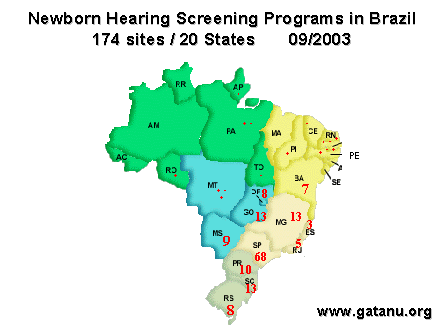
Stimulus rate: Relatively high stimulus rates are employed to minimise test time (typically faster than 30 clicks per second).
Stimulus level: The screening level of the click stimulus is typically in the range 35dBnHL to 50dBnHL with respect to normally hearing young adults Any comparison in the performance of different AABR systems must take into consideration the baseline calibration of the click stimulus (ppeSPL). The value of ppeSPL on which the dBnHL is based may be different for different AABR systems. The recommended value in the air conduction click protocol is 33dBpeSPL (2).
Earphone: Many types are in use including Telephonics TDH39/49, insert earphones e.g. type EAR- 3A, and custom designed ear shells. Before positioning the earphone, the external ear canal should be checked for any easily removable debris or blockage before placement of the earphone. Earphones should be carefully positioned so that the ear canal is not occluded by any excess pressure.


DATA COLLECTION:

The following test parameters for data collection are fixed as part of the automated test protocol. They must not be changed as this may invalidate the machine scoring algorithm. 

  •  Gain or sensitivity of the amplifier.
  •  Level of amplitude artefact rejection.
  •  Filter bandwidth.
  •  Acquisition window.
  •  Number of averaging sweeps.


WAVEFORM ANALYSIS:

The presence or absence of a response in the recorded waveform is determined objectively using a machine based scoring algorithm. Statistical and mathematical techniques are typically employed such as correlation and response to noise amplitude ratio(3), template methods (4), and Fsp based analysis (5). The algorithm must be clinically proven in terms of its performance (eg. sensitivity and specificity) 6,7. The false negative rate of an AABR screening test can be investigated using no-sound trials in a relatively small population of babies. The screening test on each ear is designated a pass or refer depending on whether or not a response is present. Occasionally, a re-test decision may be recommended if the result is marginal or if the test conditions are unreliable. The algorithm should provide a separate result for each ear so that referral of babies for further testing can be initiated using either unilateral or bilateral referral criteria.


PRESENTATION OF RESULTS:

The results of the screening test determined by the algorithm should be clearly presented as a pass, refer or re-test on each ear separately. Ideally a print-out from the equipment should be available that can be included in the case notes of the child. On some equipment the recorded ABR waveforms are displayed and available as a print-out. This enables a review and audit of the results of the screening test by a skilled observer. Under no circumstances should this interpretation be performed by inexperienced personnel as part of the screening test.


REFERENCES:

1/ Davis A, Bamford J M, Wilson I , et al. A critical review of the role of neonatal screening in the detection of congenital hearing impairment. Health Technology Assessment 1997 (1) (10).

2/ Stevens JC et al. (1999) Click auditory brainstem responses testing in babies- a recommended test protocol. British Society of Audiology News bulletin, December Issue

3/ Mason SM (1984) On-line computer scoring of the auditory brainstem response for estimation of hearing threshold. Audiology 23:277-296

4/ Kileny PR (1998) New insights on infant ABR hearing screening. Scandinavian Audiology Supplement 30: 81-88.

5/ Sininger Y (2000). Power-optimised Variance Ratio (POVR). Presented at the Association of Research in Otolaryngology, February 2000.

6/ Mason SM, Davis A, Wood S, Farnsworth A (1998). Field sensitivity of targeted neonatal hearing screening using the Nottingham ABR Screener. Ear & Hearing 19: 91- 102.

7/ Herrmann BS, Thornton AR, Joseph JM. (1995) Automated infant screening using the ABR: development and validation. American Journal of Audiology 4: 6-14 

NHS and Alternative Technologies (to OAEs)

Alternative Technologies _ ASSR


 Introduction to ASSR

by Terry Pincton Ph.D.


 Just as the speech signal can be viewed as either a change in amplitude over time or a spectrum of frequencies, so can the auditory evoked potentials be considered in either the time domain or the frequency domain. Steady-state responses are evoked potentials that maintain a stable frequency-content over time. Steady-state evoked potentials are usually evoked by stimuli that occur at rapid rates. The response then shows a spectrum with energy only at the rate of stimulation and its harmonics.

          Amplitude-modulated and frequency-modulated tones evoke clear steady-state responses. Amplitude-modulated tones have excellent frequency-specificity since they contain energy only at the frequency of the carrier tone and at two sidebands, separated from the carrier by the frequency of modulation. The most widely recorded auditory steady state response is the 40 Hz potential. This can be used to measure audiometric thresholds in waking adults and older children. However, the response is difficult to measure in infants and young children. Furthermore, the 40-Hz response is very susceptible to changes in the level of arousal, showing small amplitudes during sleep and even smaller amplitudes during anesthesia. Recently, it has been shown that the auditory steady-state responses can be recorded at stimulus rates between 75and 110 Hz.

          These responses can be readily recorded in infants and are unaffected by sleep. The responses to several amplitude-modulated stimuli presented simultaneously can be independently assessed if each stimulus is modulated at a different rate. The recorded activity, when viewed in the frequency-domain, shows a response to each carrier-frequency at its signature modulation-frequency. Since amplitude-modulated tones are not significantly distorted by free-field speakers or hearing aids, they can be used to test how well a hearing-aid is working. Responses evoked by frequency-modulated stimuli may become helpful in assessing supra-threshold auditory processes, such as those necessary for speech perception.


Additional Resources 


Clinical Applications

Tinnitus

The generation of tinnitus is a topic of much scientific debate. For example the role of the cochlea in the generation of subjective tinnitus has been theorized to be related with the excitatory drift in the operating point of the Inner Hair Cells (See Eric LePage , chapter 11 in Mechanisms of Tinnitus, by Vernon and Moller editors, Longwood, 1995).

         On the other hand a recent study on brain imaging of the effects of lidocaine on tinnitus by Reyes et al has reached different conclusions on the main generation site of tinnitus. Using a single-blind placebo-controlled design, they mapped lidocaine related changes in neural activity, measured by regional cerebral blood flow (rCBF) with (15)O-H(2)O positron emission tomography. Intravenous lidocaine produced both increases and decreases in the loudness of tinnitus. The change in tinnitus loudness was associated with a statistically significant change in neural activity in the right temporal lobe in auditory association cortex. Decreases in tinnitus loudness resulted in larger changes in rCBF than increases. The unilateral activation pattern associated with tinnitus, in contrast with the bilateral activation produced by a real sound, suggests that tinnitus originates in the central auditory system rather than the cochlea.

        Despite the difficulty of localizing the site of tinnitus generation, a number of studies (Ceranic et al, 1995; 1998) has shown evidence that in Tinnitus patients OAEs are not normal or easily detectable at the tinnitus frequency region, even in subjects with normal hearing thresholds. It is very difficult to collect data from a large number of tinnitus subjects with and without hearing deficits. Conclusions from smaller group of patients should be considered with caution. It is interesting that there is enough anecdotal and not published (or in English MEDLINE journals) information related to the abnormalities of the OAE structure close to the tinnitus region. For example in a Chinese study (Liu B, Liu C, Song B. from the Beijing Institute of Otolaryngology, 1996) examining 306 ears with tinnitus (with and without hearing deficits) the following conclusions were made:

1. In these cases there was no correlation between the frequency of tinnitus and SOAE.

2. In 94.8% of sensorineural hearing loss with tinnitus the DPOAE-gram presented lower amplitude or was absent within the frequency range of elevated pure-tone-threshold.

3. In 59% of cases with normal hearing and tinnitus the amplitude of DPOAE at nearby frequencies of tinnitus was decreased and there was no SOAE detectable. At frequencies other than that of tinnitus, the amplitude of DPOAE was normal and SOAE could be recorded.

        In another study by Rosanowski et al (1997), the measurement of TEOAEs in groups of tinnitus patients (with or without hearing deficits) treated with lidocaine did not give consistent results in either of the two groups. The Tinnitus measurement and audiometric masking could only be carried out in patients older than 10 years and showed non-reproducible results. The paper concluded that Otoacoustic emissions give no further information about the development and therapeutic outcome of the tinnitus.

         The relationship between SOAEs and subjective Tinnitus has not been found as statistically significant (Zurek, 1981; Penner and Burns 1987; Penner 1990, Ceranic et al, 1998a,b) and according to Penner (1990) only 4% of the tinnitus patients exhibit related SOAEs. In a recent study by Ceranic et al (1998b) the presence of tinnitus was related to a high variability (decreased incidence) of the recorded SOAEs.

        The above information suggests that it is still premature to conclude that OAEs provide an objective evidence of tinnitus, considering the number of variables at play and more research is required to elucidate these arguments.


References

Ceranic BJ, Prasher DK, Luxon LM. Tinnitus and Otoacoustic Emissions. Clinical Otolaryngology, 1995, 20,192-200.

Ceranic BJ, Prasher DK, Raglan E, Luxon LM.. Tinnitus after head injury: evidence from otoacoustic emissions. J Neurol Neurosurg Psychiatry 1998a Oct;65(4):523-9.

Ceranic BJ, Prasher DK, Luxon LM.. Presence of tinnitus indicated by variable spontaneous otoacoustic emissions. Audiol Neurootol 1998b Sep-Oct;3(5):332-44.

Penner MJ and Burns EM. The dissociation of SOAEs and Tinnitus.JSHR 1987, 30, 396-403.

Penner MJ . An estimate of the prevalence of tinnitus caused by SOAEs. Archives of Otoralyngology, Head and Neck Surgery, 1990, 116:418-423.

Reyes SA, Salvi RJ, Burkard RF, Coad ML, Wack DS, Galantowicz PJ, Lockwood AH. Brain imaging of the effects of lidocaine on tinnitus. Hear Res 2002 Sep;171(1-2):43-50

Rosanowski F, Hoppe U, Proschel U, Eysholdt U. Chronic tinnitus in children and adolescents. HNO 1997 Nov;45(11):927-32

Zurek P.. Spontaneous narrowband acoustic signals emitted by human ears. JASA 1981, 70: 446-450

Clinical Applications

Introduction

The clinical applications of otoacoustic emissions are mainly focused on the identification of sensorineural losses in the auditory periphery. Despite the fact that the otoacoustic emissions signals are affected by alterations in the sound transmission chain (outer ear to middle ear and middle ear to outer ear) there are no current applications based on the transmission loss concept.

If you need additional information on an application you do not find extensive references or related material, please contact us.


The clinical applications can be divided into the following categories :


  • Detection of central auditory disorders (OAE suppression studies.

             The reader might find interesting the following white papers:

    • Auditory Neuropathy: 20 Questions and answers. By Linda Hood Ph.D. Kresge Hearing Research Laboratory of the South LSUHSC, New Orleans, LA.(1998).This article is mirrored (with slight modifications in terms of esthetics) from the Louisiana State University Health Sciences Center site. It is an excellent source of information on the Auditory Neuropathy and the audiometric tests (OAEs included) used for it's detection.The article is presented in three web pages covering questions 1-7, 8-15, and 16-20 respectively.
    • The Medial Efferent Olivocochlear System in Neonates and Infants : By Thierry Morlet, Ph.D. Kresge Hearing Research Laboratory of the South LSUHSC, New Orleans, LA (2001). This introductory paper highlights some important clinical aspects of contralateral OAE suppression in neonates.
  • Differential diagnosis: (OAEs present but ABR altered), these cases belong to clinical profiles involving acoustic neuroma tumors and other central auditory system disorders. Interestingly, a number of research papers have indicated that OAEs (TEOAES or DPOAEs) can be both affected or unaffected by the presence of acoustic neuromas. An explanation for such data can be derived from information of how the growth of the tumor affects the vascular supply of the cochlea or how the growth of the tumors induces mechanical pressure alterations on the vascular supply and the cochlea itself. OAE-based measures can provide information on the sensory component of any hearing disorder, thus they can provide precise indexes of evaluating sensori-neural hearing impairment cases.
  • Noise Induced Hearing Loss Monitoring in Industrial or Military environments. Recordings of OAEs can be used to assess initial signs of cochlear injury (developing noise induced hearing loss - NIHL). Research has indicated that NIHL induces a threshold elevation in the mid to high frequencies and OAE protocols can be used very efficiently to monitor the threshold elevation progress. With the development of more accurate sensor and transducer technology it is now possible to test even higher frequencies (cubic distortion DPOAEs, up to 12- 16 kHz -referenced to F2 -) in order to define any on-set NIHL effects.

             The reader might find interesting the following resources:

  • Ototoxicity monitoring: Monitoring of the course of a potentially ototoxic drug (this area overlaps with the topics of "biophysics and OAEs") such as cisplatin, oxalyplatin, salicylate (aspirin) loop diuretics and aminoglycoside antibiotics. A number of previous white papers and powerpoint presentations provide additional information to this topic (i.e. Hatzopoulos et al, 2002 ; Vink et al, 2006)

    • Cisplatin and Derivatives: Data from patients undergoing several (or more) cisplatin treatment cycles, have shown significantly reduced OAEs specially in the high frequencies. The clinical data verify reports from various animal models and cisplatin, that is elevated doses of the drug affect first the basal regions of the cochlea and progressively affect more apical regions.In the animal models tested the ototoxic effects of cisplatin are Irreversible. Nevertheless other reports in the literature also report a significant VARIABILITY of the recorded OAEs under the same cisplatin-treatment conditions. The latter complicates the use of OAE-protocols in the monitoring of the ototoxic effects.
    • Carboplatin: It should be noted that carboplatin-based or carboplatin derivatives are also used in a number of antineoplastic treatment protocols, but work on animal models has clearly shown that the induced ototoxicity has an effect mainly on the Inner and not on the Outer hair cells of the organ of Corti. At higher levels of accumulated carboplatin the basal-OHCs are also effected, therefore in these scenarios it is possible to employ successfully OAE protocols for ototoxicity monitoring.
    • Salicylates: Data in the literature report that the administration of acetalsalicytic acid results in a temporary elevation of threshold accompanied in many cases by a sensation of ringing. In terms of OAEs oral administration of acetalsalicytic acid results in reduced TEOAEs and SOAEs. Cubic Distortion otoacoustic Emissions seem to be unaffected by salicylates, even at low stimulus intensities. On the contrary laboratory animals (rats, guinea pigs) are more sensitive to salicylates and they present significantly reduce DPOAEs.
    • Loop Diuretics: Clinically loop diuretics (drugs containing ethacrynic acid or furosemide) are used in clinical cases of kidney failure and elevated doses can produce a temporary threshold shift. Reports in the literature have shown that in animal models treated with furosemide the amplitude of DPOAEs follows very closely the decline of the Action Potential and it recovers faster.
    • Aminoglycoside Antibiotics: The chronic administration of first generation antibiotics (i.e. gentamicin) can cause a permanent threshold shift in the higher frequencies. For example, subjects with cystic fibrosis, treated with gentamicin, have shown significant amplitude reductions in their DPOAE responses. The treatment combination of aminoglycoside antibiotics and loop diuretics is very synergistic for induced ototoxic effects and animal models have indicated that the combination of drugs is more ototoxic than the single drugs.
  • Tinnitus monitoring: This category requires undoubtedly additional research in order to validate a number of assumptions presented in the literature, relating OAEs with the tinnitus phenomenon. Since Tinnitus Retraining Therapy has become a clinical option, the possibility of evaluating objectively the cochlear function of tinnitus patients with OAEs presents considerable advantages. Readers who are interested in this argument might consult the Tinnitus page.
Cochlear Implants and NHS

FAQ on Cochlear Implants


The section on  Frequently Asked Questions about Cochlear Implants is courtesy by our sponsor MEDEL.


OAE Portal

Research & Articles

🧬 24 articles articles
Recent Articles

Recent Articles: 2013, Volume 1


As of January 14, 2013 there were 4206 articles indexed by the PubMed services. The most recent 100 articles are listed below.
By clicking on the Author's name you may link to the PubMed site where you might acquire further information 


Recent Articles Volume 1 


Oliveira AA, Campos Mde S, Murashima Ade A, Rossato M, Hyppolito MA, Oliveira JA.

Braz J Otorhinolaryngol. 2012 Dec;78(6):47-50. Portuguese.


Qu J, Huang H, Wang J, Mi WJ, Qiao L, Qiu JH.

Zhonghua Er Bi Yan Hou Tou Jing Wai Ke Za Zhi. 2012 Nov;47(11):926-30. Chinese.


Xue JF, Chen L, Ma YN, Zhao DH, Duan JB, Wang ZX, Qi Y, Liu YH.

Zhonghua Yi Xue Za Zhi. 2012 Oct 30;92(40):2830-4. Chinese.


Moussavi-Najarkola SA, Khavanin A, Mirzaei R, Salehnia M, Muhammadnejad A, Akbari M.

Iran Red Crescent Med J. 2012 Oct;14(10):647-56. Epub 2012 Oct 30.


Durand-Rivera A, Manzano-Martinez E, Ceballos-Reyes G.

Front Biosci (Elite Ed). 2013 Jan 1;5:684-96.


Saberi A, Hatamian HR, Nemati S, Banan R.

Acta Med Iran. 2012 Oct;50(10):679-83.


Bhatia P, Mintz S, Hecht BF, Deavenport A, Kuo AA.

J Dev Behav Pediatr. 2013 Jan;34(1):15-21.


Brown DJ, Chihara Y, Curthoys IS, Wang Y, Bos M.

Hear Res. 2012 Dec 25. doi:pii: S0378-5955(12)00297-3. 10.1016/j.heares.2012.12.004. [Epub ahead of print]


Dalhoff E, Turcanu D, Vetešník A, Gummer AW.

Hear Res. 2012 Dec 23. doi:pii: S0378-5955(12)00296-1. 10.1016/j.heares.2012.12.003. [Epub ahead of print]


Psaltakos V, Balatsouras DG, Sengas I, Ferekidis E, Riga M, Korres SG.

Eur Arch Otorhinolaryngol. 2012 Dec 25. [Epub ahead of print]


Saunders JE, Jastrzembski BG, Buckey JC, Enriquez D, Mackenzie TA, Karagas MR.

Audiol Neurootol. 2012 Dec 15;18(2):101-113. [Epub ahead of print]


Verhulst S, Dau T, Shera CA.

J Acoust Soc Am. 2012 Dec;132(6):3842-8. doi: 10.1121/1.4763989.


Jin SH, Nelson PB, Schlauch R, Carney E.

Am J Audiol. 2012 Nov 28. [Epub ahead of print]


Engdahl B, Tambs K, Hoffman HJ.

Int J Audiol. 2013 Feb;52(2):74-82. doi: 10.3109/14992027.2012.733423. Epub 2012 Dec 10.


Chen GD, Stolzberg D, Lobarinas E, Sun W, Ding D, Salvi R.

Hear Res. 2013 Jan;295(1-2):100-13. doi: 10.1016/j.heares.2012.11.016. Epub 2012 Nov 27.


Kagoya R, Shinogami M, Kohno M, Yamasoba T.

Otolaryngol Head Neck Surg. 2012 Nov 29. [Epub ahead of print]


Fabijańska A, Smurzyński J, Hatzopoulos S, Kochanek K, Bartnik G, Raj-Koziak D, Mazzoli M, Skarżyński PH, Jędrzejczak WW, Szkiełkowska A, Skarżyński H.

Med Sci Monit. 2012 Dec 1;18(12):CR765-770.


Campo P, Venet T, Thomas A, Cour C, Castel B, Nunge H, Cosnier F.

Neurotoxicol Teratol. 2012 Nov 23;35C:1-6. doi: 10.1016/j.ntt.2012.11.002. [Epub ahead of print]


Fuente A, McPherson B, Hood LJ.

J Am Acad Audiol. 2012 Nov-Dec;23(10):824-30. doi: 10.3766/jaaa.23.10.7.


Kumar UA, Methi R, Avinash MC.

Laryngoscope. 2012 Nov 14. doi: 10.1002/lary.23623. [Epub ahead of print]


Sagit M, Korkmaz F, Akcadag A, Somdas MA.

Eur Arch Otorhinolaryngol. 2012 Nov 17. [Epub ahead of print]


Park JP, Lim HW, Shim BS, Kim TS, Chung JW, Yoon TH, Park HJ.

Otolaryngol Head Neck Surg. 2012 Nov 14. [Epub ahead of print]


Elliott SJ, Shera CA.

Smart Mater Struct. 2012 Jun;21(6):64001.


Bhagat S, Bass J, Qaddoumi I, Brennan R, Wilson M, Wu J, Galindo CR, Paglialonga A, Tognola G.

Audiol Neurootol. 2012 Nov 6;18(2):71-82. [Epub ahead of print]


Keefe DH.

J Acoust Soc Am. 2012 Nov;132(5):3319-50. doi: 10.1121/1.4757734.


Birkholz C, Gruhlke A, Neely ST, Kopun J, Tan H, Jesteadt W, Schmid KK, Gorga MP.

J Acoust Soc Am. 2012 Nov;132(5):3305-18. doi: 10.1121/1.4754526.


Gruhlke A, Birkholz C, Neely ST, Kopun J, Tan H, Jesteadt W, Schmid K, Gorga MP.

J Acoust Soc Am. 2012 Nov;132(5):3292-304. doi: 10.1121/1.4754525.


Wit HP, van Dijk P, Manley GA.

J Acoust Soc Am. 2012 Nov;132(5):3273-9. doi: 10.1121/1.4754535.


Bükülmez A, Dalgıç B, Gündüz B, Sarı S, Bayazıt YA, Kemaloğlu YK.

Int J Pediatr Otorhinolaryngol. 2012 Nov 6. doi:pii: S0165-5876(12)00583-6. 10.1016/j.ijporl.2012.10.012. [Epub ahead of print]


Lukashkin AN, Legan PK, Weddell TD, Lukashkina VA, Goodyear RJ, Welstead LJ, Petit C, Russell IJ, Richardson GP.

Proc Natl Acad Sci U S A. 2012 Nov 20;109(47):19351-6. doi: 10.1073/pnas.1210159109. Epub 2012 Nov 5.


Gilbey P, Kraus C, Ghanayim R, Sharabi-Nov A, Bretler S.

Int J Pediatr Otorhinolaryngol. 2013 Jan;77(1):97-100. doi: 10.1016/j.ijporl.2012.10.004. Epub 2012 Nov 2.


Scheifele PM, Clark JG.

Vet Clin North Am Small Anim Pract. 2012 Nov;42(6):1241-57. doi: 10.1016/j.cvsm.2012.08.012. Review.


Balatsouras DG, Felekis D, Panas M, Xenellis J, Koutsis G, Kladi A, Korres SG.

Acta Neurol Scand. 2012 Nov 5. doi: 10.1111/ane.12020. [Epub ahead of print]


Venet T, Campo P, Rumeau C, Eluecque H, Parietti-Winkler C.

Noise Health. 2012 Sep-Oct;14(60):253-9. doi: 10.4103/1463-1741.102964.


Purdy SC, Sharma M, Munro KJ, Morgan CL.

Clin Neurophysiol. 2012 Oct 29. doi:pii: S1388-2457(12)00648-7. 10.1016/j.clinph.2012.09.011. [Epub ahead of print]


Jedrzejczak WW, Kochanek K, Sliwa L, Pilka E, Piotrowska A, Skarzynski H.

Int J Pediatr Otorhinolaryngol. 2013 Jan;77(1):101-6. doi: 10.1016/j.ijporl.2012.10.005. Epub 2012 Oct 29.


Ley S, Chilian A, Harczos T, Katai A, Klefenz F, Husar P.

Biomed Tech (Berl). 2012 Sep 6;57 Suppl 1. doi:pii: /j/bmte.2012.57.issue-s1-O/bmt-2012-4145/bmt-2012-4145.xml. 10.1515/bmt-2012-4145. No abstract available.


Léger AC, Moore BC, Lorenzi C.

Hear Res. 2012 Dec;294(1-2):95-103. doi: 10.1016/j.heares.2012.10.002. Epub 2012 Oct 24.


Wang H, Song N, Li X, Lv H.

Auris Nasus Larynx. 2012 Oct 23. doi:pii: S0385-8146(12)00215-5. 10.1016/j.anl.2012.10.001. [Epub ahead of print]


Schochat E, Matas CG, Samelli AG, Mamede Carvallo RM.

Acta Neurobiol Exp (Wars). 2012;72(3):296-308.


Stuart A, Butler AK.

J Am Acad Audiol. 2012 Oct;23(9):686-96. doi: 10.3766/jaaa.23.9.3.


Aithal S, Aithal V, Kei J, Driscoll C.

J Am Acad Audiol. 2012 Oct;23(9):673-85. doi: 10.3766/jaaa.23.9.2.


Dziorny AC, Orlando MS, Strain JJ, Davidson PW, Myers GJ.

Neurotoxicology. 2012 Oct 12. doi:pii: S0161-813X(12)00245-8. 10.1016/j.neuro.2012.10.002. [Epub ahead of print]


Aithal S, Kei J, Driscoll C, Khan A.

Int J Pediatr Otorhinolaryngol. 2013 Jan;77(1):29-35. doi: 10.1016/j.ijporl.2012.09.024. Epub 2012 Oct 7.


Borkoski Barreiro SA, Falcón González JC, Bueno Yanes J, Pérez Bermúdez JL, López Cano Z, Ramos Macías A.

Acta Otorrinolaringol Esp. 2012 Oct 6. doi:pii: S0001-6519(12)00180-X. 10.1016/j.otorri.2012.07.004. [Epub ahead of print] English, Spanish.


Gassner D, Durham D, Pfannenstiel SC, Brough DE, Staecker H.

Anat Rec (Hoboken). 2012 Nov;295(11):1830-6. doi: 10.1002/ar.22593. Epub 2012 Oct 8.


van der Westhuizen Y, Swanepoel de W, Heinze B, Hofmeyr LM.

Int J Audiol. 2013 Jan;52(1):37-43. doi: 10.3109/14992027.2012.721935. Epub 2012 Oct 8.


Gockel HE, Farooq R, Muhammed L, Plack CJ, Carlyon RP.

J Acoust Soc Am. 2012 Oct;132(4):2524-35. doi: 10.1121/1.4751541.


Moleti A, Longo F, Sisto R.

J Acoust Soc Am. 2012 Oct;132(4):2455-67. doi: 10.1121/1.4751537.


Fabijańska A, Smurzyński J, Kochanek K, Bartnik G, Raj-Koziak D, Skarżyński H.

Otolaryngol Pol. 2012 Sep;66(5):318-21. doi: 10.1016/j.otpol.2012.06.024. Epub 2012 Jul 2. Polish.


Yang FF, McPherson B, Shu H.

Cleft Palate Craniofac J. 2012 Sep;49(5):566-73. doi: 10.1597/09-140.1.


Yamashita T, Fang J, Gao J, Yu Y, Lagarde MM, Zuo J.

PLoS One. 2012;7(9):e45453. doi: 10.1371/journal.pone.0045453. Epub 2012 Sep 21.


Choi MY, Yeo SW, Park KH.

Biochem Biophys Res Commun. 2012 Oct 26;427(3):629-36. doi: 10.1016/j.bbrc.2012.09.111. Epub 2012 Sep 28.


Moussavi-Najarkola SA, Khavanin A, Mirzaei R, Salehnia M, Muhammadnejad A, Akbari M.

Int J Occup Environ Med. 2012 Jul;3(3):145-52.


Ni C, Zhang D, Beyer LA, Halsey KE, Fukui H, Raphael Y, Dolan DF, Hornyak TJ.

Pigment Cell Melanoma Res. 2013 Jan;26(1):78-87. doi: 10.1111/pcmr.12030. Epub 2012 Nov 16.


Turchetta R, Mazzei F, Celani T, Cammeresi MG, Orlando MP, Altissimi G, de Vincentiis C, D'Ambrosio F, Messineo D, Ferraris A, Cianfrone G.

Int J Audiol. 2012 Dec;51(12):870-9. doi: 10.3109/14992027.2012.712721. Epub 2012 Sep 27.


Taiji H, Morimoto N.

Nihon Jibiinkoka Gakkai Kaiho. 2012 Jul;115(7):676-81. Japanese.


Cakil B, Basar FS, Atmaca S, Cengel SK, Tekat A, Tanyeri Y.

J Laryngol Otol. 2012 Nov;126(11):1097-101. doi: 10.1017/S0022215112002046. Epub 2012 Sep 14.


Deppe C, Kummer P, Gürkov R, Olzowy B.

Ear Hear. 2013 Jan;34(1):122-31. doi: 10.1097/AUD.0b013e31826709c3.


Bakır S, Ozbay M, Gün R, Yorgancılar E, Kınış V, Keleş A, Abakay A, Gökalp O, Topçu I.

Am J Otolaryngol. 2013 Jan;34(1):16-21. doi: 10.1016/j.amjoto.2012.07.003. Epub 2012 Sep 7.


Martínez-Cruz CF, García Alonso-Themann P, Poblano A, Ochoa-López JM.

Arch Med Res. 2012 Aug;43(6):457-63. doi: 10.1016/j.arcmed.2012.08.007. Epub 2012 Sep 6.


Cederholm JM, Froud KE, Wong AC, Ko M, Ryan AF, Housley GD.

Hear Res. 2012 Oct;292(1-2):71-9. doi: 10.1016/j.heares.2012.08.010. Epub 2012 Aug 28.


Seddon JA, Thee S, Jacobs K, Ebrahim A, Hesseling AC, Schaaf HS.

J Infect. 2012 Sep 6. doi:pii: S0163-4453(12)00253-8. 10.1016/j.jinf.2012.09.002. [Epub ahead of print]


Chen G, Yi X, Chen P, Dong J, Yang G, Fu S.

Int J Pediatr Otorhinolaryngol. 2012 Dec;76(12):1771-4. doi: 10.1016/j.ijporl.2012.08.021. Epub 2012 Sep 4.


Verschooten E, Robles L, Kovačić D, Joris PX.

J Assoc Res Otolaryngol. 2012 Dec;13(6):799-817. doi: 10.1007/s10162-012-0346-z. Epub 2012 Sep 5.


Bielecki I, Horbulewicz A, Wolan T.

Int J Pediatr Otorhinolaryngol. 2012 Nov;76(11):1668-70. doi: 10.1016/j.ijporl.2012.08.001. Epub 2012 Aug 29.


Silva VG, Sampaio AL, Oliveira CA, Tauil PL, Jansen GM.

Braz J Otorhinolaryngol. 2012 Jul-Aug;78(4):91-7. English, Portuguese.

Boothalingam S, Lineton B.

Int J Audiol. 2012 Dec;51(12):892-9. doi: 10.3109/14992027.2012.709641. Epub 2012 Aug 30.

Büchler M, Kompis M, Hotz MA.

Otol Neurotol. 2012 Oct;33(8):1315-22. doi: 10.1097/MAO.0b013e318263d598.

Gurbuzler L, Yelken K, Aladag I, Eyibilen A, Koc S.

Ear Nose Throat J. 2012 Aug;91(8):322-34.

Möckel D, Kössl M, Lang J, Nowotny M.

J Exp Biol. 2012 Sep 15;215(Pt 18):3309-16. doi: 10.1242/jeb.074377.

Celebi S, Gurdal MM, Ozkul MH, Yasar H, Balikci HH.

Eur Arch Otorhinolaryngol. 2012 Aug 21. [Epub ahead of print]

McFadden D, Pasanen EG, Leshikar EM, Hsieh MD, Maloney MM.

J Acoust Soc Am. 2012 Aug;132(2):968-83. doi: 10.1121/1.4731224.

Shera CA, Bergevin C.

J Acoust Soc Am. 2012 Aug;132(2):927-43. doi: 10.1121/1.4730916.

Wit HP, van Dijk P.

J Acoust Soc Am. 2012 Aug;132(2):918-26. doi: 10.1121/1.4730886.

Jupiter T.

J Am Med Dir Assoc. 2012 Oct;13(8):744-7. doi: 10.1016/j.jamda.2012.07.010. Epub 2012 Aug 11.

Le Prell CG, Dell S, Hensley B, Hall JW 3rd, Campbell KC, Antonelli PJ, Green GE, Miller JM, Guire K.

Ear Hear. 2012 Nov-Dec;33(6):e44-58. doi: 10.1097/AUD.0b013e31825f9d89.

Acar M, Aycan Z, Acar B, Ertan U, Peltek HN, Karasen RM.

J Pediatr Endocrinol Metab. 2012;25(5-6):503-8.

Srinivasan S, Keil A, Stratis K, Woodruff Carr KL, Smith DW.

Neuroscience. 2012 Oct 25;223:325-32. doi: 10.1016/j.neuroscience.2012.07.062. Epub 2012 Aug 4.

Hall A, Pembrey M, Lutman M, Steer C, Bitner-Glindzicz M.

BMJ Open. 2012 Jul 31;2(4). doi:pii: e001238. 10.1136/bmjopen-2012-001238. Print 2012.

Elbarbary NS, El-Kabarity RH, Desouky ED.

Int J Pediatr Otorhinolaryngol. 2012 Nov;76(11):1558-64. doi: 10.1016/j.ijporl.2012.07.010. Epub 2012 Jul 25.

Angrisani RM, De Azevedo MF, Carvallo RM, Diniz EM, Matas CG.

J Soc Bras Fonoaudiol. 2012;24(2):162-7. English, Portuguese.

Zhang Y, Yu H, Xu M, Han F, Tian C, Kim S, Fredman E, Zhang J, Benedict-Alderfer C, Zheng QY.

Am J Pathol. 2012 Sep;181(3):761-74. doi: 10.1016/j.ajpath.2012.05.031. Epub 2012 Jul 20.

El Ganzoury MM, Kamel TB, Khalil LH, Seliem AM.

ISRN Pediatr. 2012;2012:375038. doi: 10.5402/2012/375038. Epub 2012 Jul 1.

Moreno-Aguirre AJ, Santiago-Rodríguez E, Harmony T, Fernández-Bouzas A.

PLoS One. 2012;7(7):e41002. doi: 10.1371/journal.pone.0041002. Epub 2012 Jul 13.

Mittal R, Ramesh AV, Panwar SS, Nilkanthan A, Nair S, Mehra PR.

Int J Pediatr Otorhinolaryngol. 2012 Sep;76(9):1351-4. doi: 10.1016/j.ijporl.2012.06.005. Epub 2012 Jul 12.

Berkiten G, Salturk Z, Topaloğlu I, Uğraş H.

Am J Otolaryngol. 2012 Nov-Dec;33(6):689-92. doi: 10.1016/j.amjoto.2012.05.007. Epub 2012 Jul 9.

Zebian M, Hensel J, Fedtke T.

J Acoust Soc Am. 2012 Jul;132(1):EL8-14. doi: 10.1121/1.4723565.

Derebery MJ, Vermiglio A, Berliner KI, Potthoff M, Holguin K.

Otol Neurotol. 2012 Sep;33(7):1136-41. doi: 10.1097/MAO.0b013e31825f2328.

Abdul Wahid SN, Md Daud MK, Sidek D, Abd Rahman N, Mansor S, Zakaria MN.

Int J Pediatr Otorhinolaryngol. 2012 Sep;76(9):1366-9. doi: 10.1016/j.ijporl.2012.06.008. Epub 2012 Jul 6.

Soi D, Brambilla D, Comiotto E, Di Berardino F, Filipponi E, Socci M, Spreafico E, Forti S, Cesarani A.

Acta Otorhinolaryngol Ital. 2012 Jun;32(3):170-4.

Sinan Başoğlu M, Eren E, Aslan H, Bingölballı AG, Oztürkcan S, Katılmış H.

Int J Pediatr Otorhinolaryngol. 2012 Sep;76(9):1343-6. doi: 10.1016/j.ijporl.2012.06.003. Epub 2012 Jul 3.

Isaacson G.

Otolaryngol Head Neck Surg. 2012 Jul;147(1):179; author reply 179-80. doi: 10.1177/0194599812447051. No abstract available.

Abujamra AL, Escosteguy JR, Dall'igna C, Manica D, Cigana LF, Coradini P, Brunetto A, Gregianin LJ.

Pediatr Blood Cancer. 2012 Jun 28. doi: 10.1002/pbc.24236. [Epub ahead of print]

Patterson BM, Renaud M.

J Am Acad Nurse Pract. 2012 Jul;24(7):400-4. doi: 10.1111/j.1745-7599.2012.00718.x. Epub 2012 May 2.

Zuccotti A, Kuhn S, Johnson SL, Franz C, Singer W, Hecker D, Geisler HS, Köpschall I, Rohbock K, Gutsche K, Dlugaiczyk J, Schick B, Marcotti W, Rüttiger L, Schimmang T, Knipper M.

J Neurosci. 2012 Jun 20;32(25):8545-53. doi: 10.1523/JNEUROSCI.1247-12.2012.

Moussavi-Najarkola SA, Khavanin A, Mirzaei R, Salehnia M, Akbari M.

J Occup Med Toxicol. 2012 Jun 21;7(1):12. doi: 10.1186/1745-6673-7-12.

Pereira VR, Feitosa MÂ, Pereira LH, Azevedo MF.

Braz J Otorhinolaryngol. 2012 Jun;78(3):27-31. English, Portuguese.

Li Y, Grosh K.

J Acoust Soc Am. 2012 Jun;131(6):4710-21. doi: 10.1121/1.4707505.

Young JA, Elliott SJ, Lineton B.

J Acoust Soc Am. 2012 Jun;131(6):4699-709. doi: 10.1121/1.4707447.

Italian Authoring Activities

Italian Authoring Activities: Milano Polytechnic


Dept. of Biomedical Eng., Polytechnic of Milan:
Papers with the checkbox checked correspond to an impact factor journal 


  Parazzini M, Galloni P, Brazzale AR, Tognola G, Marino C, Ravazzani P.
  Quantitative indices for the assessment of the repeatability of distortion product otoacoustic emissions in laboratory animals.
IEEE Trans Biomed Eng. 2006 Aug;53(8):1550-6. 
  Galloni P, Parazzini M, Piscitelli M, Pinto R, Lovisolo GA, Tognola G, Marino C, Ravazzani P.
  Electromagnetic fields from mobile phones do not affect the inner auditory system of Sprague-Dawley rats.
Radiat Res. 2005 Dec;164(6):798-804. 
  Moleti A, Sisto R, Tognola G, Parazzini M, Ravazzani P, Grandori F.
  Otoacoustic emission latency, cochlear tuning, and hearing functionality in neonates.
J Acoust Soc Am. 2005 Sep;118(3 Pt 1):1576-84. 
  Pastorino G, Sergi P, Mastrangelo M, Ravazzani P, Tognola G, Parazzini M, Mosca F, Pugni L, Grandori F.
  The Milan Project: a newborn hearing screening programme.
Acta Paediatr. 2005 Apr;94(4):458-63. 
  Parazzini M, Bell S, Thuroczy G, Molnar F, Tognola G, Lutman ME, Ravazzani P.
  Influence on the mechanisms of generation of distortion product otoacoustic emissions of mobile phone exposure.
Hear Res. 2005 Jul 26; 
  Parazzini M, Hall AJ, Lutman ME, Kapadia S.
  Effect of aspirin on phase gradient of 2F1-F2 distortion product otoacoustic emissions.
Hear Res. 2005 Jul;205(1-2):44-52. 
  Galloni P, Lovisolo GA, Mancini S, Parazzini M, Pinto R, Piscitelli M, Ravazzani P, Marino C.
  Effects of 900 MHz electromagnetic fields exposure on cochlear cells' functionality in rats: Evaluation of distortion product otoacoustic emissions.
Bioelectromagnetics. 2005 Jul 21;
  Tognola G, Parazzini M, de Jager P, Brienesse P, Ravazzani P, Grandori F.
  Cochlear maturation and otoacoustic emissions in preterm infants: a time-frequency approach.
Hear Res. 2005 Jan;199(1-2):71-80. 
  Grandori F, Sergi P, Pastorino G, Uloziene I, Calo G, Ravazani P, Tognola G, Parazzini M.
Comparison of two methods of TEOAE recording in newborn hearing screening.
Int J Audiol. 2002 Jul;41(5):267-70.

  Parazzini M, Ravazzani P, Medaglini S, Weber G, Fornara C, Tognola G, Vigone MC, Bianchi C, Comi G, Chiumello G, Grandori F.
Click-evoked otoacoustic emissions recorded from untreated congenital hypothyroid newborns.
Hear Res. 2002 Apr;166(1-2):136-42.

  Tognola G, Ravazzani P, Molini E, Ricci G, Alunni N, Parazzini M, Grandori F.  
"Linear" and "derived" otoacoustic emissions in newborns: a comparative study.
Ear Hear. 2001 Jun;22(3):182-90.
  Sergi P, Pastorino G, Ravazzani P, Tognola G, Grandori F.  
A hospital based universal neonatal hearing screening programme using click-evoked otoacoustic emissions.
Scand Audiol Suppl. 2001;(52):18-20.
  Tognola G, Grandori F, Ravazzani P.  
Time-frequency analysis of neonatal click-evoked otoacoustic emissions.
Scand Audiol Suppl. 2001;(52):135-7.
  Ravazzani P, Tognola G, Sergi P, Pastorino GC, Grandori F.  
Analysis of spontaneous and click-evoked otoacoustic emissions in newborns.
Scand Audiol Suppl. 2001;(52):133-4.
  Tognola G, Grandori F, Ravazzani P.  
Data processing options and response scoring for OAE-based newborn hearing screening.
J Acoust Soc Am. 2001 Jan;109(1):283-90.
  
Morand N, Khalfa S, Ravazzani P, Tognola G, Grandori F, Durrant JD, Collet L, Veuillet E
Frequency and temporal analysis of contralateral acoustic stimulation on evoked otoacoustic emissions in humans. 
Hear Res. 2000 Jul;145(1-2):52-8. 
  
Tognola G, et al.
 

Frequency-specific information from click evoked otoacoustic emissions in noise-induced hearing loss. 
Audiology. 1999 Sep-Oct;38(5):243-50. 
  
Tognola G, et al.
 

Evaluation of click evoked otoacoustic emissions in newborns: effects of time-windowing. 
Audiology. 1999 May-Jun;38(3):127-34. 
  
Ravazzani P, et al.
 

Optimal band pass filtering of transient evoked otoacoustic emissions in neonates. 
Audiology. 1999 Mar-Apr;38(2):69-74. 
  
Tognola G, et al.
 

Time-frequency distribution methods for the analysis of click-evoked otoacoustic emissions. 
Technol Health Care. 1998 Sep;6(2-3):159-75. 
  
Ravazzani P, et al.
 

Two-dimensional filter to facilitate detection of transient-evoked otoacoustic emissions. 
IEEE Trans Biomed Eng. 1998 Sep;45(9):1089-96. 
  
Blinowska KJ, et al.
 

High resolution time-frequency analysis of otoacoustic emissions. 
Technol Health Care. 1997 Dec;5(6):407-18. 
  
Tognola G, et al.
 

Wavelet analysis of click-evoked otoacoustic emissions. 
IEEE Trans Biomed Eng. 1998 Jun;45(6):686-97. 
  
Ravazzani P, et al.
 

Optimal one- and two-dimensional filtering of transient-evoked otoacoustic emissions. 
Br J Audiol. 1997 Dec;31(6):479-91. 
  
Tognola G, et al.
 

Time-frequency distributions of click-evoked otoacoustic emissions. 
Hear Res. 1997 Apr;106(1-2):112-22. 
  
Ravazzani P, et al.
 

'Derived nonlinear' versus 'linear' click-evoked otoacoustic emissions. 
Audiology. 1996 Mar-Apr;35(2):73-86. 
  
Tognola G, et al.
 

An optimal filtering technique to reduce the influence of low-frequency noise on click-evoked otoacoustic emissions. 
Br J Audiol. 1995 Jun;29(3):153-60. 
  
Ravazzani P, et al.
 

Evoked otoacoustic emissions: nonlinearities and response interpretation. 
IEEE Trans Biomed Eng. 1993 May;40(5):500-4. 
  
Grandori F, et al.
 

Non-linearities of click-evoked otoacoustic emissions and the derived non-linear technique. 
Br J Audiol. 1993 Apr;27(2):97-102. 


Italian Authoring Activities

Italian Authoring Activities: Ferrara


Department of Audiology, University of Ferrara:
Papers with the checkbox checked correspond to an impact factor journal 


Jedrzejczak WW, Hatzopoulos S, Martini A, Blinowska KJ.
  Otoacoustic emissions latency difference between full-term and preterm neonates.
Hear Res. 2007 Sep;231(1-2):54-62. Epub 2007 May 26. 
 
Ciorba A, Hatzopoulos S, Camurri L, Negossi L, Rossi M, Cosso D, Petruccelli J, Martini A.
  Neonatal newborn hearing screening: four years' experience at Ferrara University Hospital (CHEAP project): part 1.
Acta Otorhinolaryngol Ital. 2007 Feb;27(1):10-6. 
  Hatzopoulos S, Qirjazi B, Martini A.
  Neonatal hearing screening in Albania: results from an ongoing universal screening program.
Int J Audiol. 2007 Apr;46(4):176-82. 
  P. Giordano, G. Lorito, A. Ciorba, A. Martini, S. Hatzopoulos
  Protection against cisplatin ototoxicity in a Sprague-Dawley rat animal model 
Acta Otorhinolaryngol Ital. 2006 Jun;26(3):133-9.     Download PDF File (86 k) 
  Lorito G, Giordano P, Prosser S, Martini A, Hatzopoulos S.
  Noise-induced hearing loss: a study on the pharmacological protection in the Sprague Dawley rat with N-acetyl-cysteine.
Acta Otorhinolaryngol Ital. 2006 Jun;26(3):133-9.     Download PDF File (220 k) 
   Hatzopoulos S, Petrucelli J, Morlet T, Martini A.
  TEOAE recording protocols revised: data from adult subjects.
Int J Audiol. 2003 Sep;42(6):339-47.    Download PDF File (220 k) 
   Hatzopoulos S, Petruccelli J, Laurell G, Previati M, Martini A.
  Electrophysiological findings in the Sprague-Dawley rat induced by moderate-dose carboplatin.
Hear Res. 2003 Aug;182(1-2):48-55.     Download PDF File (333 k)

   Zimatore G, Giuliani A, Hatzopoulos S, Martini A, Colosimo A.
  Otoacoustic emissions at different click intensities: invariant and subject dependent features.
J Appl Physiol. 2003 Aug 22     Download PDF File (370 k)

   Hatzopoulos S, Amoroso C, Aimoni C, Lo Monaco A, Govoni M, Martini A.
Hearing loss evaluation of Sjogren's syndrome using distortion product otoacoustic emissions.
Acta Otolaryngol Suppl. 2002;(548):20-5.     Download PDF File (319 k)

  Hatzopoulos S, Petruccelli J, Laurell G, Avan P, Finesso M, Martini A.
Ototoxic effects of cisplatin in a Sprague-Dawley rat animal model as revealed by ABR and transiently evoked otoacoustic emission measurements.
Hear Res. 2002 Aug;170(1-2):70.    Download PDF File (490 k)

  Hatzopoulos S, Petruccelli J, Laurell G, Finesso M, Martini A.
Evaluation of anesthesia effects in a rat animal model using otoacoustic emission protocols.
Hear Res. 2002 Aug;170(1-2):12.    Download PDF File (593 k)

  Zimatore G, Hatzopoulos S, Giuliani A, Martini A, Colosimo A.
Comparison of transient otoacoustic emission responses from neonatal and adult ears.
J Appl Physiol. 2002 Jun;92(6):2521-8.

  Hatzopoulos S, Di Stefano MD, Campbell KC, Falgione DF, Ricci D, Rosignoli M, Finesso M, Albertin A, Previati M, Capitani S, Martini A.
Cisplatin ototoxicity in the Sprague Dawley rat evaluated by distortion product otoacoustic emissions.
Audiology. 2001 Sep-Oct;40(5):253-64.

  Hatzopoulos S, Pelosi G, Petruccelli J, Rossi M, Vigi V, Chierici R, Martini A.  
Efficient otoacoustic emission protocols employed in a hospital-based neonatal screening program.
Acta Otolaryngol. 2001 Jan;121(2):269-73.

  Ratynska J, Grzanka A, Mueller-Malesinska M, Skarzynski H, Hatzopoulos S.  
Correlations between risk factors for hearing impairment and TEOAE screening test outcome in neonates at risk for hearing loss.
Scand Audiol Suppl. 2001;(52):15-7.
  Pelosi G, Hatzopoulos S, Chierici R, Vigi V, Martini A.  
[Distortion product otoacoustic emission (DPOAEs) and newborn hearing screening: a feasibility and performance study].
Acta Otorhinolaryngol Ital. 2000 Aug;20(4):237-44. Italian.
  Hatzopoulos S, Tsakanikos M, Grzanka A, Ratynska J, Martini A.  
Comparison of neonatal transient evoked otoacoustic emission responses recorded with linear and QuickScreen protocols.
Audiology. 2000 Mar-Apr;39(2):70-9.
  Hatzopoulos S, Cheng J, Grzanka A, Martini A.  
Time-frequency analyses of TEOAE recordings from normals and SNHL patients.
Audiology. 2000 Jan-Feb;39(1):1-12.
  Hatzopoulos S, Cheng J, Grzanka A, Morlet T, Martini A.  
Optimization of TEOAE recording protocols: a linear protocol derived from parameters of a time-frequency analysis: a pilot study on neonatal subjects.
Scand Audiol. 2000;29(1):21-7.
  Hatzopoulos S, Martini A, Stephens SD.  
TEOAE-based estimation of the auditory threshold in the mid-octave frequencies.
Br J Audiol. 1999 Dec;33(6):415-22.

  Hatzopoulos S, Di Stefano M, Albertin A, Martini A.  
Evaluation of cisplatin ototoxicity in a rat animal model.
Ann N Y Acad Sci. 1999 Nov 28;884:211-25.
  Hatzopoulos S, Petruccelli J, Pelosi G, Martini A.  
A TEOAE screening protocol based on linear click stimuli: performance and scoring criteria.
Acta Otolaryngol. 1999 Mar;119(2):135-9.
  Pelosi G, Hatzopoulos S, Chierici R, Vigi V, Martini A.  
[Evaluation of a linear TEOAE protocol in hearing screening of neonates: feasibility study].
Acta Otorhinolaryngol Ital. 1998 Aug;18(4):213-7. Italian.

  Hatzopoulos S, Prosser S, Mazzoli M, Rosignoli M, Martini A.  
Clinical applicability of transient evoked otoacoustic emissions: identification and classification of hearing loss.
Audiol Neurootol. 1998 Nov-Dec;3(6):402-18.
  Hatzopoulos S, Mazzoli M, Martini A.  
Identification of hearing loss using TEOAE descriptors: theoretical foundations and preliminary results.
Audiology. 1995 Sep-Oct;34(5):248-59.

Italian Authoring Activities

Italian Authoring Activities: An Introduction


 Have you ever wondered what is the Italian Authoring Contribution to the field of Otoacoustic Emissions? We have... and we have conducted a MEDLINE search using as keys the terms "otoacoustic emissions", "TEOAE" and "DPOAE". The MEDLINE results indicate international publications (English, German, French) and articles which appeared in ACTA ITALICA. The articles have been identified by the name of the first author and we have excluded from the list articles for which no abstracts were available i.e. commentaries, discussions, letters.NOTE: In case that you discover an error in the activity of your group please [email protected]?subject=Error%20in%20the%20Italian%20Authoring%20Lists us:


Total Number of Articles = 2926

(date of reference : Up to 7 December 2007)

Articles from Italian Authors
122 (4.16%)
Journal # of papers
ACTA Italica / other Italian 19
ACTA OTORHINOLARYNGOLICA 13
ACTA Pediatrica 1
Am J Physiol 1
Am J Otol 1
Ann NY Acad Sciences 1
Arch Otolaryngol Head Neck Surg 1
Audiology 10
Audiology and Neurootology 1
British Journal Audiology 8
Diabetes care 1
Ear and Hearing 1
European Archives of Otorhinol 3
French articles 6
German articles 2
Hearing Research 12
IEEE T. Bio-med Eng 4
International Journal of Audiology 3
J Acoustical Soc. America 10
J Applied Physiology 3
J Pediatric ORL 1
Laryngoscope 1
Metabolism 1
Scandinavian Audiology 8
Technology and Health Care 2
Various Journals of Biomedical Enginnering & Technology 3
Various Journals of Opthalmology 3


      We have tried also to estimate the contribution of each Italian working group. By clicking the name of each group you may see a list of publications which are MEDLINE enabled , that is by clicking on the name of the author you may see the abstract of the paper. Since the impact factor of the English-speaking journals is very different than those of the other languanges we have separated the contributions also by languange. Some errors might be present in this list so [email protected]?subject=Errors%20in%20the%20group%20list%20of%20Italian%20Authoring%20Activities. The active OAE groups are presented in alphabetical order, in terms of the city where the group resides.

Editor's Note:For papers where more than one Italian group was involved, credit has been given to all participant groups.


Name of the Group Total # English French 
German
Italian
Bari/Parma, Clinic of ENT 9 6 0 3
Ferrara, Department of Audiology 25 22 0 2
Milano, Ing. Biomed 29 27 0 0
Milano, ENT dept 3 3 0 0
Napoli, Dept. of Gerontology 1 1 0 0
Padova, Clinic of ENT 1 0 0 1
Perugia, Clinic of ENT 18 4 8 6
Roma, ENT Institute, Catholic Univ. 4 4 0 0
Roma, Italian AirForce Dept. 4 4 0 0
Roma, Biochemical Sciences and CISB, Univ. La Sapienza 3 3 0 0
Roma, Clinic of ENT, Univ. La Sapienza 4 2 0 0
Roma, 2nd Clinic of ENT, Univ. La Sapienza 12 7 0 3
Roma, ISPESL 9 9 0 0
Torino, Clinic of ENT 1 0 0 1


Impact Factors

Impact Factors


Editor's NoteISI, the American organization responsible for the generation of impact factor listings, has asked us to respect the copyright of their work. For this purpose the Impact Factor pages show the ENT journals in alphabetical order and how they rank in the ENT category. 


Editor's Note2: From 2002 the journals AudiologyBritish Journal of Audiology and Scandinavian Audiology will merge into a new journal called International Journal of Audiology. The journal Auditory Neuroscience is discontinued.


Editor's Note3: Despite warnings from ISI regarding the citation index data, numerous sites report them ... so this is the link for the 2012 rankings . The number of journals has increased to 40.


Journal IF 1996 IF 1997
26 journals
IF 1998 
27 journals
IF 1999
30 journals
IF 2000
29 journals
IF 2001
29 journals
IF 2002
32 journals
IF 2004
29 journals
IF 2006
30 journals

ACTA OTO-LARYNGOL


(12) (15) (19) (17) (16) (16) (15) (13)
(21)

AM J OTOL


(7) (9) (13) (10) (8) (7) (6) -----
-----

AM J OTOLARYNG


(19) (20) (21) (21) (27) (27) (28) (24)
(22)

AM J RHINOL


(18) (18) (18) (15) (12) (12) (10) (10)
(10)

ANN NY ACAD SCI


*** (19/55) *** (17/56) *** (13/62) *** (11/64) *** (9/49) *** (7/45) ***(6/46) ***(6/46)
**6/48

ANN OTO RHINOL LARYN


(4) (3) (8) (11) (9) (9) (11) (11)
(12)

ARCH OTOLARYNGOL


(3) (5) (6) (6) (5) (8) (8) (7)
(04)

AUDIOLOGY


(9) (11) (10) (13) (15) (15) (22) ------
-----

AUDIOL. NEURO-OTOL


- - - (1) (1) (1) (1) (4)
(05)

AUDIT NEUROSCI


--------- --------- (1) (2) -------- -------- -------- -------
------

B-ENT


-------- --------- ----- ----- -------- -------- -------- -------
(30)

BRIT J AUDIOL


(8) (14) (26) (18) (11) (11) (23) -----
-----

CLIN OTOLARYNGOL


(11) (16) (16) (14) (14) (18) (14) (14)
(11)

DYSPHAGIA


------- (8) (3) (3) (4) (3) (13) (12)
(15)

EAR HEARING


(1) (2) (7) (8) (6) (6) (7) (2)
(03)

EUR ARCH OTO-RHINO-L


(20) (17) (17) (25) (19) (22) (17) (20)
(19)

HEAD NECK-J SCI SPEC


(5) (4) (4) (5) (2) (2) (4) (3)
(02)

HEARING RES


** (2) (1) (2) (4) (3) (4) (2) (5)
(07)

HNO


(22) (13) (12) (24) (18) (20) (24) (25)
(26)

IEEE T BIO-MED ENG


* (16) * (13/41) * (12/45) -- -- -- -- ---
*11/47

INT  J  AUDIOL


---- ---- ----- ----- ----- ----- ----- (17)
(17)

INT J PEDIATR OTORHI


(13) (24) (27) (19) (25) (24) (21) (21)
(18)

JARO


-- -- -- -- -- -- (3) (1)
(01)

J ACOUST SOC AM


** (5) ** (5/24) ** (3/24) ** (3/26) -- **(6/27) **(6/27) **(7/27)
**6/27

J LARYNGOL OTOL


(21) (22) (22) (28) (24) (26) (27) (23)
(25)

J OTOLARYNGOL


(10) (25) (24) (24) (26) (28) (30) (28)
(29)

J VESTIBUL RES-EQUIL


------ ------ (9) (9) (10) (13) (18) (16)
(14)

J VOICE


(17) (12) (15) (16) (22) (21) (26) (18)
(20)

LARYNGO RHINO OTOL


(23) (23) (25) (22) (21) (27) (25) (26)
(28)

LARYNGOSCOPE


(2) (6) (5) (5) (7) (5) (5) (6)
(06)

ORL J OTO-RHINO-LARY


(15) (21) (20) (26) (20) (17) (12) (22)
(23)

OTOLARYNG CLIN N AM


(14) (7) (11) (20) (23) (23) (16) (19)
(16)

OTOLARYNG HEAD NECK


(06) (10) (14) (12) (13) (14) (09) (08)
(09)

OTO RHINO LARYN NOVA


------- ------- (29) (30) (29) ------ ------ ------
----

SCAND AUDIOL


(16) (19) (28) (27) (17) (19) (29) -----
----

SKULL BASE SURG


-------- (26) (23) (29) (28) (29) (31) (29)
(27)


* = ranking in the Engineering category 

** = ranking in the Acoustics category 

*** = ranking in the Multidisciplinary Sciences category


Recent Articles

Viral Diseases and OAEs


  Richardson MP, Williamson TJ, Reid A, Tarlow MJ, Rudd PT.  
Otoacoustic emissions as a screening test for hearing impairment in children recovering from acute bacterial meningitis.
Pediatrics. 1998 Dec;102(6):1364-8.

  Richardson M, Williamson T, Reid A, Tarlow M, Rudd P.  
Testing for hearing loss after meningitis.
J Pediatr. 1998 Apr;132(4):749-50. No abstract available.

  Richardson MP, Reid A, Williamson TJ, Tarlow MJ, Rudd PT.  
Acute otitis media and otitis media with effusion in children with bacterial meningitis.
J Laryngol Otol. 1997 Oct;111(10):913-6.

Daya H, Amedofu G, Woodrow CJ, Agranoff D, Brobby G, Agbenyega T, Krishna S.  
Assessment of cochlear damage after pneumococcal meningitis using otoacoustic emissions.
Trans R Soc Trop Med Hyg. 1997 May-Jun;91(3):248-9.

  Francois M, Laccourreye L, Huy ET, Narcy P.  
Hearing impairment in infants after meningitis: detection by transient evoked otoacoustic emissions.
J Pediatr. 1997 May;130(5):712-7.

  Cox LC.  
Otoacoustic emissions as a screening tool for sensorineural hearing loss.
J Pediatr. 1997 May;130(5):685-6. No abstract available.

  Richardson MP, Reid A, Tarlow MJ, Rudd PT.  
Hearing loss during bacterial meningitis.
Arch Dis Child. 1997 Feb;76(2):134-8.

  Lafreniere D, Smurzynski J, Jung M, Leonard G, Kim DO.  
Otoacoustic emissions in full-term newborns at risk for hearing loss.
Laryngoscope. 1993 Dec;103(12):1334-41.

  Fortnum H, Farnsworth A, Davis A.  
The feasibility of evoked otoacoustic emissions as an in-patient hearing check after meningitis.
Br J Audiol. 1993 Aug;27(4):227-31.

  Uziel A, Piron JP.  
Evoked otoacoustic emissions from normal newborns and babies admitted to an intensive care baby unit.
Acta Otolaryngol Suppl. 1991;482:85-91; discussion 92-3.

Recent Articles

NHS and OAEs


  Torrico Roman P, Trinidad Ramos G, de Caceres Morillo M, Lozano Sanchez S, Lopez-Rios Velasco J.  
NEONATAL HEARING LOSS SCREENING USING OTOACOUSTIC EMISSION WITH ECHOCHECK
An Esp Pediatr. 2001 Mar;54(3):283-289.

  Pelosi G, Hatzopoulos S, Chierici R, Vigi V, Martini A.  
[Distortion product otoacoustic emission (DPOAEs) and newborn hearing screening: a feasibility and performance study].
Acta Otorhinolaryngol Ital. 2000 Aug;20(4):237-44. Italian.

  Tognola G, Grandori F, Ravazzani P.  
Data processing options and response scoring for OAE-based newborn hearing screening.
J Acoust Soc Am. 2001 Jan;109(1):283-90.

  Hergils L, Hergils A.  
Universal neonatal hearing screening--parental attitudes and concern.
Br J Audiol. 2000 Dec;34(6):321-7.

  Barker SE, Lesperance MM, Kileny PR.  
Outcome of newborn hearing screening by ABR compared with four different DPOAE pass criteria.
Am J Audiol. 2000 Dec;9(2):142-8.

  Xia Z, Li B.  
[DPOAE in high-risk neonatal screening for hearing].
Lin Chuang Er Bi Yan Hou Ke Za Zhi. 1998 Jul;12(7):306-8. Chinese.

  Hosch H, Ottaviani F.  
[Otoacoustic emissions in diabetic patients with normal hearing].
Schweiz Med Wochenschr. 2000;Suppl 125:83S-85S. German.

  Zehnder A, Probst R, Vischer M, Linder T.  
[First results of a national hearing screening program in Switzerlans].
Schweiz Med Wochenschr. 2000;Suppl 125:71S-74S. German.

  Proschel U.  
[Early detection of pediatric hearing loss].
Laryngorhinootologie. 2000 Nov;79(11):629-30. German. No abstract available.

  Norton SJ, Gorga MP, Widen JE, Folsom RC, Sininger Y, Cone-Wesson B, Vohr BR, Mascher K, Fletcher K.  
Identification of neonatal hearing impairment: evaluation of transient evoked otoacoustic emission, distortion product otoacoustic emission, and auditory brain stem response test performance.
Ear Hear. 2000 Oct;21(5):508-28.

  Buller G, Hoth S, Suchandt S.  
[Expert system for aiding diagnosis in hearing tests].
Biomed Tech (Berl). 2000 Sep;45(9):248-54. German.

  Dort JC, Tobolski C, Brown D.  
Screening strategies for neonatal hearing loss: which test is best?
J Otolaryngol. 2000 Aug;29(4):206-10.

  Weichbold V, Welzl-Muller K.  
[Universal neonatal hearing screening--attitude and fears of mothers].
HNO. 2000 Aug;48(8):606-12. German.

  Morlet T, Ferber-Viart C, de Bellescize J, Badinand N, Duclaux R.  
Effect of sleep stages on synchronized spontaneous otoacoustic emissions in pre-term neonates.
Clin Neurophysiol. 2000 Aug;111(8):1498-504.

  Hatzopoulos S, Tsakanikos M, Grzanka A, Ratynska J, Martini A.  
Comparison of neonatal transient evoked otoacoustic emission responses recorded with linear and QuickScreen protocols.
Audiology. 2000 Mar-Apr;39(2):70-9.
  Valkama AM, Laitakari KT, Tolonen EU, Vayrynen MR, Vainionpaa LK, Koivisto ME.  
Prediction of permanent hearing loss in high-risk preterm infants at term age.
Eur J Pediatr. 2000 Jun;159(6):459-64.

  Isaacson G.  
Universal newborn hearing screening in an inner-city, managed care environment.
Laryngoscope. 2000 Jun;110(6):881-94.

  Kemper AR, Downs SM.  
A cost-effectiveness analysis of newborn hearing screening strategies.
Arch Pediatr Adolesc Med. 2000 May;154(5):484-8.

  Gravel J, Berg A, Bradley M, Cacace A, Campbell D, Dalzell L, DeCristofaro J, Greenberg E, Gross S, Orlando M, Pinheiro J, Regan J, Spivak L, Stevens F, Prieve B.  
New York State universal newborn hearing screening demonstration project: effects of screening protocol on inpatient outcome measures.
Ear Hear. 2000 Apr;21(2):131-40.

  Dalzell L, Orlando M, MacDonald M, Berg A, Bradley M, Cacace A, Campbell D, DeCristofaro J, Gravel J, Greenberg E, Gross S, Pinheiro J, Regan J, Spivak L, Stevens F, Prieve B.  
The New York State universal newborn hearing screening demonstration project: ages of hearing loss identification, hearing aid fitting, and enrollment in early intervention.
Ear Hear. 2000 Apr;21(2):118-30.
Recent Articles

Genetics and OAEs


  Luebke AE, Foster PK.
Variation in inter-animal susceptibility to noise damage is associated with alpha 9 acetylcholine receptor subunit expression level.
J Neurosci. 2002 May 15;22(10):4241-7.

  Lucotte G, Francois M.
[Neonatal detection of deafness by molecular genetics in maternity hospitals: report of a 1st year concerning families at risk]
Arch Pediatr. 2002 Feb;9(2):222-3. French. No abstract available.

  Garabedian EN.
[Recent advances in childhood deafness]
Arch Pediatr. 2002 Feb;9(2):107-9. French. No abstract available.

  Tamagawa Y, Ishikawa K, Ishikawa K, Ishida T, Kitamura K, Makino S, Tsuru T, Ichimura K.
Phenotype of DFNA11: a nonsyndromic hearing loss caused by a myosin VIIA mutation.
Laryngoscope. 2002 Feb;112(2):292-7.

  Szymko-Bennett YM, Russell LJ, Bale SJ, Griffith AJ.
Auditory manifestations of Keratitis-Ichthyosis-Deafness (KID) syndrome.
Laryngoscope. 2002 Feb;112(2):272-80. Review.

  Delprat B, Boulanger A, Wang J, Beaudoin V, Guitton MJ, Venteo S, Dechesne CJ, Pujol R, Lavigne-Rebillard M, Puel JL, Hamel CP.
Downregulation of otospiralin, a novel inner ear protein, causes hair cell degeneration and deafness.
J Neurosci. 2002 Mar 1;22(5):1718-25.

  Engel-Yeger B, Zaaroura S, Zlotogora J, Shalev S, Hujeirat Y, Carrasquillo M, Barges S, Pratt H.
The effects of a connexin 26 mutation--35delG--on oto-acoustic emissions and brainstem evoked potentials: homozygotes and carriers.
Hear Res. 2002 Jan;163(1-2):93-100.

  Oeken J, Stumpf R, Bootz F.
DPOAEs and vestibular function in different types of autosomal-dominant non-syndromal hearing impairment.
Auris Nasus Larynx. 2002 Jan;29(1):29-34.

  Tsutsumi T, Nishida H, Noguchi Y, Komatsuzaki A, Kitamura K.
Audiological findings in patients with myoclonic epilepsy associated with ragged-red fibres.
J Laryngol Otol. 2001 Oct;115(10):777-81.

  Stephens D, Zhao F.
The role of a family history in King Kopetzky Syndrome (obscure auditory dysfunction).
Acta Otolaryngol. 2000 Mar;120(2):197-200.

  Elfenbein JL, Fisher RA, Wei S, Morell RJ, Stewart C, Friedman TB, Friderici K.
Audiologic aspects of the search for DFNA20: a gene causing late-onset, progressive, sensorineural hearing loss.
Ear Hear. 2001 Aug;22(4):279-88.

  Bamiou DE, Campbell P, Liasis A, Page J, Sirimanna T, Boyd S, Vellodi A, Harris C.
Audiometric abnormalities in children with Gaucher disease type 3.
Neuropediatrics. 2001 Jun;32(3):136-41.

  Luebke AE, Steiger JD, Hodges BL, Amalfitano A.
A modified adenovirus can transfect cochlear hair cells in vivo without compromising cochlear function.
Gene Ther. 2001 May;8(10):789-94.

  Morishita H, Makishima T, Kaneko C, Lee YS, Segil N, Takahashi K, Kuraoka A, Nakagawa T, Nabekura J, Nakayama K, Nakayama KI.
Deafness due to degeneration of cochlear neurons in caspase-3-deficient mice.
Biochem Biophys Res Commun. 2001 Jun 1;284(1):142-9.

  Shallop JK, Peterson A, Facer GW, Fabry LB, Driscoll CL.
Cochlear implants in five cases of auditory neuropathy: postoperative findings and progress.
Laryngoscope. 2001 Apr;111(4 Pt 1):555-62.

  Luebke AE, Foster PK, Muller CD, Peel AL.
Cochlear function and transgene expression in the guinea pig cochlea, using adenovirus- and adeno-associated virus-directed gene transfer.
Hum Gene Ther. 2001 May 1;12(7):773-81.

  Oeken J, Stumpf R.
DPOAE-patterns in different types of autosomal-dominant nonsyndromal hearing impairment.
Scand Audiol Suppl. 2001;(52):119-20.

  Konrad-Martin D, Norton SJ, Mascher KE, Tempel BL.  
Effects of PMCA2 mutation on DPOAE amplitudes and latencies in deafwaddler mice.
Hear Res. 2001 Jan;151(1-2):205-220.

  Legan PK, Lukashkina VA, Goodyear RJ, Kossi M, Russell IJ, Richardson GP.  
A targeted deletion in alpha-tectorin reveals that the tectorial membrane is required for the gain and timing of cochlear feedback.
Neuron. 2000 Oct;28(1):273-85.

  Sobe T, Vreugde S, Shahin H, Berlin M, Davis N, Kanaan M, Yaron Y, Orr-Urtreger A, Frydman M, Shohat M, Avraham KB.  
The prevalence and expression of inherited connexin 26 mutations associated with nonsyndromic hearing loss in the Israeli population.
Hum Genet. 2000 Jan;106(1):50-7.

  Romand R, Sapin V, Ghyselinck NB, Avan P, Le Calvez S, Dolle P, Chambon P, Mark M.  
Spatio-temporal distribution of cellular retinoid binding protein gene transcripts in the developing and the adult cochlea. Morphological and functional consequences in CRABP- and CRBPI-null mutant mice.
Eur J Neurosci. 2000 Aug;12(8):2793-804.

  Pak MW, Ng MH, Leung CB, van Hasselt CA.  
Cochlear deafness in a Chinese family with Fechtner's syndrome.
Am J Otol. 2000 May;21(3):345-50.

  Frydman M, Vreugde S, Nageris BI, Weiss S, Vahava O, Avraham KB.  
Clinical characterization of genetic hearing loss caused by a mutation in the POU4F3 transcription factor.
Arch Otolaryngol Head Neck Surg. 2000 May;126(5):633-7.

  Knipper M, Zinn C, Maier H, Praetorius M, Rohbock K, Kopschall I, Zimmermann U.  
Thyroid hormone deficiency before the onset of hearing causes irreversible damage to peripheral and central auditory systems.
J Neurophysiol. 2000 May;83(5):3101-12.

  Borg E, Samuelsson E, Dahl N.  
Audiometric characterization of a family with digenic autosomal, dominant, progressive sensorineural hearing loss.
Acta Otolaryngol. 2000 Jan;120(1):51-7.

  Hultcrantz M, Stenberg AE, Fransson A, Canlon B.  
Characterization of hearing in an X,0 'Turner mouse'.
Hear Res. 2000 May;143(1-2):182-8.

  Chinnery PF, Elliott C, Green GR, Rees A, Coulthard A, Turnbull DM, Griffiths TD.  
The spectrum of hearing loss due to mitochondrial DNA defects.
Brain. 2000 Jan;123 ( Pt 1):82-92.

  Li D, Henley CM, O'Malley BW Jr.  
Distortion product otoacoustic emissions and outer hair cell defects in the hyt/hyt mutant mouse.
Hear Res. 1999 Dec;138(1-2):65-72.

  Kossl M, Mayer F, Frank G, Faulstich M, Russell IJ.  
Evolutionary adaptations of cochlear function in Jamaican mormoopid bats.
J Comp Physiol [A]. 1999 Sep;185(3):217-28.

  Corley VM, Crabbe LS.  
Auditory neuropathy and a mitochondrial disorder in a child: case study.
J Am Acad Audiol. 1999 Oct;10(9):484-8.

  LeBlanc CS, Fallon M, Parker MS, Skellett R, Bobbin RP.  
Phosphorothioate oligodeoxynucleotides can selectively alter neuronal activity in the cochlea.
Hear Res. 1999 Sep;135(1-2):105-12.

  Herberhold C.  
[Genetic screening for deafness].
HNO. 1999 May;47(5):456. German. No abstract available.

  Vetter DE, Liberman MC, Mann J, Barhanin J, Boulter J, Brown MC, Saffiote-Kolman J, Heinemann SF, Elgoyhen AB.  
Role of alpha9 nicotinic ACh receptor subunits in the development and function of cochlear efferent innervation.
Neuron. 1999 May;23(1):93-103.

  Butinar D, Zidar J, Leonardis L, Popovic M, Kalaydjieva L, Angelicheva D, Sininger Y, Keats B, Starr A.  
Hereditary auditory, vestibular, motor, and sensory neuropathy in a Slovenian Roma (Gypsy) kindred.
Ann Neurol. 1999 Jul;46(1):36-44.

Setzen G, Cacace AT, Eames F, Riback P, Lava N, McFarland DJ, Artino LM, Kerwood JA.  
Central deafness in a young child with Moyamoya disease: paternal linkage in a Caucasian family: two case reports and a review of the literature.
Int J Pediatr Otorhinolaryngol. 1999 Apr 25;48(1):53-76. Review.

  Pfister MH, Apaydin F, Turan O, Bereketoglu M, Bilgen V, Braendle U, Kose S, Zenner HP, Lalwani AK.  
Clinical evidence for dystrophin dysfunction as a cause of hearing loss in locus DFN4.
Laryngoscope. 1999 May;109(5):730-5.

Cohn ES, Kelley PM, Fowler TW, Gorga MP, Lefkowitz DM, Kuehn HJ, Schaefer GB, Gobar LS, Hahn FJ, Harris DJ, Kimberling WJ.  
Clinical studies of families with hearing loss attributable to mutations in the connexin 26 gene (GJB2/DFNB1)
Pediatrics. 1999 Mar;103(3):546-50.

  Parving A.  
[The Danish care of persons with hearing impairment. Medical-audiological aspects].
Ugeskr Laeger. 1999 Jan 4;161(1):11-4. Review. Danish. No abstract available.

  Hassmann E, Skotnicka B, Midro AT, Musiatowicz M.  
Distortion products otoacoustic emissions in diagnosis of hearing loss in Down syndrome.
Int J Pediatr Otorhinolaryngol. 1998 Oct 15;45(3):199-206.

  Rosanowski F, Hoppe U, Hies T, Eysholdt U.  
[Johanson-Blizzard syndrome. A complex dysplasia syndrome with aplasia of the nasal alae and inner ear deafness].
HNO. 1998 Oct;46(10):876-8. German.

  Morell RJ, Kim HJ, Hood LJ, Goforth L, Friderici K, Fisher R, Van Camp G, Berlin CI, Oddoux C, Ostrer H, Keats B, Friedman TB.  
Mutations in the connexin 26 gene (GJB2) among Ashkenazi Jews with nonsyndromic recessive deafness.
N Engl J Med. 1998 Nov 19;339(21):1500-5.

  Le Calvez S, Guilhaume A, Romand R, Aran JM, Avan P.  
CD1 hearing-impaired mice. II. Group latencies and optimal f2/f1 ratios of distortion product otoacoustic emissions, and scanning electron microscopy.
Hear Res. 1998 Jun;120(1-2):51-61.

  Le Calvez S, Avan P, Gilain L, Romand R.  
CD1 hearing-impaired mice. I: Distortion product otoacoustic emission levels, cochlear function and morphology.
Hear Res. 1998 Jun;120(1-2):37-50.

  Lalwani AK, Jackler RK, Sweetow RW, Lynch ED, Raventos H, Morrow J, King MC, Leon PE.  
Further characterization of the DFNA1 audiovestibular phenotype.
Arch Otolaryngol Head Neck Surg. 1998 Jun;124(6):699-702.

  Huang JM, Berlin CI, Lin ST, Keats BJ.  
Low intensities and 1.3 ratio produce distortion product otoacoustic emissions which are larger in heterozygous (+/dn) than homozygous (+/+) mice.
Hear Res. 1998 Mar;117(1-2):24-30.

  Sue CM, Lipsett LJ, Crimmins DS, Tsang CS, Boyages SC, Presgrave CM, Gibson WP, Byrne E, Morris JG.  
Cochlear origin of hearing loss in MELAS syndrome.
Ann Neurol. 1998 Mar;43(3):350-9. Review.

  Liu XZ, Newton VE.  
Distortion product emissions in normal-hearing and low-frequency hearing loss carriers of genes for Waardenburg's syndrome.
Ann Otol Rhinol Laryngol. 1997 Mar;106(3):220-5.

  Huang JM, Money MK, Berlin CI, Keats BJ.  
Phenotypic patterns of distortion product otoacoustic emission in inbred and F1 hybrid hearing mouse strains.
Hear Res. 1996 Sep 1;98(1-2):18-21.

  McFadden D, Loehlin JC, Pasanen EG.  
Additional findings on heritability and prenatal masculinization of cochlear mechanisms: click-evoked otoacoustic emissions.
Hear Res. 1996 Aug;97(1-2):102-19.

  Huang JM, Money MK, Berlin CI, Keats BJ.  
Auditory phenotyping of heterozygous sound-responsive (+/dn) and deafness (dn/dn) mice.
Hear Res. 1995 Aug;88(1-2):61-4.

  McFadden D, Loehlin JC.  
On the heritability of spontaneous otoacoustic emissions: A twins study.
Hear Res. 1995 May;85(1-2):181-98.

  Lafreniere D, Smurzynski J, Jung M, Leonard G, Kim DO.  
Otoacoustic emissions in full-term newborns at risk for hearing loss.
Laryngoscope. 1993 Dec;103(12):1334-41.

  Snow JB Jr, Naunton RF.  
Research in the auditory and vestibular systems. The recommendations of the National Institute on Deafness and Other Communication Disorders National Strategic Research Plan.
ORL J Otorhinolaryngol Relat Spec. 1993 May-Jun;55(3):154-8.

  Bonfils P, Avan P, Londero A, Narcy P, Trotoux J.  
Progressive hereditary deafness with predominant inner hair cell loss.
Am J Otol. 1991 May;12(3):203-6.

  Ohlms LA, Lonsbury-Martin BL, Martin GK.  
Acoustic-distortion products: separation of sensory from neural dysfunction in sensorineural hearing loss in human beings and rabbits.
Otolaryngol Head Neck Surg. 1991 Feb;104(2):159-74.

  Norton SJ, Neely ST.  
Tone-burst-evoked otoacoustic emissions from normal-hearing subjects.
J Acoust Soc Am. 1987 Jun;81(6):1860-72.

  Horner KC, Lenoir M, Bock GR.  
Distortion product otoacoustic emissions in hearing-impaired mutant mice.
J Acoust Soc Am. 1985 Nov;78(5):1603-11.
Recent Articles

Differential Diagnosis and OAEs


  Probst R.  
[Diagnostic spectrum of otoacoustic emissions].
Laryngorhinootologie. 2000 Nov;79(11):631-2. German. No abstract available.

  Linke R, Mazurek B, Matschke RG.  
[Distortion products of otoacoustic emissions (DPOAE) in acute tinnitus aurium].
Laryngorhinootologie. 2000 Sep;79(9):517-22. German.

  Furuta S, Ogura M, Higano S, Takahashi S, Kawase T.  
Reduced size of the cochlear branch of the vestibulocochlear nerve in a child with sensorineural hearing loss.
AJNR Am J Neuroradiol. 2000 Feb;21(2):328-30.

  Hoth S.  
[Improvement in the objective diagnosis of hearing disorders by a new technique of simultaneous recording of acoustic and electrical responses of the auditory system].
HNO. 1999 Oct;47(10):893-8. German.

  Scholz G, Hirschfelder A, Marquardt T, Hensel J, Mrowinski D.  
Low-frequency modulation of the 2f1-f2 distortion product otoacoustic emissions in the human ear.
Hear Res. 1999 Apr;130(1-2):189-96.

  Morlet T, Ferber-Viart C, Putet G, Sevin F, Duclaux R.  
Auditory screening in high-risk pre-term and full-term neonates using transient evoked otoacoustic emissions and brainstem auditory evoked potentials.
Int J Pediatr Otorhinolaryngol. 1998 Sep 15;45(1):31-40.

  Park MS, Lee JH.  
Diagnostic potential of distortion product otoacoustic emissions in severe or profound sensorineural hearing loss.
Acta Otolaryngol. 1998 Jul;118(4):496-500.

  Oeken J, Weber A, Bootz F.  
[Objective methods for simulated detection of unilateral deafness with special reference to DPOAE (distortion-product otoacoustic emissions) exemplified by a case report].
HNO. 1998 Apr;46(4):348-53. German.

  Sliwinska-Kowalska M, Kotylo P.  
[Is otoacoustic emission useful in the differential diagnosis of occupational noise-induced hearing loss]?
Med Pr. 1997;48(6):613-20. Polish.

  Rodriguez Jorge J, Zenner HP, Hemmert W, Burkhardt C, Gummer AW.  
[Laser vibrometry. A middle ear and cochlear analyzer for noninvasive studies of middle and inner ear function disorders].
HNO. 1997 Dec;45(12):997-1007. German.

  Stover T, Nolle C, Lenarz T.  
[Interesting case no. 5. Left acoustic neuroma].
Laryngorhinootologie. 1997 Aug;76(8):515-8. German. No abstract available.

  Mrowinski D, Scholz G, Krompass S, Nubel K.  
Diagnosis of endolymphatic hydrops by low-frequency masking.
Audiol Neurootol. 1996 Mar-Apr;1(2):125-34.

  Zheng J, Jiang S, Gu R.  
[Dysfunction of medial olivocochlear system and its audiological test].
Zhonghua Er Bi Yan Hou Ke Za Zhi. 1996;31(2):78-81. Chinese.

  Psarommatis IM, Tsakanikos MD, Kontorgianni AD, Ntouniadakis DE, Apostolopoulos NK.  
Profound hearing loss and presence of click-evoked otoacoustic emissions in the neonate: a report of two cases.
Int J Pediatr Otorhinolaryngol. 1997 Apr 11;39(3):237-43.

  Nubel K, Kabudwand E, Scholz G, Mrowinski D.  
[Diagnosis of endolymphatic hydrops with low tone masked otoacoustic emissions].
Laryngorhinootologie. 1995 Nov;74(11):651-6. German.

  Proschel U, Eysholdt U.  
[Specificity and sensitivity of transient click-evoked otoacoustic emissions (TEOAE)].
Laryngorhinootologie. 1995 Aug;74(8):481-8. German.

  Noel PE, Ramsey MJ, Amedee RG.  
Otoacoustic emissions: an emerging diagnostic tool.
J La State Med Soc. 1995 Apr;147(4):125-30. Review.

  Cane MA, Lutman ME, O'Donoghue GM.  
Transiently evoked otoacoustic emissions in patients with cerebellopontine angle tumors.
Am J Otol. 1994 Mar;15(2):207-16.

  Lenarz T.  
[Retrocochlear hearing disorders].
Ther Umsch. 1993 Sep;50(9):633-40. Review. German.

  Perez N, Fernandez S, Espinosa JM, Alcalde J, Garcia-Tapia R.  
[Distortion of otoacoustic emission].
Acta Otorrinolaringol Esp. 1993 Jul-Aug;44(4):265-72. Spanish.

  Harris FP, Probst R.  
Transiently evoked otoacoustic emissions in patients with Meniere's disease.
Acta Otolaryngol. 1992;112(1):36-44.

  Robinette MS, Facer GW.  
Evoked otoacoustic emissions in differential diagnosis: a case report.
Otolaryngol Head Neck Surg. 1991 Jul;105(1):120-3. No abstract available.

  Martin GK, Ohlms LA, Franklin DJ, Harris FP, Lonsbury-Martin BL.  
Distortion product emissions in humans. III. Influence of sensorineural hearing loss.
Ann Otol Rhinol Laryngol Suppl. 1990 May;147:30-42.

  Lutman ME, Mason SM, Sheppard S, Gibbin KP.  
Differential diagnostic potential of otoacoustic emissions: a case study.
Audiology. 1989;28(4):205-10.

  Lind O, Randa J.  
Evoked acoustic emissions in high-frequency vs. low/medium-frequency hearing loss.
Scand Audiol. 1989;18(1):21-5.
Recent Articles

CNS disorders and OAEs


  Podwall A, Podwall D, Gordon TG, Lamendola P, Gold AP.
Unilateral auditory neuropathy: case study.
J Child Neurol. 2002 Apr;17(4):306-9.

  Sininger YS, Trautwein P.
Electrical stimulation of the auditory nerve via cochlear implants in patients with auditory neuropathy.
Ann Otol Rhinol Laryngol Suppl. 2002 May;189:29-31.

  Buss E, Labadie RF, Brown CJ, Gross AJ, Grose JH, Pillsbury HC.
Outcome of cochlear implantation in pediatric auditory neuropathy.
Otol Neurotol. 2002 May;23(3):328-32.

  Kaga M, Kon K, Uno A, Horiguchi T, Yoneyama H, Inagaki M.
Auditory perception in auditory neuropathy: Clinical similarity with auditory verbal agnosia.
Brain Dev. 2002 Apr;24(3):197-202.

  Strumberg D, Brugge S, Korn MW, Koeppen S, Ranft J, Scheiber G, Reiners C, Mockel C, Seeber S, Scheulen ME.
Evaluation of long-term toxicity in patients after cisplatin-based chemotherapy for non-seminomatous testicular cancer.
Ann Oncol. 2002 Feb;13(2):229-36.

  Madden C, Hilbert L, Rutter M, Greinwald J, Choo D.
Pediatric cochlear implantation in auditory neuropathy.
Otol Neurotol. 2002 Mar;23(2):163-8.

  Brown DK, Dort JC.
Auditory neuropathy: when test results conflict.
J Otolaryngol. 2001 Feb;30(1):46-51. Review. No abstract available.

  Sawada S, Mori N, Mount RJ, Harrison RV.
Differential vulnerability of inner and outer hair cell systems to chronic mild hypoxia and glutamate ototoxicity: insights into the cause of auditory neuropathy.
J Otolaryngol. 2001 Apr;30(2):106-14.

  Ohwatari R, Fukuda S, Chida E, Matsumura M, Kuroda T, Kashiwamura M, Inuyama Y.
Preserved otoacoustic emission in a child with a profound unilateral sensorineural hearing loss.
Auris Nasus Larynx. 2001 May;28 Suppl:S117-20.

Marco J, Morant A, Orts M, Pitarch MI, Garcia J.
Auditory neuropathy in children.
Acta Otolaryngol. 2000 Mar;120(2):201-4.

  Oysu C, Aslan I, Basaran B, Baserer N.
The site of the hearing loss in Refsum's disease.
Int J Pediatr Otorhinolaryngol. 2001 Nov 1;61(2):129-34.

  Lee JS, McPherson B, Yuen KC, Wong LL.
Screening for auditory neuropathy in a school for hearing impaired children.
Int J Pediatr Otorhinolaryngol. 2001 Oct 19;61(1):39-46.

  Sheykholeslami K, Kaga K, Kaga M.
An isolated and sporadic auditory neuropathy (auditory nerve disease): report of five patients.
J Laryngol Otol. 2001 Jul;115(7):530-4.

  Shallop JK, Peterson A, Facer GW, Fabry LB, Driscoll CL.
Cochlear implants in five cases of auditory neuropathy: postoperative findings and progress.
Laryngoscope. 2001 Apr;111(4 Pt 1):555-62.

  Starr A, Sininger Y, Nguyen T, Michalewski HJ, Oba S, Abdala C.  
Cochlear receptor (microphonic and summating potentials, otoacoustic emissions) and auditory pathway (auditory brain stem potentials) activity in auditory neuropathy.
Ear Hear. 2001 Apr;22(2):91-9.

  Vatovec J, Velickovic Perat M, Smid L, Gros A.  
Otoacoustic emissions and auditory assessment in infants at risk for early brain damage.
Int J Pediatr Otorhinolaryngol. 2001 Apr 27;58(2):139-45.

Morant Ventura A, Orts Alborch M, Garcia Callejo J, Pitarch Ribas MI, Marco Algarra J.  
[Auditory neuropathies in infants].
Acta Otorrinolaringol Esp. 2000 Aug-Sep;51(6):530-4. Spanish.

   Tapia MC, Lirola A, Moro M, Antoli Candela F.  
[Auditory neuropathy in childhood].
Acta Otorrinolaringol Esp. 2000 Aug-Sep;51(6):482-9. Spanish.

  Abdala C, Sininger YS, Starr A.  
Distortion product otoacoustic emission suppression in subjects with auditory neuropathy.
Ear Hear. 2000 Dec;21(6):542-53.

  Sheykholeslami K, Kaga K, Murofushi T, Hughes DW.  
Vestibular function in auditory neuropathy.
Acta Otolaryngol. 2000 Oct;120(7):849-54.

  Morant Ventura A, Orts Alborch M, Garcia Callejo J, Pitarch Ribas MI, Marco Algarra J.  

Acta Otorrinolaringol Esp. 2000 Aug;51(6):530-4. Spanish.

  Tapia MC, Lirola A, Moro M, Antoli Candela F.  

Acta Otorrinolaringol Esp. 2000 Aug;51(6):482-9. Spanish.

  Miyamoto RT, Kirk KI, Renshaw J, Hussain D.  
Cochlear implantation in auditory neuropathy.
Laryngoscope. 1999 Feb;109(2 Pt 1):181-5.

  Simmons JL, Beauchaine KL.  
Auditory neuropathy: case study with hyperbilirubinemia.
J Am Acad Audiol. 2000 Jun;11(6):337-47.

  Trautwein PG, Sininger YS, Nelson R.  
Cochlear implantation of auditory neuropathy.
J Am Acad Audiol. 2000 Jun;11(6):309-15.

  Salvi RJ, Wang J, Ding D, Stecker N, Arnold S.  
Auditory deprivation of the central auditory system resulting from selective inner hair cell loss: animal model of auditory neuropathy.
Scand Audiol Suppl. 1999;51:1-12.

  Ptok M.  
[Otoacoustic emissions, auditory evoked potentials, pure tone thresholds and speech intelligibility in cases of auditory neuropathy].
HNO. 2000 Jan;48(1):28-32. Review. German.

  Sasso FC, Salvatore T, Tranchino G, Cozzolino D, Caruso AA, Persico M, Gentile S, Torella D, Torella R.  
Cochlear dysfunction in type 2 diabetes: a complication independent of neuropathy and acute hyperglycemia.
Metabolism. 1999 Nov;48(11):1346-50.

  Hood LJ.  
A review of objective methods of evaluating auditory neural pathways.
Laryngoscope. 1999 Nov;109(11):1745-8.

  Corley VM, Crabbe LS.  
Auditory neuropathy and a mitochondrial disorder in a child: case study.
J Am Acad Audiol. 1999 Oct;10(9):484-8.

  Deltenre P, Mansbach AL, Bozet C, Christiaens F, Barthelemy P, Paulissen D, Renglet T.  
Auditory neuropathy with preserved cochlear microphonics and secondary loss of otoacoustic emissions.
Audiology. 1999 Jul-Aug;38(4):187-95.

  Butinar D, Zidar J, Leonardis L, Popovic M, Kalaydjieva L, Angelicheva D, Sininger Y, Keats B, Starr A.  
Hereditary auditory, vestibular, motor, and sensory neuropathy in a Slovenian Roma (Gypsy) kindred.
Ann Neurol. 1999 Jul;46(1):36-44.

  Rance G, Beer DE, Cone-Wesson B, Shepherd RK, Dowell RC, King AM, Rickards FW, Clark GM.  
Clinical findings for a group of infants and young children with auditory neuropathy.
Ear Hear. 1999 Jun;20(3):238-52.

  Harrison RV.  
An animal model of auditory neuropathy.
Ear Hear. 1998 Oct;19(5):355-61.
Recent Articles

Biophysics and OAEs


  Ryding M, Konradsson K, Kalm O, Prellner K.
Auditory consequences of recurrent acute purulent otitis media.
Ann Otol Rhinol Laryngol. 2002 Mar;111(3 Pt 1):261-6.

  Martin P, Hudspeth AJ, Julicher F.
Comparison of a hair bundle's spontaneous oscillations with its response to mechanical stimulation reveals the underlying active process.
Proc Natl Acad Sci U S A. 2001 Dec 4;98(25):14380-5.

  Maruyama J, Kobayashi T, Sugimoto A, Gyo K.
Effects of lidocaine on basilar membrane vibration in the guinea pig.
Acta Otolaryngol. 2001 Oct;121(7):803-7.

  Tabuchi K, Okubo H, Fujihira K, Tsuji S, Hara A, Kusakari J.
Protection of outer hair cells from reperfusion injury by an iron chelator and a nitric oxide synthase inhibitor in the guinea pig cochlea.
Neurosci Lett. 2001 Jul 6;307(1):29-32.

  Lue AJ, Zhao HB, Brownell WE.
Chlorpromazine alters outer hair cell electromotility.
Otolaryngol Head Neck Surg. 2001 Jul;125(1):71-6.

  De Ceulaer G, Yperman M, Daemers K, Van Driessche K, Somers T, Offeciers FE, Govaerts PJ.
Contralateral suppression of transient evoked otoacoustic emissions: normative data for a clinical test set-up.
Otol Neurotol. 2001 May;22(3):350-5.

  Popelar J, Erre JP, Syka J, Aran JM.
Effects of contralateral acoustical stimulation on three measures of cochlear function in the guinea pig.
Hear Res. 2001 Feb;152(1-2):128-38.

  Avan P, Wit HP, Guitton M, Mom T, Bonfils P.  

On the spectral periodicity of transient-evoked otoacoustic emissions from normal and damaged cochleas.
J Acoust Soc Am. 2000 Sep;108(3 Pt 1):1117-27.

  Molenaar DG, Shaw G, Eggermont JJ.  

Noise suppression of transient-evoked otoacoustic emissions. II. Derived narrow-band contributions.
Hear Res. 2000 May;143(1-2):208-22.

  Knight RD, Kemp DT.  
Indications of different distortion product otoacoustic emission mechanisms from a detailed f1,f2 area study.
J Acoust Soc Am. 2000 Jan;107(1):457-73.

  Avan P, Elbez M, Bonfils P.  
Click-evoked otoacoustic emissions and the influence of high-frequency hearing losses in humans.
J Acoust Soc Am. 1997 May;101(5 Pt 1):2771-7.

  Moulin A, Kemp DT.  
Multicomponent acoustic distortion product otoacoustic emission phase in humans. I. General characteristics.
J Acoust Soc Am. 1996 Sep;100(3):1617-39.

  van Hengel PW, Duifhuis H, van den Raadt MP.  
Spatial periodicity in the cochlea: the result of interaction of spontaneous emissions?
J Acoust Soc Am. 1996 Jun;99(6):3566-71.

  Ryan S, Kemp DT.  
The influence of evoking stimulus level on the neural suppression of transient evoked otoacoustic emissions.
Hear Res. 1996 May;94(1-2):140-7.

  Avan P, Erre JP, da Costa DL, Aran JM, Popelar J.  
The efferent-mediated suppression of otoacoustic emissions in awake guinea pigs and its reversible blockage by gentamicin.
Exp Brain Res. 1996 Apr;109(1):9-16.

  Avan P, Bonfils P, Loth D, Elbez M, Erminy M.  
Transient-evoked otoacoustic emissions and high-frequency acoustic trauma in the guinea pig.
J Acoust Soc Am. 1995 May;97(5 Pt 1):3012-20.

  Avan P, Bonfils P, Loth D, Wit HP.  
Temporal patterns of transient-evoked otoacoustic emissions in normal and impaired cochleae.
Hear Res. 1993 Oct;70(1):109-20.

  Avan P, Bonfils P.  
Frequency specificity of human distortion product otoacoustic emissions.
Audiology. 1993;32(1):12-26.

  Avan P, Bonfils P, Loth D, Teyssou M, Menguy C.  
Exploration of cochlear function by otoacoustic emissions: relationship to pure-tone audiometry.
Prog Brain Res. 1993;97:67-75.

  Avan P, Bonfils P.  
Analysis of possible interactions of an attentional task with cochlear micromechanics.
Hear Res. 1992 Jan;57(2):269-75.

  Vedantam R, Musiek FE.  
Click evoked otoacoustic emissions in adult subjects: standard indices and test-retest reliability.
Am J Otol. 1991 Nov;12(6):435-42.
Recent Articles

Recent Articles: 2006, Volume 1


As of February 15, 2006 there were 2696 articles indexed by the PubMed services. The most recent 97 articles are listed below.
By clicking on the Author's name you may link to the PubMed site where you might acquire further information 


Recent Articles Volume 1 

  Gothelf D, Farber N, Raveh E, Apter A, Attias J.
  Hyperacusis in Williams syndrome: characteristics and associated neuroaudiologic abnormalities.
Neurology. 2006 Feb 14;66(3):390-5. 
  Konopka W, Olszewski J.
  [Otoacoustic emissions and recruitment]
Otolaryngol Pol. 2005;59(5):731-6. Polish. 
  Xu J, Huang W, Liu G, Zhou J, Gao B.
  [Patterns of hearing disorders in normal otoacoustic emissions]
Lin Chuang Er Bi Yan Hou Ke Za Zhi. 2005 Nov;19(22):1023-5. Chinese. 
  Drottar M, Liberman MC, Ratan RR, Roberson DW.
  The Histone Deacetylase Inhibitor Sodium Butyrate Protects Against Cisplatin-Induced Hearing Loss in Guinea Pigs.
Laryngoscope. 2006 Feb;116(2):292-296. 
  Zehnder AF, Kristiansen AG, Adams JC, Kujawa SG, Merchant SN, McKenna MJ.
  Osteoprotegrin Knockout Mice Demonstrate Abnormal Remodeling of the Otic Capsule and Progressive Hearing Loss.
Laryngoscope. 2006 Feb;116(2):201-206. 
  Popelar J, Groh D, Pelanova J, Canlon B, Syka J.
  Age-related changes in cochlear and brainstem auditory functions in Fischer 344 rats.
Neurobiol Aging. 2006 Mar;27(3):490-500. Epub 2005 Apr 7. 
  Ozimek E, Wicher A, Szyfter W, Szymiec E.
  Distortion product otoacoustic emission (DPOAE) in tinnitus patients.
J Acoust Soc Am. 2006 Jan;119(1):527-38. 
  Johnson TA, Neely ST, Garner CA, Gorga MP.
  Influence of primary-level and primary-frequency ratios on human distortion product otoacoustic emissions.
J Acoust Soc Am. 2006 Jan;119(1):418-28. 
  Hyppolito MA, Oliveira AA, Lessa RM, Rossato M.
  Amifostine otoprotection to cisplatin ototoxicity: a guinea pig study using otoacoustic emission distortion products (DPOEA) and scanning electron microscopy.
Rev Bras Otorrinolaringol (Engl Ed). 2005 Jun;71(3):268-273. Epub 2005 Dec 14. 
  De Barros Boishardy A, Lenoir FM, Brami P, Kapella M, Obstoy MF, Amstutz-Montadert I, Lerosey Y.
  [Universal hearing screening: 10,835 newborns tested in maternity wards of the geographical Department of Eure, France]
Ann Otolaryngol Chir Cervicofac. 2005 Nov;122(5):223-30. French. 
  Chabert R, Guitton MJ, Amram D, Uziel A, Pujol R, Lallemant JG, Puel JL.
  Early maturation of evoked otoacoustic emissions and medial olivocochlear reflex in preterm neonates.
Pediatr Res. 2006 Feb;59(2):305-8. 
  Macias S, Mora EC, Coro F, Kossl M.
  Threshold minima and maxima in the behavioral audiograms of the bats Artibeus jamaicensis and Eptesicus fuscus are not produced by cochlear mechanics.
Hear Res. 2006 Jan 21; [Epub ahead of print] 
  de Boer E, Nuttall AL.
  Spontaneous Basilar-Membrane Oscillation (SBMO) and Coherent Reflection.
J Assoc Res Otolaryngol. 2006 Jan 21;:1-12 [Epub ahead of print] 
  George P, Anestis P, Magda AH, Athanasios K.
  Hearing assessment in pre-school children with speech delay.
Auris Nasus Larynx. 2006 Jan 14; 
  Muller J, Janssen T, Heppelmann G, Wagner W.
  Evidence for a bipolar change in distortion product otoacoustic emissions during contralateral acoustic stimulation in humans.
J Acoust Soc Am. 2005 Dec;118(6):3747-56. 
  Hesse G, Schaaf H, Laubert A.
  Specific findings in distortion product otoacoustic emissions and growth functions with chronic tinnitus.
Int Tinnitus J. 2005;11(1):6-13. 
  Ngo RY, Tan HK, Balakrishnan A, Lim SB, Lazaroo DT.
  Auditory neuropathy/auditory dys-synchrony detected by universal newborn hearing screening.
Int J Pediatr Otorhinolaryngol. 2006 Jan 13; 
  Berg AL, Olson TJ, Feldstein NA.
  Cerebellar pilocytic astrocytoma with auditory presentation: case study.
J Child Neurol. 2005 Nov;20(11):914-5. 
  El-Kady MA, Durrant JD, Tawfik S, Abdel-Ghany S, Moussa AM.
  Study of auditory function in patients with chronic obstructive pulmonary diseases.
Hear Res. 2006 Jan 10; 
  Fitzgerald TS, Prieve BA.
  Detection of hearing loss using 2f2-f1 and 2f1-f2 distortion-product otoacoustic emissions.
J Speech Lang Hear Res. 2005 Oct;48(5):1165-86. 
  Guo YK, Yang XM, Xie DH, Tang QL, Lu YD.
  [Clinical observation of sensorineural hearing loss in patients suffering from nasopharyngeal carcinoma after radiotherapy]
Zhonghua Er Bi Yan Hou Tou Jing Wai Ke Za Zhi. 2005 Nov;40(11):805-9. Chinese. 
  Arikan OK, Muluk NB, Budak B, Apan A, Budak G, Koc C.
  Effects of ropivacaine on transient-evoked otoacoustic emissions: a rabbit model.
Eur Arch Otorhinolaryngol. 2006 Jan 12; 
  Morawski K, Telischi FF, Niemczyk K.
  A model of real time monitoring of the cochlear function during an induced local ischemia.
Hear Res. 2006 Jan 3; 
  Abdullah A, Hazim MY, Almyzan A, Jamilah AG, Roslin S, Ann MT, Borhan L, Sani A, Saim L, Boo NY.
  Newborn hearing screening: experience in a Malaysian hospital.
Singapore Med J. 2006 Jan;47(1):60-4. 
  Rita M, de Azevedo MF.
  [Otoacoustic emissions and medial olivocochlear system: patients with tinnitus and no hearing loss]
Pro Fono. 2005 Apr-Dec;17(3):283-92. Portuguese. 
  Valk WL, Wit HP, Albers FW.
  Changes in distortion of two-tone cochlear microphonic and otoacoustic emission signals during an acute endolymphatic hydrops in the guinea pig.
Eur Arch Otorhinolaryngol. 2005 Dec 28; 
  Gorga MP, Dierking DM, Johnson TA, Beauchaine KL, Garner CA, Neely ST.
  A validation and potential clinical application of multivariate analyses of distortion-product otoacoustic emission data.
Ear Hear. 2005 Dec;26(6):593-607. 
  Smits C, Swen SJ, Theo Goverts S, Moll AC, Imhof SM, Schouten-van Meeteren AY.
  Assessment of hearing in very young children receiving carboplatin for retinoblastoma.
Eur J Cancer. 2005 Dec 20; 
  Varga R, Avenarius MR, Kelley PM, Keats BJ, Hood LJ, Berlin CI, Morlet TG, Brashears SM, Starr A, Cohn ES, Smith RJ, Kimberling WJ.
  OTOF mutations revealed by genetic analysis of hearing loss families including a potential temperature-sensitive auditory neuropathy allele.
J Med Genet. 2005 Dec 21; 
  Hamed SA, Elattar AM, Hamed EA.
  Irreversible cochlear damage in myasthenia gravis -- otoacoustic emission analysis.
Acta Neurol Scand. 2006 Jan;113(1):46-54. 
  Stuart A, Jones SM, Walker LJ.
  Insights into elevated distortion product otoacoustic emissions in sickle cell disease: Comparisons of hydroxyurea-treated and non-treated young children.
Hear Res. 2005 Dec 15; [Epub ahead of print] 
  Groh D, Pelanova J, Jilek M, Popelar J, Kabelka Z, Syka J.
  Changes in otoacoustic emissions and high-frequency hearing thresholds in children and adolescents.
Hear Res. 2005 Dec 15; 
  Riga M, Psarommatis I, Korres S, Lyra C, Papadeas E, Varvutsi M, Ferekidis E, Apostolopoulos N.
  The effect of treatment with vincristine on transient evoked and distortion product otoacoustic emissions.
Int J Pediatr Otorhinolaryngol. 2005 Dec 13; [Epub ahead of print] 
  Yilmaz S, Karasalihoglu AR, Tas A, Yagiz R, Tas M.
  Otoacoustic emissions in young adults with a history of otitis media.
J Laryngol Otol. 2005 Nov 25;:1-5 
  Guven S, Tas A, Adali MK, Yagiz R, Alagol A, Uzun C, Koten M, Karasalihoglu AR.
  Influence of anaesthetic agents on transient evoked otoacoustic emissions and stapedius reflex thresholds.
J Laryngol Otol. 2006 Jan;120(1):10-5. Epub 2005 Nov 25. 
  Lisowska G, Namyslowski G, Hajduk A, Polok A, Tomaszewska R, Misiolek M.
  [Hearing evaluation in children during the chemotherapy]
Pol Merkuriusz Lek. 2005 Sep;19(111):340-2. Polish. 
  Widziszowska A, Namyslowski G, Genge A, Buczynska G, Hajduk A, Godula-Stuglik U.
  [Assessment of cochlea activity in a group of newborns with central nervous system impairment as an effect of perinatal asphyxia using click-evoked otoacoustic emissions (CEOAEs)]
Pol Merkuriusz Lek. 2005 Sep;19(111):312-4. Polish. 
  Hajduk A, Lisowska G, Namyslowski G, Szprynger K, Szczepanska M, Widziszowska A.
  [Cochlear function evaluation in chronic renal failure children]
Pol Merkuriusz Lek. 2005 Sep;19(111):304-6. Polish. 
  Konopka W, Olszewski J, Pietkiewicz P, Mielczarek M.
  [Impulse noise influence on hearing]
Pol Merkuriusz Lek. 2005 Sep;19(111):296-7. Polish. 
  Aniol-Borkowska M, Namyslowski G, Lisowska G, Kwiek S, Hajduk A.
  [Evaluation of the cochlear efferent system in patients with cerebello-pontine angle tumor]
Pol Merkuriusz Lek. 2005 Sep;19(111):283-5. Polish. 
  [No authors listed]
  Newborn hearing screening devices: sound advice on choosing the right technology.
Health Devices. 2005 Oct;34(10):350-6. 
  Bulut E, Yagiz R, Tas A, Uzun C, Yildirim C, Kaymak K, Karasalioglu AR.
  [Evaluation of the protective effect of magnesium on amikacin ototoxicity by electrophysiologic tests in guinea pigs.]
Kulak Burun Bogaz Ihtis Derg. 2005 Sep-Oct;15(3-4):70-77. Turkish. 
  Kirkim G, Serbetcioglu MB, Ceryan K.
  Auditory neuropathy in children: diagnostic criteria and audiological test results.
Kulak Burun Bogaz Ihtis Derg. 2005 Jul-Aug;15(1-2):1-8. 
  Huang LH, Han DM, Liu S, Mo LY, Shi L, Zhang H, Liu B, Qi BE, Zhang W, Yang YL, Tang XQ, Xing JH.
  [Follow-up study for newborns and infants who failed hearing screening]
Zhonghua Er Bi Yan Hou Tou Jing Wai Ke Za Zhi. 2005 Sep;40(9):643-7. Chinese. 
  Killan EC, Kapadia S.
  Simultaneous suppression of tone burst-evoked otoacoustic emissions - Effect of level and presentation paradigm.
Hear Res. 2005 Nov 29; 
  Katbamna B, Brown JA, Collard M, Ide CF.
  Auditory brainstem responses to airborne sounds in the aquatic frog Xenopus laevis: correlation with middle ear characteristics.
J Comp Physiol A Neuroethol Sens Neural Behav Physiol. 2005 Dec 2;:1-7 
  Kumar AU, Jayaram M.
  Auditory processing in individuals with auditory neuropathy.
Behav Brain Funct. 2005 Dec 1;1:21. 
  Davilis D, Korres SG, Balatsouras DG, Gkoritsa E, Stivaktakis G, Ferekidis E.
  The efficacy of transiently evoked otoacoustic emissions in the detection of middle-ear pathology.
Med Sci Monit. 2005 Dec;11(12):MT75-8. Epub 2005 Nov 24. 
  Wagner W, Heppelmann G, Kuehn M, Tisch M, Vonthein R, Zenner HP.
  Olivocochlear activity and temporary threshold shift-susceptibility in humans.
Laryngoscope. 2005 Nov;115(11):2021-8. 
  Lin HC, Shu MT, Lee KS, Ho GM, Fu TY, Bruna S, Lin G.
  Comparison of hearing screening programs between one step with transient evoked otoacoustic emissions (TEOAE) and two steps with TEOAE and automated auditory brainstem response.
Laryngoscope. 2005 Nov;115(11):1957-62. 
  Korres SG, Balatsouras DG, Gkoritsa E, Eliopoulos P, Rallis E, Ferekidis E.
  Success rate of newborn and follow-up screening of hearing using otoacoustic emissions.
Int J Pediatr Otorhinolaryngol. 2005 Nov 27; 
  Powers BE, Widholm JJ, Lasky RE, Schantz SL.
  Auditory deficits in rats exposed to an environmental PCB mixture during development.
Toxicol Sci. 2006 Feb;89(2):415-22. Epub 2005 Nov 29. 
  Frisina ST, Mapes F, Kim S, Frisina DR, Frisina RD.
  Characterization of hearing loss in aged type II diabetics.
Hear Res. 2006 Jan;211(1-2):103-113. Epub 2005 Nov 23. 
  Salvinelli F, D'Ascanio L, Casale M, Vadacca M, Rigon A, Afeltra A.
  Auditory pathway in rheumatoid arthritis. A comparative study and surgical perspectives.
Acta Otolaryngol. 2006 Jan;126(1):32-6. 
  Chen CN, Young YH.
  Differentiating the cause of acute sensorineural hearing loss between Meniere's disease and sudden deafness.
Acta Otolaryngol. 2006 Jan;126(1):25-31. 
  Manley GA.
  Spontaneous otoacoustic emissions from free-standing stereovillar bundles of ten species of lizard with small papillae.
Hear Res. 2005 Nov 21; 
  Galloni P, Parazzini M, Piscitelli M, Pinto R, Lovisolo GA, Tognola G, Marino C, Ravazzani P.
  Electromagnetic fields from mobile phones do not affect the inner auditory system of Sprague-Dawley rats.
Radiat Res. 2005 Dec;164(6):798-804. 
  Berlin CI, Hood LJ, Morlet T, Wilensky D, St John P, Montgomery E, Thibodaux M.
  Absent or elevated middle ear muscle reflexes in the presence of normal otoacoustic emissions: a universal finding in 136 cases of auditory neuropathy/dys-synchrony.
J Am Acad Audiol. 2005 Sep;16(8):546-53. 
  Harkrider AW, Smith SB.
  Acceptable noise level, phoneme recognition in noise, and measures of auditory efferent activity.
J Am Acad Audiol. 2005 Sep;16(8):530-45. 
  Attias J, Zwecker-Lazar I, Nageris B, Keren O, Groswasser Z.
  Dysfunction of the auditory efferent system in patients with traumatic brain injuries with tinnitus and hyperacusis.
J Basic Clin Physiol Pharmacol. 2005;16(2-3):117-26. 
  Korres S, Nikolopoulos TP, Komkotou V, Balatsouras D, Kandiloros D, Constantinou D, Ferekidis E.
  Newborn hearing screening: effectiveness, importance of high-risk factors, and characteristics of infants in the neonatal intensive care unit and well-baby nursery.
Otol Neurotol. 2005 Nov;26(6):1186-90. 
  Siegel JH, Cerka AJ, Recio-Spinoso A, Temchin AN, van Dijk P, Ruggero MA.
  Delays of stimulus-frequency otoacoustic emissions and cochlear vibrations contradict the theory of coherent reflection filtering.
J Acoust Soc Am. 2005 Oct;118(4):2434-43. 
  Neely ST, Johnson TA, Garner CA, Gorga MP.
  Stimulus-frequency otoacoustic emissions measured with amplitude-modulated suppressor tones (L).
J Acoust Soc Am. 2005 Oct;118(4):2124-7. 
  Medica I, Rudolf G, Prpic I, Stanojevic M, Peterlin B.
  Incidence of the del35G/GJB2 mutation in Croatian newborns with hearing impairment.
Med Sci Monit. 2005 Nov;11(11):CR533-5. 
  Korres S, Balatsouras DG, Vlachou S, Kastanioudakis IG, Ziavra NV, Ferekidis E.
  Overcoming difficulties in implementing a universal newborn hearing screening program.
Turk J Pediatr. 2005 Jul-Sep;47(3):203-12. 
  Abdullah A, Long CW, Saim L, Mukari SZ.
  Sensitivity and specificity of portable transient otoacoustic emission (TEOAE) in newborn hearing screening.
Med J Malaysia. 2005 Mar;60(1):21-7. 
  Gonzalez de Dios J, Mollar Maseres J.
  [Neonatal hypoacusis global screening: tests assessment against program assessment]
Acta Otorrinolaringol Esp. 2005 Aug-Sep;56(7):331-4; author reply 334. Spanish. No abstract available. 
  Moleti A, Sisto R, Tognola G, Parazzini M, Ravazzani P, Grandori F.
  Otoacoustic emission latency, cochlear tuning, and hearing functionality in neonates.
J Acoust Soc Am. 2005 Sep;118(3 Pt 1):1576-84. 
  Abdala C.
  Effects of aspirin on distortion product otoacoustic emission suppression in human adults: a comparison with neonatal data.
J Acoust Soc Am. 2005 Sep;118(3 Pt 1):1566-75. 
  Balatsouras DG, Tsimpiris N, Korres S, Karapantzos I, Papadimitriou N, Danielidis V.
  The effect of impulse noise on distortion product otoacoustic emissions.
Int J Audiol. 2005 Sep;44(9):540-9. 
  Ellison JC, Keefe DH.
  Audiometric predictions using stimulus-frequency otoacoustic emissions and middle ear measurements.
Ear Hear. 2005 Oct;26(5):487-503. 
  Zhou H, Xing GQ, Chen ZB, Wang DY, Bu XK.
  [Clinical study of acute low-tone sensorineural hearing loss]
Zhonghua Er Bi Yan Hou Tou Jing Wai Ke Za Zhi. 2005 May;40(5):331-4. Chinese. 
  Rouillon I, Marcolla A, Roux I, Marlin S, Feldmann D, Couderc R, Jonard L, Petit C, Denoyelle F, Garabedian EN, Loundon N.
  Results of cochlear implantation in two children with mutations in the OTOF gene.
Int J Pediatr Otorhinolaryngol. 2005 Oct 11; 
  Khandekar R, Khabori M, Jaffer Mohammed A, Gupta R.
  Neonatal screening for hearing impairment-The Oman experience.
Int J Pediatr Otorhinolaryngol. 2005 Oct 10; 
  Marler JA, Elfenbein JL, Ryals BM, Urban Z, Netzloff ML.
  Sensorineural hearing loss in children and adults with Williams syndrome.
Am J Med Genet A. 2005 Nov 1;138(4):318-27. 
  Cheng X, Li L, Brashears S, Morlet T, Ng SS, Berlin C, Hood L, Keats B.
  Connexin 26 variants and auditory neuropathy/dys-synchrony among children in schools for the deaf.
Am J Med Genet A. 2005 Nov 15;139(1):13-8. 
  Kim JS, Nam EC, Park SI.
  Electrocochleography is more sensitive than distortion-product otoacoustic emission test for detecting noise-induced temporary threshold shift.
Otolaryngol Head Neck Surg. 2005 Oct;133(4):619-24. 
  Tabuchi K, Murashita H, Tobita T, Oikawa K, Tsuji S, Uemaetomari I, Hara A.
  Dehydroepiandrosterone sulfate reduces acoustic injury of the guinea-pig cochlea.
J Pharmacol Sci. 2005 Oct;99(2):191-4. Epub 2005 Oct 6. 
  Blinowska KJ, Jedrzejczak WW, Konopka W.
  Resonant modes and musical ratios in otoacoustic emissions.
Biol Cybern. 2005 Nov;93(5):366-72. Epub 2005 Nov 4. 
  Mao X, Lin L, Zheng C, Zheng R, Lin X, Shen Z, Wang H.
  [Comprehensive evaluation of the middle ear function in children with secretory otitis media after tympanotomy tube insertion]
Lin Chuang Er Bi Yan Hou Ke Za Zhi. 2005 Jul;19(13):585-7. Chinese. 
  Berg AL, Spitzer JB, Towers HM, Bartosiewicz C, Diamond BE.
  Newborn hearing screening in the NICU: profile of failed auditory brainstem response/passed otoacoustic emission.
Pediatrics. 2005 Oct;116(4):933-8. 
  Gkoritsa E, Tsakanikos M, Korres S, Dellagrammaticas H, Apostolopoulos N, Ferekidis E.
  Transient otoacoustic emissions in the detection of olivocochlear bundle maturation.
Int J Pediatr Otorhinolaryngol. 2005 Sep 28; 
  Zagolski O.
  [Bilateral progressive sensorineural hearing loss of unknown aetiology]
Pol Merkuriusz Lek. 2005 Jul;19(109):80-2. Polish. 
  Halsey K, Fegelman K, Raphael Y, Grosh K, Dolan DF.
  Long-term effects of acoustic trauma on electrically evoked otoacoustic emission.
J Assoc Res Otolaryngol. 2005 Dec;6(4):324-40. 
  Stanton SG, Ryerson E, Moore SL, Sullivan-Mahoney M, Couch SC.
  Hearing screening outcomes in infants of pregestational diabetic mothers.
Am J Audiol. 2005 Jun;14(1):86-93. 
  Yilmaz M, Baysal E, Gunduz B, Aksu A, Ensari N, Meray J, Bayazit YA.
  Assessment of the ear and otoacoustic emission findings in fibromyalgia syndrome.
Clin Exp Rheumatol. 2005 Sep-Oct;23(5):701-3. 
  Del Buono ZG, Mininni F, Delvecchio M, Pannacciulli C, Mininni S.
  [Neonatal hearing screening during the first and second day of life]
Minerva Pediatr. 2005 Aug;57(4):167-72. Italian. 
  Stepp CE, Voss SE.
  Acoustics of the human middle-ear air space.
J Acoust Soc Am. 2005 Aug;118(2):861-71. 
  Kapadia S, Lutman ME, Palmer AR.
  Transducer hysteresis contributes to "stimulus artifact" in the measurement of click-evoked otoacoustic emissions (L).
J Acoust Soc Am. 2005 Aug;118(2):620-2. 
  Khairi MD, Din S, Shahid H, Normastura AR.
  Hearing screening of infants in Neonatal Unit, Hospital Universiti Sains Malaysia using transient evoked otoacoustic emissions.
J Laryngol Otol. 2005 Sep;119(9):678-83. 
  Perrot X, Ryvlin P, Isnard J, Guenot M, Catenoix H, Fischer C, Mauguiere F, Collet L.
  Evidence for Corticofugal Modulation of Peripheral Auditory Activity in Humans.
Cereb Cortex. 2005 Sep 8; 
  Balkany TJ, Eshraghi AA, Jiao H, Polak M, Mou C, Dietrich DW, Van De Water TR.
  Mild hypothermia protects auditory function during cochlear implant surgery.
Laryngoscope. 2005 Sep;115(9):1543-7. 
  Sun Q, Sun JH, Shan XZ, Li XQ.
  [Effect of glutamate on distortion product otoacoustic emission and auditory brainstem response in guinea pigs]
Zhonghua Er Bi Yan Hou Tou Jing Wai Ke Za Zhi. 2005 Jun;40(6):435-9. Chinese. 
  Johnson JL, White KR, Widen JE, Gravel JS, James M, Kennalley T, Maxon AB, Spivak L, Sullivan-Mahoney M, Vohr BR, Weirather Y, Holstrum J.
  A multicenter evaluation of how many infants with permanent hearing loss pass a two-stage otoacoustic emissions/automated auditory brainstem response newborn hearing screening protocol.
Pediatrics. 2005 Sep;116(3):663-72. 
  Korres SG, Balatsouras DG, Nikolopoulos T, Korres GS, Economou NC, Ferekidis E.
  The effect of the number of averaged responses on the measurement of transiently evoked otoacoustic emissions in newborns.
Int J Pediatr Otorhinolaryngol. 2006 Mar;70(3):429-33. Epub 2005 Sep 2. 
  Vannier E, Avan P.
  Classification of technical pitfalls in objective universal hearing screening by otoacoustic emissions, using an ARMA model of the stimulus waveform and bootstrap cross-validation.
Med Eng Phys. 2005 Oct;27(8):669-77. Epub 2005 Feb 25. 
Recent Articles

Recent Articles: 2006, Volume 4,5, 6


As of December 27, 2006 there were 2917 indexed by the PubMed services. The most recent 65 articles are listed below.
By clicking on the Author's name you may link to the PubMed site where you might acquire further information 


Recent Articles Volume 4  Recent Articles Volume 5  Recent Articles Volume 6   

  Filipo R, Attanasio G, Barbaro M, Viccaro M, Musacchio A, Cappelli G, De Seta E.
Distortion Product Otoacoustic Emissions in Otosclerosis: Intraoperative Findings.
Adv Otorhinolaryngol. 2007;65:133-136. 
  Probst R.
  Audiological evaluation of patients with otosclerosis.
Adv Otorhinolaryngol. 2007;65:119-26. 
  Dalhoff E, Turcanu D, Zenner HP, Gummer AW.
  Distortion product otoacoustic emissions measured as vibration on the eardrum of human subjects.
Proc Natl Acad Sci U S A. 2007 Jan 22; [Epub ahead of print] 
  Abdala C, Keefe DH.
  Effects of middle-ear immaturity on distortion product otoacoustic emission suppression tuning in infant ears.
J Acoust Soc Am. 2006 Dec;120(6):3832-42. 
  Kossl M, Coro F.
  L1,L2 maps of distortion-product otoacoustic emissions from a moth ear with only two auditory receptor neurons.
J Acoust Soc Am. 2006 Dec;120(6):3822-31. 
  Mendez-Ramirez Mdel R, Altamirano-Gonzalez A.
  [Transient evoked otoacoustic emissions (TEOAEs) in patients with acute middle ear pathology.]
Cir Cir. 2006 Sep-Oct;74(5):309-14. Spanish. 
  Gouveris H, Victor A, Mann W.
  Transient evoked otoacoustic emissions in vestibular neuritis.
Ann Otol Rhinol Laryngol. 2006 Dec;115(12):908-11. 
  Olszewski J, Milonski J, Olszewski S, Majak J.
  Hearing threshold shift measured by otoacoustic emissions after shooting noise exposure in soldiers using hearing protectors.
Otolaryngol Head Neck Surg. 2007 Jan;136(1):78-81. 
  Park SN, Park KH, Park SY, Jeon EJ, Chang KH, Yeo SW.
  Clinical and biochemical factors that affect DPOAE expressions in children with middle ear effusion.
Otolaryngol Head Neck Surg. 2007 Jan;136(1):23-26. 
  Chu PL, Wu CC, Hsu CJ, Wang YT, Wu KD.
  Potential ototoxicity of aluminum in hemodialysis patients.
Laryngoscope. 2007 Jan;117(1):137-41. 
PMID: 17202943 [PubMed - in process]
  El-Badry MM, McFadden SL.
  Electrophysiological correlates of progressive sensorineural pathology in carboplatin-treated chinchillas.
Brain Res. 2006 Dec 30; [Epub ahead of print] 
  Santos JN, do Couto IC, Amorim RM.
  [Auditory training in workshops: group therapy option]
Pro Fono. 2006 Sep-Dec;18(3):293-302. Portuguese.<br< td="">
  Tas A, Yagiz R, Tas M, Esme M, Uzun C, Karasalihoglu AR.
  Evaluation of hearing in children with autism by using TEOAE and ABR.
Autism. 2007 Jan;11(1):73-9. 
  Xing G, Cao X, Tian H, Chen Z, Li X, Wei Q, Bu X.
  Clinical and Genetic Features in a Chinese Pedigree with Autosomal Dominant Auditory Neuropathy.
ORL J Otorhinolaryngol Relat Spec. 2006 Dec 13;69(2):131-136 [Epub ahead of print] 
  Akil O, Chang J, Hiel H, Kong JH, Yi E, Glowatzki E, Lustig LR.
  Progressive deafness and altered cochlear innervation in knock-out mice lacking prosaposin.
J Neurosci. 2006 Dec 13;26(50):13076-88. 
  Griffiths H, James D, Davis R, Hartland S, Molony N.
  Hearing threshold assessment post grommet insertion. Is it reliable?
J Laryngol Otol. 2006 Dec 12;:1-4 [Epub ahead of print] 
  Sievert U, Eggert S, Goltz S, Pau HW.
  [Effects of Electromagnetic Fields Emitted by Cellular Phone on Auditory and Vestibular Labyrinth.]
Laryngorhinootologie. 2006 Dec 12; [Epub ahead of print] German. 
  Goldman B, Sheppard L, Kujawa SG, Seixas NS.
  Modeling distortion product otoacoustic emission input/output functions using segmented regression.
J Acoust Soc Am. 2006 Nov;120(5 Pt 1):2764-76. 
  Wagner W, Heppelmann G, Muller J, Janssen T, Zenner HP.
  Olivocochlear reflex effect on human distortion product otoacoustic emissions is largest at frequencies with distinct fine structure dips.
Hear Res. 2007 Jan;223(1-2):83-92. Epub 2006 Nov 29. 
  Plantinga RF, Cremers CW, Huygen PL, Kunst HP, Bosman AJ.
  Audiological Evaluation of Affected Members from a Dutch DFNA8/12 (TECTA) Family.
J Assoc Res Otolaryngol. 2006 Nov 30; [Epub ahead of print] 
   Pyott SJ, Meredith AL, Fodor AA, Vazquez AE, Yamoah EN, Aldrich RW.
  Cochlear function in mice lacking the bk channel alpha , beta 1, or beta 4 subunits.
J Biol Chem. 2006 Nov 29; [Epub ahead of print] 
  Berninger E, Nordmark J, Alvan G, Karlsson KK, Idrizbegovic E, Meurling L, Al-Shurbaji A.
  The effect of intravenously administered mexiletine on tinnitus-a pilot study.
Int J Audiol. 2006 Dec;45(12):689-96. 
  Kei J, Brazel B, Crebbin K, Richards A, Willeston N.
  High frequency distortion product otoacoustic emissions in children with and without middle ear dysfunction.
Int J Pediatr Otorhinolaryngol. 2007 Jan;71(1):125-33. Epub 2006 Nov 28. 
  Marques FP, da Costa EA.
  Exposure to occupational noise: otoacoustic emissions test alterations.
Rev Bras Otorrinolaringol (Engl Ed). 2006 May-Jun;72(3):362-6. 
  Chen CN, Wang SJ, Wang CT, Hsieh WS, Young YH.
  Vestibular evoked myogenic potentials in newborns.
Audiol Neurootol. 2007;12(1):59-63. Epub 2006 Nov 20. 
  Kuroda T.
  Clinical investigation on spontaneous otoacoustic emission (SOAE) in 447 ears.
Auris Nasus Larynx. 2006 Nov 18; [Epub ahead of print] 
  Zang Z, Jiang ZD.
  Distortion product otoacoustic emissions during the first year in term infants: A longitudinal study.
Brain Dev. 2006 Nov 17; [Epub ahead of print] 
  Tadros SF, D'Souza M, Zettel ML, Zhu X, Waxmonsky NC, Frisina RD.
  Glutamate-related gene expression changes with age in the mouse auditory midbrain.
Brain Res. 2007 Jan 5;1127(1):1-9. Epub 2006 Nov 17. 
  Mathur NN, Dhawan R.
  An alternative strategy for universal infants hearing screening in tertiary hospitals with a high delivery rate, within a developing country, using transient evoked oto-acoustic emissions and brainstem evoked response audiometry.
J Laryngol Otol. 2006 Nov 20;:1-5 [Epub ahead of print] 
  Neumann K, Gross M, Bottcher P, Euler HA, Spormann-Lagodzinski M, Polzer M.
  Effectiveness and efficiency of a universal newborn hearing screening in Germany.
Folia Phoniatr Logop. 2006;58(6):440-55. 
  Balatsouras DG, Korres S, Manta P, Panousopoulou A, Vassilopoulos D.
  Cochlear function in facioscapulohumeral muscular dystrophy.
Otol Neurotol. 2007 Jan;28(1):7-10. 
  Ferro LM, Tanner G, Erler SF, Erickson K, Dhar S.
  Comparison of universal newborn hearing screening programs in Illinois hospitals.
Int J Pediatr Otorhinolaryngol. 2007 Feb;71(2):217-30. Epub 2006 Nov 13. 
  Morimoto N, Tanaka T, Taiji H, Horikawa R, Naiki Y, Morimoto Y, Kawashiro N.
  Hearing loss in Turner syndrome.
J Pediatr. 2006 Nov;149(5):697-701. 
  Martines F, Porrello M, Ferrara M, Martines M, Martines E.
  Newborn hearing screening project using transient evoked otoacoustic emissions: Western Sicily experience.
Int J Pediatr Otorhinolaryngol. 2007 Jan;71(1):107-12. Epub 2006 Nov 13. 
  Dagli M, Sivas Acar F, Karabulut H, Eryilmaz A, Erkol Inal E.
  Evaluation of hearing and cochlear function by DPOAE and audiometric tests in patients with ankylosing spondilitis.
Rheumatol Int. 2006 Nov 9; [Epub ahead of print] 
  Darrow KN, Maison SF, Liberman MC.
  Selective removal of lateral olivocochlear efferents increases vulnerability to acute acoustic injury.
J Neurophysiol. 2006 Nov 29; [Epub ahead of print] 
  Bielefeld EC, Henderson D.
  Influence of sympathetic fibers on noise-induced hearing loss in the chinchilla.
Hear Res. 2007 Jan;223(1-2):11-9. Epub 2006 Nov 7. 
  Mansbach AL.
  [Deafness in children]
Rev Med Brux. 2006 Sep;27(4):S250-7. French. 
  Guinan JJ Jr.
  Olivocochlear efferents: anatomy, physiology, function, and the measurement of efferent effects in humans.
Ear Hear. 2006 Dec;27(6):589-607. 
  Karatas E, Miman MC, Ozturan O, Erdem T, Kalcioglu MT.
  Contralateral normal ear after mastoid surgery: evaluation by otoacoustic emissions (mastoid drilling and hearing loss).
ORL J Otorhinolaryngol Relat Spec. 2007;69(1):18-24. Epub 2006 Nov 2. 
  Syka J, Ouda L, Nachtigal P, Solichova D, Semecky V.
  Atorvastatin slows down the deterioration of inner ear function with age in mice.
Neurosci Lett. 2007 Jan 10;411(2):112-6. Epub 2006 Nov 7. 
  Halligan CS, Bauch CD, Brey RH, Achenbach SJ, Bamlet WR, McDonald TJ, Matteson EL.
  Hearing loss in rheumatoid arthritis.
Laryngoscope. 2006 Nov;116(11):2044-9. 
  Engel J, Braig C, Ruttiger L, Kuhn S, Zimmermann U, Blin N, Sausbier M, Kalbacher H, Munkner S, Rohbock K, Ruth P, Winter H, Knipper M.
  Two classes of outer hair cells along the tonotopic axis of the cochlea.
Neuroscience. 2006 Dec 13;143(3):837-49. Epub 2006 Oct 30. 
  Withnell RH, Lodde J.
  In search of basal distortion product generators.
J Acoust Soc Am. 2006 Oct;120(4):2116-23. 
  Wilson HK, Lutman ME.
  Mechanisms of generation of the 2f2-f1 distortion product otoacoustic emission in humans.
J Acoust Soc Am. 2006 Oct;120(4):2108-15. 
  Vetesnik A, Nobili R, Gummer A.
  How does the inner ear generate distortion product otoacoustic emissions?. Results from a realistic model of the human cochlea.
ORL J Otorhinolaryngol Relat Spec. 2006;68(6):347-52. Epub 2006 Oct 26. 
  Duifhuis H.
  Distortion product otoacoustic emissions: a time domain analysis.
ORL J Otorhinolaryngol Relat Spec. 2006;68(6):340-6. Epub 2006 Oct 26. 
  Janssen T, Niedermeyer HP, Arnold W.
  Diagnostics of the cochlear amplifier by means of distortion product otoacoustic emissions.
ORL J Otorhinolaryngol Relat Spec. 2006;68(6):334-9. Epub 2006 Oct 26. 
  Mirzaee R, Allameh A, Mortazavi SB, Khavanin A, Kazemnejad A, Akbary M.
  Assessment of outer hair cell function and blood antioxidant status of rabbits exposed to noise and metal welding fumes.
Auris Nasus Larynx. 2006 Oct 23; [Epub ahead of print] 
  Lorito G, Giordano P, Prosser S, Martini A, Hatzopoulos S.
  Noise-induced hearing loss: a study on the pharmacological protection in the Sprague Dawley rat with N-acetyl-cysteine.
Acta Otorhinolaryngol Ital. 2006 Jun;26(3):133-9. 
  Kevanishvili Z, Hofmann G, Burdzgla I, Pietsch M, Gamgebeli Z, Yarin Y, Tushishvili M, Zahnert T.
  Behavior of evoked otoacoustic emission under low-frequency tone exposure: Objective study of the bounce phenomenon in humans.
Hear Res. 2006 Dec;222(1-2):62-9. Epub 2006 Oct 18. 
  Donovalova G.
  Otoacoustic emissions and their use in diagnosing hearing impairment in children.
Bratisl Lek Listy. 2006;107(6-7):271-2. No abstract available. 
  Muluk NB, Yilmaz E, Dincer C.
  Effects of extracorporeal shock wave lithotripsy treatment on transient evoked otoacoustic emissions in patients with urinary lithiasis.
J Otolaryngol. 2006 Oct;35(5):320-6. 
  Moser T, Strenzke N, Meyer A, Lesinski-Schiedat A, Lenarz T, Beutner D, Foerst A, Lang-Roth R, von Wedel H, Walger M, Gross M, Keilmann A, Limberger A, Steffens T, Strutz J.
  [Diagnosis and therapy of auditory synaptopathy/neuropathy.]
HNO. 2006 Nov;54(11):833-841. German. 
  Harkrider AW, Tampas JW.
  Differences in responses from the cochleae and central nervous systems of females with low versus high acceptable noise levels.
J Am Acad Audiol. 2006 Oct;17(9):667-76. 
  Gallo-Teran J, Morales-Angulo C, Sanchez N, Manrique M, Rodriguez-Ballesteros M, Moreno-Pelayo MA, Moreno E, del Castillo I.
  [Auditory neuropathy due to the Q829X mutation in the gene encoding otoferlin (OTOF) in an infant screened for newborn hearing impairment]
Acta Otorrinolaringol Esp. 2006 Aug-Sep;57(7):333-5. Spanish. 
  Riga M, Psarommatis I, Korres S, Varvutsi M, Giotakis I, Apostolopoulos N, Ferekidis E.
  Neurotoxicity of vincristine on the medial olivocochlear bundle.
Int J Pediatr Otorhinolaryngol. 2007 Jan;71(1):63-9. Epub 2006 Oct 4. 
  Attias J, Al-Masri M, Abukader L, Cohen G, Merlov P, Pratt H, Othman-Jebara R, Aber P, Raad F, Noyek A.
  The prevalence of congenital and early-onset hearing loss in Jordanian and Israeli infants.
Int J Audiol. 2006 Sep;45(9):528-36. 
  Lisowska G, Namyslowski G, Hajduk A, Polok A, Tomaszewska R, Misiolek M.
  [Otoacoustic emissions measurements in children during the chemotherapy because of the acute lymphoblastic leukemia]
Otolaryngol Pol. 2006;60(3):415-20. Polish. 
  van Looij MA, Meijers-Heijboer H, Beetz R, Thakker RV, Christie PT, Feenstra LW, van Zanten BG.
  Characteristics of hearing loss in HDR (hypoparathyroidism, sensorineural deafness, renal dysplasia) syndrome.
Audiol Neurootol. 2006;11(6):373-9. Epub 2006 Sep 21. 
  Sanches SG, Carvallo RM.
  Contralateral suppression of transient evoked otoacoustic emissions in children with auditory processing disorder.
Audiol Neurootol. 2006;11(6):366-72. Epub 2006 Sep 21. 
  Chao TK, Chen TH.
  Distortion product otoacoustic emissions as a prognostic factor for idiopathic sudden sensorineural hearing loss.
Audiol Neurootol. 2006;11(5):331-8. Epub 2006 Sep 18. 
  Calderon A, Derr A, Stagner BB, Johnson KR, Martin G, Noben-Trauth K.
  Cochlear developmental defect and background-dependent hearing thresholds in the Jackson circler (jc) mutant mouse.
Hear Res. 2006 Nov;221(1-2):44-58. Epub 2006 Sep 7. 
PMID: 16962269 [PubMed - in process]
  Guimaraes P, Frisina ST, Mapes F, Tadros SF, Frisina DR, Frisina RD.
  Progestin negatively affects hearing in aged women.
Proc Natl Acad Sci U S A. 2006 Sep 19;103(38):14246-9. Epub 2006 Sep 7. 
  Mills DM.
  Determining the cause of hearing loss: differential diagnosis using a comparison of audiometric and otoacoustic emission responses.
Ear Hear. 2006 Oct;27(5):508-25. 
PMID: 16957501 [PubMed - in process]
Recent Articles

Recent Articles: 2007, Volume 1


As of June 06 2007 there were 2892 articles indexed by the PubMed services. The most recent 20 articles are listed below.
By clicking on the Author's name you may link to the PubMed site where you might acquire further information 


Recent Articles Volume 1 

Zang Z, Wilkinson AR, Jiang ZD.
  Distortion product otoacoustic emissions at 6 months in term infants after perinatal hypoxia-ischaemia or with a low Apgar score.
Eur J Pediatr. 2007 May 31; 
 > Mockel D, Seyfarth EA, Kossl M.
  The generation of DPOAEs in the locust ear is contingent upon the sensory neurons.
J Comp Physiol A Neuroethol Sens Neural Behav Physiol. 2007 May 30; 
  Gkoritsa E, Korres S, Segas I, Xenelis I, Apostolopoulos N, Ferekidis E.
  Maturation of the auditory system: 2. Transient otoacoustic emission suppression as an index of the medial olivocochlear bundle maturation.
Int J Audiol. 2007 Jun;46(6):277-86. 

Gkoritsa E, Korres S, Psarommatis I, Tsakanikos M, Apostolopoulos N, Ferekidis E.
  Maturation of the auditory system: 1. Transient otoacoustic emissions as an index of inner ear maturation.
Int J Audiol. 2007 Jun;46(6):271-6. 
PMID: 17530511
 
Yilmaz I, Erbek S, Erbek S, Ulusoy O, Calisaneller T.
  [Sudden hearing loss in a patient with a 3-mm acoustic tumor.]
Kulak Burun Bogaz Ihtis Derg. 2007 Mar-Apr;17(2):120-125. Turkish. 
 
Fechter LD, Gearhart C, Fulton S, Campbell J, Fisher J, Na K, Cocker D, Nelson-Miller A, Moon P, Pouyatos B.
  Promotion of Noise-Induced Cochlear Injury by Toluene and Ethylbenzene in the Rat.
Toxicol Sci. 2007 May 21; 
PMID: 17517824
 
Johnson AC, Morata TC, Lindblad AC, Nylen PR, Svensson EB, Krieg E, Aksentijevic A, Prasher D.
  Audiological findings in workers exposed to styrene alone or in concert with noise.
Noise Health. 2006 January-March;8(30):45-57. 
 
He J, Zhou J, Wen R, Luo R.
  [Hearing evaluation in children with congenital malformations of the external ear]
Lin Chung Er Bi Yan Hou Tou Jing Wai Ke Za Zhi. 2007 Feb;21(4):149-50, 153. Chinese. 
 
Dettman SJ, Pinder D, Briggs RJ, Dowell RC, Leigh JR.
  Communication development in children who receive the cochlear implant younger than 12 months: risks versus benefits.
Ear Hear. 2007 Apr;28(2 Suppl):11S-18S. 
 
Fechter LD, Gearhart C, Fulton S, Campbell J, Fisher J, Na K, Cocker D, Nelson-Miller A, Moon P, Pouyatos B.
/a> JP-8 Jet Fuel Can Promote Auditory Impairment Resulting From Subsequent Noise Exposure in Rats.
Toxicol Sci. 2007 May 4; 
 
  Hearing loss and middle ear involvement in patients with juvenile idiopathic arthritis.
Int J Pediatr Otorhinolaryngol. 2007 Jul;71(7):1079-85. Epub 2007 May 4. 
 
Wiegand S, Burdzgla I, Kuhlisch E, Hofmann G, Kevanishvili Z.
  Reflection of bounce phenomenon in dpoae: a human study.
Georgian Med News. 2007 Mar;(144):34-7. 
 
Burdzgla I, Pietsch M, Chkhartishvili B, Kevanishvili Z.
  The proper time for hearing screening in newborns.
Georgian Med News. 2007 Mar;(144):24-7. 
 
Gamgebeli Z, Burdzgla I, Bornitz M, Kevanishvili Z, Zahnert T.
  Reflection of bounce phenomenon in teoae in humans: dependence upon exposure parameters.
Georgian Med News. 2007 Mar;(144):8-13. 
 
Reis AC, Iorio MC.
  [P300 in subjects with hearing loss]
Pro Fono. 2007 Jan-Apr;19(1):113-22. Portuguese. 
 
Zhang F, Boettcher FA, Sun XM.
  Contralateral suppression of distortion product otoacoustic emissions: effect of the primary frequency in Dpgrams.
Int J Audiol. 2007 Apr;46(4):187-95. 
 
Hatzopoulos S, Qirjazi B, Martini A.
  Neonatal hearing screening in Albania: results from an ongoing universal screening program.
Int J Audiol. 2007 Apr;46(4):176-82. 
 
Chiong C, Ostrea E Jr, Reyes A, Llanes EG, Uy ME, Chan A.
  Correlation of hearing screening with developmental outcomes in infants over a 2-year period.
Acta Otolaryngol. 2007 Apr;127(4):384-8. 

Zettel ML, Zhu X, O'neill WE, Frisina RD.
  Age-related Decline in Kv3.1b Expression in the Mouse Auditory Brainstem Correlates with Functional Deficits in the Medial Olivocochlear Efferent System.
J Assoc Res Otolaryngol. 2007 Jun;8(2):280-93. Epub 2007 Feb 15. 
 
Korres SG, Balatsouras DG, Gkoritsa E, Kandiloros D, Korres GS, Ferekidis E.
  The effect of very low birth weight on otoacoustic emissions.
B-ENT. 2007;3(1):15-20. 
Recent Articles

Recent Articles: 2007, Volume 2


As of August 22, 2007 there were 2926 articles indexed by the PubMed services. The most recent 34 articles are listed below.
By clicking on the Author's name you may link to the PubMed site where you might acquire further information 


Recent Articles Volume 1 

  
Truong MT, Winzelberg J, Chang KW.
  Recovery from cisplatin-induced ototoxicity: A case report and review.
Int J Pediatr Otorhinolaryngol. 2007 Aug 14;
 
Jedrzejczak WW, Hatzopoulos S, Martini A, Blinowska KJ.

Other papers of the Italian group
  Otoacoustic emissions latency difference between full-term and preterm neonates.
Hear Res. 2007 Sep;231(1-2):54-62. Epub 2007 May 26. 
  
Lin HC, Shu MT, Lee KS, Lin HY, Lin G.
  Reducing False Positives in Newborn Hearing Screening Program: How and Why.
Otol Neurotol. 2007 Aug 2;
 
Shupak A, Tal D, Sharoni Z, Oren M, Ravid A, Pratt H.
  Otoacoustic Emissions in Early Noise-Induced Hearing Loss.
Otol Neurotol. 2007 Jul 26;
 
Van Eyken E, Van Laer L, Fransen E, Topsakal V, Hendrickx JJ, Demeester K, Van de Heyning P, Maki-Torkko E, Hannula S, Sorri M, Jensen M, Parving A, Bille M, Baur M, Pfister M, Bonaconsa A, Mazzoli M, Orzan E, Espeso A, Stephens D, Verbruggen K, Huyghe J, Dhooge I, Huygen P, Kremer H, Cremers C, Kunst S, Manninen M, Pyykko I, Rajkowska E, Pawelczyk M, Sliwinska-Kowalska M, Steffens M, Wienker T, Van Camp G.
  The Contribution of GJB2 (Connexin 26) 35delG to Age-Related Hearing Impairment and Noise-Induced Hearing Loss.
Otol Neurotol. 2007 Jul 26;
 
Krumm M.
  Audiology telemedicine.
J Telemed Telecare. 2007;13(5):224-9. 
 
Matsnev EI, Sigaleva EE, Tikhonova GA, Buravkova LB.
  [Otoprotective effect of argon in exposure to noise.]
Vestn Otorinolaringol. 2007;(3):22-26. Russian. 
 
Moore RE, Estis JM, Zhang F, Watts C, Marble E.

,
  Relations of pitch matching, pitch discrimination, and otoacoustic emission suppression in individuals not formally trained as musicians.
Percept Mot Skills. 2007 Jun;104(3 Pt 1):777-84. 
 
Sockalingam R, Kei J, Ho CD.
  Test-retest reliability of distortion-product otoacoustic emissions in children with normal hearing: a preliminary study.
Int J Audiol. 2007 Jul;46(7):351-4. 
 
Purcell DW, Ross B, Picton TW, Pantev C.
  Cortical responses to the 2f1-f2 combination tone measured indirectly using magnetoencephalography.
J Acoust Soc Am. 2007 Aug;122(2):992-1003. 
PMID: 17672647 [PubMed - in process]
 
Pawlak-Osinska K, Kazmierczak H, Kuczynska R, Szaflarska-Poplawska A.
  [Looking for the auditory and vestibular pathology in celiac disease]
Otolaryngol Pol. 2007;61(2):178-83. Polish. 
 
Dreisbach LE, Kramer SJ, Cobos S, Cowart K.
  Racial and gender effects on pure-tone thresholds and distortion-product otoacoustic emissions (DPOAEs) in normal-hearing young adults.
Int J Audiol. 2007 Aug;46(8):419-26. 
 
Hoth S, Polzer M, Neumann K, Plinkert P.
  TEOAE amplitude growth, detectability, and response threshold in linear and nonlinear mode and in different time windows.
Int J Audiol. 2007 Aug;46(8):407-18. 
 
Wang J, Bu X, Zhou A, Xing G, Shi Q.
  [Auditory neuropathy in deaf school students]
Lin Chung Er Bi Yan Hou Tou Jing Wai Ke Za Zhi. 2007 May;21(10):457-9. Chinese. 
 
Wang J, Shi L, Gao L, Xie J, Han L.
  [Audiological characteristics of unilateral auditory neuropathy: 11 case study]
Lin Chung Er Bi Yan Hou Tou Jing Wai Ke Za Zhi. 2007 May;21(10):436-40. Chinese. 
 
Griz S, Cabral M, Azevedo G, Ventura L.
  Audiologic results in patients with Moebius sequence.
Int J Pediatr Otorhinolaryngol. 2007 Sep;71(9):1457-63. Epub 2007 Jul 20. 
 
[No authors listed]
  [Newborn hearing screening]
Srp Arh Celok Lek. 2007 May-Jun;135(5-6):264-8. Serbian. 
 
Nie WY, Wu HR, Qi YS, Lin Q, Zhang M, Hou Q, Gong LX, Li H, Li YH, Dong YR, Guo YL, Shi JN, Yin SY, Li PY, Zhang WH.
 
  [Simultaneous screening program for newborns hearing and ocular diseases]
Zhonghua Er Bi Yan Hou Tou Jing Wai Ke Za Zhi. 2007 Feb;42(2):115-20. Chinese. 
 
Job A, Baille V, Dorandeu F, Pouyatos B, Foquin A, Delacour C, Denis J, Carpentier P.
  Distortion product otoacoustic emissions as non-invasive biomarkers and predictors of soman-induced central neurotoxicity: A preliminary study.
Toxicology. 2007 Sep 5;238(2-3):119-29. Epub 2007 Jun 2. 
 
Sisto R, Chelotti S, Moriconi L, Pellegrini S, Citroni A, Monechi V, Gaeta R, Pinto I, Stacchini N, Moleti A.

Other papers of this group
  Otoacoustic emission sensitivity to low levels of noise-induced hearing loss.
J Acoust Soc Am. 2007 Jul;122(1):387-401. 
 
Reuter K, Ordonez R, Hammershoi D.
  Overexposure effects of a 1-kHz tone on the distortion product otoacoustic emission in humans.
J Acoust Soc Am. 2007 Jul;122(1):378-86. 
 
Rubens DD, Vohr BR, Tucker R, O'neil CA, Chung W.
  Newborn oto-acoustic emission hearing screening tests Preliminary evidence for a marker of susceptibility to SIDS.
Early Hum Dev. 2007 Jul 3; 
 
Ciorba A, Hatzopoulos S, Camurri L, Negossi L, Rossi M, Cosso D, Petruccelli J, Martini A.

Other papers of this group
  Neonatal newborn hearing screening: four years' experience at Ferrara University Hospital (CHEAP project): part 1.
Acta Otorhinolaryngol Ital. 2007 Feb;27(1):10-6. 
 
Duvdevany A, Furst M.
  Immediate and long-term effect of rifle blast noise on transient-evoked otoacoustic emissions.
J Basic Clin Physiol Pharmacol. 2006;17(3):173-85. 
 
Tushishvili M, Burdzgla I, Yarin Y, Hofmann G, Kevanishvili Z.
  Reflection of bounce phenomenon in teoae in humans: dependence upon test-stimulus parameters.
Georgian Med News. 2007 May;(146):17-21. 
 
Mazurek B, Haupt H, Amarjargal N, Yarin YM, Machulik A, Gross J.
  Up-regulation of prestin mRNA expression in the organs of Corti of guinea pigs and rats following unilateral impulse noise exposure.
Hear Res. 2007 Sep;231(1-2):73-83. Epub 2007 May 24. 
PMID: 17592749 [PubMed - in process]
 
Peng JH, Tao ZZ, Huang ZW.
  Long-term sound conditioning increases distortion product otoacoustic emission amplitudes and decreases olivocochlear efferent reflex strength.
Neuroreport. 2007 Jul 16;18(11):1167-70. 
 
Durante AS, Carvallo RM.
  Contralateral suppression of linear and nonlinear transient evoked otoacoustic emissions in neonates at risk for hearing loss.
J Commun Disord. 2007 May 13;
 
Leveque M, Schmidt P, Leroux B, Danvin JB, Langagne T, Labrousse M, Chays A.
  Universal newborn hearing screening: a 27-month experience in the French region of Champagne-Ardenne.
Acta Paediatr. 2007 Aug;96(8):1150-4. Epub 2007 Jun 18. 
 
Turcanu D, Dalhoff E, Zenner HP, Gummer AW.

,
  [Laser Doppler vibrometric measurements of DPOAE in humans : Eardrum vibrations reflect middle- and inner-ear characteristics.]
HNO. 2007 Jun 15; German. 
 
Zhu X, Vasilyeva ON, Kim S, Jacobson M, Romney J, Waterman MS, Tuttle D, Frisina RD.
  Auditory efferent feedback system deficits precede age-related hearing loss: Contralateral suppression of otoacoustic emissions in mice.
J Comp Neurol. 2007 Aug 10;503(5):593-604. 
 
Marquardt T, Hensel J, Mrowinski D, Scholz G.

s
  Low-frequency characteristics of human and guinea pig cochleae.
J Acoust Soc Am. 2007 Jun;121(6):3628-38. 
 
Abdala C, Keefe DH, Oba SI.


  Distortion product otoacoustic emission suppression tuning and acoustic admittance in human infants: birth through 6 months.
J Acoust Soc Am. 2007 Jun;121(6):3617-27. 
 
Coradini PP, Cigana L, Selistre SG, Rosito LS, Brunetto AL.


  Ototoxicity from cisplatin therapy in childhood cancer.
J Pediatr Hematol Oncol. 2007 Jun;29(6):355-60. 
OAE Articles & MEDLINE

Introduction


This section aims to bring you the latest information on the published articles on Otoacoustic Emissions according to the PubMed indexing services of the National Library of Medicine. The section contains three sub-areas:

Recent Articles

OAEs and Aging


  Gates GA, Mills D, Nam BH, D'Agostino R, Rubel EW.
Effects of age on the distortion product otoacoustic emission growth functions.
Hear Res. 2002 Jan;163(1-2):53-60.

  Abdala C.
DPOAE suppression tuning: cochlear immaturity in premature neonates or auditory aging in normal-hearing adults?
J Acoust Soc Am. 2001 Dec;110(6):3155-62.

  Quaranta N, Debole S, Di Girolamo S.
Effect of ageing on otoacoustic emissions and efferent suppression in humans.
Audiology. 2001 Nov-Dec;40(6):308-12.

  Coro F, Kossl M.
Components of the 2f(1)-f(2) distortion-product otoacoustic emission in a moth.
Hear Res. 2001 Dec;162(1-2):126-33.

  Abdala C.

Maturation of the human cochlear amplifier: distortion product otoacoustic emission suppression tuning curves recorded at low and high primary tone levels.
J Acoust Soc Am. 2001 Sep;110(3 Pt 1):1465-76.

  Morishita H, Makishima T, Kaneko C, Lee YS, Segil N, Takahashi K, Kuraoka A, Nakagawa T, Nabekura J, Nakayama K, Nakayama KI.

Deafness due to degeneration of cochlear neurons in caspase-3-deficient mice.
Biochem Biophys Res Commun. 2001 Jun 1;284(1):142-9.

  Parthasarathy TK.  
Aging and contralateral suppression effects on transient evoked otoacoustic emissions.
J Am Acad Audiol. 2001 Feb;12(2):80-5.
  Oeken J, Lenk A, Bootz F.  
Influence of age and presbyacusis on DPOAE.
Acta Otolaryngol. 2000 Mar;120(3):396-403.
  Brownab DK, Bowmanbc DM, Kimberleya2 BP.  
The effects of maturation and stimulus parameters on the optimal f(2)/f(1) ratio of the 2f(1)-f(2) distortion product otoacoustic emission in neonates(1).
Hear Res. 2000 Jul;145(1-2):17-24.
  Torre P 3rd, Fowler CG.  
Age-related changes in auditory function of rhesus monkeys (Macaca mulatta).
Hear Res. 2000 Apr;142(1-2):131-40.
  Yoshida N, Hequembourg SJ, Atencio CA, Rosowski JJ, Liberman MC.  
Acoustic injury in mice: 129/SvEv is exceptionally resistant to noise-induced hearing loss.
Hear Res. 2000 Mar;141(1-2):97-106.
PMID: 10713498 [PubMed - indexed for MEDLINE]
  Jimenez AM, Stagner BB, Martin GK, Lonsbury-Martin BL.  
Age-related loss of distortion product otoacoustic emissions in four mouse strains.
Hear Res. 1999 Dec;138(1-2):91-105.
PMID: 10575118 [PubMed - indexed for MEDLINE]
  McFadden SL, Campo P.  
Cubic distortion product otoacoustic emissions in young and aged chinchillas exposed to low-frequency noise.
J Acoust Soc Am. 1998 Oct;104(4):2290-7.
PMID: 10491693 [PubMed - indexed for MEDLINE]
  Morant Ventura A, Marco Algarra J, Sequi Canet J, Caballero Mallea A, Mir Planas B.  
[Modifications of evoked otoacoustic emissions: study of age groups].
Acta Otorrinolaringol Esp. 1999 Jun-Jul;50(5):355-8. Spanish.
  Sie KC, deSerres LM, Norton SJ.  
Age-related sensitivity to cisplatin ototoxicity in gerbils.
Hear Res. 1999 Aug;134(1-2):39-47.
  Parham K, Sun XM, Kim DO.  
Distortion product otoacoustic emissions in the CBA/J mouse model of presbycusis.
Hear Res. 1999 Aug;134(1-2):29-38.
  Freeman S, Khvoles R, Cherny L, Sohmer H.  
Effect of long-term noise exposure on the developing and developed ear in the Rat.
Audiol Neurootol. 1999 Sep-Oct;4(5):207-18.
  Tampakopoulou DA, Sie KC.  
Cisplatin ototoxicity in developing gerbils.
Hear Res. 1999 Jun;132(1-2):51-9.
  Xu ZM, Vinck B, De Vel E, van Cauwenberge P.  
Mechanisms in noise-induced permanent hearing loss: an evoked otoacoustic emission and auditory brainstem response study.
J Laryngol Otol. 1998 Dec;112(12):1154-61.
  LePage EL, Murray NM.  
Latent cochlear damage in personal stereo users: a study based on click-evoked otoacoustic emissions.
Med J Aust. 1998 Dec 7-21;169(11-12):588-92.
  Ochi A, Yasuhara A, Kobayashi Y.  
Comparison of distortion product otoacoustic emissions with auditory brain-stem response for clinical use in neonatal intensive care unit.
Electroencephalogr Clin Neurophysiol. 1998 Nov;108(6):577-83.
  Zheng Y, Ikeda K, Nakamura M, Takasaka T.  
Endonuclease cleavage of DNA in the aged cochlea of Mongolian gerbil.
Hear Res. 1998 Dec;126(1-2):11-8.
  Chida E.  
[Distortion product otoacoustic emissions for the assessment of auditory sensitivity].
Nippon Jibiinkoka Gakkai Kaiho. 1998 Nov;101(11):1335-47. Japanese.
  Lamprecht-Dinnesen A, Pohl M, Hartmann S, Heinecke A, Ahrens S, Muller E, Riebandt M.  
Effects of age, gender and ear side on SOAE parameters in infancy and childhood.
Audiol Neurootol. 1998 Nov-Dec;3(6):386-401.
  Dorn PA, Piskorski P, Keefe DH, Neely ST, Gorga MP.  
On the existence of an age/threshold/frequency interaction in distortion product otoacoustic emissions.
J Acoust Soc Am. 1998 Aug;104(2 Pt 1):964-71.
  Satoh Y, Kanzaki J, O-Uchi T, Yoshihara S.  
Age-related changes in transiently evoked otoacoustic emissions and distortion product otoacoustic emissions in normal-hearing ears.
Auris Nasus Larynx. 1998 May;25(2):121-30.
Biophysical Research

Extra sources of Information

 Usually the OAE applications in the area of Hearing Research and Biophysics are considered state of the art. The reader might consult the following white papers and lectures:

Biophysical Research

Ototoxicity and OAEs

Report compiled by : Claudia Cavallini MA, Center of Bioacoustics, University of Ferrara, Italy

        Cisplatin is an antineoplastic agent with known ototoxic effects. It is used in the treatment of testicular, ovarian and head and neck squamous cell malignancies in adults. Children receive Cisplatin for the treatment of central nervous system tumors, neuroblastoma and osteosarcoma. It is usually administered in a single dose over several hours or in smaller doses over 2 to 5 days. The dose is generally repeated every 3 to 4 weeks. Although nephrotoxicity has been the main dose-limiting side effect, that has been effectively managed with concomitant use of diuretic and intravenous hydration, ototoxicity side effects remain as a un-resolved clinical problem. The ototoxic effect in adults is characterized as an irreversible, progressive and bilateral high-frequency sensorineural hearing loss associated with tinnitus. In adults the hearing loss is usually moderate with threshold in the 15 to 40 dB.
         The symptoms and audiologic findings in patients with Cisplatin ototoxicity are most consistent with a cochlear process, which is more pronounced in the basal turn. Ultrastructural examination of human temporal bones has shown that the primary site of the Cisplatin ototoxicity is the outer hair cells (OHCs) of the basal and middle turns of the cochlea (Sie and Norton, 1997).
         There have been numerous clinical and experimental reports on cisplatin -induced ototoxicity, and there are many report on the short -term effects of cisplatin on OAE measured in different rodent species (Sockalingam et al, 2000). Evoked otoacoustic emissions (EOAEs) are potentially useful in following ototoxic insults involving OHCs as a measure of outer hair cell function. For the latter several animal models have been developed to study the effect of antineoplastic agents on OHCs (Hatzopoulos et al, 2002) and TEOAEs and DPOAEs have been utilized as early indicators of cisplatin-induced ototoxicity in different rodents species. Sie and Norton (1997) measured distortion- product otoacoustic emissions (DPOAEs) , in gerbils at 2, 4, 6, 8, 10 and 12 kHz after a single large dose of Cisplatin ( 10mg/kg subcutaneously). Animals treated with saline served as controls. The findings were compared to auditory brainstem evoked response (ABR) threshold, using tone pips of the same frequencies. The DPOAE and ABR thresholds were measured before treatment and again 2, 5 and 14 days after the drug administration. No treatment effect was observed in the 2-day group. Animals treated with Cisplatin demonstrated significant elevation of DPOAE and ABR thresholds compared with control animals at 5 and 14 days. There was no significant difference between the threshold changes in the 5 and 14-day group. However the DPOAE and TEOAE responses were also normal before cisplatin treatment, but depressed 3 days after cisplatin administration.


         Sockalingam et al (2000),used three rodent species (the guinea pig, the albino rat, and the fat sand rat) to determine which of these is the most susceptible to cisplatin-induced ototoxicity. Cisplatin (Abiplatin 50mg/50ml,ABIC,Netanya,Israel)was systemically administered as a single high dose (12mg/kg intra-peritoneally) and the ototoxic effect were measured before and 3 days after treatment. Among the three rodent species the guinea pig showed to be the most sensitive animal model for cisplatin ototoxicity studies, demonstrating the greatest degree of ABR depression and OAE signal levels attenuation.


          An experiment by Ekborn et al (2000) investigated the influence of drug administration (bolus vs slow infusion) on the observed cisplatin induced hearing-los was investigated . The cisplatin peak concentration was considerably higher, 19.2+/-2.4 microg/ml, in the bolus injection group than in the infusion group, 6.7+/-0.5 microg/ml (mean+/-S.E.M.). The area under the blood ultrafiltrate concentration time curve (AUC) for cisplatin was slightly greater in the infusion group, 442+/-26 microg/ml/min, than in the bolus injection group, 340+/-5 microg/ml/min. A significant ototoxic effect was observed in both groups at 20 and 12.5 kHz, but there was no difference between the groups in the extent of threshold shift. The interindividual variability in susceptibility to ABR threshold shift was far greater than the variability in pharmacokinetics, suggesting that other factors are more important in determining the degree of hearing loss.


          Most studies have focused on the effects of CDDP on the outer hair cells. The ototoxic effect of cisplatin has been evaluated in a Sprague-Dawley rat model by recordings of auditory brainstem responses and transiently evoked otoacoustic emissions, and has been demonstrated that the use of OAEs can provide not only a verification of the presence of an ototoxic effect, but evidence regarding the progress of the ototoxicity as seen from the perspective of the OHCs (Hatzopoulos et al, 2002).


         The ototoxic insult is not limited to the outer hair cells but has a significant impact on the stria-vascularis. Meech et al (1998) provided data on the stria induced alterations working with Wistar rats. Results from the semiquantitative analysis employed indicate that cisplatin has a deleterious effect on the stria vascularis including strial edema; bulging, rupture and/or compression of the marginal cells and depletion of the cytoplasmic organelles.


         The ototoxic effects of cisplatin and relative antineoplastic molecules (i.e, carboplatin) have fueled research in the direction of oto-protection. Currently there are numerous reports that D-methionine protects systemically the inner ear, but in most studies no emission protocols have been used.


Useful References (in alphabetical order)


RP Meech, KC Campbell, LP Hughes, LP Rybak. A semiquantitative analysis of the effect of cisplatin on the rat stria vacsularis. Hearing Research 124(1998) 44-59.

A. Ekborn, G.Laurell, A.Andersson, I.Wallin, S.Eksborg, H.Ehrsson. Cisplatin-induced hearing-loss: influence of the mode of drug administration in the guinea pig. Hearing Research 140 (2000) 38-44.

S. Hatzopoulos , J.Petrucelli, G.Laurell, P.Avan, M.Finesso, A.Martini. Ototoxic effects of cisplatin in a Sprague-Dawley rat animal model as revealed by ABR and transiently evoked otoacoustic emission measurements. Hearing Research 170(2002)70-82.

Kathleen Y. Sie and Susan J. Norton. Changes in otoacoustic emissions and auditory brain stem response after cis-platinum exposure in gerbils. Otolaryngol head Neck Surg 1997; 116; 585-92.

R. Sockalingam, S. Freeman, L. Cherny and H. Sohmer. Effect of high-dose cisplatin on Auditory Brainstem Responses and Otoacoustic Emissions in laboratory animals. Am J Otol. 2000 Jul;21(4):521-7.

Biophysical Research

Noise and OAEs

Report compiled by : Guiscardo Lorito PhD, Center of Bioacoustics, University of Ferrara, Italy

        Noise has always been a relevant environmental problem for mankind. Since the second half of XX century, an enormous number of cars regularly crosses our cities and the countryside. Among heavy car traffic, day and night large trucks equipped with diesel engines, very poorly silenced for both engine and exhaust noises, travel on city roads and highways. Aircrafts and trains add up to the environmental noise background. In industry, machinery emits high noise levels, while leisure and amusement places, such as pubs and disco dances, constantly broadcast high volume music. Hearing protections must be provided at levels above 90dBA, but no one can imagine people permanently living with a mechanical hearing protection. However, hearing protection can be provided in several forms. Presently we are trying to develop a pharmaceutical way of hearing protection. Following a decade of research in the field, our aim is to obtain a protection drug for the inner ear. One of our investigating instrument is OAEs technique, it can reveal problems in the inner ear, or it can be used to find threshold shifts in the experimental animals.
         It was found by Hamerik and Qiu (2000) that there are Correlations among evoked potential thresholds, distortion product otoacoustic emissions and hair cell loss following various noise exposures in the chinchilla. Changes in cubic distortion product otoacoustic emissions (Delta-DPOAEs), evoked potential threshold shifts (TSs) and outer hair cell (OHC) losses were measured in a population of 95 noise-exposed chinchillas. Each animal was exposed to one of 23 different noises in an asymptotic threshold shift (ATS) producing paradigm or an interrupted noise paradigm which typically produced a toughening effect. Noises were narrow band (400 Hz) impacts with center frequencies of 0.5, 1.0, 2.0, 4.0 or 8.0 kHz presented 1 impact/s at peak SPLs of 109, 115, 121 or 127 dB. The duration of the exposures was 24 h/day for 5 days (ATS paradigm) or 6 h/day for 20 days (toughening paradigm). Based on a linear regression analysis of individual subject and group mean data, correlations among the following dependent variables were made: DeltaDPOAEs, ATS, toughening or TS recovery (TS(r)), permanent threshold shift (PTS) and OHC loss. Correlations among these metrics were generally highest for DPOAE primary frequency levels, L(1)=L(2)=70 dB. Correlation between DeltaDPOAE and TS(r) was typically low, while a considerably higher correlation was found between DeltaDPOAE and ATS. Correlations among the permanent measures of noise-induced effects, i.e. for DeltaDPOAE/PTS and DeltaDPOAE/OHC loss were typically poor when there was only a small or a moderate noise-induced effect (PTS less than 25 dB and DeltaDPOAE less than 20 dB). However, for PTS less than 25 dB the correlation between PTS and OHC loss was considerably better than the correlation between DeltaDPOAE and OHC loss. For more severe noise-induced changes there was generally a good correspondence between OHC loss, PTS and DeltaDPOAE metrics.
          Another recent study made by Fraenkel et al. (2001) investigated the effect of various durations of noise exposure in animals on physiological responses from the cochlea. The study used ABR, TEOAE and DPOAE measurements. Rats were exposed to 113 dB SPL broad-band noise (12 h on/12 h off) for durations of 3, 6, 9, 12, 15 and 21 days, and tested 24 h after cessation of the noise and again after a period of 6 weeks. ABR threshold to click stimuli and to a 2-kHz tone burst (TB), TEOAE energy content and DPOAE amplitude in the exposed rats were compared to those in a group of control rats not exposed to noise. ABR thresholds (click and TB) were significantly elevated in all exposure duration groups compared to control rats. DPOAE amplitudes and TEOAE energy content were significantly reduced. The mean ABR thresholds following 21 days exposure were significantly greater (click = 100 dB pe SPL; TB = 115 dB pe SPL) than those following 3 days exposure (click = 86 dB pe SPL; TB = 91 dB pe SPL). Linear regression analysis between recorded responses and duration of noise exposure (days) showed a significant increase in ABR thresholds of approximately 0.8-- 1.4 dB/day. TEOAE and DPOAE responses showed no such dependence on noise duration and were already maximally reduced after only 3 days of exposure. This can be explained by the possibility that short noise exposures may cause damage to the early, more active stages of cochlear transduction (as shown by TEOAEs and DPOAEs). As the noise exposure continues, further damage may be induced at additional, later stages of the cochlear transduction cascade (as shown by ABR). Thus, ABR seems more sensitive to noise duration than OAE measures.
         Another study by Attias et al. (2003) discovered that increasing magnesium (Mg2+) intake in guinea-pigs provides a significant biological cochlear protective effect. In this study thirteen animals were fed with high Mg2+ intake (39 mmol Mg2+/l in drinking water) and 12 without the Mg2+ additive. The OAE amplitudes and frequency ranges as well as the DPOAE thresholds were affected significantly less by noise exposure in the animals fed Mg2+-enriched water. Following the exposure, the auditory recovery was faster in the high than the low Mg2+ animals (controls). In addition, a relationship was found between the Mg2+ level and the emission loss. The post-exposure measures may result from the effect of Mg2+ on cochlear metabolic processes and vascular microcirculation. The results demonstrate that pre-existing low Mg2+ levels will exacerbate noise induced hearing loss (NIHL), and increased Mg2+ intake provides a significant biological cochlear protective effect.
         The most recent study by Davis et al (2004) was focused on the use of distortion product otoacoustic emissions in the estimation of hearing and sensory cell loss in noise-damaged cochleas. Distortion product otoacoustic emissions (DPOAE), permanent threshold shifts (PTS). and outer hair cell (OHC) losses were analyzed in a population of 187 noise-exposed chinchillas to determine the predictive accuracy (sensitivity and specificity) of the DPOAE for PTS and OHC loss. Auditory evoked potentials (AEP) recorded from the inferior colliculus of the brainstem were used to estimate hearing thresholds and surface preparation histology was used to determine sensory cell loss. The overlapping cumulative distributions and high variability in emission responses for both PTS and OHC loss made it difficult to predict AEP threshold and OHC loss from DPOAE level measurements alone. Using a strict criterion (i.e. emissions better than the 5th percentile of the pre exposure DPOAE level, and PTS < or = 5 dB or OHC loss< or = 5%), it was found that the post exposure DPOAE level could be used with reasonable confidence to determine if the status of peripheral auditory system was either normal (i.e. PTS< or = 5 dB) or abnormal (PTS>30 dB or OHC loss>40%). However, the high variability of individual DPOAE responses resulted in a broad region of 'uncertainty' (i.e. 5 less than PTS less than or = 30 dB and 5% less than OHC loss less than or = 40%) making it difficult in the chinchilla model to use the post exposure DPOAE level with confidence to predict in individual subjects the amount of PTS or OHC loss. Our results also indicate that significant reductions in the amplitude of the DPOAE are related primarily to a systematic loss of OHCs, and that a post exposure DPOAE level< or = 10 dB SPL, obtained with a low frequency primary level of 65 dB SPL, represents a criterion value which can serve as an indication of significant OHC loss (> or = 50%) or PTS (> or = 35 dB) in noise-exposed chinchillas. Based on an exponential regression analysis of individual subjects, correlations were higher for PTS/DPOAE than for OHC loss/DPOAE.


Useful References (in chronological order)


Hamernik RP, Qiu W., Correlations among evoked potential thresholds, distortion product otoacoustic emissions and hair cell loss following various noise exposures in the chinchilla., Hear Res. 2000 Dec; 150(1-2): 245-57.

Fraenkel R, Freeman S, Sohmer H., The effect of various durations of noise exposure on auditory brainstem response, distortion product otoacoustic emissions and transient evoked otoacoustic emissions in rats., Audiol Neurootol. 2001, Jan-Feb; 6(1): 40-9.

Attias J, Bresloff I, Haupt H, Scheibe F, Ising H., Preventing noise induced otoacoustic emission loss by increasing magnesium (Mg2+) intake in guinea-pigs., J Basic Clin Physiol Pharmacol. 2003; 14(2): 119-36.

Davis B, Qiu W, Hamernik RP., The use of distortion product otoacoustic emissions in the estimation of hearing and sensory cell loss in noise-damaged cochleas., Hear Res. 2004 Jan; 187(1-2): 12-24.

Biophysical Research

Noise

At present it is hypothesized that NIHL is expressed with multiple effects on the inner ear. Besides the mechanical injury of the organ of Corti, due to the acoustical overstimulation, other subtle mechanisms involve the formation of reactive oxygen species -ROS- (Clerici et al, 1995; Jacono et al, 1998; Rao et al, 2001 ), the generation of nitric oxide and the co-involvement of glutamate receptors (Duan et al, 2000b) . Increased levels of ROS in the cochlea could cause cytotoxic effects through a variety of different biochemical mechanisms (Clerici et al, 1995; Ohinata et al, 2000a). The primary target of ROS is the mitochondria and the endoplasmatic reticulae. A number of in-vivo pilot studies has suggested that hair cell damage due to acoustic overstimulation can be effectively prevented by using drugs blocking the NMDA receptors , iron chelators and scavengers of reactive oxygen species (Agerman et al, 1999; Selvadurai et al, 2000; Soji et al; 2000a; 2000b; Shinohara et al, 2001; Suzuki et al, 2001). In vitro studies have also demonstrated that the administration of thiolic antioxidants increases the activity of respiratory mitochondrial enzymes, which in turn presumably attenuates the NIHL damage (Yamasoba et al, 1998).
       In this context, current research indicates that an increase of the cellular level of antioxidants facilitates and enhances the oto-protective mechanisms of the inner ear. The cellular level of antioxidants in the inner ear can be increased by a number of pathways : 1) by gene-therapy which might generate the production of antioxidants (van de Water et al, 1999; Duan et al, 2000); (2) by introducing of a non-hydrolyzable adenosine analogue (R-PIA) which has been found effective in upregulating the antioxidant enzyme activity levels (Hu et al, 1997) ; 3) by administering a cysteine pro-drug, which promotes rapid restoration of glutathione -GSH- (Yamasoba et al, 1998 ) ; and 4) by administering antioxidants, such as neurotrophins and glutamate antagonists, by a local or a systemic infusion (Henderson et al, 1999 ). The round window is probably the most important soft tissue interface between the middle ear and inner ear that can be used for pharmacological therapy of inner ear disorders.
       These otoprotection schemes target a high survival rate of outer hair cell (OHCs), inner hair cell(IHCs) and gaglion neurons. Testing the residual cochlear function (post-administration of the oto-protector) is commonly conducted with distortion product otoacoustic emissions spanning a wide range of frequencies i.e from 2.0 to 16.0 / 20.0 kHz (note: the reader should recall that the clinically employed TEOAEs, use click stimuli which in optimal conditions stimulate cochlear segments corresponding to 5-6 kHz). It is common to use Input-Output curves at a number of frequencies of interest (this depends on the animal species tested) and medium-intensity protocols ( i.e. 50-40 or 50-50 dB SPL) to evaluate the performance of the cochlear amplifier prior to saturation. The evaluation of the IHC and gaglion-neuron functional integrity is usually conducted with compound action potential (CAP) or ABR recordings. In theory functional alterations of the IHCs and the gaglion neurons are reflected by alterations to the efferent feedback effect on the OHCs, thus suppression studies might contribute information on the status of the auditory system "beyond" the OHCs.


Useful References


Agerman K, Canlon B, Duan M, Ernfors P. Neurotrophins, NMDA receptors, and nitric oxide in development and protection of the auditory system. Ann N Y Acad Sci 1999 Nov 28;884:131-42

Clerici WJ, DiMartino DL, Prasad MR . Direct effects of reactive oxygen species on cochlear outer hair cell shape in vitro. Hearing Res 1995;84, 30-40.

Campbell KC, Rybak LP, Meech RP, Hughes L. D-methionine provides excellent protection from cisplatin ototoxicity in the rat. Hear Res 1996;102:90-8

Duan ML, Ulfendahl M, Ahlberg A, Pyykko I, Borg E. Future cure of hearing disorders? Gene therapy and stem cell implantation are possible new therapeutic alternatives. Lakartidningen 2000a;97:1106-8, 1111-2.

Duan M, Agerman K, Ernfors P, Canlon B. Complementary roles of neurotrophin 3 and a N-methyl-D-aspartate antagonist in the protection of noise and aminoglycoside-induced ototoxicity.Proc Natl Acad Sci U S A. 2000b;97(13):7597-602.

Hamernik RP, Qiu W. Correlations among evoked potential thresholds, distortion product otoacoustic emissions and hair cell loss following various noise exposures in the chinchilla. Hear Res 2000;150:245-57.

Henderson D, McFadden SL, Liu CC, Hight N, and Zheng XY. The Role of Antioxidants in Protection from Impulse Noise. Ann NY Acad Sci 1999; 884: 368-380

Hu BH, Zheng XY, McFadden SL, Kopke RD, Henderson D . R-phenylisopyladenoside attenuates noise-induced hearing loss in chinchilla. Hearing Res; 113, 198-206, 1997.

Jacono AA, Hu BH, Kopke RD, Henderson D, Van De Water TR, Steinman HM. Changes in cochlear antioxidant enzyme activity after sound conditioning and noise exposure in the chinchilla. Hearing Res 117, 31-38, 1998.

Ohinata Y, Miller JM, Altschuler RA, Schacht J. Intense noise induces formation of vasoactive lipid peroxidation products in the cochlea. Brain Res. 2000a;878:163-73

Ohinata Y, Yamasoba T, Schacht J, Miller JM. Glutathione limits noise-induced hearing loss. Hear Res. 2000b ;146:28-34.

Rao DB, Moore DR, Reinke LA, Fechter LD. Free radical generation in the cochlea during combined exposure to noise and carbon monoxide: an electrophysiological and an EPR study. Hear Res 2001;161:113-22

Selvadurai DK, Etheridge S, Jones P, Mulheran M, Cook JA. Pharmacological protection of auditory function against noise and hypoxia with MK 801. Clin Otolaryngol. 2000;25(6):570-6.

Shoji F, Yamasoba T, Magal E, Dolan DF, Altschuler RA, Miller JM. Glial cell line-derived neurotrophic factor has a dose dependent influence on noise-induced hearing loss in the guinea pig cochlea. Hear Res. 2000a; 142:41-55.

Shoji F, Miller AL, Mitchell A, Yamasoba T, Altschuler RA, Miller JM. Differential protective effects of neurotrophins in the attenuation of noise-induced hair cell loss. Hear Res. 2000b;146:134-42.

Shinohara T, Bredberg G, Ulfendahl M, Pyykko I, Olivius NP, Kaksonen R, Lindstrom B, Altschuler R, Miller JM. Neurotrophic factor intervention restores auditory function in deafened animals. Proc Natl Acad Sci U S A. 2002 Feb 5;99:1657-60.

Van De Water TR, Staecker h, Halterman MW, and Federoff HJ. Gene Therapy in the Inner Ear: Mechanisms and Clinical Implications. Ann NY Acad Sci 1999 884: 345-360.

Yamasoba T, Nuttall AL, Harris C, Raphael Y, Miller JM. Role of glutathione in protection against noise-induced hearing loss. Brain Res 784, 82-90, 1998.


Biophysical Research

Cochlear Modelling

In this section you can find two types of information : (1) Brief descriptionsof recent developments in cochlear modeling, related more to the OAE function than to the physiological structure of the cochlea; (2) Brief comments on issues related to cochlear functionality.


Recent Developments

        From the May -June 2002 Editorial

The traditional categorization of OAEs often divides them simply into two categories based upon the stimulus parameters needed to evoke the specific classes of OAEs (Probst et al 1991). For example, spontaneous OAEs (SOAEs) are in a class of their own in that no stimulus is required to evoke these emissions. Transient-evoked OAEs (TEOAEs), stimulus-frequency OAEs (SFOAEs), and DPOAEs are placed in the other category referred to as the stimulus-evoked emissions in that all these OAEs are elicited by applying deliberate acoustic stimulation to the ear. A major limitation of this simple classification scheme is that little information is provided about the mechanisms of generation for the unique subtypes of OAEs. Generally, under this schema, all OAEs are assumed to arise from the same nonlinear mechanical workings that underlie cochlear processing (eg, Kemp 1978; Kemp & Brown 1983). Recently, Shera and Guinan (1999) presented a taxonomy for mammalian OAEs that can be experimentally verified (Kalluri & Shera 2001). In this conceptualization, Shera and Guinan (1999) proposed that OAEs arise from two fundamentally different mechanisms. Thus, there are OAEs that arise by linear reflection and those that are generated by nonlinear distortion. This distinction forms a 'family tree' of OAEs in which TEOAEs, SFOAEs, and SOAEs are based upon linear reflections, whereas DPOAEs are produced mainly from nonlinearities acting as emission sources. This classification system is extremely useful in that OAEs can be categorized based upon their mechanisms of generation. Thus, the familiar click-evoked TEOAEs come from reflection off of pre-existing micromechanical impedance perturbations, distributed along the organ of Corti, which might include such conditions as disorganized outer hair cell (OHC) arrays (eg, Lonsbury-Martin et al 1988), that are unique to each cochlea. On the other hand, DPOAEs arise primarily from nonlinear elements in the cochlea that are stimulated by the in-coming traveling waves. What is most important to realize is that OAEs recorded in the ear canal, especially in humans, are rarely due purely to one form or the other, but represent a mixture of the two emission sources.


Recent Comments

07/04/2004


  •  We have recommended numerous times to our visitors, who are interested in cochlear biophysics to visit the site auditorymodels.org, in order to get the latest information on the status of cochlear models and OAEs. One of the most recent postings is quite interesting, as it refers to new studies suggesting that the backward traveling wave (which in theory generates what we record as TEOAEs and DPOAEs) actually does not exist.
                      "On Tues, 30 Mar 2004, [email protected] wrote: List members will no doubt be interested to note a recent paper by Tianying Ren [Nature Neuroscience, 21 March 2004] which supplies a convincing demonstration that the reverse traveling wave in the cochlea does not exist. Instead, Ren could find only a fast backward compressional (pressure) wave. The reverse traveling wave is a key entity required by conventional cochlear mechanics to explain acoustic emissions of all kinds, including, in the case under observation, distortion product emissions (DPOAEs). The 2f1-f2 distortion product, for example, originates at a location on the partition through non-linear interaction of two primary tones (e.g., 17000 Hz and 15455 kHz in one gerbil experiment reported) giving a strong vibration at 13910 Hz; this tone is presumed to travel backwards, via a traveling wave of displacement, to the stapes and the ear canal, where it is detected. To Ren's surprise, he found with his scanning laser interferometer that he could detect no displacement of the basilar membrane at 13910 Hz until after_ the stapes had started vibrating at this frequency. That is, the tapes vibrated some 50 us before the basilar membrane did. There must have been a fast (nearly instantaneous) compressional wave at 13910 Hz which originated at some distance along the partition and excited movement of the stapes; only later did the basilar membrane join in.
                       This paper will cause us to reexamine the basics of how the cochlea works. A couple of years back discussion on this list centred around the question of whether the (forward-) traveling wave is itself an epiphenomenon, arising only as a consequence of outer hair cells reacting to a fast pressure wave entering the cochlea. This latest work gives strong support to this notion. If outer hair cells can produce a fast pressure wave, it seems natural to suppose that, by reciprocity, the fast pressure wave is the key stimulus in the cochlea."
Biophysical Research

Principal Applications of OAEs in Biophysical Research


  • Detection (and identification) of the alterations in the cochlear functionality. Possible applications are the monitoring of the cochlear function after an exposure to industrial, continous or impulsive noise.
  • Monitoring of the cochlear stress (ototoxic effects) caused by the administration of antineoplastic drugs (cisplatin, carboplatin), and aminoglycoside antibiotics etc.
  • Monitoring of the cochlear stress induced by any potentially-ototoxic agent (ie industrial solvents).
  • New Models of the cochlear signal processing which might lead to new areas of clinical applications.


        It should be noted that at present the majority of projects (which receive national funding) are focusing more on research regarding inner ear and gaglion-neurons oto-protection molecules, and less on the study / identification of cochlear stress.

Biophysical Research

Introduction

The processing of the otoacoustic emission responses provides a valuable and powerful tool to study the effects on the forward and backward sound propagation, from the external ear to the cochlea. Any obstacles in the sound transmission result in an alteration of the recorded otoacoustic emission responses. Within this context, any factor influencing the sound propagation to the cochlea can be monitored successfully.

        Although the standard emission protocols refer mostly to effects within the auditory periphery, new emission protocols can provide information on the status of the efferent system identifying possible hearing complications in the central nervous system. Verification of the latter is derived by the information obtained from recordings of evoked auditory potentials, which monitor the course of the sound stimuli from the external ear up to the brainstem.

OAE Portal

OAE Books & Chapters

📚 17 articles articles
Book \"Advances in Audiology ... \"

Volume 1, Chapter 07: Recent Advances in Otoacoustic Emissions


Summary

The chapter presents a complete excursus into the area of the clinical applications of Otoacoustic Emissions in neonates , children and adults.


Multimedia

No specific material has been  deposited.


Chapter Contributor

Lisa Hunter, PhD

Dr. Lisa Hunter, is the Scientific Director for Audiology in the Communication Sciences Research Center at Cincinnati Children’s Hospital Medical Center, and a Professor of Otolaryngology and Communication Sciences and Disorders at the University of Cincinnati.  Dr. Hunter has 30 years of pediatric clinical, research and teaching experience.  She is a graduate of the University of Cincinnati and the University of Minnesota.  She has authored over 100 published articles, chapters and books in pediatric audiology and frequently lectures nationally and internationally, as well as serving on expert panels and task forces.  She is serving on the board of the American Auditory Society. Dr. Hunter can be contacted at: [email protected]


Book \"Advances in Audiology ... \"

Volume 1, Chapter 06: Central Auditory Processing: from diagnosis to rehabilitation


Summary

Central auditory processing (CAP) and its disorders are consolidated as an established field of clinical practice and research. This chapter addresses Central Auditory Processing disorders (CAPD) and their assessment, management and treatment. An overview about the origins of CAP is described, including the definition and basics concepts related to behavioral manifestations, etiology, auditory mechanisms and behavioral battery tests. Once the CAPD is detected the auditory intervention and rehabilitation might be applied to minimize the impact of the deficit on communication and learning. In addition, this chapter discuss the treatment approaches and management strategies for children/adolescents/adults with CAPD.


Multimedia

No material is deposited.


Chapter Contributors

Maria Isabel Ramos do Amaral, PhD.

 Professor and Audiology Clinical Supervisor at the Human Development and Rehabilitation Department/Graduate course in Speech-Language Pathology and Audiology  – Faculty of Medical Sciences / State University of Campinas, São Paulo, Brazil (DDHR-FCM/Unicamp). Collaborating professor in the Postgraduate Program in Health, Interdisciplinarity and Rehabilitation and Tutor of the Multi-professional Health Residency Program (FCM/Unicamp). Clinical and research expertise in audiological diagnosis, central auditory processing and vestibular disorder. 


Leticia Reis Borges, PhD.

Professor at Pontifícia Universidade Católica de Campinas. Director of Braincare clinic of Audiology, Speech Pathology and Neuropsychology Treatment and Rehabilitation. Clinical and research expertise in audiological diagnosis, central auditory processing and auditory training.


Maria Francisca Colella-Santos, PhD.

Associate Professor and Head (chair) of Human Development and Rehabilitation Department/Faculty Medical Sciences/ State University of Campinas/São Paulo/Brazil. Professor of Audiology(undergraduate and postgraduate) and Coordinator of the research group focused on children´s hearing (child hearing diagnostic and neonatal hearing screening, central auditory processing, auditory evoked potentials).Coordinator of the Multi-professional Health Residency Program (FCM/Unicamp). Director of the Brazilian Academy of Audiology in the bienniums 2011-2013 and 2015-2017. Dr. Colella-Santos can be reached at the following email: [email protected]

Book \"Advances in Audiology ... \"

Volume 1, Chapter 05: Canine Audiology


Summary

 Studies of canine hearing using auditory measures have been ongoing since the 1980’s.  Congenital deafness has been identified in over 80 breeds of dog.  Auditory evoked potentials, specifically, the auditory brainstem response, or brainstem auditory evoked response, is the gold standard for auditory assessment in dogs.  Hearing loss in dogs can either be inherited or acquired.  Inherited hearing loss results from genetic defects, commonly occurring in dogs with white pigmentation patterns, whereas acquired hearing loss can originate from intrauterine infection, middle ear dysfunction, ototoxicity, presbycusis, or noise exposure.  To identify congenital hearing loss a hearing screen is warranted.  To identify the type and degree of hearing loss, a diagnostic audiological assessment is warranted.  Protocols for screening have been previously identified and adhered to over the past several years; however, standardized protocols specifically for diagnostic testing in dogs vary across the literature.  Diagnostic testing should include a battery of audiological measures to ensure a comprehensive assessment of the outer, middle and inner ear, vestibulocochlear nerve and central auditory pathway.  Research is ongoing regarding effective and practical assessment approaches in dogs for diagnostic purposes.  A review of canine hearing, anatomy and physiology of the auditory system and common audiological assessments used for this population will be covered.  The status of contemporary canine audiology practices will be discussed, including current advances about auditory cognition and noise induced hearing loss in dogs.  Suggestions will be proposed regarding the future direction of the field.  The management of hearing loss in dogs, including recommendations for training and rehabilitation will conclude this chapter.


Multimedia

 No material has been deposited.


Chapter Contributors


Kristine Sonstrom, Au.D., Ph.D


Dr. Sonstrom  is an Assistant Professor of Audiology at the University of Akron (Northeast Ohio Audiology Consortium) and Director of the Facility for the Education and Testing of Canine Hearing and the Laboratory for Animal Bioacoustics (FETCHLAB)TM Akron.  She holds a Bachelor’s and Master’s degree in Animal Science from the University of Connecticut and a dual Doctorate in Clinical Audiology and Hearing Science from the University of Cincinnati.  Her research interests include auditory electrophysiology, animal audiology and bioacoustics, neuroaudiology, and vestibular assessment.  Through education and research,Dr. Sonstrom has worked collaboratively with Dr. Scheifele, the founder and executive director of FETCHLABTM, over the past 13 years on projects pertaining to the assessment and management of hearing in animals. She can be reached at [email protected]


Peter ‘Skip’ Scheifele, MDr, PhD, LCDR USN (Ret.)


 Dr. Scheifele is an Associate Professor in the College of Allied Health Sciences and the College of Medicine at the University of Cincinnati.  Dr. Scheifele’s degrees are in physics, physical oceanography, electives in mechanical engineering, medicine, speech and hearing science and animal science.  He is the Founder and Executive Director of FETCHLAB™ (Facility for Education and Testing of Canine Hearing and Laboratory for Animal Bioacoustics), a world-renowned animal audiology laboratory and clinic, including: FETCHLAB UNC (University of Northern Colorado) under the direction of Katie Bright, Ph.D. and FETCHLAB Akron (University of Akron) under the direction of Kristine E. Sonstrom Au.D., Ph.D.  He is a Navy Vietnam Era Veteran; Submarine Officer/Diver and Oceanographer.  Dr. Scheifele directed the Navy Marine Mammal Technology Program and was a head trainer at Mystic Aquarium. He was awarded the Order of the Decibel and a presidential citation for pioneering work in marine mammal bioacoustics. Dr. Scheifele trained and handled narcotics and bomb dogs for the U.S. Coast Guard. Currently  serves as the U.S. Army Special Forces/Department of Defense subject matter expert on tactical military working dog audiology. He can be reached at: [email protected]


Book \"Advances in Audiology ... \"

Volume 1, Chapter 04: Blinking and Looking: An Eye-Tracking Approach to Studying Cognitive Processing Differences in Individuals with Speech, Language, and Communication Disorders


Summary

Taken together, large advances in eye-tracking technology has lead to advances in understanding underlying cognitive processes in child and adult populations exhibiting neuro-typical and deficits in their developmental trajectories. In this chapter, we first discuss the historical progression of eye-tracking technology, that has left us with advanced techniques for collecting time sensitive and moment-to-moment changes in cognition. Volitional (saccades, fixations, and dwell times) and non-volitional (blinking and pupilometry) measures were evaluated and described with reference to the types of cognitive processes that can be and have been measured in neuro-typical populations and populations with communication sciences and disorders. The chapter ends on special considerations for eye-tracking with young children and children with communication disorders, while providing special considerations for creating an eye-tracking environment that maximizes the ability to evaluate the most appropriate linking hypothesis between measurement and cognition.


Multimedia

 No Material has been deposited


Chapter Contributors


Jennifer M. Roche, PhD

 Dr. Roche is an assistant Professor, at Kent State University andstudies communication and communication breakdown in neuro-typical adult populations. She can be reached at: [email protected].


Schea N. Fissel, M.A., CCC-SLP,


Schea Fissel is a Doctoral student at Kent State University and studies interactions between language, learning and literacy in persons with autism spectrum disorder (ASD) and complex communication needs (CCN). She can be reached at : [email protected]

Book \"Advances in Audiology ... \"

Volume 1, Chapter 03: The Auditory Efferent System


Summary

The central auditory system can modulate afferent input through an extensive corticofugal pathway, projecting its fibers from the cortex to the cochlea. This chapter introduces the reader to the auditory efferent system, covering its anatomical, physiological and functional aspects. We also provide an overview of the available assessment tools, addressing the latest news on this issue and discussing clinical implications of the auditory efferent system on human hearing.


Multimedia

No material has been deposited so far


Chapter Contributors

Thalita Ubiali

PhD student in Medical Sciences, in the Child and Adolescent Healthy Program, at the Faculty of Medical Sciences, State University of Campinas (UNICAMP) - Brazil, supported by the funding institution FAPESP (Fundação de Amparo à Pesquisa do Estado de São Paulo). Clinical and research experience in Audiology, Central Auditory Processing, and Electrophysiology. She can be reached at [email protected]


Maria Francisca Colella-Santos, PhD

Associate Professor and head (chair) of Human Development and Rehabilitation Department, Faculty Medical Science, State University of Campinas, São Paulo/Brazil. Professor of Audiology (undergraduate and postgraduate) and Coordinator of the research group focused on children´s hearing (child hearing diagnostic and neonatal hearing screening, central auditory processing, auditory evoked potentials).Coordinator of the Multi-professional Health Residency Program (FCM/Unicamp). Director of the Brazilian Academy of Audiology in the bienniums 2011-2013 and 2015-2017. Dr. Colella-Santos can be reached at: [email protected]


Book \"Advances in Audiology ... \"

Volume 1, Chapter 02: Application of Wideband Acoustic Immittance (WAI) in Assessment of the Middle Ear in Newborns, Children, and Adults


Summary

As wideband acoustic immittance (WAI) gains popularity, it is essential to understand the impact of different middle ear pathologies on Absorbance patterns. The purpose of this chapter is to cover the general principles of absorbance/reflectance techniques and examine absorbance patterns in normal and various middle ear pathologies in newborns, children and adults. Absorbance results in cases of otitis media with effusion, negative middle ear pressure, otosclerosis, ossicular discontinuity, and ear drum perforation will be compared to age appropriate normative data. Where applicable, absorbance patterns obtained at ambient pressure as well as pressurized mode (Wideband Tympanometry) will be reviewed and compare with traditional tympanometric results.


Multimedia

 Most Recent Webinar link on WAI in Youtube :


Chapter Contributor

Navid Shahnaz PhD, AuD


Dr. Shahnaz  is currently an Associate Professor of audiology in the School of Audiology & Speech Sciences at the University of British Columbia (UBC), where he has been a faculty member since July 2002. He has been a Speech-Language and Audiology Canada (SAC) certified member since November 1995. He was a member of the national (CASLPA) Audiology Examination Committee between 2002 and 2008, and a member of the CASLPA Board of Governors (2011-2014), where he was the representative of the Canadian Council of University Programs in Communication Sciences and Disorders. His main area of research interest includes multi-frequency tympanometry, Wideband Acoustic Immittance, otoacoustic emissions, and acoustic reflex studies in adults, children, and infants. His research interests also focus on the assessment of the balance systems using vestibular evoked myogenic potentials, and the development of test batteries for assessment of the silent (hidden) hearing loss. He can be reached at : [email protected]


Book \"Advances in Audiology ... \"

Volume 2, Chapter 14: Teleaudiology practices in Asia


Summary

While telepractice has been explored extensively in Western countries, this alternative mode of service delivery is still at a nascent stage in the low and middle income countries of Asia and Africa. Limitations in human resources, funds and infrastructure has prompted hearing health care providers in these continents to explore tele-practice. However, there are challenges in implementing telepractice due to poor internet speed, lack of internet access in remote locations, trained personnel, and test spaces that are less than optimum. While there is some evidence of telepractice for provision of medical health services, there is limited information available on teleaudiology practice in the Asian context. This chapter highlights the lessons learnt from tele audiology projects in the Indian subcontinent. The information shared is likely to benefit practitioners considering tele audiology services in countries with similar resource constraints.


Multimedia

Attention: You might experience some delays depending on your INTERNET connection

Link 1: Video showing Village Health Workers (VHW) conducting DPOAE screening in rural community (45 MB).

Link 2 : Video showing a diagnostic tele-ABR conducted in the mobile van (37 MB).


Chapter Contributor

 Dr. Vidya Ramkumar is an associate professor  at the Department of Speech, Language and Hearing Sciences at Sri Ramachandra University, Chennai. She was awarded the Fulbright-Nehru Doctoral Professional Research fellowship in 2014 to pursue her interest in teleaudiology applications in school age children. She has completed her PhD at, Sri Ramachandra University, Chennai, in the area of teleaudiology application in newborn hearing screening in rural villages in South India.  She has several minor projects in m and e-health applications in audiology and speech pathology and was co-investigator of an Indian Council of Medical Research funded major project titled “Newborn hearing screening using teleaudiology”. She has also been involved in development of mobile phone based applications in hearing screening and tinnitus. She has published research articles in the area of teleaudiology, community based services for ear and hearing health and tinnitus. Dr. RamKumar can be reached at : [email protected]


Book \"Advances in Audiology ... \"

Volume 2, Chapter 13: mHealth solutions in hearing care for sub-Saharan Africa


Summary

Over 5% of the world’s population, 360 million people, have a disabling hearing loss with the prevalence of hearing loss set to increase due to an aging world population.  This together with the limited number of hearing health providers globally exacerbates the gap in demand for hearing care and the availability of hearing care. Furthermore, countries are unlikely to invest in the high costs associated with typical audiometric equipment and the need for skilled persons to conduct audiometry is a major barrier to access. As a result, hearing loss remains largely unidentified in children and adults. However, with the widespread penetration of 1.08 billion smartphones worldwide, mobile health or mHealth hearing health applications are demonstrating promise to overcome barriers of cost and penetration. This chapter is considers mHealth projects underway in sub-Saharan Africa for improved hearing health access. These projects include consumer solutions (e.g. hearZa) as well as clinical use of mobile applications for screening and diagnosis (e.g. hearScreen and hearTest) in the health and education settings.


Multimedia


  • Multimedia 1. Multimedia 1. hearScreen webpage:  http://www.hearxgroup.com/hearscreen


Contributing Authors

Faheema Mahomed Asmail, PhD


Dr Faheema Mahomed-Asmail is a lecturer and clinical research audiologist at the Department of Speech-Language Pathology and Audiology, University of Pretoria, South Africa. Her research and clinical interests are in the field of telehealth and access to hearing health care which involves early identification and diagnosis of school-aged hearing loss, including screening, diagnostic assessment, the use of mobile technology and automated testing. She has published numerous peer reviewed articles and chapters in books and is a reviewer for a number of ISI accredited journals. Dr. Mahomed-Asmail can be reached at [email protected]


De Wet Swanepoel, PhD


Dr. De Wet Swanepoel is professor in the Department of Speech-Language Pathology and Audiology, University of Pretoria with adjunct positions at the University of Western Australia, University of Texas at Dallas and is a senior research fellow at the Ear Science Institute Australia. Dr. Swanepoel’s research capitalises on the growth in information and communication technologies to explore, develop and evaluate innovative service delivery models and applied solutions to improve access to early development and health services, particularly in ear and hearing care. He has published more than 130 peer-reviewed articles, books and book chapters and has received numerous national and international awards in recognition of his work. Dr. Swanepoel serves as president of the International Society of Audiology and as deputy editor-in-chief of the International Journal of Audiology. Dr. Swanepoel can be reached at: [email protected]


Book \"Advances in Audiology ... \"

Volume 2, Chapter 10: Stems Cells and Nanotechnology


Summary

 The chapter is divided in two parts, respectively describing new findings in the fields of regenerative medicine and nanotechnologies applied to hearing therapies.

The first part will begin with an introduction on stem cell classification, genesis and presence in ear tissues. Applications of stem cells in regenerating the three ear regions (outer, middle and inner ear) will then be examined, analyzing advantages and disadvantages of each procedure. The discussion shall include recent advances in development of medical devices.

The second part will introduce nanotechnologies applied to hearing therapies, discussing the different uses of nanomaterials and nanoparticles. The chemical and physical characteristics of nanocompounds will be reported according to their applications in hearing therapies. The conclusion of the chapter will extensively analyze the concept of biocompatibility, the most relevant issue in application of exogenous compounds.


Multimedia

Link1: What are stem cells   https://ed.ted.com/lessons/what-are-stem-cells-craig-a-kohn


Link2: Anatomy and development of the external and middle ear.

https://www.slideshare.net/shwetas4/anatomy-of-the-external-and-middle-ear-49422253?qid=39a88637-3939-4142-8ccc-41ed6d7f2b9f&v=&b=&from_search=8


Link3: Anatomy and development of the inner ear.https://embryology.med.unsw.edu.au/embryology/index.php/Hearing_-_Inner_Ear_Development


Link4: What are nanoparticles and nanomaterials ?  https://www.youtube.com/watch?v=VB3nqIXzb0w&t=60s


Chapter Contributors


Laura Astolfi, PhD

Dr Laura Astolfi, (PhD in Biology with a a curriculum in Genetics), is assistant research professor at the Department of Neurosciences University of Padua, Padua, Italy. Since 2008, she directs the Laboratory of Cell and Molecular Biology applied to Bioacoustics, where she supervises the research activities of post-doctoral research fellows and PhD students in Biomedical Sciences in the field of hearing impairment.  Dr Astolfi attended many specialization courses and has published 76 papers on international journals and meetings. She has been involved in many national and international research programs. As a Principal Investigator she supervised several research projects  and she has been responsible for the experimental part of research projects about prevention of hearing loss and hearing recovery in mouse, rat and Guinea pig models. Her research interests are the improvement of acoustic prosthetics by application of cochlear implants on experimental models, in studies of ototoxicity prevention which employ gene and stem cell therapies for recovering of hearing loss.  Dr. Astolfi can be reached at : [email protected]


Serena Danti, Ph

Serena Danti is Assistant Professor at the Department of Civil and Industrial Engineering, University of Pisa (Italy) where she teaches Biomaterials for Materials & Nanotechnology Master Degree and Speech Therapist Bachelor Degree. She received a M.S. in Chemical Engineering from the University of Pisa in 2003 and her Ph.D. in “Health Technologies” in 2007. Her postdoctoral training was performed at the Centre for the Clinical Use of Stem Cells, and, as a senior Post Doc, at the Otorhinolaryngology Unit, Department of Neurosciences/Surgical, Medical and Molecular Pathology, University of Pisa. She two received research fellowships from Pisa Hospital, ENT, Audiology & Phoniatrics Unit, where she established a laboratory of otologic bioengineering (OtoLab). Dr. Danti has authored 40 papers in international journals, 9 book chapters and 3 patents. Her interests are smart biomaterial-based approaches for ear, bone and cancer. Dr. Danti can be reached at : [email protected]


Book \"Advances in Audiology ... \"

Volume 2, Chapter 11: Tinnitus

Summary

In this chapter, the basic ideas about tinnitus will be introduced and various controversial topics in the field will be explored. The key message is “that when providing management to patients with tinnitus, the diagnosis and treatment should always be multidisciplinary in nature”.


Multimedia Links

 1.There are different types of tinnitus that individuals will experience. The types of sounds associated with tinnitus can be heard at the following site: https://www.youtube.com/watch?v=82Eo9ZfjXbI.

2. For more information on somatosensory tinnitus watch an excellent lecture of Susan Shore https://www.youtube.com/watch?v=vxhjn-iKOAY

3. Various types of software have been developed to measure the audiometric properties of tinnitus. All of all of them are based on objective assessment. Very recently, self-assessment software has become available so that patients can evaluate their own tinnitus frequency (for an example, see the following site):  http://www.tinnitracks.com/en/matching#).

4. Several tinnitus-specific self-report psychometric instruments have been developed to date (you will find the majority of tinnitus questionnaires used in the English-speaking countries under this web address: https://www.ncrar.research.va.gov/Education/Documents/TinnitusDocuments/TinnitusQuestionnaires.asp).


Chapter Contributor


Agnieszka Szczepek MSc, PhD is a Polish-Canadian scientist living and working in Berlin, Germany. She graduated from the University of Warsaw, Poland from the Faculty of Biology in Medical Microbiology and Immunology and obtained her PhD in Medical Sciences from the University of Alberta in Edmonton, Canada. She is presently a deputy director of the research laboratories at the Department of ORL, Head and Neck Surgery at the Charite University Hospital in Berlin, Germany. Since 2006, she is involved in clinical research on tinnitus, since 2014 she is a member of TINNET (paneuropean tinnitus research network). In 2017, Dr Szczepek edited and coauthored a book “Tinnitus and Stress - An Interdisciplinary Companion for Healthcare Professionals”. Dr. Szczepek can be reached at  [email protected]


Book \"Advances in Audiology ... \"

Volume 2, Chapter 04: The Active Middle Ear Implant VIBRANT SOUNDBRIDGE: Outcomes on Safety, Efficacy, Effectiveness and Subjective Benefit 1996-2017

Summary

Since 2001, the World Health Organisation (WHO) has included adult-onset hearing loss in the tables of global burden of disease in the World Health Report. Hearing loss has become a major global health issue, affecting about 15 % of the world’s adult population. In 2015, approximately half a billion of people (~6.8 % of the world’s population) suffered from disabling hearing loss (moderate, severe and profound degree of hearing loss, defined in Table 1) (Wilson et al., 2017). If left untreated, this unaddressed hearing loss (greater than 35 dB in the better-hearing ear) poses an annual cost in the range of $750-$790 billion globally (WHO, 2017b). It has to be noted, that these estimates do not include other expenses, such as hospital outpatient visits, sign language interpreters and family out-of-pocket expenses. Therefore the actual economic costs of hearing loss will be even higher than what is reported here. (Grosse 2007 in WHO, 2017a).


There are different types of hearing loss including sensorineural, mixed and conductive hearing losses. People with hearing loss can benefit from medical hearing devices, such as hearing aids, cochlear implants, middle ear implants, active bone conduction implants and other assistive devices. These devices represent cost-effective strategies in treating hearing loss (Wilson et al., 2017). However, the current production of hearing devices meets less than 10% of the global need and estimates indicate that about 72 million (untreated) people with hearing loss could potentially benefit from the use of a hearing device (WHO, 2017a). Hearing implants can be a solution when conventional hearing aids no longer give enough benefit. Implant systems can also be an option for individuals who are not satisfied with conventional hearing aids. They are designed for different types of hearing loss and are surgically implanted electronic devices, which can give individuals the sensation of sound.


As a clear drawback regarding published evidence, when analysing literature on hearing implants in general, one can observe quite poor reporting of sample and/or methods, unrepresentative samples, sample size being equal to or less than 5 subjects, incomparable outcome measures, no or poor reporting of outcome data, e.g., data being collapsed across study groups or implant types. In some of these cases no definite conclusions can be drawn. Due to the lack of comparative studies, no binding statement can be made on which kind of implant is better or worse than another. They all have their pros and cons.


This being a chapter on the outcomes on safety, efficacy/effectiveness and subjective benefit of the VIBRANT SOUNDBRIDGE (VSB), only the middle ear implant “VIBRANT SOUNDBRIDGE” and the Vibroplasty Couplers will be discussed. As demonstrated in the literature, the VSB offers a safe and effective alternative for patients with various middle ear pathologies. This new strategy in hearing rehabilitation has led to an improved quality of hearing and life. Besides the functional gain, speech perception in quiet and noise is a major tool to evaluate the functionality and dynamic range of a hearing implant. Yet the more publications refer to the same topic the more apparent it becomes regarding the variety of testing tools that are available. It is only possible to say that in general, test scores improved with the VSB. The most compact group that could be discussed applied the ‘Freiburger Sprachtest’ at 65 dB. In this setting the VSB leads to an improvement of speech understanding of about 41 % in sensorineural hearing loss (SNHL), 55.5 % in mixed hearing loss (MHL) and 78.1 % in pure conductive hearing loss (CHL), respectively.


Data collected on speech perception in noise reflects even more heterogeneity in methods. It is only possible to say that in general test scores improved with the VSB. Patient satisfaction and performance with the SOUNDBRIDGE have been high and consistent across centres, countries and continents, evidenced by the data and reports in numerous publications and presentations. In general, patients who wear the device all day long (up to about 16 hours, some patients even sleep with it on), report a natural sound quality, high device satisfaction, and a better ability to understand especially in noisy environments (Luetje et al., 2002). Again the number of available testing tools outweighs the results; the most frequent ones being the Abbreviated Profile of Hearing Aid Benefit APHAB and the Glasgow Benefit Inventory (GBI). In all studies reporting on subjective outcomes patients benefit from a VSB (and hearing aids, either in addition or compared to), but there are major differences within the subscales (background noise, reverberation, ease of communication, aversiveness to sound). In general the VSB is described as much more comfortable, clearer in sound perception and less events of unease are reported.


In conclusion the VSB can be a safe tool in surgically experienced hands. As there are no standard operating procedures to compare functional outcomes or measure subjective qualities of device performance the data measured are rarely comparable. Nonetheless the VSB turns out to be a highly reliable device that significantly improves perception of speech in noisy situations with a high sound quality. The applications of the VSB in mixed and conductive hearing loss have widened the therapeutic spectrum to improve hearing in those patients who could not be treated effectively enough as yet. Adverse events are below the range for conventional ME surgery and bone conduction hearing implantation; and the audiological outcomes demonstrate a long-term effectiveness. As shown very recently by Kosaner Kliess and colleagues (Kosaner Kliess et al., 2017), it is also a very cost-effective solution in terms of costs (measured as incremental cost-utility ratio (ICUR)) of AUD 9,913.72 per QALY being below a willingness-to-pay threshold of AUD 34,500 in the Australian healthcare setting

Multimedia

Link 1: How the SOUNDBRIDGE Works (English) - https://youtu.be/khvrHgSFl_8

Link 2: VSB implantation: https://medel.webgate.media/en/directlink/ae19966676143c21/133269

Link 3: Key Features Video SOUNDBRIDGE - 503 and Couplers: https://youtu.be/gzpNY6Rk-Hc

Link 4: 20 yrs VSB Users Video ( English) - https://youtu.be/KUhTWV397pE

Link 5: 20 yrs VSB Professional Video (English) - https://youtu.be/YVWY0D3zq3w

Link 6: 20 yrs VSB Lenarz und Frau Nacke Video (English subtitles) - https://youtu.be/24oBiS6avQo

Link 7: Daniel VSB Testimonial https://youtu.be/me4VMw49rhE


Chapter Contributors


Michael Urban Dr. rer. nat.,MBA, MS


Michael is a Group Leader Technology Assessment at MED-EL Hearing Technology GmbH, BU Vibrant and a member of ISPOR and HTAi. He is based in Innsbruck, Austria. Michael received his degree in Chemistry at the LMU Munich. After working in the bioanalytics field for several years, further education led him to an MBA in General Management at the Management Center Innsbruck and an MSc in Pharmacoeconomics and Health Economics at the UPF Barcelona School of Management. Since 2012 he is responsible for the reimbursement of Middle Ear and Bone Conduction Implants within the family of MED-EL’s implantable solutions. Based on his in-depth experience in clinical epidemiology, EBM, health economics and public health, Michael focusses on planning, developing, reporting results of systematic literature reviews, value dossiers or brochures and communicating these outcomes to all kinds of stakeholders. He has managed several peer reviewed publications as well as submissions to reimbursement and HTA authorities worldwide. He can be reached at: [email protected]


Severin Fürhapter PhD


Severin Fürhapter holds a Master’s degree in Physics obtained at the University of Innsbruck and a PhD in Medical Sciences from the Innsbruck Medical University. During this time, he published 11 peer reviewed articles (3 of them as a first author). He has worked for MED-EL, Business Unit Vibrant since May 2008 and since October 2013 he is Head of Hearing Science and Clinical Research at MED-EL, Business Unit Vibrant. Dr. Fürhapter can be reached at [email protected]


Anna Truntschnig, MSc


Anna Truntschnig, studied at the Erasmus University Rotterdam, Università di Bologna, University of Oslo and Management Center Innsbruck, where she successfully completed the European Master in Health Economics and Management. In 2016 she implemented a database for a malnutrition project of the Health Foundation Nepal in Saudiyar, Dang as data analyst. Since 2017, she works as Technology Assessment Associate at the Business Unit Vibrant, MED-EL in Innsbruck, Austria. She can be reached at: [email protected]


Francesca M. Scandurra PhD


Francesca M. Scandurra earned a degree in molecular biology (July 2003) and a European PhD in Biochemistry (March 2007) contributing on the field of structure-function of metallo-proteins and Nitric Oxide. She worked successfully 2 years as Post-Doc at the Medical University of Innsbruck and at the OROBOROS GmbH searching on mitochondrial respiration (2007-2009). At BIOCRATES Life Sciences (2009 until 2012), she was analyzing and interpreting metabolomics data as part of the Contract Research team. In April 2012 she joined the HTA team in BU Vibrant MED-EL as scientific publication specialist. She can be reached at: [email protected]


Geoffrey Ball MS


Geoffrey R. Ball is originally a native of Silicon Valley California. He holds a Masters of Science degree from University of Southern California and Bachelors of Science degree from the University of Oregon. He worked at Stanford University and was the director of the Hearing Science lab under Dr. Richard L. Goode for nine years. He founded Symphonix Devices, Inc. in San Jose California in 1994 where he served as Vice President, CTO, Founder and director from 1994 through 2003. Since 20013 Mr. Ball has been the CTO and now Business Unit Director for the Vibrant Division of Med-El in Innsbruck Austria. He has over a hundred patent filings for 23 separate invention categories mostly related to the field of hearing devices. Mr. Ball was implanted with a the Vibrant Soundbridge in 1997 a product he invented in 1992 to treat his deafness and is the only known person to have developed technology to heal a major health issue. Mr. Ball also published a book that he considers a “technology adventure story” based on his own experiences with deafness, academics and business. Mr. Ball also founded the medical field now known as Vibroplasty. He also works to advocate access to and rights to  hearing treatments for the deaf community. He can be reached at: [email protected]


Book \"Advances in Audiology ... \"

Volume 2, Chapter 03: Music Therapy as specific and complementary training in the early rehabilitation of adult CI users – Insights from the “Heidelberg Model”.

Summary


Hearing disorders are among the most common diseases. One treatment option for severe hearing loss is cochlear implantation.


Music has evolved in all cultures around the world. Music is no discursive form of communication and does not contain semantic meaning but is much more precise than speech when it comes to expressing emotions. Music supports human well-being, helps us to regulate the mood and fosters social cohesion.


Post-lingually deaf adult CI users usually achieve good speech comprehension in silent surroundings but CI users often are unable to appreciate music. In auditory segregation, CI users rely on loudness cues rather than on pitch. This strategy works quite well with linguistic features but has clear limits when processing musical sounds which are based on fine-grained spectral changes. Consequently, the ability to perceive music is viewed as a pinnacle of achievement that may be possible through cochlear implants. This chapter will illustrate the differences in spectral and temporal resolution for speech and music and take a look behind the scenes of technical and psychophysiological challenges and restrictions in CI processing strategies.


Improving access to rehabilitation services and augmented rehabilitative strategies will help CI users to get the most out of their device. Aural rehabilitation is not standardized for adults after cochlear implantation. Comprehensive individual music trainings for adult in the early stages of rehabilitation are sparse. Most approaches use pre-recorded or electronically produced (MIDI) files and often focus on single music aspects, such as timbre, pitch or contours. Interactive music-based rehabilitation programs are a promising innovation. They can enhance musical pattern perception, stimulate the hearing performance of CI users and possibly extend to prompt better speech intelligibility.


As one example, the Heidelberg music therapy for post-lingually deaf adult CI recipients will be presented. Apart from accuracy, the musical appraisal is of utmost importance for the Heidelberg music therapy. CI users attend 5 to 10 individualized 50-minutes sessions during their first year of rehabilitation. The treatment is subdivided into five modules, each pursuing a specific therapeutic goal, taking into account the individual needs and problems of the CI users. Study results indicate a significant increase in hearing quality, in musical hearing performance as well as prosodic elements in speech. Further lines of research will be sketched out.


Speech recognition performance is no predictor of music perception but advances in hearing abilities of musical elements after a cochlear implantation tend to improve linguistic features. Music based trainings not only are “nice to have” but they have profound consequences not only on speech comprehension and vocal expression but also on improvements in quality of life and social engagement. We advocate, that multidimensional, person-centered music based trainings seems to be a fruitful and far-reaching completion and should become a cornerstone of CI rehabilitation.


Multimedia Elements


Spectral vs. temporal organization of acoustic stimuli: Animated graphical score

Stephen Malinowski. The first movement of Vivaldi's Concerto in E major (RV 269), "Spring" (from The Four Seasons) performed by the American Baroque. Retrieved from https://www.youtube.com/watch?v=CcrrXHnN5uU

  1. 1.     Basic music elements

a)     Pitch

b)     Beat and Rhythm

c)     Timbre

  1. 2.     Speech sound samples – normal hearing vs. cochlea implant simulation

a)     Unprocessed sentence : http://www.rle.mit.edu/apc/sounddemos/snd_demo1_unproc.wav

b)     Processed with a 24-channel noise-excited vocoder :http://www.rle.mit.edu/apc/sounddemos/snd_demo2_24ch.wav

c)     Unprocessed sentence in background speech: http://www.rle.mit.edu/apc/sounddemos/snd_demo3_uproc_int.wav

d)     Processed with a 24-channel vocoderProcessed with a 24-channel noise-excited vocoder:
http://www.rle.mit.edu/apc/sounddemos/snd_demo4_24ch_int.wav

  1. 3.     Music sound samples – normal hearing vs. cochlea implant simulation

Institut für Schallforschung (ISF). Acoustic CI simulations: Music 11. Retrieved from https://www.kfs.oeaw.ac.at/index.php?option=com_content&view=article&id=496&Itemid=765&lang=de


Film documents

  • Film 1: Music perception – a patient‘s perspective
    Narration of a bilateral CI user concerning his music perception before music therapy (German with English subtitles)
  • Film 2: Variability of voice and speech I – Kazoo-Imitation of melodic contours
    Female patient (Instructions in German language only)
  • Film 3: Variability of voice and speech II – Vocal improvisation using simple words (“hallo”, “saxophone”)
    Male patient (Instructions in German language only)
  • Film 4: Basic components of music I – Kazoo imitation of tones played on the piano
    Male patient – two parts: 1) at the start of therapy, 2) after 5 sessions music therapy (Instructions in German language only)
  • Film 5: Basic components of music II – Timbre identification
    Female patient (German with English subtitles)
  • Film 6: Results from a patient‘s perspective
    Narration of the bilateral CI user from film 1 concerning his music perception after music therapy (German with English subtitles)


 Chapter Contributors


Dr. Heike Argstatter


Dr. Heike Argstatter is chairwoman and research CEO at the German Center for Music Therapy Research (Deutsches Zentrum für Musiktherapieforschung DZM e.V.). The DZM e.V. is one of Europe’s leading music therapy research centers. Dr. Argstatter holds a diploma in psychology and a master's degree in musicology and completed her doctors degree at the ENT-department of the university hospital Heidelberg (Prof. Plinkert). In recent years, her main focus of research has been with music therapy in the field of hearing disorders. Since 2010 she has been significantly involved in establishing music therapy as specific and complementary training for adults after cochlear implantation – both in the context of research and as part of the routine rehabilitation procedure the ENT-department of the Heidelberg University hospital.


Elisabeth Hutter


Elisabeth Hutter holds a degree as psychologist from the University Regensburg and the Université Aix-Marseille I in France. From 2011 to 2016 she was the research associate at the German Center for Music Therapy Research (Deutsches Zentrum für Musiktherapieforschung, DZM e.V.) in Heidelberg. From 2014-2016 she was head of the cochlear implant outpatient center at the DZM and also worked for the CI rehabilitation center of the ENT clinic Heidelberg. Since 2016 she has been a permanent employee of the CI-team at the ENT clinic Heidelberg. Her key activities are research and development of music therapy in the early rehabilitation for adult CI recipients.


Book \"Advances in Audiology ... \"

Volume 2, Chapter 01: Assessment of Early Auditory Development in Children After Cochlear Implantation

Summary

 This chapter presents information on cochlear implants (CI’s) and their use in the treatment of  childhood hearing loss. Specifically, normal auditory development in children is discussed which is critical for clinicians to understand. A rationale is provided for CI’s as a means to promote the auditory development of children with profound hearing loss. In addition, the theoretical foundations of methods for assessing auditory development using questionnaires are provided, as well as their clinical application. The role of questionnaires is important to assure valid and effective CI fitting and early intervention programs. Finally, data on CI’s suggest that early implantation with young children at 12 months of age is efficacious. Consequently, delaying this process even a short period of time, may lead to unfavorable and unnecessary outcomes.


Multimedia  Content

Readers can access a Powerpoint presentation file , showing a "Methodology for calculating the delay in Auditory development". Use arrows keys or the mouse to see the development of the presentation. The material can be accessed here .


Chapter Contributors


Anita Obrycka Ph.D., Eng. was born in 16 of May 1972 in Brzeziny, Poland. Since 1996 she is a Clinical Engineer at the Auditory Implant and Perception Department of the Institute of Physiology and Pathology of Hearing, Warsaw, Poland. She has considerable clinical and scientific experience in the field of cochlear implant systems, Teleaudiology in particular telefitting of cochlear implant systems and in elaboration and adaptation of assessment tools for self-reported benefit in cochlear implanted patients. She is a Member of the Polish Scientific Association of the Hearing and Communication Disorders and Polish Society for Pediatric Otorhinolaryngology. Awarded the Badge of Merit and the Bronze Cross of Merit by the Minister of Health in Poland.


Professor Artur Lorens Ph.D. Eng was born in 25 of October 1967 in Warsaw, Poland. Head of the Department of Auditory Implant and Perception of World hearing Center of the Institute of Physiology and Pathology of Hearing , Warsaw, Poland. Scientific experience in the field of auditory implants, psychoacoustics and auditory perception modeling. Member of the Polish Scientific Association of the Hearing and Communication Disorders Member of the American Auditory Society, International Society of Audiology, European Society for Artificial Organs, European Academy of Otology&Neurootology. Scientist in charge of the HearingTreat Marie Curie EU project (2006-2010). Main executor of five projects of the Polish State Committee for Scientific Research. He achieved First Award granted by the Minister of Health and Social Welfare for outstanding achievements in health care, including elaboration and implementation of the brainstem implants program (2000) and First Degree Award for elaboration of the first Polish version of rehabilitation program for the hearing impaired, provided with the cochlear implants (1997), granted by the Minister of Health and Social Welfare in Poland.


Prof. Henryk Skarzynski, M.D., Ph.D.,

Prof. Henryk Skarzynski, M.D., Ph.D., is a world-known otosurgeon, expert in otorhinolaryngology, audiology and phoniatrics. His innovative otosurgical methods are implemented in medical centers all over the world. First surgeon in Poland to perform cochlear implantation (1992), brainstem implantation (1998). He is the author of the program of the partial deafness treatment of patients with cochlear implants (PDT), that he implemented for the first time in the world in 2002 in an adult and in 2004 in a child. His method is considered a Polish specialty known as “Skarzynski’s method”. It has been implemented in many medical centers all over the world. For this purpose, prof. Skarzynski had developed a new type of safe electrode, which has been used in a new generation of cochlear implants. In 2003, he has introduced middle ear implants and several dozen of new clinical procedures in Poland. Prof. Skarzynski’s activity has contributed to the dynamic development of the field of hearing implants, otosurgery and audiology in Poland and in the world. He was an initiator and organizer of the second in Europe Center for Deaf and Hearing Impaired People “Cochlear Center”(est. 1993), and then of the Institute of Physiology and Pathology of Hearing (est. 1996), the International Center of Hearing and Speech (est. 2003) and the World Hearing Center. Due to the activities performed by prof. H. Skarzynski and the team of the Institute of Physiology and Pathology of Hearing during last 20 years, Poland is in the world’s lead of the countries which realize hearing screening programs in children of different ages.

 Prof. Skarzynski is the author and co-author of over 3000 research studies published in Poland and abroad, as well as over 1800 speeches delivered. He leads an extensive teaching activity for students and physicians in the country and from abroad. He is the member of most prestigious national and international scientific associations. Prof. Skarzynski has been awarded with several state honors, Award of the Prime Minister, Awards of the Minister of Health, Awards of Minister of Science and Award of Minister of Foreign Affairs, as well as numerous scientific awards and other prestigious ones awarded in the country and abroad


Book \"Advances in Audiology ... \"

Volume 1, Chapter 08: Non-conventional clinical applications of Otoacoustic Emissions: From middle ear transfer to cochlear homeostasis to access to cerebrospinal fluid pressure.

Summary

The potential utility of otoacoustic emissions, especially distortion product ones (DPOAEs), has considerably expanded over the last two decades, from their initial goal, neonatal hearing screening, to new noninvasive methods for monitoring a variety of aspects of hearing relevant to clinical exploration. Because they are exquisitely sensitive to the amplifying capabilities of outer hair cells in the cochlea, DPOAE levels have been profitably used for tracking dangerous changes in cochlear blood flow during vestibular schwannoma resection surgery, or the detrimental effects of noise exposure. But DPOAEs are also ideally suited for probing minor changes in middle and inner-ear transfer functions produced by intracranial or intralabyrinthine pressure changes. Their sensitivity to pressure applies to two clinical domains, for patients with neurological conditions relating to disrupted homeostasis of cerebrospinal fluid, and with Menière symptoms in which endolymphatic pressure may vary abnormally. Both categories can benefit from a noninvasive, technically simple follow-up.

This chapter develops these two original applications of DPOAE detection, from the biophysical models that underpin how they physiologically relate to the tracked structures of interest, to the feasibility, performance and shortcomings of the resulting methods in clinical settings.


Multimedia Links

1. Testing of an MD patient using DPOAEs is shown and explained, from the patient installation, how body tilt is applied and what the OAE screen shows online, completed by online explanations given to the patient. 


Chapter Contributors

Blandine Lourenço, PhD

Biomedical engineer and PhD in neurosciences, BL was manager of several clinical research projects using the audiological tests developed by PA (DPOAE and CM) to assess hydrostatic pressure of labyrinthine fluids and alteration in cochlear blood flow in patients. BL helped to improve the technology of the audiological tests and collected /analyzed the clinical data. She can be reached at [email protected]


Thierry Mom, MD

Head of the functional unit of Auditory implants at the University Hospital of Clermont-Ferrand, France, and teaching researcher. TM focuses his research works, both clinical and fundamental, on the cochlear function. His PhD thesis, 'On acoustic distortion during cochlear ischemia', was achieved in part at the Miami Ear Institute, in 1998. He can be reached at [email protected]


Fabrice Giraudet, PhD

PhD in Neuroscience, Associate Professor in the Laboratory of Neurosensory Biophysics. His research topic is objective electrophysiological and acoustical methods of exploration of the peripheral auditory system in small rodents. Trained as an audiologist in Brussels, he has a long-standing expertise in human audiological assessment (clinical exploration and rehabilitation). He can be reached at : [email protected]


Paul Avan, MD

Being both a physicist and a MD in biophysics, PA developed complementary skills to design original objective methods of exploration of the cochlea and auditory pathways. These methods have been validated on models of mutant mice with precise molecular deficits that affect specific parts of their auditory system, thus creating fruitful bonds between audiology and molecular physiology. He can be reached at [email protected]


Book \"Advances in Audiology ... \"

Volume 1, Chapter 01: Current and Emerging Clinical Applications of the Auditory Steady State Response (ASSR)

Summary

The chapter provides an up-to-date review of evidence-based clinical applications of the auditory steady state response (ASSR), and research findings on emerging applications of ASSR. The chapter begins with a discussion of brief overview of information necessary for measurement and analysis of the ASSR in a clinical setting, including the anatomical and physiological bases of the ASSR. Instrumentation for recording and automated analysis of test results, and non-pathological factors influencing the ASSR. The remainder of the chapter is devoted to a summary of research supported current clinical applications of ASSR among them estimation of auditory thresholds in infants and young children with severe-to-profound sensory hearing loss, diagnosis of auditory neuropathy spectrum disorder (ANSD), objective confirmation of hearing status in patients with false or exaggerated hearing loss, and diagnosis of auditory processing disorders in at risk patient populations.


Multimedia Links 


Chapter Contributors

James W. Hall III (corresponding author)

 James W. Hall III, PhD is an internationally recognized audiologist with 40-years of clinical, teaching, research, and administrative experience. He received his Ph.D. in audiology from Baylor College of Medicine under the direction of James Jerger.  During his career, Dr. Hall has held clinical and academic audiology positions at major medical centers. He now holds academic appointments as Professor (part-time) at Salus University and the University of Hawaii, numerous adjunct and visiting professor positions. Dr. Hall is the author of over 150 peer-reviewed journal articles, monographs, or book chapters, and nine textbooks including the 2014 Introduction to Audiology Today and the 2015 eHandbook of Auditory Evoked Responses. Dr. Hall can be reached at [email protected] 


Sara Momtaz

 Sara Momtaz is a clinical audiologist in Tehran Iran. She received her bachelor's degree at Iran University of Medical Sciences and her Master's degree at Tehran University of Medical Sciences. Her clinical duties include a focus on electrophysiological assessment of children and adults. She provides clinical services in AmirAlam Hospital and in the otology clinic of Dr. Masoud Motesaddi. 


Free Book Chapters

Advances in UNHS

The book chapter  was published in October 2015, by the open Access publisher Intech. The authors of the review are Stavros Hatzopoulos PhD, Henryk Skarzynski MD, Phd and Piotr Henryk Skarzynski, MD, PhD. The chapter offers an excursus of the technologies available at present in the identification and intervation phases of neonatal hearing screening programs (UNHS).

To download the chapter use this link.

If you have any problems accessing the above link , please let us know

OAE Books

OAE Books


J. Hall III . (ed). Amazon Inc
 
 
                        Editor's note : The book is available in the Kindle format

The eHandbook of Auditory Evoked Responses is a completely revised and updated digital version of the popular New Handbook of Auditory Evoked Responses (2007). The eHandbook is offers a clear yet comprehensive review of auditory evoked responses from the cochlea to the cortex including test principles, protocols, and procedures for clinical application. The latest advances in clinical research and applications are covered in the eHandbook among them the use of ECochG in ANSD and cochlear implantation, the clinical advantages of chirp stimulation in ABR and ASSR recordings, and the multiple contributions of cortical auditory evoked responses to assessment and management of pediatric and adult patients. The competitively priced eHandbook of Auditory Evoked Responses can be used as a textbook for graduate students enrolled in auditory electrophysiology and also as up-to-date resource on auditory evoked response measurement and analysis for practicing audiologists and hearing scientists.


Active processes and otoacoustic emissions in Hearing, (Springer Handbook of Auditory Research Vol. 30.) August 2008.

Manley, G.A., Fay, R.R. and Popper, A. (eds), New York, Springer-Verlag
 
 
Editor's note : The book is available in the Kindle format as well and can be displayed on smartphones and tablets.


Cochlear Mechanisms and Otoacoustic Emissions (Advances in Audiology, Vol 7 : by F Grandori, et al (Hardcover - August 1990) 


Hair Cell Micro-Mechanics and Otoacoustic Emissions
 :by Charles I. Berlin, Linda Hood et al 


Hair Cells and Hearing AIDby Charles I. Berlin(Editor) (Hardcover - January 1996)


EcoG, OAE and Intraoperative Monitoringby D. Hohmann (Hardcover) 


Establishing and Implementing Universal Newborn Hearing Screening Programs: by Brandt Culpepper Phd. (Paperback - April 2002) 


   Handbook of Otoacoustic Emissions  by James W. III Hall (Paperback) 


Introduction to the Practical Application of Otoacoustic Emissions: by Brenda L. Lonbury-Martin; Paperback 


  Otoacoustic Emissions:  M Tsalingopoulos, P. Lallaki, I Daniilidis (Greek


Otoacoustic Emissions (Oaes) (Sipac)by Jan Maurer(Editor), American Academy of Otolaryngology--Head and Neck s (Paperback - June 1997) 


Otoacoustic Emissions : A Manual for Clinical Applicationsby Brenda L. Lonbury-Martin (Paperback) 


Otoacoustic Emissions : Basic Science and Clinical Applications (Singular Audiology Text): by Charles I. Berlin (Editor) 


  Otoacoustic Emissions: Clinical Applications  by Martin S., Phd Robinette(Editor), Theodore J., Phd Glattke (Hardcover) 


Screening Children for Auditory Function: by Fred H. Bess, James W. Hall (Hardcover - August 1992) 


  [email protected]?subject=Book%20Request%20from%20the%20OAE%20Portal
by Antonio F. Werner( August 2001, Spanish)

Editor's note: We are very proud to present in these pages Dr. Werner's recent book, in Spanish, which covers very well a large number of important OAE topics. Dr. Werner is well known in Argentina and South America for his contributions in the area of acoustics and he has contributed in the OAE Portal an excellent synopsis on the adult OAE clinical applications. 
     The book is organized in a very clear and precise manner. There are chapters in cochlear physiology, and the history of the cochlear processing / cochlear amplifier, chapters dedicated to each of the types of emissions, a very well -presented chapter on neonatal screening with a good exposure of the auditory neuropathy topic. The chapter dedicated to the OAE applications for adults and children presents data from ototoxicity monitoring to studies of genetics and it is the most complete compilation of data published in a book so far. Though-out the book Dr. Werner presents a lot of practical examples using screen-shots of Madsen's Capella system. Although this might be conceived as a limitation, the ergonomics of the Capella's software compensate for such a drawback. In the Appendix the book contains national and international documents on neonatal screening. 
     The book can securely serve as an text for undergraduate or first year-graduate courses in Audiology. 


  Universal Newborn Hearing Screening
by Lynn G. Spivak (Editor) (Hardcover - August 1997) 


Search:
Keywords:  
In Association with Amazon.com

OAE Portal

News & Updates

📰 115 articles articles
News

26/03/2025: Paper on the Screening practises in Europe

As it was announced, this is the first paper on the Hearing Screening practices in Europe, which was published in the Journal Children.

Abstract:

Background: The reported data on European universal neonatal hearing screening (UNHS)
practices tend to be scarce, despite the fact that the European Union project, EUScreen, collected
unofficial data from 38 collaborating European institutions. The objectives of this systematic review
were as follows: (a) to identify the most recent (in a 20-year span) literature information about UNHS
programs in Europe and (b) to provide data on the procedures used to assess the population, the
intervention policies, and on the estimated prevalence of congenital hearing loss with emphasis on the
bilateral hearing loss cases.

Methods: Queries were conducted via the Pubmed, Scopus and Google
Scholar databases for the time period of 2004–2024. The Mesh terms used were “OAE”, “Universal
Neonatal Hearing Screening”, “congenital hearing loss” and “well babies”. Only research articles and
review papers of European origin were considered good candidates. The standard English language
filter was not used, in order to identify information from non-English-speaking scientific communities
and groups.

Results: Very few data and reports were identified in the literature search. Eleven
manuscripts were identified corresponding to eight UNHS programs. Except in Poland, most of the
data refer to regional and not national programs. The screening coverage estimates of all programs
exceed 90%; infants were mostly assessed by a three-stage protocol (TEOAE + TEOAE + AABR),
followed by a clinical ABR test. The average prevalence (i.e., from well babies AND NICU infants) of
bilateral hearing loss ranged from 0.5 to 20.94 per 1000 (Zurich sample). Infants presenting unilateral
or bilateral hearing losses were first rehabilitated by hearing aids and consequently (>15 mo) by
cochlear implants.

Conclusions: Even though UNHS programs are well-established clinical practices
in the European States, the amount of information in the literature about these programs is surprising
low. The existing data in the timespan 2004–2024 corroborate the international UNHS data in terms of
coverage and bilateral hearing loss prevalence, but there is a strong need to supplement the existing
information with the latest developments, especially in the area of hearing loss rehabilitation.

You can download the paper from here:

News

05/01/2025: A new sponsor for the OAE Portal

After a successful collaboration with the Italian Company Inventis on the evaluation of their evoked potentials system Celesta, we are very pleased to announce that Inventis will support the OAE Portal , as an active sponsor. Details on their ABR system will appear in the Portal in the section of ABR hearing screening.

News

20-03-2023

We have been conducting an internal re-organization of the Portal material, specially in the areas of Hardware and Software. Additional thematic areas will be updated within this coming trimester (-June 2023).

News

26/06/2020 : The Book advances in Audiology and Hearing Science

The 2-volume book Advances in Audiology and Hearing Science has been finally published by AAP. There are significant contributions in the area of otoacoustic emissions and other electrophysiological techniques, for the students and professionals of the field.

Image of the advances Book

Interested readers can accessed information at the AAP link here :

Since the 2-volume book has a steep price undergraduate or graduate students can contact me via the OAE POrtal for a possible discount.

News

26/09/2020 : Special issue on Pediatric and Adult Cochlera Implants

I am happy to announce that with two close collaborators profs Andrea Ciorba and Piotr H Skarzynski we will edit a special issue of the Journal of Clinical Medicine dedicated to Pediatric and Adult Cochlear Implants and Middle Ear prostheses. These technologies are closely related to otoacoustic Emissions and hearing screening as the two major strategies to account for hearing deficits identified during the screening process.

Readers who are interested in sending in a contribution are welcome to visit this link : https://www.mdpi.com/journal/jcm/special_issues/Pediatric-Adult-Cochlear-Implantation

News

26/09/2019 :Technical beta-testing report on the R-140 AOAE device

After a series of measurements in 2018 we were able to evaluate a new interesting AOAE device the R140 from Resonance Italy. The device was in pre-clinical release status and its performance was not fully optimized. Nevertheless, the device showed great potential for screening applications and the company has informed us that the software will be soon updated with AABR capabilities.

The report shows the performance index of the R140 in a group of adults and neonates.

News

07/05/2018: Multimedia content of the book Advances in Audiology

We are working (and in parallel editing the book ..) on the implementation of the Multimedia contents of the book "Advances in Audiology, Speech Pathology and Hearing Science". The authors of the book have done an excellent presenting links with video personal material, animations and Youtube links which  will improve considerably  the apprehension of the book contents.

News

26/03/2018: Updates on the Advances Book

We have initiated the final construction of the additional elements needed in relationship to the multimedia elements of the book "Advances in Audiology , Speech Pathology and Hearing Science". While these links and materials are free for everyone who accesses the OAE Portal, they will make sense only to the readers of the book.

News

25/01/2018 : Updates on the \"Advances on Audiology book\"

The book "Advances in Audiology, Speech Pathology and Hearing Science" is an attempt to move teaching and learning to a new level, which we call 2.0. The idea of the book editors (Hatzopoulos, Ciorba & Krumm) is to supply not only the latest information in their field, but to provide a multimedia liaison of their material. In other words within the chapters there will be available multimedia links which will facilitate the comprehension of the material.

As it was announced in 2017, the OAE Portal will be used as a reservoir of this multimedia content, where possible (of not copyrighted material). The book is in its latest editorial phase, it has been divided into two volumes and unfortunately, a 40% of the submitted multimedia links reside within Youtube. It is still unknown ( copyright issues)  if these links can be placed within a container in the OAE Portal. 

Meetings and Workshops

HeAL 2018 conference, Cernobbio Lake Como Italy : June 7-9 2018

The HEAL 2018 conference is being organized at Cernobbio Lake Como, Italy in the period June 7 - 9 2018. The topics of the meeting are along the following (but not limited to)

Screening and Early Identification

Traditionally, Screening and Early Identification of Hearing Loss is a central theme of the Hearing Across the Lifespan (HEAL) conference. Also in 2018 this will be one of the main themes of the conference. It concerns screening across the lifespan from newborn to adult and elderly hearing screening. It also includes targeted screening such as at the workplace and with at-risk populations, the design and application of methods, techniques and devices for hearing screening, and policy issues as well as intervention and rehabilitation strategies following screening for hearing loss. The topic in this theme include:

  • Hearing screening across the lifespan: newborn, pre-school, school-age, adult and elderly screening; targeted screening (workplace, at-risk populations)
  • Screening methods, techniques, and devices
  • Audiological assessment: audiological test battery, evoked potentials, central and cognitive tests, medical imaging
  • Early Hearing Detection and Intervention programs: guiding principles, protocols and implementation, quality assurance
  • Hearing loss prevention
  • Clinical decision making and health policy issues
  • Development of hearing devices and instrumentation
  • Patient and family centered care
  • Hearing carer -patient communication
  • Family and carers empowerment
  • Outcome evaluation


Several Sessions of past HEAL Conferences have been dedicated to Intervention and Rehabilitation Strategies. At HEAL2018, themes and topics in this area are shortly described below:

  • Development of hearing devices and instrumentation
  • Cochlear implants
  • Implantable devices
  • Auditory training
  • Psychosocial approaches
  • e-health resources
  • Family and carers empowerment
  • Outcome evaluation


Hearing Loss: Mechanisms, Effects and Medical Issues are other basic areas usually widely covered by Keynotes and several communications or Special Sessions. Topics in these areas include (but are not limited to):

  • Basic research on hearing loss
  • Speech and language development
  • Maturation and plasticity
  • Causes of hearing loss: genetics, risk-factors and harmful agents, age-related hearing loss
  • Medical conditions, comorbidity, and syndromes
  • Cognitive decline
  • Binaural issues
  • Music and Hearing Loss
  • Impact of hearing disorders: communicative, psychological, social and family issues


In addition, at HEAL2018 particular focus will be placed on e-Health in Audiology, Listening Effort & Fatigue and Epidemiology of Hearing loss. Each of these themes are of emerging importance and innovations in each of these areas are developing rapidly. We would like to see further advances in each of these areas addressed at the next edition of HEAL in 2018. The themes and topics are shortly described below.


e-Health for Hearing Healthcare

Emergence of e-Health in Audiology indicates that the role of the Audiologist and the entire hearing healthcare pathway from diagnostics to the delivery of services and aftercare may change drastically. What is the state-of-the art in 2018?  Topics include (but are not limited to):

  • Use of the internet for the interaction between healthcare providers and patients
  • E-Health for hearing self-testing
  • Self-fitting hearing aid amplification
  • Mobile Health (m-Health) for hearing screening & assessment
  • m-Health for Education & Information
  • m-Health for Intervention & Rehabilitation
  • m-Health for Assistive tools
  • m-Health for preventive purposes (e.g. Noise Induced HL)
  • e-treatment /e-rehab/e-training and effects: patients and professionals attitudes
  • Ecological Momentary Assessment
  • Safety and privacy issues related to the implementation of e-Health
  • Policy issues related to the implementation of e-Health
  • Assessment of quality, efficacy, and usability of apps for hearing healthcare
  • Big data analytics
  • Cognitive computing for better management of the hearing impaired


Listening effort and fatigue

While the number of labs using methods to assess listening effort is still increasing, many start to question how the outcomes of behavioral, subjective, and physiological measures relate to each other. Importantly, it is critical to evaluate how lab-based effort measures relate to or can be transferred to real-life settings and how measures of listening effort can be implemented in the evaluation and development of hearing rehabilitation techniques and clinical practice. Topics include (but are not limited to):

  • Models and theories
  • Concepts and constructs: which method is measuring what?
  • Measuring effort and fatigue in ecological conditions or real-life settings
  • Task demands and listening effort
  • Listening effort and motivation
  • Listening effort and cognition
  • Listening effort, short-term (e.g. time-on-task) fatigue, long-term / daily-life fatigue and hearing loss
  • Listening effort and benefit from hearing aids and CIs


Epidemiology of hearing loss

Observational (longitudinal) studies focusing on the causes and effects of hearing loss and determinants of hearing health-related outcomes are scarce but highly valuable for the field of Audiology.

Topics include (but are not limited to):

  • (Predicting) change of hearing status over the lifespan
  • Causal pathways between hearing loss and cognitive decline/dementia
  • Hearing loss and the co-occurrence of chronic diseases -  hearing loss and psychosocial health
  • Sensory determinants of successful participation in society
  • Predictors of hearing help-seeking, hearing aid uptake, use, and satisfaction
  • Interaction between hearing, health, and environmental factors
  • Big Data analyses

 Additional information can be found at the HEAL 2018  website.

News

01/02/2018 : New HEAL Conference at Lake Como, Italy

There are news about the new HEAL (HEaring Across the Lifespan) Conference: According to the organizer Ferdinando Grandori 


"The HEAL Conferences, known also as the Lake Como Conferences, have become the place where a broad community investigating all components of hearing care across the lifespan can work together to merge contemporary research findings with cutting-edge clinical practice.

Across the years, participation of some 500 to 600+ delegates representing some 50 to 60+ different countries, about 300 to 350+ selected presentations (oral communications and Posters), Round Tables, Satellite Events, together with vibrant discussions among participants, have made these meetings a great event, paralleling the increasing demands of this ever-growing field.

 Presentations cover a perfect mix of topics and include (but are not limited to) basic research on mechanisms of hearing and hearing dysfunction, technological development in diagnosis, advances in hearing devices and instrumentation, medical issues related to programs implementation and patient management, psychosocial effects, causal pathways between hearing loss and cognitive decline/dementia, as well as clinical decision making, protocols and models, quality assurance, parents and public health perspectives and the most advanced e-Health applications to almost all areas of Audiology and Hearing care."

Additional information can be found at the HEAL 2018 website.

News

24/10/2017 : New multimedia contents related to AAP Book

From the Editor: I am privileged to edit with Drs Andrea Ciorba and Mark Krumm ( associate editors) a new book titled "Advances in Audiology, Speech Pathology, and Hearing Science". The book will be published in 2018 by American publisher Apple Academic Press (AAP). The book describes the latest advances in the three disciplines mentioned and its novel features include not only numerous images BUT links to multimedia elements,  found either at the youtube site or in this Portal !! As the saying goes " a picture is a 1000 words" .. you can imagine what a multimedia element of an animation or of a video, could convey !! 

We are working on an update of the Portal's structure which will facilitate the access to these elements which will contribute to a higher comprehension of the presented book material.

Additional posts on this topic should appear as early as December 2017.

News

02/07/2017: Survey useful for Hearing Research

We have received this message and we are make it public, for those users interested in contributing Hearing Research.

Dear colleague

We are the UK’s largest charity representing people with hearing loss, deafness, and tinnitus. We’re planning the next 5 years of our work, and we hope you can help.

A key priority for us is to accelerate the development of treatments and technology to protect and restore hearing, and silence tinnitus. We want to understand the challenges, bottlenecks and opportunities that exist in developing technology and treatments, and what we need to do to have the biggest impact.

We want to hear the views of researchers engaged in hearing-related research, so please can you complete our Hearing Research survey by following the link below.

 https://www.surveymonkey.co.uk/r/hearingresearch

 We will use the results of this survey to help shape our Research Strategy for the next five years. 

News

05/07/2017: Book chapters request

From the Editor: I am currently editing an Open Access book, by the Intech publisher, with the working title "Hearing Loss" . The topic is quite open and I am sure it will interest many colleagues across many different disciplines.

To see the call for submitting a chapter , please follow this link:  

https://www.intechopen.com/welcome/a38726fa9ccb2ba12a90ef3f02843770/ .

Let me know if you are interested or if you have any questions. Thanks

News

09/02/2017: Social Security Benefits for Hearing disabilities

This information is interesting to the US audience of the OAE Portal. We have been informed from Mr. Gabrielle Gonzalez about a series of Social Security benefits regarding hearing disabilities. The links provided are placed in the section "Information for Families". 
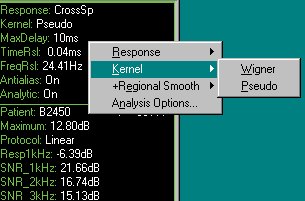
News

05/12/2916 : Updates on the \"Information for Families\" material

The "information for Families" material has been updated with 4  Successful Cochlear Implant stories, which were presented in the Second Conference on Cochlear Implants and Music (July 14th 2016, Warsaw Poland).

News

19/11/2016: New Tools for Tracking screened INfants

In the November issue of the ECHO initiative Probes & Tips, there is a presentation of a simple EXCEL tool , which can track and provide basic information on hearing screening activities. Although the information has to be inserted manually, the EXCEL solution is a good backup strategy for hearing screening sites with low birth rates. It can be also a good solution for displaying monthly screening activities. The EXCEL spreadsheet (2016 version )  and the guide of how to use it can be downloaded from the ECHO website

News

19/11/2016: New experimental drug (Keyzilen) to treat short-term tinnitus

Usually we do not report in the Portal inner ear Pharmacology news, but this one is different. The news refer to clinical data treating patients with tinnitus after an occurrence of otitis media. This scenario implies a peripheral tinnitus generation and as such it is of great interest, since the genesis mechanisms of tinnitus are multiple and usually more central-Auditory System oriented.

From the web site of Auris Medical Holding :

Auris Medical Holding AG (NASDAQ: EARS), a clinical-stage company dedicated to developing therapeutics that address important unmet medical needs in otolaryngology, today announced additional clinical data as well as updates to its development plan for KeyzilenTM (AM-101) in acute inner ear tinnitus.

Based on insights from the recently completed TACTT2 trial, the Company is submitting a protocol amendment to regulatory agencies in Europe for TACTT3, the ongoing second Phase 3 clinical trial. In the amended trial protocol, the change in Tinnitus Functional Index (TFI) score will be elevated from a key secondary endpoint to an alternate primary efficacy endpoint. Certain patient subgroups will be included in confirmatory statistical testing, and the trial size will be increased to enhance statistical sensitivity to the effects of treatment. Top-line results from the expanded TACTT3 trial are now expected in early 2018. The outcomes from TACTT2 and the regulatory path forward will be reviewed with the US Food and Drug Administration in early December 2016.

TACTT2 was a randomized, double-blind, placebo-controlled trial conducted primarily in North America, enrolling 343 patients suffering from acute inner ear tinnitus following traumatic cochlear injury or otitis media. As previously announced, the trial failed to meet its two co-primary endpoints: the change in subjective tinnitus loudness (tinnitus loudness question; TLQ) and the change in tinnitus burden measured by the TFI from baseline to Day 84 over placebo. However, the TACTT2 trial data show treatment effects on TFI in favor of KeyzilenTM for specific subgroups. In the pre-specified subgroup of patients suffering from tinnitus following otitis media, treatment with KeyzilenTM resulted in a clinically meaningful and statistically significant reduction of 14.8 points in the TFI from baseline, as compared to 6.2 points for placebo (p=0.048). A reduction of 13 points was defined as clinically meaningful by the developers of the TFI. A trend for improvement was also observed in active-treated patients who suffered from severe or extreme tinnitus at baseline with a clinically meaningful reduction in TFI of 15.5 points as compared to 11.5 points in the placebo group (p=0.238). Unexpectedly, the TLQ showed a lower sensitivity to change than the TFI, which the Company believes to be related to the frequent (daily) rating of tinnitus loudness over an extended period of time.

You can access the rest of the article in the Auris Medical Holding website: 

News

29/10/2016 : New white paper

The section on White papers , subsection of Clinical applications was updated with a contribution from Dr.  Maria Riga titled "Subjective tinnitus and contralateral suppression of otoacoustic emissions; an attempt to validate cut-off points with clinically useful positive or negative predictive value in normal hearing adults". Dr. Riga is currently an Assistant Professor of Otorhinolaryngology at Democritus University of Thrace, in Alexandroupolis, Greece.

News

27/10/2016 : Visualization of white papers

From this month , we offer the visitors of the OAE Portal the possibility to visualize the last submitted white paper, in accordance with the presentation of the Guest Editorials, where emphasis is given to the contributing author.

The presented white paper page will contain information on the author and his /her collaboration team,  as well a short abstract of the submitted work. A reminder that white papers are synopses of papers published in other journals. 

News

20/10/2016 : Updates on the Free Book chapters

The section on FREE book chapters has been updated with a chapter contribution titled " Technological Advances in Universal Neonatal Hearing Screening" by S. Hatzopoulos, H. Skarzynski and PH Skarzynski.

Chapter data

DOI: 10.13140/RG.2.1.4287.1762 

Book title : Update on Hearing Loss, Edition: First, Chapter: 9, Publisher: INTECH, Editors: Fayez Bahmad Jr, pp.169 - 184

News

22/09/2016: Attention on this month\'s Editorial

This month's editorial , by Dr. James Hall III, is part of his book on Evoked Auditory Potentials. Dr. Hall was generous enough to share with the international OAE Portal community important  clinical cues on the topic of hearing loss assessment.  Amazon.com offers the new handbook in a convenient Kindle version. The editorial and the handbook material are great educational resources for students and professionals. 

News

19/09/2016 : Free Book chapter Section

Towards the end of September 2016, we will start posting on-line chapters from Open Access books which might be interesting to Students and Professionals.

In the Free Book Chapter section  you will find Book chapters on OAEs and relative technologies from  early detection and Intervention policies. Some chapters will be downloadable from the Portal, others from ResearchGate links. 

All material is FREE under the Open Access Agreement.

News

21/09/2016: More information for Families

There is a wealth of information in the FORUM section , specially for Families of implanted or for Cochlear implantation candidates. The stories which are posted are from children who have received successfully a Cochlear implant (mostly as a result of a Neonatal Hearing Screening program).

We have noticed that rarely visitors check the FORUM for additional topics or for more details on a specific topic, therefore in the section Information for Families we will start posting these success stories. The idea behind this is to distribute in a larger scale the successes and the positive experiences of Cochlear Implant users , who have faced in one particular period of their lives serious social integration challenges.  The material is quit optimistic, because it tells the stories of people with hearing deficits who managed to master various musical organs. 

News

26/08/2016 : More Delays in the content updates

Due to internal updates and server maintainance .. the scheduled updates for the month of July and early August will start appearing in the month of September 2016.

News

15/06/2016: Music and CIs conference in Warsaw


More news for the forthcoming conference ( http://symposium.ifps.org.pl ) have been released and a general pamphlet which you can access here .

2nd International Scientific Conference „Hearing Implants and Music” in the World Hearing Center in Kajetany, Poland on 14 July, 2016


‘Hearing Implants and Music’ is a popular-science conference addressed to all people interested in the latest achievements of science and medicine in the field of cochlear implantation.

Scientific program includes invited lectures presenting the state of knowledge related to music perception and influence of music on cognitive development, with particular attention given to issues related to hearing loss and implants. Workshops will include practical demonstrations of hearing and sound functions, meetings with specialists in hearing rehabilitation, technical novelties in hearing implants and other interesting activities for adults and children.

A particular attraction will be the meeting with the finalists of the 2nd International Music Festival for Children, Youths, and Adults with Hearing Disorders “Beats of Cochlea” - cochlear implant users with the exceptional gift for music.

Participation in the conference is free. We ask all interested to register online for organizational purposes.

Program Schedule

9:00 - 10:30 Workshop session
10:30 - 10:45 Opening of the Conference (Prof. H. Skarżyński)
10:45 - 11:15 Opening lecture, Prof. H. Skarżyński, Institute of Physiology and Pathology of Hearing
11:15 - 11:30 Musical surprise
11:30 - 13:20 Lecture session
13:40 - 14:30 Lunch break
14:30 - 15:30 Meeting of hearing implant users and participants of the Festival "Beats of Cochlea"

Lectures and conference materials will be presented in English or Polish. Organizers will provide translation of scientific sessions.

Venue:
World Hearing Center
Kajetany, 17 Mokra St
05-830 Nadarzyn

Contact with organizers: [email protected]


News

6/06/2016 : Updates for ILO TEOAE users

The section on ILO-Viewers was updated with information regarding the structure of the old TEOAE ILO files (up to v5 & probably v6) . This information has been requested many times over the years , but we were hoping to get access to more modern MATLAB subroutines , which could read ILO files (still not available) . Nevertheless the information is valid for anyone who wishes to build his / her  own subroutine code. 

News

05/06/2016 : Update delays

We apologize for some delays in the update of information in the months of April and May, all updates will be uploaded in the month of June 2016. For obvious reasons the editorials , which usually span 2-3 months , will appear with a 2 month delay. 

News

14/04/2016: Updating the Access Statistics

Upon request the Access Statistics page (On the Sponsoring the OAE Portal page)  has been updated with the  2015 data. 

News

14/01/2016: News and Tips about Scopus

One of the most important services for scientific authors is related to Elsevier's Scopus platform. Scopus is the largest abstract and citation database of peer-reviewed literature: scientific journals, books and conference proceedings. Delivering a comprehensive overview of the world's research output in the fields of science, technology, medicine, social sciences, and arts and humanities, Scopus features smart tools to track, analyze and visualize research. A possible disadvantage is that you cannot access its extensive services without a subscription (private or from your Institution). 

In the first 2016 newsletter , the editors of Scopus provide interesting tips on how to use the service efficiently (i.e. tips on the famous h-index)  and above all the new enhancements found in the platform. Access the newsletter  here .   

News

02/01/2016: Updates in the Forthcoming Editorials and meetings

The pages of the forthcoming Editorials have been up updated with the 2016 material. Also the pages on forthcoming meetings have been updated with information regarding the HEAL (Hearing Across the Lifespan) conference in Como , Italy (2-4 June 2016).

News

30/11/2015: Updates on Mimosa Acoustics: FPL software Update

Mimosa Acoustics has announced a new software release designed mainly for clinical researchers.  The latest handheld OtoStat wideband immittance and DPOAE system is now capable of  forward-pressure level (FPL) calibration. By calibrating using FPL, errors up to 20 dB stimulus-level are eliminated, and variability due to probe insertion depth and angle is greatly reduced. This is a limited edition release for early adopters who wish to investigate the benefits of FPL for their specific clinical populations and research interests.

OtoStat 2.1 features:

  • Based on the OtoStat 2.0 handheld touchscreen device, with OtoStation patient management software 
  • In-the-ear calibration with FPL or SPL as the target level 
  • Extended data export to Excel for both wideband immittance and DPOAE
  • Configurable parameters saved as named protocols

What is FPL?

In a sealed ear canal, FPL is the forward-going or incident waveform on the tympanic membrane. Regular in-the-ear calibration measures the pressure at the probe microphone, which is a mix of forward and reflected pressure components. By using a specially calibrated probe, the forward going component can be derived and the stimulus level adjusted so that it is constant across frequency. This improves measurement accuracy and reliability.

Is additional time or effort needed to use FPL?

No. If you're already making wideband immittance+DPOAE measurements, no additional time is needed. The FPL information is derived from the immittance measurement. If you're only making DPOAE measurements, the immittance test takes the place of the regular DPOAE calibration, and in addition you get information about middle-ear status which you can use to help interpret the DPOAE results.

Where can I find out more about FPL and DPOAEs?

An overview and example is on the June-October 2015 guest editorial.

For more information or to get a quote, call Kyle on +1 (217) 359-9740 or email [email protected].

News

19/11/2015: Collaboration with the Journal of Hearing Science

We are very glad to announce a closer collaboration with the Journal of Hearing Science (JoHS), an emerging open access journal in the area of Audiology and ENT. All contributors to the OAE Portal material (guest-editorials , white papers, webinars, powerpoint presentations from conferences, etc) are eligible to be author candidates to the journal (after a peer review of course) with a minimum number of textual modifications (the Portal has open-format requirements  which are different than those of the JoHS). 

News

17/11/2015: New MENUs

We have made a number of simple & esthetic changes in the MENUs that you use in the Portal . Analytically : 


1. the FORUM menu now opens the corresponding page, without showing a cascade MENU as in the past. The reason for it is that the new Chrome & Firefox browsers for the Mac were displaying badly the cascade MENU. We still have this issue in the Who are we , but these are not  pages with a lot of traffic. 

2. the Italian Portal pages & the OLD Portal content can be found in the left vertical menu with other OAE material. 

News

12/11/2015 : NEW collaborators are NEEDED

We are seeking collaborators from areas where the hearing screening information is kind of difficult to get (India, Iran, Nothern, Central, & Southern Africa, Central America ),  so please if you reside in these areas  drop us a line and tell us what you think about the information we provide in the Portal and how we can establish a connection / collaboration with you.

News

20/10/2015: Multiple frequency Tympanograms educational Video

In late 2014 Interacoustics launched the Titan portable device, capable of recording OAEs and impedance tympanometry at various frequencies. The  novelty of Titan was the way Interacoustics selected to represent the tympanometric data, coined as wideBand Tympanometry. There is nothing new to the approach , the data from each tested tympanometric frequency are stacked in a 3D format , showing the areas of the middle ear where we have maximum absorbance and minimum reflectance of the incident acoustic energy.

Recently Interacoustics built a video explaining the functionality of Wideband Tympanometry which can be a useful aid in the classroom and in the clinic. 

News

29/10/2015: Invitation to a ECho Initiative Seminar

MIRRORED from the ECHO Initiate Web site: 

We invite you to join the Early Childhood Hearing Outreach (ECHO) Initiative for an intermediate webinar focusing on Otoacoustic Emissions (OAE) hearing screening.  Early Head Start (EHS) programs already using OAE screening will have a chance to examine effective screening and follow-up practices. Staff can reflect on their own experiences and ask questions. They can also learn to improve screening skills and the administration of OAE hearing screening protocols.


Topics for the webinar include:
  • Obtaining a good probe fit
  • Strategies for screening young children
  • Screening and follow-up protocols
  • Reporting children identified with
    permanent hearing loss
Who Should Attend?

This webinar is designed for EHS programs that have been using OAE hearing screening methods and who want to review and improve their current screening and follow-up practices.
 
You can get more information here where you can also register for the event. 
News

15/10/2015: ECHO Initiative : Webinar on Hearing and Hearing Loss for the Layman

MIRRORED From the ECHO Initiative pages :
 
Jeff Hoffman and Terry Foust recently presented a webinar to introduce state Early Hearing Detection and Intervention (EHDI) program staff to the basics of hearing and hearing loss. The audience response was so positive that we also wanted to make the information available to early  childhood education providers and families. The content will be particularly helpful to any parent who has a child undergoing audiological assessment and to the professionals who are serving that family.  
 
 
The 70-minute webinar covers:  
  • Anatomy of the ear
  • Types of hearing loss
  • Prevalence and causes of hearing loss
  • Diagnostic tools and procedures 
  • Audiogram fundamentals
  • Hearing loss simulation
  • Treatment and intervention options
News

12/10/2015: Meetings and Conferences

The Meetings and Conferences pages have been updated with the latest information about the HEaring Across Lifespan (HEAL) meeting , at lake Como (Italy) in the period  June 2-4 2016

Meetings and Workshops

Hearing Across the LifeSpan (HEAL): Cernobbio, Lake Como , Italy: 2-4 June 2016

Topics to be addressed in the HEAL conference : 


Screening and Early Identification

  • Hearing screening across the lifespan: newborn, pre-school, school-age, adult and elderly screening; targeted screening (workplace, at-risk populations)
  • Screening methods, techniques, and devices
  • Audiological assessment: audiological test battery, evoked potentials, central and cognitive tests, medical imaging
  • Early Hearing Detection and Intervention programs: guiding principles, protocols and implementation, quality assurance
  • Hearing loss prevention
  • Clinical decision making and health policy issues

Intervention and Rehabilitation Strategies

  • Development of hearing devices and instrumentation
  • Cochlear implants
  • Implantable devices
  • Auditory training
  • Psychosocial approaches
  • e-health resources
  • Family and carers empowerment
  • Outcome evaluation

Hearing Loss: Mechanisms, Effects and Medical Issues

  • Basic research on hearing loss
  • Speech and language development
  • Maturation and plasticity
  • Causes of hearing loss: genetics, risk-factors and harmful agents, age-related hearing loss
  • Medical conditions, comorbidity, and syndromes
  • Impact of hearing disorders: communicative, psychological, social and family issues
News

02/10/2015: Hearing Screening for Life movement in the UK

There is a considerable interest in the scientific community regarding the impact of hearing deficits in the quality of life  for adults > 65 y. There is a movement in the UK called "Hearing Screening for life" , which aims at informing the general public and the British government about hearing issues in the elderly life. Screening in this context is not the same as it is for the neonatal population (OAEs, ABR etc), but it follows standard audiological paradigms (pure tone testing, immitance tympanometry etc).

Data from the UK movement suggest the following: "A recent cost-benefit analysis found that hearing screening would cost an estimated £255 million over ten years, but the benefits across this period would amount to over £2 billion . A proactive introduction of hearing screening will have a host of follow on benefits and will echo the government’s focus on prevention and early intervention".

News

01/10/2015: MUSIC Stories from young Implanted Patients

The pages of the OAE Forum have been updated with cases from young adults who have implanted at an early age and who have followed their passion in MUSIC. The data come from interviews and poster presentation of these patients during the first International meeting of Hearing Implants and MUSIC, which took place on July 16th in Warsaw, Poland. 

News

16/07/2015: Hearing Implants and Music

It is well known that Cochlear Implants can help young patients hear and participate in the sonic world. But what about the efficiency of these devices in helping young people pursue a carreer in MUSIC ?  The first International Scientific Conference on "Hearing Implants and Music" was held in Warsaw on July 16th and addressed this very problem not only from a theoretical point of view but from a practical point as well. Young and Adult implanted patients presented posters with their experiences and gave an impressive performance in front of a live audience. The performance was code-named "Beats of Cochlea". We strongly advice users to follow this performance at this YouTube link.

Since a number of young patients was implanted with MEDEL implants, we have asked permission to publish their posters in the appropriate FORUM section. It is estimated that this information will be available from middle-September 2015.


News

21/09/2015 : New Book on Evoked Potentials

The OAE Book section was updated with an Amazon Kindle 2015 release  of the Handbook of Evoked Potentials by James W.  Hall III.

The eHandbook of Auditory Evoked Responses is a completely revised and updated digital version of the popular New Handbook of Auditory Evoked Responses (2007). The eHandbook is offers a clear yet comprehensive review of auditory evoked responses from the cochlea to the cortex including test principles, protocols, and procedures for clinical application. The latest advances in clinical research and applications are covered in the eHandbook among them the use of ECochG in ANSD and cochlear implantation, the clinical advantages of chirp stimulation in ABR and ASSR recordings, and the multiple contributions of cortical auditory evoked responses to assessment and management of pediatric and adult patients. The competitively priced eHandbook of Auditory Evoked Responses can be used as a textbook for graduate students enrolled in auditory electrophysiology and also as up-to-date resource on auditory evoked response measurement and analysis for practicing audiologists and hearing scientists.

News

11/09/2015: The future of Scientific Publishing

This announcement is not entirely related to the main topics of the OAE Portal,  but to Science and to Scientific Publishing. A new electronic Reader has been announced which integrates many interesting features, not present in the paper-version of scientific articles. Reader is a software platform that brings scientific and technical documents into the 21st century by adding intuitive navigation and rich context to scientific and technical documents. You can access manuscripts via a URL in your web browser and there is no software or app to install or configure.

The project has been funded from the KickStarter platform, where you can follow all the details and participate if you like.

News

15/06/2015 : June Newsletter of the ECHO initiative

The June 2015 ECHO Initiative newsletter has been released with emphasis on Learn "who's who" in Early childhood screening in your state

News

13/06/2015 : A welcome to the ECHO Initiative

We are very pleased to announce the the ECHO Initiative provided us with a permission to use their excellent on-site materials on neonatal and children OAE hearing screening.

Although the ECHO site is designed with the lay-screener in mind, students of Audiology, Hearing Science and ENT can find a lot of educational material related to OAE practices in the form of videos and webinars.

News

08/06/2015: Updates in the OAE Software -Simulations and Modelling Category

The Simulations & Modelling pages have been updated with a contribution from Dr. Michael Berg on the classical issue of the distortions in the  Tartini Tone.

It is expected that within June 2015 all the contents from the old OAE site will be transferred to the Portal. The reason for this delay is that the majority of the simulations were written for the DOS environment, which today is obsolete.  Nevertheless some DOS simulators still exist and these programs have an important educational role, specially for the students of Audiology and Hearing Science.

News

10/06/2015: Updates in the OAE software category

The OAE Software , Databases / Patient Tracking pages were updates with a recent description of the Hitrack 4 software package. Within the same page there are included updates on the price availability of Hitrack, for 2015.

News

20/05/2015: Interacoustics Updates

Mr David Speidel, director of the Audiological services of Interacoustics US provided a series of interesting information regarding the new Titan platform , a TEOAE webinar and a series of how-to do-guides for the following topics :

(1) How to run a DP measurement

(2) How to handle Titan for screening

(3) OAE - DPOAE pass criteria and interpretation

(4) How to analyze a DP-Gram

(5) Screening using Titan

(6) OAEs: Cleaning the probe tip


The Titan platform  has its own 'Suite' of software that includes Clinical Impedance, Wide Band Tympanometry, DP & TEOAE (screening and clinical uses) , ABRIS (ABR Screening Module). The software is NOAH compatible, but it includes its own database (OtoAccess) to manage the data. The OtoAccess database has a HiTrack add-on, which is an essential element for those conducting hearing screening in the US.

News

06/05/2015 : New Entries in the FORUM channel for the families of Implanted Children

The FORUM space dedicated to the families of Implanted children has been updated with two success stories. The cases come from the Institute of Physiology and Pathology of Hearing in Warsaw , Poland. The Portal Editorial staff would like to thank Jolanta Chylkiewicz , Aneta Olkowska and Olga Wanatowska for summarizing  and  translating the Polish material into English.

News

18/04/2015: New Webinar on children\'s Hearin Screening

There is a new entry in the webinar pages, originating from the ECHO Initiative project. The title is " Improving Hearing Screening practices in children up to 5 years of age"

News

08/04/2015 : Updates in Children Screening

The pages on Children Screening were updated with additional references from the ECHO initiative.

News

25/03/2015: New White Paper

A new white paper has been added to the Hearing Screening category, titled " A Comparison of the Frequency of Positive Hearing Screening Outcomes in School Children from Poland and other countries of Europe , Central Asia and Africa" by Piotr H Skarzynski et al.

News

20/03/2015: START posting Webinars

The Webinars are the latest trend in long-distance Education and Training. In the OAE Portal we usually post or on-line powepoint lectures or white papers. A Webinar though, combines both aspects of these presentations with audio / video from the presenter , thus promoting a better understanding of the conceptual ideas of the lecture.

The fist Webinar we post is from the 2015 Otometrics Webinar series. It is titled "Bridging the Hearing Screening Gap: The importance of periodic hearing screening in the pre-school population".

News

19/03/2015

The Children Screening pages were updated with an extended Introduction to the topics of the section and of future content.

News

16/03/2015: Neonatal screening Category changes to Hearing Screening

From this month the Neonatal Screening category changes name to Hearing Screening in order to include information on Children's screening ( which we will start posting from April 2015).

News

27/02/2015: Updates on the Sentiero Desktop from Path Medical Solutions

German manufacturer Path Medical Solutions has announced updates in the Sentiero Desktop line. The device is not handheld,  but small enough for enhanced portability. It supports standard and high frequency tympanometry (i.e. 226 and 1000 Hz) , TEOAEs, DPOAEs and Standard Audiometry tests, thus it can be a very good candidate for school children testing.

News

25/02/2015

The future highlights  pages were updated with the latest news about white papers and Editorials.

News

23/02/2015: Phonak Links to the Hearing Aid pages

From November 2014 we have started a campaign asking all major Hearing Aid companies to help us with relative information on the outcome of EDHI programs and the corresponding experiences of the families of young patients. We know that it takes some time to attract the attention of the right person, but fortunately Phonak- Italy (Dott. Franco Lucato)  communicated a few important links to follow when searching for HA info in the neonatal population. The links appear in the HA section , under the Neonatal screening category of the main menu.

News

09/02/2015 : Updates on Intelligent Hearing Systems devices

Mrs Raquel Lauture from Intelligent Hearing Systems sent us an update regarding their OAE / ABR line of products.

SmartOAE: 

 The SmartDPOAE system is a full-featured Distortion Product OAE (DPOAE) and Transient OAE (TrOAE) testing system. It can acquire a DP-Gram with up to 41 frequency points. Its built-in scripting feature allows advanced users to define sequences of frequencies and intensities for automated data collection. The user also has full control over the stimulus levels, frequency ratio, artifact rejection, and sweep count. We offer a high frequency option for testing at up to 16kHz for human subjects and at up to 32kHz for animal testing using the 10B+ probe microphone and our High Frequency Transducers. The system also allows for the acquisition of the DPOAE Input-Output function. The data can be exported to an ASCII file.

 The SmartTrOAE provides graphical displays of the OAE time signal, frequency analysis, and ear canal response. Advanced features include time-frequency plots, which can be used to illustrate how the frequency composition of transient OAE responses, Noise, and SNR change over time. Linear, non-linear, and spontaneous acquisition modalities are included. The user can change the stimulus from clicks to tones or user-defined stimulus files.

IHS offers a dual probe system which allows for recording contralateral, ipsilateral, and binaural suppression.  The Suppression Option includes full control of suppressor level, duration, and the amount of time between the masking and the stimulus signal. The module also includes a suppression analysis module developed by the Kresge Hearing Research Laboratory, which incorporates a temporal and spectral comparison of the control and suppression data.

 SmartEP

For ABR testing, IHS offers the SmartEP system. SmartEP is a sophisticated, multi-channel (up to 8) full-featured evoked potentials system with the versatility to meet both all clinical and research needs. SmartEP offers the ability to acquire ECochGs, ABRs, a fast rate intensity sequence using Chain Stimuli, Frequency Specific ABRs using Notch-Noise Masking, eABR, MLR,  LLR, P300/MMN, Frequency Following Responses using Advanced Auditory Research module, High Frequency EPs up to 32kHz, Somatosensory/ ENoG EPs,  and VEPs.  SmartEP gives the user full-control of all acquisition parameters.

IHS offers also the SmartEP-CAM module, a continuous acquisition module which simplifies the acquisition of continuous multi-channel high resolution AEP, OAE and EEG signals.  It is also available a Complex ABR (cABR) Research Module based on  Dr. Nina Kraus and colleagues at Northwestern University’s,  Complex ABR analysis of speech elicited AEP responses.


Specific information on these devices (brochures) can be obtained from IHS .

News

02/02/2015: New OAE Hardware models

The OAE hardware models category has been updated with the Mimosa Acoustics product line. To provide an additional service to  our generous sponsors, this category will include product information only from their product lines.

News

29/01/2015 : Clinical Applications updates

In parallel with the upgrades on the OAE hardware pages we will update the clinical OAE Application pages. The latter updates are scheduled till  February the 25th. We apologize but till that period you may encounter some broken links on these pages .

News

22/01/2015 : Welcome to Mimosa Acoustics

It is our great pleasure to welcome in the list of our sponsors Mimosa Acoustics and Dr. Lapsey-Miller as our liaison with the firm . The next couple of weeks we will update our hardware pages with material from the product line of Mimosa Acoustics.  Within the first semester of 2015 we will present an editorial on MEPA, the reflective immitance methodology used in the Mimosa OAE line, which assists significantly the correct assessment of the hearing function of a neonate. 

ALSO : Hardware updates on their upcoming medial-olivocochlear reflex (MOCR) module have been posted in the hardware update pages.

News

22/01/2015 : OAE Hardware vendor Updates

The updates in the area of OAE hardware have made us notice that we had to put more emphasis on the various hardware / software updates posted by the OAE and AEP vendors. Now you can find these communications in a special page , but you will notice that vendors do not communicate routinely outside their websites new information. For the last 8 years .. we were obtaining these "details" by contacting the regional sales managers. Unfortunately there is a global turn-over of positions and the same people rarely remain in the same post .. for more than 2-3 years ... this results in loss of new information. We will try to regain these contacts , if you have someone to suggest that we should contact please  ... email us.

News

15/01/2015: Otometrics Webimar series

The INTERNET is without a doubt the best channel to share information, thus the creation of the term webinar, meaning a on-line seminar.

Otometrics , the known Danish audiology/ENT equipment manufacturer, advertises a series of webinars one of which is on pre-school hearing screening (March 16, 2015). For more information access the main Otometrics Webinar series page. In case you are interested in a past event , just register in the Otometrics site and you will get access to the recorded webinar event.

News

20/01/2015: Success Stories in Cochlear Implant patients

The first report of a MEDEL success-story has been posted in the Forum by Kinga Wołujewicz from the Institute of Physiology and Pathologty of Hearing ( Warsaw, Poland). This is the first report from this interesting case , further reports in the future will provide additional information on his experiences with the CI as well the views of his family.

News

04/01/2015: 2014 Access Statistics

The Access statistics of 2014 are on-line earlier that expected , thanks to Google ... Several trends emerge with the most obvious the globalization of accesses in comparison to the numbers we had 4 years ago. The number of countries requesting information has also increased to 131 ... some have very few accesses to the Portal material ... but it is important to see that we move to an global INTERNET community.

Some details which should be mentioned:


1. The "Americas" are monopolized mainly by accesses from the US and Canada (73.78%)

2. South America is monopolized by accesses from Brasil (68.77%).

3. Asia is strongly monopolized by accesses from India (81.11%) and Iran (12.21%)

News

Season Greetings for 2015

The Editorial Board of the OAE Portal wishes to all a Merry Christmas and a happy new Year. Let's hope that 2015 will bring more peace , less friction and poverty  and great scientific discoveries to our mankind.

News

20/12/2014: FORUM topic

An interesting topic has been appeared on the OAE FORUM, as a question of how to register DPOAEs in children with ventilation tubes.

News

27/11/2014: Updates in the OAE Hardware pages

The  OAE Hardware pages were updated with the product line of Mimosa Acoustics including a portable DPOAE screener and a portable OAE system capable of TEOAE / DPOAE / SFOAE recordings. Both products are capable of recording middle ear reflectance, a state of the art approach to middle ear function assessment.

In Early 2015 , we have programmed a revision of the OAE Hardware and OAE software pages  since a lot of the models which are theoretically available have been redrawn in 2014.  

News

Content for Families and non-professionals

From the month of October 2014, we will start the insertion of material geared towards the families of children with hearing impairment. The family & non-professional section as well as  the thematic channel on Cochlear Implants ( still in preparation) should provide some answers to commonly asked questions , specially prior to an implantation.

News

July - September 2003: OAEs in early detection and monitoring of Noise-Induced Hearing Loss (NIHL)

1.  Introduction

       This editorial attempts to provide some answers and insights to the question of whether the otoacoustic emissions (OAEs) can serve as a clinical tool in the early diagnosis and monitoring of noise-induced hearing loss (NIHL).


        OAEs are sounds originating mainly from the micromechanical properties of the normal functioning OHCs (1). These sounds could be recorded in the external ear canal either spontaneously or after sound stimulation. OAEs elicited by sound stimulation are known as Evoked OAEs, and depending on the stimulus, they called Transiently Evoked OAEs and Distortion Product OAEs. The stimulus for TEOAEs consists of broad band non-linear clicks. This type of emissions reflect the OHCs' activity throughout the length of the basilar membrane at threshold level. DPOAEs are elicited by two simultaneously presented pure-tone stimuli and reflect the OHCs' activity at specific places on the basilar membrane at supra-threshold level. OAEs are used as an objective, sensitive and non-invasive test for screening the functional status of the cochlear amplifier.
        In general, TEOAEs can be recorded from all normal hearing ears (2) and DPOAEs from ears with pure-tone hearing thresholds up to 50-55 dB HL (3), provided that the tympanic membrane and middle ear are functioning normally. TEOAEs recorded from normal hearing adults have an overall amplitude of at least 6 to 7 dB SPL and a frequency range greater than 3 kHz 2. Mean overall DPOAEs amplitude of normal hearing ears is greater than 6 dB SPL, showing greater peaks at 1.2 kHz and 5.3 kHz. DPOAEs can be recorded across a frequency range from 0.8 to 8 kHz (3).
        It is well established that OHCs are extremely vulnerable to sound over-stimulation and are the first to be affected amongst the inner ear cells (4). Noise results in either temporary or permanent changes of the stereocilia bundle of the OHCs(5). Since otoacoustic emissions mirror OHCs activity, it has been proposed that they have the necessary features to serve as an objective, sensitive and quick tool for the diagnosis of NIHL.
        NIHL is currently detected and monitored with Pure Tone Audiogram (PTA). NIHL is largely preventable but when the noise exposure is terminated the hearing loss remains constant. One of the main goals of hearing conservation programs is to detect noise-induced OHCs functional alterations at primary and still reversible stages. PTA is insensitive to such subtle cochlear changes and cannot serve as a method for early detection and prevention of NIHL. On the contrary, OAEs might be the ideal non-invasive method for that purpose. Another disadvantage of the PTA is that this sort of hearing assessment is not an objective hearing test. Many authors have reported that an estimated 30% of claimants aggravate their true hearing threshold for compensation reasons (6). In this context, the need for an objective and reliable audiometric test for routine clinical use becomes evident. Due to their objectivity and sensitivity, OAEs might provide indispensable information in medico-legal cases.

       So, is there sufficient scientific evidence suggesting that OAEs could serve for screening AND early diagnosis and monitoring of NIHL? It is rather difficult to give a straight answer to that. In order to do so, one has to answer the following questions:

1. Can OAEs detect Temporary Threshold Shift (TTS)?

2. Can OAEs detect Permanent Threshold Shift (PTS)? Both TTS and PTS are seen in hearing conservation programs. It is, thus, really important to consider both, when making physiological measurements of cochlear damage in applied settings.

3. How well can OAEs differentiate ears with NIHL from those with normal hearing? 4. Can OAEs detect noise-induced cochlear changes before they become evident as threshold shift in PTA (sub-clinical changes)?

5. Is it possible to have any information about the individual susceptibility to NIHL?

An overview of the current literature may give some answers. All the following data are derived from human studies. The characteristic changes of OAEs in both TTS and PTS are presented separately.


2. TEOAEs in detecting TTS


        Changes of TEOAEs after brief overexposure to noise have been studied in both laboratory settings, where experimental control of the exposure is possible, and in field settings, which have the advantage of higher noise level than those allowed in the lab. All studies showed that TTS is accompanied by:

1. A reduction of the overall TEOAEs amplitude (7,8-10)

2. Amplitude reduction of TEOAEs at high frequencies. If the subjects have been exposed to narrow band noise, the maximum affected OAEs are those at ½ or 1 octave above the center frequency of the exposure noise (8,9,11).

3. Some studies showed that, in a number of subjects, noise-induced emission changes were recorded even in the absence of TTS, as estimated by PTA (8-10).

4. There are contradicting evidence regarding the existence of any correlation between TTS and noise-induced temporary emission changes. It is noteworthy that in a study conducted by Sliwinska-Kowalska et al (1999), a strong positive correlation was found between the pre- and post- exposure amplitude of TEOAEs. Furthermore, Vinck et al. have reported that TEOAE and TTS recovery time patterns were not the same; while TTS was fully recovered 4h after exposure, the TEOAE shift in 4kHz was only partially recovered. This might suggest that OAEs are more sensitive than the behavioral audiogram in detecting subtle cochlear changes.


3. DPOAEs in detecting TTS

        The possibility of detecting TTS with DPOAEs has been assessed in a number of studies. Most of them confirm that TTS is usually accompanied by DP-gram changes, which are characterized by:

1. A significant amplitude reduction at the cubic distortion product frequency in the high frequencies, if subjects were exposed to broad band noise, and a maximum amplitude reduction of ½ -1 octave above the center frequency of the noise, when the subjects were exposed to narrow band noise (8,12,13).

2. A strong positive relationship between TTS and the amplitude reduction of DPOAEs (13). Earlier studies (14,15) do not report such a correlation. This might be due to the methodology used (for example: time of post-exposure measurements and level of the primary tones).

3. The recovery patterns of DPOAEs Temporary Shift and TTS are the same (12,13).


4. TEOAEs in detecting PTS

         Regarding the use of TEOAEs for the detection of PTS, there is a great body of evidence that PTS is accompanied by characteristic emission noise-induced changes, which more or less resemble those of TTS cases.

1. TEOAEs are greatly reduced in amplitude, throughout their frequency range (16-19). Furthermore, emissions at lower frequencies are less affected than those at higher frequencies. Two possible explanations are available : (a) that the OHCs at the medial and upper turn of the cochlea are already affected by noise, despite normal hearing at low and medium audiogram frequencies; or (b) that the functional integrity of the OHCs at the first turn of the cochlea significantly contributes to the TEOAEs generation.

2. TEOAEs are recorded in a narrow frequency range (16,19-22). In fact, the last peak of TEOAEs spectrum in adult subjects is at or just below the frequency at which NIHL begins. A study conducted by Attias et al in a large sample of young adults suffering NIHL, showed that the highest frequency at which TEOAEs could be reliably recorded was 2 kHz, while in normal hearing adults this limit is approximately at 3.8 kHz. The above results suggest that TEOAEs might serve as a frequency specific monitor of the cochlear status.

3. Finally, as the hearing loss increases the overall response and frequency range of TEOAEs becomes smaller (19,23).


5. DPOAEs in detecting PTS

         DPOAEs are sensitive in detecting PTS, showing some characteristic changes as well.

1. There is a reduced overall amplitude and/or absence of the emissions in the geometric mean frequency range between 2 and 4 kHz. The frequency at 3 kHz is usually the most affected (17,19,24).

2. Presumably due to DPOAEs frequency specificity, the DP-gram follows the pattern of PTA (24,25).

        Many researchers suggest that the sensitivity of DPOAEs in detecting NIHL, even at early stages, depends on the stimuli characteristics. Greatest sensitivity has been established when the intensity of the primary tones is below 60 dB SPL and when L2 is less than L1. It is thought that under such a condition, the primary site for distortion product 2f2-f1 generation is near or at the place on the basilar membrane which is tuned to f2, thus increasing the frequency selectivity of the method. Furthermore, when the primary tones are of low intensity, the main source of the emissions is related linearly with the cochlear amplifier. On the contrary, DPOAEs generated by higher level primaries are probably reflect an indirect relationship with the micromechanics of the basilar membrane (12, 13,26,27) . Another way to increase the DPOAE sensitivity in establishing TTS and PTS, is to perform the sampling and analysis of data at the maxima of DPOAE microstructure (12).


6. OAEs for NIHL screening

         To use OAEs as a screening method for NIHL, it is of great importance to know how well can OAEs differentiate ears with NIHL from normal hearing ears. This means that we need a method with high sensitivity and specificity. Attias et al (1993), have conducted a study on large samples of subjects, so that the results could be of statistical significance. They studied the noise-induced emission changes in a group of 283 adults, with NIHL according to PTA, due to chronic exposure to industrial or military noise, and in a group of 176 age-matched subjects with documented exposure to hazardous noise but with normal hearing thresholds. Results were compared to those of 310 adults with normal hearing and no history of exposure to intense noise (19).
         The analysis was performed using as criteria for distinguishing ears with NIHL the presence of TEOAEs at 2 and 3 kHz. The results showed a correct discrimination rate of NIHL of 92.1% (sensitivity) and correct discrimination rate of NH of 79% (specificity) with an overall correct prediction rate of 84.4%. The fact that TEOAEs at high frequencies could be affected in noise-exposed subjects, despite normal PTA thresholds, may serve as a possible explanation for the relatively low specificity in this sample.
        A similar analysis performed for DPOAEs at 2,3 and 4 kHz showed an 89% sensitivity, 92.5% specificity with an overall correct prediction rate of 87%. When the same criteria were applied only to the normal hearing - no noise exposed group, a specificity of 95.2% was found.


7. OAEs in detecting sub-clinical noise-induced cochlear changes

         The most challenging field in the use of OAEs in hearing conservation programs is about the evidence than OAEs could possibly provide for sub-clinical cochlear noise-induced changes, which have not become evident as PTA threshold shifts.
          Studies performed on large samples of normal hearing adults but documented exposure to noise, showed that a noise-induced emission loss or reduced amplitude at high frequencies was noted for both types of Evoked Emissions (8,9,18,23,28). Thus, it seems that noise-induced emission loss provides the first and silent sign of cochlear damage.
          Another finding which supports that TEOAEs are very sensitive in detecting sub-clinical noise-induced cochlear changes is that, after exposure to noise, TTS recovers more quickly than TEOAEs noise-induced loss does (9).
          Comparing the two types of evoked OAEs for their sensitivity in detecting sub-clinical cochlear changes, some authors report greater sensitivity of TEOAEs (24) , but others support the idea that DPOAEs could be of equal sensitivity with TEOAEs if recordings are performed with low intensity primaries and at the highest frequency resolution (12,19,29).


8. OAEs in detecting susceptibility to NIHL.

         It would be advantageous to be able to determine a priori who is most at risk for noise-induced TTS and PTS. A number of ways about how OAEs might be used have been proposed, but they all need further investigation. For the moment, there are only a few and contradictory data and we surely need more longitudinal studies for establishing whether OAEs can be used for this purpose and how.
          According to the results of the study conducted by Marshall et al, (2000)., a low overall TEOAEs amplitude is associated for greater risk for developing PTS. It is under investigation whether the development of noise-induced sub-clinical emission changes and abnormal contralateral suppression is predictive of higher risk for NIHL. No data have been published yet.
           The more the role of the efferent auditory system is being understood the more it is believed that it plays an important protective role against high level auditory stimuli. Thus, it has been proposed that the efferent strength, as measured with OAEs suppression, could serve as a tool for prediction of susceptibility to NIHL. It has been found that greater DPOAEs suppression is associated with greater TTS but less PTS (14,31). Also, a significant positive correlation between the magnitude of TEOAEs suppression and the TTS recovery has been established in another recent study (32). Results from the great majority of experimental studies in guinea pigs show that destruction of olivo-cochlear bundle is significantly associated with greater TTS, PTS and OHC loss (33-36). Only one study conducted by Liberman in cats failed to prove the same (37).


9. Conclusions

1. Spectral analysis of TEOAEs and DPOAEs is an efficient tool that could objectively identify normal hearing ears from those with NIHL.

2. Both TEOAEs and DPOAEs may be used for early diagnosis of subclinical noise-induced cochlear damage and for monitoring the cochlear status in noise-exposed subjects.

3. Expectation exists that OAEs could provide information about individual susceptibility to NIHL.

4. It is unlikely that OAEs could replace PTA in hearing conservation programs or legal cases, but could be used complementary to identify malingerers.

5. More data sets are needed, so as to establish well defined criteria for successful use of OAEs in clinical settings.


10. Bibliography

  1. Kemp DT. (1978) Stimulated acoustic emissions from within the human auditory system. J Acoust Soc Am 64:1386-1391.
  2. Glattke Th, Robinette MS. (1997). Transient evoked otoacoustic emissions. In Otoacoustic Emissions: Clinical Applications. Glattke Th, Robinette MS (eds). Thieme, New York-Stuttgart, pp 63-82.
  3. Lonsbury-Martin BL, Martin G, Whitehead ML. (1997). Distortion product otoacoustic emissions. In Otoacoustic Emissions: Clinical Applications. Glattke Th, Robinette MS (eds). Thieme, New York-Stuttgart, pp 83-109.
  4. Hamernick RP, Patterson JH, Turrentine GA, Ahroon WA (1989). The quantitative relation between sensorycell loss and hearing thresholds. Hear Res 38: 199-212.
  5. Patuzzi RB (1998). A four state kinetic model of the temporary threshold shift after loud sound based on inactivation of hair cell transduction channels. Hear Res 125: 39-70.
  6. Luxon LM. (1998). Clinical diagnosis of noise-induced hearing loss. In Advances in Noise Research. Prasher D, Luxon LM (eds). Whurr Publishers, London, pp 83-114.
  7. Kvaerner KJ, Engdahl B, Arnesen AR, Mair IWS. (1995). Temporary threshold shift and otoacoustic emissions after industrial noise exposure. Scand Audiol 24: 137-41.
  8. Attias J, Bresloff I. (1996). Noise induced temporary otoacoustic emissions shift. J Basic Clin Physiol Pharmacol 7(3): 221-33.
  9. Vinck BM, Van Cauwenberge PB, Leroy L, Corthals P. (1999). Sensitivity of transient evoked and distortion product otacoustic emissions to the direct effects of noise on the human cochlea. Audiology 38: 44-52.
  10. Sliwinska-Kowalska M, Kotylo P, Hendler B. (1999). Comparing changes in transient-evoked otoacoustic emission and pure-tone audiometry following short exposure to industrial noise. Noise Health 2: 50-57.
  11. Marshall L, Heller LM. (1998). Transient-evoked otoacoustic emissions as a measure of noise-induced threshold shift. J Speech Lang Hear Res 41: 1319-34.
  12. Sutton LA, Lonsbury-Martin BL, Martin GK, Whitehead ML. (1994). Sensitivity of distortion-product otoacoustic emissions in humans to tonal over-exposure: time course of recovery and effects of lowering L2. Hear Res 75: 161-74.
  13. Marshall L, Heller LM, Lentz B. (1998). Distortion-product emissions accompanying TTS. Assoc Res Abs pp 150.
  14. Engdahl B. (1996). Effects of noise and exercise on distortion product otoacoustic emissions. Hear Res93: 72-82.
  15. Oeken J, Menz ST. (1996) Amplitude changes in distortion products of otoacoustic emissions after acute noise exposure. Laryngorhinootologie 75: 265-69.
  16. Reshef I, Attias J, Furst M. (1993). The characteristics of click-evoked otoacoustic emissions in ears with normal hearing and with noise-induced hearing loss. Br J Audiol 27: 387-95.
  17. Tsalighopoulos MG, Lalaki P, Markou K, Daniilidis I. (1997). Otoacoustic emissions in acoustic trauma cases (preliminary results of 55 cases). Hel ORL H-N Surg 1: 33-40
  18. Desai A, Reed D, Cheyne A, Richards S, Prasher D. (1999). Absence of otoacoustic emissions in subjects with normal audiometric thresholds implies exposure to noise. Noise Health 2: 50-58.
  19. Attias J, Horowitz G, El-Hatib N, Nageris B. (2001). Detection and clinical diagnosis of noise-induced hearing loss by otoacoustic emissions. Noise Health 3: 19-31.
  20. Robinette MS. (1992). Clinical observations with transient evoked otoacoustic emissions with adults. Semin Hear 13: 23-36.
  21. Avan P, Bonfils P, Loth D, Wit HP. (1993). Temporal patterns of transient-evoked otoacoustic emissions in normal and impaired cochleae. Hear Res 70: 109-20.
  22. Xu ZM, Van Cauwenberge PB, Vinck B, De Vel E. (1998). Sensitive detection of noise-induced damage in human subjects using transiently evoked otoacoustic emissions. Acta Otorhinolaryngol Belg 52: 19-24.
  23. Attias J, Furst M, Furman V, Reshef I, Horowitz G, Bresloff I. (1995). Noise-induced otoacoustic emission loss with or without hearing loss. Ear Hear 16: 612-18.
  24. Attias J, Bresloff I, Reshef I, Horowitz G, Furman V. (1998). Evaluating noise-induced hearing loss with distorion product otoacoustic emissions. Br J Audiol 32: 39-46.
  25. Marshall L, Lapsey Miller JA, Heller LM. (2001). Distortion-product otoacoustic emisions as a screening tool for noise-induced hearing loss. Noise Health 3: 43-60.
  26. Engdahl B, Kemp D. (1996). The effect of noise exposure on the details of distortion product otoacoustic emissions in humans. J Acoust Soc Am 99: 1573-87.
  27. Delb W, Hoppe U, Liebel J, Iro H. (1999). Determination of acute noise effects using distortion product otoacoustic emissions. Scand Audiol 28: 67-76.
  28. Kowalska S, Sulkowski W. (1997). Measurments of click-evoked otoacoustic emission in industrial workers with noise-induced hearing loss. Int J Occup Med Environ Health 10: 441-59.
  29. Knight RD, Kemp DT. (2000). Indications of different distortion product otoacoustic emission mechanisms from a detailed f1,f2 area study. J Acoust Soc Am 107: 457-73.
  30. Marshall L, Heller LM, Westhusin LJ, Lapsey Miller JA. (2000). TEOAE/DPOAE changes associated with developing NIHL. Assoc Res Otolaryngol Abs pp 66.
  31. Maison SF, Liberman MC. (2000). Predicting vulnerability to acoustic injury with a noninvasive assay of olivocochlear reflex strength. J Neurosci 20: 4701-7.
  32. Veuillet E, Martin V, Suc B, Vesson JF, Morgon A, Collet L. (2001). Otoacoustic emissions and medial olivocochlear suppression during auditory recovery from acoustic trauma in humans. Acta Otolaryngol 121: 278-83.
  33. Hildesheimer M, Makai E, Muchnik C, Rubinstein M. (1990). The influence of the efferent system on acoustic overstimulation. Hear Res 43: 263-67.
  34. Patuzzi RB, Thompson ML. (1991). Cochlear efferent neurones and protection against acoustic trauma: protection of outer hair cell receptor current and interanimal variability. Hear Res 54: 45-58.
  35. Liberman MC, Gao WY. (1995). Chronic cochlear de-efferentation and susceptibility to permanent acoustic injury. Hear Res 90: 158-68.
  36. Zheng XY, Henderson D, McFadden SL, Hu BH. (1997). The role of the cochlear efferent system in acquired resistance to noise-induced hearing loss. Hear Res 104: 191-203.
  37. Liberman MC. (1991). The olivocochlear efferent bundle and susceptibility of the inner ear to acoustic injury. J Neurophysiol 65: 123-132.


            Supplemental material for this editorial can be found in a powepoint on-line lecture, authored by Dr. Lalaki, in the clinical OAE applications section.

News

01/04/2014: Updates on the TEOAE TF-analysis

Assistant editor Dr. Antoni Grzanka has updated the  OAE Portal content related to TEOAE TF-analysis. There is a new software tool (TFAnalyzer, 2005) which can select a region on the TF plane and then conduct the appropriate filtering. Additional details on the tool and the methodology can be found in a on-line lecture (Time -Frequency filtration of TEOAEs)

News

28/03/2014 : Migration of older Guest Editorials

The migration of older Guest Editorials (2001 - 2004) has been programmed from March 31th to April 10th

News

12/03/2014 : Additional info on the Partial Deafness Treatment

The On-line lectures section was updated with a contribution on Partial Deafness Treatment by Arthur Lorenz and Henryk Skarzynski.  The file is presented in a powerpoint format (pdf file). Due to the large dimension of the file (11.2 MB), some download delays might be experienced.

News

03/03/2014: Regarding FORUM posting

We have received a number of questions regarding "Freezing" actions on posts from various users. From January 01, 2014 we have established a new set of rules with the objective to protect the OAE Portal from spamming. In the past the FORUM addresses have been captured by various  INTERNET fishing programs and as a result many sections were saturated with advertisements and other irrelevant information.

In order to block these actions we have introduced a small delay in the FORUM posting procedure. First, the sender has to be approved and then the argument he/she submits has to be evaluated and approved as well. This takes about 24-36 hours , after which a post is visible in the FORUM.

The details on how to post an argument are presented here .

News

19/02/2014 : 2013 Portal Statistics

The data from Google Analytics are in,  regarding the OAE Portal activity in 2013. There is a light decrease of accesses per month (5300) probably due due to the fact that the sections with the powerpoint lectures and white paper were available in the old site , for which we don't have tracking statistics.

The accesses from the Americas still display the highest ranking with 41.38% , followed by European accesses with 30.98% . There is a rather strong increase in the accesses from Asia (19.94 %), a number tripled over the last 2 years. 


Comparison data can be found in the sponsoring pages of the Portal.

News

11/02/2014

The Cochlear Implant section (under Neonatal Screening)  was updated with a contribution by Henryk Skarzynski and Artur Lorenz on the treatment of Partial Deafness. Additional and more detailed material on this topic will be presented in March 2014, in the form of a powerpoint presentation.

News

08/02/2014

The highlights section was updated with the latest material in the sections of Reports and Powerpoint presentations.

News

09/02/2014

The white paper section was updated with a contribution from Dale Lisonbee MS, CCCA titled "Performing Distortion Product Otoacoustic Emissions Using Synchronous Telehealth Services: Hardware, Software and Personnel Considerations". The paper is a companion to the April-October 2013, editorial on Tele-Health technology by Dr. Mark Krumm.

         Dale graduated with a bachelor’s degree in Communicative Disorders from Utah State University in 1988 and received his Masters of Science degree in Communicative Disorders from Utah State University in 1990. He is a Doctoral Candidate at Kent State University with areas of interestincluding telehealth, pediatric electrophysiology, and educational audiology. Dale worked as an educational audiologist for an Education Service District in Coos Bay Oregon for eight years working with children birth to twenty-one in regular school districts and early intervention. He then became an educational audiologist for Utah Schools for the Deaf and the Blind. He worked there until coming to Kent to complete his PhD. He works as a preceptor at the KSU speech and hearing clinic and teaches Preparation for Clinical Audiology.

News

03/02/2014

The OAE books section was updated with a new entry signaled by its author Dr. Manley. Amazon offers the book with a very good price and also in the Kindle format. This means that students & educators  can access this book with their tablets.

News

Updating of the White Papers and Powerpoint presentations

From January 04-31 the contents of the White Papers and On-line Powerpoint presentations might NOT be available due to a general content update. Similar updates have been planned for the OAE Articles & Medline  section.

News

03/12/2013

Our sponsor Mercury has informed us that GN-Otometrics has released a new version of its clinical OAE platform Capella. The new product is called Capella2 and it is the collaboration result between the American IHS (Intelligent Hearing systems) and GN-otometrics, with a major emphasis on the OAE user interface .

Additional  information about the product can be found in this You-Tube video and in the GN-Otometrics website.

News

16/11/2013

From the Editor :

My impressions from the last meetings I have attended in 2012/2013, is that OAE technology has arrived at a still point (plateau). I believe this is the direct consequence of using OAEs exclusively to -partially- screen infants (I am trying to be  a bit provocative here ...) . The OAE technology has not evolved in consumer terms,  despite considerable developments in signal processing, algorithm design, electronics etc. Border line changes arrive at the consumer .. mainly as a re-elaboration of previously developed OAE technologies .

I have been asked many times .. What I would like to see in the next generation of OAE equipment .. and I turn this question to the vaster OAE community  .. asking you to tell us your opinion. So please visit the OAE Portal FORUM  and feel free to express what the future should be like !!!!

Please remember to register in the  FORUM .. otherwise  .. you will not be able to share your thoughts  !!!

News

New Rules of the Forum

The last two weeks we have noticed that we had had four cases of SPAM in the OAE Forum. The reasons for SPAM are beyond our understanding. With the initial FORUM setup it was impossible to create topics automatically (by spamming spiders, spamming robots etc) and we had tried to resolve the problems we had in the old Forum. A spamming message requires a manual insertion .. and despite this in 4 cases someone took time to insert spamming messages. The objectives can be multiple .. but we would like to stop here.

We have established two NEW RULES for the OAE Forum. These introduce a small delay in posting a message , but  they constitute a safe measure to avoid spam. To post or reply to any message a USER has to register . The registration has to be  be approved by the Forum administrators. Once this happens the USER is active and can post or reply to a message.  The post will be assigned as pending and will be available to the Forum once it is approved. In simulations we have seen that it takes less than 24 hours for a post to appear.

News

The NEW Forum


We have activated the structure of the NEW OAE Forum. For the moment this platform will contain information from October 2013 and on. We have also inserted a link to the OLD Forum (under the FORUM menu), to maintain access to old information, till September 2013. A word of caution about the OLD Forum, it is plagued by high level of SPAM. 

We are also considering importing various messages from the OLD Forum to the New, but there is a lot to consider here specially of what can be considered important.

News

30/09/2013


The Cochlear Implant section was updated with a short paper on the CI Electrode Selection, written by the section Editor Dr. Nadia Giarbini.

News

26/09/2013


We are very glad and honored that Dr. Arthur Lorenz, has accepted the position of co-editor of the CI section of the Portal. Dr. Lorenz will coordinate the section with Dr. Nadia Giarbini.

Dr. Lorenz is currently the Head of the Department of Auditory Implant and Perception of World hearing Center of the Institute of Physiology and Pathology of Hearing , Warsaw, Poland. His scientific experience is in the field of auditory implants, psychoacoustics and auditory perception modeling. He is Member of the Polish Scientific Association of the Hearing and Communication Disorders Member of the American Auditory Society, International Society of Audiology, European Society for Artificial Organs, European Academy of Otology&Neurootology. He was , Scientist in charge of the Hearing Treat Marie Curie EU project (2006-2010). He is principal investigator for four projects of the Polish State Committee for Scientific Research. He has achieved a First Award granted by the Minister of Health and Social Welfare for outstanding achievements in health care, including elaboration and implementation of the brainstem implants program (2000) and First Degree Award for elaboration of the first Polish version of rehabilitation program for the hearing impaired, provided with the cochlear implants (1997), granted by the Minister of Health and Social Welfare in Poland.


News

06/08/2013

The section on Cochlear Implants was updated, with additions in the page on Cochlear Implantation

News

17/09/2013

The section of Cochlear implants was updated with the MEDLINE pages on NHS and CIs. The pages will be updated twice per year to capture the latest technological trends and their connection to UNHS.

News

Special BRI Issue on NHS

We would like to announce that three Portal Editors (Hatzopoulos, Morlet, Jedrzejczak) will be involved in the editing of a special issue on NHS (technologies, practices etc) for the open-access Biomed Research International journal (impact factor 2.88) . The deadline for submission is set for December 20th, 2013.

Topics include :

  • Evaluation of automated TE/DP/ABR NHS devices
  • Evaluation and development of new signal processing algorithms for TEOAE/DPOAE/ABR/ASSR signal extraction
  • Development of new AOAE/AABR  protocols
  • Development and evaluation of alternative technologies in NHS (such as ASSR)
  • Assessing the hearing of infants from various groups (well-babies, intensive care unit residents, and specific groups presenting genetic or nongenetic hearing deficits)
  • Maturation of the auditory system and NHS outcomes
  • New data on auditory dyssynchrony and NHS protocols outcomes
  • Development and evaluation of new intervention policies (updated EDHI programs)
  • NHS and late-onset hearing loss
  • Cost-effectiveness of NHS
  • Development and evaluation of patient tracking NHS software
  • Functional and genetic hearing screening


We invite the Portal visitors  to send papers describing developments in NHS in terms of norms, technologies, and early hearing detection and intervention (EHDI) strategies. We are particularly interested in papers describing the possible next step in NHS using new approaches such as the auditory steady-state responses.

For additional informational on how to submit an article for the special issue on NHS,  please visit the BRI special issue announcement page.

In addition, articles which might not be accepted for the special issue will be  (1) re-reviewed by the Portal editorial Board for a possible inclusion as white papers ; and (2) alternative solutions (i.e. submission to other impact factor journals) will be offered to the authors.

News

02/03/2013

The sections of OAE software and hardware were updated.

News

02/04/2013

We great pleasure we welcome to the sponsors of the OAE Portal the Institute of Physiology and Pathology in Warsaw, Poland. The Institute is a state of the art organization responsible for new methodologies in the area of Cochlear Implants and Neonatal / Children hearing screening. Within 2013 the staff of the Institute will generously contribute a number of white papers in the areas where they excel.

News

10/04/2013


The Future Highlights Section has been re-edited and updated

Meetings and Workshops

11th Congress of the European Federation of Audiology Societies (EFAS), 19-22 June 2013, Budapest, Hungary


The  11th Congress of  the European Federation of Audiology Societies (EFAS) will be held  between 19-22 June 2013, in Budapest, Hungary.


Please note that the webpage of the congress has been updated with new information (for example the EFAS Scolarship). We would also like to raise the participants' attention that the deadline for early  registration and abstract submission is 28th February.


You can register online on the official website of the Congress. For further information please download the Announcement or contact  [email protected].


In the program several sections related to OAEs and NHS have been announced  : 


(i) Thursday June 20th, 11:00 - 12.30 : Auditory Neuropathy Pathogenesis and Clinical Findings

(ii) Friday June 21st, 11:00 -12.30 : European School Children Hearing Screening 


News

22/01/2013


We have received a number of messages regarding the fact that some links in the OAE Portal do not appear to work. This is caused by the fact that NOT all the material has been transfered to the new platform. When we finish translocating  a section, THEN we  control the links and we update them accordingly. Everything should be in order by the end of March 2013 , mid-April the latest.

News

Old Site

This is a link to the contents of the static OAE Portal in the form it had up to 2012. Be aware that many links do not function anymore , specially in the Lectures and Powerpoint presentations. For those you need to access the current OAE Portal pages. If you cannot find some material in the present Portal and CANNOT download it from the old site, PLEASE let us know


                                                        You can access the old site here : 

News

23/12/2012


The latest news, prior to the forthcoming festivities break:


  • A good percentage of the Portal pages is already on-line, but as it is mentioned in the December 2012 Editoriala   considerable amount of time is spent for revision purposes not only in terms of text but in terms of graphics as well. For the period till the end of December please expect some formatting issues .. since we are setting things right !!!


  • We have a good visualization of the Portal on Mobile devices (landscape mode on phones of course, both modes for tablets). 


  • Due to time restrictions we have decided to update the PowerPoint presentations, White papers and Editorials in the first trimester of 2013.


  • New information (i.e. material not present in the old site) will be available from January 5th 2013


Meetings and Workshops

International Conference on NHS, 19 November 2012, Brussels, Belgium

Continuing on the experiences of various projects, the University of Leuven (Belgium) and the VU University Medical Centre Amsterdam (The Netherlands) are organizing on 19 November 2012 the international conference 'Newborn Screening: Challenges for Europe' in Brussels.
A flyer on the conference is available on following website:
http://med.kuleuven.be/Faculteit_Geneeskunde/english/borders/erasmus-mundus-bioethics/documents/flyer-def-1.pdf
The conference has received the kind support of the Flemish Agency for Care and Health (Flanders, Belgium) and the Centre for Genomics and the Life Sciences (the Netherlands).
Participation is free, but registration is required before 12 November through following website:
ttp://www.surveygizmo.com/s3/1005395/Newborn-Screening-conference-Monday-19-November-2012
We are looking forward to meet you in Brussels in November.
Kind regards,

Prof. Pascal Borry (University of Leuven)
Prof. Martina Cornel (VU University Medical Center Amsterdam)

Meetings and Workshops

IERASG, June 6th 2009 , Rio di Janeiro, Brazil

The Brazilian Universal Neonatal Hearing Screening Association is organizing the XXI International Evoked Response Audiometry Study Group (IERASG) Symposium, at Windsor Barra Hotel in Rio de Janeiro, 8-11 June 2009.

The meeting will gather professionals from all over the world, to share research and clinical information in the fields of hearing and audiology with special emphasis on evoked potentials and otoacoustic emissions.

The IERASG meeting, held every two years, is attended by a small but prestigious group of international scientists with strong clinical backgrounds. The local committee will also be hosting a one day meeting on newborn hearing screening. This meeting will provide information for South Americans on current standard and technology from around the world. We hope you will be able to join us for this important event.

               Monica Chapchap                              Yvonne S. Sininger
               Chair of the IERASG 2009           XXI Program Committee Chair

Meetings and Workshops

NHS, June 19 - 21 2008 Cernobbio, Italy

From the NHS-2008 organizers  Ferdi Grandori and Deborah Hayes :

  • Colleagues and friends from all over the world will meet in Italy to discuss and share ideas, models and results on the most recent research in hearing screening, audiologic and medical diagnosis, intervention for infants and children with hearing loss, as well as models for hearing surveillance and outcomes for infants and children identified early. Both basic scientific advances and clinical studies will be presented underthe form of platform communications and poster presentations. To let delegates concentrate on the most important topics, the number of concurrent oral Sessions will be limited to two.
  • As a specific component of the NHS, a special event is being planned, a Guidelines Development Conference on Auditory Neuropathy (AN), with state-of-the-art information on identification, diagnosis and management of children with AN. This event is co-sponsored by the Bill Daniels Center for Children's Hearing, The Children's Hospital - Denver, Deborah Hayes and Yvonne Sininger, Co-Chairs.

  • Submissions to present at the NHS are particularly encouraged on:
    - Neuromaturation and plasticity 
    - Genetics of hearing loss 
    - Auditory Neuropathy 
    - Cochlear implants 
    - Technological improvements in diagnosis and Hearing Aids 
    - Steady State Evoked Potentials 
    - Intervention strategies for infants 
    - Changing criteria for cochlear implantation in early infancy 
    - Outcome measures of early intervention

  • Other topics of interest are:

    Physiologic measures of audiological function - Language development,
    cognition and deafness - Newborn hearing screening - 
    Audiological assessment - Clinical decision making in the audiological test
    battery - Aetiological evaluation - Mild and unilateral hearing loss - 
    Information management, tracking and monitoring - Program evaluation and
    quality issues - Outcomes of early identified children (long lasting programs) - 
    Language outcomes in infants with cochlear implants - Medical and surgical
    intervention for hearing loss - Pediatric hearing health services - 
    Family-directed services for deaf and hard-of-hearing infants - Family
    counselling - Web-based resources for parents and professionals - 
    Impact of deafness on family systems - Perspectives of the Deaf community -
    Parents' perspective.

  • The scientific sessions will be complemented by a comprehensive Exhibition.
    Ample time will be allowed for all attendees to visit the exhibits 
    and speak with exhibit representatives.
  • Important dates:
    January 25, 2008: Deadline for abstract submission;
    - end of February 2008: Notification of acceptance and format (poster/oral);
    March 15, 2008: Deadline for early registration and hotel reservation

  • Further details will be available on the website www.nhs2008.polimi.it 
Meetings and Workshops

American Academy of Audiology, April 01 -13 2008 Dallas TX, USA

The American Academy of Audiology is organizing a Research conference on OAEs. Dates are set from April 1, 2009 in Dallas TX. There is a CALL FOR PAPERS for Poster submissions open right now. The Poster Submissions are due November 24, 2008.

Highlights

White Papers


The light gray text  and the    symbol indicate already presented material. The data are shown from more recent to older. Links will be inserted when the whole Portal material is transferred.


A. Giorba : From the OAE Portal Vault Archives: A Comparison of IV generation AOAE devices (March 2015)

D Lisonbee : Performing Distortion Product  Otoacoustic Emissions using synhcronous Tele-Health services. (May, 2013

Z Zhang: A Minimum Variance Spectral Estimation-Based Time-Frequency Analysis for Click-Evoked Otoacoustic Emissions . (November 2008 

Bart M. Vinck and Ingeborg Dhooge: Distortion product otoacoustic emissions: An objective technique for the screening of hearing loss in children treated with platin derivatives. (September 2008

Sebastian Hoth. On a possible prognostic value of otoacoustic emissions: A study on patients with sudden hearing loss (April 2008)  

Giota Lalaki: Suppression of TEOAEs in SIHL tinnitus vs NIHL tinnitus (November 2005)

Jemma Hine. Conventional and High Rate Otoacoustic Emissions in Normally Hearing and Hearing Impaired Subjects (October 2005

Enrique Dal Monte : Hearing Loss Screening In Newborns And Infants In Paysandu, Uruguay. Presentation at the Cairo IFOS meeting 2003. (December 2004)  

Bob Davis et al : The use of distortion product otoacoustic emissions in the estimation of hearing and sensory cell loss in noise-damaged cochleas. (October 2004)  

Alireza Ziarani: A New Signal Processing Technique for the Estimation of DPOAE Signals. NOTE: The white paper will include links to downloadable (from the Portal FTP archives) simulation software written in MATLAB and also instructions of how to use the software. (November 2004)  

Christopher Shera. Stimulus-spectrum irregularity and the generation of evoked and spontaneous otoacoustic emissions: Comments on the model of Nobili et al. (September 2004)  


Highlights

Reports


The light gray text  and the    symbol indicate already presented material. The data are shown from more recent to older. Links will be inserted when the whole Portal material will be transferred.


Luciano Bubblico MD. : The pre lingual deafness in Italy (April 2013).

Cryssa Thodi Ph.D. A description of the newly established NHS program in Cyprus (it will substituted by an editorial ).


Ljiljana N. Jelicic , MS: The procedure of Prenatal hearing screening-PHS- (January 2008)  

Nick Waddell (IT Manager) . An update on the established NHS program in the UK (November 2006

Joseph Pytel MD. Hearing Screening of 10.000 Hungarian Newborns. A Multicentric Study in One Year Period(November 2005)

Nick Waddell (IT Manager) and Anne Stevenson (Operations Manager). A description of the established NHS program in the UK (October 2005

Birkena Qirjazi MD. A description of the newly established UNHS program in Albania. (May 2005).  

Luisa Monteiro MD : A description of the newly established UNHS program in Portugal . (April 2005). 


Highlights

PowerPoint Presentations


 The light gray text  and the    symbol indicate already presented material. The data are shown from more recent to older. Links will be inserted when the whole Portal material is transfered.


Artur Lorenz, 

Henryk Skarzynski


 Partial Deafness Treatment (March 2014) 


Joseph Pytel


Main difficulties in establishing a successful EDHI program (lights and shadows in Hungary) (May 2008) 


Antoni Grzanka


Time-Frequency filtration of TEOAE responses. (January 2006)


Michael Gorga


DPOAE I/O Functions in Normal and Impaired Human Ears (September 2004


Michael Gorga


Predicting Behavioral Thresholds From DPOAE I/O Functions  (September 2004)  


Michael Gorga


DPOAE Suppression Tuning Curves in Normal and Impaired Human Ears  (April 2005


James Hall III


Application of Auditory Steady State Response (ASSR) in Diagnosis of Infant Hearing Loss in the Era of Universal Newborn Hearing Screening. (October 2005)  


James Hall III


The Role of Auditory Steady State Response (ASSR) in Audiology Today (note from the editors: as a part of the alternative technologies section). (March 2005) 


James Hall III


Music Induced Hearing Loss: Early Detection with Otoacoustic Emissions (OAEs). (July 2004)


Alexander LaPira


The Application of Otoacoustic Emissions in Detecting Carriers of Autosomal Recessive Non-Syndromic Hearing Loss(March 2005


Michael Tsakanikos


The Management Of Children Failing NHS (material presented during the 6th ESPO meeting in Athens Greece, 2004)  (March 2005) 


Rudolph Probst


Possibilities and limits of clinical use of OAEs  (February 2005) 


Stavros Hatzopoulos


Impact of Otoacoustic Emissions technologies to Audiology and Hearing Science.….. Past… Present…and Future.  (October 2004


Highlights

Editorials


This is a sample of the latest and forthcoming Guest Editorials (articles prior to 2005 can be found in the Guest Editorial page) . The light gray text  and the    symbol indicate already presented material. The data are shown from more recent to older. 


June-October 2016: A review of the speech-evoked Auditory Brainstem Response (sp-ABR) . By Milaine Dominici Sanfins 


February - May 2016:  Objective assessment of Infant Hearing.  By Jay Hall, PhD


December  2015 - January 2016: Telehealth applications and Otoacoustic Emissions. Clinical Applications 2. By Mark Krumm PhD


June- October 2015: Why Wideband Acoustic Immitance. by Judi Lapsey Miller PhD


 March 2015 : A review on the technological trends in UNHS:   by Stavros Hatzopoulos PhD , Lech Sliwa PhD and Piotr Skarzynski MD, PhD


October 2013 : Also 2nd- and 3rd-order intervals of spontaneous otoacoustic emissions confirm theory of local tuned oscillators    by Martin Brown PhD.


April 2013 :  TeleHealth and Otoacoustic Emissions    by Mark Krumm PhD.


December 2010 : Estimating DPOAE generation component levels: How well do they correlate to behavioral thresholds ? : by Sumit Dhar PhD &  Lauren Shaffer PhD.


November 2008:  Presence and Behavior of Otoacoustic Emissions in Children with Auditory Neuropathy/Auditory Dys-Synchrony :    by Paula Moore Au.D.


December 2007 - April 2008:  Ototoxicity and OAEs. PART 3: Animal models and Protector molecules :    by Sathiyaseelan Theneshkumar Ph.D. & Stavros Hatzopoulos Ph.D.


February- October 2007 :  Auditory Neuropathy / Dys-chrony      by Giannis Psaromatis Ph.D


November-December 2006 : Comments on the use of DPOAEs in clinical practice :    by Paul Avan Ph.D.


December 2005- February 2006 : Analysis of transiently evoked otoacoustic emissions by means of a Matching Pursuit Algorithm:     by W. Wiktor Jedrzejczak Ph.D.


September - October 2005 : Otoacoustic emissions research in China: Breaking the language barrier :   by Vicky W. Zhang MS  & Bradley McPherson  Ph.D.


May - August 2005  : Efferent suppression and OAEs :    by Giota Lalaki MD, Ph.D


News

08/12/2012

We can report that the new Portal implementation has entered in stage Beta 3. The January 2013 deadline is still valid but we are considering publishing a part of the material and updating the site gradually.

News

30/09/2012

There is an announcement for the International Conference on Neonatal Screening, thic coming November : The invitation text goes like this :
In Europe, approximately 5 million newborns are screened yearly based on the drawing of a drop of blood from an infant's heel or from a dorsal hand vein. European policies around newborn screening are challenges by various policy controversies, including questions to what degree newborn screening panels should be expanded, to what degree informed consent of parents should be obtained, how carrier status results should managed, and how storage and research use should be dealt with.

   Continuing on the experiences of various projects, the University of Leuven (Belgium) and the VU University Medical Centre Amsterdam (The Netherlands) are organizing on 19 November 2012 the international conference 'Newborn Screening: Challenges for Europe' in Brussels.
A flyer on the conference is available on following website:
http://med.kuleuven.be/Faculteit_Geneeskunde/english/borders/erasmus-mundus-bioethics/documents/flyer-def-1.pdf
The conference has received the kind support of the Flemish Agency for Care and Health (Flanders, Belgium) and the Centre for Genomics and the Life Sciences (the Netherlands).
Participation is free, but registration is required before 12 November through following website:
ttp://www.surveygizmo.com/s3/1005395/Newborn-Screening-conference-Monday-19-November-2012
We are looking forward to meet you in Brussels in November.
Kind regards,

Prof. Pascal Borry (University of Leuven)
Prof. Martina Cornel (VU University Medical Center Amsterdam)

News

01/10/2012

The program for the face-lifting of the site is on schedule but we are facing delays with material related to our sponsors, therefore a realistic date for the "revamped" material should be in early January 2013. If you have a COMMENT to make on something you would like to see in the new site please tell us , or leave a message in the FORUM area.

News

14/11/2012

OAE Portal

Lectures & Webinars

🎓 3 articles articles
Webinars

20/05/2015: Interacoustics Webinar on the use of TEOAEs

The following webinar, from the Interacoustics web site explains how the ear can produce sound (OAE), how this can be measured with the TEOAE and DPOAE methods and what the clinical value of such measurement is. Jos Huijnen Msc , senior Manager of Interacoustics, International Clinical Training,  presents the information.

Webinars

18/04/2015 : Improving HS practices for children -5 years of age

This is a webinar, posted in the ECHO Initiate pages, on the topic " Hearing Screening for Children up to 5 years of age". The Webinar was transmitted on April 8, 2015 and it was presented by Dr. William Eiserman and Audiologist Jeff Hoffman .

Webinars

20/03/2015: Bridging the Hearing Screening Gap: The importance of periodic hearing screening in the pre-school population

This Webinar is from the Otometrics 2015 Webinar series. The presenters are Jill Craig and William Eiserman. It is audio only and runs approximately 32 min. The link to the YouTube video is here.

OAE Portal

Information for Families

👨‍👩‍👧 13 articles articles
Information for Families and other non professionals

Social Security Benefits for Hearing Disabilities

We have been informed from Mr. Gabrielle Gonzalez that there are Social Security benefits , for US citizens with Hearing disabilities. In his communication to the OAE Portal he mentioned the following: 

We recently investigated the Social Security Disabilities Benefits and in the course of our research, we found that most people who have become or already living with disabilities are not fully aware of the benefits and resources that are available to them. So, our team spent weeks reviewing the US Social Security Administration's documentation to develop our 2016 Disability Benefit Guide. This guide breaks down qualifications and the application process, as well as provides a calculator that can help estimate monthly and annual benefits.

You can see the entire guide along with some of its features here:


http://www.thesimpledollar.com/disability-benefits-guide/


http://www.thesimpledollar.com/disability-benefits-guide/#social-security-disability-benefit-calculator

Information for Families and other non professionals

Cochlear Implants and MUSIC : The case of Daria Wladzinska

Material from the second meeting on Cochlear Implants and Music, Warsaw Poland July 14, 2016


Information for Families and other non professionals

Cochlear Implants and MUSIC : The case of Thomas M Haase

Material from the second meeting on Cochlear Implants and Music, Warsaw Poland July 14, 2016


Information for Families and other non professionals

Cochlear Implants and MUSIC : The case of Salome Daghundaridze

 Material from the second meeting on Cochlear Implants and Music, Warsaw Poland July 14, 2016


Information for Families and other non professionals

Cochlear Implants and MUSIC : The case of Ada Atabay

Material from the second meeting on Cochlear Implants and Music, Warsaw Poland July 14, 2016


Information for Families and other non professionals

Success CI Stories : The case of Bartosz Chotkowski

15 years old Bartosz Chotkowski, is a talented swimmer and has won 55 medals. 

At the swimming pool he overtakes other competitors despite that he does not hear the whistle. How does he manage to do that? Bartosz (born in 1999) suffers from congenital deafness. 

15 years ago there was no Universal Newborn Hearing Screening (UNHS) in Poland. At that time, nobody suspected that Bartosz has health issues. 

Only when he is 8–9 months old his mom noticed that her son did not respond to her voice. Exams performed at the Institute of Physiology and Pathology of Hearing, where Bartosz was admitted at the age of 10 months, confirmed her suspicion that the boy cannot hear. The resulted diagnosis was: profound sensorineural hearing loss. 

The boy received hearing aids and begun an intensive rehabilitation. – Together with specialists we worked really hard, but there were no results – recalls his mother. 

A hearing aid which amplifies sounds gives satisfying benefits only when there are enough receptors in the ear. In the case of profound sensorineural hearing loss, the cochlea is lacking hair cells which are responsible for receiving sound stimuli from the surroundings. To picture it – in Bartosz’s case, it is like that the acoustic information he received via the hearing aid was going to a black whole. 

That is why, when the boy was 1 year old, the physicians proposed a Medel cochlear implant. The cochlear implant was to replace the damaged section of the auditory path, and transmit sound information to his cortex. This could create the basis for hearing and speech development. Having the cochlear implant, Bartosz begun making fast progress. 

– When he was using hearing aids, rehabilitation process was a hopeless effort, but after the cochlear implantation each session finished with an applause for my son, as he was developing his hearing and speech skills so well. – recalls the mother. – We have supported him strongly, but mostly it was his own success, the success he owed to his own intelligence, pertinacity and eagerness to learn. 

His determination to pursue a goal has been very helpful also at the swimming pool. While practicing at trainings, he had a problem with the moment of start, but still he didn’t give up and looked for a solution to be able to develop his swimming career. 

In 2011 Bartosz begun to participate in contests for deaf swimmers. Repeatedly he set national records in the age categories of 14 and 15-17. In 2013, he participated in the Championship for Deaf in Poland and won 3 races – 50, 100 and 200 meters, in classic style. His success was widely noticed and Bartosz received an invitation to the Olympic Team. 

For Bartosz, participation in international contests was not only a competition to win a medal - it was also a motivation to learn foreign languages. He started studying English and German. Lately, while preparing for the European Swimming Championships for the Deaf, which took place in Russia, he started learning Russian. 

– If I had to make a decision about cochlear implantation once again, I would make it even earlier and regarding both ears – said Bartosz’s mother. 

And the boy is simply enjoying the fact that he can hear, and even though while swimming he is surrounded by silence, he does not feel as a deaf person.

Information for Families and other non professionals

Cochlear Implants and MUSIC : The case of Zbigniew Dadela

Cochlear implantation: right ear 23.11.2005 

‘My neighbours have no complaints about my music’ 

Zbigniew has loved music since he was a child. He started learning to play an instrument in primary school. Then he continued education under the tutelage of a bandmaster, playing trumpet in a factory orchestra. 

In 1982, he started to loose hearing due to medical complications. Hearing loss was progressing until 3 years later he became totally deaf in both ears. After 20 years of deafness, in 2005, he received a C40+ implant in a right ear with a Tempo+ processor. It was his chance to return to the world of sounds. His love for music rewoke and once again he wanted to play some instrument. In 2007 he started to teach himself to play an accordion. His earlier musical experience with music and knowledge of sheet music were very helpful. 

In following years he was able to get more and more satisfaction with sounds and his musical passion progressed. He modestly says that he will never become a virtuoso, but plays for his own enjoyment and, what is most important, can do what he really loves. Today, Zbigniew uses an Opus2 processor and in spite of a 20-year long bilateral deafness he has good benefits in terms of speech comprehension. In a monosyllabic word test he scores about 80% in silence and 70% in noise. 


Author: Tomasz Wiśniewski, World Hearing Center, Institute of Physiology and Pathology of Hearing, Warsaw/Kajetany, Poland

Information for Families and other non professionals

Cochlear Implants : The story of Adrianna Bodziony

Fourteen years old Adrianna Bodziony was born with profound hearing loss. At the age of 2 years and 4 months she received at her right ear a MEDEL C40+ cochlear implant, at the Institute of Physiology and Pathology of Hearing in Warsaw, Poland.

Today, she studies in the best junior high school in Cracow and takes part in international mathematical competitions. Her passion is in informatics and she has started writing her first computer programs. She successfully studies two foreign languages. She likes also sport and won medals in swimming and skiing competitions. 

Adrianna’s hearing loss was diagnosed when she was 2 years old. Earlier nobody in her family had realized that she cannot hear, because she learned lip-reading very well. After consultation with Prof. Skarżyński at the Institute of Physiology and Pathology of Hearing, Adrianna’s parents decided to provide their daughter with a cochlear implant. 

The girl was delighted having the implant. 
– She would point to her ear all the time, to show that she could hear. She willingly attended speech therapy and exercised a lot at home – recollects her mother. 

Adrianna started talking several months after cochlear implantation. When she was four, she started reading. Since then, books are her passion. She is particularly fond of fantasy. 
Adrianna attends a mainstream school, together with her hearing kindergarten friends. 

– We were aware that it will be more difficult for her, but we wanted our daughter to stay in the peer group she was familiar with. We believed she will be able to cope, so we did not try to protect her. We did not want her to have a false picture if the world, because it was unavoidable that at some time she would have to face the difficulties – says her mother. 

A couple of months later Adrianna was the best student in her class. She finished primary school with a distinction. She took the universal school competency test performed at the end of primary school without taking advantage of any handicap for her hearing loss. She obtained the maximum score, which won her admittance to the best junior high school in Cracow. Adrianna has made a lot of friends there and cannot imagine studying at another school. Hear hearing peers have no problems with accepting her implant. Adrianna may count on their help and support. 

– We have always spoken about our daughter’s hearing loss frankly and openly – says Adrianna’s mother, – because the more you are trying to hide something, the more unhealthy atmosphere gathers around it. So we would often ask her: Ada, show your cool implant! We have helped her to accept it as something normal. This is probably why her friends also treat her implant as something ordinary. 

Adrianna Bodziony’s story has been published in „Słyszę” issue 5/2014 – Polish bimonthly magazine for people with hearing and speech disorders, published in collaboration with the Institute of Physiology and Pathology of Hearing. 

Author: Aneta Olkowska 
English translation: Olga Wanatowska

Information for Families and other non professionals

Cochlear Implants and MUSIC : The case of Estera Labiga

Cochlear implantation: left ear, 29 November 2005 

‘Therapy through Music’ 

Estera: When I was little, my mother took me to music lessons of mu elder siblings, who have musical talents, and to concerts at Philharmonic Concert Hall. My parents did not know then that I had severe hearing loss. When I was 5 and half years old, I was referred to the Institute of Physiology and Pathology of Hearing, where I was diagnosed. At first I had hearing aids and later I had been qualified for cochlear implantation. My parents wanted to make up for the delays in my hearing and speech development and decided that I will take flute lessons. At the beginning it was to be only an element of my rehabilitation programme. An experienced music teacher encouraged my parents to enrol me to a music school to a flute class. Flute produces sounds close to an ear, so it is conducive to a general hearing development. Thus started my fascinating adventure with music and rapid overall development, because I needed to talk with people. In time, music became my true passion. 

After cochlear implantation I started to be able to hear much better and I could better tell apart different sounds, especially in high register. Today I attend 2nd level music school and I am looking forward to receiving a diploma. It is a kind of musical matriculation, it would allow me pursuing a professional musical career. I have many opportunities open as I have completed also a piano class beside the flute. I am not sure yet what I would like to be in life, but I like music and do not have any problems with performing in front of an audience. 

To begin with music helped me in hearing rehabilitation, but I owe it a lot more. It taught me to be persistent in pursuing my dreams, to overcome obstacles, to believe in my strength. Music school developed in me a specific aesthetical sensibility. I treasure good art and artists who have something important to say. I have no time for mediocrity. 

Author: Malgorzata Jeruzalska, 
World Hearing Center, Institute of Physiology and Pathology of Hearing, Warsaw/Kajetany, Poland 

Information for Families and other non professionals

Cochlear Implants and MUSIC : The case of Jan Turbanski

Cochlear implantation: right ear, 25 June 2013 

‘Playing music is my greatest passion’ 

Jan was interested in music since he was young. He started singing in a church choir, it was a beginning of his fascination in music. In 1977 he joined a regional folk music group ‘Chojnioki’ and started learning to play the local type of bagpipes – dudy wielkopolskie. He had to study on his own as there were no teachers; his only aid were tips from an older bagpiper. After one year of study he was accepted into the brotherhood of the Greater Poland bagpipers. He was a member of a folk group consisting of bagpipes and fiddle. 

Unfortunately, he had to abandon music because he started to loose hearing. It was probably caused by the noise associated with his profession – he is a blacksmith. 

In 2013 he received a Sonata cochlear implant. After one year of rehabilitation he started again singing in a church choir and playing bagpipes. He noticed that after cochlear implantation his playing has improved, because he can better hear fiddles and singing. He performs with ‘Chojnioki’ on different events and festivities. 

‘Music gives me a sense of being able to give something of myself to others and being needed’. 

Author: Mohamed Aymen Najjar
World Hearing Center, Institute of Physiology and Pathology of Hearing, Warsaw/Kajetany, Poland

Information for Families and other non professionals

Cochlear Implants and MUSIC : The case of Zuzanna Moczydłowska

Cochlear implantation: right ear 04.09.2002 

‘In the rhythm of drums’ 

Zuzanna: "For two years I had been playing piano. Now it has been two years since I started playing percussion. My teacher is Konrad Ciesielski from the Blindead. I listen to the Gorillaz, AC/DC, 30 Seconds to Mars, Red Hot Chilli Peppers and The White Stripes. My idols are Shannon Leto and Chad Smith as well as Phil Collins. Presently I play solo, but I have a plan to start a band.
Dreams come true, you only need to help them a little …" 

When 2,5 year-old Zuzanna received a cochlear implant, her parents have hoped that she will finally start developing speech. They did not expect that their child will develop a passion for music. 

Zuzanna’s parents did not play any instruments, but they liked to listen to music. Soon they discovered that their little daughter shared their interests. When Zuzanna was 7, she started to insist on her parents to let her learn playing percussion. Parents tried to redirect her interests to other areas – sports, arts. They thought that hearing loss, even compensated with a cochlear implant, would be an obstacle to her dream. They wanted to save her disappointment and distress, so each year they put off implementing this idea. In 5th grade, Zuzanna, almost resigned, suggested : ‘OK, if not percussion then maybe a piano?’. They accepted under a condition that she will find a teacher herself – they thought that difficulties will cool down her eagerness. But Zuzanna persisted. She found on the Internet contact to a music student who gave piano lessons and thus her adventure begun. After one month she already could read sheet music on a basic level, which allowed her to play songs of her favourite artists. Every morning, before school she did her piano exercises. After two years she again asked her parents for percussion. As they have already seen that music gives her a lot of fun, they relented and she received an electronic percussion as a surprise birthday gift


Author: Małgorzata Jeruzalska, World Hearing Center, Institute of Physiology and Pathology of Hearing, Warsaw/Kajetany, Poland

Information for Families and other non professionals

A simple an easy approach to Hearing and Hearing loss

This material is a  webinar mirrored from the ECHO Initiative web site and it is an excellent approach in explaining the basics of hearing and the major causes of hearing loss. The tone and the style are for non professionals who need a quick understanding of a problem at hand.  

 
The 70-minute webinar covers:  
  • Anatomy of the ear
  • Types of hearing loss
  • Prevalence and causes of hearing loss
  • Diagnostic tools and procedures 
  • Audiogram fundamentals
  • Hearing loss simulation
  • Treatment and intervention options
Information for Families and other non professionals

Some initial explanations : General Guide-lines

The content of this section is to be affiliated with the thematic channel of the FORUM in the area of Cochlear Implants. While the articles of this category will provide some general information from hearing screening to Intervention( hearing aids and Cochlear Implants), the  FORUM will publish the experiences of families of implanted children.

Obviously this objective will take some time to be fully  realized , but if you don't find what you are looking for please contact us with your questions, or post a question in the FORUM.

OAE Portal

Sponsoring & Credits

🤝 12 articles articles
Sponsoring

FACT sheet : Portal stats 2015

On-line Date:

June 1, 2001
Search Engines:

First page listing in the major engines including: Altavista, Excite,

Google, Lycos, Yahoo (local and international sites)

Average number of hits per month:  63196
Average number of visitors per month:  5415
Average number of visited pages: > 11,6  pages per visitor
Coverage in terms of countries: Visitors from 144 countries (increase from 2014)
Percentage of American Audience: 40.10 %
Percentage of African Audience :   6.40 %
Percentage of European Audience:  25.80 %
Percentage of Asian Audience: 23.60 %
Percentage of Oceania Audience   4.10 %


  • The access numbers remain more or less the same as in 2014, in terms of average demographics, although the number of monthly hits is slightly lower.
  • It is interesting that we had slightly less visitors who spent more time in the Portal, accessing 20% more pages.
  • In comparison to previous years we finally see a rise in the accesses from Africa & Oceania and a drop in the accesses from Europe. We believe that the penetration of INTERNET technologies has caused this effect , implying that knowledge is not centralized .. but it can be diffused almost equally around the globe.  


           Some additional observations on  sub-trends in the above reported numbers:


1. As in the past,  the "Americas" are monopolized mainly by accesses from the US and Canada (71.2%)

2. South America is still monopolized by accesses from Brasil (74.9 %). In comparison to 2014 this figure has grown approximately by 8%.

3. Asia is still monopolized by accesses from India (76.4%) and Iran (13.9%)


Sponsoring

Journal of Hearing Science


The journal of Hearing Science (JoHS) is an open access journal and it is dedicated to current peer-reviewed scientific research in all areas of Otolaryngology, Audiology, ENT (ear nose throat), Phoniatrics, and Rhinology. Its primary mission is to offer an international forum for professionals; a secondary aim is to assist hearing practitioners by providing important knowledge helpful to patients with hearing, voice, speech, and balance disorders.

JoHS is issued on continuous basis as a primary on-line electronic journal. The journal is an open access publication which allows all readers around the world free access to articles. Moreover, there are no publication fees or page charges. Before acceptance for publication, each manuscript is subject to critical review by leading authorities in the field.

JoHS has a distinguished International Advisory Board and an impressive Editorial Board. Their high academic standing ensures that the journal produces multidisciplinary papers of the highest quality. The broad international membership promotes fair and thorough assessment.

Sponsoring

Echo Initiative


The Early Childhood Hearing Outreach (ECHO) Initiative is part of the National Center for Hearing Assessment and Management at Utah State University. The ECHO Initiative focuses on extending the benefits of periodic hearing screening to young children in a variety of health and education settings. It also serves Early Head Start programs as the National Resource Center on Early Hearing Detection and Intervention.

The goals of Echo Initiative are to ensure that early childhood education and health care providers have:

  • Up-to-date information about recommended hearing screening practices for children 0–3 and 3–5 years of age;
  • Tools to effectively implement hearing screening so that children with hearing-health needs are identified as early as possible and provided with appropriate follow-up services and support; and
  • Strategies for using hearing screening as an opportunity to promote language development in all children as an integral part of school readiness.

In the website of ECHO Initiative users can find multimedia material (Webinars , videos) related to screening practices for neonates and children.

Also the ECHO Initiative publishes a monthly newsletter to which interested parties can subscribe for free, just providing an email address.

Sponsoring

Pronesis


Pronesis is our super web agency  !!!!

Sponsoring

GN- Otometrics: Mercury

A few words for our sponsor Mercury / GN-Resound


Otometrics is an audiology industry leader providing hearing and balance diagnostic solutions to hearing care professionals worldwide. With more than 500 employees and offices in 34 countries, we help hearing care professionals succeed in improving the quality of life for millions of people by delivering expert knowledge, reliable solutions and trusted partnership.

Otometrics develops, manufactures and markets computer-based audiological, otoneurologic and vestibular instrumentation in more than 70 countries under the MADSEN®, AURICAL®, HORTMANN® and ICS® brand names. Otometrics is part of the GN Group, one of the largest companies in Denmark.

In Italy GN Otometrics is represented by GN Hearing SRL (ex Mercury Diagnostics)


Sponsoring

Mimosa Acoustics

A few words about our sponsor Mimosa Acoustics


Mimosa Acoustics is based in the tech-hub of Champaign-Urbana, Illinois. With our closeness to the UIUC community, we draw from a rich source of expertise and access to advanced facilities. We have received numerous NIH and Navy SBIR and STTR grants, allowing us to push the frontiers of diagnostic audiology, in collaboration with top audiological researchers.

Our passion at Mimosa Acoustics is in advancing diagnostic audiology through research. It is our goal to bring the best possible auditory diagnostics to clinicians through our continuing collaboration with leading researchers and the use of state-of-the-art technologies.

Company History

In 1994 Dr. Patricia Jeng created Mimosa Acoustics, following an initial marketing of CUBeDIS™ - a joint product with Etymōtic Research. Mimosa Acoustics was formed to take advantage of basic cochlear research from the Acoustics Research Dept. of Bell Laboratories, Murray Hill, NJ, from 1979-1992. Dr. Jeng and Jont Allen, along with personnel from Etymōtic Research, marketed one of the first commercially available Distortion Product Otoacoustic Emission (DPOAE) measurement systems, CUBeDIS™. In 1994, Mimosa went on to release one of the first clinically available DPOAE systems.

The clinical transient-evoked otoacoustic emission (TEOAE) system was developed by Mimosa Acoustics, in conjunction with the US Navy, with adult hearing-conservation programs in mind. We then developed the first clinically available wideband immittance system, the Middle-Ear Power Analyzer (MEPA3). Through our commitment to hearing research, we broke technological barriers and extended middle ear immittance measurements out to 6 kHz.

Our HearID and OtoStat systems encompass MEPA3 and OAE technology that allows you to test for middle- and inner-ear dysfunction with the same probe fit. False-positives for sensorineural hearing loss are reduced because short-term conductive disorders are detected immediately. Audiologists continue to discover and validate MEPA’s unique clinical applications and benefits to this day.

Mimosa Acoustics holds basic patents for advanced auditory measurements, and in conjunction with our research partners, publishes in the hearing-research literature. Our flagship HearID system now incorporates DPOAE, TEOAE and MEPA software modules, with its patient database, allowing clinicians to quickly diagnose a multitude of middle-ear and cochlear hearing disorders. Our OtoStat screener takes that technology and makes it portable and convenient.

On May 8, 1998, Jont Allen (CTO at Mimosa Acoustics) gave a "lecture" to Mead Killion (President/CTO at Etymōtic Research) at Mead's request, on the history of Sysid and CUBeDIS. It was recorded and transcribed at the time, and sent from Mead to Jont as a fax. For those of you interested in acoustics history and historical documents, here is a transcription of non-proprietary excerpts from the fax.


You can access the website of Mimosa Acoustics clicking here

Sponsoring

MEDEL

A few Words about our sponsor MED-EL


As the industry’s technology leader in implantable hearing solutions, MED−EL products are the result of 30 years of focused research and a commitment by its founders to fostering a company culture of excellence.

MED−EL has a strong tradition of advancing the technological and scientific foundation in the field of hearing implants. The company’s strong and consistent focus on research and development will continue to fuel the pipeline of new ideas and innovations. Our broad portfolio of products ensures that we can provide a hearing implant solution to fit each candidate’s unique hearing loss.

MED−EL was there at the beginning and they will be there for you today, tomorrow and in the future offering state−of−the−art hearing implant solutions that are comfortable to wear and easy to use.


  • 1977 Multi-channel micro-electronic CI
  • 1991 BTE (Behind-the-Ear) processor
  • 1994 Electrode array capable of stimulating entire length of cochlea
  • 1996 Bilateral implantation for purpose of binaural hearing
  • 1996 Miniaturised multichannel implant (4 mm thin)
  • 1999 Modular BTE processor design making the body-worn processor obsolete
  • 2005 EAS System integrating acoustic and electric stimulation
  • 2006 Switch-free processor design featuring remote control
  • 2006 FLEX Electrode array developed specifically for the most atraumatic insertion
  • 2006 FineHearing™ technology providing the fine structure information of sound
  • 2007 FLEXEAS indicated for partial deafness
  • 2008 VIBRANT SOUNDBRIDGE Middle Ear Implant System with expanded indication for conductive and mixed hearing loss
  • 2009 Middle Ear Implant System indicated for children
  • 2012 BONEBRIDGE Active Bone Conduction Implant System
  • 2013 Launch of the RONDO®, the first single-unit processor for cochlear implants.
  • 2013 MED-EL receives CE mark approval for marketing cochlear implants for the indication of Single-Sided Deafness in children and adults as the first hearing implant company.
  • 2014 Market relaunch for the new generation of the VIBRANT SOUNDBRIDGE implant and market launch of the new SAMBA audio processor for the SOUNDBRIDGE and BONEBRIDGE.


You can Access the MED-EL's web site clicking here

Sponsoring

Institute of Physiology and Pathology of Hearing

A few Words about our Collaborator and Sponsor 


The Institute of Physiology and Pathology of Hearing

The Institute of Physiology and Pathology of Hearing is a leading Polish research institute and a highly specialized hospital providing comprehensive care for persons suffering from the disorders of organs of hearing, voice, speech and balance, and sinuses. According to Polish legal regulations, it is a public institution whose activities are subject to the Act on Research Institutes and other acts on science and the Act on Medical  Activities. It represents a scientific and medical institution's highest reference level (category A+).

The Institute was established in 1996 by the Minister of Health. The Director of the Institute is Prof. Henryk Skarżyński, MD, PhD, dr. h.c. (multi).

The World Hearing Center (WHC)is the primary unit of the Institute, the hub of its research, educational and clinical activities. It is located in Kajetany, 20km from the center of Warsaw.

The World Hearing Center

The World Hearing Center in Kajetany near Warsaw is the primary unit of the Institute of Physiology and Pathology of Hearing (IFPS) - a research center and, at the same time, a highly specialized hospital providing comprehensive care for people with hearing, voice, speech, breathing, balance impairments. The IFPS World Hearing Center conducts clinical, scientific, research and teaching activities and cooperates with dozens of centres worldwide. The most significant number of hearing improvement surgeries worldwide are performed here. The WHC is a modern clinical and scientific center that consists of:

  • six operating rooms equipped with state-of-the-art equipment, enabling, among other things, the transmission of surgical procedures to the whole world;
  • unique laboratories for advanced scientific research;
  • he world's first National Teleaudiology Network and two telemedicine studios enabling video connections with cooperating centers from the country and the world for telediagnosis, telerehabilitation and teleeducation;
  • a state-of-the-art Education Center with a unique laboratory for clinical research, simulation and training in oto-surgery, rhinosurgery and phonosurgery;
  • an excellently equipped Scientific Center for Biomedical Imaging adapted for functional magnetic resonance imaging;


The World Hearing Center performs the most significant number of hearing-improving surgeries in the world every day - more than 20,000 a year (in terms of the number of procedures, the center is ahead of the world's renowned oto-surgical centers).

World Hearing Center specialists provide up to a thousand outpatient medical services (consultations and examinations) daily. More than 200,000 patients are treated annually.

The center provides diagnosis and treatment of hearing disorders and other problems at the highest level:

- tinnitus

- voice, speech and language communication disorders

- dizziness and balance disorders

- nasal and sinus disorders (including sinus surgery using an image navigation system)

Patients of the World Hearing Center have access to state-of-the-art medical technology as the first or among the first in the world.

For more than 30 years, Prof. Henryk Skarzynski, who performed the first cochlear implant surgery on a deaf person in Poland on July 16, 1992, has systematically implemented new procedures and medical programs to treat successive groups of deaf and hard of hearing patients.

World's first National Teleaudiology Network

This innovative telemedicine solution implemented on the initiative of Prof. Henryk Skarzynski enables teleconsultations with patients and specialists from several centers simultaneously, remote rehabilitation and telefitting, i.e. remote adjustment of speech processors in patients with hearing implants, especially cochlear implants.

The network includes 27 telemedicine workstations - 2 located in the central center at the World Hearing Center, and 18 in national cooperating centers. In addition, such posts are located in: Kyiv, Odesa and Lutsk in Ukraine, Bishkek and Oshi in Kyrgyzstan, Shymkent in Kazakhstan and Dakar in Senegal. Work is underway to open more centers in Africa and South America.

The telemedicine solutions developed and implemented at IFPS have become an inspiration and model for many medical centers in Europe and around the world.


Medical experience

The Institute has an enormous experience in healthcare services. More than 12,000 patients are hospitalized yearly, and about 18,500 surgical procedures are performed.

Every day there are about 70 hearing-improving surgeries performed at present. In 98,7% of these surgeries are planned. Most is performed the same day the patient is admitted to the hospital. Particularly noteworthy is the fact that until today, nearly 4,500 cochlear implants have been implanted in the Institute, making it one of the global leaders in this field.

In the outpatients' clinic otolaryngologists, audiologists, phoniatricians and speech therapists, teachers of the deaf, clinical engineers and technicians provide yearly more than 200,000 consultations and examinations.

More than 1,000,000 hearing screenings performed in school-aged children in Poland

More than 200,000 patients consulted annually

More than 12,500 hearing implants implanted

Development of the Institute

One of the foundations of the development of the modern society is the unprecedented progress in the interpersonal contacts, access to and exchange of information, development of information technologies and tools.

An integral part of that progress is the level of development and exploitation of out senses of hearing, voice, speech and language communication. It gives a new importance to all research and clinical activities in this field. Progress that happened in the ten years in terms of the possibilities of diagnosing, treating and rehabilitating the disorders of hearing, voice and speech is the result of the work of many groups of specialists in numerous fields of science and medicine, such as: acoustics, biomedical engineering, computer science, pedagogy, audiology, phoniatrics, genetics, otolaryngology or rehabilitation.


You can Access the Institute's pages clicking here

Sponsoring

FACT Sheet: Portal Traffic 2014

On-line Date:

June 1, 2001
Search Engines:

First page listing in the major engines including: Altavista, Excite,

Google, Lycos, Yahoo (local and international sites)

Average number of hits per month:  64563
Average number of visitors per month:  5720
Average number of visited pages: > 9.4 pages per visitor
Coverage in terms of countries: Visitors from 132 countries (significant increase from 2013)
Percentage of American Audience: 41.06 %
Percentage of African Audience :  2.70 %
Percentage of European Audience:  31.57 %
Percentage of Asian Audience: 21.07 %
Percentage of Oceania Audience 3.30 %


The access numbers remain more or less the same as in 2013, in terms of average demographics, although the number of monthly hits is slightly higher.  Several observations on the trends in the above reported numbers:


1. The "Americas" are monopolized mainly by accesses from the US and Canada (73.78%)

2. South America is monopolized by accesses from Brasil (68.77%).

3. Asia is strongly monopolized by accesses from India (81.11%) and Iran (12.21%)


Sponsoring

FACT sheet : Portal Statistics 2013


On-line Date:

June 1, 2001
Search Engines:

First page listing in the major engines including: Altavista, Excite,

Google, Lycos, Yahoo (local and international sites)

Average number of hits per month:  63630
Average number of visitors per month:  5302
Average number of visited pages: > 7.1 pages per visitor
Coverage in terms of countries: Visitors from 91 countries
Percentage of American Audience: 41.38 %
Percentage of African Audience :  2.89 %
Percentage of European Audience:  30.98 %
Percentage of Asian Audience: 19.94 %
Percentage of Oceania Audience 3.9 %
Sponsoring

FACTS-sheet of the OAE Portal activity in 2010


On-line Date:

June 1, 2001
Search Engines:

First page listing in the major engines including: Altavista, Excite,

Google, Lycos, Yahoo (local and international sites)

Average number of hits per month:  74083
Average number of visitors per month:  9220
Average number of visited pages: > 7.8 pages per visitor
Coverage in terms of countries: Visitors from 83 countries
Percentage of American Audience: 52.5 %
Percentage of South-American Audience: 2.1%
Percentage of European Audience:  24.6%
Percentage of Asian Audience: 08.3%
Percentage of Australian, African Audience: 4.2%
Sponsoring

Sponsoring


          In our effort to maintain uninterrupted the services of the OAE Portal and the annual multimedia publications on OAE material, we are seeking external sponsors.    What we propose to each OAE equipment or software manufacturer is to PLACE their company's logo in our pages, which remains always visible to the user, in exchange for a minimum sponsoring amount we have defined for this year.

In the scheme we are proposing, we are offering the possibility to built up several custom-made pages (called sponsored pages) for the products of each manufacturer , bearing the design style of the OAE Portal. Additional pages can be also be constructed for an additional amount of € 500 . The pages can contain detailed information on the presented products, but they cannot express subjective views such as " the best product", " the most advanced solution in the market" etc. For such marketing policies links to the manufacturer web pages will be also provided.     

If you are interested in sponsoring us, you might find interesting the following of recorded access activities of the Portal pages :

  OAE Portal activity in 2010

  OAE Portal activity in 2013

  OAE Portal activity in 2014 

  OAE Portal activity in 2015

From the end of 2012 the traffic of the Portal is monitored by Google Analytics in order to provide in depth-analyses to interested sponsoring parties.

All sponsoring acts will be considered research donations. For further information on any sponsoring acts, you may contact the Web-editor.     


OAE Portal

About the Portal

ℹ️ 13 articles articles
Forum

OAE FORUM


Welcome to the OAE Portal FORUM. Here you can post your questions and communicate with various sponsors, through the thematic FORUM channels.

If this is thew first time you are accessing the FORUM please have a look at the HOW to guide below. 

If you are ready to ACCESS the FORUM,  click here :

Additional Information

  • HOW to use the Forum 
  • RULES of the Forum
  • OLD FORUM files ( till 09/2013).
Who

Site Credits


The Portal (ver 2) has been implemented using the services of the following people and agencies :


(1) The team of Pronesis (provider and database management)

(2) The creative collaborators of Helios consulting (updates & INTERNET searches) 

(3) The artistic inspiration of the Visiva agency (main visual layout)

OAE Links

OAE Links


General Links

  • American Academy of Audiology (AAA)

  • Association for Research in Otolaryngology (ARO). In the ARO site it is possible to search for OAE-related work presented in the ARO meetings the last ten years. 

  • American Speech - Language Association (ASHA)

  • The Amplifon Center for Research and Studies (CRS). In the CRS site you can find interesting compilations of recent Audiological articles, lists of audiological sites etc 

  • Karolinska Institute library 

  • NATASHA (Network and Tools for the Assessment of Speech/Language and Hearing Ability)

  • The Promenade 'round the cochlea by Remý Pujol et al . The site is a state of the art  reference for students and teachers of cochlear anatomy and physiology. One of the very few international sites where material is presented in English, French, Spanish and Portuguese.


Specific Links 


     The evaluation of every site was conducted according to two criteria: (1) amount of information useful to a wider public (i.e not too much emphasis on personal activities) ; and (2) esthetics and organization. Sites employing later INTERNET technologies (i.e. easy-navigation tools, interesting graphics) were rated higher.


Just visit the site
  Site with some interesting features
   Site with many interesting features
    Very interesting site
         State of the Art. Point of reference


Name
Ranking 
Last Visited

Auditory biophysics laboratory
 at Purdue University. Small amount of OAE information.


  December  2012
     
 Cochlear biophysics laboratory
, Boston University : Very good site for information related to cochlear processes, cochlear mechanics and computer-basaed auditory models but there is little information on OAEs.


December 2012 


European Concerted Action AHEAD-II, for information on activities on neonatal hearing screening and related technologies. The project is not active from the end of 2004. The AHEAD-II group is also responsible for the NHS series of conventions and the presentations of each year can be still found on-line : Have a look at www.nhs2004.polimi.it and www.nhs2006.polimi.it


      Reports on the status of local / regional / state NHS or EHDI programs around the globe can be found in the report pages of the newly formed International Group of Chilhood Hearing


December 2012

     
Laboratory of Otoacoustic Emissions
, University of Ferrara, Italy. Most of the information of that site has been transferred to the Italian and English sections of this OAE Portal. 


August 2007

Marion Downs National Center for Infant Hearing , University of Colorado.


December 2012 

    
National Center for Hearing Assessment and Management
 , Utah State University. The NCHAM site remains as the best resource on neonatal hearing screening activities. The site has been recently re-structured to include a new bulletin-board (FORUM). 


  December 2012
   
 The Otodynamics home page. The scientific (not commercial) information on OAEs is the same as it was two years ago. From 2012 Otodynamics has started a FORUM section as well, which can be another useful resource. 

  December 2012


General Interest sites ,  documents and Links on Cochlear Mechanics (with OAE material)


Editor's Note: The links in the previous section have been initially identified by using the search engine of Google. Unfortunatelly By 2007 the majority of these sites provide only static and not-upgraded information with very few exceptions. For this reason and starting this year we intend to include a HTML file containing the first 100 hits of a global OAE search in Google.

      OAE search- file   August-2007 . 


  • An excellent group of discussion FORUMs with numerous references to OAEs is the Auditory Models site, maintained by Jont Allen . 
Site Reviews

Audiology Today, May-June 2003, pag.58

Site Reviews

ENT News, September - October 2003, Number 4, Volume 12

Site Reviews

Audiology Today, November - December 2004

Site Reviews

Acta Laryngologica , September 2002

Reviewed by Pierre Bonfils MD, Ph.D.
ENT Professor
University of Medicine of Paris, France 

Purpose : To communicate the ideas, techniques et studies that have evolved in the expanded field of clinical aspects and basic science of otoacoustic emissions (evoked otoacoustic emissions, distortion product otoacoustic emissions).

Contents : The OAE portal successfully uses a standard web site organization with a high quality and a user-friendly source of information. Navigation within the site is accomplished by selecting highlighted topics from the « sidebar ». The sidebar is arranged in eleven categories : basics of OAEs, biophysical research and modelling, clinical applications, neonatal screening, OAE articles - Medline, OAE books, OAE hardware, OAE links, OAE software, congresses and meetings, on-line lectures. This easily understood organization of the OAE portal greatly increases its interest. The OAEs portal zone accepts contributions from outside authors on topics that may be useful . These outside submissions undergo a peer-review process prior to publication. Each two months, an editorial is presented on various topics : for example, neonatal screening by Thierry Morlet in september 2001, an introduction to time-frequency analysis for a TEOAE interpretation by Antoni Grzanka in november 2001, mechanisms of DPOAE generation by Glen K Martin in may 2002 ... The material on the site is very frequently updated and new information continues to appear each week. This important task is organized with success by the Web editor Stavros Hatzopoulos (Italy) with the help of three Web assistant editors, Antoni Grzanka (Poland), Thierry Morlet (USA), and Katia De Almeida (Brazil), and an important web editorial board : Paul Avan (France), Ted Glattke (USA), Marlis Knipper (Germany), Glen Martin (USA), Brenda Lonsbury-Martin (USA), Mark Lutman (UK), Jacek Smurzynski (Switzerland) and Graciela Brik (Argentina).


Applicability : Clinicians, clinical researchers, and basic scientists will all benefit from this excellent otoacoustic emissions (OAEs) portal zone.
Site Reviews

Ear and Hearing, September 2002

Reviewed by Kelly J. Shea-Miller
Department of Speech-Language Pathology and Audiology
Seton Hall University
South Orange, NJ 07052

       The quality and usability of resources provided on the web can vary greatly. The Otoacoustic Emissions (OAEs) Portal Zone is a high quality, user-friendly source of information on the clinical aspects and basic science of otoacoustic emissions (OAEs). The stated mission of the site is to "represent all the aspects of OAE research and related developments till today". This is an enormous task, and the web editor, Stavros Hatzopoulos Ph.D., from the Center of Bioacoustics and Department of Audiology at the University of Ferrara in Italy, admits that this project cannot be accomplished without help. Assistance is provided in two ways. First, Dr. Hatzopoulos has put together a team of international experts to serve as his assistant web editors and as the web editorial board. This team appears to provide much of the research and content of the web page. The second way in which the plethora of information regarding OAEs is collected is to accept contributions from outside authors on topics that might be useful to the OAE community. The outside submissions undergo a peer-review process prior to publication in the OAE Portal Zone, in order to ensure the validity of the material. In this way, Dr. Hatzopoulos hopes that the website can "evolve into a true PORTAL".

        Evolve is a very appropriate term for the OAE Portal. The material already on the site is frequently updated and new information continues to appear. Due to this expansion of information the web site material must be clearly organized or it would loose usability. The OAE Portal successfully uses a standard web site organization to bring order to the large body of information. The website homepage provides current information such as a bi-monthly "Guest Editorial" and a section on "The Latest News". Navigation within the site is accomplished by selecting highlighted topics in the various content pages or selecting topics from the "sidebar". The sidebar is arranged in three categories; on-line information references (types of OAEs, biophysical research and other topics) clinical applications of OAEs (books, software and hardware reviews etc.) and educational material (on-line power point courses and white papers on aspects of OAEs). Within each of these topics there is a separate content list so the user does not have to scan through pages of irrelevant information in order to find what they need. Many of the topics will link to outside sites, as would be expected in a true portal. When a link to an outside site occurs the new web page either opens in a separate window or retains the OAE Portal sidebar, so navigation back to the portal is easily accomplished. In addition to the sidebar, the web site has a traditional "top navigation bar". This bar provides general contact information, guidelines for submissions and information about the site's sponsors. Once again these selections are clearly organized with easy navigation back to the home page. The easily understood organization of the OAE portal greatly increases its value as a resource.

        The content on the OAE Portal offers material for a range of knowledge levels. The site includes both basic definitions and advanced biophysical research, such as the current guest editorial on Time- Frequency (TF) analysis for TEOAE interpretation by A. Graznaka. The educational materials also range in level. There are powerpoint slides covering introductory information on distortion product otoacoustic emissions and hearing loss from such familiar names as M. Gorga and S. Neely, as well as advanced topics, including a 32-slide presentation on Thyroid Sensitive periods and DPOAEs by M. Knipper. These presentations are available to download for free, as long as you notify the web site when you intend to copy something and give credit to the original author. The ease of downloading the powerpoint presentations, however, is less than desirable. Either by design or unintended omission, presentations cannot be downloaded as a whole, only as individual slides. If the purpose of providing these presentations was as an educational tool, the difficulty downloading multiple slides will greatly limit the use of this tool.

         The question arises "If the information is free to users, how is the site supported financially?" This is accomplished through site sponsorship. A list of sponsors, as well as some limited logos placed in the top panel, generates the revenue needed to support this project. These "advertisements" are not intrusive and, thus far; do not detract from the value of the content on the web site. In addition, there appears to be no bias towards these sponsors in relevant materials.

        Perhaps the most unique and beneficial quality of the OAE Portal is it's ability to change. Unlike a published text or software package this resource can quickly adapt to the interests and demands of the OAE community. Corrections of material, new advances, and conflicting views can easily be incorporated into the medium. The web editors encourage users to contact them with feedback and the site can only benefit by this ability to interact. With this in mind, individuals interested in OAEs should not only visit the site but also contribute to its expanding body of knowledge. Contributions, in the form of feedback to the site editors or submissions of materials, will improve this already valuable resource.

Forum

How to use the FORUM

NOTE: Changes in the FORUM Posting rules as of 01/01/2014

           In order to avoid spamming in the OAE Forum we have established 2 new rules which might delay a bit a response to a FORUM post.

        (1) The Email of the sender has to be approved

        (2) The argument of the sender has to be approved


--------------------------------------------------------------------------------------------------------------------------------------


       HOW to POST a contribution in a FORUM Section

    • FIRST, you need to select the section area (or technically speaking the thread) you are interested in, i.e. Biophysics, Clinical OAE Applications, OAE hardwareetc. For example once you ENTER into the FORUM you should see something like the image below (7 sections in English one section in Italian). 


    • To SELECT a message from a specific section you need to CLICK on the section you are interested in . NOTE: The sections are shown in BLUE. Once you select the section you can DO TWO THINGS : (1) you can respond or continue the discussion of a posted argument : For example Assume you want to see the message Welcome in the section of Clinical OAE applications. Once you click on the message you should see something like the image below: In the space under the subject ( Re: below) you can enter your opinion, or express further questions on that argument. Once you are ready you can POST your contribution to the FORUM. For long messages you can PREVIEW your contribution by pressing the PREVIEW button; 


  • The second thing you can do once you are in a section, is to POST a new question/ statement . First you have to select the voice NEW TOPIC and then you will see something like in the image below. Assume that you are in the Clinical OAE applications section, your name is eager user, your email is [email protected] and the topic of your question is "Do emissions detect retrocochlear pathologies?" . Under the subject title you can type the Question and then REVIEW it or POST it . 
     

                  If you still have questions please send us an email

The Italian OAE Portal

The Italian OAE Portal

Due to economic restrictions the Italian contents of the Portal will not be updated yet with the dynamic platform used in the English OAE Portal material. Eventually with the generous support of our sponsors  such a task might be finalized in the near future.

The Italian contents can be reached at the old link here:

Who

Who are We


[email protected] Ph.D. Department of Audiology University of Ferrara, Italy


Web Assistant Editors

  1. [email protected] Ph.D. (South America): Faculty of Medicine,Santa Casa University São Paulo, Brazil.
  2. [email protected] D.Sc. (Europe): Warsaw University of Technology,  Institute of Electronic Systems, Warsaw, Poland
  3. [email protected] PhD (Europe): Institute of Physiology and Pathology of Hearing, Warsaw, Poland
  4. [email protected] Ph.D. (USA): Auditory Physiology and Psychoacoustics Laboratory, Center for Pediatric Auditory and Speech Sciences ,A.I. duPont Hospital for Children, Wilmington, USA


Web Editorial Board

  1. Paul Avan Ph.D. Laboratory of Sensory Biophysics, School of Medicine, Clermont Ferrand, France.
  2. Pedro Berruecos, MD, PhD. Audiology and Speech Therapy , Facolta di Medicina, Universita Nazionale del Messico, Mexico.
  3. Graciela Brik, FLCA Department of Audiology, Italian Hospital, Buenos Aires, Argentina.
  4. Sumitrajit Dhar Ph.D. Roxelyn and Richard Pepper Dept.  of Communication Sciences and Disorders, Northwestern University in Evanston, Illinois, USA.
  5. Ted Glattke Ph.D. Department of Speech and Hearing Sciences, University of Arizona, Tuscon, Arizona, USA
  6. James Hall III Ph.D. Department of Communicative Disorders at the University of Florida in Gainesville, USA
  7. Marlis Knipper Ph.D. Hearing Research Center, ENT Department, Tübingen University, Germany.
  8. Stavros Korres MD, Ph.D. ENT dept., University of Athens, Greece.
  9. Glen Martin Ph.D. Department of Otolaryngology, University of Miami, Ear Institute, Miami, USA.
  10. Bradley MacPherson Ph.D. Division of Speech and Hearing Sciences, University of Hong Kong, HK.
  11. Eric LePage Ph.D. National Acoustic Laboratories, Australia.
  12. Brenda Losburry-Martin Ph.D.Department of Otolaryngology (B-205), University of Colorado, Denver, USA
  13. Mark Lutman Ph.D. Institute of Sound and Vibration Research University of Southampton, UK.
  14. Joseph Pytel,  MD, Ph.D ENT Department of the Medical School of University, Pécs, Hungary
  15. Jacek Smurzynski Ph.D. Department of ASLP  East Tennessee State University USA.


         Neonatal Screening :

                  Christie Yoshinaga-Itano Ph.D: University of Colorado, USA.

↑ Back to top